One of my favorite themes of the Bible is the “Chaos Monster.” Modern readers often view the sea as a place of recreation, beauty, or adventure, but the biblical authors frequently saw it differently. To Israel, the sea represented danger, unpredictability, death, and the untamed forces that threatened God’s good creation. While Scripture certainly celebrates the majesty of the waters (Ps 104:24–26), it repeatedly employs maritime imagery to symbolize chaos, rebellion, and the hostile powers opposed to the reign of YHWH. Consequently, storms in the biblical narrative are rarely mere weather reports. They are often theological events. When the sea rages, the biblical authors invite readers to look beyond meteorology and consider deeper questions concerning divine sovereignty, human rebellion, redemption, and kingdom hope.

The ancient Near Eastern world helps illuminate this imagery. Israel’s neighbors commonly portrayed creation as emerging from divine conflict with chaotic sea powers. In the Babylonian Enuma Elish, the god Marduk establishes order by defeating the sea goddess Tiamat.^1 Similar themes appear throughout Ugaritic literature, where Baal defeats Yam, the personified sea.^2 While the Hebrew Scriptures occasionally employ comparable imagery, they radically transform it. Rather than depicting YHWH as one deity among many struggling for supremacy, the Old Testament consistently presents him as the unrivaled Creator who effortlessly rules the waters. The sea is not his rival; it is his creation (Gen 1:9–10). The chaos monster Leviathan is not a threat to God; it is merely one of his creatures (Ps 104:26). Israel’s theology therefore subverts rather than adopts ancient Near Eastern mythology. The point is not that God barely survives conflict with chaos, but that chaos itself exists under his sovereign authority.^3
This theme emerges immediately in Genesis. Contrary to popular assumptions, Genesis 1 does not describe creation ex nihilo as its primary concern. Rather, the narrative focuses upon God’s ordering of an uninhabitable world into a sacred, life-giving cosmos. The earth begins as tohu wabohu—formless and empty—while darkness covers the face of the deep (tehom) (Gen 1:2). The language intentionally evokes a world not yet functioning according to God’s design.^4 The Creator’s first actions involve establishing boundaries, separating waters, assigning functions, and bringing order out of disorder. Throughout Scripture, these primordial waters remain a symbol of forces opposed to flourishing life. Creation itself is portrayed as God’s triumph over chaos.
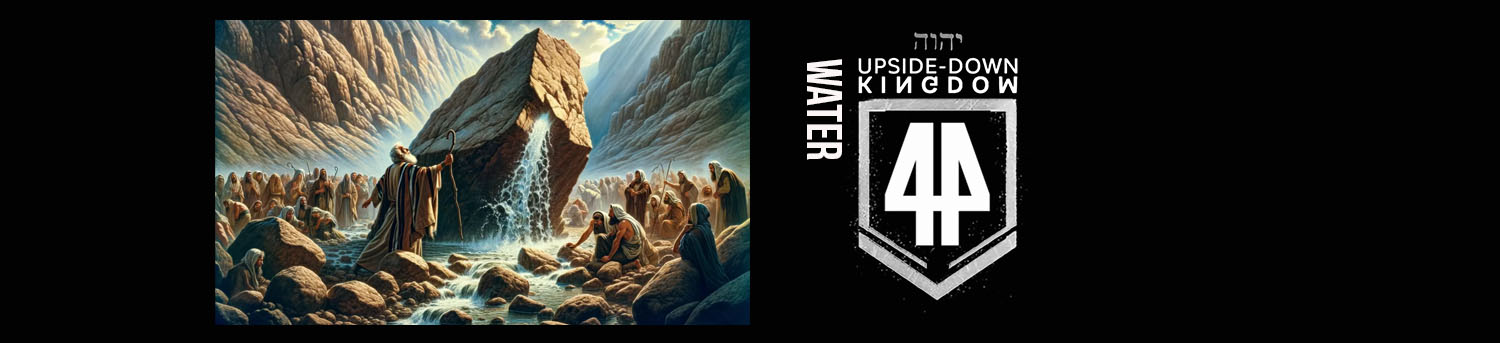
The Exodus deepens this imagery. Israel’s redemption begins not merely with liberation from Egypt but with passage through the sea. The waters that represented death and chaos become the very instrument through which YHWH delivers his people and judges their oppressors. The crossing of the Red Sea becomes Israel’s foundational salvation event (baptismal waters), repeatedly celebrated throughout the Old Testament as evidence of God’s supremacy over the powers of disorder.^5 The prophets and psalmists repeatedly recall the Exodus using creation language. God “divides the sea,” “crushes Rahab,” and “breaks the heads of Leviathan” (Ps 74:13–14; Isa 51:9–10). These texts are not zoological observations but theological declarations. The God who subdued chaos at creation is the same God who subdued chaos at the Exodus. (
This connection reaches one of its most profound expressions in Psalm 89. Here the psalmist celebrates YHWH’s authority over the raging sea: “You rule the raging of the sea; when its waves rise, you still them” (Ps 89:9). Immediately thereafter, he recounts God’s defeat of Rahab, the symbolic embodiment of chaos and opposition to God’s purposes (Ps 89:10). Remarkably, the psalm then transitions directly into God’s covenant with David (Ps 89:19–37). For the biblical writers, these themes belong together. God’s victory over chaos and God’s establishment of his kingdom are inseparable realities. The defeat of chaos serves the advancement of covenant purposes. The calming of the sea points toward the enthronement of the king. In biblical theology, order is never an end in itself; it exists so that God’s reign might flourish among his people.^6
These themes provide essential background for understanding one of the most famous storm narratives in Scripture: the book of Jonah. The story begins with a prophet fleeing the presence of YHWH. Yet the narrative is carefully crafted to reveal more than simple disobedience. Jonah’s movements form a repeated pattern of descent. He goes down to Joppa. He goes down into the ship. He goes down into the inner part of the vessel. Eventually he descends into the sea and then into the depths of Sheol itself (Jonah 2:2–6). The language intentionally portrays Jonah moving away from God’s life-giving presence and toward the realm of chaos and death.^7 What makes the story especially striking is its irony. Jonah, the prophet of Israel, behaves worse than everyone around him. The pagan sailors fear God more than the prophet. They pray while Jonah sleeps. They seek mercy while Jonah resists it. They display compassion while Jonah remains consumed by resentment. The storm exposes what already exists within Jonah’s heart. The external chaos reflects an internal chaos. The sea becomes a theological mirror revealing the prophet’s misplaced priorities and distorted understanding of divine mercy.^8 The narrative reaches its climax not merely when the storm ceases but when the sailors worship YHWH. The story therefore moves beyond judgment to mission. God’s sovereignty over the storm becomes a means of drawing Gentiles into worship. Long before Nineveh repents, the sailors themselves become evidence that YHWH’s redemptive purposes extend beyond Israel. The sea that threatened death becomes the setting for unexpected conversion.
Against this backdrop, the Gospel accounts of Jesus calming the storm take on extraordinary significance. Modern readers often focus on the miracle itself, but first-century audiences would have recognized something much larger occurring. In Mark 4:35–41, Jesus sleeps during a violent storm while his companions panic. The parallels to Jonah are unmistakable. Both figures sleep amid a storm. Both are awakened by terrified companions. Both become the focal point of questions concerning identity. Yet the differences are even more important than the similarities.
- Jonah is responsible for the storm. Jesus rebukes it.
- Jonah must be thrown into the sea to save others. Jesus commands the sea directly.
- Jonah is a reluctant prophet fleeing God’s mission. Jesus is the faithful Son accomplishing it.
The disciples therefore ask the central question of the narrative: “Who then is this, that even the wind and sea obey him?” (Mark 4:41). The answer reaches back into Israel’s Scriptures. Throughout the Old Testament, authority over the sea belongs to YHWH alone (Job 38:8–11; Ps 65:7; 89:9; 107:23–30). Jesus does not merely perform a miracle. He acts in the very role reserved for Israel’s God.^9 Even the language employed by Mark strengthens this conclusion. Jesus “rebukes” (epetimēsen) the wind and commands the sea to be silent (Mark 4:39). The same terminology appears elsewhere when Jesus confronts demonic powers (Mark 1:25; 9:25). Many scholars have therefore observed that the storm is portrayed not simply as bad weather but as a manifestation of hostile forces opposing God’s kingdom.^10 The calming of the sea becomes an enacted parable of the Messiah’s authority over every power that threatens God’s purposes.
The theme continues in an often-overlooked passage near the conclusion of Acts. Luke devotes an astonishing amount of space to Paul’s shipwreck (Acts 27–28). At first glance, the narrative appears excessively detailed. Yet Luke’s literary artistry suggests otherwise. The voyage functions as a theological drama in which God’s purposes advance despite seemingly overwhelming opposition. As the storm intensifies, experienced sailors despair of survival. Cargo is thrown overboard. Hope disappears. Chaos once again threatens God’s people. Yet Paul emerges as the calm center of the narrative. Unlike Jonah, whose rebellion endangered everyone aboard, Paul becomes the means through which others are preserved. God’s promise ensures that every life aboard survives the storm. The narrative thus presents Paul as a faithful witness whose confidence rests not in favorable circumstances but in divine faithfulness.^11
The ending of Acts becomes especially significant when viewed through this lens. Following the shipwreck, Paul arrives in Rome and spends two years proclaiming the kingdom of God and teaching about Jesus Christ “with all boldness and without hindrance” (Acts 28:31). Chaos fails to stop the mission. The sea cannot prevent the kingdom from advancing. The storm becomes another testimony that God’s purposes move forward despite every obstacle. The biblical story ultimately culminates in Revelation’s vision of new creation. Among the most intriguing statements in the book appears in Revelation 21:1: “the sea was no more.” For modern readers who enjoy oceans and lakes, the statement can seem perplexing. Yet within the broader framework of biblical theology, the symbolism becomes clearer. Revelation does not suggest that God’s renewed creation lacks beauty or water. Rather, the sea functions as a symbol of the chaos, evil, rebellion, and death that have plagued creation since Genesis.^12 The elimination of the sea signifies the final removal of everything that opposes God’s kingdom. The story that began with chaotic waters in Genesis concludes with their ultimate defeat in Revelation.
The biblical witness therefore presents storms as far more than natural phenomena. They become theological symbols pointing toward a larger reality. Throughout Scripture, God’s people repeatedly find themselves surrounded by forces that appear overwhelming. The sea rages. The winds howl. The future seems uncertain. Yet again and again, the biblical authors direct our attention not to the size of the storm but to the One who stands above it. From Genesis to Revelation, from the Exodus to Jonah, from Galilee to Rome, the story remains remarkably consistent: chaos never gets the final word. The God who separated the waters in the beginning continues to rule them in the present and will one day eliminate every vestige of chaos in the age to come.
CONCLUSION
The goal of discipleship is not a storm-free existence but a deeper confidence in the God who stands above the storm. Perhaps the most surprising truth in all of these narratives is that God’s greatest work often takes place not after the storm has passed, but in the middle of it. The sea reveals what calm waters often conceal. Storms expose our fears, our idols, our misplaced trusts, our assumptions, and sometimes even our calling. They strip away the illusion that we were ever in control to begin with. What remains is the question every generation of believers must answer: Is God enough when the ship begins to break apart?
Most of us spend our lives trying to preserve the ship. We cling to plans, expectations, structures, ministries, careers, relationships, reputations, and dreams. We thank God for these gifts, and rightly so. Yet somewhere along the journey we can begin to trust the vessel more than the One who called us into it. Then the storm comes, and we discover that faith was never about preserving the ship. Faith was always about learning to trust the Captain. One of the most overlooked verses in Acts records that some reached shore by swimming while others arrived clinging to broken pieces of the vessel. It is hardly the triumphant ending we would have scripted. No one arrives looking impressive. No one is celebrated for keeping everything together. They simply arrive. Wet. Exhausted. Empty-handed. Alive.
That may be one of the most beautiful pictures of grace in all of Scripture.
Some readers will recognize themselves there. Perhaps the ministry survived, but not in the form you imagined. Perhaps the marriage survived, but only after years of difficulty. Perhaps the dream changed. Perhaps the career ended. Perhaps the certainty disappeared. Perhaps the ship was lost altogether. Yet somehow, by the mercy of God, you found yourself standing on a shore you never expected to reach. The testimony of Scripture is not that God’s people never lose ships. The testimony of Scripture is that God never loses his people.
The same God who hovered over the chaos waters in Genesis, who parted the sea for Israel, who pursued Jonah into the deep, who slept peacefully in the storm, and who carried Paul through the shipwreck remains faithful today. The waves may be real. The wind may be strong. The night may feel long. Yet none of these things have ever possessed the authority to overturn the purposes of God. In the end, the story of Scripture is not about chaos becoming stronger. It is about the kingdom of God advancing steadily through every storm until all chaos is finally undone. One day every raging sea will be stilled. Every storm will cease. Every tear will be wiped away. Until then, we take courage from the faithfulness of the One who rules the waters.
And if the ship should break apart before you reach the shore, do not lose heart. The God who commands the sea is fully capable of carrying his children home on the broken pieces.
If you found this article interesting and want to go deeper in this area, consider this article next: INTO THE STORM: the weird pigs passages | EXPEDITION 44

Notes: Special Thanks to Chris Riggs of the TOV community for his investment in the piece
- Alexander Heidel, The Babylonian Genesis, 2nd ed. (Chicago: University of Chicago Press, 1951), 42.
- Mark S. Smith, The Ugaritic Baal Cycle, vol. 1 (Leiden: Brill, 1994), 81.
- John H. Walton, The Lost World of Genesis One (Downers Grove, IL: IVP Academic, 2009), 24.
- John H. Walton, Genesis, NIVAC (Grand Rapids: Zondervan, 2001), 70.
- T. Desmond Alexander, From Eden to the New Jerusalem (Grand Rapids: Kregel, 2008), 22.
- Stephen G. Dempster, Dominion and Dynasty (Downers Grove, IL: IVP Academic, 2003), 173.
- Jack M. Sasson, Jonah, AB 24B (New York: Doubleday, 1990), 116.
- Phyllis Trible, Rhetorical Criticism: Context, Method, and the Book of Jonah (Minneapolis: Fortress, 1994), 186.
- Richard Bauckham, Jesus and the God of Israel (Grand Rapids: Eerdmans, 2008), 186.
- Craig S. Keener, The Gospel of Mark (Grand Rapids: Eerdmans, 2024), 263.
- David W. Pao and Eckhard J. Schnabel, Acts, ZECNT (Grand Rapids: Zondervan, 2016), 535.
- G. K. Beale, The Book of Revelation, NIGTC (Grand Rapids: Eerdmans, 1999), 1042.