Reconsidering Penal Substitution: Exegesis, Divine Character, and the Persistence of the “Cosmic Child Abuse” Critique

Few critiques of Penal Substitutionary Atonement (PSA) have been as rhetorically charged as the accusation that it amounts to “cosmic child abuse.” Popularized in contemporary theological discourse, the critique is often rejected as reductionistic, emotionally manipulative, and inattentive to Trinitarian theology.¹ Yet its persistence suggests that it is not sustained merely by caricature. Rather, it functions as a theological pressure point, exposing a deeper unease regarding the coherence of PSA with the character of God revealed in Scripture.


The task, therefore, is not to accept the critique uncritically, nor to dismiss it reflexively, but to ask whether the conceptual framework of PSA, particularly its emphasis on divine wrath, penal satisfaction, and substitutionary punishment, arises from the biblical text itself or is imposed upon it. This study argues that while substitutionary language is present in Scripture as a simple metaphor, the penal structuring of that substitution is not exegetically grounded in the way often claimed (as doctrine). When elevated to a controlling paradigm, PSA not only reduces the biblical witness but risks introducing tensions that give rise to the very critique it seeks to refute.

It is also important to acknowledge that for some, this is not merely a theoretical tension. There are many who have not simply questioned the cross, but have walked away from the Christian faith altogether because they found themselves unable to reconcile a strongly penal vision of the cross with the character of a loving and merciful God. This dynamic, and the pastoral weight it carries, will be explored more fully in an appendix.

Any serious engagement with atonement must begin within the Ancient Near Eastern (ANE) context in which Israel’s sacrificial system emerged. In surrounding cultures, sacrifice often functioned within a framework of appeasement, where divine anger was placated through offerings, including, at times, child sacrifice.² Texts from Ugarit and Phoenicia attest to rituals in which the death of a child was understood as a means of satisfying divine demands.³ Against this backdrop, the Hebrew Scriptures present a striking polemic. The prohibition of child sacrifice is unequivocal (Lev 18:21; Deut 12:31), and prophetic literature repeatedly condemns the practice as something that “never entered the mind” of God (Jer 7:31).⁴ The implication is not merely ethical but theological: Israel’s God is fundamentally unlike the gods of the nations. This distinction is critical. If Israel’s sacrificial system is to inform our understanding of the cross, it must be interpreted within its own conceptual world, not retrofitted into ANE patterns of appeasement. The central concern of Levitical sacrifice is not the satisfaction of divine anger through punishment, but the purification of sacred space and the restoration of covenantal relationship.⁵ The term כִּפֶּר (kipper) reflects this orientation. As Milgrom demonstrates, its primary function is to purge or cleanse, particularly in relation to the sanctuary.⁶ Blood is applied to objects, not persons, indicating that the problem addressed is not primarily legal guilt but cultic defilement.⁷

Thus, the sacrificial system does not operate on penal logic. It operates on purificatory and relational logic.


Isaiah 52:13–53:12 is frequently cited as the clearest Old Testament support for PSA. Yet a close reading reveals a more complex picture. The Servant is said to “bear” (נָשָׂא) and “carry” (סָבַל) the sins of many (Isa 53:4, 11–12). These terms, however, do not inherently denote penal substitution. They often signify bearing the consequences of sin within a communal or relational framework.⁸ The Servant enters into the condition of Israel’s suffering rather than stepping into a juridical exchange.

More significantly, Isaiah 53:4 introduces a hermeneutical correction: “We considered (חָשַׁב) him stricken, smitten by God…”

The assumption that the Servant is being punished by God is explicitly attributed to the observers.⁹ The text then reframes this perception, revealing that the Servant’s suffering is not the result of divine retribution but the means of healing (“by his wounds we are healed,” 53:5). The verb דָּכָא (“to crush”) in 53:10 further complicates penal readings. While it denotes severe suffering, it does not necessarily imply judicial punishment.¹⁰ Within Isaiah’s broader narrative, such language is often associated with oppression and exile rather than retributive justice. The designation of the Servant as an אָשָׁם (ʾāšām, “guilt offering”) likewise resists penal interpretation. The guilt offering functions to restore covenantal order and address breaches in relationship, not to transfer punishment.¹¹ Thus, Isaiah 53 presents a model of vicarious suffering and restorative purpose, but it does not clearly articulate penal substitution.


Was God torturing Jesus? The concept of divine wrath (ὀργή or torture) plays a central role in PSA. Yet Paul’s use of the term complicates its interpretation. In Romans 1:18–32, wrath is not depicted as an active outpouring of punishment but as God “giving over” humanity to the consequences of their actions.¹² The repeated use of παρέδωκεν (“he gave them over”) suggests a form of judicial abandonment rather than retributive infliction. This pattern continues throughout Paul’s letters. Wrath is eschatological, revealing the destructive trajectory of sin rather than a mechanism requiring satisfaction.¹³

Romans 3:21–26, often cited as the cornerstone of PSA, must be read within this framework. The term ἱλαστήριον, traditionally translated “propitiation,” is better understood as a reference to the mercy seat (כַּפֹּרֶת).¹⁴ This shifts the focus from appeasement to presence: Christ is the place where God meets humanity in mercy. The phrase δικαιοσύνη θεοῦ (“righteousness of God”) further supports this reading. Rather than denoting a standard of retributive justice, it reflects God’s covenant faithfulness—His commitment to set the world right.¹⁵

Paul’s declaration that God “passed over” former sins (πάρεσις) indicates that forgiveness was already operative prior to the cross.¹⁶ The cross, therefore, is not the precondition for forgiveness but its public demonstration.


Substitutionary language in the New Testament is used as a light metaphor. Scripture is filled with metaphors that illuminate truth without exhausting it. Jesus calls Himself “the door” (John 10:9), yet no one imagines that Christ is literally a plank of wood or that salvation is a matter of passing through a physical threshold. The image communicates access, not architecture. It would be theologically careless to take that metaphor and construct a literal doctrine from it. And yet, this is often what happens with atonement language. A single metaphor—legal, sacrificial, or economic—is elevated beyond its intended function and made to carry the full weight of the cross. The problem is not the metaphor, but the moment we forget that it is one voice among many.

It is also worth noting, as will be explored in a later endnote in the appendix, that the specifically penal form of substitution is a relatively late development in the history of Christian theology, which at minimum invites careful reflection before treating it as the controlling lens of Scripture.

In this way, the nature of that substitution is often misunderstood. The preposition ὑπέρ (“for/on behalf of”) dominates Pauline usage. While it can imply substitution, its primary sense is representative.¹⁷ Christ acts on behalf of humanity, not as a third party absorbing punishment, but as the true human who embodies and restores the human vocation. This is evident in 2 Corinthians 5:21, where Christ is said to be “made sin” (ἁμαρτία). The term likely carries sacrificial connotations, referring to a sin offering rather than a literal transfer of guilt.¹⁸ The result is participatory: “that we might become the righteousness of God.”

Similarly, Galatians 3:13 speaks of Christ becoming a “curse” (κατάρα). The curse, drawn from Deuteronomy, refers to covenantal exile and death, not a metaphysical transfer of punishment.¹⁹ Christ enters into Israel’s cursed condition in order to redeem it from within.


The cumulative effect of these exegetical observations raises significant theological questions. First, the insistence that God must punish in order to forgive risks subordinating divine freedom to an external principle of justice. Scripture consistently portrays God as free to forgive (Exod 34:6–7; Mic 7:18), suggesting that forgiveness is an expression of divine character rather than a response to satisfied demands.²⁰ Second, PSA introduces tension within Trinitarian theology. While defenders affirm the unity of will between Father and Son, the logic of punishment can suggest a division that must be carefully managed.²¹ Third, the ethical implications are difficult to ignore. The punishment of an innocent person is consistently condemned in Scripture (Deut 24:16; Ezek 18:20). To frame the cross in such terms requires a significant reconfiguration of biblical justice.


The charge that Penal Substitutionary Atonement amounts to “cosmic child abuse” did not arise in a vacuum. It is not merely the product of rhetorical excess or theological immaturity, as it is often dismissed, but rather the convergence of modern moral intuition and perceived theological inconsistency.²² At its most basic level, the critique argues that if the Father inflicts punishment upon the Son in order to satisfy divine wrath, then the cross begins to mirror patterns of abusive violence rather than reveal divine love.

In its most vulgar form, the argument is intentionally provocative. God is imagined as directing anger toward His Son, punishing Him in place of others. That picture is clearly distorted. It fails to account for the unity of the Trinity, the voluntary obedience of the Son (Phil 2:6–8), and the New Testament’s insistence that “God was in Christ” (2 Cor 5:19).²³ But dismissing the critique at that level is too easy, because it avoids the deeper question—why does this description feel intuitively plausible to so many who encounter PSA?

The plausibility is not accidental. It emerges from the internal logic of certain PSA formulations themselves. If divine justice is defined as the necessary punishment of sin, and if Christ is said to bear that punishment in the place of humanity, then the cross is structurally framed as punitive action directed toward an innocent substitute.²⁴ Even when carefully qualified within Trinitarian theology, this structure creates tension. Scripture consistently resists the punishment of the innocent as a violation of justice (Deut 24:16; Ezek 18:20), and yet PSA appears to affirm precisely that dynamic at the center of the gospel.²⁵

That tension becomes even more pronounced when read against the broader biblical narrative, especially the prophetic critique of sacrificial violence. The Hebrew Scriptures repeatedly reject the idea that God desires or is appeased by destructive offerings—particularly those involving human life. “They built the high places of Baal…to burn their sons and daughters in the fire—which I did not command, nor did it enter my mind” (Jer 7:31).²⁶ This is not simply a prohibition; it is a revelation of God’s character. The God of Israel does not operate according to the sacrificial logic of the surrounding nations.

When this prophetic witness is placed alongside certain PSA articulations, the dissonance becomes difficult to ignore. In the Ancient Near Eastern world, sacrifice often functioned as a means of appeasing divine anger, sometimes even through the offering of human life.²⁷ Israel’s sacrificial system, however, was structured to resist that pattern, emphasizing purification, covenant restoration, and the preservation of life.²⁸ To reintroduce a framework in which divine wrath is satisfied through the death of a representative figure risks collapsing the very distinction Scripture works so hard to maintain between Israel’s God and the gods of the nations.

This helps explain why the “cosmic child abuse” critique resonates so strongly in a modern context. In a culture deeply sensitive to the dynamics of power, violence, and abuse, any theological model that appears to legitimize the punishment of the innocent will immediately raise suspicion.²⁹ And while cultural sensitivity alone cannot determine theological truth, it is worth noting that these ethical instincts often echo the moral trajectory already present within Scripture itself.

At the same time, the critique must be carefully qualified. It becomes theologically inaccurate when it isolates the Father as the agent of violence and the Son as its passive recipient. The New Testament presents the cross as a unified divine act: the Son gives Himself (Gal 2:20), the Father sends the Son in love (Rom 5:8), and the Spirit participates in the offering (Heb 9:14).³⁰ The cross is not an event in which God acts against God, but one in which God acts through Himself for the sake of the world.

Even so, that clarification does not fully resolve the tension. The deeper question remains whether the category of penal satisfaction itself (even when framed within Trinitarian unity) accurately reflects the biblical portrayal of God’s justice. If the structure of the model requires that punishment be inflicted in order for forgiveness to occur, then the underlying logic remains vulnerable to the critique.

This is where the issue becomes decisively exegetical. Nowhere does Scripture explicitly state that God must punish sin in order to forgive it. On the contrary, the biblical narrative consistently presents forgiveness as an expression of divine freedom and mercy (Exod 34:6–7; Mic 7:18–19).³¹ Jesus forgives sins without reference to satisfaction (Mark 2:5), and the apostolic proclamation centers on reconciliation initiated by God, not secured through the prior appeasement of divine wrath (2 Cor 5:18–19).³²

The issue, then, is not whether the “cosmic child abuse” critique is rhetorically excessive (it often is) but whether it exposes a genuine tension within the conceptual framework of PSA. When stripped of exaggeration, the critique presses a necessary question: does the logic of penal substitution truly align with the character of God revealed in Christ, or does it impose a structure upon the text that generates unintended theological consequences?

If the cross is the definitive revelation of God’s nature, then any model of atonement must not only explain what happens there, but also cohere with the God who is revealed there. Where that coherence begins to strain, the problem may not lie with the critique, but with the framework itself.


Penal Substitutionary Atonement, while containing elements of biblical truth, cannot be sustained as the controlling framework for understanding the cross (or perhaps even be understood within any viable manner theologically). Its reliance on retributive categories, its tension with the sacrificial logic of the Hebrew Scriptures, and its implications for the character of God all suggest that it represents a theological development rather than a conclusion that arises organically from the text itself. When pressed exegetically, the model repeatedly depends upon importing categories that Scripture does not clearly prioritize and, at times, appears to resist.

This becomes most evident when viewed through the lens of the “cosmic child abuse” critique. While that language is often exaggerated and at points theologically imprecise, it persists because it names a real tension. When the cross is framed primarily as the moment in which divine wrath is satisfied through the punishment of an innocent substitute, the resulting picture of God risks drifting toward the very sacrificial logic the prophets rejected and the biblical narrative works to overturn. The critique gains traction not because it is entirely correct, but because it exposes a dissonance between certain articulations of PSA and the moral and theological contours of Scripture itself.

At the same time, the solution is not to abandon sacrifice, or the seriousness of sin. Scripture does not permit such a move. The cross remains the decisive act through which God deals with sin, death, and the fractured condition of creation.

What emerges from a sustained exegetical reading is not the elimination of metaphorical substitution, but its reconfiguration. The language of “for us” (ὑπέρ) consistently carries the weight of representation, participation, and covenantal solidarity rather than strictly penal exchange. Christ does not stand over against humanity as a third party absorbing punishment, but as the true human who enters fully into our condition—into our sin, our exile, our death—in order to heal it from within. In this sense, the cross is not the site where God’s disposition toward humanity is changed, but where God, in Christ, acts decisively to overcome everything that has stood in the way of communion.

This reframing also allows the biblical witness concerning sacrifice to stand on its own terms. The Levitical system is not primarily concerned with the transfer of punishment, but with purification, restoration, and the maintenance of sacred space. The Servant of Isaiah does not simply endure divine retribution, but bears the weight of human violence and suffering in a way that exposes, absorbs, and ultimately transforms it. Paul’s language of righteousness, reconciliation, and participation similarly resists reduction to a purely forensic framework, pointing instead to a vision of salvation that is relational, transformative, and cosmic in scope.

Within this broader vision, divine justice is not diminished but clarified. Justice is not revealed as a necessity that binds God to a system of retribution, but as the faithful expression of God’s own character—His commitment to set the world right, to heal what has been corrupted, and to restore what has been lost. The cross, therefore, is not the moment where justice is satisfied through violence, but where justice is enacted through self-giving love.

It is here that the pastoral significance of this discussion comes into view. How we understand the cross inevitably shapes how we understand God. If the cross is interpreted primarily through the lens of retributive necessity, it can subtly form a vision of God marked by distance, tension, or even fear. But when the cross is read within the full narrative of Scripture—as the act in which God Himself enters into human brokenness in order to redeem it—the result is not fear, but trust; not distance, but communion.

PSA tends to compress the richness of the biblical witness and, in doing so, risks obscuring the very character of God it intends to defend.

The task before the church, then, is not to discard the cross, but to see it more clearly. This requires returning to Scripture with fresh attentiveness, allowing its language, categories, and narrative to shape our theology rather than forcing them into predetermined frameworks. It calls for a recovery of the multifaceted witness of the early church, where the cross was proclaimed not as a singular mechanism, but as the decisive act of God’s victory, reconciliation, and restoration.

In the end, the cross is not less than what has often been proclaimed—it is far more. It is the place where sin is truly dealt with, where death is defeated, where the powers are disarmed, and where humanity is brought back into communion with God. But it is all of this not because God required violence in order to forgive, but because God, in Christ, was willing to go to the furthest depths of human brokenness to heal it.

And that is a vision of the cross that not only withstands critique, but more faithfully reflects the God revealed in Jesus Christ.


  1. Steve Chalke and Alan Mann, The Lost Message of Jesus (Grand Rapids: Zondervan, 2003), 182–84.
  2. John Day, Molech: A God of Human Sacrifice in the Old Testament (Cambridge: Cambridge University Press, 1989), 45–52.
  3. Mark S. Smith, The Early History of God: Yahweh and the Other Deities in Ancient Israel (Grand Rapids: Eerdmans, 2002), 135–138.
  4. Christopher J. H. Wright, Old Testament Ethics for the People of God (Downers Grove: IVP, 2004), 198–200.
  5. Jacob Milgrom, Leviticus 1–16: A New Translation with Introduction and Commentary (New Haven: Yale University Press, 1991), 253–255.
  6. Ibid., 1029–1035.
  7. Baruch A. Levine, Leviticus (Philadelphia: Jewish Publication Society, 1989), 113–115.
  8. John Goldingay, The Theology of the Book of Isaiah (Downers Grove: IVP Academic, 2014), 104–106.
  9. Brevard S. Childs, Isaiah (Louisville: Westminster John Knox, 2001), 412–414.
  10. Ludwig Koehler and Walter Baumgartner, The Hebrew and Aramaic Lexicon of the Old Testament, rev. ed. (Leiden: Brill, 2001), 223–224.
  11. Gordon J. Wenham, The Book of Leviticus (Grand Rapids: Eerdmans, 1979), 107–109.
  12. Douglas J. Moo, The Epistle to the Romans (Grand Rapids: Eerdmans, 1996), 103–105.
  13. N. T. Wright, Paul and the Faithfulness of God (Minneapolis: Fortress Press, 2013), 799–802.
  14. C. E. B. Cranfield, A Critical and Exegetical Commentary on the Epistle to the Romans, Vol. 1 (Edinburgh: T&T Clark, 1975), 209–211.
  15. N. T. Wright, Paul and the Faithfulness of God, 801.
  16. Douglas J. Moo, Romans, 232–235.
  17. Richard B. Hays, The Faith of Jesus Christ (Grand Rapids: Eerdmans, 2002), 156–160.
  18. David M. Moffitt, Atonement and the Logic of Resurrection in the Epistle to the Hebrews (Leiden: Brill, 2011), 87–92.
  19. James D. G. Dunn, The Epistle to the Galatians (Peabody: Hendrickson, 1993), 180–183.
  20. Karl Barth, Church Dogmatics, Vol. IV/1 (Edinburgh: T&T Clark, 1956), 253–255.
  21. Jürgen Moltmann, The Crucified God (Minneapolis: Fortress Press, 1993), 242–244.
  22. Steve Chalke and Alan Mann, The Lost Message of Jesus, 182–84.
  23. Thomas F. Torrance, The Mediation of Christ (Colorado Springs: Helmers & Howard, 1992), 83–85.
  24. John Stott, The Cross of Christ (Downers Grove: IVP, 1986), 159–161.
  25. Christopher J. H. Wright, Old Testament Ethics for the People of God, 312–315.
  26. Walter Brueggemann, Theology of the Old Testament (Minneapolis: Fortress Press, 1997), 704–706.
  27. Mark S. Smith, The Early History of God, 135–138.
  28. Jacob Milgrom, Leviticus 1–16, 253–255.
  29. Miroslav Volf, Exclusion and Embrace (Nashville: Abingdon Press, 1996), 265–267.
  30. Jürgen Moltmann, The Crucified God, 242–244.
  31. Karl Barth, Church Dogmatics IV/1, 253–255.
  32. Murray J. Harris, The Second Epistle to the Corinthians (Grand Rapids: Eerdmans, 2005), 442–444.

Penal Substitutionary Atonement is often treated in modern evangelical discourse as though it were the historic Christian explanation of the cross. The historical record is more complicated. The earliest centuries of the church tended to emphasize themes such as Christ’s victory over death and the powers, recapitulation, liberation, and participation in restored life rather than a fully developed doctrine of penal satisfaction.¹ A significant shift occurs with Anselm, whose satisfaction model reframed the problem in terms of divine honor and debt, though not yet in the stricter penal sense later associated with Protestant orthodoxy.² The specifically penal and juridical form of substitution (where Christ bears the punishment due to sinners under divine judgment) comes into much sharper focus in the Reformation, especially in Calvin and in later Reformed development.³ This does not, by itself, make PSA false. Doctrine can develop over time, and lateness alone is not a refutation. But it should at least raise a legitimate caution when a comparatively later formulation is treated as though it were the obvious, universal, or controlling lens of Scripture and the church.⁴ At minimum, the relative historical newness of PSA in its mature form invites humility, careful exegetical testing, and a renewed willingness to let the wider biblical and patristic witness speak with its full range rather than being collapsed into a single model.⁵

  1. Gustaf Aulén, Christus Victor: An Historical Study of the Three Main Types of the Idea of Atonement (Eugene, OR: Wipf & Stock, 2003), 4–5, 16–20.
  2. Anselm of Canterbury, Cur Deus Homo, 1.11–15.
  3. John Calvin, Institutes of the Christian Religion, 2.16.5–10.
  4. N. T. Wright, The Day the Revolution Began (New York: HarperOne, 2016), 275–80.
  5. Oliver D. Crisp, Participation and Atonement: An Analytic and Constructive Account (Grand Rapids: Baker Academic, 2022), 10–12, 130–42.

In both pastoral conversations and what we’re seeing more broadly, a pattern keeps showing up that we can’t ignore. Many people aren’t walking away from the idea of God altogether—they’re walking away from a version of God they’ve been given that they simply cannot reconcile with love, mercy, and goodness.¹ And more often than we might want to admit, that version of God has been shaped—at least in part—by strongly penal ways of talking about the cross, especially when those ideas are paired with doctrines like eternal conscious torment.² (I personally can’t reconcile that doctrine to the character and nature of God either and find conditionalism to be a more exegetical framework.)

For many, the issue isn’t whether God judges sin. Most people instinctively understand that justice matters. The struggle comes when God’s justice is framed primarily in terms of punishing an innocent substitute or expressed through forms of judgment that feel excessive, unending, or disconnected from the character of Jesus.³ At that point, the tension becomes more than intellectual—it becomes deeply personal, and for some, it becomes irreconcilable.

Some have tried to resolve this tension by holding on to Jesus while distancing themselves from God, embracing Christ as loving while rejecting the Father as wrathful – but such a move ultimately collapses under the weight of Scripture’s unified witness, where the fullness of God’s character is revealed in Christ, not set against Him. PSA struggles to reconcile this tension.

This doesn’t mean PSA is the only reason people walk away, and it doesn’t settle the doctrine on sociological grounds alone. But it should at least give us pause. When PSA is presented as the only faithful or truly biblical way to understand the cross, it can create a real stumbling block for those trying to hold together the goodness of God with the story of Scripture as a whole.⁴ In many cases, what people end up rejecting isn’t the gospel itself, but a particular lens through which the gospel was taught to them.⁵

That’s not something to weaponize or use as a cheap critique. But it is something to take seriously. If the way we are framing the cross consistently produces confusion, moral dissonance, or even distance from God, then we have to be willing to ask hard questions—not about whether God is just, but whether our way of describing that justice actually reflects the God we see revealed in Christ.

  1. James K. A. Smith, How (Not) to Be Secular: Reading Charles Taylor (Grand Rapids: Eerdmans, 2014), 109–112.
  2. David Bentley Hart, That All Shall Be Saved: Heaven, Hell, and Universal Salvation (New Haven: Yale University Press, 2019), 1–5, 43–48.
  3. Bradley Jersak, A More Christlike God: A More Beautiful Gospel (Pasadena: Plain Truth Ministries, 2015), 13–18.
  4. Joshua Ryan Butler, The Skeletons in God’s Closet: The Mercy of Hell, the Surprise of Judgment, the Hope of Holy War (Nashville: Thomas Nelson, 2014), 52–56.
  5. Sarah E. Lane, Theological Worlds: Understanding the Alternative Spiritual Lives of Americans (Oxford: Oxford University Press, 2011), 87–92.

Eden as Cosmic Temple, Cosmic Rebellion, and the Reversal of the Curse

The opening chapters of Genesis have traditionally been interpreted primarily as a narrative describing the origin of humanity and the fall of Adam and Eve. While this reading is not incorrect, it may be incomplete. Increasingly, scholars have recognized that Genesis 1–11 presents a much broader theological framework in which the story of humanity unfolds alongside a wider cosmic conflict involving both human and spiritual agents.¹ When read within the ancient Near Eastern context and the larger biblical narrative, the Garden of Eden appears not merely as a geographical location but as the primordial temple of creation, the sacred center where heaven and earth intersect.

Within this framework, Genesis 1–11 may be understood as the opening movement of a larger biblical drama—one that narrates a series of escalating rebellions that disrupt God’s intended order for creation. These rebellions involve both humanity and spiritual beings and culminate in the need for divine restoration. The New Testament ultimately portrays the work of Christ as the decisive reversal of this cosmic disorder, restoring humanity’s original vocation and reclaiming creation from the powers that had corrupted it.


A growing body of scholarship recognizes that the imagery surrounding Eden closely parallels the symbolism of later biblical temples.² The garden contains precious stones and gold, features rivers flowing outward from its center, and is guarded by cherubim following humanity’s expulsion.³ Ezekiel’s depiction of Eden further situates it upon the “mountain of God,” imagery frequently associated with sacred cosmic geography.⁴ These elements strongly suggest that Eden functions as the sanctuary of creation, the place where divine presence and human vocation converge.

Within this sacred environment, Adam appears to be commissioned with a priestly role. Genesis 2:15 states that Adam was placed in the garden “to work it and to keep it.” The Hebrew verbs ʿābad (“serve”) and šāmar (“guard”) later describe the duties of Levites serving in the tabernacle.⁵ This linguistic correspondence indicates that Adam’s task is not merely agricultural but priestly: he is appointed to guard sacred space and maintain the order of God’s sanctuary.⁶

The opening structure of Genesis has often been interpreted as recursive, with Genesis 1 providing a cosmic overview of creation and Genesis 2 retelling the story with a specific focus on Adam and Eve.⁷ However, the narrative can also be read sequentially, much like any other historical narrative. In this reading, Genesis 1 describes the creation of humanity in general terms while Genesis 2 focuses on the installation of Adam within the sacred environment of Eden.

Under this interpretation, Adam may be understood as the first human placed within God’s cosmic temple, while humanity more broadly inhabits the wider earth. One might describe this broader human realm—borrowing Tolkien’s evocative language—as the “lower earth,” the ordinary sphere of human habitation outside the sanctuary of Eden. Adam is then placed within the garden as humanity’s representative priest within sacred space.


Reading Genesis in this narrative manner offers a possible resolution to several tensions within the early chapters of Scripture. After the murder of Abel, Cain fears retaliation from others and subsequently establishes a city.⁸ Such details imply the presence of a broader human population beyond Adam’s immediate family.

Within this framework, the creation of Eve may be understood not as the creation of the second human in existence but as the creation of a suitable partner within the sacred environment of Eden. The text emphasizes that no suitable helper was found for Adam among the animals, not necessarily that no other humans existed elsewhere. Eve therefore functions as Adam’s partner within his priestly vocation inside the garden. This interpretation preserves Adam’s unique role as the first human placed within sacred space while allowing for the presence of humanity outside the garden.


When read together, Genesis 1–11 may be understood as a narrative describing a series of escalating rebellions that disrupt God’s intended order for creation. The fall in Eden introduces disobedience within sacred space. Genesis 6 describes divine beings transgressing their proper boundaries and corrupting humanity. The Tower of Babel narrative portrays humanity once again challenging divine authority.

These events align closely with what many scholars have described as the Deuteronomy 32 worldview, in which the nations of the earth become associated with spiritual powers following Babel while Israel remains under the direct authority of Yahweh.⁹ Within this framework, the primeval history depicts both human and spiritual rebellion unfolding together.

From this perspective, the fall of Adam and Eve may coincide with the corruption of a divine challenger figure—often identified with ha-śāṭān—who oversteps his role within the divine council. The Eden narrative therefore may represent a dual fall: the failure of humanity’s priestly representatives and the simultaneous corruption of a cosmic adversary.

This possibility also opens the door for reconsidering the chronological placement of the Book of Job within the primeval narrative (several scholars have noted Job and Song of Solomon to be ordered within Genesis 1-2). If the adversarial figure in Job is understood as functioning in a legitimate challenger role within the divine council, the events of Job could plausibly occur prior to the events of Eden, portraying the challenger in a pre-fall state and perhaps within the sphere of ordinary human life—what might be described as the “lower earth,” the broader realm of humanity outside the sacred garden. Such a framework naturally raises an important theological question concerning the place of sin in the unfolding story. Was sin first introduced through the failure of Adam and Eve within Eden, or could forms of moral disorder have already existed within the wider human world beyond the garden? The language of Romans 5:12 need not require that Adam be the first being to sin in any conceivable realm of creation; rather, Paul’s argument could center on Adam as the representative head through whom sin and death enter the human order in a covenantally decisive way. Within this temple framework, Adam’s failure within sacred space marks the moment when sin becomes universally determinative for humanity, even if rebellion may have already existed elsewhere in creation.

A further interpretive consideration concerns the meaning of the term Adam itself. In the Hebrew Scriptures, ʾādām often functions not strictly as a proper name but as a collective term referring to humanity or humankind more broadly. When Paul draws upon Adam in Romans 5:12, his argument is framed in corporate and representative terms, contrasting the fate of humanity “in Adam” with the new life offered “in Christ.” Within this framework, Adam may be understood not merely as an isolated individual but as the representative embodiment of humanity itself. Such a reading emphasizes Paul’s theological point: that sin and death enter the human order through humanity’s representative head, just as righteousness and life are restored through the representative work of Christ.


One of the central tensions of the Old Testament emerges from this cosmic conflict. Humanity was created to function as God’s royal priesthood, mediating divine presence and extending God’s rule throughout creation.¹⁰ Yet throughout Israel’s history, humanity repeatedly abandons this vocation.

The biblical narrative frequently attributes this corruption not only to human disobedience but also to the influence of hostile spiritual powers. These powers appear repeatedly throughout the Old Testament narrative, drawing humanity away from its intended role and contributing to the persistent cycle of rebellion that characterizes the biblical story.


The New Testament presents the work of Jesus as the decisive resolution to this cosmic conflict. The ministry, death, and resurrection of Christ are portrayed not only as the redemption of humanity but also as the defeat of the rebellious spiritual powers that had corrupted creation.

Some scholars have described this victory as a Christus Victor event, in which Christ triumphs over the hostile powers and reclaims authority over creation.¹¹ In this sense, the work of Christ may be understood as the moment in which God begins reversing the curse introduced in the primeval rebellions.

This theme is symbolically reinforced in the geographical setting of several events in Jesus’ ministry. The region of Bashan, historically associated with the domain of rebellious spiritual beings and the traditions surrounding Mount Hermon, becomes the setting for Jesus’ declaration that “the gates of Hades will not prevail.”¹² Within this framework, the cross and resurrection represent the decisive reversal of the cosmic disorder that began in the earliest chapters of Genesis.

Through Christ’s victory, the powers are subdued, the authority of the adversary is broken, and humanity’s original vocation is restored. The temple of God is no longer confined to a geographic sanctuary but is reconstituted in the people of God themselves, who once again become a royal priesthood called to mediate God’s presence in the world.


When Genesis 1–11 is read within the broader biblical narrative, the early chapters of Scripture appear to describe far more than the origin of human sin. They depict the opening stage of a cosmic conflict involving both humanity and spiritual powers. Within this framework, Eden functions as the sacred center of creation, where humanity is installed as priestly representatives of God’s rule.

The rebellion that unfolds within these chapters involves both human disobedience and the corruption of spiritual beings who seek to undermine God’s order. Yet the biblical story does not end with this cosmic disorder. The New Testament presents the work of Christ as the decisive turning point in which the curse is reversed, the powers are subdued, and humanity’s original vocation is restored.

Thus the story that begins in Eden ultimately finds its resolution in Christ, who reclaims creation, restores God’s temple among his people, and establishes once again the royal priesthood that humanity was always intended to be.


Footnotes

Michael S. Heiser, The Unseen Realm, 287–293.

Michael S. Heiser, The Unseen Realm (Bellingham: Lexham, 2015), 23–28.

John H. Walton, The Lost World of Genesis One (Downers Grove: IVP Academic, 2009), 72–74.

G. K. Beale, The Temple and the Church’s Mission (Downers Grove: IVP Academic, 2004), 66–80.

Gordon J. Wenham, Genesis 1–15 (WBC 1; Dallas: Word, 1987), 61–63.

Beale, Temple and the Church’s Mission, 67–70.

John H. Walton, The Lost World of Adam and Eve (Downers Grove: IVP Academic, 2015), 92–95.

Kenneth A. Mathews, Genesis 1–11:26 (NAC; Nashville: B&H, 1996), 188–190.

Victor P. Hamilton, Genesis 1–17 (NICOT; Grand Rapids: Eerdmans, 1990), 238–240.

Patrick D. Miller, Deuteronomy (Louisville: Westminster John Knox, 1990), 255–258.

G. K. Beale, Temple and the Church’s Mission, 81–90.

Gustaf Aulén, Christus Victor (London: SPCK, 1931), 20–22.

Red Moons, Red Heifers, and the Temptation to Weaponize Jesus

Apocalyptic Anxiety, Prophetic Imagination, and Faithful Christian Eschatology

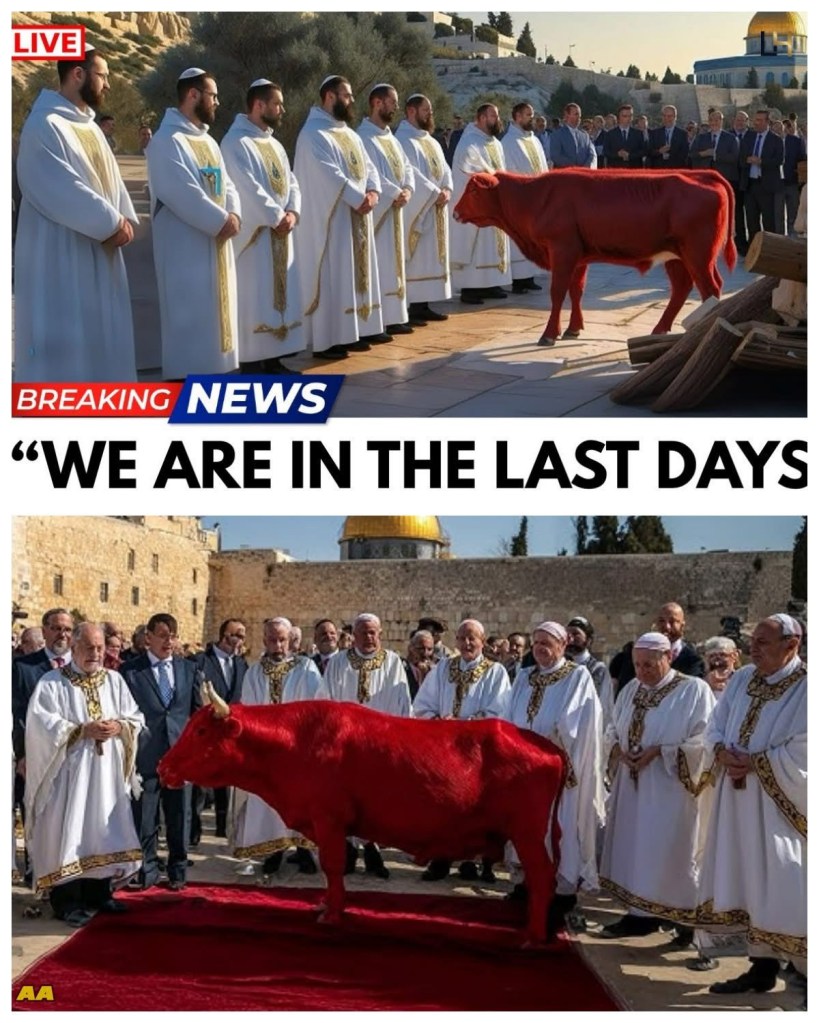
In every generation, the people of God have wrestled with headlines, celestial events, wars, and rumors of wars. In our moment, images of blood-red moons, renewed interest in the red heifer ritual, Purim framed through geopolitical conflict, and even portrayals of a militarized Jesus circulate rapidly across Christian media. These phenomena are frequently interpreted as decisive indicators that “we are in the last days.”

As followers of Christ committed to careful biblical theology, we must ask: What is faithful eschatological attentiveness, and what drifts toward speculation? How do we distinguish biblical prophecy from patterns that more closely resemble divination? And how do we guard against subtly weaponizing Jesus in the service of national or ideological agendas?

This essay proposes that much contemporary apocalyptic rhetoric conflates symbolic prophetic language with predictive sign-reading, misapplies temple typology, and risks distorting the cruciform nature of Christ’s kingship. I ask you to consider a better theology, one that is deeply rooted, Christ-centered eschatology that cultivates hope without hysteria.


The phrase “the moon will be turned to blood” appears in Joel 2:31 and is echoed in Acts 2:20 and Revelation 6:12.¹ Yet within prophetic and apocalyptic literature, such imagery functions symbolically to describe covenantal upheaval and divine intervention, not necessarily astronomical forecasting.²

When Peter cites Joel at Pentecost (Acts 2:16–21), he interprets the prophecy as fulfilled in the outpouring of the Spirit.³ The early church did not await literal lunar phenomena; they recognized that the decisive turning point in redemptive history had already occurred in Christ’s death, resurrection, and exaltation.⁴

Scholars such as John Walton remind us that in the Ancient Near East, celestial events were commonly interpreted as omens.⁵ Israel’s Torah, however, explicitly forbids divinatory practices tied to signs and portents (Deut 18:10–14).⁶ When modern Christians assign predictive significance to eclipses in ways that mirror ancient omen-reading, the hermeneutical posture begins to resemble the very practices Scripture warns against.⁷

Apocalyptic imagery unveils theological realities—it does not invite astrological decoding.


The red heifer ritual of Numbers 19 concerns purification under the Mosaic covenant.⁸ Contemporary movements anticipating a Third Temple sometimes treat the reintroduction of this ritual as a necessary eschatological trigger.⁹

Yet the New Testament consistently reinterprets temple theology christologically. Jesus declares himself the true temple (John 2:19–21).¹⁰ Paul extends temple identity to the gathered people of God (1 Cor 3:16).¹¹ The epistle to the Hebrews insists that Christ’s priestly work is once-for-all and surpasses the sacrificial system (Heb 9–10).¹²

To frame renewed animal sacrifice as a prophetic necessity risks implying insufficiency in Christ’s atoning work.¹³ As Steve Gregg has argued in his engagement with Revelation’s various interpretive frameworks, much apocalyptic expectation misunderstands the covenantal transition already accomplished in the first century.¹⁴

Looking for a rebuilding of the Temple is a slap in the face to Jesus; it is essentially saying you don’t believe He was enough.

The trajectory of Scripture moves from shadow to substance—not from substance back to shadow.


The book of Esther recounts Jewish survival within imperial Persia and culminates in the celebration of Purim (Esth 9).¹⁵ It is a narrative of providence and covenant preservation—not a blueprint for Christian militarization.

Revelation 19 portrays Christ as a rider on a white horse, yet the sword proceeds from his mouth—symbolizing the power of his word.¹⁶ Earlier, Revelation presents the conquering Messiah as the slain Lamb (Rev 5:6).¹⁷ The Lamb’s victory comes through self-giving sacrifice.

Shane J. Wood argues that Revelation functions as an unveiling of how empire masquerades as ultimate power while the Lamb redefines kingship through suffering love.¹⁸ The book calls believers to faithful witness, not violent triumphalism.¹⁹

When Jesus is draped in national symbolism or framed primarily as a military figure aligned with geopolitical agendas, the church risks conflating the kingdom of God with earthly power structures—precisely the confusion Revelation critiques.²⁰

The Lamb conquers not by coercion, but by cruciform allegiance.


Biblical prophecy is covenant proclamation rooted in God’s revealed purposes.²¹ Divination, by contrast, seeks hidden knowledge through decoding signs, omens, or speculative patterns.²²

Jeremiah warns against prophets who speak “visions of their own minds” (Jer 23:16).²³ Ezekiel rebukes those who practice “lying divination” (Ezek 13:6–9).²⁴ Jesus himself cautions his disciples against alarmism: “See that you are not alarmed” (Matt 24:6).²⁵

The apostolic exhortation is vigilance without panic (1 Thess 5:1–8).²⁶ When Christian rhetoric becomes dominated by chronological speculation tied to celestial events or ritual developments, it begins to mirror the divinatory impulse Scripture explicitly forbids.²⁷

True prophecy deepens faithfulness. Divination fuels anxiety.


Christian eschatology has long been described as “already and not yet.”²⁸ Christ has decisively inaugurated the kingdom, yet its fullness awaits consummation.

Wood’s “thin veil” metaphor captures apocalyptic literature’s purpose: heaven’s perspective breaks into earthly history, revealing who truly reigns.²⁹ Revelation is not primarily a timetable but a theological unveiling of allegiance, empire, and worship.³⁰

Thus, blood moons need not provoke fear. Red heifers need not signal regression. Wars and rumors of wars do not require sacralized nationalism. The church’s vocation remains steadfast: faithful witness shaped by the Lamb.³¹

Peter reminds believers that they are a holy nation—not defined by geopolitical boundaries, but by covenant identity in Christ (1 Pet 2:9–12).³²

Our eschatological posture is hopeful watchfulness grounded in the finished work of Jesus.


The final word of Revelation is not dread but invitation: “The Spirit and the Bride say, ‘Come’” (Rev 22:17).³³

Apocalyptic texts unveil hope, not panic. They expose empire, not empower it. They center the Lamb, not lunar cycles.

To remain faithful in an age of apocalyptic noise is not to disengage from current events, but to interpret them through the crucified and risen Christ. We do not decode eclipses; we embody the kingdom. We do not weaponize Jesus; we witness to him.

In a world prone to sensationalism, the church’s steadiness becomes its testimony.


Footnotes

  1. Joel 2:31; Acts 2:20; Rev 6:12.
  2. G. K. Beale, The Book of Revelation.
  3. Acts 2:16–21.
  4. Richard Bauckham, The Theology of the Book of Revelation.
  5. John H. Walton, Ancient Near Eastern Thought and the Old Testament.
  6. Deut 18:10–14.
  7. Michael S. Heiser, The Unseen Realm.
  8. Num 19.
  9. Randall Price, The Temple and Bible Prophecy.
  10. John 2:19–21.
  11. 1 Cor 3:16.
  12. Heb 9–10.
  13. David Peterson, Hebrews and Perfection.
  14. Steve Gregg, Revelation: Four Views.
  15. Esth 9.
  16. Rev 19:15.
  17. Rev 5:6.
  18. Shane J. Wood, Thinning the Veil.
  19. Rev 12:11.
  20. Rev 13; Bauckham.
  21. Walter Brueggemann, The Prophetic Imagination.
  22. Deut 18:10–14.
  23. Jer 23:16.
  24. Ezek 13:6–9.
  25. Matt 24:6.
  26. 1 Thess 5:1–8.
  27. Heiser, The Unseen Realm.
  28. George Eldon Ladd, The Presence of the Future.
  29. Wood, Thinning the Veil.
  30. Eugene H. Peterson, Reversed Thunder.
  31. Rev 12:11.
  32. 1 Pet 2:9–12.
  33. Rev 22:17.

Bibliography

Bauckham, Richard. The Theology of the Book of Revelation. Cambridge: Cambridge University Press.

Beale, G. K. The Book of Revelation. New International Greek Testament Commentary. Grand Rapids: Eerdmans.

Brueggemann, Walter. The Prophetic Imagination. 2nd ed. Minneapolis: Fortress Press.

Gregg, Steve. Revelation: Four Views. Nashville: Thomas Nelson.

Heiser, Michael S. The Unseen Realm: Recovering the Supernatural Worldview of the Bible. Bellingham, WA: Lexham Press.

Ladd, George Eldon. The Presence of the Future. Grand Rapids: Eerdmans.

Peterson, David. Hebrews and Perfection. Cambridge: Cambridge University Press.

Peterson, Eugene H. Reversed Thunder: The Revelation of John and the Praying Imagination. San Francisco: HarperCollins.

Price, Randall. The Temple and Bible Prophecy. Eugene, OR: Harvest House.

Walton, John H. Ancient Near Eastern Thought and the Old Testament. Grand Rapids: Baker Academic.

Wood, Shane J. Thinning the Veil: Revelation and the Kingdom of Heaven. Cincinnati: Standard Publishing.

NATURAL ORDER

I want to talk about what is meant by God’s order, but before I do that, I want to guide you through a brief exegetical teaching through the text. When you hear the word order in relation to a biblical sense we have been conditioned to think about creation, law, hierarchy in the church and marriage, and perhaps even church discipline. Although it encompasses those things, I find it unfortunate that we start there, and therefore I feel we might need some deconstruction to get to good.

As I begin to read this in Hebrew the first thing that I notice in contrast to most English translations is the phrase “My prayer” is not found in the text. It isn’t a bad translation as I get the context leans that way but in Hebrew the verse better reads, “I will order toward you” which emphasizes a slightly different posture. Interesting the word prayer isn’t really there, perhaps a NT implication or even insertion. Prayer in the OT was a bit different than the way we understand it today. It was communal and far less personal (unless God appeared to you in a bush and orally spoke directly to you), after Jesus ascends to the throne and sends the Spirit to dwell in us and intercede, the biblical concept of prayer takes on a different form than what it had been considered over the last 2000 years or more. The way people thought of “prayer” in the OT may or may not be accurate. Are we just reading what they thought prayer was supposed to be perhaps based on what they knew of their former deities? Is this something that they got a bit off track with and Jesus sought to adjust or shed new light on? Perhaps, but perhaps not. Maybe our prayer should take a cue from the OT notions. When we read this verse in Hebrew form, we see that David isn’t talking about ritualistic prayer, or is he? He isn’t necessarily folding his hands and closing his eyes – but he is sort of. He is making a statement that if his life is in alignment with what is of God – TOV (creation order language), then he expects God to acknowledge and “DO THINGS” on his behalf. This may tie into the never-ending OT grappling over whether God was retributive or not, but it certainly had the trajectory of demonstrating the idea of devotion in connection to intimacy with the Lord. This connection over the years will then be attributed to the conjecture of relationship with the father in prayer. Some prayer is communal and some is personal.

Different people interact with God differently and perhaps in different seasons. Some say they don’t hear God and others act like God never stops screaming in their ear. How can the voice of God differ from person to person? Is it based on the posture of the heart, covenant faithfulness, gifting, seasons, understanding, choice, some sort of prejudice, or something completely different that is higher than our understanding? I believe that God is just that dynamic. I don’t know why He communicates differently to people and what it might be based on; I don’t always have the eyes of God. I believe Him to be Sovereign and know significantly more than we do in a much more complex grid. I am convinced that there are many things that influence this covenant relationship at a cosmic level. It is far bigger than simply me, and to think of my relationship with God (the creator of the universe) as doating on my every thought seems like a selfish notion. Does that view minimize a personal relationship or exemplify it?

God’s order is described in everything naturally defined by Yahweh and described generally as what is good (TOV). This is creation, the waters, the counting of the ark, the building of the temple, the pieces of firewood set in order for a sacrificial fire, showbread set out in two rows of six cakes on the gold table (Lev 24:8); seven altars set up by the pagan mantic Balaam (Num 23:4); stalks of flax arranged by Rahab for hiding the spies (Josh 2:6); a table prepared for dining (Ps 23:5; Isa 21:5); words produced for speaking (Job 32:14); a legal case developed for presentation (Job 13:18); etc. In II Sam 23:5 David exults in the covenant granted him by Yahweh, “for he has made with me an everlasting covenant, / ordered (ʿărûkâ) in all things and secure.[1] We see God’s order in many ways, but the common thread that binds seems to be that it is given as a framework for our devotion to Him. This intimate devotion that is often described as reading or memorizing scripture, devotional repetition, standards of practice and living, and so much more are all described as what it means to be defined as SET APART. That we are defined and claimed as part of God’s order not the chaos of the world.

What defines this? Covenant. Covenant is the secure, accessible, and recognizable attribute of everything good that God offers to us. It is the basis of all of our interaction with the LORD. Without covenant we are detached or separated from the creator and his ways. When David chooses every morning to be in order, he is making a statement about the balance of life and the posture of the heart. The Hebrew term בְּרִית bĕriyth for “covenant” is from a root with the sense of “cutting”, because pacts or covenants were made by passing between cut pieces of flesh of an animal sacrifice.[2] It meant something deep.

The New Covenant is a biblical interpretation originally derived from a phrase in the Book of Jeremiah and often thought of as an eschatological world to come related to the biblical concept of the Kingdom of God. Generally, Christians believe that the New Covenant was instituted at the Last Supper as part of the Eucharist, which in the Gospel of John includes the New Commandment.[3] A connection between the Blood of Christ and the New Covenant is portrayed with the saying: “this cup that is poured out for you is the new covenant in my blood”. Jesus is therefore the mediator of this New Covenant, and that his blood, shed is the required blood of the covenant. This is true looking back in both testaments and can be seen in all of the biblical covenants of the bible.

In the Christian context, this New Covenant is associated with the word ‘testament‘ in the sense of a ‘will left after the death of a person (Latin testamentum),[4] the original Greek word used in Scripture being diatheke (διαθήκη) which in the Greek context meant ‘will (left after death)’ but is also a word play having a dual meaning of ‘covenant, alliance’.[5] This notion implies a reinterpreted view of the Old Testament covenant as possessing characteristics of a ‘will left after death’ placing the old covenant, brit (בְּרִית) into a new application of understanding as revealed by the death, resurrection, ascension, and throning of CHRIST THE KING, JESUS. All things will forever connect at the covenants and be defined by the atoning accomplishments that transform into a covenant of eternity.

Order today might be better understood as a continually evolving algorithm based on the posture of your covenant faithfulness which, as I have described, is defined by many facets of devotion. Some may hear the audible voice of God more clearly while others simply see Him in every image. The revelation of God to us isn’t in a form of hierarchy. One form of transcendence doesn’t trump another. Who are we to judge anyway. But I do know that most of Christianity seems to be off course here. Rather than coming to the LORD as the cosmic wish granting genie in a bottle, let’s get back to biblical roots and think more covenantal and devotional based on the order that God modeled for us.

[1] Harris, R. L., Archer, G. L., Jr., & Waltke, B. K. (Eds.). (1999). Theological Wordbook of the Old Testament (electronic ed., p. 696). Chicago: Moody Press.

[2] Strong’s Concordance (1890).

[3] “Comparison of the two covenants mediated by Moses and the two covenants mediated by Jesus”. 25 September 2022. Archived from the original on 2022-09-28. Retrieved 2023-01-29.

[4]“testamentum: Latin Word Study Tool”. http://www.perseus.tufts.edu. Retrieved 2020-08-12.

[5] G1242 – diathēkē – Strong’s Greek Lexicon (KJV)”. Blue Letter Bible. Retrieved 2020-08-12.