
An Expedition44 Review of Ian J. Vaillancourt’s Unfolding Redemption
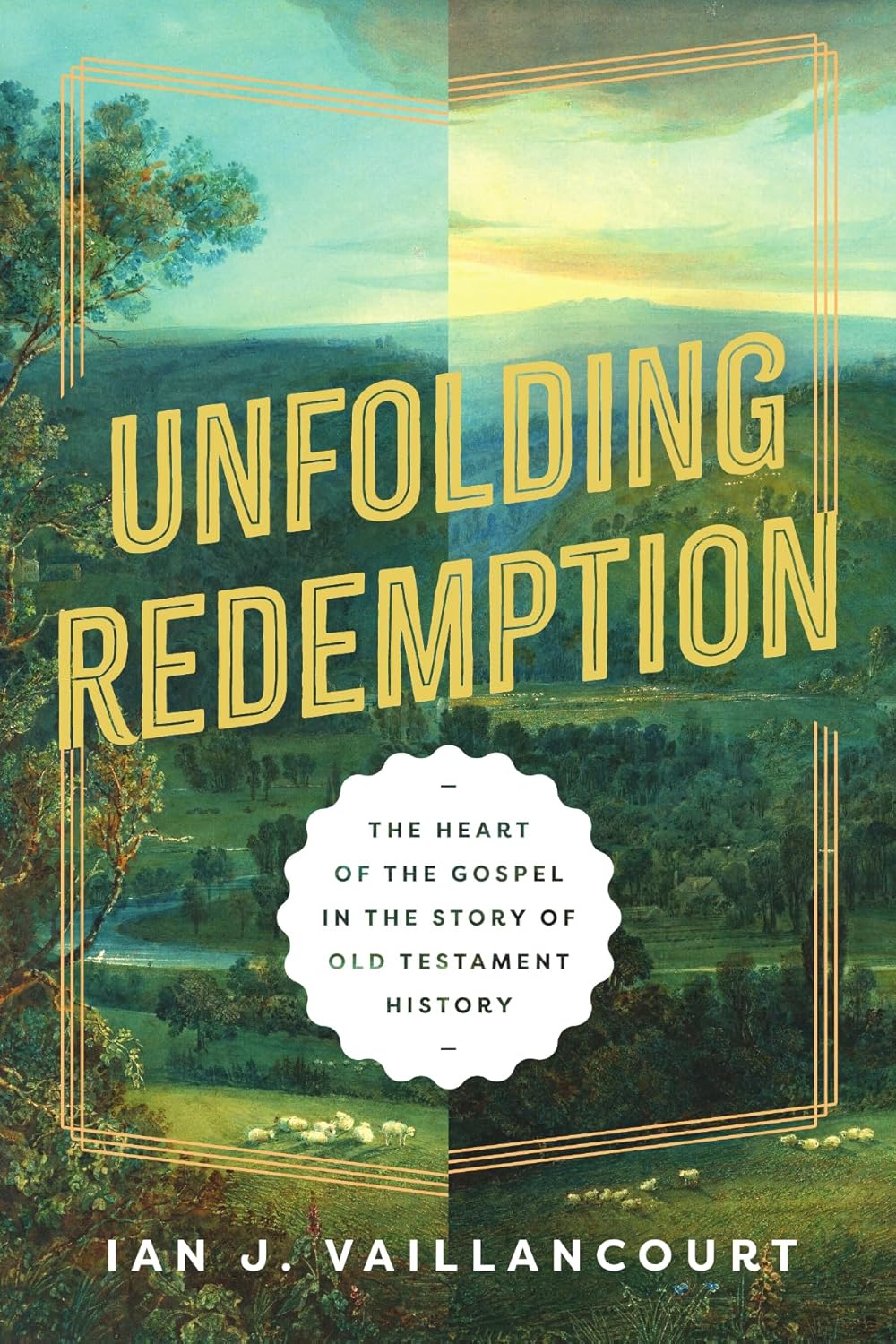
Ian J. Vaillancourt’s Unfolding Redemption: The Heart of the Gospel in the Story of Old Testament History enters a crowded but deeply necessary field of contemporary biblical theology. In recent decades, evangelical scholarship has produced a significant body of work aimed at recovering the theological coherence of Scripture, particularly through the lenses of canon, covenant, kingdom, temple, exile, promise, and fulfillment. One thinks here of Stephen Dempster’s Dominion and Dynasty, G. K. Beale’s work on temple and new creation, T. Desmond Alexander’s Eden-to-new-creation trajectories, and Graeme Goldsworthy’s redemptive-historical hermeneutic. Vaillancourt’s contribution should be located within this broader renewal of biblical theology, but it should not be dismissed as merely derivative. Its particular value lies in the way it offers a readable, pastorally attentive, and canonically alert account of the Old Testament Historical Books as a continuing redemption story that begins in the Pentateuch, moves through land, judges, kingship, temple, exile, return, and hope, and ultimately presses the reader toward Jesus Christ.¹
The introduction establishes the hermeneutical agenda with unusual clarity. Vaillancourt begins not with an abstract theory of canon but with Jesus’ claim in John 5:39–40 that the Scriptures bear witness about him. His point is not that the Old Testament may occasionally be mined for messianic prooftexts, but that the failure to read the Scriptures as testimony to Christ constitutes a fundamental misreading of Scripture itself. This is a crucial claim because it refuses two common errors. On the one hand, it resists the modern tendency to neglect the Old Testament because its narratives, genealogies, cultic structures, geographical allotments, and violent episodes feel distant from Christian discipleship. On the other hand, it also resists a flat moralizing approach that reads Old Testament figures primarily as exemplary or cautionary characters without situating them in the larger redemptive movement of Scripture. Vaillancourt’s interpretive burden is therefore not simply to make the Old Testament “interesting,” but to recover its witness-bearing function within the economy of redemption.²
One of the more academically significant features of the book is its sustained attention to the order of the Hebrew canon. Vaillancourt argues that readers shaped by the English ordering of the Old Testament often encounter the Historical Books as a relatively straightforward chronological sequence, followed by poetic and prophetic materials. Yet the earliest attested Hebrew order presents the Scriptures according to Torah, Prophets, and Writings, with Chronicles functioning as the canonical conclusion.³ This is not a mere technicality. The canonical placement of Ruth, Psalms, Daniel, Ezra-Nehemiah, and Chronicles affects how the reader experiences the theological movement of the Old Testament. Vaillancourt is careful not to overstate the case, but he rightly observes that Jesus’ reference to “the Law of Moses and the Prophets and the Psalms” in Luke 24:44 suggests a threefold understanding of the Scriptures, with “Psalms” likely functioning as a representative title for the Writings.⁴ He further appeals to Matthew 23:35, where Jesus refers to the blood of Abel and Zechariah, a statement that appears to assume a canonical frame beginning with Genesis and ending with Chronicles.⁵ This argument places Vaillancourt in conversation with a significant stream of canonical scholarship, especially the work of Roger Beckwith, Stephen Dempster, and those who have argued that the shape of the canon participates in the theological meaning of the canon.
The canonical discussion is not merely academic scaffolding; it shapes the book’s theological argument. Vaillancourt contends that the Old Testament story beyond the Pentateuch is “out of order” in two senses. First, it is out of order because Israel’s story does not move in a simple upward trajectory from redemption to consummation. The narrative proceeds through divine faithfulness and human failure, blessing and curse, covenant renewal and covenant betrayal, return and incompletion. Second, the story is out of order because the English Bible’s arrangement does not always foreground the thematic and canonical movements that become clearer when read according to the Hebrew order.⁶ This framing is particularly fruitful because it allows Vaillancourt to present the Historical Books not merely as historical reportage but as theologically selective narration. The Old Testament writers are not antiquarian chroniclers preserving every event for its own sake; they are Spirit-inspired witnesses who shape historical memory around YHWH’s unfolding redemption.⁷
Vaillancourt’s use of Deuteronomy 28 and 30 as a controlling lens is one of the most persuasive elements of the volume. The blessings for covenant fidelity, curses for covenant rebellion, exile for covenant breach, and restoration for covenant repentance provide a theological grammar for reading Joshua through Chronicles. The land in Joshua, the deliverers in Judges, Davidic kingship in Samuel, temple centrality in Kings and Chronicles, exile, and return are all interpreted within this Deuteronomic horizon.⁸ This is precisely where the book exhibits strong Old Testament instincts. Rather than forcing a Christological reading upon the narrative from the outside, Vaillancourt shows how the internal covenantal logic of the Old Testament generates its own forward movement. The story itself creates longing because the blessings are real but unstable, the land is given but contested, the kingship is established but compromised, the temple is glorious but vulnerable, and the return from exile is genuinely merciful but still incomplete.
The first chapter, “Land: Settling the Redeemed,” demonstrates this method well. Vaillancourt does not evade the difficulty of Joshua. He acknowledges that modern readers may struggle with narratives of holy war, the eradication language of the conquest, and the apparently tedious geographical material that dominates the latter portion of the book.⁹ Yet rather than reducing Joshua to a problem of violence or to a triumphalist conquest narrative, he places land within the broader redemptive architecture of Scripture. Land is not merely real estate; it is the appointed place where the redeemed people of God are to dwell with YHWH, embody covenant fidelity, and anticipate the larger creational purposes of God. This allows Vaillancourt to connect Joshua’s land theology to the larger biblical movement toward inheritance, resurrection, and new creation. His claim that the land promise ultimately opens toward an embodied, global, eschatological inheritance is especially important, since it resists both a purely spiritualized reading of land and a narrowly territorial one.¹⁰
The chapter on Judges further shows Vaillancourt’s ability to make difficult Old Testament material theologically coherent without domesticating its darkness. His opening analogy of cancer is pastorally accessible, but the larger exegetical point is serious: sin among the redeemed is not static. If left untreated, it spreads through the covenant community with destructive force.¹¹ Judges begins with partial success but quickly reveals the deeper covenantal crisis, particularly when a generation arises that does not know YHWH or the works he had done for Israel.¹² Vaillancourt’s diagnosis here is important for contemporary ecclesiology. The failure in Judges is not simply military incompletion; it is failed covenant transmission. Israel does not merely fail to remove enemies from the land; Israel fails to form a people who remember, teach, obey, and worship. This is one of the places where the book’s pastoral usefulness becomes especially apparent. Vaillancourt is not merely helping readers understand Judges historically; he is helping the church recognize the formational danger of generational amnesia.
The treatment of monarchy and temple likewise reflects a mature canonical instinct. In the chapter on division, decline, and exile, Vaillancourt reads the books of Kings through the Deuteronomic lens of covenant blessing and curse, with kingship functioning as a corporate headship over YHWH’s redeemed people.¹³ The strength of this reading is that it avoids treating Israel’s monarchy as merely political history. Kingship is theological representation. A faithful king may lead the people toward covenant life, while an unfaithful king accelerates covenant disaster. This allows Vaillancourt to present David not as morally flawless but as covenantally paradigmatic because of humility and repentance.¹⁴ Solomon, by contrast, embodies both the glory and fragility of Israel’s hopes. The temple’s construction represents one of the great high points of the Old Testament story, with YHWH’s dwelling among his people moving from tent to temple.¹⁵ Yet even this apex is unstable because covenant disobedience will eventually fracture the kingdom, corrupt worship, and bring exile. In this sense, Vaillancourt’s temple theology resonates with the broader work of Beale and Alexander, though his presentation remains more introductory and pastoral than technical.
The Chronicles material is among the strongest portions of the book and deserves particular attention. Vaillancourt rightly emphasizes that Chronicles, read at the end of the Hebrew canon, functions as a hope-filled theological summation of the Old Testament story. Its genealogies are not dead archival lists but acts of covenantal memory. Beginning with Adam, Chronicles frames Israel’s story within the whole human story, and by moving toward David and the Davidic line it reassures the postexilic community that the promises of God remain alive.¹⁶ Vaillancourt’s use of Todd Bolen, Paul House, Stephen Dempster, Bruce Waltke, Charles Yu, Andreas Köstenberger, and Gregory Goswell demonstrates that he is not working in isolation but synthesizing a recognizable scholarly consensus regarding Chronicles’ theological selectivity and Davidic hope.¹⁷ His reading of the Chronicler’s omission of many of David’s sins is especially measured. Rather than accusing the Chronicler of whitewashing David, Vaillancourt follows Bolen in understanding the omission as a matter of theological emphasis. Chronicles is not denying David’s failures; it is emphasizing the covenant promises attached to David and the hope those promises generated for a restored people.¹⁸
Vaillancourt’s treatment of Ezra-Nehemiah is similarly valuable because he refuses to let the return from exile become the full resolution of the Old Testament story. The decree of Cyrus is glorious, and Vaillancourt rightly attends to the surprising theological language surrounding this Persian king. Cyrus is stirred by YHWH, commissioned to rebuild the house of God, described in Isaiah as YHWH’s shepherd, and even called YHWH’s anointed.¹⁹ This is an important observation because it reveals the wideness of divine sovereignty. YHWH’s redemptive purposes are not confined to Israelite agency. He may use a Persian ruler as an instrument of covenant restoration. Yet Vaillancourt also rightly insists that the return is only “partly accomplished” redemption.²⁰ The people return, the temple is rebuilt, and covenant mercies are evident, but the fullness remains absent. There is still a lingering ache in the story. This is one of the book’s most important theological instincts: biblical hope is not satisfied by partial restoration. It waits for the ultimate redemption that only Christ can accomplish.
The consistent strength of Unfolding Redemption is its ability to read the Old Testament as both historically particular and canonically forward-moving. Vaillancourt does not flatten Joshua, Judges, Samuel, Kings, Ruth, Daniel, Esther, Ezra-Nehemiah, and Chronicles into generic “Jesus stories.” Nor does he leave them as isolated historical episodes. Instead, he reads them as discrete textual witnesses within a unified redemptive drama. This is precisely the kind of work needed in the church today. Many readers either avoid the Old Testament because they find it morally troubling or devotionally inaccessible, or they rush too quickly to Christ in a way that bypasses the texture of Israel’s own story. Vaillancourt offers a better way. He allows land, kingship, temple, exile, and return to speak in their own Old Testament grammar, while still showing how that grammar becomes ultimately intelligible in Christ.
At the same time, the academic reader may wish for deeper engagement at several points. The book’s strength is also its limitation: it is a synthetic, accessible biblical theology rather than a technical monograph. There is little sustained engagement with Ancient Near Eastern backgrounds, the compositional history of the Historical Books, the complexities of conquest rhetoric, or Second Temple Jewish reception. Readers looking for the kind of thick historical and literary analysis found in Eerdmans, Baker Academic, or IVP monographs may need to supplement Vaillancourt with more specialized works. Yet this should not be mistaken for a failure of the book. The genre is different. Vaillancourt is not writing a critical introduction to the Historical Books; he is writing a canonically ordered, Christ-centered, pastorally useful guide to the redemptive movement of Old Testament history.
The book’s accessibility is also worth noting. Vaillancourt writes in a clear style, often opening chapters with contemporary illustrations before moving into textual exposition. In some academic settings this may feel lighter than the subject matter deserves, but for the intended readership the strategy is effective. He is attempting to bring non-specialists into serious biblical theology without overwhelming them at the doorway. This makes the book especially useful for pastors, Bible teachers, seminary students beginning their Old Testament studies, and thoughtful lay readers who need help seeing why these texts matter for Christian faith. As an Old Testament person, I find this pedagogical instinct commendable. The church does not need fewer technical studies, but neither does it need biblical theology trapped behind academic walls. Vaillancourt succeeds in translating substantial canonical-theological insights into a form that can nourish the life of the church.
CONCLUSION
Unfolding Redemption arrives at an important moment in contemporary biblical studies and church life. While scholarly interest in biblical theology continues to grow, many pastors and lay readers still struggle to connect the Old Testament’s historical narratives to the gospel they proclaim and cherish. Vaillancourt serves as a capable guide through this terrain, helping readers see that Israel’s story is neither a collection of disconnected episodes nor merely the backdrop to the New Testament, but an indispensable part of God’s unified redemptive drama.
The book’s greatest strength is its ability to bring together canonical sensitivity, theological depth, and pastoral accessibility. By tracing the themes of land, kingship, temple, exile, restoration, and hope through the Historical Books, Vaillancourt demonstrates how the Old Testament itself creates anticipation for the coming Messiah. In doing so, he helps readers recover a richer appreciation for the continuity of Scripture and the faithfulness of God throughout redemptive history.
Scholars will recognize the volume’s indebtedness to important conversations surrounding biblical theology, canonical interpretation, and the shape of the Hebrew Bible. Pastors and teachers will appreciate its usefulness for preaching and discipleship. Most importantly, ordinary readers will find themselves drawn back into portions of the Old Testament that are too often neglected or misunderstood.
Few books manage to be academically responsible, pastorally useful, and genuinely enjoyable to read. Vaillancourt has accomplished all three. For those seeking a clearer understanding of how the story of Israel unfolds toward Christ and ultimately finds its fulfillment in him, Unfolding Redemption is a significant contribution and a highly recommended resource. It is the kind of biblical theology that not only informs the mind but also deepens one’s love for the God who has been faithfully unfolding his redemptive purposes from Genesis to Revelation.
ORDER HERE https://a.co/d/0hgzm7Ky
Unfolding Redemption – InterVarsity Press

Endnotes
- Ian J. Vaillancourt, Unfolding Redemption: The Heart of the Gospel in the Story of Old Testament History (Wheaton, IL: Crossway, 2025), 2. For comparable biblical-theological projects, see Stephen G. Dempster, Dominion and Dynasty: A Theology of the Hebrew Bible, New Studies in Biblical Theology 15 (Downers Grove, IL: InterVarsity Press, 2003); G. K. Beale, The Temple and the Church’s Mission: A Biblical Theology of the Dwelling Place of God, New Studies in Biblical Theology 17 (Downers Grove, IL: InterVarsity Press, 2004); T. Desmond Alexander, From Eden to the New Jerusalem: An Introduction to Biblical Theology (Grand Rapids: Kregel Academic, 2008); Graeme Goldsworthy, According to Plan: The Unfolding Revelation of God in the Bible (Downers Grove, IL: InterVarsity Press, 2002).
- Vaillancourt, Unfolding Redemption, 1–2.
- Ibid., 9.
- Ibid., 10–11.
- Ibid., 12.
- Ibid., 7.
- Ibid., 8.
- Ibid., 6.
- Ibid., 18.
- Ibid., 35.
- Ibid., 37.
- Ibid., 38.
- Ibid., 87.
- Ibid.
- Ibid., 88.
- Ibid., 151–54.
- Todd Bolen, “1–2 Chronicles,” in What the Old Testament Authors Really Cared About: A Survey of Jesus’ Bible, ed. Jason S. DeRouchie (Grand Rapids: Kregel Academic, 2013), 448; Paul R. House, Old Testament Theology (Downers Grove, IL: InterVarsity Press, 1998), 524–25; Stephen G. Dempster, Dominion and Dynasty, 226; Andreas J. Köstenberger and Gregory Goswell, Biblical Theology: A Canonical, Thematic, and Ethical Approach (Wheaton, IL: Crossway, 2023), 329.
- Vaillancourt, Unfolding Redemption, 155.
- Ibid., 134–35.
- Ibid., 133.

