
Noel Forlini Burt
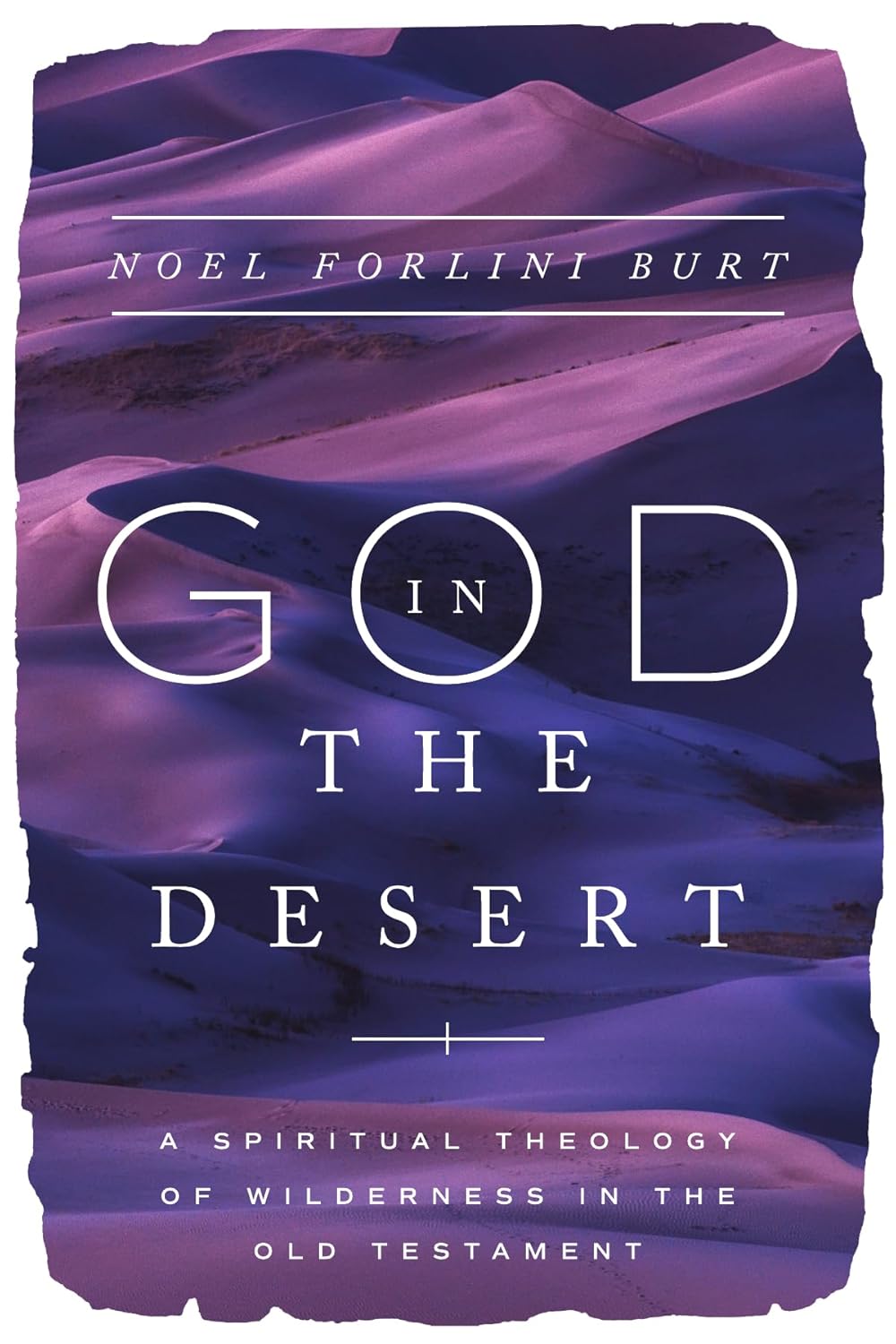
There are certain publishers that, over time, earn a kind of theological trust. For many pastors, biblical scholars, and serious students of Scripture, InterVarsity Press has consistently occupied that space. Noel Forlini Burt’s God in the Desert stands comfortably within that tradition. More than a devotional reflection on suffering, Burt offers a richly textured theology of wilderness that is exegetically attentive, spiritually formative, pastorally aware, and deeply informed by the theological imagination of the Hebrew Scriptures. Quite simply, for readers who love the Old Testament, appreciate Hebraic textures of interpretation, and long for scholarship that nourishes both mind and soul, this book is a grand slam.
At the heart of Burt’s work stands a deceptively simple but profoundly biblical question: “Who is the God we encounter in the desert?”¹ Rather than reducing wilderness to a sentimental metaphor for hardship, Burt treats the desert as theological geography, a recurring sacred space throughout Scripture where covenant formation, divine encounter, suffering, dependence, ambiguity, and transformation converge. This framing immediately distinguishes the book from much contemporary Christian writing on suffering, which too often collapses hardship into formulas of punishment, therapeutic growth, or spiritual breakthrough. Burt understands something profoundly Hebraic: wilderness is rarely punitive in Scripture alone. Rather, wilderness frequently functions as sacred space where God strips away false securities in order to cultivate covenantal dependence. Burt writes, “Wilderness is a landscape of grace. It is a liminal space,” a place that teaches us to hold what we think we know “loosely, with self-reflection, and on occasion with repentant care.”² Israel is fed in the desert, Elijah hears the quietness of God there, Hosea reimagines wilderness as betrothal, and Jesus begins ministry through forty days of stripping and testing.
One of the strongest dimensions of the work is its canonical sensitivity. Rather than isolating wilderness as a motif confined to Exodus or Numbers, Burt traces the theological contours of desert across the breadth of Scripture. Hagar, Jacob, Moses, Elijah, Hosea, the psalmists, John the Baptist, and Jesus all emerge as wilderness figures whose stories reveal something essential about the character of God. Burt rightly insists that “physical geography and spiritual geography often intertwine.”³ The Pentateuchal sections are especially strong. Burt carefully observes that Israel’s journey through wilderness was not accidental but divinely orchestrated. Her treatment of Exodus 13:18, where God “caused the people to take the roundabout way of the wilderness,” demonstrates the sort of exegetical precision too often absent in popular spirituality texts. Burt notes the Hebrew hiphil form of savav (“to go around,” “encircle”), underscoring divine agency in Israel’s detour.⁴ The implication is enormously significant: wilderness is often not the consequence of divine absence but of divine intentionality.
Modern readers frequently interpret wilderness through the lens of failure. If life is difficult, perhaps God has abandoned us or we have missed his will. Yet the Hebrew Scriptures often tell another story entirely. Israel receives manna not in abundance but in dependence. The wilderness becomes, paradoxically, the place where covenant identity is forged. Deuteronomy reframes Israel’s desert experience not merely as punishment but as divine consolation and formation.⁵ In this regard, God in the Desert retrieves something desperately needed in contemporary theology: suffering is not always transactional.
Indeed, one of Burt’s strongest contributions is her resistance to transactional spirituality altogether. Too much contemporary evangelical theology operates according to formulas: obedience produces blessing, hardship indicates disobedience, breakthrough follows enough faith. Burt resists this framework without collapsing into theological nihilism. Wilderness is not meaningless suffering, nor is it simplistic cause-and-effect. Rather, it becomes sacred ambiguity, where sophisticated theological systems undergo what Burt memorably calls a “kenosis, an emptying, a bottomless collapse.”⁶ Where the book becomes particularly compelling is in its treatment of Hagar. Quite frankly, this chapter alone is worth the price of the book. Burt’s treatment of Genesis 16 and 21 represents some of the strongest exegetical work in the volume. Rather than flattening Hagar into either victimhood or ideological symbol, Burt reads her story with remarkable literary, theological, and pastoral sensitivity. What immediately stands out is Burt’s attentiveness to the Hebrew text itself. Abram and Sarai repeatedly reduce Hagar to shiphkhah (“slave-girl”), reinforcing her status through language, while the narrator and the angel of the Lord restore personhood through naming.⁷ Hagar is female, Egyptian, enslaved, and foreign. Yet it is precisely this outsider who becomes one of Scripture’s most profound wilderness theologians.
The grammar itself becomes theological. Burt notes the passivity embedded in Genesis 16. Sarai “takes” (wattiqqakh) and “gives” (wattiten) Hagar to Abram, while Abram simply “goes into” her (wayyabo).⁸ The literary effect is difficult to miss. Hagar becomes commodified within patriarchal systems, her body treated as utility rather than personhood. Yet wilderness becomes the place where heaven interrupts exploitation. Equally impressive is Burt’s engagement with womanist scholarship, particularly Delores Williams’s Sisters in the Wilderness. Williams’s proposal that Hagar’s naming of God functions as theological resistance receives fruitful treatment. Burt writes, “Voicing our experiences, especially when they differ from hegemonic power structures, is an act of resistance.”⁹ This observation is especially powerful when considered alongside Hagar’s naming of God as El Roi, “the God who sees me.” Burt rightly reminds readers that Hagar is uniquely depicted as naming God, a remarkable act in an ancient Near Eastern context where naming often signified authority.¹⁰ Most strikingly, Burt reframes wilderness itself as hospitality. Ironically, Abram and Sarai’s supposedly covenantal household becomes more dangerous than the desert. Wilderness, paradoxically, becomes sanctuary. Hagar’s story forces readers to ask where God’s hospitality is actually encountered and whether some religious households may become less safe than the wilderness into which the wounded flee.
One of the more compelling dimensions of God in the Desert is Burt’s ability to hold rigorous biblical scholarship and spiritual formation together without allowing either discipline to eclipse the other. Too often, biblical studies become little more than historical cataloging, while spiritual formation literature drifts untethered from serious exegesis. Burt refuses this divide. Throughout the work, the desert becomes both exegetical territory and spiritual pedagogy. This is particularly evident in Burt’s interaction with wilderness as formation rather than punishment. Drawing on the wider canonical witness, Burt repeatedly frames the desert as a place where God dismantles false securities in order to cultivate covenantal trust. Such a perspective feels profoundly Hebraic. Hosea’s wilderness is not merely judgment but renewed intimacy, where Yahweh allures Israel again into covenant relationship.¹¹ Burt captures this paradox well: “Wilderness teaches us to let go, to come and die. And it is a space that teaches us to be reborn.”¹²
Burt’s critique of simplistic suffering theology is also pastorally refreshing. Reflecting on clichés such as “Everything happens for a reason,” she cautions against speaking carelessly about suffering in ways that resemble Job’s friends, who are rebuked because they have not spoken rightly of God.¹³ This is the kind of pastoral maturity the church desperately needs. Wilderness is often not something to explain quickly but something to inhabit faithfully. Another major strength of God in the Desert lies in its integration of historical spirituality. Burt revisits the third- and fourth-century desert movements, reminding readers that early Christians often fled to the Egyptian, Syrian, and Arabian deserts not merely to escape the world but to resist the spiritual complacency of empire Christianity. Drawing on Thomas Merton, Burt highlights the conviction that wilderness mattered precisely because it “offered nothing” to human ambition.¹⁴
The discussion of hesychasm is especially fruitful. Burt introduces the prayer of the heart, “Lord Jesus Christ, Son of God, have mercy on me, a sinner,” as a spiritual practice cultivated amid wilderness experiences.¹⁵ Rooted in stillness, such prayer becomes an acknowledgment of dependence upon God rather than the self-sufficiency modern Christians so often prize. Drawing on Henri Nouwen, Burt describes prayer as learning to “denounce self-made props and trust that God is enough.”¹⁶ Perhaps the single most significant contribution of God in the Desert is Burt’s refusal to compartmentalize scholarship and holiness. She writes, “Scholarship is spiritually impoverished when it fails to take an affective turn.”¹⁷ That sentence captures much of what makes the book so valuable. Prayer and scholarship belong together. Exegesis and formation belong together. Knowledge and holiness belong together. Here Burt draws fruitfully upon M. Robert Mulholland’s definition of spiritual formation as “the process of being conformed to the image of Christ for the sake of others.”¹⁸ This final phrase matters. Wilderness formation is not merely personal survival or private piety. It is transformation for the sake of the community. The God of the desert forms saints and scholars, but he does so in ways that bend them outward toward love.
In an era marked by spiritual exhaustion, theological fragmentation, and simplistic explanations for suffering, God in the Desert offers something increasingly rare: theological depth without abstraction, scholarship without sterility, and spiritual formation without sentimentality. For pastors, seminarians, counselors, scholars, and weary believers walking through their own wilderness seasons, Noel Forlini Burt has written a work worthy of careful reading.
This is vintage IVP Academic at its best. More importantly, it is a reminder that wilderness, though painful, is not empty. The God of the desert still meets people there.
BUY HERE

Endnotes
- Noel Forlini Burt, God in the Desert: Encountering the God of the Wilderness (Downers Grove, IL: InterVarsity Press Academic, forthcoming), 2–3.
- Burt, God in the Desert, 10–11.
- Burt, God in the Desert, 3–5.
- Burt, God in the Desert, 4.
- Burt, God in the Desert, 4–5.
- Burt, God in the Desert, 9–10.
- Burt, God in the Desert, 20–22.
- Burt, God in the Desert, 21–23.
- Burt, God in the Desert, 23–24.
- Burt, God in the Desert, 28–29.
- Burt, God in the Desert, 13–14.
- Burt, God in the Desert, 10–12.
- Burt, God in the Desert, 187–88.
- Burt, God in the Desert, 6–7; Thomas Merton, Thoughts in Solitude (New York: Farrar, Straus & Giroux, 1956), 4–5.
- Burt, God in the Desert, 185–86.
- Burt, God in the Desert, 186; Henri J. M. Nouwen, The Inner Voice of Love: A Journey through Anguish to Freedom (New York: Doubleday, 1996), 5.
- Burt, God in the Desert, 12–13.
- M. Robert Mulholland Jr., Invitation to a Journey: A Road Map for Spiritual Formation (Downers Grove, IL: InterVarsity Press, 1993), 15.
 EXPEDITION 44