Palm Sunday and the Subversive Kingship of Jesus:Prophetic Fulfillment, Royal Sign-Act, and the Reconstitution of Power


This study offers a socio-rhetorical and intertextual reading of the so-called Triumphal Entry narratives (Matt 21:1–11; Mark 11:1–11; Luke 19:28–44; John 12:12–19), arguing that Palm Sunday is best understood not as a spontaneous celebration but as a carefully staged prophetic sign-act. Drawing upon Second Temple interpretive practices, Ancient Near Eastern royal symbolism, and recent scholarship on anti-imperial readings of the Gospels, this article contends that Jesus’ entry into Jerusalem functions as a deliberate redefinition of kingship. The event fulfills Scripture not merely predictively but typologically and narratively, culminating in a paradoxical vision of victory that coheres with a Christus Victor framework. The pastoral implication is clear: the kingdom Jesus inaugurates subverts conventional expectations of power, calling the Church to embody a cruciform understanding of authority and mission.


Palm Sunday has often been domesticated within Christian liturgical practice, framed as a moment of celebratory anticipation preceding the solemnity of the Passion. Yet such readings risk obscuring the narrative’s theological density and socio-political force. The Gospel writers do not present this event as incidental but as programmatic, situating it within the charged atmosphere of Passover—a festival already laden with liberationist memory and eschatological expectation.¹

Within this context, Jesus’ approach to Jerusalem is neither accidental nor merely devotional; it is a calculated enactment of kingship. As such, the Triumphal Entry must be read as a prophetic sign-act, akin to those performed by Israel’s prophets, wherein symbolic actions communicate divine intention.² The question, therefore, is not simply whether Jesus fulfills Scripture, but how that fulfillment reconfigures prevailing conceptions of messiahship, kingship, and power.


All four Gospels frame the entry in relation to Zechariah 9:9, though Matthew alone explicitly cites the text.³ The prophetic oracle announces a king who is “righteous and having salvation, humble and mounted on a donkey.”⁴ This imagery stands in stark contrast to Ancient Near Eastern and Greco-Roman royal iconography, where kingship is typically associated with chariots, horses, and military triumph.⁵

Scholarly debate has often centered on Matthew’s apparent reference to two animals (Matt 21:2–7). While some have attributed this to a misunderstanding of Hebrew parallelism,⁶ a more nuanced reading recognizes Matthew’s engagement in Second Temple interpretive expansion, wherein multiple scriptural traditions are woven together to amplify messianic identity.⁷ The pairing of donkey and colt may evoke Genesis 49:10–11, linking Jesus to the royal line of Judah and reinforcing his Davidic credentials.⁸

Such hermeneutical practices are not aberrations but reflect a broader Jewish exegetical culture in which texts are read dialogically, allowing earlier Scriptures to reverberate within new narrative contexts.⁹ Fulfillment, therefore, is not merely predictive but participatory, as Jesus embodies Israel’s story in climactic form.¹⁰


The choice of a donkey is central to the narrative’s theological force. In the Ancient Near East, while donkeys could be associated with peaceful rule in certain Israelite traditions,¹¹ the dominant imperial imagery of the first century privileged the war horse as a symbol of conquest and domination.¹² Zechariah itself underscores this contrast, declaring that the coming king will “cut off the chariot… and the war horse… and shall command peace to the nations.”¹³

Jesus’ deliberate enactment of this imagery constitutes a rejection of militarized kingship. As Wright observes, the entry into Jerusalem is not a parody but a prophetic critique of power structures that define authority in terms of violence and coercion.¹⁴ Similarly, Horsley situates the event within a broader pattern of anti-imperial resistance, wherein Jesus symbolically confronts Roman claims to sovereignty.¹⁵

Even scholars operating within more critical frameworks acknowledge the symbolic significance of the donkey as indicative of peaceful kingship.¹⁶ The convergence of these perspectives suggests that the Triumphal Entry is best understood as a counter-imperial performance, one that exposes the inadequacy of prevailing political paradigms.


The geographical and temporal setting of the entry further amplifies its meaning. Jesus approaches Jerusalem from the Mount of Olives, a location associated with eschatological expectation in Jewish tradition.¹⁷ At the same time, Roman authorities would have been particularly vigilant during Passover, a festival commemorating liberation from imperial oppression.¹⁸

Some scholars have proposed that Jesus’ entry functioned as a counter-procession to Roman displays of power, wherein governors such as Pontius Pilate would enter the city with military escort to assert imperial control.¹⁹ While direct historical evidence for simultaneous processions remains debated, the symbolic juxtaposition is theologically compelling: two kingdoms, two visions of power, two claims to authority.

The crowd’s acclamation, drawn from Psalm 118, reinforces this tension.²⁰ The cry of “Hosanna” (“save now”) carries both liturgical and political connotations, invoking divine intervention and royal deliverance.²¹ Yet the narrative quickly reveals the ambiguity of these expectations, as the same populace that welcomes Jesus will soon reject him.


The Triumphal Entry is marked by profound irony. The crowd correctly identifies Jesus as the one who comes “in the name of the Lord,” yet their understanding of his mission remains incomplete.²² Second Temple Jewish hopes for a Davidic messiah often included expectations of political restoration and national sovereignty.²³ Jesus’ actions both affirm and subvert these hopes.

This tension is particularly evident in Luke’s account, where Jesus weeps over Jerusalem, lamenting its failure to recognize “the things that make for peace.”²⁴ The irony is not merely narrative but theological: the city longs for liberation while rejecting the very form it takes.

From a Christus Victor perspective, this moment anticipates the paradox of the cross. Victory will not be achieved through the defeat of Rome by force, but through the defeat of sin, death, and the powers by self-giving love.²⁵ As Gorman argues, the cruciform pattern of Jesus’ life and death reveals a redefinition of power that stands in stark contrast to imperial paradigms.²⁶


John’s explicit mention of palm branches introduces additional layers of meaning.²⁷ In Jewish tradition, palms were associated with victory, festal celebration, and national identity.²⁸ The act of laying cloaks on the road evokes royal enthronement scenes, such as that of Jehu in 2 Kings 9:13.²⁹

These symbolic actions suggest that the crowd is participating in a form of improvised coronation. Yet the narrative subverts this coronation by redirecting its trajectory toward the cross. The enthronement of Jesus does not culminate in political ascendancy but in crucifixion, where the inscription “King of the Jews” becomes both mockery and proclamation.³⁰


Palm Sunday thus functions as a hermeneutical key for understanding the nature of Jesus’ kingship. The convergence of prophetic fulfillment, symbolic action, and narrative irony reveals a kingdom characterized by:

  • Peace rather than violence
  • Humility rather than domination
  • Sacrifice rather than coercion

This reconfiguration aligns with broader New Testament themes, wherein the exaltation of Christ is inseparable from his suffering.³¹ The kingdom he inaugurates is not merely future but present, calling forth a community that embodies its values.


The enduring significance of Palm Sunday lies in its capacity to confront contemporary assumptions about power and discipleship. The question it poses is not only historical but existential: Do we receive Jesus as the king he reveals himself to be, or as the king we prefer?

The temptation to align the kingdom of God with systems of control, influence, or cultural dominance remains ever-present. Yet the Triumphal Entry calls the Church back to a cruciform vision of authority, one that mirrors the self-giving love of its King.

In this sense, Palm Sunday is not merely a prelude to Good Friday; it is an invitation to participate in the very pattern of Jesus’ life—a pattern in which true victory is found not in grasping power, but in relinquishing it for the sake of others.


  1. E. P. Sanders, Judaism: Practice and Belief (London: SCM, 1992), 125–30.
  2. John H. Walton, Ancient Near Eastern Thought and the Old Testament (Grand Rapids: Baker, 2006), 305–10.
  3. Matt 21:4–5.
  4. Zech 9:9 (ESV).
  5. K. Lawson Younger Jr., Ancient Near Eastern Conquest Accounts (Sheffield: JSOT Press, 1990), 180–85.
  6. Bart D. Ehrman, Jesus: Apocalyptic Prophet of the New Millennium (Oxford: Oxford University Press, 1999), 215.
  7. Richard B. Hays, Echoes of Scripture in the Gospels (Waco: Baylor University Press, 2016), 112–18.
  8. Gen 49:10–11.
  9. Michael Fishbane, Biblical Interpretation in Ancient Israel (Oxford: Clarendon, 1985), 350–60.
  10. N. T. Wright, Jesus and the Victory of God (Minneapolis: Fortress, 1996), 490–95.
  11. K. A. Kitchen, On the Reliability of the Old Testament (Grand Rapids: Eerdmans, 2003), 340.
  12. Younger, Conquest Accounts, 182.
  13. Zech 9:10.
  14. Wright, Jesus and the Victory of God, 492.
  15. Richard A. Horsley, Jesus and Empire (Minneapolis: Fortress, 2003), 85–90.
  16. Ehrman, Jesus, 216.
  17. Zech 14:4.
  18. Sanders, Judaism, 128.
  19. Marcus J. Borg and John Dominic Crossan, The Last Week (San Francisco: HarperOne, 2006), 2–5.
  20. Ps 118:25–26.
  21. Craig A. Evans, Mark 8:27–16:20 (WBC; Nashville: Thomas Nelson, 2001), 149.
  22. John 12:13.
  23. John J. Collins, The Scepter and the Star (Grand Rapids: Eerdmans, 2010), 102–10.
  24. Luke 19:42.
  25. Gustaf Aulén, Christus Victor (London: SPCK, 1931), 20–25.
  26. Michael J. Gorman, Cruciformity (Grand Rapids: Eerdmans, 2001), 45–50.
  27. John 12:13.
  28. 1 Macc 13:51.
  29. 2 Kgs 9:13.
  30. John 19:19.
  31. Phil 2:5–11.

Selected Bibliography

Aulén, Gustaf. Christus Victor. London: SPCK, 1931.

Borg, Marcus J., and John Dominic Crossan. The Last Week. San Francisco: HarperOne, 2006.

Brueggemann, Walter. The Prophetic Imagination. 2nd ed. Minneapolis: Fortress, 2001.

Collins, John J. The Scepter and the Star. 2nd ed. Grand Rapids: Eerdmans, 2010.

Evans, Craig A. Mark 8:27–16:20. WBC. Nashville: Thomas Nelson, 2001.

Fishbane, Michael. Biblical Interpretation in Ancient Israel. Oxford: Clarendon, 1985.

France, R. T. The Gospel of Matthew. NICNT. Grand Rapids: Eerdmans, 2007.

Gorman, Michael J. Cruciformity. Grand Rapids: Eerdmans, 2001.

Gorman, Michael J. Reading Revelation Responsibly. Eugene, OR: Cascade, 2011.

Hays, Richard B. Echoes of Scripture in the Gospels. Waco: Baylor University Press, 2016.

Heiser, Michael S. The Unseen Realm. Bellingham, WA: Lexham, 2015.

Horsley, Richard A. Jesus and Empire. Minneapolis: Fortress, 2003.

Keener, Craig S. The Gospel of John. 2 vols. Grand Rapids: Baker Academic, 2003.

McKnight, Scot. The King Jesus Gospel. Grand Rapids: Zondervan, 2011.

Sanders, E. P. Judaism: Practice and Belief. London: SCM, 1992.

Walton, John H. Ancient Near Eastern Thought and the Old Testament. Grand Rapids: Baker Academic, 2006.

Walton, John H., and Tremper Longman III. The Lost World of the Prophets. Downers Grove, IL: IVP Academic, 2018.

Wright, N. T. Jesus and the Victory of God. Minneapolis: Fortress, 1996.

Wright, N. T. How God Became King. New York: HarperOne, 2012.

Zahnd, Brian. The Wood Between the Worlds. Downers Grove, IL: IVP, 2022.
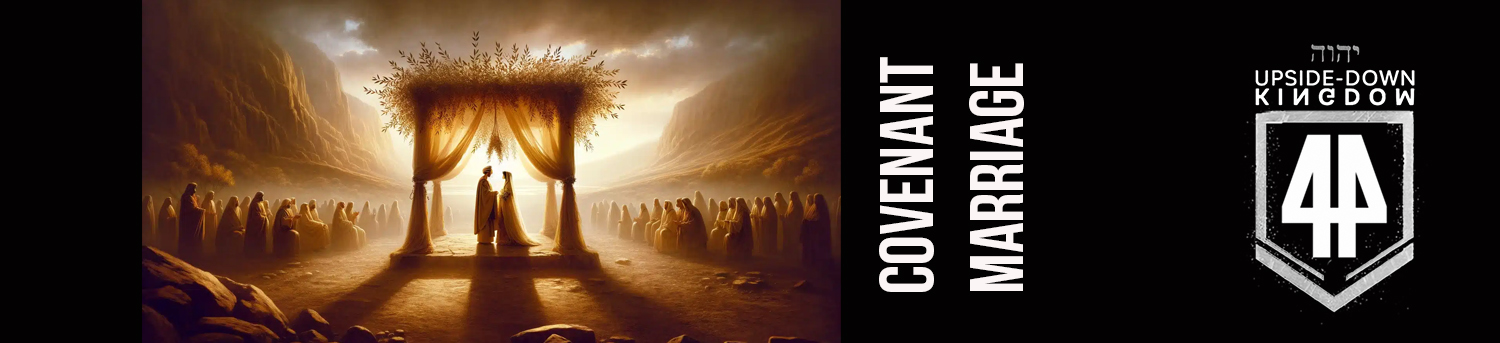
The Covenant of Marriage – Conference Notes

A Biblical-Theological and Socio-Historical Exploration

1. Berit (בְּרִית): Covenant as Ontological Bond

The Hebrew term berit cannot be reduced to “contract.” In the Ancient Near Eastern world, covenants (Hittite suzerainty treaties, parity treaties, kinship covenants) established binding relational realities. They were often ratified by oath, sacrifice, and symbolic acts (cf. Gen 15; Jer 34:18–20). The covenant did not merely regulate behavior; it created a new relational status.

Hebrew philological studies suggest that covenant language often involved embodied ritual actions — cutting animals, sharing meals, oath invocations — signifying life-and-death seriousness. The expression “cut a covenant” (karat berit) implies sacrificial solemnity. Marriage, when named covenant in Malachi 2:14, is therefore elevated into this sacred category.

Malachi rebukes Israelite men who deal treacherously (bagad) with “the wife of your covenant.” The covenant is not merely between spouses; “the LORD was witness.” The text suggests divine juridical oversight. Marriage is a theologically accountable bond under YHWH’s covenant justice.

2. Genesis 1–2: Creation as Proto-Covenantal Structure

Genesis 1:26–28 situates humanity as royal vice-regents bearing the imago Dei. The Hebrew plural deliberation (“Let us make…”) and the parallel structure (“male and female he created them”) present differentiated unity within shared image-bearing.

The dominion mandate (radah) is given jointly. Thus, marriage emerges within a shared vocational stewardship.

Genesis 2 deepens this through narrative theology. The woman as ezer kenegdo must be handled carefully. Ezer appears 21 times in the Hebrew Bible; in most cases it refers to divine aid (e.g., Ps 121:1–2). It connotes indispensable strength. Kenegdo (“corresponding to him,” “according to what is opposite”) implies complementarity of relational correspondence, not subordination.

The covenantal nature becomes clearer in Genesis 2:24:

“Therefore a man shall leave (‘azab) his father and mother and cling (dabaq) to his wife…”

Dabaq frequently describes covenant fidelity to YHWH (Deut 10:20; 30:20). The semantic overlap is significant. Marriage mirrors Israel’s covenantal clinging to God.

The phrase “one flesh” (basar echad) reflects kinship formula language. In the ancient world, flesh signified shared clan identity (cf. Gen 29:14; 2 Sam 5:1). Marriage forms a new covenant kinship unit.

Thus, Genesis presents marriage not merely as companionship but as a covenantal reconstitution of primary allegiance and shared identity before God.


1. Prophetic Marriage Metaphor and Covenant Theology

The prophetic corpus elevates marriage into theological metaphor. Hosea’s enacted prophecy (Hos 1–3) frames Israel’s idolatry as adultery. The covenant violation is sexualized imagery because marriage best captures the intimacy and exclusivity of divine-human covenant.

Isaiah 54:5 declares:

“For your Maker is your husband (בֹּעֲלַיִךְ).”

The marital title affirms covenant loyalty despite judgment. Jeremiah 31:32 explicitly refers to YHWH as husband in relation to Sinai covenant.

This is theologically decisive: marriage becomes the primary analogy for covenant faithfulness, exclusivity, and restorative grace. The logic moves from divine covenant to human marriage, and back again.

2. Second Temple Developments

By the Second Temple period, Jewish marriage involved ketubah agreements, bride-price (mohar), and legally binding commitments. While economic dimensions existed, marriage retained theological framing under Torah.

Divorce debates between Hillel and Shammai (m. Gittin) reveal interpretive tensions over Deuteronomy 24. By Jesus’ time, some permitted divorce for trivial reasons. Thus, covenant permanence was contested.


Roman marriage functioned within patria potestas. The male head wielded legal control. Marriage types (cum manu vs. sine manu) affected whether the wife came under the husband’s legal authority or remained under her father’s household.

Aristotle (Politics 1.1253b) described the husband-wife relationship hierarchically within household management. The household codes reinforced stratified order: husband over wife, father over children, master over slave.

Yet Roman moralists also valued marital fidelity as stabilizing civic order.

Against this background, New Testament teaching neither abolishes structure nor baptizes patriarchy; instead, it reorients marriage christologically and covenantally.


In Matthew 19:3–9, Jesus addresses divorce controversies. His interpretive move is hermeneutically profound: he appeals to Genesis 1 and 2 as normative revelation.

By joining both creation texts (“male and female” + “one flesh”), Jesus presents a canonical synthesis. The verb “joined together” (synezeuxen) implies divine yoking. God is the covenantal agent.

Jesus’ restriction of divorce does not ignore Mosaic concession but reframes it as accommodation to hardness of heart. Covenant permanence reflects divine intent.

In elevating Genesis over concessionary legislation, Jesus restores marriage to its creational-covenantal gravity.


1. Ephesians 5:21–33 — Mystery and Covenant Christology

The participial structure beginning in 5:18 (“being filled with the Spirit”) governs the household code. Verse 21 introduces mutual submission (hypotassomenoi allelois).

When Paul instructs wives to submit, the verb is borrowed from v. 21 — situating marriage within the larger ethic of Spirit-shaped humility.

Husbands are commanded to love (agapate) “as Christ loved the church and gave himself up.” The analogy is covenantal and sacrificial. Christ’s headship (kephalē) must be read through cruciform self-giving.

Verse 25–27 evokes covenant purification imagery. Christ sanctifies the church, presenting her in glory — echoing prophetic marital restoration themes.

Verse 32 is climactic:

“This mystery (mystērion) is great — but I speak concerning Christ and the church.”

Marriage is typological participation in the new covenant. The earthly union signifies the eschatological union.

Thus, Paul situates marriage within redemptive history — not merely ethics but covenant drama.

2. 1 Corinthians 7: Reciprocity in a Patriarchal Context

In Corinth, influenced by both asceticism and libertinism, Paul affirms marital sexual obligation. The reciprocal language of authority (exousiazei) over one another’s bodies is unprecedented in Roman literature.

Marriage is framed as mutual covenant obligation, not unilateral male entitlement.


1. Coram Deo: Marriage Before the Face of God

Ecclesiastes 5 warns against rash vows. Biblical marriage vows invoke divine witness. The covenant is triangulated — husband, wife, and God.

Marriage is therefore an act of worshipful oath-taking.

2. Covenant Fidelity as Sanctification

Hebrews 13:4 affirms marriage as honorable and the bed undefiled. Sexual exclusivity is covenant fidelity embodied.

Sanctification occurs through daily covenant keeping: forgiveness, repentance, reconciliation. Marriage becomes a means of grace.

3. Eschatological Orientation

Revelation 19 and 21 culminate in nuptial imagery. The Lamb’s marriage fulfills prophetic anticipation. Earthly marriage is provisional signpost toward ultimate covenant union.


Modern Western culture often treats marriage contractually — dissolvable when preferences change.

Biblical covenant marriage requires:

  • Vow consciousness
  • Theological literacy
  • Liturgical seriousness
  • Church accountability

Premarital counseling must teach covenant ontology, not merely compatibility tools.

Pastorally, couples must be shepherded toward:

  • Prayer as covenant renewal
  • Eucharistic imagination (self-giving love patterned after Christ)
  • Endurance rooted in God’s covenant faithfulness

Marriage thrives when grounded not in emotional volatility but in the steadfast love (hesed) of God.


Conclusion

Marriage in Scripture is covenantal from creation to consummation. It is:

  • Rooted in Genesis’ covenant-shaped anthropology
  • Interpreted through prophetic covenant metaphor
  • Restored by Jesus’ appeal to creation
  • Reframed in Paul’s Christological mystery
  • Fulfilled in eschatological union

To stand in marriage is to stand before the Lord — bound by oath, sustained by grace, accountable to divine witness, and participating in the redemptive covenant story of God.

When the church recovers this theological depth, marriage becomes not merely a personal commitment but a living proclamation of God’s covenant faithfulness.


  1. Covenant Ontology and Marriage:
    How does the Hebrew concept of berit (particularly as expressed in karat berit, “cutting a covenant”) deepen our understanding of marriage as an ontological bond rather than a contractual agreement? In what ways does Malachi 2:14 reinforce this covenantal seriousness?
  2. Genesis 2:24 and Covenant Fidelity:
    In light of the semantic range of dabaq (“to cling/cleave”) elsewhere in Deuteronomy’s covenant language, how might Genesis 2:24 intentionally frame marriage as an analogue to Israel’s covenant loyalty to YHWH? What theological implications arise from this connection?
  3. Second Temple and Greco-Roman Contexts:
    How did Jewish covenant consciousness interact with Greco-Roman legal structures such as patria potestas? In what ways do Jesus’ teaching in Matthew 19 and Paul’s instructions in Ephesians 5 both affirm and subvert their socio-historical environments?
  4. Christological Typology in Ephesians 5:
    How does Paul’s use of mystērion (Eph 5:32) situate marriage within redemptive history? What are the implications of reading marriage primarily through the lens of Christ’s covenant with the church?
  5. Eschatology and Pastoral Formation:
    If earthly marriage functions as an anticipatory sign of the eschatological marriage of the Lamb (Rev 19–21), how should this shape pastoral counseling, marital endurance through suffering, and the church’s theology of permanence?

Bibliography & Further Reading

Biblical and Lexical Resources

Bauer, Walter, Frederick W. Danker, William F. Arndt, and F. Wilbur Gingrich. A Greek-English Lexicon of the New Testament and Other Early Christian Literature (BDAG). 3rd ed. Chicago: University of Chicago Press, 2000.

Brown, Francis, S. R. Driver, and Charles A. Briggs. The Brown-Driver-Briggs Hebrew and English Lexicon. Peabody, MA: Hendrickson, 1996.

Koehler, Ludwig, Walter Baumgartner, and Johann Jakob Stamm. The Hebrew and Aramaic Lexicon of the Old Testament (HALOT). Leiden: Brill, 1994–2000.


Covenant Theology and Old Testament Foundations

Robertson, O. Palmer. The Christ of the Covenants. Phillipsburg, NJ: P&R Publishing, 1980.

Gentry, Peter J., and Stephen J. Wellum. Kingdom through Covenant. Wheaton, IL: Crossway, 2012.

Hahn, Scott W. Kinship by Covenant. New Haven: Yale University Press, 2009.

Ancient Hebrew Research Center. “Covenants from a Hebrew Perspective.”

Ancient Hebrew Research Center. “Definition of Covenant.”


Marriage in the Old Testament and Ancient Near East

Matthews, Victor H. Marriage and Family in the Biblical World. Downers Grove, IL: IVP Academic, 2003.

Westbrook, Raymond. Old Babylonian Marriage Law. AfO Beiheft 23. Vienna: Institut für Orientalistik, 1988.

Wright, Christopher J. H. Old Testament Ethics for the People of God. Downers Grove, IL: IVP Academic, 2004.


Second Temple and Greco-Roman Context

Cohick, Lynn H. Women in the World of the Earliest Christians. Grand Rapids: Baker Academic, 2009.

Osiek, Carolyn, and David L. Balch. Families in the New Testament World: Households and House Churches. Louisville: Westminster John Knox, 1997.

Malina, Bruce J. The New Testament World: Insights from Cultural Anthropology. Louisville: Westminster John Knox, 2001.

Witherington, Ben III. Women in the Earliest Churches. Cambridge: Cambridge University Press, 1988.

Bryn Mawr Classical Review. 2021. Review of scholarship on marriage and family in antiquity (BMCR 2021.03.05).


New Testament Theology of Marriage

Keener, Craig S. Paul, Women & Wives: Marriage and Women’s Ministry in the Letters of Paul. Grand Rapids: Baker Academic, 1992.

Westfall, Cynthia Long. Paul and Gender: Reclaiming the Apostle’s Vision for Men and Women in Christ. Grand Rapids: Baker Academic, 2016.

Thielman, Frank. Ephesians. Baker Exegetical Commentary on the New Testament. Grand Rapids: Baker Academic, 2010.

Thiselton, Anthony C. The First Epistle to the Corinthians. NIGTC. Grand Rapids: Eerdmans, 2000.


Theological and Pastoral Reflection

Hauerwas, Stanley. A Community of Character. Notre Dame: University of Notre Dame Press, 1981.

John Paul II. Man and Woman He Created Them: A Theology of the Body. Boston: Pauline Books, 2006.

Reconstructing Judaism. “Covenant & Marriage” (D’var Torah).

CBE International. “How the New Testament Turned Marriage in the Ancient World on Its Head.”