Covenant Intimacy: Cultivating Oneness in Marriage
Marriage in the biblical sense is not merely a social contract or a partnership; it is a sacred covenant—a divinely instituted bond that mirrors God’s covenant love with His people. The Hebrew term berith (בְּרִית) denotes a solemn, binding agreement, marked not only by promises but by loyalty, faithfulness, and mutual self-giving. In the New Testament, this covenantal reality is deepened through Christ, who embodies sacrificial love (agape, ἀγάπη) that calls spouses to serve one another in humility and grace (Ephesians 5:21–33).
At the heart of covenant intimacy is oneness. Genesis 2:24 provides the foundational paradigm: “Therefore a man shall leave his father and his mother and hold fast to his wife, and they shall become one flesh” (yada’, יָדַע). This “knowing” is both relational and sexual, reflecting the full depth of emotional, spiritual, and physical unity. The Hebrew concept carries intentionality: to truly know is to commit, to enter into the mystery of the other in trust and vulnerability.
1. Emotional and Spiritual Intimacy: Grounded in Discipleship
Intimacy begins in the soul. Couples are called to cultivate mutual transparency, confession, and encouragement, echoing the pastoral model of discipleship. Paul’s admonition in Ephesians 4:32—“Be kind to one another, tenderhearted, forgiving one another, as God in Christ forgave you”—offers a template for relational healing.
Practical Steps:
Regular Spiritual Check-ins: Set aside time weekly to share personal spiritual victories, struggles, and prayers. This mirrors the Jewish practice of hevruta, spiritual partnership, applied to marriage.
Scripture Sharing: Read passages together that emphasize covenant faithfulness, such as Hosea 2:19–20 or Song of Solomon 2:16. Discuss what it means to love sacrificially in the context of God’s covenant.
Example: A husband and wife may take a Psalm each week, reflecting on God’s steadfast love (chesed, חֶסֶד), and share how it encourages them to act faithfully toward one another.
2. Physical Intimacy as Covenant Expression
Sexual intimacy in marriage is not a mere physical act but a profound covenantal sign. Paul’s instruction in 1 Corinthians 7:3–5 emphasizes mutual authority over one another’s bodies, highlighting consent, desire, and attentive love. The Greek word soma (σῶμα) underscores the body as integral to relational unity, not separate from spiritual or emotional connection.
Practical Steps:
Intentional Touch and Affection: Beyond sexual encounters, daily gestures of touch—holding hands, gentle hugs, and affirming kisses—strengthen the sense of oneness.
Sexual Rhythm and Communication: Like cultivating agape, sexual intimacy benefits from intentionality, listening, and mutual understanding rather than routine or obligation.
Example: A couple may schedule regular “covenant nights” where the focus is on emotional closeness first, leading into physical intimacy, emphasizing the full scope of knowing (yada’) one another.
3. Reconciliation and Covenant Repair
Covenantal intimacy is tested in conflict and broken trust. The Hebrew Scriptures often illustrate covenant repair through rituals of atonement, dialogue, and restoration (e.g., Numbers 5:5–10). In a marriage, bitterness or resentment acts as a barrier to oneness. Forgiveness is the vessel through which intimacy is restored.
Practical Steps:
Transparent Apologies: Use “I statements” to express hurt without blame. Example: “I felt distant when…”
Counseling as Shepherding: Pastoral or Christian counseling can provide structured guidance in rebuilding trust.
Example: After a major disagreement, a couple may intentionally pray together, verbally affirming mutual commitment to repair and trust, creating a spiritual as well as relational healing.
4. Covenant Rituals and Symbolic Practices
Hebrew and Christian traditions often employ ritual as a tangible expression of covenant faithfulness. Small but intentional practices cultivate relational memory and reinforce unity.
Practical Steps:
Weekly Covenant Meals: Sharing intentional meals without distraction, reflecting on God’s covenant with each other, mirrors the covenantal feasts of Israel.
Anniversary Reflections: Beyond gifts, reflecting on God’s faithfulness through marriage fosters gratitude and spiritual depth.
Shared Devotional Practices: Singing, prayer, or journaling together enhances both spiritual and emotional oneness.
Example: A couple may light a candle each week, reading Song of Solomon 8:6–7, symbolizing love as a flame strengthened by trust and God’s covenant presence.
Conclusion
Covenant intimacy in marriage is a dynamic, God-centered pursuit. It is not achieved merely through techniques but through a sustained commitment to oneness—emotional, spiritual, and physical—modeled on Christ’s sacrificial love. Couples who approach marriage as a covenant discover that intimacy grows from shared vulnerability, forgiveness, and disciplined love. As shepherds of one another’s hearts, husbands and wives reflect the divine covenant in ways that are both deeply relational and spiritually formative.
Discussion Questions
Oneness and Covenant Theology
Genesis 2:24 emphasizes the couple becoming “one flesh” (yada’, יָדַע). How does this Hebrew concept of “knowing” inform our understanding of emotional, spiritual, and physical intimacy in marriage?
In what ways can modern couples cultivate “oneness” beyond physical intimacy, reflecting covenant faithfulness in daily life?
Discuss practical ways to apply the biblical model of covenant to repair relational breaches or build deeper trust.
Spiritual Intimacy and Discipleship in Marriage
Ephesians 5:21–33 and Colossians 3:12–14 call for mutual submission, forgiveness, and love. How does viewing marriage as a context for mutual discipleship transform conflict resolution, emotional vulnerability, and spiritual growth?
Share examples of habits, practices, or rituals that encourage spiritual intimacy and accountability within your marriage.
Physical Intimacy as Covenant Expression
1 Corinthians 7:3–5 presents the body as a shared authority (soma, σῶμα) within marriage. How does this concept challenge or expand contemporary cultural understandings of sexual intimacy?
Discuss how intentionality, communication, and mutual consent can enhance covenantal physical intimacy, making it both relational and spiritual.
Forgiveness, Reconciliation, and Covenant Repair
Reflect on biblical examples of covenant restoration (e.g., Hosea’s marriage as metaphor, Numbers 5:5–10). How do forgiveness and transparent apology function as practical and spiritual tools to rebuild intimacy?
What are the barriers in your own context to practicing “record-free” covenant-keeping, and how might couples cultivate an environment of grace and restoration?
Ritual, Memory, and Symbolic Practices
How do small, intentional practices (shared meals, anniversary reflections, devotional rituals) reinforce covenantal intimacy?
Explore the relationship between symbolic acts and emotional memory. How can couples adapt biblical ritual principles (berith, בְּרִית) to cultivate ongoing intimacy in their marriage today?
Bibliography
Brueggemann, Walter. Genesis: A Bible Commentary for Teaching and Preaching. Westminster John Knox Press, 2010.
Longman III, Tremper. Song of Solomon: An Introduction and Commentary. IVP Academic, 2001.
Fee, Gordon D., and Douglas Stuart. How to Read the Bible for All Its Worth. 5th ed., Zondervan, 2014.
Perrotta, Kevin, and Louise Perrotta. Oneness: Jesus’ Vision of Marriage. 2024.
Gregoire, Sheila, and Dr. Keith Gregoire. The Marriage You Want: Moving Beyond Stereotypes for a Relationship Built on Scripture, New Data, and Emotional Health. 2025.
Reynolds, Adrian, and Celia Reynolds. Closer: A Realistic Book About Intimacy for Christian Marriages. 2021.
Konzen, Dr. Jennifer. The Art of Intimate Marriage: A Christian Couple’s Guide to Sexual Intimacy. 2016.
Westermann, Claus. Genesis 12–36: A Commentary. Augsburg Fortress, 1985.
Packer, J. I. Knowing God. IVP, 1973. (for theological foundations of covenant love)
Recommended Reading
Kevin and Louise Perrotta, Oneness: Jesus’ Vision of Marriage. 2024.
Adrian Reynolds & Celia Reynolds, Closer: A Realistic Book About Intimacy for Christian Marriages. 2021.
Sheila & Dr. Keith Gregoire, The Marriage You Want. 2025.
Dr. Jennifer Konzen, The Art of Intimate Marriage. 2016.
Emerson Eggerichs, Love & Respect: The Love She Most Desires; The Respect He Desperately Needs. 2004.
Timothy Keller & Kathy Keller, The Meaning of Marriage: Facing the Complexities of Commitment with the Wisdom of God. 2011.
Rebuilding Covenant Love: Humility, Servanthood, and the Healing of a Broken Christian Marriage
Prayer as a Catalyst for Healing and Restoration in Marriage
Prayer is foundational for the healing and restoration of a marriage because it invites the presence and transformative power of God into the relational space. Through prayer, spouses can confess their own shortcomings, seek forgiveness, and intercede for one another, fostering humility and dependence on the Holy Spirit rather than relying solely on human effort. Prayer aligns hearts with God’s will, softens pride, and cultivates empathy, enabling couples to approach conflict with grace and patience. Applicable practices include joint prayer times, where couples speak aloud their needs and blessings for each other; silent intercessory prayer, focusing on God’s intervention in challenging areas; and praying Scripture over the marriage, such as Ephesians 4:2–3 or 1 Corinthians 13, which reinforces covenantal love and unity. Regular, intentional prayer not only strengthens the spiritual bond but also provides a safe, sacred rhythm for ongoing restoration and emotional reconciliation. In this sense, every aspect of healing and restoration should be bathed in prayer. Welcome others to also faithfully intercede for your marriage in prayer.
I. Marriage as Covenant: The Theological Foundation of Restoration
Christian marriage is not sustained by sentiment but by covenant. Scripture consistently frames marriage within the moral architecture of covenant fidelity (בְּרִית, berît), a binding relational oath rooted in loyal love (ḥesed). Malachi 2:14 explicitly calls marriage a “covenant” before God, invoking not merely a private contract but a sacred, witnessed union accountable to Yahweh.
As Christopher J. H. Wright argues, Old Testament ethics are covenantal at their core; relational faithfulness mirrors God’s own covenant loyalty to Israel. Marriage, therefore, is a lived parable of divine fidelity. Daniel Block similarly demonstrates that in ancient Israel marriage was embedded within kinship structures of honor, obligation, and permanence—not fragile romantic individualism.
In the New Testament, Paul intensifies this covenantal vision in Ephesians 5:21–33. Marriage reflects the mystērion—the profound mystery—of Christ and the church. The call to “submit to one another” (5:21) precedes and frames all marital exhortation. Christ’s love is defined by kenosis (Phil 2:5–11): self-emptying humility, not self-assertion.
Thus, when trust is shattered, healing must begin not with techniques but with identity: Who are we in Christ? Marriage recovery is not merely emotional repair; it is covenant renewal grounded in Christ-centered humility.
II. The Roots of Marital Rupture: Mistrust, Bitterness, and Record-Keeping
When relationships fracture, three corrosive dynamics often emerge:
1. Mistrust
Trust is the fruit of consistent covenant faithfulness. When vows are violated—whether through betrayal, deception, neglect, or emotional withdrawal—security collapses.
2. Bitterness (pikria)
Hebrews 12:15 warns of a “root of bitterness” that defiles many. Bitterness is unresolved moral injury. It grows when pain is rehearsed without reconciliation.
3. Record-Keeping
Paul’s description of love in 1 Corinthians 13:5 states that love “keeps no record of wrongs.” The Greek logizetai is an accounting term—love does not maintain a ledger. Yet wounded spouses often mentally catalogue offenses, weaponizing history during conflict.
Gary Thomas rightly suggests in Sacred Marriage that conflict often exposes our uncrucified self rather than merely our spouse’s faults. Hurt becomes a mirror revealing pride, fear, entitlement, and unmet expectations.
III. Christ-Centered Identity: The Path of Humility and Servanthood
Marriage restoration requires a return to Christ-shaped identity:
A. Embrace Kenotic Humility
Philippians 2 calls believers to adopt the mind of Christ—voluntary self-lowering for the good of another. This does not excuse sin, but it reshapes posture. The question shifts from:
“How do I win?” to
“How do I love like Christ?”
B. Reframe Marriage as Sanctification
Gary Thomas provocatively asks: What if God designed marriage to make us holy more than happy? Viewing conflict through a sanctification lens reframes pain as spiritual formation.
C. Love and Respect Dynamics
Emerson Eggerichs’ work highlights cyclical breakdowns: a wife feels unloved; a husband feels disrespected. Though simplified at times, the model recognizes that emotional deprivation fuels defensiveness. Healing requires intentional counter-movement: offering love when one feels disrespected; offering respect when one feels unloved.
IV. Practical Steps for Rebuilding Trust and Healing
Below are structured, hands-on pathways toward reconciliation.
1. Structured Confession and Repentance
Healing begins with specific confession, not vague apologies.
Practical Exercise: The Ownership Conversation
Each spouse writes down:
Specific actions they regret.
The impact those actions had.
What repentance will look like behaviorally.
Use language like: “I was wrong when I ___. It harmed you by ___. I commit to ___.”
True repentance includes measurable change. Trust rebuilds through observable consistency over time.
2. Establish a “No Ledger” Covenant
Agree together:
We will not weaponize past forgiven offenses.
If an issue resurfaces, we will address current behavior rather than resurrecting history.
Practical Tool: Create a symbolic act—shred written grievances after forgiveness prayer. Tangible rituals reinforce spiritual decisions.
3. Rebuild Emotional Safety Through Predictability
Trust is rebuilt through small, repeated faithfulness.
Weekly Faithfulness Practices:
30-minute undistracted check-in. Marriage Summits.
Shared prayer.
Calendar transparency.
Financial openness.
Trust grows through consistency, not intensity.
4. Relearn Each Other’s Love Languages (Chapman)
Pain often obscures how each spouse experiences love.
Hands-On Exercise:
Identify primary and secondary love languages.
Commit to one intentional expression daily for 30 days.
Journal perceived impact.
This cultivates attentiveness and retrains affection.
5. Practice Servant Posture in Conflict
Before difficult conversations:
Pray individually: “Lord, reveal my pride.”
Ask: “What is my contribution to this tension?”
Conflict Guidelines:
No interrupting.
Reflect back what you heard.
Validate feelings before responding.
Address one issue at a time.
6. Replace Bitterness with Lament and Intercession
Bitterness thrives when pain has no outlet.
Spiritual Practice:
Write a lament psalm regarding marital hurt.
Pray it aloud together.
Transition from lament to intercession for your spouse’s spiritual flourishing.
Intercession transforms posture from adversary to advocate.
7. Create a Shared Mission (Chan)
Francis and Lisa Chan emphasize eternal purpose. Couples stuck in bitterness often become inward-focused.
Restoration Strategy:
Identify a shared ministry or service opportunity.
Pray for neighbors together.
Serve in church or community jointly.
Shared mission realigns marriage around something larger than conflict.
8. Establish Boundaries for Severe Breaches
In cases of betrayal (infidelity, addiction, deception):
Full transparency (devices, accounts).
Professional Christian counseling.
Accountability structures.
Clear recovery milestones.
Forgiveness does not eliminate wisdom. Covenant restoration includes rebuilding integrity.
Be concrete (“I appreciated how you handled the kids calmly tonight”).
10. Renew Covenant Vows
Once meaningful progress has occurred:
Write personal covenant statements.
Include commitments to humility and servanthood.
Read them privately or before trusted witnesses.
Ritual reinforces renewal.
V. The Deep Love of Christ as Model and Motivation
Ephesians 5 grounds marital love in Christ’s self-giving love that “gave himself up.” Christ loved at cost to himself. He forgave while bearing wounds.
Yet Christ’s love is not naïve—it is holy, covenantal, and transformative. He restores dignity while calling sinners into new obedience.
A restored marriage reflects:
Grace without denial.
Forgiveness without amnesia of wisdom.
Trust rebuilt through embodied faithfulness.
Servanthood shaped by cross-bearing love.
VI. Pastoral Exhortation
Rebuilding from severed trust is slow. It requires:
Patience measured in months and years.
Repentance deeper than apology.
Humility stronger than pride.
Grace rooted in the gospel.
Christian marriage is not sustained by compatibility but by cruciform love.
When two spouses embrace Christ-centered identity—dying to self, serving one another, forgiving as they have been forgiven—they participate in a living testimony of covenant redemption.
Your marriage can become a sanctuary of restored trust not because you are flawless, but because Christ is faithful.
Discussion Questions
Covenant and Identity: How does understanding marriage as a covenant (berît) rather than a contract influence the way we approach forgiveness and restoration after a breach of trust? How can this shape daily attitudes in marriage?
Bitterness and Records of Wrong: Hebrews 12:15 warns against the “root of bitterness,” and 1 Corinthians 13:5 instructs that love “keeps no record of wrongs.” What practical steps can a couple take to release past hurts while maintaining healthy boundaries?
Christ-Centered Humility: How does embracing Christ’s example of self-emptying love (kenosis) practically change the way we engage in conflict and repair trust in marriage? Are there areas where pride still hinders reconciliation?
Love Languages and Respect: Drawing from Gary Chapman and Emerson Eggerichs, how can identifying each other’s primary love language and needs for respect contribute to rebuilding emotional safety and intimacy after relational damage?
Shared Mission and Spiritual Formation: Francis and Lisa Chan emphasize eternal purpose in marriage. How can pursuing a shared mission or ministry help couples move beyond personal hurt toward mutual growth and sanctification?
Bibliography
Block, Daniel I. “Marriage and Family in Ancient Israel.” In Marriage and Family in the Biblical World, edited by Ken M. Campbell, 33–102. Downers Grove, IL: IVP Academic, 2003.
Chapman, Gary. The 5 Love Languages: The Secret to Love That Lasts. Chicago: Northfield Publishing, 2015.
Chan, Francis, and Lisa Chan. You and Me Forever: Marriage in Light of Eternity. Colorado Springs: Claire Love Publishing, 2014.
Eggerichs, Emerson. Love & Respect: The Love She Most Desires; The Respect He Desperately Needs. Nashville: Thomas Nelson, 2004.
Thomas, Gary. Sacred Marriage: What If God Designed Marriage to Make Us Holy More Than to Make Us Happy? Grand Rapids: Zondervan, 2000.
Wright, Christopher J. H. Old Testament Ethics for the People of God. Downers Grove, IL: IVP Academic, 2004.
Recommended Further Reading
Tripp, Paul David. What Did You Expect? Redeeming the Realities of Marriage. Wheaton, IL: Crossway, 2009. (Focus on gospel-centered marriage in daily life.)
Yancey, Philip. What’s So Amazing About Grace? Grand Rapids: Zondervan, 1997. (Helpful for understanding forgiveness and mercy in relational contexts.)
Keller, Timothy. The Meaning of Marriage: Facing the Complexities of Commitment with the Wisdom of God. New York: Dutton, 2011. (Biblically rooted, culturally aware.)
Powlison, David. Speaking Truth in Love: Counsel in Community. Phillipsburg, NJ: P&R, 2005. (Counseling-focused, with insight into relational restoration.)
Sandberg, Paul. Rebuilding Trust in Marriage. Wheaton, IL: Crossway, 2016. (Practical, step-by-step guidance for recovery after betrayal.)
Communicating as Covenant Partners: A Christ-Centered Theology and Practice of Marriage Communication
Introduction
Marriage is more than a social institution or emotional partnership—it is a holy covenant established by God, modeled throughout Scripture, and fulfilled in Christ’s relationship with the Church. Communication within marriage is not merely a set of skills; it is a sacramental expression of covenanted love, shaped by identity in Christ and sustained by grace.
In a world of transactional relationships and consumerized romance, Christian couples are called to something deeper: speaking truth in love (Eph. 4:15), bearing one another’s burdens (Gal. 6:2), and reflecting God’s steadfast love (חסד, chesed) in how they listen, speak, and respond to one another.
I. Covenant as the Foundation for Communication
1. The Hebraic Concept of Covenant
In Scripture, covenant (ברית, berith) is not a contract; it is a relational pledge grounded in faithfulness and identity. It structures marriage not around feelings or performance, but around being–with–one–another under God.
Genesis 2:24—“Therefore a man shall leave his father and his mother and hold fast to his wife, and they shall become one flesh.” One flesh implies unity in identity, purpose, and narrative—a shared life.
Malachi 2:14–16—God calls Israel my companion (רעיה, re‘iyah) in covenant, highlighting vow-keeping as essential to relational integrity. Marriage communication reflects this same vow-oriented faithfulness.
2. Christ and the Church as the Ultimate Covenant Model
Ephesians 5:25–33 anchors marital love in Christ’s sacrificial love for the Church:
Self–giving love
Cleansing through the Word
Nurturing growth and flourishing
In this model, communication is not negotiable nor optional—it is an expression of covenant identity.
II. Biblical Models of Christ-Centered Communication
1. Jesus: Communicating with Presence and Truth
Jesus embodied communication that was:
Attentive — He saw and called individuals by name (Mark 10:21; John 4:27–30).
Restorative — He spoke truth that healed rather than harmed (John 8:1–11).
Sacrificial — His words pierced, yet offered life (John 6:60–69).
Application for couples:
Be fully present in conversation (no half-listening).
Seek truth to heal, not to win.
2. Paul: Words That Build Up
Paul repeatedly encourages the church to communicate with grace:
Ephesians 4:29 — “Let no corrupting talk come out … but only such as is good for building up.”
Make speech an agent of edification, not accusation.
Aim for restoration and peace (Matt. 5:9).
3. Proverbs: Wisdom for Everyday Speech
Proverbs 15:1 contrasts gentleness with provocation:
“A soft answer turns away wrath, but a harsh word stirs up anger.”
Application for couples:
Choose tone and timing wisely.
Slow down before responding; give space for Spirit-guided reflection.
III. Avoiding Destructive Patterns: The “Crazy Cycle” and Other Traps
John and Stacy Edwards’ Love & Respect highlights the “Crazy Cycle”:
Wives want love, feel unheard →
Husbands want respect, feel dismissed →
Escalation ensues.
While their gender framing has sparked discussion, the core insight resonates with covenant communication: each partner deeply desires to be known, honored, and treasured.
Redemptive pattern:
Respond to hurts with clarifying questions rather than assumptions.
Affirm identity (“I hear you; your heart matters to me”), then seek understanding.
IV. Communication as Intimacy: Pillars for Practice
Drawing from One Extraordinary Marriage (6 Pillars of Intimacy):
1. Physical Presence
Not just being in the same room—being fully present and undistracted.
2. Emotional Space
Create an environment where vulnerability is welcomed, not weaponized.
3. Spiritual Unity
Pray together before you problem-solve together.
4. Intellectual Engagement
Value curiosity over defensiveness.
5. Relational Investment
Set rhythms (weekly check-ins, shared devotions) that speak covenant over chaos.
6. Communal Support
Accountability with trusted mentors or couples enriches communication health.
V. Tools That Serve Covenant Communication
1. Love Languages (Gary Chapman)
Understanding each other’s primary love languages—words of affirmation, quality time, acts of service, gifts, physical touch—enhances mutual empathy and expressive clarity.
2. Rhythms from Sacred Marriage (Gary Thomas)
Thomas reframes marriage as sanctification before satisfaction. Communication becomes a means to God’s glory, not just emotional comfort.
3. Eternal Perspective from The Meaning of Marriage (Timothy Keller)
Marriage reflects Christ’s gospel: steadfast, gracious, covenantal. Communication is therefore missionary—bearing witness in everyday speech.
4. You and Me Forever (Francis & Lisa Chan)
Focuses couples on shared Gospel mission, reducing self-absorption and enhancing sacrificial dialogue.
VI. Practical Communication Principles Grounded in Covenant Identity
1. Listen Before You Respond
Listening communicates worth and attention.
Practical tip:
Reflect back what you heard before responding.
2. Speak Truth in Love
Truth without love wounds; love without truth obscures reality.
Practical tip:
Use “I” statements and describe specific behaviors, not character labels.
3. Forgive and Seek Forgiveness
Covenant speech includes reconciliation language.
Practical tip:
Practice short, daily reconciliations to prevent relational drift.
4. Pray Before Difficult Conversations
Invite the Spirit to shape hearts before words are exchanged.
Practical tip:
Frame hard discussions with scripture (“Lord, make us quick to listen…” James 1:19).
5. Celebrate Small Wins
Acknowledging growth builds trust.
Practical tip:
Weekly “gratitude moments” during meals or prayer times.
Conclusion: Communicating as Covenant Worship
Communication in Christian marriage is not primarily a technique—it is covenant language. It reflects who we are in Christ and how covenant love shapes everyday life. Words become acts of worship, spaces of grace, and pathways of transformation when we speak and listen in the presence of God.
May our marriages echo the speech of Christ—patient, kind, humble, forgiving, and anchored in love that never ends (1 Cor. 13:4–8).
Discussion Questions
1. Covenant vs. Contract: How Does Ontology Shape Communication?
The Hebrew concept of בְּרִית (berith) frames marriage as a covenant grounded in identity and faithfulness rather than performance or emotional satisfaction.
In what ways does viewing marriage as covenant (rather than contract) reshape expectations during conflict?
How might this covenantal framework alter the way couples interpret silence, criticism, or emotional withdrawal?
How does Malachi 2:14–16 challenge modern consumerist assumptions about relational fulfillment?
2. Christological Communication: Imitating the Speech of Jesus
Ephesians 5 roots marriage in the self-giving love of Christ.
How does Christ’s communicative posture (John 4; John 8; Mark 10:21) inform a theology of attentiveness and truth-telling in marriage?
What does it mean to “cleanse by the washing of water with the word” (Eph. 5:26) in the context of marital speech?
In practical terms, how can couples ensure their words are redemptive rather than corrective alone?
3. The “Crazy Cycle” and the Doctrine of Sin
Eggerich’s “Crazy Cycle” describes relational escalation when love and respect feel absent.
How does this dynamic reflect the broader biblical doctrine of sin as relational fracture (Gen. 3)?
In what ways does pride distort listening and self-giving communication?
How might a theology of repentance interrupt destructive communication cycles?
4. Sanctification Through Speech
Gary Thomas argues marriage is more about holiness than happiness.
How can communication function as a primary instrument of sanctification?
Reflect on James 1:19–20 and Ephesians 4:29. What spiritual disciplines are necessary for obedient speech?
How might difficult conversations serve as means of grace rather than merely problems to solve?
5. Identity in Christ and Shared Mission
Drawing from Keller and the Chans, marriage reflects the gospel and participates in mission.
How does shared identity “in Christ” stabilize communication when emotions fluctuate?
What practices (prayer, shared Scripture, missional engagement) tangibly reinforce covenant identity in daily dialogue?
How does a shared eternal vision recalibrate trivial conflicts?
Bibliography
Chapman, Gary. The 5 Love Languages: The Secret to Love That Lasts. Chicago: Northfield Publishing, 2015.
Chan, Francis, and Lisa Chan. You and Me Forever: Marriage in Light of Eternity. Colorado Springs: Claire Love Publishing, 2014.
Eggerichs, Emerson. Love & Respect: The Love She Most Desires; The Respect He Desperately Needs. Nashville: Thomas Nelson, 2004.
Keller, Timothy, with Kathy Keller. The Meaning of Marriage: Facing the Complexities of Commitment with the Wisdom of God. New York: Dutton, 2011.
Thomas, Gary. Sacred Marriage: What If God Designed Marriage to Make Us Holy More Than to Make Us Happy? Grand Rapids: Zondervan, 2000.
Gregoire, Sheila Wray. The Great Sex Rescue. Grand Rapids: Baker Books, 2021.
Wright, Christopher J. H. Old Testament Ethics for the People of God. Downers Grove, IL: IVP Academic, 2004.
Block, Daniel I. “Marriage and Family in Ancient Israel.” In Marriage and Family in the Biblical World, edited by Ken M. Campbell, 33–102. Downers Grove, IL: IVP Academic, 2003.
A Biblical-Theological and Socio-Historical Exploration
I. Covenant Ontology in the Hebrew Scriptures
1. Berit (בְּרִית): Covenant as Ontological Bond
The Hebrew term berit cannot be reduced to “contract.” In the Ancient Near Eastern world, covenants (Hittite suzerainty treaties, parity treaties, kinship covenants) established binding relational realities. They were often ratified by oath, sacrifice, and symbolic acts (cf. Gen 15; Jer 34:18–20). The covenant did not merely regulate behavior; it created a new relational status.
Hebrew philological studies suggest that covenant language often involved embodied ritual actions — cutting animals, sharing meals, oath invocations — signifying life-and-death seriousness. The expression “cut a covenant” (karat berit) implies sacrificial solemnity. Marriage, when named covenant in Malachi 2:14, is therefore elevated into this sacred category.
Malachi rebukes Israelite men who deal treacherously (bagad) with “the wife of your covenant.” The covenant is not merely between spouses; “the LORD was witness.” The text suggests divine juridical oversight. Marriage is a theologically accountable bond under YHWH’s covenant justice.
2. Genesis 1–2: Creation as Proto-Covenantal Structure
Genesis 1:26–28 situates humanity as royal vice-regents bearing the imago Dei. The Hebrew plural deliberation (“Let us make…”) and the parallel structure (“male and female he created them”) present differentiated unity within shared image-bearing.
The dominion mandate (radah) is given jointly. Thus, marriage emerges within a shared vocational stewardship.
Genesis 2 deepens this through narrative theology. The woman as ezer kenegdo must be handled carefully. Ezer appears 21 times in the Hebrew Bible; in most cases it refers to divine aid (e.g., Ps 121:1–2). It connotes indispensable strength. Kenegdo (“corresponding to him,” “according to what is opposite”) implies complementarity of relational correspondence, not subordination.
The covenantal nature becomes clearer in Genesis 2:24:
“Therefore a man shall leave (‘azab) his father and mother and cling (dabaq) to his wife…”
Dabaq frequently describes covenant fidelity to YHWH (Deut 10:20; 30:20). The semantic overlap is significant. Marriage mirrors Israel’s covenantal clinging to God.
The phrase “one flesh” (basar echad) reflects kinship formula language. In the ancient world, flesh signified shared clan identity (cf. Gen 29:14; 2 Sam 5:1). Marriage forms a new covenant kinship unit.
Thus, Genesis presents marriage not merely as companionship but as a covenantal reconstitution of primary allegiance and shared identity before God.
II. Marriage in Israel’s Covenant Consciousness
1. Prophetic Marriage Metaphor and Covenant Theology
The prophetic corpus elevates marriage into theological metaphor. Hosea’s enacted prophecy (Hos 1–3) frames Israel’s idolatry as adultery. The covenant violation is sexualized imagery because marriage best captures the intimacy and exclusivity of divine-human covenant.
Isaiah 54:5 declares:
“For your Maker is your husband (בֹּעֲלַיִךְ).”
The marital title affirms covenant loyalty despite judgment. Jeremiah 31:32 explicitly refers to YHWH as husband in relation to Sinai covenant.
This is theologically decisive: marriage becomes the primary analogy for covenant faithfulness, exclusivity, and restorative grace. The logic moves from divine covenant to human marriage, and back again.
2. Second Temple Developments
By the Second Temple period, Jewish marriage involved ketubah agreements, bride-price (mohar), and legally binding commitments. While economic dimensions existed, marriage retained theological framing under Torah.
Divorce debates between Hillel and Shammai (m. Gittin) reveal interpretive tensions over Deuteronomy 24. By Jesus’ time, some permitted divorce for trivial reasons. Thus, covenant permanence was contested.
III. Marriage in the Greco-Roman World: Legal and Philosophical Context
Roman marriage functioned within patria potestas. The male head wielded legal control. Marriage types (cum manu vs. sine manu) affected whether the wife came under the husband’s legal authority or remained under her father’s household.
Aristotle (Politics 1.1253b) described the husband-wife relationship hierarchically within household management. The household codes reinforced stratified order: husband over wife, father over children, master over slave.
Yet Roman moralists also valued marital fidelity as stabilizing civic order.
Against this background, New Testament teaching neither abolishes structure nor baptizes patriarchy; instead, it reorients marriage christologically and covenantally.
IV. Jesus: Covenant Restoration and Creation Authority
In Matthew 19:3–9, Jesus addresses divorce controversies. His interpretive move is hermeneutically profound: he appeals to Genesis 1 and 2 as normative revelation.
By joining both creation texts (“male and female” + “one flesh”), Jesus presents a canonical synthesis. The verb “joined together” (synezeuxen) implies divine yoking. God is the covenantal agent.
Jesus’ restriction of divorce does not ignore Mosaic concession but reframes it as accommodation to hardness of heart. Covenant permanence reflects divine intent.
In elevating Genesis over concessionary legislation, Jesus restores marriage to its creational-covenantal gravity.
V. Pauline Theology: Marriage Within the New Covenant
1. Ephesians 5:21–33 — Mystery and Covenant Christology
The participial structure beginning in 5:18 (“being filled with the Spirit”) governs the household code. Verse 21 introduces mutual submission (hypotassomenoi allelois).
When Paul instructs wives to submit, the verb is borrowed from v. 21 — situating marriage within the larger ethic of Spirit-shaped humility.
Husbands are commanded to love (agapate) “as Christ loved the church and gave himself up.” The analogy is covenantal and sacrificial. Christ’s headship (kephalē) must be read through cruciform self-giving.
Verse 25–27 evokes covenant purification imagery. Christ sanctifies the church, presenting her in glory — echoing prophetic marital restoration themes.
Verse 32 is climactic:
“This mystery (mystērion) is great — but I speak concerning Christ and the church.”
Marriage is typological participation in the new covenant. The earthly union signifies the eschatological union.
Thus, Paul situates marriage within redemptive history — not merely ethics but covenant drama.
2. 1 Corinthians 7: Reciprocity in a Patriarchal Context
In Corinth, influenced by both asceticism and libertinism, Paul affirms marital sexual obligation. The reciprocal language of authority (exousiazei) over one another’s bodies is unprecedented in Roman literature.
Marriage is framed as mutual covenant obligation, not unilateral male entitlement.
VI. Theological Themes of Covenant Marriage
1. Coram Deo: Marriage Before the Face of God
Ecclesiastes 5 warns against rash vows. Biblical marriage vows invoke divine witness. The covenant is triangulated — husband, wife, and God.
Marriage is therefore an act of worshipful oath-taking.
2. Covenant Fidelity as Sanctification
Hebrews 13:4 affirms marriage as honorable and the bed undefiled. Sexual exclusivity is covenant fidelity embodied.
Sanctification occurs through daily covenant keeping: forgiveness, repentance, reconciliation. Marriage becomes a means of grace.
3. Eschatological Orientation
Revelation 19 and 21 culminate in nuptial imagery. The Lamb’s marriage fulfills prophetic anticipation. Earthly marriage is provisional signpost toward ultimate covenant union.
VII. Contemporary Application: Recovering Covenant Gravity
Modern Western culture often treats marriage contractually — dissolvable when preferences change.
Biblical covenant marriage requires:
Vow consciousness
Theological literacy
Liturgical seriousness
Church accountability
Premarital counseling must teach covenant ontology, not merely compatibility tools.
Pastorally, couples must be shepherded toward:
Prayer as covenant renewal
Eucharistic imagination (self-giving love patterned after Christ)
Endurance rooted in God’s covenant faithfulness
Marriage thrives when grounded not in emotional volatility but in the steadfast love (hesed) of God.
Conclusion
Marriage in Scripture is covenantal from creation to consummation. It is:
Rooted in Genesis’ covenant-shaped anthropology
Interpreted through prophetic covenant metaphor
Restored by Jesus’ appeal to creation
Reframed in Paul’s Christological mystery
Fulfilled in eschatological union
To stand in marriage is to stand before the Lord — bound by oath, sustained by grace, accountable to divine witness, and participating in the redemptive covenant story of God.
When the church recovers this theological depth, marriage becomes not merely a personal commitment but a living proclamation of God’s covenant faithfulness.
Discussion Questions
Covenant Ontology and Marriage: How does the Hebrew concept of berit (particularly as expressed in karat berit, “cutting a covenant”) deepen our understanding of marriage as an ontological bond rather than a contractual agreement? In what ways does Malachi 2:14 reinforce this covenantal seriousness?
Genesis 2:24 and Covenant Fidelity: In light of the semantic range of dabaq (“to cling/cleave”) elsewhere in Deuteronomy’s covenant language, how might Genesis 2:24 intentionally frame marriage as an analogue to Israel’s covenant loyalty to YHWH? What theological implications arise from this connection?
Second Temple and Greco-Roman Contexts: How did Jewish covenant consciousness interact with Greco-Roman legal structures such as patria potestas? In what ways do Jesus’ teaching in Matthew 19 and Paul’s instructions in Ephesians 5 both affirm and subvert their socio-historical environments?
Christological Typology in Ephesians 5: How does Paul’s use of mystērion (Eph 5:32) situate marriage within redemptive history? What are the implications of reading marriage primarily through the lens of Christ’s covenant with the church?
Eschatology and Pastoral Formation: If earthly marriage functions as an anticipatory sign of the eschatological marriage of the Lamb (Rev 19–21), how should this shape pastoral counseling, marital endurance through suffering, and the church’s theology of permanence?
Bibliography & Further Reading
Biblical and Lexical Resources
Bauer, Walter, Frederick W. Danker, William F. Arndt, and F. Wilbur Gingrich. A Greek-English Lexicon of the New Testament and Other Early Christian Literature (BDAG). 3rd ed. Chicago: University of Chicago Press, 2000.
Brown, Francis, S. R. Driver, and Charles A. Briggs. The Brown-Driver-Briggs Hebrew and English Lexicon. Peabody, MA: Hendrickson, 1996.
Koehler, Ludwig, Walter Baumgartner, and Johann Jakob Stamm. The Hebrew and Aramaic Lexicon of the Old Testament (HALOT). Leiden: Brill, 1994–2000.
Covenant Theology and Old Testament Foundations
Robertson, O. Palmer. The Christ of the Covenants. Phillipsburg, NJ: P&R Publishing, 1980.
Gentry, Peter J., and Stephen J. Wellum. Kingdom through Covenant. Wheaton, IL: Crossway, 2012.
Hahn, Scott W. Kinship by Covenant. New Haven: Yale University Press, 2009.
Ancient Hebrew Research Center. “Covenants from a Hebrew Perspective.”
Ancient Hebrew Research Center. “Definition of Covenant.”
Marriage in the Old Testament and Ancient Near East
Matthews, Victor H. Marriage and Family in the Biblical World. Downers Grove, IL: IVP Academic, 2003.
Westbrook, Raymond. Old Babylonian Marriage Law. AfO Beiheft 23. Vienna: Institut für Orientalistik, 1988.
Wright, Christopher J. H. Old Testament Ethics for the People of God. Downers Grove, IL: IVP Academic, 2004.
Second Temple and Greco-Roman Context
Cohick, Lynn H. Women in the World of the Earliest Christians. Grand Rapids: Baker Academic, 2009.
Osiek, Carolyn, and David L. Balch. Families in the New Testament World: Households and House Churches. Louisville: Westminster John Knox, 1997.
Malina, Bruce J. The New Testament World: Insights from Cultural Anthropology. Louisville: Westminster John Knox, 2001.
Witherington, Ben III. Women in the Earliest Churches. Cambridge: Cambridge University Press, 1988.
Bryn Mawr Classical Review. 2021. Review of scholarship on marriage and family in antiquity (BMCR 2021.03.05).
New Testament Theology of Marriage
Keener, Craig S. Paul, Women & Wives: Marriage and Women’s Ministry in the Letters of Paul. Grand Rapids: Baker Academic, 1992.
Westfall, Cynthia Long. Paul and Gender: Reclaiming the Apostle’s Vision for Men and Women in Christ. Grand Rapids: Baker Academic, 2016.
Thielman, Frank. Ephesians. Baker Exegetical Commentary on the New Testament. Grand Rapids: Baker Academic, 2010.
Thiselton, Anthony C. The First Epistle to the Corinthians. NIGTC. Grand Rapids: Eerdmans, 2000.
Theological and Pastoral Reflection
Hauerwas, Stanley. A Community of Character. Notre Dame: University of Notre Dame Press, 1981.
John Paul II. Man and Woman He Created Them: A Theology of the Body. Boston: Pauline Books, 2006.
From the beginning, Scripture uses marriage as a central metaphor for the deep intimacy God desires with His people. It is the closest human image of the nearness and unity God longs to share with us. This is why Christ describes the church as His bride, expressing His desire for a relationship with His body. Throughout the Old Testament, God continually pursues His people, making a way back to them even when they break covenant. The central theme of the entire narrative of the Bible is God’s desire to intimately dwell with us.
Many can recall moments in their marriage when everything seemed perfectly aligned—when joy was intense and love felt effortless. Those moments are gifts, brief glimpses of heaven touching earth. They reflect, in part, the kind of covenantal intimacy God desires with His people and with a husband and wife together: a union strengthened as a cord of three strands, bound by God Himself.
As I write, my wife and children are on a mission trip, and I’m home alone for the first time in nearly 25 years of marriage. It feels strange. There are some benefits—quiet, a clean house, no hectic evenings or morning routines—but the house feels empty. I miss my family. With extra time on my hands, I find myself remembering the best moments of our life together. Even in the hard times, we shared joy. I don’t know how I will handle empty nesting when that day comes, but this short season alone has helped me re-gather what is most dear.
I think every marriage could benefit from that kind of intentional pause. As my time apart grows, I’m becoming more purposeful in praying for them, thinking about what I want to emphasize when they return and what truly defines our family. I’m asking: What is God doing in our lives, and where have we missed His plan?
In Genesis 17, God renames Abram and Sarai as Abraham and Sarah, marking a defining moment in the covenant. These name changes are not merely symbolic but carry deep theological, linguistic, and cultural meaning. While Abraham’s renaming often receives greater attention, Sarah’s change is equally significant, affirming her essential role as matriarch within God’s covenant promises.
The name אַבְרָם (Avram) means “exalted father.” In Genesis 17:5, God changes his name to אַבְרָהָם (Avraham), meaning “father of a multitude,” expanding his identity to encompass many nations. This shift highlights the covenant’s widened scope.
I realize most of my readers will not know Hebrew but look closely at the differences in the Hebrew spelling. The added letter ה (he) is significant. It appears in God’s name Yahweh (יהוה), symbolizing divine presence and creative power. Its inclusion marks God’s direct involvement in Abraham’s calling and, in Hebraic tradition, echoes the five books of the Torah, linking Abraham to God’s covenantal law. Even the sound of the name changes: the sharp ending of Avram gives way to the openness of Avraham, reflecting his transformation from a local patriarch into a figure of global promise. The same change happens with Sarai. The names שָׂרָי (Sarai) and שָׂרָה (Sarah) share the root שָׂר (sar), meaning “ruler” or “princess,” and both convey strength and authority. Sarai likely means “my princess,” with the possessive ending tying her role closely to Abraham’s household. Sarah, without that ending, signals a broader calling. Like Abraham, Sarah receives the letter ה (he), associating her name with God’s blessing and promise. Her renaming reveals her identity not merely as Abraham’s wife but as a matriarch of nations and kings. The shift from י (yod) to ה (he) reflects this expansion—from a limited, familial role to a universal one—while the softer sound of Sarah mirrors the widening scope of her influence. Essentially, both names are changed by simply adding the Hebrew letter that signifies God Himself residing in them.
Today we have the advantage of seeing the Bible in its full narrative, but Abraham and Sarah did not. They did not fully understand God’s unfolding plan, which is why Scripture highlights their remarkable faith. Genesis 17 is one of the earliest indications of God’s desire to dwell within His people. In a powerful way, the name changes of Abraham and Sarah symbolize God’s presence being placed within them.
Yet the story is not complete without Jesus. Regardless of which atonement theory one holds, we all agree that Christ’s death, resurrection, ascension, enthronement, and the sending of the Spirit are essential to fulfill what began with that simple name change. In Christ, we see the ultimate fulfillment of God dwelling in us—not merely as a promise, but as a reality.
This is why the New Testament speaks so clearly about being “dead to self” and alive in Christ. Paul writes that our old self was crucified with Him so that sin might be rendered powerless (Romans 6:4–7). We are called to put off the old self and put on the new, created to be like God in true righteousness and holiness (Ephesians 4:22–24). “I have been crucified with Christ,” Paul declares, “and it is no longer I who live, but Christ lives in me” (Galatians 2:20). This transformation is not merely moral improvement but a radical renewal: we are no longer conformed to the world but transformed by the renewing of our minds (Colossians 3:10). Indeed, “if anyone is in Christ, he is a new creation; the old has passed away” (2 Corinthians 5:17).
These passages show that the promise of God dwelling within us, first hinted at in Abraham and Sarah’s name changes, finds its full expression in Christ—where the old self is crucified and the new self is born. Perhaps today you need to consider inserting the ה into your names together!
He (pronounced in English as hey) ה is the fifth letter of the Hebrew alphabet. The letter ה (he) is formed from a ד (dalet) and a י (yud). The dalet, composed of horizontal and vertical lines, represents the physical world—its breadth and height, material space and structure. The yud, the small detached element, symbolizes God and the spiritual realm. Together, they form the heh, expressing the union of the material and the divine. In this way, God calls those in whom He dwells to sanctify the physical world by filling it with spirituality and Godliness. We are His ambassadors, sent to reclaim creation and restore the holiness lost when humanity left Eden.
The top horizontal line of the ה represents thought and points toward equality. From the beginning, God’s design for male and female reflects this equality, though it was fractured at the Fall. Still, we are called to restore God’s ideal. In the future renewed creation, equality and righteousness will be fully realized. Yet the horizontal line that unites Abraham and Sarah may suggest that God’s ideal can begin to take shape even now, sooner than we often expect. God’s ideal plan is for a husband and wife to edify one another in unison.
The debate between complementarianism and egalitarianism often depends on how key biblical passages are interpreted. Some verses emphasize equality in creation, while others appear to assign distinct roles for men and women in the church. Commonly cited texts include Genesis 1:27, Galatians 3:28, 1 Timothy 2:11–15, and 1 Corinthians 14. I will revisit some of these later, but regardless of where you land, I believe we can agree that when we humbly live out our callings with God at the center, the debate becomes less crucial, and the outcomes are remarkably similar. These passages are frequently used by both sides, but their meaning depends heavily on context, audience, and intended purpose. Evaluating them requires careful consideration of the broader biblical narrative.
So much of this conversation can be seen in the Hebrew Grammar of this passage. In the ה, the shorter, detached left leg represents action. Its separation highlights the difficulty of translating right thoughts and words into deeds. The gap reminds us that action requires effort and intention. Without action, thought and speech remain incomplete—leaving only the dalet, symbolizing spiritual emptiness.
As the fifth letter of the Hebrew alphabet, ה has traditionally been linked to the five levels of the soul—nefesh, ruach, neshamah, chayah, and yechidah. In Hebrew thought, these elements tend to represent who a person “really” is. The fifth tier, yechidah, signifies union and represents the deepest part of the soul. This level is often described as the pintele Yid, the indestructible divine spark within every image bearer. It is a spark that can never be extinguished or corrupted, and it remains the eternal bond that unites us with God. The pintele Yid is also the source of mesirat nefesh, or self-sacrifice. When Christ takes up dwelling in us, we should take on Christ’s sense of humble self-sacrifice (Romans 12:1). The bond between a Christian and God is intrinsic and unbreakable, anchored in the pintele Yid.
Her first name Sarai in Hebrew (שָׂרַי, “my princess”), meant princess and could have denoted her as an Egyptian princess which Gen 12:11-20 might allude to; but later she is *renamed by the Lord because of her faith as Sarah (שָׂרָה, which also meant “princess”, but is slightly different. In Hebrew text also has a number correlation and often means something. This is a form of numerology. Regarding Sarah’s name change, the Yod (whose numerical value is 10) was “taken” from Sarai and divided into two Heys (whose numerical value is 5). Half was given (by God) to form the name Sarah and the other half was given to form the name Abraham (from Abram). The implication was that she was already “whole” or “complete” which later is described by Jesus as “perfection” being what believers can attain to in the way they are made new in Christ. In this thinking, Abraham was not complete and needed something from her to be returned to the complete or equal state. There is a sense of “reversing hermon” going on here if you speak that language. It is a reverse of the God taking something from Adam to make Eve; for Abraham to be reinstated, Sarah would have to give something from herself. That is why if you don’t read this in Hebrew you can’t truly understand the implications of Hebrews 11 and why Sarah is actually considered “THE” true heroine of faith (Heb. 11:11) and Abraham isn’t mentioned. Is your mind blown yet? Essentially, at this point in the Timeline what God was attempting to accomplish in Sarah was to re-establish the royal priesthood that had been lost in the fall. Perhaps she thought Issac was the one that would bring life, and perhaps that was God’s plan that men then continued to mess up. The woman began the fall, but man has sustained it. Together in covenant relationship through a strand of three cords we can restore it, but will we get there and when?
(The above paragraph is an excerpt from an earlier x44 post. If you haven’t read the PART 1 and 2 of the Expedition 44 posts of the Akedah or binding of Isaac, you may want to read those posts. You can find them using the search bar to the upper right of this post.)
The renaming of Abraham and Sarah reveals them as equal partners in God’s covenant. Although Abraham often receives greater attention, Genesis 17 clearly affirms Sarah’s central role. God’s promise that she would be “a mother of nations” and that “kings of peoples shall come from her” parallels Abraham’s calling, showing that she fully shares in the covenant. Both receiving the letter ה underscores their shared participation in God’s blessing and purpose.
This shared status challenges ancient cultural norms that minimized women’s significance. By renaming Sarah and granting her covenantal promises, God elevates her beyond the domestic sphere. Her name, “princess” (שָׂרָה), signals real authority—later demonstrated in decisive moments such as the sending away of Hagar and Ishmael (Gen 21:10–12).
Sarah’s renaming is especially powerful because she was barren (Genesis 11:30). In her time, not having children was a source of shame, but God turns her from an outsider to a mother of nations. Her laughter in Genesis 18:12, often considered doubt, can also show her surprise at God’s bold promise—a barren woman giving birth to kings. This shows how God picks unlikely people, like Moses or David, to do great things.
Sarah’s influence goes beyond Israel. In Galatians 4:22–31, Paul calls her the mother of the “children of promise,” contrasting her with Hagar. In 1 Peter 3:6, she’s a model of faith. Her name, שָׂרָה, becomes a symbol of strength and hope. Some would even deduce from these passages that she might even be credited with greater faith than Abraham.
There are many deeper details in this text that I won’t address here, but the central theme from Genesis to Revelation is clear: God desires to dwell within us. He wants our marriages to be holy and intimate, reflecting—but never fully replacing—our deepest union with Him. What would a marriage look like if the distractions and compromises of the world were set aside, and a couple pursued the purpose God always intended for them? This is the heart of what it means to be in Covenant with the almighty God. That we may be fully devoted to image Him as He resides in us. And your marriage partner is God’s gift of grace to this plan.
Michal (/mɪˈxɑːl/; Hebrew: מִיכַל) was, was the younger daughter of King Saul and the first wife of David (1 Samuel 18:20–27) where it is said in 1 Samuel 18:20 and 18:28 that Michal loved David. The narrative does not indicate whether this is reciprocated. 1 Her story is shrouded in transparency and strange allegiance creating a mystery of interpretation. What can we glean from her part of the story? Why is she significant in the pages of the text?
DAVID’S FAME AND SAUL’S JEALOUSY
David’s early success was marked by his victory over Goliath, the Philistine giant,detailed in 1 Samuel 17, where David declares, “The LORD, who delivered me from the paw of the lion and the paw of the bear, will deliver me from the hand of this Philistine” (1 Samuel 17:37). His triumph brought him immediate fame and favor in the eyes of the people and King Saul.
However, David’s rising popularity soon became a source of intense jealousy for Saul. We read in 1 Samuel 18:7-9 “the women sang out: ‘Saul has slain his thousands, and David his tens of thousands.’ And Saul was furious and resented this song. ‘They have ascribed tens of thousands to David,’ he said, ‘but only thousands to me. What more can he have but the kingdom?’ And from that day forward, Saul kept a jealous eye on David.”
David was 15 years old when he fought Goliath and shortly after was wed and found himself fleeing Saul all within three short years.2
THE MARRIAGE
The story begins to go south by the time Saul invited David to marry Michal. The text tells us that Saul’s daughter Michal was in love with David, and when they told Saul about it, he was pleased. “I will give her to him,” he thought, “so that she may be a snare to him and so that the hand of the Philistines may be against him.” (1 Sa 18:20–21a). But when David was offered a bride, he replied, “I am a poor and lightly esteemed man”, meaning that he was unable to provide a bride price, especially one of a king’s daughter. Saul then advised him that no bride price was required except for the foreskins of 100 Philistines, to which David then “answered” by killing 200 Philistines. In the ancient world this would have been a “double portion” sentiment essentially expressing that the dowry was far greater than the price asked and also communicating a message that he was able and willing. It was often viewed in a client benefactor relationship as the returning of a reciprocal gestured gift. But I want you to also consider the implications of the text. This is a 16–17-year-old boy (likely with a forming army) who kills 200 philistines.
Can you deconstruct any traditional (David was a man after God’s own heart) thoughts you might have on David to just take a step back and unbiasedly consider the repercussions of this? David was anointed to bring back Israel to God. Saul represents the world. David is quickly enticed by the praises of the world, the flesh, and the kingship that he will do nearly anything to continue his rise to power. I doubt his interest in the wedding to Michal was much more than a political step. We don’t seem to see any inkling of more than that in the text. But consider what David did, at the request of Saul, the worldly king who at this point is positioned in the text as one being opposite of God, kills 200 philistines and brings back part of their genitals.
There is nothing in the text to hint that God thought this was a good idea, there is no divine sanction given; we are simply reading the narrative of what took place. You are always being mentored by someone and here we see David begin to be mentored by the ways of the world. Some even go as far to say that King Saul was demon possessed at this time.3 You have to ask the question then, is this cold-blooded murder? Is it an act of war and permissible in the ancient world? Why would David do this? The evident answer is it was a way of personally solidifying the throne rather than relying on God’s timing. The reality of the situation was likely that Each foreskin represents a life taken. Not by natural disaster, chaos or an act of God, not even by war, or accident. Each life was taken by David, on the jealous whim of King Saul.
By the time David is only 18 years old, Saul turns on David throwing the Javelin at him causing David to flee and rally some men for protection. Michal chooses the welfare of David over the wishes of her father. When Saul’s messengers search for David in order to kill him, Michal sends them away while pretending he was ill and laid up in bed. She lets David down through a window and hides teraphim in his bed as a ruse. J. Cheryl Exum points out that although she risked her life in helping him, after he leaves the court, he makes no attempt to contact her.4 This might imply a one-sided love, but we would have to deduce that as the text doesn’t clearly say one way or another. It could also be an act to protect her so that she would not have been implicated or even killed. We also don’t know why she helped David or her heart’s intentions; the text doesn’t give us that. I don’t know that at this point in the story we should be deducing much. There don’t seem to be any great biblical takeaways, it is merely character development, but don’t miss that. I used to think that David’s heart was “pure” at the beginning but after really thinking through the early parts of this story and particularly the 200 foreskins and likely trying to assume a place in the kingdom for himself, I am no longer convinced. On the other hand, we all make mistakes, but hopefully that doesn’t entail the murder of 200 people.
DAVID ALIGNS WITH THE PHILISTINES
What is even more strange than this is that within a short period of time from this instance, David sought refuge among the Philistines, specifically with Achish, the king of Gath. In 1 Samuel 27, David and his men settled in Ziklag, a town given to him by Achish. David lived among the Philistines for a year and four months, during which he conducted raids against various groups while maintaining the pretense of loyalty to Achish.
Some have tried to argue that David killed 200 Philistines as some kind of holy sanction in the name of the LORD to drive out and annihilate them. I don’t think this is a faithful view. The text doesn’t make any effort to suggest such a “smile” from God and the over whelming commands of YHWH would not line up with this kind of violence or murder particularly in form of a payment or dowry. You also have to ask the question would God be aligned with the Philistines?
The Philistines played a crucial role in the events leading to Saul’s downfall. In 1 Samuel 28-31, the Philistines gathered their forces to fight against Israel. David, still under the guise of a Philistine ally, was initially expected to join the battle. However, the Philistine commanders, wary of David’s potential betrayal, refused to allow him to fight alongside them (1 Samuel 29:4-7).
The battle culminated in a disastrous defeat for Israel at Mount Gilboa, where Saul and his sons, including Jonathan, were killed. This defeat paved the way for David’s ascension to the throne of Israel. If you are paying attention, you are going to figure out that David aided the Philistines in fighting against Israel so that he could assume the throne of Israel. In other words, he put Himself in alliance with those that God had commanded clearly not to be in alliance with. Again, if you can allow yourself to read unbiasedly, it sure seems like David is making decisions away from the heart of God and violating several of God’s commands rather than being one who aligns with them.
REMARRIAGE
The plot thickens, while David was in hiding Saul gave Michal as a wife to Palti, son of Laish. Again, the Biblical narrative doesn’t tell us much. Was this an act to blot out David from Israel as if he were dead? David will also go on to take on several other wives (which should also allude to some thigs in your plot and character analysis), but when David becomes king of Judah and Ish-bosheth (Michal’s brother, and Saul’s son) is king of Israel, David demands her return to him in return for peace between them. Ish-bosheth complied, despite the public protests of Palti (2 Samuel 3:13–16.) Again, the text doesn’t give us a lot. Is this David wanting his first love back or more of a power play? Robert Alter observes that by stressing that he had paid the requested bride price, David makes a legal argument as a political calculation to reinforce his legitimacy as a member of the royal house. Alter notes the contrast between David’s measured negotiations and Palti’s public grief.5 It appears Michal had a real relationship with the second husband, as he weeps bitterly as she’s taken away (2 Sam. 3:12). We don’t hear from her again until that fateful day when the Ark came into Jerusalem. But this could account for bitterness. Is she a woman in captivity?
This is where things get interesting. I have said it for many years; David is a wild card. Most people think of him as a guy with a heart after God, but as I have made the point subsequentially that isn’t biblically accurate. John Walton has a book coming out on this topic. I am not sure I could trust David, or who knows, maybe he would be my best friend. It’s messy. It is complicated. I have no idea. He loved the Lord but seemed so far away at times. He did great things for the kingdom but was nearly solely responsible for Israel’s demise and set the table for Israel completing turning from the Lord. He had been given everything necessary to do great things for the Lord but seemed to fall hugely short. The rest of the story of David and Michal continues to show this sort of messiness begging the question, what exactly is going on.
ARK HISTORY
When David brought the ark in the first time, he did so in complete ignorance. Here is the danger when every generation does not go back to the word of God and study fresh without consideration of the traditions established by the previous generation. The ark had been carted around the countryside off and on and housed for many years so that a generation arose that had no idea that God had legislated transporting the ark. In 1 Chron. 15:12, David admits his error – notice the words, “we did not seek the Lord according to the rule.” Wow, that is a Geraldo episode!
IT IS COMPLICATED
After Michal was returned to David, she criticized him for dancing in an undignified manner, as he brought the Ark of the Covenant to the newly captured Jerusalem in a religious procession (2 Samuel 6:14–22). But if you dive into the context of 2 Samuel 6 this is very complicated. We need some prior context. 2 Samuel 6:3-8 and 1 Chronicles 13:7-11 tell us that when the Ark of the Covenant was being brought back from the land of the Philistines Uzzah drove the cart on which the ark was placed when David sought to bring it up to Jerusalem. When the oxen stumbled, making the ark tilt, Uzzah steadied the ark with his hand, in direct violation of the divine law (Numbers 4:15), and he was immediately killed by the Lord for his error. This seems harsh, but that’s a different article. David, displeased because Yahweh had killed Uzzah,6 called the place where this occurred “Perez-uzzah”, which means “to burst out against Uzzah” according to 2 Samuel 6:8 and 1 Chronicles 13:11. That is quite a statement against the Lord. Consider that for a moment and I will remind you that it was a public profession. Can you imagine a “heart after God’s heart” making that kind of a statement?
David was afraid to bring the ark any further (after making a statement about God like that I would be too) and placed it in the house of Obed-Edom the Gittite for what ended up being only three months. The Lord then blessed Obed-edom and David went and brought up the ark of God into the city of David. Was David just in it for the blessings? At this point you should be wondering what exactly is happening between David and God. God kills Uzzah, David is mad, David drops off the Ark, God blesses them, David then wants it back and goes and gets it; then does one of his famous naked dances in the street and his wife gets upset.
“DANCING” WITH GOD
There is a word play in Hebrew that might describe David dancing like a mad man and the implication would be that he was mad at God. David danced before the Lord. The Hebrew word used for before is lipeni. This is often used as a preposition, but it can also be used as an adjective. As a preposition, it would simply mean that David danced before God. But as an adjective, it would mean that David danced in God’s presence. Actually, it would be more correct to say that David danced with God. But In Hebrew this is a contranym, meaning it can be a dance or a tussle. I say this because the Hebrew word for dance that is used here, it is karar. The common word for dance in Hebrew is mawkhole, but that is not used here. In fact, karar is used only two times in the Hebrew Bible, both in this passage. In extra-Biblical sources karar does not mean to dance at all, it means to spin around like a top and pictured as children fighting in ancient times. karar in its Semitic root means one who is possessed. In verse 20, we learn his wife Michal was upset with David because he danced naked. The word naked or uncovered however is the word nigelah in Hebrew, in English we would say to become “unhinged.” Are you following me? The Hebrew words are specific in the text and are purposeful. The implication is he was acting like a fighting child. This could be good or bad. Was he actually “dancing” beautifully with the Lord? If so, why the strange use of Hebrew words and the play on them? The Hebrew verbiage seems to imply a negative childish act of fighting with God or being mad in the way that he danced.
DAVID’S DRESS OR NACKEDNESS
Michal accuses him of going around “half-naked.” The Hebrew word is the passive form of גילה gi-lay, which is נגלה nig-la, and means to be revealed. Her meaning in 2 Sam. 6:20 seems to be “to expose oneself.” Was it a naked dance? But we need to understand grammatical voices in the text as a texture of interpretation. This is an accurate account of what Michal said, but not necessarily an accurate account of what David actually did. Particularly because the text itself says that he was clothed.
Michal may have been just in criticizing David. Her words are accurate. David was not behaving in a kingly fashion, and she accused him of taking a sexual overtone in the way he showed himself. You might read into the text an accusation of pride here. But in a way she was correct, this was not a “kingly” gesture, and it may not have been portrayed as a “Godly” gesture to some. In light of what we have discovered, interpreting this as any kind of a “God honoring” dance seems far-fetched, but that is what David claims it was.
THE EPHOD
The ephod David wore was a garment usually reserved for priests and those ministering before the Lord.7 As David led the procession of the ark into the city, he laid aside the royal garments and worshiped the Lord, in ecstatic joy. This is complicated. David wasn’t a priest, although all of Israel was supposed to have been priests. Is this a slap in the face or a returning to the divine plan? In some ways Michal and others might have even wondered if God would strike him down for going from wearing a priest’s ephod to being nearly naked, especially knowing what he did in terms of naming the place of Uzzah’s death. This is reminiscent of a controversial super bowl half time show of modern America. Israel knew how to party, and this could have been construed many different ways.
The text tells us that “David danced before the Lord with all his might” (2 Sam. 6:14). But this could be interpreted several different ways. It doesn’t say that is what the Lord thought or received it as. It is more like a narrator at a parade, or a restating of what David said. Michal condemned David for dressing or undressing in such a common fashion and lowering himself to dance and rejoice with the common people as the ark was being brought into Jerusalem. Was she right? Was she simply embarrassed or could she have been spiritually concerned? Is there any way this could have been an act of humility on David’s part?
FORESHADOWS
Some have made the point that perhaps he was attempting to be a nobody in his nakedness. Was he acting in pride or humility? Sometimes that is a fine line. Was Michal in alignment with God or worried about her own reputation? Whatever your thoughts, there is an element of the dance that foreshadows Jesus. David was humble to dance unlike the perceived character of the world’s expectations for a king. Jesus also in humility, did not meet the world’s expectations for a king. Perhaps in the same mindset, David knew that “poor in spirit” was the way he needed to approach God. God is the one he needed to honor, not himself. It is also worth considering that the priests were supposed to be the image of humility before the Lord and David in stripping down to nearly nothing was showing his complete transparent humility before Israel and the Lord. This could also be a foreshadow of Christ’s ultimate act of humility wearing nearly the same thing to the cross.
When later questioned by Michal David’s response is interesting, “It was before the Lord … and I will celebrate before the Lord. I will make myself yet more contemptible than this, and I will be abased in your eyes. But by the female servants of whom you have spoken, by them I shall be held in honor” (2 Sam. 6:21-22). Was his dance an act of pride, humility, or madness? He seems to get quite offensive with Michal, especially if he then withholds offspring from her. I will remind you that such dancing or leaping, seems to be a posture of the heart affirmed by Jesus (Luke 6:22, 23). I bring this up because as we question, we should be reminded that Jesus came to clarify and set several records straight. However, the context of Luke 6 doesn’t seem to be pointing towards David either, so I am not sure that applying it is a faithful hermeneutic.
MICHAL AND THE WINDOW
Saul had little inkling for anything Godly. Maybe Michal didn’t either. But perhaps she has lost any passion to truly seek to know God. The procession to bring the sacred box, called the ark, to Jerusalem was a very joyful event and much like the procession for a bride on her wedding day. On a groom’s wedding day, it was accustomed for a man to dance in front of the bride. He may be an upstanding man; but at the wedding, he was happy for people to laugh with him. On that day, he desired no honor for himself, he desired only that the bride should receive honor. This also might give us some implications to the foreshadowing of Christ as the Bride of the church which was intended to have been Israel.8
DAVID REBUKES MICHAL
I want to ask a challenging question for your deep consideration. Does the Bible actually tell us that the Lord was pleased by David’s dance? In the next chapter Nathan starts by telling David that the Lord is “with Him”, but then Nathan gets a word from the Lord that seems contrary and the Lord doesn’t sound pleased, in fact David is downright reprimanded by the WORD OF THE LORD. But David’s responsive prayer seems very humble in reply. OHHHHHH This back and forth….
David rebuked Michal in the Bible for criticizing his exuberant dancing before the Lord, perhaps emphasizing his devotion to God over royal propriety, or was it possibly a holy disgust? Could Michal actually be the voice (picture) of one that is holy, and the lack of children shows the tribulation of Israel before God? Either way, this incident further strained their relationship, and the Bible notes that Michal remained childless until her death. 9 While some interpret this as a divine punishment for her judgment of David’s worship, I don’t think that is the case or the nature of God. It is more likely that David, in his anger, withheld himself from her sexually, especially considering his other options. King David had several wives, including Michal, Abigail of Carmel, Ahinoam of Jezreel, Maacah, Haggith, Abital, and Eglah, as well as concubines. The estrangement between Michal and David, rooted in their differing perspectives on loyalty to God and the monarchy, ultimately led to their childlessness and the end of Saul’s lineage.
Let’s consider for a moment that the barrenness was a message from God. If your theology finds yourself believing David was pure in his actions and Michal was not in alignment with God or David but rather represents the world in this story, then her barrenness might also be significant as understanding foreshadowing to Christ. If the world is against Christ, then perhaps they are made barren, which means to no longer produce life… Choose Jesus or choose death. That might be an interesting implication of the text to those unbelieving of Jesus as the Messiah, which ironically was near the same cultural audience several hundred years later. Would barrenness be seen as then a punishment from God? That might be theologically problematic if you believe God is only capable of what is good. It is also interesting that Michal is not described as being beautiful (when other brides sometimes are), though Rabbinic tradition holds that she was of “entrancing beauty.”10
It is also worth noting that from this time on the Levites facilitated the worship of the nation of Israel from the days of King David to the days of Nehemiah in the temple with musical instruments and singing but not dancing according to Numbers 1:48-54, 8:15; 1 Chronicles 23:1-6; Nehemiah 10:39, 11:22. Does this carry any implications?
CONCLUSIVE THOUGHTS:
First of all, I don’t want to shape your conclusion but provide a basis of better interpretation. I am not spoon-feeding babies here.
This story is ugly in so many ways. But it didn’t have to be. This is why I am so conflicted with David and his character. What if, instead of rebuking her, he loved her? What if he sought to bring healing to her bitter heart? It is the kindness of the Lord that leads us to repentance (Romans 2:4). While I love David’s zeal, I see a little bit of pride and childishness in his response to his wife.11 But then again, what if we are really missing the big picture? What if God was smiling on David because his heart had changed in the dance off or wrestling match. Could the composure of David’s prayer in the next chapter finally show him bringing a heart of repentance before the Lord?
Michal remained barren until the end of her life. But I think David could have brought healing to her wounded heart. Traditionally we hear things like David had a heart after God and danced before the Lord and God was pleased, but the text doesn’t actually say or even imply anything close to that upon more careful reading.
Lastly, we are told not to judge, but we are supposed to study the word, test the spirit, and act to bear fruit. What can we learn transparently from this text? And herein is the hope for us: If God can extend love and grace to a man like David – if God can establish the kingdom of Jesus Christ through the merciless murder of 200 Philistine men and boys – then the depth of His grace is boundless. And the same grace that fell to David is available to us all, through the Son of David, the Lord Jesus Christ. Praise be to God.
In 1 Samuel 18:26, David is “pleased … to become the king’s son-in-law” but we are not told whether he was pleased to have married Michal. See Cohen, M., “The Transparency of Saul”, European Judaism, volume 39, no. 1, 2006, for a comparison of the transparent presentation of Saul and the opaqueness of David’s character in 1 Samuel. ↩︎
In Hebrew the word Berith is nearly always translated as the English word Covenant. What is the meaning of the word covenant in Biblical context? The word covenant according to more than 40 biblical authors spanning 1500 remains consistent. In most situations the word takes on a pledge or an alliance, coming from the Semitic root word barah which means to bind, to cut and to break (bread). You might raise an eyebrow at the inference of bread, but if you are a covenant keeper you will immediately go to the elements of communion as a symbol of covenant. The idea goes back thousands of years when “deals” or “agreements” were made over the breaking of bread, which meant sharing a meal together. Today in the Middle East you might still find such a ritual.
Chaim Bentorah reminds us that, “When David said in Psalms 23:5: “Thou preparest a table before me in the presence of mine enemies:” he was making a reference to reconciliation with his enemies for when you had a meal together it was to talk peace. Eating a meal together was an excellent opportunity to negotiate terms of a berith or covenant. It was also an excellent opportunity to off your enemy by slipping a little poison in his food. Thus, to share a meal with an enemy was the ultimate in a good will gesture. You were showing that you trusted this enemy’s intentions for peace enough that you would stake your life on it believing he would not poison you.” [1]
However, in other Middle East cultures we see pacts or covenants were made by passing between cut pieces of flesh of an animal sacrifice.[2] In the Old Testament, the English phrase “make a covenant” is most often a translation of the Hebrew kārat berît, which literally means “cut a covenant.”[3] The verb kārat means “cut off, cut down,”[4] and the noun berît means “covenant,”[5] similar in meaning to the words pact, compact, treaty, alliance, and league. While other Hebrew verbs are sometimes used with berît, such as qûm (“establish” or “confirm”) and nātan (“give”),[6] kārat occurs ninety times in the Hebrew Bible in reference to making covenants.[7]
In the Ancient Near East, it was common for two people to make a covenant by cutting animals in half, splitting the halves, and then walking in between the pieces to make an oath. By walking between the split animals, each person was swearing that if they broke their part of the agreement, they would meet the same end as the sacrificed animal. [8]
In evangelicalism, there is a lot of talk about conditional and unconditional covenants; however, when you really dive in, you are going to find that every covenant has an element of conditionalism to it. I will even say, there really is no such thing as an unconditional covenant. In the dance of Grace, every amazing action is met with a reciprocal and similar reaction. [9] Ben Witherington shares, “covenants while many were unilateral, were almost always conditional in nature. This is the very nature of a covenant with stipulations, which if they were not kept, the suzerain had obligated himself to enact the curse sanctions. Thereafter, it was up to the suzerain to decide whether even to do another covenant or not. Fortunately for us, the Biblical Suzerain, our God, has chosen to continue to re-up, either renewing (some of the OT covenants), or in the case of the new covenant, starting afresh with a new covenant, which promised to be more permanent.” [10] Witherington uses the terminology, “more permanent” to show that our English idea of “unconditional” leaves us a little short.
If your wondering about God and animal sacrifice. You are probably heading in the right direction. My Friend Greg Boyd has an excellent write up here. Animals were sacrificed not because God needed them to forgive people but because his people needed them to remember the death consequences of sin and to therefore repent when they’d broken covenant with God. God meets them in their broken culture of animal sacrifice and eventually turns it towards His good. Later in Israel’s history, when people began sacrificing animals without repenting in their hearts, the Lord told them (through prophets like Isaiah, Hosea and Amos) that he despised their sacrifices, for they are meaningless without a change in heart. [11]
But it is easy to miss the point by simply studying ancient near east culture. You see Yahweh didn’t want to simply be another god to Israel, or do what the other gods were doing. The other gods acted in mutual agreement they wanted something physical from the people. John Walton reminds us that, “Typically, both parties to a contract, treaty or similar legal agreement could expect to benefit from their commitment. It is not at all clear that the Biblical text wants its readers to believe that Yahweh will receive some benefit from this relationship with the Israelites that he would not otherwise be able to obtain. The text speaks of great benefit awaiting the Israelites for their consistent obedience to their covenantal obligations. For Yahweh’s part, his actions do not appear to be based in self-interest but in a willingness to be gracious and to extend freely his blessing.” [12]
So, what does God get out of it? A relationship with us. Sound underrated? Maybe. But it goes back to the dance of Grace I have written so much about in my series “this is the Way.” The story of the Bible is that for some reason, this is what God desires more than anything and will stop at nothing to come back into a free will love relationship with his created beings. It is incomprehensible to our broken minds. This is the standard of covenant that we are then asked to live out to others.
As you could study covenant to many different levels, what I am really leaning into is the fundamental Biblical theme that God wants to partner with us. In the garden God offers to walk intimately with his treasured possession to reign and rule, keep and cultivate reconciling all of His creation to His glory. That first covenant was quickly broken but it doesn’t stop God from being the way maker. The story of the Bible is God’s plan to not only bring back the intimacy between man and maker in the garden but even surpass it that we might bear His very image, and kingdom kinship completely reconciled and “then some” in a recreated heaven and earth.
This partnership wasn’t merely intended for a husband and wife, although that become the biblical metaphor for such an image, but for every biblical relationship. God’s plan was for all of his relationship to be in covenant together. What does this mean? I guess you will need to wait for part three.
Francis Brown, S. R. Driver, and Charles A. Briggs, The Brown-Driver-Briggs Hebrew and English Lexicon: With an Appendix Containing the Biblical Aramaic (Peabody, MA: Hendrickson Publishers, 2000), 503.
Brown, Driver, and Briggs, Hebrew and English Lexicon, 136.
Warren Baker and Eugene Carpenter, The Complete Word Study Dictionary: Old Testament (Chattanooga, TN: AMG Publishers, 2003), 166.
According to a search of the text of the Hebrew Bible in The Scriptures: CD-ROM Resource Edition 1.0.
See how “covenant” is italicized (added by translators) in 1 Samuel 11:2; 20:16; 1 Kings 8:9; 2 Chronicles 5:10; Nehemiah 9:38; and Isaiah 57:8.
I want to talk about what is meant by God’s order, but before I do that, I want to guide you through a brief exegetical teaching through the text. When you hear the word order in relation to a biblical sense we have been conditioned to think about creation, law, hierarchy in the church and marriage, and perhaps even church discipline. Although it encompasses those things, I find it unfortunate that we start there, and therefore I feel we might need some deconstruction to get to good.
In the morning, O Lord, You will hear my voice; in the morning I will order my prayer to You and eagerly watch. Psalm 5:3 NASB
As I begin to read this in Hebrew the first thing that I notice in contrast to most English translations is the phrase “My prayer” is not found in the text. It isn’t a bad translation as I get the context leans that way but in Hebrew the verse better reads, “I will order toward you” which emphasizes a slightly different posture. Interesting the word prayer isn’t really there, perhaps a NT implication or even insertion. Prayer in the OT was a bit different than the way we understand it today. It was communal and far less personal (unless God appeared to you in a bush and orally spoke directly to you), after Jesus ascends to the throne and sends the Spirit to dwell in us and intercede, the biblical concept of prayer takes on a different form than what it had been considered over the last 2000 years or more. The way people thought of “prayer” in the OT may or may not be accurate. Are we just reading what they thought prayer was supposed to be perhaps based on what they knew of their former deities? Is this something that they got a bit off track with and Jesus sought to adjust or shed new light on? Perhaps, but perhaps not. Maybe our prayer should take a cue from the OT notions. When we read this verse in Hebrew form, we see that David isn’t talking about ritualistic prayer, or is he? He isn’t necessarily folding his hands and closing his eyes – but he is sort of. He is making a statement that if his life is in alignment with what is of God – TOV (creation order language), then he expects God to acknowledge and “DO THINGS” on his behalf. This may tie into the never-ending OT grappling over whether God was retributive or not, but it certainly had the trajectory of demonstrating the idea of devotion in connection to intimacy with the Lord. This connection over the years will then be attributed to the conjecture of relationship with the father in prayer. Some prayer is communal and some is personal.
Different people interact with God differently and perhaps in different seasons. Some say they don’t hear God and others act like God never stops screaming in their ear. How can the voice of God differ from person to person? Is it based on the posture of the heart, covenant faithfulness, gifting, seasons, understanding, choice, some sort of prejudice, or something completely different that is higher than our understanding? I believe that God is just that dynamic. I don’t know why He communicates differently to people and what it might be based on; I don’t always have the eyes of God. I believe Him to be Sovereign and know significantly more than we do in a much more complex grid. I am convinced that there are many things that influence this covenant relationship at a cosmic level. It is far bigger than simply me, and to think of my relationship with God (the creator of the universe) as doating on my every thought seems like a selfish notion. Does that view minimize a personal relationship or exemplify it?
God’s order is described in everything naturally defined by Yahweh and described generally as what is good (TOV). This is creation, the waters, the counting of the ark, the building of the temple, the pieces of firewood set in order for a sacrificial fire, showbread set out in two rows of six cakes on the gold table (Lev 24:8); seven altars set up by the pagan mantic Balaam (Num 23:4); stalks of flax arranged by Rahab for hiding the spies (Josh 2:6); a table prepared for dining (Ps 23:5; Isa 21:5); words produced for speaking (Job 32:14); a legal case developed for presentation (Job 13:18); etc. In II Sam 23:5 David exults in the covenant granted him by Yahweh, “for he has made with me an everlasting covenant, / ordered (ʿărûkâ) in all things and secure.[1] We see God’s order in many ways, but the common thread that binds seems to be that it is given as a framework for our devotion to Him. This intimate devotion that is often described as reading or memorizing scripture, devotional repetition, standards of practice and living, and so much more are all described as what it means to be defined as SET APART. That we are defined and claimed as part of God’s order not the chaos of the world.
What defines this? Covenant. Covenant is the secure, accessible, and recognizable attribute of everything good that God offers to us. It is the basis of all of our interaction with the LORD. Without covenant we are detached or separated from the creator and his ways. When David chooses every morning to be in order, he is making a statement about the balance of life and the posture of the heart. The Hebrew term בְּרִית bĕriyth for “covenant” is from a root with the sense of “cutting”, because pacts or covenants were made by passing between cut pieces of flesh of an animal sacrifice.[2] It meant something deep.
The New Covenant is a biblical interpretation originally derived from a phrase in the Book of Jeremiah and often thought of as an eschatological world to come related to the biblical concept of the Kingdom of God. Generally, Christians believe that the New Covenant was instituted at the Last Supper as part of the Eucharist, which in the Gospel of John includes the New Commandment.[3] A connection between the Blood of Christ and the New Covenant is portrayed with the saying: “this cup that is poured out for you is the new covenant in my blood”. Jesus is therefore the mediator of this New Covenant, and that his blood, shed is the required blood of the covenant. This is true looking back in both testaments and can be seen in all of the biblical covenants of the bible.
In the Christian context, this New Covenant is associated with the word ‘testament‘ in the sense of a ‘will left after the death of a person (Latin testamentum),[4] the original Greek word used in Scripture being diatheke (διαθήκη) which in the Greek context meant ‘will (left after death)’ but is also a word play having a dual meaning of ‘covenant, alliance’.[5] This notion implies a reinterpreted view of the Old Testament covenant as possessing characteristics of a ‘will left after death’ placing the old covenant, brit (בְּרִית) into a new application of understanding as revealed by the death, resurrection, ascension, and throning of CHRIST THE KING, JESUS. All things will forever connect at the covenants and be defined by the atoning accomplishments that transform into a covenant of eternity.
Order today might be better understood as a continually evolving algorithm based on the posture of your covenant faithfulness which, as I have described, is defined by many facets of devotion. Some may hear the audible voice of God more clearly while others simply see Him in every image. The revelation of God to us isn’t in a form of hierarchy. One form of transcendence doesn’t trump another. Who are we to judge anyway. But I do know that most of Christianity seems to be off course here. Rather than coming to the LORD as the cosmic wish granting genie in a bottle, let’s get back to biblical roots and think more covenantal and devotional based on the order that God modeled for us.
[1] Harris, R. L., Archer, G. L., Jr., & Waltke, B. K. (Eds.). (1999). Theological Wordbook of the Old Testament (electronic ed., p. 696). Chicago: Moody Press.
[2]Strong’s Concordance (1890).
[3] “Comparison of the two covenants mediated by Moses and the two covenants mediated by Jesus”. 25 September 2022. Archived from the original on 2022-09-28. Retrieved 2023-01-29.
Marriage is a covenant relationship instituted by the Lord. The term covenant in Hebrew (berith) has a literal meaning of ‘a cut where blood flows’ and is used to accurately portray the strongest of all possible relationship structures we could divinely engage in. This word and concept is one of the largest hermeneutics in scripture and is a necessary component for true revelation of the scriptures, the nature of God, and our new life in Christ Jesus and the basis for all relationships.
Written by Dr. Steve Cassell and edited by Dr. Will Ryan
When I was younger I was entangled with the ‘thug’ or ‘gang’ life because, well, I was stupid. I can almost hear the diverse reactions to that revelation among the readership… from guffaws, to eye-rolls, and possibly a few raised eyebrows of shock. Nevertheless, it is an accurate historical reality. The main compelling factor propelling me in that direction was the deep longing of my heart for a real, committed relationship. One of the first things I learned about gang life was the mantra, “Blood in, blood out”. This just simply meant that you were required to shed blood (your own in a self-sacrificial activity like gang-banging in another gang’s territory that would likely get you thrashed or even killed) or the shedding of innocent blood in an armed robbery or potentially a murder. There was no way into the gang without bloodshed. Once you were in, there was no way out without bloodshed. This mostly meant that you were going to die if you ever wanted out, but in some instances, the exiting member would be ‘allowed’ to go through a gauntlet-style beating that would usually hospitalize them and complicate their health for the remainder of their life. I know it sounds barbaric, but I was desperate for authentic relationships. Ultimately (by the enormous grace of God) I chose a different path which mostly had to do with a God-sent gift sashaying into my cosmos by the name of Kay… who is now my covenant bride. We are most definitely committed unto the blood of self-sacrifice to one another without hesitation or consideration.
Suppose you, our reader, are married or intend to enter into the sacred and divine institution of a marriage covenant at some point in the future. In that case, these words must have a powerful resonation in your soul (nephesh, psyche). I have been doing full or part-time ministry for almost thirty years and the degradation of the covenantal aspect of marriage has been nearly destroyed by our ever-darkening world and the decay of basic humanity as we are propagandized into some animalistic attitudes towards relationships and society.
When a couple is joined in Holy Matrimony the vow is something akin to:
“I swear to honor and love you;
In riches and in poverty,
In sickness and in health,
For the better or the worse,
Until death do we part,
So help me God.”
Those are not just words… they are a covenant vow unto another person sworn in the presence of and under the submission to our Great God. In actuality, in antiquity, this was a “blood in, blood out” solemn oath giving God (and the gathered witnesses) the right to punish, even unto the shedding of blood, either participant if they violate that covenant vow. God’s perfect intention in marriage was ‘blood in’ (the blood of the hymen on the wedding night) and ‘blood out’ which was the ‘until death do we part’ provision.
The first thing we, as the image-bearers of God to a broken mirror of the world, need to embrace is doing our marriages the way God says, not the way culture or our fickle emotions scream. If that is a place you dare to transverse with Doc Ryan and I, then I double-dog-dare you to read on…
Glad you are here this far!
Since you have determined to do the hard thing and stay in this message to this point, firstly I want to applaud you for being willing to be a hero (heroes do hard things) and also warn you that you will be shunned as a rarity in our modern world. But consider that God loves to use heroes and rare people to do great things.
______________________________________________
“You shall fear the LORD your God; you shall serve Him and cling to Him, and you shall swear by His name.” Deuteronomy 10:20
Throughout the Bible God uses the relationship of Marriage to give us an earthly or physical example of our relationship to God and others. You don’t have to be married to glean from this discussion. God positions himself as the forever faith pursuer, the lover that will never leave us despite our shortcomings and continual failure and perhaps even unfaithfulness. Love, compassion, grace, mercy, and forgiveness are just a snapshot of this unending example to us. The Hebrew verb for cling is davaq and is the word used for glue. The implication is longevity, reliability, and consistency in faithful commitment.
What’s important is this: a husband is to cling to his wife in the same way that we are to cling to God. There are several other verses in the Bible that portray the same analogy. In each one, God is represented by the woman, not the man; the scriptures seem to imply a reciprocal role of equality that compliments the relationship by each person’s gifts. A reciprocal circle of grace accepted and freely returned.
The example of covenant relationship is not only exhibited or modeled in the biblical marriage through scripture, but then serves in many ways as an archetype of our relationship with God and between others merging the gap between heaven and earth. We see a glimmer or foreshadow of what all relationships will be in an eschatological sense in a recreated heaven and earth to come. A return to Eden. – Will Ryan Th.D.
______________________________________________
Every relationship is regularly challenged by conflict. There is an undeniable truth to this statement: “Familiarity breeds contempt”. It is true in many Christians relating to their relationship with God and also true in human relationships. The time of Jesus’ life and ministry was regularly hindered by the masses of people who could not reconcile the idea of Jesus being all human and all God at the same time. The majority of people in His time rejected Him because they justified their devaluation of Him based upon His humanity.
John 8:48-53 ESV
The Jews answered him, “Are we not right in saying that you are a Samaritan and have a demon?” Jesus answered, “I do not have a demon, but I honor my Father, and you dishonor me. Yet I do not seek my own glory; there is One who seeks it, and he is the judge. Truly, truly, I say to you, if anyone keeps my word, he will never see death.” The Jews said to him, “Now we know that you have a demon! Abraham died, as did the prophets, yet you say, ‘If anyone keeps my word, he will never taste death.’ Are you greater than our father Abraham, who died? And the prophets died! Who do you make yourself out to be?”
Due to the conflict these religious hypocrites could not reconcile they all missed out on the greatest blessing, the greatest gift, and the greatest possible salvation that would give them the greatest life ever. Conflict steals away the blessings of God from one’s life. As people of the Kingdom of our God, we need to walk out a better way of dealing with ‘conflict and resolve’.
Luke 17:1 NKJV
Then He said to the disciples, “It is impossible that no offenses should come, but woe to him through whom they do come!
Knowing it is impossible to do life without having conflict, we should be desirous to navigate this territory supernaturally. To begin that process we first need to answer the question: “Where do conflicts come from?”
In my attempt at brevity, I am going to only give you the ‘big two’.
Pride (me first, my wants, my ways, my control)
Lack of Understanding (comprehension of your covenant partner)
Let us take up arms against the first evil monster hungry to devour us as its prey… Pride.
Pride has two main expressions. The first we are all mostly familiar with is the overt me-istic, I-centric expression that displays itself in self-aggrandizing, self-focused, self-concerned, self-serving, and narcissistic type attitudes that usually turn our guts when we are confronted with it. Sadly, our culture today has turned pride into an object of worship (by abominable parades and a month-long holiday celebrating perversity). But the scriptures and the life of Christ make it uber clear that pride is an evil foe of everything good and right.
James 4:5-10 ESV
Or do you suppose it is to no purpose that the Scripture says, “He yearns jealously over the spirit that he has made to dwell in us”? But he gives more grace. Therefore it says, “God opposes the proud but gives grace to the humble.” Submit yourselves therefore to God. Resist the devil, and he will flee from you. Draw near to God, and he will draw near to you. Cleanse your hands, you sinners, and purify your hearts, you double-minded. Be wretched and mourn and weep. Let your laughter be turned to mourning and your joy to gloom. Humble yourselves before the Lord, and he will exalt you.”
These statements are echoed by Peter (1 Peter 5:5-7) and quoted from the wisdom of Proverbs (3:34). The stories of narcissistic pride destroying people in the scriptures are on nearly every page from the fall of the divine couple, Adam and Eve looking for their own way into the life of God, to the fall of the divine being ‘Lucifer’ into the wretched Satan as the arch-enemy of God and man, to the mind-numbing ignorance of David’s adulterous murder account of self-gratification resulting in a dead baby and a civil war, to the sadness of Judas selling Jesus for a pittance of silver coins.
A lesser-known expression of pride has the same dangers but is a bit more subtle. This is the prideful attitude of self-debasing words, actions, or identity. A person who operates in insecurity, low self-imaging, fearful social interactions, sheepish or shy behaviors, and isolation as an introvert is equally operating in pride. There are just at the other end of the spectrum. I illustrate it this way:
PR-I-DE.
Anything that has “I” in the center is pride. Whether it takes the form of PR-omoting the “I” or in the DE-basing of “I”… both are “I” in the center. Covenant is a commitment to lay down your “I” for another as Christ exemplified. The definitive aspect of what separates covenant from contractural- or performance-based relationships is the self-sacrificial commitment. In a secular performance-based contract of marriage, the normal interaction will be, “You do this for me and I will do that for you”. That is basically a business transaction where we are ‘purchasing’ the affection or performance of our spouse. The Bible has a word for this type of faux marriage: concubine.
Proverbs 13:10a KJV
Only by pride cometh contention
Only… that is a big word. The cause of any and all contention is pride. Yikes!
When I counsel marriages in this the most normal response is, “No way!” Most folks do not think the contention in their marriage is their fault… it has to be that OTHER person. The scriptures argue that it takes two to tango, and it would behoove us to agree with the scriptures.
James 3:16 Aramaic Bible in Plain English
For where there is envy and contention there is also chaos and every evil thing.
I often refer to this as the ‘other’ 3:16 verse that is WAY less memorized. John 3:16 makes us have warm fuzzies, James 3:16 makes us angry… Jesus said the truth will make you free (John 8:32) but in my experience, before the truth liberates you it tends to make you REALLY mad. Pride is the ONLY root of ALL contention. Where there is contention there is chaos and EVERY evil thing. (Think about that for a second… EVERY evil thing… like sickness, abuse, poverty, anger, oppression, depression, sin…) Does that statement illustrate any of the areas of your marriage?
The second cause of conflict in our covenant relationships is a lack of understanding. You do not know what you do not know. When we do not understand, the natural human response is to assume, analyze, or project our own opinions into the circumstances or motives. “I know why you did that! It is because you think I am stupid!” “No… no, I do not think you are stupid… I just wanted to do something nice for you.”
One of the most precarious places we can attempt to transverse is thinking we know another person’s motives. Kay and I have established a ‘rule’ that we are not allowed to assume one another’s emotions, intentions, or motives. It has actually affected the overall culture of Beloved Church because we have adopted the statement, “That person is blankety-blank at me right now.” What we mean by that is we recognize that something is going on in their heart but we will not speculate in arrogance as to what it is exactly. It requires communication, honesty, courage to be transparent, and a relational commitment to sincerely listen to one another.
But spiritual and covenantal ‘understanding’ is much larger than just a psychologically invented, and sociologically driven ‘model’ of interpersonal communication tactics. That is worldly, and frankly, arrogant as well.
Proverbs 11:2 BSB
When pride comes, disgrace follows, but with humility comes wisdom.
The divine weapon against pride is humility. Humility is the most virtuous character that is the most shunned and avoided in all of Christianity. The more humble we engage in relationships with one another the more fruitful, intimate, and unified they will ultimately be. Humility is a necessary component to spiritually based relationships, as in marriage covenants, because without humility true communication cannot exist.
1 Corinthians 2:11 BSB For who among men knows the thoughts of man except his own spirit within him? So too, no one knows the thoughts of God except the Spirit of God.
If you look closely at that text you will see an eternal principle being expressed: it is only by the Spirit that any one of us can understand the heart. That means our own heart as well as the heart of our covenant spouse. Humility is required to embrace a principle like that because human wisdom and psychological analysis will defiantly argue that our cognitive functions are primitive chemical processes as a derivative of whatever emotion or disposition we randomly are being controlled by. No, Beloved reader. We were created much more complex than science has the capacity to embrace. ONLY by the Spirit of God can we rightly and effectively navigate the deep waters of each other’s souls.
Proverbs 20:5 BSB
The intentions of a man’s heart are deep waters, but a man of understanding draws them out.
When the Bible declares that something is deep, you can bet your bottom dollar it is DEEP. Notice though, that the way to draw that sweet cool water that is in that deep well out is through the ‘bucket’ of understanding. There is much strength and determined effort involved with lowering a bucket on a rope into a deep well and then, hand-over-hand, lifting that heavy bucket back up for the reward of a refreshing drink. The Spirit of God is Who gives us the ability (grace) to ‘understand’ each other in an accurate way. This should convince us of the great importance of knowing each other through the Spirit and not only by the flesh (or psychologically analyzed personalities).
2 Corinthians 5:16
So from now on we regard no one according to the flesh. Although we once regarded Christ in this way, we do so no longer.
Our regard for one another needs to be of a spiritual valuation, not a carnal or natural one. This is only possible by intimacy with the Spirit where we are humbly submitted to allowing God to help us ‘understand’ our mate. This imperative to comprehend our spouse goes much further than just having a happy marriage.
1 Peter 3:7 ESV
Likewise, husbands, live with your wives in an understanding way, showing honor to the woman as the weaker vessel, since they are heirs with you of the grace of life, so that your prayers may not be hindered.
The commitment to live with one another without contention, in humility, and submitted to the intimacy that can only come through the Spirit is necessary for our overall spiritual/soulical health beyond just our marital well-being. This verse says plainly that your prayer life will be hindered if this is not engaged in properly. You can search the scriptures and you will not find another place that declares a more direct reason for hindered prayers. That should impress upon us the needful resolve to guard our marriages voraciously, in these ways.
Doc Ryan and I are deeply invested in the covenantal realm for the body of Christ, especially in the arena of the marriage covenant. This is why we have penned this teaching together and sacrificed our time and energy to sow into your lives. We pray that your life is impacted and blessed by these words are truths to the degree that they inspire true repentance and change in whatever places your Good Father and your covenant community is shepherding you into.


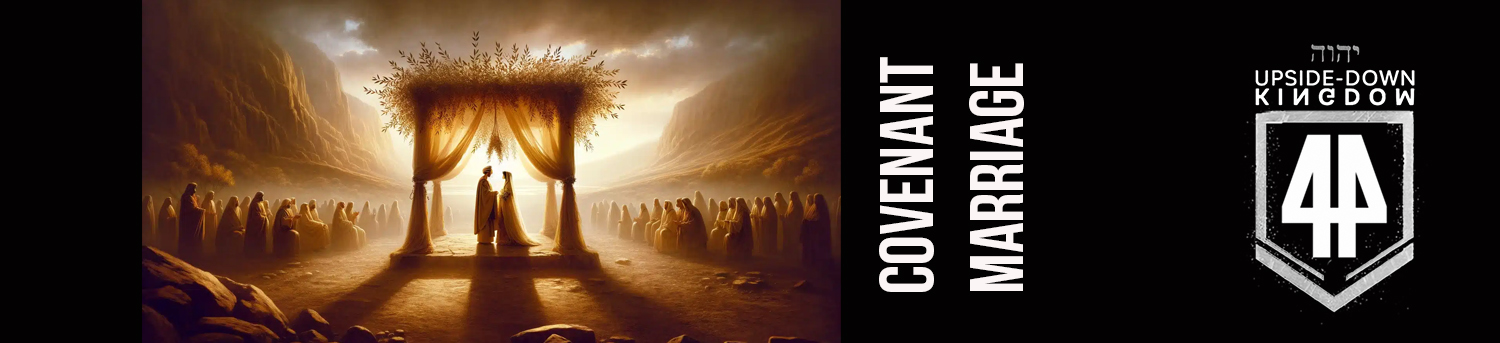





 EXPEDITION 44