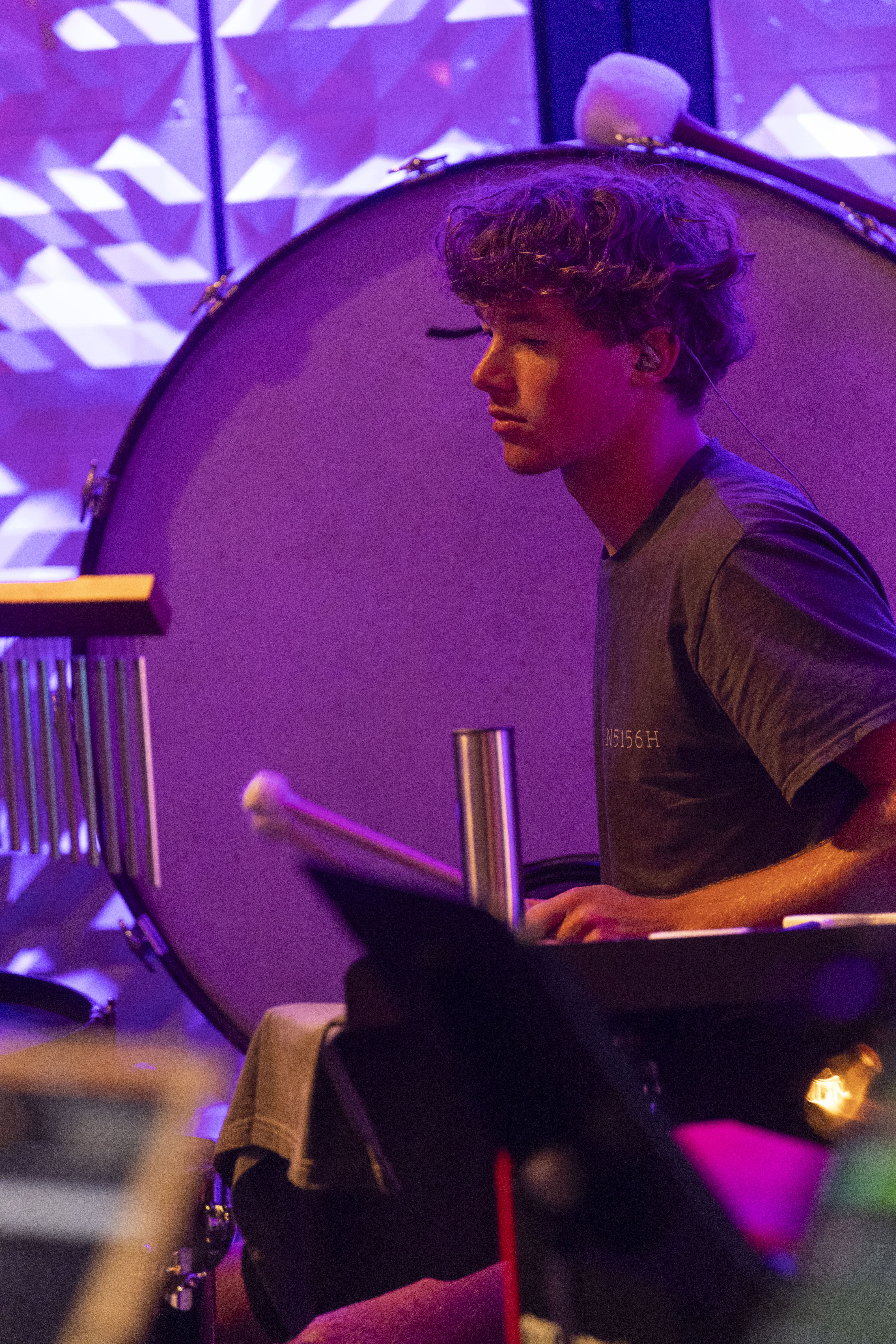
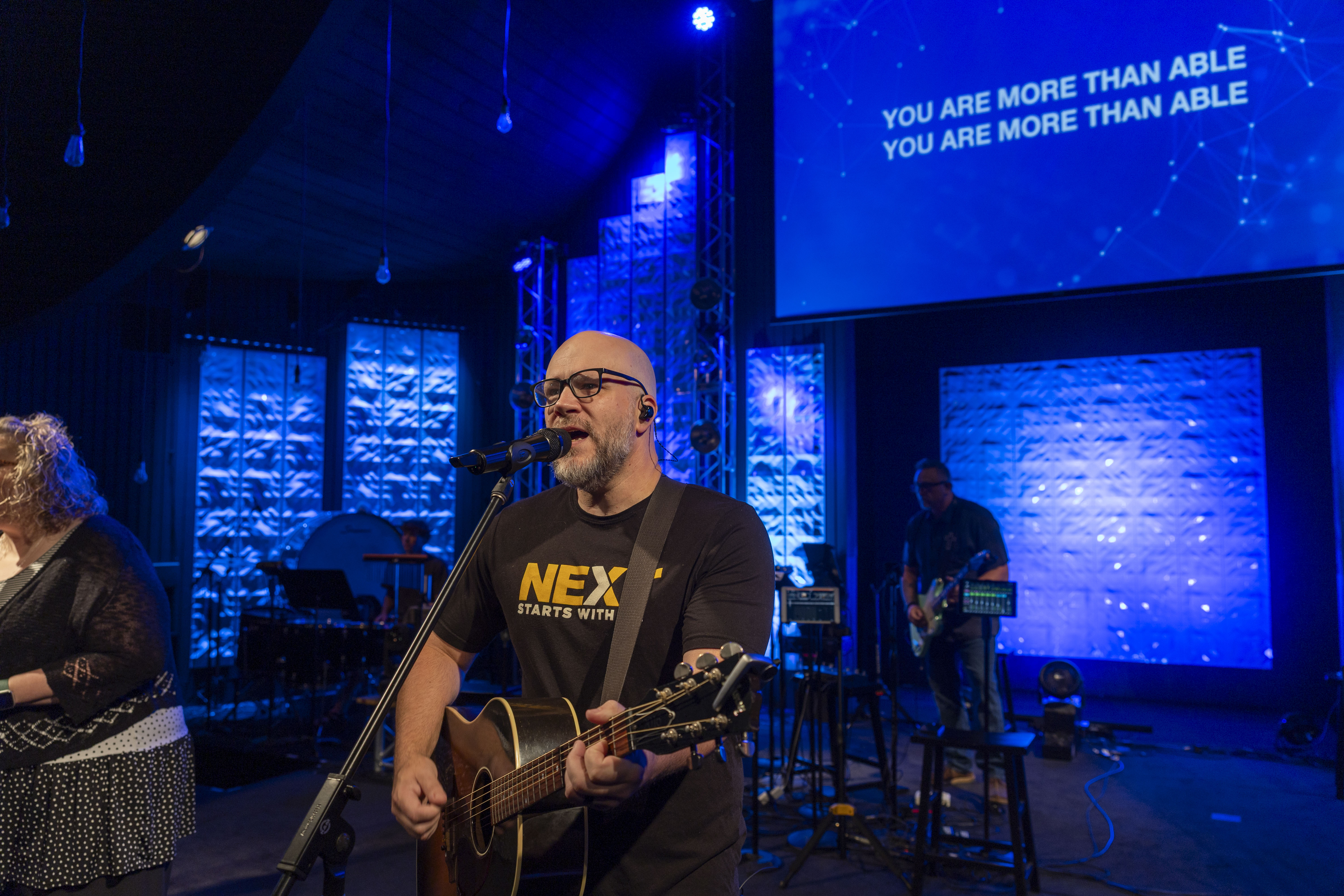
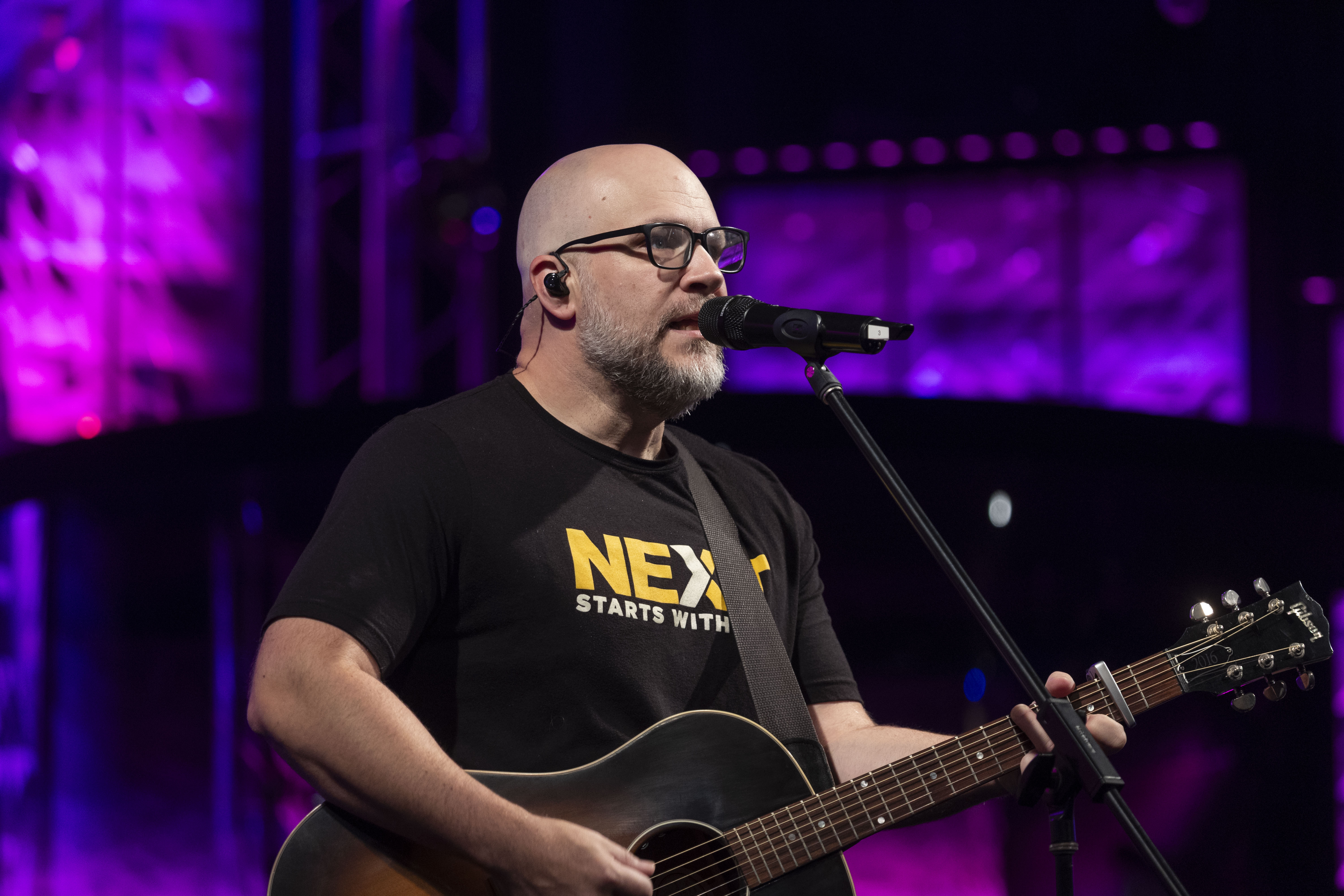
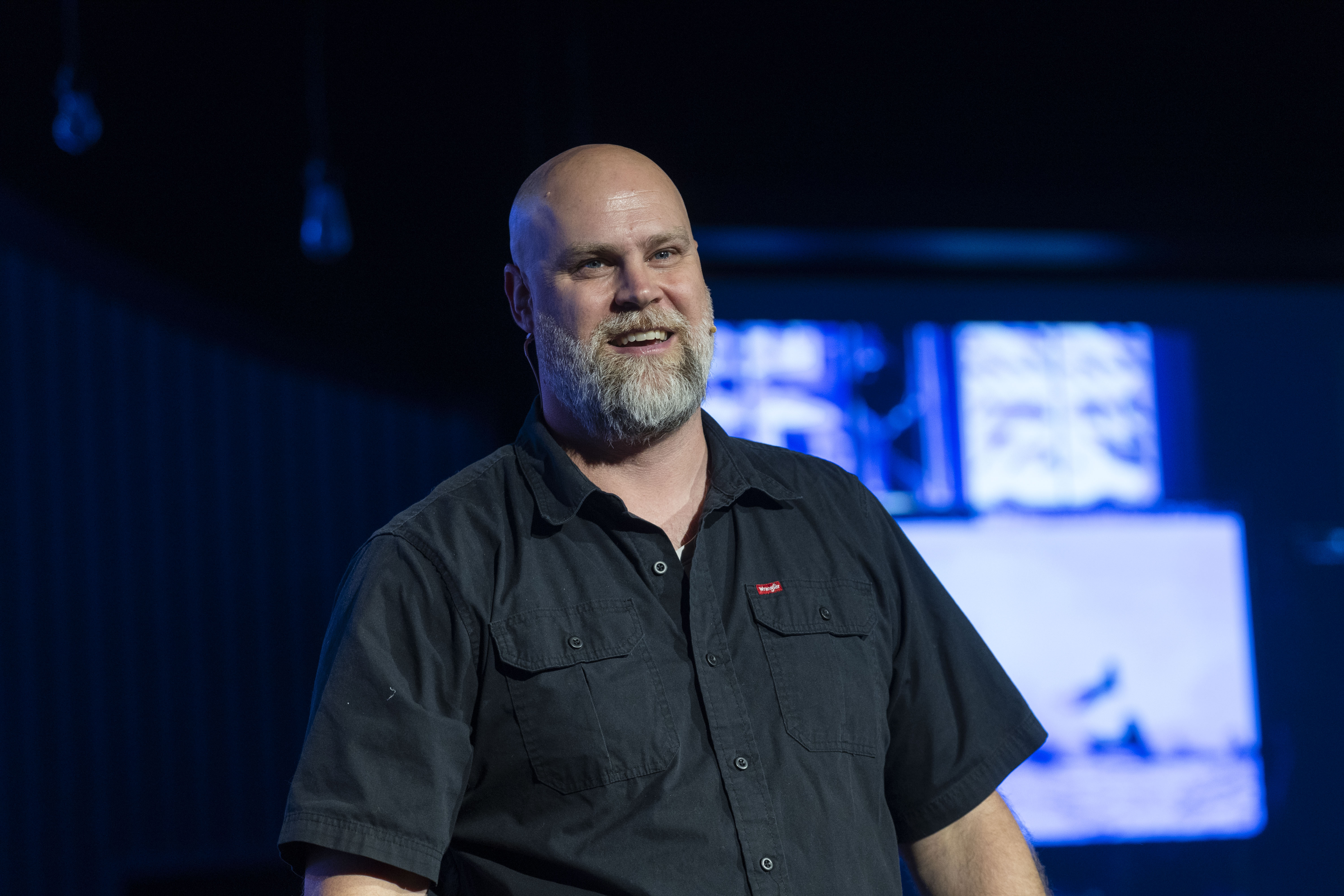
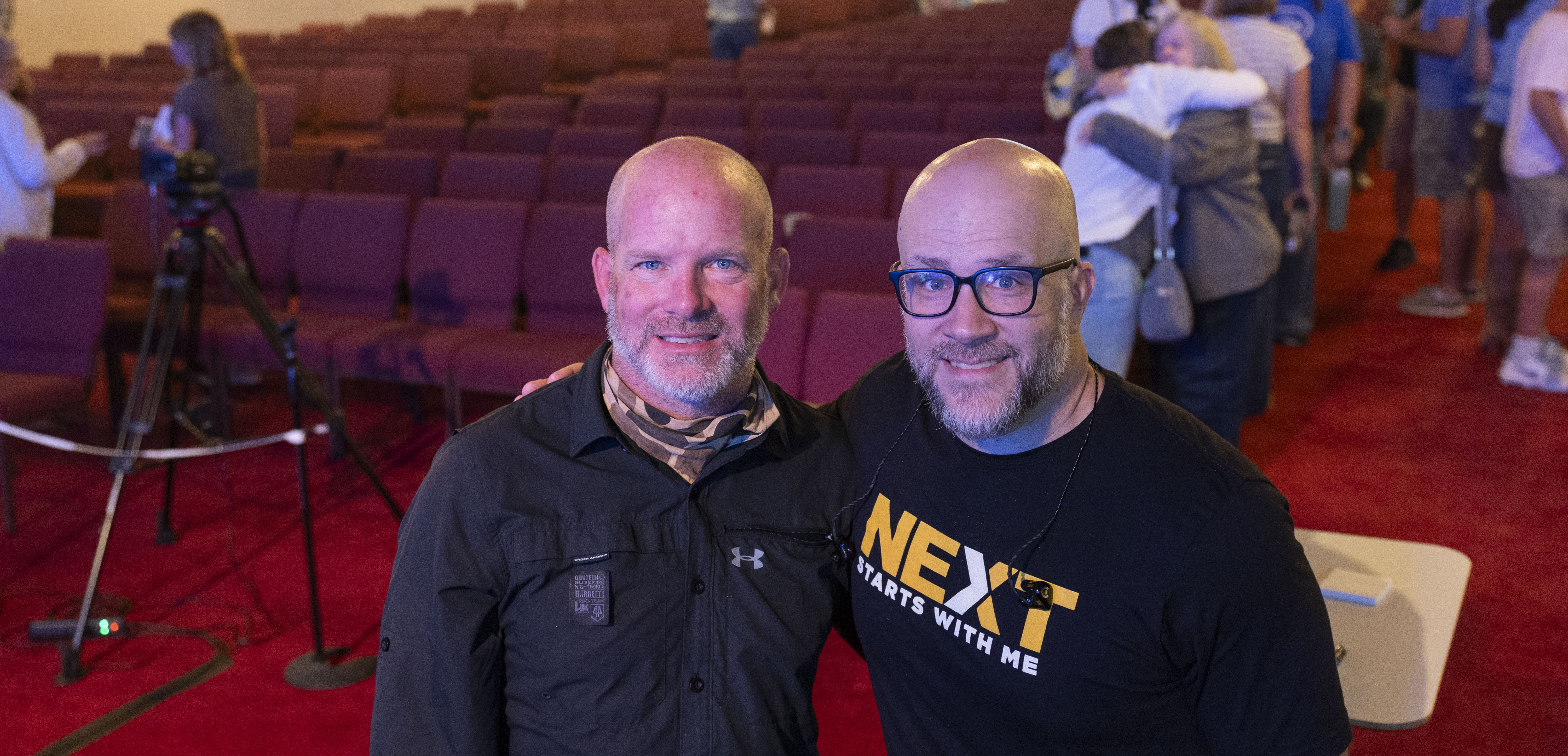
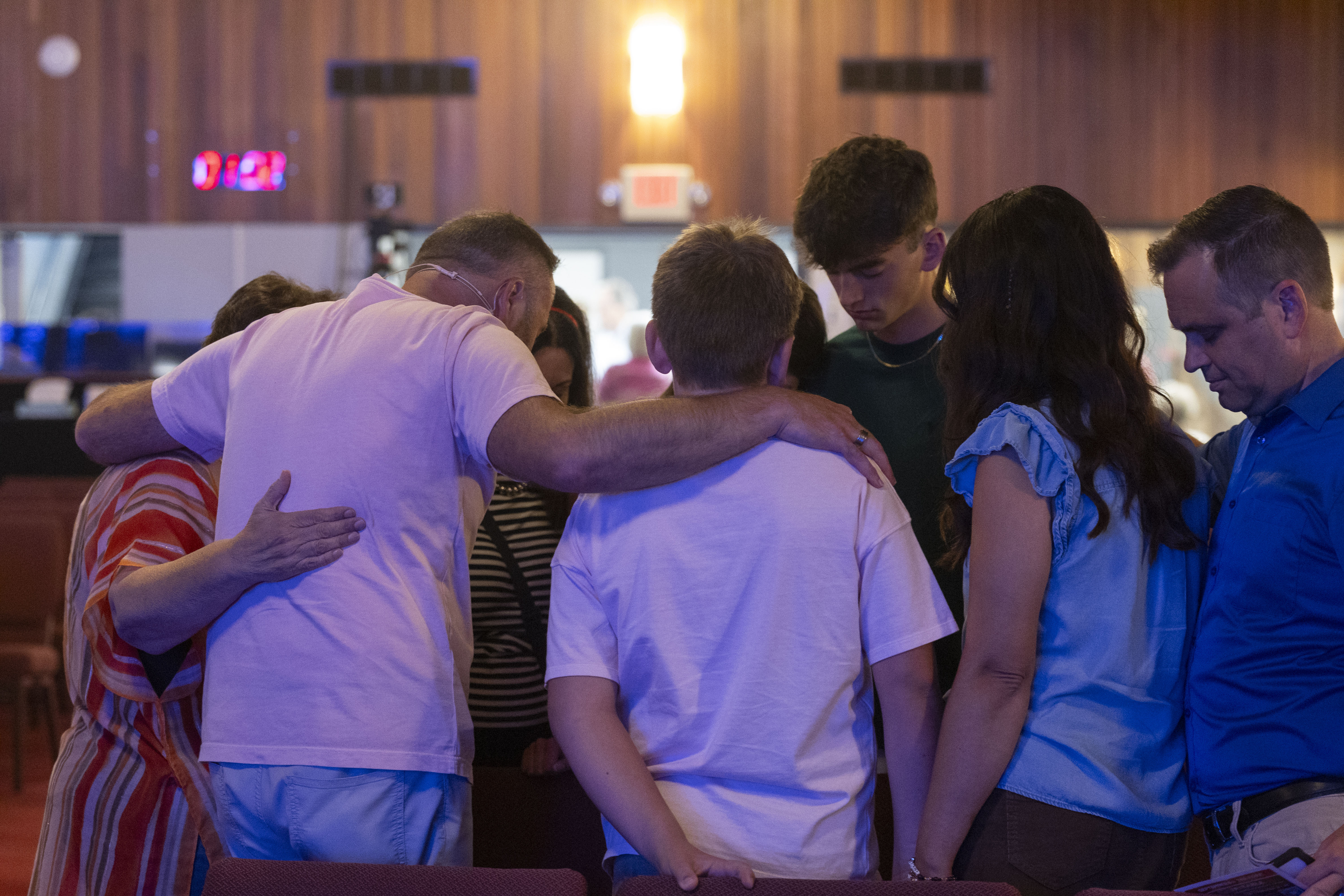
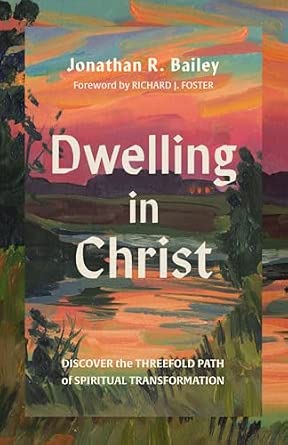
I was deeply grateful to spend this morning at The Point in Seymour, Indiana. Matt did an incredible job preparing our hearts and minds for the morning, and Pastor Jon Gibson brought a timely and challenging message about something that sits near the center of genuine discipleship: God does not simply want to modify our behavior; he wants to transform the way we think.
Paul writes:
“You were taught… to be renewed in the spirit of your minds, and to put on the new self, created after the likeness of God.” (Eph 4:22–24)
There is something much deeper happening here than positive thinking or simply replacing bad thoughts with good ones. The Greek word Paul uses for “renewed,” ananeoō (ἀνανεόω), carries the sense of being made new or “divinely” renewed again. Even more striking is Paul’s phrase tō pneumati tou noos hymōn—“in the spirit of your mind.”¹ The transformation Christ brings reaches beneath outward behavior into the interior place from which our perceptions, desires, judgments, and actions emerge. Paul places this within the larger biblical movement of old humanity becoming new humanity. Ephesians 4 speaks of taking off the palaios anthrōpos, the “old person,” and putting on the kainos anthrōpos, the “new person.” This is almost clothing language: one identity is stripped away and another is put on. But Paul’s imagery reaches even deeper. The “new person” is created according to God (Eph 4:24). That language echoes Genesis. Humanity was created in the image and likeness of God; now, in Christ, humanity is being recreated toward what it was always intended to become. That makes transformation much more than “How can I become a better version of myself?”
The gospel asks a more radical question: What if Jesus intends to make me into someone new?
This is where Jon’s message connected beautifully with Paul’s words in 1 Corinthians 2.
Paul contrasts the wisdom of the present age with the wisdom revealed through the Spirit. God’s wisdom cannot finally be reached merely through human intelligence, education, cultural assumptions, or inherited ways of seeing the world. The Spirit searches even “the depths of God” (1 Cor 2:10), and Paul concludes the chapter with an extraordinary declaration:
“But we have the mind of Christ.” (1 Cor 2:16)
The Greek is noun Christou—νοῦν Χριστοῦ.
The nous is more than the modern idea of the brain. It involves understanding, perception, judgment, disposition—the internal framework through which we interpret reality.² Paul is saying that through the Spirit we are learning to perceive reality through Christ. That is spiritual transformation.
The Hebrew Scriptures anticipate something similar. Biblical wisdom—ḥokmâ (חָכְמָה)—was never merely knowing information. Wisdom was knowing how to live faithfully within God’s world. “The fear of YHWH is the beginning of wisdom” (Prov 9:10). Wisdom begins when our perception of reality becomes reordered around God. Paul takes that ancient wisdom tradition and centers it upon Jesus. Christ becomes “the wisdom of God” (1 Cor 1:24). So encountering Christ necessarily challenges the ways we have learned to think without Christ. And perhaps that is where Jon’s message should stay with us beyond Sunday morning.
Before asking, “What do I need to do differently?”, perhaps we should ask: “What is keeping me from thinking like Jesus?”
Maybe it is fear.
Maybe pride.
Maybe resentment.
Maybe the need to control everything.
Maybe an old wound through which we interpret every new relationship.
Maybe success, money, sexuality, politics, reputation, addiction, insecurity, bitterness, or simply an identity we constructed long before we learned who we are in Christ.
Whatever it is, name it.
There is tremendous spiritual significance in identifying the thing that continues shaping our minds. We cannot easily surrender what we refuse to acknowledge.
Paul’s imagery in Ephesians is wonderfully practical: take it off.
Not because God is waiting for us to fix ourselves, but because Christ has already invited us into another way of being human.
Take off the old.
Be renewed in the mind.
Put on the new.
And increasingly discover what Paul could astonishingly say was already becoming a spiritual reality among God’s people:
“We have the mind of Christ.”
The invitation from this morning is therefore much larger than gaining a few new ideas. It is an invitation to encounter Jesus so completely that his Spirit begins reshaping the very way we see ourselves, other people, our circumstances, and ultimately God himself.
So perhaps the challenge for this week is simple:
What is one thing shaping your mind that needs to be surrendered to Christ?
Identify it. Name it. Bring it before Jesus. Give it up.
Then ask the Spirit to teach you to see that same place through the mind of Christ.
Because following Jesus isn’t merely about changing what we do.
It is allowing Christ to transform the place from which everything we do begins.
I’m thankful for Pastor Jon Gibson’s faithful challenge this morning and for the people at The Point who welcomed us so warmly. May we not simply hear the invitation to transformation, but encounter Christ deeply enough that our minds, desires, identities, and lives are continually made new in him.
Notes
Frederick William Danker, ed., A Greek-English Lexicon of the New Testament and Other Early Christian Literature, 3rd ed. (Chicago: University of Chicago Press, 2000), s.v. “ἀνανεόω”; cf. Eph 4:23.
Danker, Greek-English Lexicon, s.v. “νοῦς.” See also Rom 12:2, where Paul similarly connects transformation (metamorphoō) with the “renewal of the mind.”
On biblical wisdom as embodied skill and faithful orientation rather than merely intellectual knowledge, see Michael V. Fox, Proverbs 1–9: A New Translation with Introduction and Commentary, AB 18A (New York: Doubleday, 2000), 31–43.
See also Rom 12:1–2; Col 3:9–10; Phil 2:5; 1 Cor 1:18–31; 2 Cor 5:17.
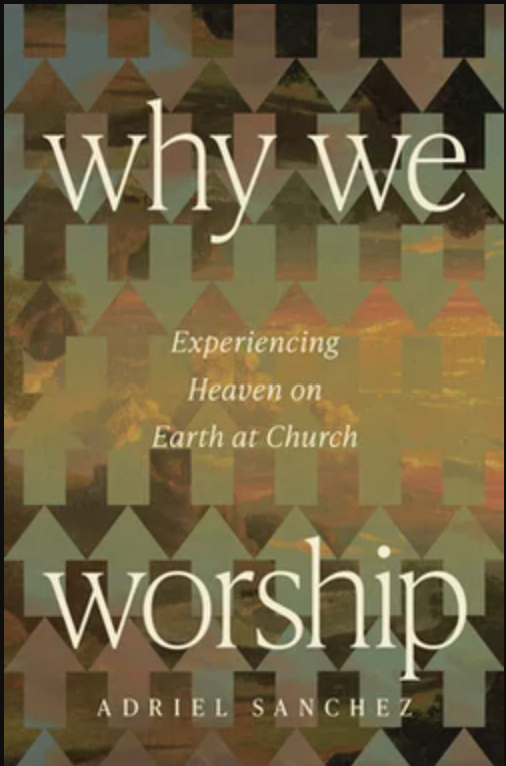
A Review of Adriel Sanchez, Why We Worship: Experiencing Heaven on Earth at Church (Downers Grove, IL: InterVarsity Press, 2026).
Adriel Sanchez’s Why We Worship enters a crowded conversation about Christian worship, but it does so from a somewhat different direction than many recent evangelical works. Rather than centering the discussion on musical style, congregational preference, technological excellence, or the perennial tension between traditional and contemporary forms, the book begins with a more fundamental theological question: what is actually happening when the church gathers? Sanchez answers by drawing upon the biblical imagery of sacred ascent. The assembled church approaches Zion, enters the presence of God, receives the gifts of Word and Table, and then returns to the world as a priestly and prophetic people whose lives have been reordered by worship.
This image of ascent gives the book its structure and much of its theological coherence. The opening section considers the church as a people moving toward the mountain of God. The central chapters explore what happens at the summit through the call to worship, confession, song, preaching, Communion, and benediction. The final movement brings the congregation back into ordinary life and vocation. In this sense, Why We Worship is not so much a manual for constructing worship services as it is an accessible biblical theology of Christian liturgy. Sanchez wants the reader to recover a conviction that has often become thin within modern evangelicalism: Sunday worship is not merely a gathering Christians arrange for themselves, but a response to the initiative of God, who calls his people into his presence.
That point is worth emphasizing because it places the book against several habits that have become almost instinctive within contemporary church culture. Worship can easily become something evaluated primarily through the categories of experience, preference, production, or effectiveness. The question becomes whether people were engaged, whether the music connected emotionally, whether the sermon held attention, or whether visitors felt comfortable. Sanchez does not dismiss those pastoral concerns, but he relocates them within a much larger theological reality. Christian worship begins before human response. God summons; the people answer. God speaks; the congregation listens. God gives; the church receives. Worship, then, is fundamentally responsive rather than self-generated.
Sacred Space and the Ascent of Worship
One of the more compelling elements of the book is its use of temple and mountain imagery. The tabernacle and Jerusalem temple are not treated simply as ancient religious structures but as earthly representations of a heavenly reality, sacred spaces in which creation, divine presence, priesthood, sacrifice, and human vocation converge. Sanchez’s approach sits comfortably within a substantial stream of contemporary biblical theology represented by G. K. Beale, L. Michael Morales, T. Desmond Alexander, and others who have drawn attention to the Eden-tabernacle-temple trajectory that runs across the canon.¹
The importance of that trajectory becomes clearer when Eden, Sinai, Zion, Hebrews, and Revelation are allowed to speak together. Eden itself carries features later associated with sanctuary and sacred mountain imagery. Rivers flow outward from the divine dwelling place, humanity serves within the garden, and Ezekiel 28 can describe Eden in relation to the “holy mountain of God.” Sinai becomes another site of divine encounter, a place where God descends and Israel is summoned upward, although access is carefully guarded. Zion and the temple continue this theology of divine dwelling and ordered approach. Hebrews 12 then announces that believers have come not merely to an earthly mountain but “to Mount Zion and to the city of the living God, the heavenly Jerusalem” (Heb 12:22).
There is also a wider ancient Near Eastern texture beneath these images that helps illuminate their significance. Temples throughout the ancient world commonly represented cosmic centers, places where divine and earthly realms were understood to intersect. Mesopotamian temple complexes and ziggurats participated in a broader cultural imagination in which height, sacred geography, divine presence, and royal authority were interconnected. Israel participates in some of this shared symbolic world while simultaneously resisting its theology. Yahweh is not a deity who can be maintained, manipulated, or localized through human ritual. Solomon’s declaration that even “heaven and the highest heaven” cannot contain God (1 Kgs 8:27) becomes especially significant when read against cultures in which temples could function as houses constructed for localized divine presence.
This background adds depth to Sanchez’s argument because biblical worship does not make God manageable. Quite the opposite occurs. Sacred space confronts the worshiper with the holiness, otherness, and gracious nearness of a God who chooses to dwell among his people while remaining utterly beyond human control. That biblical tension offers an important corrective to forms of worship that unintentionally reduce God to an atmosphere that can be generated through music, lighting, emotional intensity, or carefully managed liturgical movement.
The language of ascent, however, should remain in conversation with an equally prominent biblical movement: God comes down. Yahweh descends upon Sinai (Exod 19:18–20); divine glory fills the tabernacle (Exod 40:34–38) and later the temple (1 Kgs 8:10–11); the incarnation itself is the supreme movement of divine presence toward humanity; and Revelation reaches its culmination not with humanity permanently escaping upward but with the New Jerusalem descending from heaven to earth (Rev 21:2). The biblical story therefore includes both ascent and descent. God comes near so that humanity may approach. Heaven and earth are not finally separated but reconciled within the renewed creation.
This does not weaken the controlling metaphor of Why We Worship. It gives it greater canonical texture. Christian worship participates in an extraordinary meeting of movements: God graciously draws near, and humanity, in Christ, is brought into divine fellowship.
Leviticus, Sacrifice, and the Logic of Approach
The book’s interaction with Leviticus is particularly fruitful. Sanchez draws attention to the Hebrew title of the book, wayyiqrāʾ, “and he called,” and uses that opening word to reinforce the claim that worship begins with divine initiative. Israel does not simply devise a way into God’s presence. God calls, orders, provides, and makes approach possible.
Leviticus is therefore about much more than a collection of sacrifices. At its theological center stands a difficult question: how can a holy God dwell among a people who are vulnerable to impurity, sin, and death? The sacrificial system belongs within that larger drama of divine presence. Approach requires purification, atonement, mediation, holiness, and ultimately a reordered communal life. Worship is not merely ritual performance but participation in a world in which God is present at the center.
Sanchez makes imaginative use of the burnt offering, Hebrew ʿōlâ, connecting the terminology with the concept of “going up.” Morales has developed this motif substantially in his own work on Leviticus, particularly in relation to humanity’s return to divine presence.² The connection works well within Sanchez’s broader mountain theology, especially when sacrificial smoke, priestly movement, sacred geography, and the ascent toward God are considered together.
At times, however, the lexical observation risks carrying slightly more theological freight than a word by itself can support. The verb ʿlh certainly conveys ascent, and the offering “goes up” before God, but the fuller theology of sacrificial ascent comes from the ritual, spatial, and canonical context rather than from etymology alone. This is not a serious problem in the book so much as an example of a tendency that appears occasionally throughout it: the larger theological pattern is often persuasive even when the exegetical bridge could have been developed with a little more precision.
Still, the larger insight remains valuable. The Levitical world reminds modern readers that access to God is never casual in the biblical imagination. Grace makes approach possible, but grace does not make divine holiness trivial.
Revelation and the Shape of Heavenly Worship
Another creative feature of the book is its treatment of Revelation as something resembling a worship order. Revelation 1 situates John’s vision on the Lord’s Day, chapters 2–3 call the churches toward repentance and faithfulness, chapters 4–5 open heaven and reveal the throne room, the scroll is opened, songs and proclamations erupt around the Lamb, and the Apocalypse eventually moves toward the marriage supper and final blessing.
There is real theological value in reading Revelation this way. The book is saturated with worship. Incense, prayers, hymns, elders, altars, robes, temple imagery, heavenly creatures, repeated acclamations, and liturgical responses fill John’s vision. The suffering churches of Asia Minor are invited to see their earthly circumstances from the perspective of the heavenly throne. Rome may appear sovereign, but Revelation repeatedly relocates sovereignty around God and the Lamb.
It is probably best, however, to understand the “worship bulletin” idea as a theological analogy rather than as the literary architecture of Revelation itself. John was not encoding a first-century order of service into the Apocalypse, and the marriage supper in Revelation 19 is first an eschatological image before it becomes a source of Eucharistic resonance. The distinction is important because typological connections are often most persuasive when they are allowed to remain typological rather than being pressed into claims about original literary structure.
Even so, Sanchez succeeds in recovering something that many modern readings of Revelation miss. The Apocalypse is not primarily a chart for decoding the end of history. It is a book that teaches churches how to see reality and whom to worship while empires claim their allegiance.
Confession and the Formation of Christian Desire
The chapter on confession is among the more pastorally useful portions of the book because it recognizes that liturgy does more than transfer theological information. Repeated practices shape the imagination of a congregation. They teach Christians what to notice, what to love, what to lament, and how to understand themselves before God.
This places Why We Worship in productive conversation with Simon Chan and James K. A. Smith, although Sanchez approaches the matter more pastorally than philosophically.³ A congregation that regularly confesses sin develops a theological vocabulary for repentance, mercy, forgiveness, and reconciliation. A church that never confesses corporately may eventually find that these categories become increasingly difficult to articulate because its liturgical habits have ceased to rehearse them.
Isaiah 6 provides a particularly rich biblical pattern. Isaiah encounters divine holiness, recognizes his own uncleanness, receives cleansing, and is then commissioned. The movement is neither self-loathing nor therapeutic affirmation. It is revelation, confession, grace, and vocation. Matthew 5:23–24 similarly refuses to separate worship from reconciliation, while Paul’s instruction surrounding the Lord’s Table in 1 Corinthians 11 demonstrates that communal sin cannot simply be ignored in sacred practice.
At the same time, a helpful distinction remains between biblical theology and liturgical prescription. The New Testament strongly supports confession as part of Christian life and communal worship, but it does not clearly prescribe an identical corporate confession at the same point in every Lord’s Day gathering. Historic liturgies have often embodied sound biblical theology through such practices, yet the theological wisdom of a practice should not always be described as though it were a direct apostolic rubric.
That nuance matters particularly for churches emerging from low-church evangelical traditions, where recovering historic practices can occasionally turn into an overcorrection in which later liturgical patterns are retroactively read into the New Testament.
Singing, Allegiance, and the Divine Warrior
Sanchez’s discussion of congregational singing moves in an interesting direction by drawing upon biblical warfare imagery. Exodus 15 is simultaneously a song of worship and a victory hymn. The Psalms frequently portray Yahweh as king and divine warrior. In 2 Chronicles 20, singers move before Jehoshaphat’s army, while Revelation repeatedly places songs of praise alongside the conquest of the Lamb.
This material has an important ANE setting as well. Divine-warrior language, royal hymns, temple praise, and victory songs were common throughout Israel’s cultural environment. Israel does not invent those categories in isolation, but the biblical writers radically redirect them. Yahweh’s kingship relativizes every earthly empire, and the New Testament ultimately reveals divine victory in the crucified and risen Messiah.
That Christological development is essential. Without it, language about “worship as warfare” can easily drift toward contemporary ideas in which music itself is treated almost mechanically, as if sufficient intensity, volume, or spiritual enthusiasm could displace demonic forces from geographic territory. The New Testament offers a more demanding picture. Revelation’s conquering Lion appears as a slaughtered Lamb. Christian victory is therefore cruciform. Praise becomes an act of spiritual resistance because it publicly names the true king, refuses rival allegiances, and forms a people around the Lamb rather than around the liturgies of empire.
Seen this way, congregational song is far more significant than emotional preparation for preaching. Songs teach theology, preserve memory, confess allegiance, and form the identity of the gathered people.
Preaching and the Voice of God
The chapter on preaching reflects Sanchez’s Reformed commitments and provides another needed corrective to contemporary worship culture. The sermon is not an informational interruption between more experiential elements of the service, nor is it simply a motivational talk shaped loosely around biblical themes. Preaching belongs within worship because the congregation gathers to hear the Word of God proclaimed.
His resistance to Christless moralism is particularly welcome. Scripture cannot finally be reduced to a series of character lessons in which David teaches courage, Daniel teaches conviction, and Joseph teaches perseverance. Those themes may be present, but the canonical witness continually draws the reader into the larger redemptive drama that culminates in Christ.
There is, nevertheless, an important theological safeguard when speaking about hearing “God’s voice” through preaching. The authority of a sermon is derivative rather than inherent. A preacher does not possess canonical authority by virtue of occupying a pulpit. The church hears the Word of God through preaching insofar as the preacher faithfully bears witness to the scriptural text. Acts 17 provides a healthy model because proclamation can be received eagerly while still being examined in light of Scripture.
This is not a diminishment of preaching but one of its most important protections. The authority of Christian proclamation should remain tethered to the text rather than to personality, office, charisma, or institutional power.
Communion, Participation, and the Coming Feast
The treatment of Communion may be the strongest theological contribution of the book, particularly for readers formed within low-church evangelical settings. Sanchez resists the thin memorialism that has sometimes reduced the Lord’s Supper to little more than a symbolic reminder of an absent Christ. Instead, he places Communion within the larger biblical worlds of covenant, sacrifice, remembrance, participation, eschatology, and the work of the Spirit.
His discussion of anamnēsis is especially helpful. “Do this in remembrance of me” need not be heard as though Jesus were simply asking disciples to engage in private mental recollection. Biblical memorial language carries covenantal depth. Memorials bring God’s saving acts into the worshiping present and place the community again within the story those acts created.
First Corinthians 10:16 provides an even stronger anchor. Paul describes the cup and bread as koinōnia in the blood and body of Christ. Christian traditions have disagreed sharply over how Christ is present at the Table, but Paul’s language is difficult to collapse into mere mental recollection. Something participatory is happening.
At this point the book enters fruitful conversation not only with Reformed sacramental theology but also with voices such as Alexander Schmemann and the broader Christian tradition, where Eucharistic worship has consistently been understood as participation in Christ and anticipation of the age to come.⁴ The recovery of the epiclesis is particularly noteworthy because it places sacramental life within dependence upon the Holy Spirit rather than within any mechanical understanding of the elements themselves.
The connection between Isaiah 25, eschatological banquet imagery, victory over the enemies of God, and the marriage supper of the Lamb also gives Communion an important forward-looking dimension. The Table remembers the cross, but it does not only look backward. It stands between resurrection and consummation. The church eats and drinks while announcing that the crucified Christ has been vindicated and that the final feast is still coming.
John 6 deserves some caution here. The language of eating Christ’s flesh and drinking his blood became deeply Eucharistic within the early Christian tradition, but exegetes continue to debate how directly the discourse should be identified with the Lord’s Supper. It may be better to allow the Johannine language to retain both its emphasis on receiving Christ by faith and its unmistakable sacramental resonance rather than forcing the passage into a single later theological category.
Even with that qualification, this chapter is one of the book’s most important correctives. It invites evangelical readers to recover a Table that is simultaneously remembrance, participation, proclamation, thanksgiving, communion, and anticipation.
Descending the Mountain: Worship and Vocation
The ascent motif becomes most useful when Sanchez refuses to leave the church on the mountain. Worship does not terminate in an encounter, however profound. The congregation descends into neighborhoods, workplaces, families, relationships, and ordinary responsibilities as a people whose lives have been reordered around God.
First Peter 2 provides much of the biblical framework for this movement. The church is a “holy priesthood” and a “royal priesthood,” language that joins worship and witness rather than separating them. Priestly identity involves sacrifice, holiness, mediation, proclamation, mercy, prayer, and service.
Isaiah 6 again offers a beautiful pattern: the prophet sees, confesses, is cleansed, and is sent. The movement toward God eventually becomes movement toward the world. Christian worship that never produces compassion, reconciliation, justice, patience, hospitality, witness, and sacrificial love has failed to carry the worshiper very far into the character of the God being worshiped.
This becomes especially important when worship is considered alongside political power. The church’s public vocation is not strengthened when Christian identity is reduced to the acquisition of cultural control. Revelation offers another way. The Lamb conquers through faithful witness, suffering love, and resurrection. The priestly people of God are sent into the nations not merely to secure influence but to embody the life of another kingdom.
In Conversation with Contemporary Worship Scholarship
Within the wider landscape of worship studies, Why We Worship occupies a useful middle ground. Simon Chan’s Liturgical Theology offers a more developed ecclesiology of worship. James K. A. Smith explores the formative power of liturgical practice through the language of desire, habit, and cultural formation. Lester Ruth and Lim Swee Hong provide the historical genealogy necessary for understanding how the term “worship” came to be associated so strongly with congregational music in many Protestant contexts.⁵ Beale and Morales provide much of the temple and sacred-space theology that supports Sanchez’s ascent imagery, while Schmemann offers a broader sacramental vision in which worship participates in the life of the coming kingdom.
Sanchez does not attempt to match the technical depth of all these works, nor does he need to. The value of Why We Worship lies partly in its ability to gather conversations that often remain separated—biblical theology, sacramental theology, liturgical history, ecclesiology, mission, and pastoral practice—and place them within reach of the ordinary church reader.
Those already familiar with this scholarship will occasionally wish for slower exegetical development at several points. The mountain imagery could have benefited from a fuller ANE context, the Revelation material needs careful qualification, and some of the sacramental connections might have been strengthened by sustained engagement with competing interpretations. Even so, the overall theological architecture is compelling and, importantly, pastorally usable.
Conclusion: Worship That Reorders a Life
Perhaps the most important contribution of Why We Worship is its resistance to a church culture in which worship has become increasingly easy to evaluate according to the categories of consumption. We ask whether the music was good, whether the sermon was interesting, whether the service flowed, whether we felt something, whether we were comfortable, or whether the whole experience was worth coming back for next week. None of those questions are entirely meaningless, but they become dangerously small if they are allowed to define Christian worship.
The biblical vision is far stranger and far more beautiful. The church gathers because God has called a people to himself. Christians come carrying gratitude and sin, faith and doubt, joy and grief, maturity and immaturity. They confess, listen, sing, eat, drink, pray, receive blessing, and then return to lives that may look externally much the same as they did before they arrived. Yet worship assumes that something has happened in the meantime. The imagination has been re-centered. Allegiance has been rehearsed. Grace has been announced. The story of the world has been told again, and Christ has been named as Lord within it.
This is where the mountain image becomes especially useful pastorally. The goal is not to spend the entire Christian life attempting to preserve a mountaintop experience. Scripture rarely allows its people to remain on the mountain. Moses descends. Elijah returns. The disciples come down after the transfiguration. Isaiah is sent. Even the glory of the resurrection drives the disciples toward Jerusalem, Judea, Samaria, and the nations.
The test of worship, therefore, is not whether we managed to feel close to God for ninety minutes. It is whether the encounter with God begins to shape the way we descend.
Do we become easier to reconcile with? Are we slower to anger? Do we become more attentive to the lonely person standing at the edge of the room? Does the Table teach us to stop dividing people whom Christ has welcomed? Does confession make us less defensive when someone exposes our failures? Does hearing the Word make us more willing to obey when obedience is costly? Does singing about the Lamb slowly detach our hearts from the smaller kingdoms competing for our allegiance?
These are not secondary consequences of worship. They are among its fruits.
Romans 12 makes the connection explicit when Paul moves from the mercies of God into the call to present our bodies as a living sacrifice. The sanctuary expands into ordinary life. Worship continues in the marriage, at the workplace, around the dinner table, in forgiveness, generosity, sexual faithfulness, care for the poor, hospitality toward strangers, and courageous witness to Jesus. The gathered liturgy trains the church for this scattered liturgy of everyday faithfulness.
That may ultimately be where Sanchez’s book is most helpful. Why We Worship does not merely ask churches to reconsider what they do on Sunday mornings. It invites them to reconsider what sort of people Sunday worship is forming.
Pastors and worship leaders should probably ask more than whether the congregation sang loudly or whether the service landed emotionally. We might ask whether our people are learning the story of Scripture, whether they know how to confess without despair, whether they know how to receive grace without entitlement, whether the Table is teaching reconciliation, whether preaching is forming allegiance to Christ, and whether benediction is actually sending them into the world as people of peace.
Perhaps that is what it finally means to ascend Zion. We do not climb toward God in order to escape the world. We are drawn into the presence of God so that we may return to the world carrying something of his character with us.
And if our worship never makes us more truthful, more merciful, more faithful, more forgiving, more hospitable, more courageous, and more deeply committed to the way of Jesus, we may need to ask whether we have actually understood what worship is for.
Sanchez has written a helpful invitation to ask that question again.
Notes
See G. K. Beale, The Temple and the Church’s Mission: A Biblical Theology of the Dwelling Place of God, New Studies in Biblical Theology 17 (Downers Grove, IL: InterVarsity Press, 2004); T. Desmond Alexander, From Eden to the New Jerusalem: An Introduction to Biblical Theology (Grand Rapids: Kregel Academic, 2008); and L. Michael Morales, Who Shall Ascend the Mountain of the Lord? A Biblical Theology of the Book of Leviticus, New Studies in Biblical Theology 37 (Downers Grove, IL: InterVarsity Press, 2015).
Morales, Who Shall Ascend the Mountain of the Lord? Sanchez’s use of sacrificial ascent works particularly well alongside Morales’s larger reading of Leviticus as a movement toward restored access to divine presence.
Simon Chan, Liturgical Theology: The Church as Worshiping Community (Downers Grove, IL: IVP Academic, 2006); James K. A. Smith, You Are What You Love: The Spiritual Power of Habit (Grand Rapids: Brazos Press, 2016).
Alexander Schmemann, For the Life of the World: Sacraments and Orthodoxy (Crestwood, NY: St. Vladimir’s Seminary Press, 1973); Michael Horton, People and Place: A Covenant Ecclesiology (Louisville: Westminster John Knox, 2008).
Lester Ruth and Lim Swee Hong, A History of Contemporary Praise & Worship: Understanding the Ideas That Reshaped the Protestant Church (Grand Rapids: Baker Academic, 2021).
For the broader cosmic-temple trajectory from Eden through new creation, see Beale, Temple and the Church’s Mission.
Hebrews 12:22–24 is particularly important for Sanchez’s argument because the author does not merely describe Zion as a future destination. The perfect verb proselēlythate portrays believers as those who have already “come” to Mount Zion, the heavenly Jerusalem, and the festal assembly.
Chan’s account of ecclesial formation through worship provides an important conversation partner here because it resists treating liturgy as a secondary expression of an already fully constituted church. See Chan, Liturgical Theology, 41–66.
Paul’s use of koinōnia in 1 Cor 10:16 remains one of the stronger New Testament challenges to purely memorialist interpretations of the Lord’s Supper. The text does not resolve every later sacramental debate, but it clearly presents the meal in participatory terms.
For Revelation’s throne-room worship and temple imagery, see G. K. Beale, The Book of Revelation: A Commentary on the Greek Text, New International Greek Testament Commentary (Grand Rapids: Eerdmans, 1999). Sanchez’s use of Revelation as a liturgical pattern is most convincing when treated as theological correspondence rather than as a claim about the formal literary structure of the Apocalypse.
Sanchez’s discussion of priesthood may also be placed alongside Hank Voss, The Priesthood of All Believers and the Missio Dei: A Canonical, Catholic, and Contextual Perspective, Princeton Theological Monograph Series 223 (Eugene, OR: Pickwick, 2016).
Romans 12:1 is especially important for bringing the book’s final movement into focus. Paul’s description of embodied Christian existence as logikē latreia prevents Christian theology from placing an artificial boundary between liturgical worship and the life that follows it.
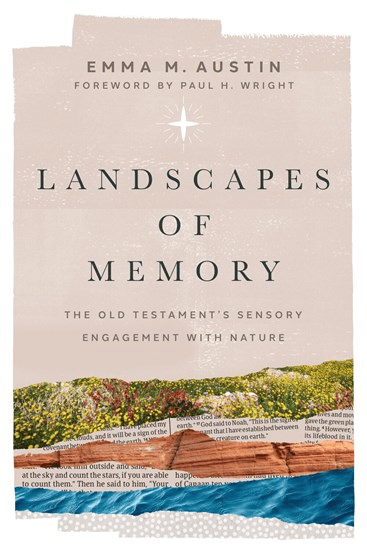
Emma M. Austin. Landscapes of Memory: The Old Testament’s Sensory Engagement with Nature. Foreword by Paul H. Wright. Downers Grove, IL: IVP Academic, 2026. 176 pp.
Emma M. Austin’s Landscapes of Memory begins with an observation that is easy to acknowledge but harder to work consistently into biblical interpretation: the world of the Old Testament was experienced bodily. Its first hearers knew the heat of the land, the relief of rain, the anxiety of drought, the difficulty of long travel, the sound of animals in the night, the smell of cultivated fields, and the visual force of a sky crowded with stars. Modern readers encounter all of these things in the text, but usually at a distance. What for an ancient audience belonged to ordinary experience often reaches us only as imagery. We know what a wilderness is lexically without necessarily knowing what it feels like to depend on water within one, and we understand that grass withers without necessarily seeing that image against the rapid seasonal transformation of the southern Levant. Austin’s contribution is to argue that these elements of the natural world should not be treated merely as scenery surrounding the theological message of Scripture. They frequently participate in the message itself, carrying memory, shaping imagination, and reminding Israel of encounters with God.
Austin develops this idea through the category of mnemonature, by which she describes the relationship between nature, sensory experience, and memory.¹ The terminology is her own, but the underlying argument stands within a substantial scholarly conversation. Walter Brueggemann famously demonstrated that “land” within Israel’s Scriptures is never simply territory but becomes gift, promise, inheritance, loss, exile, and hope. Ellen Davis has shown how profoundly agriculture and the rhythms of land shape Israel’s theological imagination, while Yael Avrahami’s study of sensory perception has helped recover the embodied character of biblical thought.² Austin’s work intersects with these conversations while pressing in a somewhat different direction. Her concern is not simply that nature means something, but that repeated encounters with the natural world may have helped biblical communities remember what God had said and done. A tree, a dry field, the stars, seasonal rain, a particular road, or even an animal could participate in a network of associations that extended well beyond a single literary image.
One of the strengths of Austin’s approach is that it pays attention to matters the biblical writers frequently leave unexplained because their audiences did not need them explained. Judges 6:11 offers a good example. Gideon is found threshing wheat in a winepress, a scene that can pass quickly in modern reading unless one understands that threshing normally required an exposed location where the wind could separate grain from chaff. A winepress was hardly the proper place for the task. Gideon’s behavior therefore communicates before he speaks. The Midianite threat has become so pervasive that ordinary agricultural life has been distorted, and Gideon is attempting to perform a public, wind-dependent activity in a concealed place. Cultural-background scholarship has long helped readers recover such information, but Austin’s method asks a further question: what would an audience accustomed to threshing floors and winepresses have sensed immediately upon hearing this description? Historical information explains the practice; sensory reconstruction helps recover the incongruity.
This distinction between knowing about the ancient world and imaginatively entering its physical texture becomes especially helpful in Austin’s treatment of Genesis. Her discussions of the rainbow in Genesis 9 and the stars in Genesis 15 provide some of the clearest examples of her central thesis. The rainbow is explicitly connected with covenant remembrance, while the stars become connected to God’s promise concerning Abram’s descendants. Readers naturally recognize the metaphor of innumerability in Genesis 15, but Austin encourages us to remain in the scene for a moment longer. Abram has already received the promise, yet the fulfillment appears increasingly improbable. Sarah remains barren, time is passing, and the promise is beginning to stand in tension with visible reality. God takes Abram outside and directs his attention toward the heavens. The stars are therefore not only an illustration of future descendants; they become attached to the promise itself. Abram will see them again. The natural world can continue to recall what was spoken after the divine speech has ended.³
That reading gains additional texture within the wider ancient Near Eastern environment. Celestial bodies throughout Mesopotamian cultures were associated with divine order, calendrical observation, omens, and the interpretation of human destiny. Austin is careful not to flatten Genesis into comparative mythology, but the broader background remains significant. In Genesis, the stars are not deities or autonomous powers determining Abram’s fate. They belong to the Creator who makes the promise. The heavens that surrounding cultures could read as sources of divine knowledge are relocated within Israel’s theology as creatures under YHWH’s authority and, in this particular narrative, as witnesses to his faithfulness.⁴ The theological point is strengthened rather than threatened by comparative study because Genesis participates in the symbolic world of the ancient Near East while simultaneously reconfiguring it.
Austin’s treatment of Abram’s movement through the land adds another dimension to this discussion. Genesis can make travel appear almost effortless because enormous distances are compressed into a few sentences: Abram departs, passes through a region, pitches a tent, builds an altar, moves again, goes down toward Egypt, and later returns. The reader turns a page more easily than Abram crossed the land. Austin slows the narrative down by asking what travel required in an ancient setting: water, animals, household movement, elevation changes, available roads, seasonal conditions, provisions, and exposure to danger. Her approach intersects naturally with historical geography and the work of scholars such as Yohanan Aharoni and David Dorsey, who have demonstrated how roads, routes, and terrain inform biblical narrative.⁵ Yet Austin is particularly interested in the bodily dimension of the journey. Abram’s response to God is not simply intellectual assent to a promise; obedience is expressed through movement. He leaves a known world and walks into an unknown one.
That observation fits well with Brueggemann’s work on the theological tension between landedness and landlessness.⁶ Abram is promised land long before he possesses it. In fact, much of the Abraham narrative is lived inside that tension. He travels through what has been promised without yet owning what has been promised, and the geography itself reinforces the theological shape of his life. Faith takes place between departure and possession. The roads, campsites, wells, and altars are not incidental to that story because the promise is being lived bodily before it is secured materially. Austin’s geographical sensitivity makes that familiar theological theme feel less abstract.
Her treatment of rain and drought develops the argument in another direction. Biblical readers know that Deuteronomy and the historical books associate rainfall with covenant blessing and drought with judgment, but modern readers in highly engineered environments can easily underestimate the immediacy of that language. In the ancient southern Levant, rain was not simply pleasant weather. Agricultural survival depended upon it. A failed rainy season could mean declining crops, empty cisterns, weakened animals, economic desperation, migration, famine, and death. When the biblical writers speak of the heavens being shut, therefore, the imagery is both theological and brutally practical.
This becomes particularly important in 1 Kings 17–18, where Elijah announces drought in a cultural environment in which Baal was associated with storm and fertility. The encounter on Mount Carmel is often remembered primarily as a contest involving fire from heaven, but the larger narrative has already turned the weather into a theological argument. The absence of rain raises the question of who truly governs the fertility of the land. Against the wider Canaanite world, YHWH’s sovereignty is demonstrated not through abstract theological claims alone but through the very natural processes over which Baal was believed to exercise authority. Austin’s emphasis on sensory and environmental experience allows the reader to feel more clearly what was at stake. The polemic is not simply about rival religious ideas. It concerns the conditions under which people survive.
Some of the richest exegetical material appears in Austin’s treatment of Jeremiah. The prophet repeatedly describes covenant judgment through the breakdown of creation: the land mourns, vegetation withers, birds disappear, the heavens darken, and the world begins to look increasingly uninhabitable. Jeremiah 4:23 is especially striking because the prophet looks upon the land and sees tohu wabohu, the same language used of the primordial earth in Genesis 1:2. The imagery is not simply one of destruction but of uncreation. Ordered creation is being reversed under the weight of covenantal collapse.
That pattern is well known within prophetic scholarship, yet Austin adds useful physical texture to it. Drought, dust, scorching winds, ruined fields, devastated landscapes, and darkened skies were not invented merely as poetic symbols. They belonged to the ecological world of the prophet and his audience. Robert Alter has consistently emphasized the concrete force of biblical imagery, and Austin’s work supports that literary instinct by reconnecting the imagery to lived environmental experience.⁷ Jeremiah’s language is powerful because it is both theological and recognizable. A land that once sustained life begins to look like a world moving backward toward chaos.
There is also an important theological implication here. The biblical writers do not generally imagine sin as a private interior problem disconnected from the rest of creation. Human faithlessness, social injustice, violence, failed leadership, idolatry, exile, and the condition of the land continually intersect. Modern readers often divide spiritual concerns from material ones far more sharply than the biblical text does. Jeremiah’s rhetoric resists that separation. Covenant disorder spreads outward, and the natural world becomes part of the prophetic witness against it.
Austin’s discussion of seasonal imagery makes a similar point on a smaller scale. Readers living in northern climates may instinctively associate summer with abundance and winter with barrenness, but those associations do not map neatly onto the ecology of the biblical world. Green vegetation follows the rains, while the intense heat of the dry season rapidly transforms the landscape. Biblical comparisons between human life and grass therefore emerge from an annually recurring visual experience. Grass flourishes and disappears. The image communicates transience because people repeatedly watched transience occur around them. The landscape provided its own vocabulary for mortality.
The treatment of animals works along the same lines. Lions, ravens, wild donkeys, ostriches, horses, and other creatures were not merely decorative additions to biblical poetry. Their behavior, danger, usefulness, unpredictability, or wildness could carry associations immediately recognizable to the audience. Austin is particularly effective when this insight reaches Job 38–41. The divine speeches in Job have long puzzled interpreters because Job’s questions concern justice, suffering, and the moral governance of the world, while YHWH responds by directing attention toward weather, stars, mountain goats, ravens, wild donkeys, ostriches, warhorses, Behemoth, and Leviathan. Scholars such as Carol Newsom and David Clines have explored how these speeches destabilize Job’s assumptions concerning the moral structure of creation.⁸ Austin’s method allows the creatures themselves to retain a greater degree of interpretive weight.
The world YHWH describes in Job is strikingly uninterested in organizing itself around human usefulness. Rain falls where no one lives. Wild animals inhabit places no one controls. Creatures reproduce without human supervision. Some animals are useful, some dangerous, some absurd, and some apparently impossible to domesticate. The point is not that human beings are insignificant, but that creation is larger than the human frame through which Job has understandably been interpreting his suffering. The world belongs to God before it belongs to us, and God’s delight in creation extends beyond what humans can control, explain, or exploit.
This is one of the areas where Landscapes of Memory becomes particularly valuable theologically. Western Christian interpretation can become highly anthropocentric, even when it intends to be biblical. We readily ask what a passage says about our identity, calling, suffering, salvation, or destiny. Job’s divine speeches resist that instinct by turning the reader outward. Austin’s sensory approach reinforces the same movement. Biblical interpretation occasionally requires us to stop asking what creation means for us long enough to recognize that the biblical writers also understood creation as belonging to God in its own right.
Within contemporary scholarship, Austin’s work sits naturally beside several related approaches without merely duplicating them. Brueggemann’s The Land remains a more expansive theological account of land as gift, promise, possession, loss, and hope. Ellen Davis’s Scripture, Culture, and Agriculture offers a more sustained agrarian and ethical reading, while Avrahami’s The Senses of Scripture provides a more technical treatment of sensory language and perception in the Hebrew Bible. Historical geographers provide greater topographical precision, and memory theorists such as Jan Assmann offer a denser conceptual framework for cultural remembrance. Austin’s strength lies in bringing several of these conversations together in a form that remains accessible to pastors, students, and serious readers who may not ordinarily enter all of those disciplines separately.⁹
There are, of course, limits to any attempt at sensory reconstruction. A modern reader standing in the Judean wilderness has not thereby entered Jeremiah’s consciousness, and contemporary travel through Israel, Palestine, or Jordan cannot reproduce ancient experience. Landscapes change, roads change, agricultural practices change, political realities change, and modern assumptions travel with us. The most responsible use of Austin’s method therefore comes when sensory observation is held together with textual work, archaeology, historical geography, ancient Near Eastern comparison, and careful exegesis. Austin generally handles that balance well. Mnemonature works best not as a substitute for historical interpretation but as a reminder that historical interpretation must include bodies, environments, and remembered experience.
Conclusion
What I appreciated most about Landscapes of Memory is that it gradually changes the way you read. I found myself slowing down at details I might previously have passed over: the condition of the ground, the direction of a journey, the absence of rain, the appearance of grass, the stars overhead, an animal mentioned almost casually in a poem. Austin has a way of reminding us that those details were often not casual at all. They belonged to a world people knew intimately, and God repeatedly met Israel within that world.
For pastors and teachers, I think there is something important here beyond a better method of interpretation. We spend a great deal of time teaching people to look for God in ideas, sermons, books, and explicitly religious moments, but Scripture often trains people to remember God through ordinary things. Abraham can look at the stars and remember a promise. Israel can see a rainbow and remember covenant. Rain can remind a community that life is received rather than manufactured. Withered grass can teach the brevity of human life. A wilderness can recall dependence. A road can become a testimony to obedience. Even the animals in Job can remind us that the world is much larger than the problems we are currently trying to solve.
There is something pastorally healthy about recovering that way of seeing. Most people will not spend their lives in seminar rooms, and very few will spend every day studying commentaries, but everyone lives somewhere. We wake beneath a sky, walk across ground, experience seasons, notice weather, hear birds, watch things grow and eventually die. The created world is still around us, even if modern life has made it easier to ignore. Austin’s book made me wonder whether part of discipleship involves learning to notice again.
That does not mean finding a hidden spiritual message in every sunset or turning nature into another form of divination. Scripture gives us something much more grounded than that. It teaches us that ordinary creation can become connected to remembered truth. Once God attached his promise to the stars for Abram, the stars could never be entirely ordinary again. Once Israel learned to associate wilderness with both testing and provision, wilderness carried memory. The natural world did not replace revelation; it helped people remember revelation.
Pastorally, that may be one of the most helpful implications of this book. There are seasons when people struggle to remember what God has said because their circumstances are telling them something different. Abram knew that experience. Jeremiah knew it. Israel knew it. Job certainly knew it. In those moments, faith often depends less upon discovering something new than upon remembering what has already been given. Scripture repeatedly ties that remembrance to things people can see, touch, walk through, and experience.
Perhaps we need more of that.
Perhaps the next time we stand beneath a clear night sky, feel the first rain after a long dry stretch, watch something green emerge from apparently dead ground, or walk through a season that feels more like wilderness than home, we might allow the world around us to remind us of truths we already know but have temporarily forgotten. God has been faithful before. We are creatures rather than masters. Life is received as gift. The world belongs to God. Promises sometimes require long journeys before they are fulfilled. And even when our own understanding becomes painfully small, God remains at work within a creation far larger than the part we can presently see.
Landscapes of Memory is ultimately valuable because it helps us read Scripture with more attention, but I think its deeper gift is that it may help us live with more attention as well. Austin reminds us that the biblical world was not merely a backdrop for encounters with God. It was one of the places where those encounters were remembered. That remains worth recovering.
Notes
Emma M. Austin, Landscapes of Memory: The Old Testament’s Sensory Engagement with Nature (Downers Grove, IL: IVP Academic, 2026)
Walter Brueggemann, The Land: Place as Gift, Promise, and Challenge in Biblical Faith, 2nd ed. (Minneapolis: Fortress, 2002); Ellen F. Davis, Scripture, Culture, and Agriculture: An Agrarian Reading of the Bible (Cambridge: Cambridge University Press, 2009); Yael Avrahami, The Senses of Scripture: Sensory Perception in the Hebrew Bible, LHBOTS 545 (London: T&T Clark, 2012).
Austin, Landscapes of Memory, chap. 2. See also Emma M. Austin, “‘When I See . . . I Will Remember’: Exploring the Memorability of Rainbows and Stars in Genesis through Mnemonature,” Biblical Theology Bulletin 55 (2025): 184–98.
Jeffrey L. Cooley, Poetic Astronomy in the Ancient Near East: The Reflexes of Celestial Science in Ancient Mesopotamian, Ugaritic, and Israelite Narrative (Winona Lake, IN: Eisenbrauns, 2013).
Yohanan Aharoni, The Land of the Bible: A Historical Geography, trans. Anson F. Rainey (Philadelphia: Westminster, 1979); David A. Dorsey, The Roads and Highways of Ancient Israel (Eugene, OR: Wipf & Stock, 2018).
Brueggemann, Land.
Robert Alter, The Art of Biblical Poetry (New York: Basic Books, 1985); Walter Brueggemann, A Commentary on Jeremiah: Exile and Homecoming (Grand Rapids: Eerdmans, 1998).
Carol A. Newsom, The Book of Job: A Contest of Moral Imaginations (Oxford: Oxford University Press, 2003); David J. A. Clines, Job 38–42, WBC 18B (Nashville: Thomas Nelson, 2011).
Jan Assmann, Religion and Cultural Memory: Ten Studies, trans. Rodney Livingstone (Stanford, CA: Stanford University Press, 2006); Jeannine Marie Hanger, Engaging Jesus with Our Senses: An Embodied Approach to the Gospels (Grand Rapids: Baker Academic, 2024).
A Review of Jonathan R. Bailey, Dwelling in Christ: Discover the Threefold Path of Spiritual Transformation (Downers Grove, IL: IVP Formatio, 2026).
Jonathan R. Bailey’s Dwelling in Christ enters an increasingly crowded field of books on spiritual formation while managing to recover something many contemporary treatments have lost: the conviction that Christian transformation is not primarily an event to be experienced, a theological position to be affirmed, or a technique to be mastered, but a life to be inhabited. Bailey’s argument is deceptively simple. Christians are not merely converted to Christ; they are invited to become like Christ. That becoming ordinarily unfolds slowly, unevenly, relationally, and communally. To describe this process Bailey retrieves the ancient threefold way of purgation, illumination, and union, presenting it not as an esoteric mystical technology but as a grammar for understanding the ordinary Christian life.
Bailey writes within a recognizable stream of contemporary spiritual formation associated especially with Dallas Willard, Richard Foster, Renovaré, and the retrieval of historic Christian disciplines. Yet Dwelling in Christ is more than a repackaging of Willardian formation. Its deeper conversation partners include Gregory of Nyssa, John Climacus, Benedict of Nursia, the Desert Fathers and Mothers, Teresa of Ávila, Thomas à Kempis, Evelyn Underhill, Kallistos Ware, Thomas Merton, George MacDonald, and several voices from Eastern Christian spirituality. Bailey therefore occupies an interesting middle ground. This is not an academic monograph on ascetical theology, patristic anthropology, or participation in Christ. It is instead a pastoral retrieval of those traditions for Christians who may never read The Ladder of Divine Ascent, The Life of Moses, or The Interior Castle themselves. That accessibility is one of the book’s principal strengths.
From Conversion as Moment to Conversion as Way
The autobiographical opening is particularly effective. Bailey remembers repeatedly “getting saved,” responding to invitations, praying conversion prayers, and expecting these moments to produce an immediate transformation that never quite materialized. His concern is not to demean evangelical conversion or deny the significance of decisive encounters with Christ. Rather, he exposes the inadequacy of a Christianity that knows how to invite someone across the threshold but possesses little theology for the long hallway beyond it.
Here Bailey touches a significant weakness within some expressions of modern evangelicalism. The New Testament certainly contains decisive moments of repentance, baptism, reception of the Spirit, and allegiance to Jesus, yet its dominant language of discipleship is strikingly developmental: walk, follow, abide, grow, bear fruit, put off, put on, be renewed, become mature, run the race, endure, and be transformed. Conversion may have a beginning, but discipleship resists reduction to a beginning.
Bailey’s threefold way gives conceptual shape to that biblical instinct. Purgation concerns the relinquishment of distorted desires and attachments. Illumination involves an increasing awareness of God, ourselves, and the life toward which grace is drawing us. Union describes an ever-deepening participation in the divine life in which the human will is increasingly harmonized with the character and purposes of God. Importantly, Bailey refuses to turn these into rigid sequential stages. Purgation, illumination, and union overlap, recur, and spiral through the Christian life. One does not graduate permanently from purgation; old attachments may surface even amid considerable spiritual maturity. Likewise, moments of profound communion with God may occur surprisingly early in the journey.
This prevents the threefold way from becoming precisely the kind of formula Bailey is attempting to replace.
The progression also gives the book its elegant architecture. Purgation moves from quick fixes toward training, from certainty toward the mystery encountered through affliction, and from perfectionism toward patient progress in temptation. Illumination moves toward a rule of life, prayer, and humility. Union then redirects the mature Christian away from the need to be seen and toward seeing others, away from control and toward charity, and finally away from the illusion of spiritual arrival toward what Gregory of Nyssa described as epektasis, the endless movement of the creature into the inexhaustible life of God.
That final refusal of arrival may be the book’s most important contribution. Christian maturity, for Bailey, is not the point at which one finally becomes impressive. It is the point at which one increasingly forgets the need to be impressive at all.
Image, Likeness, and the Human Vocation
One of Bailey’s most compelling theological moves appears in his discussion of Genesis 1:26. Drawing particularly upon Kallistos Ware and the Eastern tradition, Bailey distinguishes between the divine image as gift and divine likeness as vocation: humanity begins in the image and journeys toward likeness. The image is given; likeness is developed.
This is historically rich Christian theology, though a careful exegetical distinction is useful. The Hebrew terms ṣelem (“image”) and dĕmût (“likeness”) in Genesis 1:26 should probably not be pressed into two entirely distinct anthropological categories on grammatical grounds alone. Ancient Near Eastern studies have increasingly emphasized the royal background of “image” language. Kings could function as images or earthly representatives of a deity; Genesis astonishingly extends this representative vocation to humanity as humanity.¹ Humanity is therefore not merely given some invisible metaphysical quality called the imago Dei. Humans are commissioned to image the Creator within creation.
This ANE texture actually strengthens Bailey’s formative vision.
If imaging God is a vocation rather than merely a possession, then Christlikeness concerns more than private moral improvement. Human beings become increasingly faithful images by representing God’s character and wise rule within the world. The movement from image toward likeness can therefore be understood canonically as the restoration of humanity’s original vocation. Purgation removes those allegiances and desires that deform the image; illumination teaches us to perceive creation and neighbor through the light of God; union increasingly conforms human action and desire to the self-giving life revealed in Christ.
Bailey’s emphasis on becoming “fully human” belongs naturally within this framework. Salvation is not God rescuing humans from humanity but restoring humanity to what humanity was created to become.
Dwelling, Temple, and Divine Presence
The title itself invites another biblical-theological layer that remains somewhat underdeveloped in the book. Bailey primarily uses “dwelling in Christ” relationally and spiritually. Yet Scripture possesses an enormous theology of divine dwelling that stretches from Eden through tabernacle and temple, into the incarnation, the Spirit-filled church, and finally the new creation.
Within the ancient world, temples represented the earthly dwelling places of divine presence. Israel shared this broad cultural vocabulary while simultaneously transforming it: YHWH could not be contained within a human structure (1 Kgs 8:27), yet God graciously chose to place his presence among his covenant people. The tabernacle thus becomes a portable Eden-like sanctuary; the Jerusalem temple becomes the concentrated locus of divine presence; prophetic hope anticipates the restoration and expansion of that presence; John presents Jesus himself as the true temple (John 2:19–21); Paul describes both the gathered church and the believer as God’s temple (1 Cor 3:16; 6:19); and Revelation culminates not in humanity escaping earth for heaven but in God’s dwelling descending to humanity until creation itself becomes sanctuary (Rev 21:1–3, 22).²
Read against this canonical trajectory, Bailey’s language of dwelling becomes even richer. Spiritual formation is not merely the effort to become a better religious person. It is life lived within the presence of God and increasingly permeated by that presence. The biblical movement is not simply humanity trying to ascend toward God but God coming to dwell with humanity and humanity being transformed because God has made his dwelling among and within them.
This also guards ascetical spirituality against becoming anthropocentric. Purgation, illumination, and union are never techniques by which human beings climb successfully into the divine realm. They are responses to divine initiative. Grace precedes the journey, accompanies the journey, and finally constitutes its destination.
The distinction matters. Christian ascent is possible only because God has first descended.
Participation and Union with Christ
Bailey’s treatment of union also resonates fruitfully with contemporary New Testament scholarship. Pauline theology in particular has experienced renewed interest in the participatory dimensions of salvation. Constantine Campbell has demonstrated the pervasive character of Paul’s “in Christ,” “with Christ,” incorporation, participation, and identification language; Grant Macaskill has argued that New Testament union should be understood covenantally and christologically, mediated through Jesus the covenant Messiah; Michael Gorman has pressed further into the participatory and cruciform dimensions of Pauline soteriology.³ Macaskill describes New Testament union as covenantal participation in the life of God mediated through Christ. Bailey’s language sits comfortably within this recovery. Christianity is more than believing truths about Christ. It involves participation in Christ.
John 15 therefore becomes particularly significant. The vine and branches do not present discipleship principally as imitation at a distance. Branches bear fruit because they abide (menō) in the vine. Likewise, Paul can speak of believers being crucified with Christ (Gal 2:19–20), dying and rising with Christ (Rom 6:1–11), being incorporated into Christ’s body (1 Cor 12:12–27), and being transformed “from glory to glory” by the Spirit (2 Cor 3:18). Participation precedes transformation. The branch becomes fruitful because it shares the life of the vine. This provides perhaps the strongest exegetical foundation for Bailey’s rejection of performance-based Christianity. Christian obedience is not an attempt to manufacture the life of Christ independently. It is the embodied manifestation of a life already being received from Christ.
Perfection, Teleios, and the Shape of Love
Bailey’s treatment of Matthew 5:48 is also pastorally valuable: “Be perfect, therefore, as your heavenly Father is perfect.” He rightly resists the common assumption that Jesus demands neurotic moral flawlessness. The immediate context is enemy-love: the Father gives sun and rain indiscriminately, and the disciples are called to embody that same boundary-breaking generosity.
A small exegetical qualification actually sharpens Bailey’s point. The Greek teleios should not be defined merely through an etymological relationship to telos, as though its lexical meaning were simply “fulfilling one’s purpose.” In context it carries the sense of completeness, maturity, or wholeness. Yet this makes Bailey’s theological conclusion stronger rather than weaker. Jesus is calling his followers toward an undivided love—a love that does not love friends while withholding itself from enemies. “Perfection” in Matthew 5 is the wholeness of a person whose love increasingly resembles the indiscriminate generosity of the Father. Formation, then, is not perfectionism. Perfectionism obsessively watches the self. Christlike maturity increasingly liberates the self to love the other.
This distinction runs throughout Dwelling in Christ and gives the book considerable pastoral power. The Christian who is constantly measuring his or her spiritual performance may appear serious about holiness while remaining profoundly self-absorbed. Bailey instead asks what would happen if holiness were measured less by spiritual self-consciousness and more by the increasing capacity to love. The question is worth lingering over.
Ancient Wisdom Without Antiquarianism
Bailey is particularly successful when introducing ancient Christian voices without treating antiquity as automatically authoritative. Gregory of Nyssa, Climacus, Benedict, the Desert Fathers and Mothers, à Kempis, Teresa, Fénelon, and Underhill appear as companions rather than museum exhibits. Bailey retrieves practices and categories because they help illuminate the journey toward Christlikeness.
In this respect, Dwelling in Christ belongs beside Richard Foster’s Celebration of Discipline and Dallas Willard’s The Spirit of the Disciplines and The Divine Conspiracy, though Bailey’s explicit threefold structure distinguishes his contribution. Evelyn Underhill’s Mysticism provides an obvious historical analogue, while Gregory’s Life of Moses and Climacus’s Ladder represent much older accounts of the soul’s ascent. Bailey himself acknowledges this lineage, including Dante and Bunyan among the spiritual itineraries that portray Christian existence as pilgrimage rather than static possession.
Yet his book remains thoroughly contemporary. Personal stories, failures, family life, suffering, prayer, ambition, the need for recognition, and ordinary relationships prevent the ancient vocabulary from drifting toward abstraction. This is important because Christian formation literature can sometimes make spiritual maturity sound strangely disembodied. Bailey repeatedly pulls it back toward the ordinary: listening to another person, becoming interruptible, relinquishing recognition, learning patience, establishing rhythms of prayer, loving the people immediately before us. The saint is not necessarily the spectacular Christian. The saint may simply be the person whose presence has become safe for others.
Pastoral Shepherding: From Producing Decisions to Forming People
For pastors and ministry leaders, this may be where Dwelling in Christ becomes most consequential. Much of modern ministry has been organized around moments: the salvation decision, the altar call, the baptism, the conference, the sermon series, the retreat, the emotional breakthrough, the new program. None of these things are inherently wrong. Scripture itself contains decisive moments. The danger comes when shepherds become skilled at producing moments but remain poorly equipped to accompany people through years.
Shepherding is necessarily slower. A shepherd cannot shout a sheep into maturity. A pastor cannot preach someone instantly through purgation, illumination, and union. Formation takes place through Scripture, Spirit, suffering, community, table, confession, correction, imitation, prayer, forgiveness, repeated obedience, and time. Bailey’s treatment of spiritual direction becomes particularly important here. Mature believers eventually become people capable of attending to others. The movement toward union is therefore not an escape into private mystical experience. Its fruit is relational. Those who dwell deeply in Christ become people capable of making space for another person’s life before God. This may offer a needed corrective to contemporary conceptions of pastoral leadership.
The New Testament shepherd is not primarily a religious entrepreneur, content producer, organizational executive, or platform personality. The shepherd knows the sheep (John 10). Elders live among the flock as examples capable of imitation (1 Pet 5:1–4). Paul can therefore tell communities not merely to believe what he teaches but to imitate the pattern of life they have witnessed in him (1 Cor 11:1; Phil 3:17; 4:9). Formation travels relationally.
Bailey’s discussion of mimēsis makes this point particularly well. People learn Christianity partly by inhabiting life beside people who have themselves learned Christ. The pastor’s life therefore inevitably becomes part of the congregation’s curriculum. That should both humble and sober anyone entrusted with shepherding. The question is no longer merely, Did I preach the correct sermon? It becomes:
What kind of people are we becoming together? Are our churches producing people who need to be noticed, or people capable of noticing others? Are we creating increasingly anxious religious performers, or men and women learning to rest in the life of Christ? Are we measuring maturity by biblical information, institutional loyalty, gifting, visibility, and activity—or by patience, courage, humility, reconciliation, generosity, enemy-love, faithfulness, and increasing freedom from the tyranny of self? And perhaps most searchingly: Would living closely beside the leaders of our churches actually help someone become like Jesus? That is the pastoral weight of Bailey’s project.
Conclusion
Dwelling in Christ is ultimately a hopeful book because it removes transformation from the frantic timetable of religious performance. Bailey reminds readers that Christian maturity is neither instantaneous nor mechanical. We are being formed within a relationship that precedes us, sustains us, and will finally outlast death itself. Purgation, illumination, and union are not techniques for becoming spiritually impressive; they describe the long schooling of desire through which grace teaches human beings how to love. There are places where the biblical theology could be developed further. The ANE and canonical background of divine dwelling could deepen the book’s central metaphor. Genesis 1’s image-language could be connected more explicitly to humanity’s representative vocation. Pauline participation could give the category of union a fuller exegetical scaffolding. Yet these are less deficiencies than openings created by a book that succeeds in making ancient Christian formation accessible again. Bailey has not written a technical theology of union with Christ, nor an exhaustive history of Christian spirituality. He has done something more pastoral. He has placed an old path back in front of ordinary Christians and invited them to walk it. For shepherds, that invitation may be especially timely.
The church does not merely need pastors capable of gathering crowds, explaining texts, defending doctrines, or leading organizations. It needs men and women who have remained with Christ long enough that his life has begun to become visible in theirs. It needs shepherds who understand that sanctification cannot be hurried, that suffering cannot always be explained, that people cannot be reduced to projects, and that maturity frequently looks less like certainty and more like patient, self-giving love.
Perhaps the great pastoral task, then, is not simply convincing people to come to Christ. It is teaching them how to dwell there. And then remaining beside them long enough that, together, we begin to look like the One in whom we dwell.
Notes
John H. Walton, Ancient Near Eastern Thought and the Old Testament: Introducing the Conceptual World of the Hebrew Bible, 2nd ed. (Grand Rapids: Baker Academic, 2018).
On the canonical development of the divine-dwelling motif, see G. K. Beale, The Temple and the Church’s Mission: A Biblical Theology of the Dwelling Place of God, NSBT 17 (Downers Grove, IL: InterVarsity Press, 2004);
Constantine R. Campbell, Paul and Union with Christ: An Exegetical and Theological Study (Grand Rapids: Zondervan, 2012)
Gregory of Nyssa, The Life of Moses, trans. Abraham J. Malherbe and Everett Ferguson, Classics of Western Spirituality (New York: Paulist Press, 1978).
John Climacus, The Ladder of Divine Ascent, trans. Colm Luibheid and Norman Russell, Classics of Western Spirituality (New York: Paulist Press, 1982).
Evelyn Underhill, Mysticism: A Study in the Nature and Development of Spiritual Consciousness (London: Methuen, 1911).
Dallas Willard, The Spirit of the Disciplines: Understanding How God Changes Lives (San Francisco: Harper & Row, 1988)
The threefold language of purgation, illumination, and union has a complex history and should not be imagined as a single rigid developmental scheme. Within the Christian mystical tradition, the three movements have often been understood as overlapping or mutually implicating rather than as strictly successive spiritual ranks. Bailey’s refusal to make them mechanically sequential is therefore one of the strengths of his retrieval.
The parable commonly called “the Good Samaritan” is so familiar that it is easy to reduce it to a general encouragement to be kind. Jesus certainly calls His followers to compassion, but the story is sharper, more disruptive, and more deeply rooted in Israel’s Scriptures than a simple lesson in kindness. It confronts the human desire to define the limits of love. It asks whether we will recognize the image of God in the wounded person before us, and whether we are willing to receive or shepherd an enemy as an example of covenant faithfulness.
A legal expert stands up to test Jesus and asks, “Teacher, what must I do to inherit eternal life?” (Luke 10:25). The expression “eternal life” refers not merely to going to heaven after death, but to sharing in the life of the age to come—the life of God’s restored kingdom. His question is therefore substantial: What does faithfulness to God look like for someone who hopes to participate in His coming world? Jesus responds in thoroughly Jewish fashion, answering a question with questions: “What is written in the Law? How do you read it?” (10:26). Jesus does not dismiss Torah. He directs the lawyer back to it and asks him to interpret it.
The lawyer joins two texts: Deuteronomy 6:5, the command to love God with one’s whole being, and Leviticus 19:18, the command to “love your neighbor as yourself.” This combination is not a random collection of religious duties. Love of God and love of neighbor summarize a life ordered around covenant faithfulness. Jesus affirms the answer: “You have answered correctly. Do this and you will live” (10:28), language that likely echoes Leviticus 18:5.
Question for the group: Why do you think Jesus asks, “How do you read it?” rather than simply giving the lawyer an answer? What is the difference between knowing the correct text and allowing that text to examine us?
The Desire to Justify Ourselves
Luke then reveals the deeper issue: “But wanting to justify himself, he asked Jesus, ‘And who is my neighbor?’” (10:29). The problem is not that the lawyer lacks biblical knowledge. He gives the right answer. The problem is what he wants the answer to permit him to avoid. “Who is my neighbor?” can sound like a sincere theological question, but in context it is a request for a boundary. If the command says that I must love my neighbor, I may naturally want to know who qualifies—and, more revealingly, who does not. How far does my obligation extend? Where may my mercy reasonably stop?
Leviticus 19:18 originally speaks of “the sons of your own people,” which could be read narrowly. Yet the same chapter commands Israel to love the resident foreigner as oneself: “The alien who resides with you shall be to you as the citizen among you; you shall love the alien as yourself” (Lev. 19:34). The Torah itself was already pressing Israel beyond tribal self-interest by grounding compassion in memory: “for you were aliens in the land of Egypt.” The lawyer asks Jesus to identify the proper object of neighbor-love. Jesus will instead describe the person who became a neighbor.
Question for the group: Where are we tempted to turn God’s commands into discussions about minimum obligation? Are there people we find easier to classify, criticize, or avoid than to love?
The Road Down from Jerusalem
Jesus places the story on the road from Jerusalem to Jericho. Jerusalem sits high in the Judean hills, while Jericho lies far below sea level. The traveler was literally “going down,” descending through rugged and exposed terrain known as dangerous country. Robbers attack him, strip him, beat him, and leave him “half dead” (Luke 10:30). He is deprived not only of health but also of the ordinary markers by which others might identify him. Without clothing and perhaps unable to speak, his social status, occupation, and even ethnicity cannot easily be determined. Before he can be categorized, he must simply be seen as a wounded human being.
A priest comes down the road, sees the man, and passes by on the opposite side. A Levite does the same. Interpreters often assume they avoided the victim because touching a corpse could produce ritual impurity. That possibility may add tension to the scene, especially because the man appears nearly dead, but the text never provides this explanation. It does not say that either man was traveling to perform temple service, and the priestly corpse regulations do not offer a blanket excuse for refusing mercy. Jesus gives us no access to their private reasoning. What Luke emphasizes is simpler and more troubling: they saw him and moved away.
The failure is not primarily that they lacked religious knowledge. They represent people associated with Israel’s worship and Scriptures. Their danger is one that remains painfully contemporary: it is possible to organize one’s life around sacred things and still step around the suffering person whom God has placed in one’s path.
Question for the group: What explanations might the priest and Levite have given for passing by? Which of those explanations sound like excuses we still use—fear, schedule, uncertainty, personal safety, emotional exhaustion, or the assumption that someone else will help?
The Scandal of the Samaritan
Jesus then introduces a Samaritan. To modern ears, “Samaritan” nearly means “helpful stranger,” but that association exists because this parable transformed the word. For Jesus’ Jewish audience, the Samaritan was not a sentimental hero. Jews and Samaritans carried centuries of religious, ethnic, and political hostility. They disagreed about sacred history, the legitimate place of worship, and the identity of the faithful covenant community. Luke has already shown this tension: in the previous chapter, a Samaritan village refused hospitality to Jesus because He was traveling toward Jerusalem (Luke 9:51–56). Jesus does not choose a neutral outsider. He makes the despised religious rival the moral center of the story.
When the Samaritan sees the wounded man, he is “moved with compassion” (Luke 10:33). The Greek verb splagchnizomai describes a deep, visceral movement of mercy. Luke uses such language elsewhere for the compassion of Jesus and for the father who runs to welcome his lost son (Luke 7:13; 15:20). The Samaritan does not merely feel sympathy; his compassion takes bodily and costly form.
He approaches the man others avoided. He bandages the wounds. He applies oil and wine, common resources used for soothing and cleansing injuries. He puts the victim on his own animal, brings him to an inn, and personally cares for him. The next day he gives the innkeeper two denarii and promises to cover any additional expense when he returns. His mercy costs him supplies, money, time, comfort, transportation, and the acceptance of continuing responsibility.
This is neighbor-love in the biblical sense. It is not an emotion entertained at a safe distance. It crosses the road.
Question for the group: Notice each action the Samaritan takes in verses 33–35. Which forms of cost does he accept? Which costs—time, inconvenience, money, emotional energy, reputation, or risk—are hardest for you to accept when someone needs care?
Jesus Reverses the Question
At the conclusion, Jesus does not ask, “Which of these three encountered his neighbor?” He asks, “Which of these three, do you think, became a neighbor to the man who fell into the hands of the robbers?” (Luke 10:36, reflecting the force of the Greek). The lawyer wanted Jesus to define the category of people he was required to love. Jesus refuses the category and turns the question back upon him. The important question is no longer, Who qualifies as my neighbor? It is, Will I become a neighbor to the person whose suffering I can see?
The lawyer answers, “The one who showed him mercy” (10:37). Strikingly, he does not say, “the Samaritan.” Perhaps the identity remains difficult even to speak aloud. Yet he correctly identifies the heart of the story: mercy. Jesus replies, “Go and do likewise.” The parable does not end with admiration for the Samaritan, but with imitation of him.
There is also a profound Christ-shaped dimension to the story. We should not erase the parable’s ethical force by turning every character into an allegorical symbol. Nevertheless, the mercy Jesus commands reflects the mercy He embodies. Christ comes near to wounded humanity, crosses boundaries of estrangement, bears our burden, pays the cost, and promises to return. We do not show mercy in order to make God merciful toward us. We become merciful because, in Christ, God has come near to us.
Question for the group: Why is it easier to admire mercy than to practice it? Who is the person—or what is the kind of person—you find most difficult to imagine Jesus placing in the center of this story?
A Neighbor-Shaped Community
This parable speaks directly to the kind of community TOV desires to become. A church can gather around good teaching, worship faithfully, share meals, and still miss the wounded person at the edge of the room. The priest and Levite warn us that proximity to holy things does not automatically produce a merciful life. The Samaritan reminds us that God may reveal covenant faithfulness through someone whom our religious instincts have taught us to distrust.
Neighbor-love does not require pretending that wisdom, boundaries, or safety never matter. Nor does mercy mean enabling destructive behavior. The Samaritan’s response is concrete and ordered: he addresses the immediate wound, brings the man to a place of continuing care, recruits another person, provides resources, and establishes future responsibility. Biblical compassion is neither detached sentiment nor reckless rescuing. It is love that truthfully asks, What would genuinely serve this person’s good?
For a community, “go and do likewise” may mean noticing the person others overlook, listening before making assumptions, sharing the burden of care rather than leaving it to one person, providing food or transportation, making room at the table, protecting someone who is vulnerable, or remaining present after the initial crisis has passed. Mercy is often ordinary. Its holiness lies in refusing to pass by.
Question for the group: If TOV fully embodied this parable, what would become more visible in our life together? Who might feel safer, more welcomed, or more genuinely cared for?
The Question We Carry Home
Jesus never supplies the lawyer with a manageable list of neighbors. He gives him a wounded man, an unexpected hero, and a command: “Go and do likewise.” The kingdom of God is not formed in us merely by correctly identifying the command to love. It becomes visible when compassion moves us toward the person lying in the road.
The parable leaves each of us with a better question than the one with which the lawyer began. Not, How far does my responsibility extend? Not, Does this person belong to my group? Not even, What is the least that faithfulness requires? The question is: Because God has shown mercy to me, to whom am I now being called to become a neighbor?
Closing Reflection
Take a quiet moment and bring one person before God—not an abstract category, but a name and a face. Ask: What would it mean for me to move toward this person in wise, truthful, and costly mercy? Then identify one action that can move compassion from intention into practice this week.
Closing Prayer
Jesus, You did not love us from a distance. You saw us in our woundedness, came near, and showed us mercy at great cost. Forgive us for the times we have used busyness, fear, religious certainty, or social boundaries as reasons to pass by. Give us eyes that truly see, hearts that are moved with compassion, and courage to cross the road. Form TOV into a people among whom the wounded are noticed, the outsider is welcomed, and mercy becomes visible. Teach us to go and do likewise. Amen.
References and Further Reading
Joel B. Green, The Gospel of Luke, New International Commentary on the New Testament (Eerdmans, 1997), especially the discussion of Luke 10:25–37.
Kenneth E. Bailey, Jesus Through Middle Eastern Eyes: Cultural Studies in the Gospels (IVP Academic, 2008), chapter 13, “The Good Samaritan.”
Amy-Jill Levine, Short Stories by Jesus: The Enigmatic Parables of a Controversial Rabbi (HarperOne, 2014), chapter 3, “The Good Samaritan.”
Darrell L. Bock, Luke 9:51–24:53, Baker Exegetical Commentary on the New Testament (Baker Academic, 1996), on Luke 10:25–37.
For related biblical texts, read Leviticus 19:9–18, 33–34; Deuteronomy 6:4–5; 2 Chronicles 28:8–15; Hosea 6:6; Micah 6:8; Luke 6:27–36; and James 2:8–17.