
Following another election, I’ve found myself reflecting on the relationship between the church and political power, particularly the way Christians have been treating one another. I’ve been troubled by how easily political disagreements turn into anger, hostility, and even contempt among people who profess to follow Jesus. I think this points to a deeper issue concerning our allegiance and how we understand the Kingdom of God.
There’s a passage I’ve been thinking about that often comes up in conversations about Christianity and politics:
“Give back to Caesar what is Caesar’s and to God what is God’s” (Mark 12:17).
This passage is frequently used as a prooftext for the Christian’s political duty to earthly governments. It’s often interpreted as Jesus establishing two separate spheres of allegiance, one political and one spiritual. Caesar gets our political loyalty, while God gets our religious devotion. But when we examine the historical and theological context, I think Jesus is doing something far more profound.
In Mark 12:13–17, the Pharisees and Herodians attempt to trap Jesus with a question about paying taxes to Caesar. For first-century Jews, Roman taxation was more than an economic burden. It was a reminder that God’s covenant people were living under foreign occupation, subject to an empire that made competing claims to divine authority. If Jesus supported the tax, he risked alienating those who opposed Roman rule. If he rejected it, he could be accused of rebellion.
But notice what Jesus does. He refuses to answer their question on their terms. Instead, he reframes the entire conversation.
They ask whether it is lawful to give (didōmi) taxes to Caesar. In other words, the question is framed around what Caesar is owed. And isn’t that precisely the question Caesar wants people asking? The conversation begins with his authority, his demands, and what belongs to him. But Jesus refuses to allow Caesar to define the conversation.
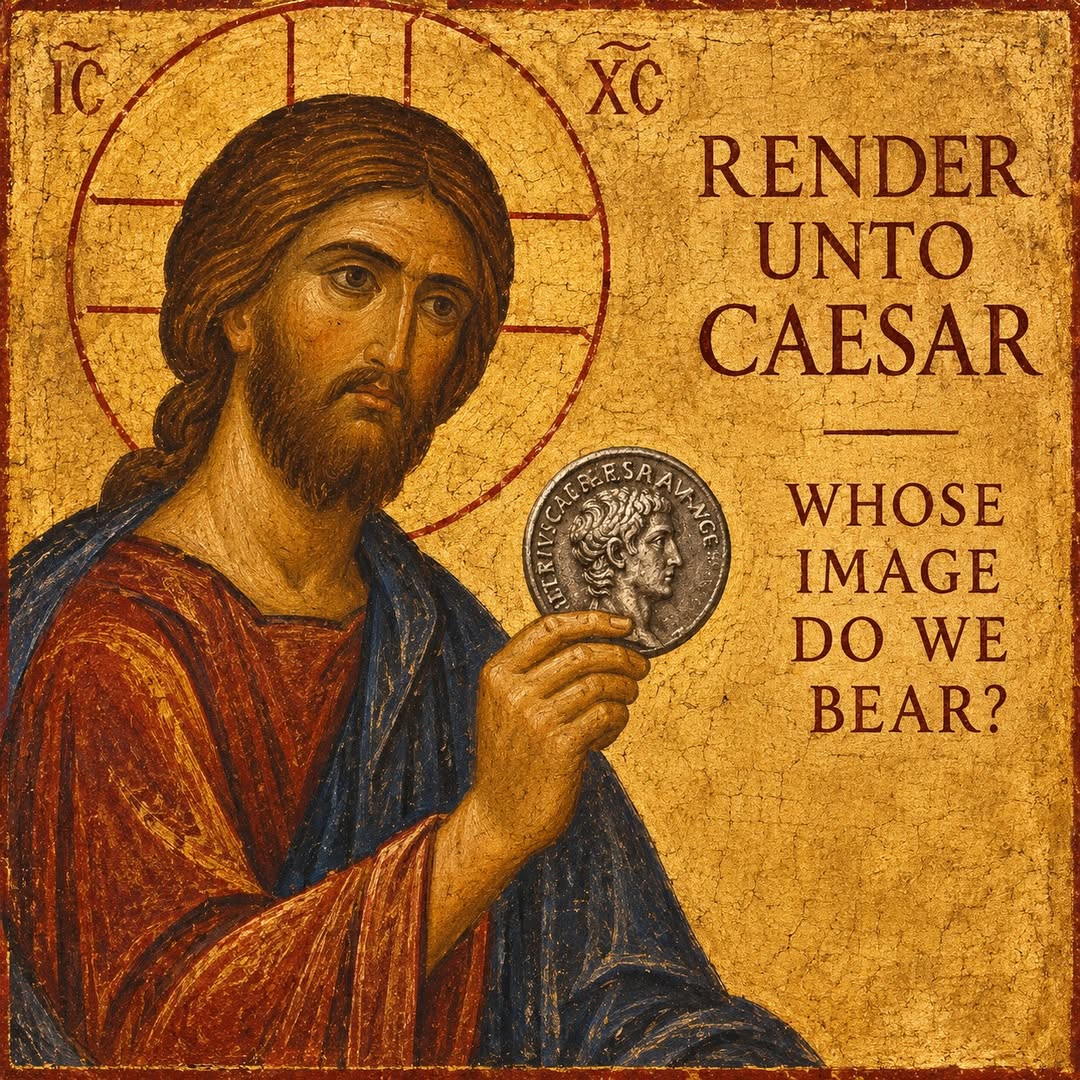
Instead, he asks them to produce a denarius. And here’s an interesting detail we often overlook: this exchange takes place in the Temple courts, the very place dedicated to the worship of Yahweh.
The coin they produce likely bore the image of Tiberius Caesar, along with the inscription, “Tiberius Caesar Augustus, son of the divine Augustus.” On the reverse was the title Pontifex Maximus (chief priest), accompanied by a figure associated with Pax, the Roman personification of peace. Think about what this coin was communicating. Caesar was presented as the son of a god, Rome’s chief priest, and a representative of the peace the empire claimed to bring to the world. This wasn’t simply currency. It was imperial theology stamped into silver. And here’s the irony: standing in the courts of God’s Temple, Jesus’ opponents readily produce a coin bearing these claims while attempting to trap the very Son of God!
Jesus asks, “Whose image (eikōn) is this? And whose inscription (epigraphē)?”
“Caesar’s,” they respond.
The Greek word eikōn is the same word used in the Greek Old Testament when Genesis describes humanity as created in God’s image (Genesis 1:26–27). Jesus then tells them to give back (apodidōmi) to Caesar what belongs to Caesar and to God what belongs to God. Notice the shift. They want to know what they owe Caesar, but Jesus redirects their attention toward something much more significant: what belongs to God?
Caesar’s image was stamped upon the coin, but God’s image was stamped upon humanity. As Psalm 24:1 reminds us, “the earth is the LORD’s, and everything in it.” Jesus wasn’t dividing our lives into competing allegiances. He was exposing the limits of Caesar’s claims while reminding his audience of God’s comprehensive claim upon their lives.
In other words, give Caesar back his stupid coin (not your allegiance), and give God all of you because you are his image.
But there’s another fascinating detail in Mark’s Gospel. The Greek word epigraphē (inscription) appears again at Jesus’ crucifixion, where the inscription above his head reads, “The King of the Jews” (Mark 15:26). Caesar’s claims to power were inscribed upon a coin, while Jesus’ kingship was proclaimed above a cross. Two radically different expressions of kingship.
And Jesus had already explained the difference to his disciples. In Mark 10:42–45, he reminds them that the rulers of the Gentiles “lord it over” others and exercise authority through domination. Then he says something that should challenge every Christian understanding of power: “Not so with you.” Greatness in his Kingdom is measured not by the ability to control others but by the willingness to serve them. Jesus himself came “not to be served, but to serve, and to give his life as a ransom for many.”
This doesn’t mean God’s people should withdraw from the world or remain silent about injustice. Throughout Scripture, God’s people are called to be prophetic witnesses, speaking truth to earthly powers and embodying an alternative way of life. But our calling is not to rule the world according to Caesar’s methods while claiming to advance Jesus’ Kingdom. We cannot accomplish the purposes of a crucified Messiah through domination, coercion, and the pursuit of worldly power.
And this is where I think the passage becomes particularly challenging for the American church.
When we become too entangled in the politics of this world, we risk being formed into the image of Caesar rather than the image of Christ. We begin adopting the patterns of earthly kingdoms: tribalism, ethnocentrism, consumerism, the pursuit of power, and the tendency to “other” those who disagree with us. Rather than being a prophetic witness to the world, we begin reflecting the very systems we are called to challenge.
I’ve been particularly disappointed by the way I’ve seen Christians treating one another following another election. The anger, hostility, and contempt directed toward those of a different political persuasion are troubling, especially when we begin acting as though our preferred political party represents God’s side.
But Jesus is not left or right… He is above. His Kingdom cannot be reduced to our political categories, and neither party can claim him as its own. God has one Kingdom, and it cannot be identified with any earthly nation, political party, or government. America is not the Kingdom of God, nor can any earthly nation claim to be the Christian nation.
In 1 Peter 2:9, Peter describes the church as “a chosen people, a royal priesthood, a holy nation, God’s special possession.” Notice who Peter identifies as God’s holy nation. It isn’t Rome or any other earthly empire. It’s the people of God. This nation isn’t defined by geographical borders, ethnic identity, or earthly citizenship, but by allegiance to Jesus. It is a people gathered from every nation, tribe, people, and language (Revelation 7:9), united under the reign of one King. Our identity as citizens of God’s Kingdom must transcend every earthly allegiance.
And the way we treat others should reflect the character of that King. In Matthew 5:21–22, Jesus takes the commandment against murder and presses it deeper, confronting the anger and contempt we harbor toward others. We may congratulate ourselves for never taking another person’s life, but Jesus challenges the hostility we allow to take root in our hearts. The same contempt that dehumanizes another person stands in direct opposition to the Kingdom he came to establish. He then goes even further, commanding us to love our enemies and pray for those who persecute us (Matthew 5:43–48). If Jesus calls us to love even our enemies, how much more should that shape the way we treat fellow Christians whose political convictions differ from our own?
We can hold different political convictions without allowing those differences to produce contempt for people who bear God’s image. But when our political allegiances begin determining who we love, who we reject, and how we treat one another, perhaps we’ve already given Caesar far more than his coin.
Jesus held up a coin and asked whose image it bore. The question for us is whether we’ve allowed the kingdoms of this world to reshape the image we’re supposed to reflect.
Give Caesar his coin. Give God your whole life. And don’t let Caesar remake you in his image.
Your soul is reserved for bearing the divine image of Christ, not the beastly image of Caesar.
written by Matt Mouzakis Th.D.

