
Dr. Will Ryan
For many Christians, the book of Revelation has been understood through the popular Left Behind perspective, a theological framework largely shaped by dispensationalism. In this understanding, believers are suddenly removed from the earth in an event called the rapture, followed by a period of tribulation, the rise of the Antichrist, and eventually the return of Jesus to establish his earthly kingdom. Revelation 19 is often understood as a heavenly celebration involving a church that has already escaped the suffering of the world. While this interpretation has become familiar in modern evangelicalism, it is not the only historic Christian understanding of Revelation, nor do we believe it best reflects the larger biblical narrative.[1]
At Expedition 44, we have consistently encouraged readers to understand Revelation through its first-century Jewish context, its connections to the Hebrew Scriptures, and the kingdom Jesus has already inaugurated. We are not waiting for Jesus to become king. Through his death, resurrection, and ascension, Jesus has already been enthroned (Acts 2:32–36; Eph. 1:20–23). He announced that the kingdom had drawn near (Mark 1:15), demonstrated its arrival through his ministry (Luke 11:20), and declared that all authority in heaven and earth had been given to him (Matt. 28:18). We await the full restoration of creation, but we are already living under the reign of the Lamb. Revelation 19, therefore, is not primarily about escaping a world God has abandoned. It celebrates the defeat of oppressive powers, the faithfulness of God’s covenant people, and the ultimate marriage of heaven and earth.[2]
The Fall of Babylon: The Victory of the Lamb (Revelation 19:1–5)
Revelation 19 opens with heaven celebrating the judgment of Babylon. Within John’s first-century setting, Babylon evokes Rome, the great imperial power whose political, economic, and religious systems demanded allegiance. Yet the imagery reaches further back into Israel’s history. Egypt, Assyria, and Babylon each represented oppressive kingdoms that exalted themselves against Yahweh and his covenant purposes. Daniel 7 portrays these empires as terrifying beasts, while the kingdom of God is given to one like a son of man (Dan. 7:13–14). John employs this same prophetic language to reveal the conflict between the kingdoms of this world and the reign of the Lamb.[3]
An interesting detail is John’s repeated use of Hallelujah, from the Hebrew halelu-Yah, meaning “Praise Yahweh.” The word appears four times in Revelation 19, its only appearances in the New Testament. The worship recalls Israel’s praise following deliverance from Egypt (Exod. 15:1–18). Just as Israel celebrated the defeat of Pharaoh, heaven celebrates the defeat of Babylon. The message is not that God’s people have escaped creation, but that the powers corrupting creation have been judged. This is an expression of Christus Victor: Jesus has conquered the powers that enslave and destroy.
There is also a fascinating contrast between Revelation 18 and 19. The merchants of Babylon mourn because their wealth and security have collapsed, while heaven rejoices because God’s justice has prevailed. What Babylon calls prosperity, heaven recognizes as exploitation. The victory of Jesus exposes the false promises of empire and reminds the church that our ultimate allegiance belongs to the Lamb rather than the systems that compete for our worship.
The Lord God Almighty Reigns (Revelation 19:6)
John hears the declaration that the Lord God Almighty reigns. The Greek title Pantokratōr emphasizes God’s authority over all things. In the Roman world, emperors claimed extraordinary authority and were celebrated as sources of peace, stability, and salvation. Revelation challenges those claims by announcing the sovereignty of Israel’s God.
This declaration recalls Exodus 15:18: “The LORD will reign for ever and ever.” It also connects to Psalm 110, where the Messiah is seated at God’s right hand. Peter explicitly applies this psalm to the resurrected and ascended Jesus in Acts 2:34–36. The kingdom is not postponed until a future political arrangement. Jesus reigns now, even as we await the day when every enemy, including death itself, will finally be defeated (1 Cor. 15:24–26).
This is the important distinction between the kingdom’s inauguration and its consummation. We are living in what theologians describe as the “already and not yet.” The Lamb is already reigning, and his followers are called to embody that reign through justice, mercy, reconciliation, and sacrificial love. Our prayer remains, “Your kingdom come, your will be done, on earth as it is in heaven” (Matt. 6:10).
The Marriage of the Lamb: The Fulfillment of Covenant (Revelation 19:7–8)
The imagery of marriage is deeply rooted in the Hebrew Scriptures. God repeatedly describes his relationship with Israel through the language of marriage and covenant. In Hosea 2:19–20, Yahweh promises to betroth his people in righteousness, justice, steadfast love, and faithfulness. Isaiah 54:5 identifies Israel’s Maker as her husband, while Isaiah 62:4–5 anticipates a restored people over whom God rejoices as a bridegroom rejoices over his bride.
John’s announcement that the marriage of the Lamb has come should therefore be understood within this larger covenant narrative. Jesus is fulfilling God’s longstanding promise to restore his relationship with his people. The bride represents the covenant community gathered around Israel’s Messiah, including Gentiles who have been grafted into God’s covenant promises (Rom. 11:17–24).
Notice something beautiful in Revelation 19:8. The bride is granted fine linen, bright and pure, which John identifies as the righteous deeds of the saints. The Greek edothē means “it was given,” emphasizing that the bride’s clothing is received through grace. Yet the clothing also represents the faithful actions of God’s people. Grace and covenant participation belong together. The bride is being prepared through a life of allegiance to Jesus.
John deliberately contrasts two women and ultimately two cities. Babylon embodies corruption and rebellion, while the bride represents the faithful people of God, later pictured as the New Jerusalem descending from heaven (Rev. 21:2, 9–10).
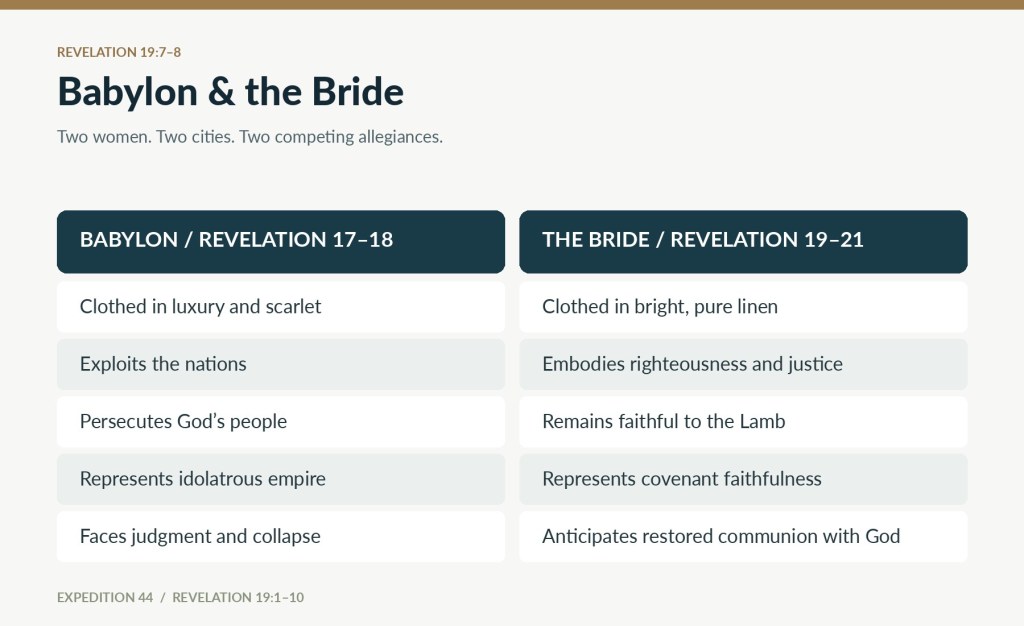
This imagery is profoundly practical. The church does not prepare for the wedding by withdrawing from the world or waiting passively for a heavenly rescue. We prepare through lives shaped by the character of Jesus. The righteous deeds of the saints are expressions of a kingdom already at work among us.
The Marriage Supper: The Great Messianic Banquet (Revelation 19:9)
The marriage supper of the Lamb has one of its richest Old Testament connections in Isaiah 25:6–9. There, Yahweh prepares a magnificent feast for all peoples, removes the covering over the nations, swallows up death, and wipes away tears. This is not merely a picture of people escaping to heaven. It is a prophetic vision of God’s victory over death and the restoration of his creation.
Jesus repeatedly draws upon this banquet imagery. In Matthew 8:11, people come from east and west to share the feast with Abraham, Isaac, and Jacob. In Luke 14:15–24, the kingdom is pictured as a banquet welcoming those whom society often overlooks. At the Last Supper, Jesus anticipates drinking the fruit of the vine anew in his Father’s kingdom (Matt. 26:29). Revelation 19 brings these promises together in the great wedding feast of the Lamb.
The direction of the biblical story is particularly important. In Revelation 21:2, John sees the New Jerusalem coming down out of heaven from God. The final vision is not humanity permanently departing the earth, but God dwelling with humanity in renewed creation. Genesis begins with heaven and earth in communion, and Revelation concludes with the restoration and fullness of that relationship (Gen. 1–2; Rev. 21–22).
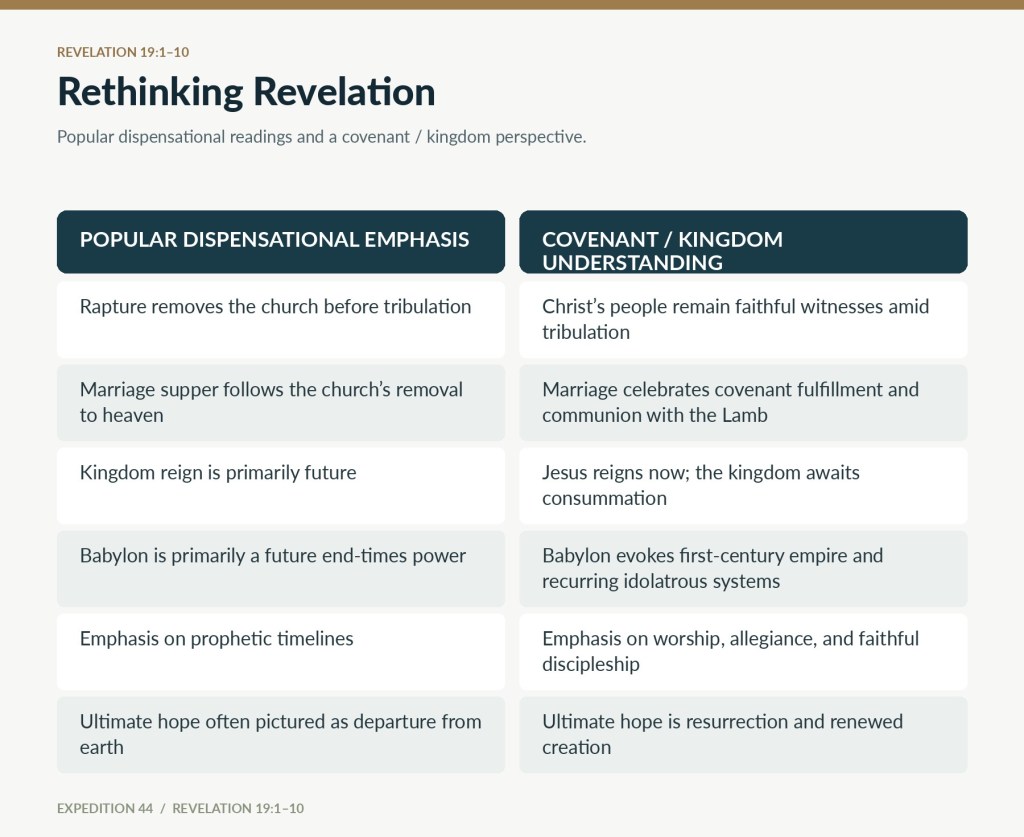
This does not eliminate the future return of Christ, bodily resurrection, or final judgment. These remain central to Christian hope. Rather, it places those promises within the biblical expectation of restoration rather than permanent separation from creation.[4]
The Testimony of Jesus Is the Spirit of Prophecy (Revelation 19:10)
John concludes this vision by falling at the feet of an angel, who immediately redirects his worship toward God. The angel then declares, “For the testimony of Jesus is the spirit of prophecy.” The Greek expression hē martyria Iēsou can refer to testimony concerning Jesus or testimony given by Jesus, but in either case the prophetic message is inseparable from him.
This is an important corrective to the modern tendency to treat prophecy primarily as a mechanism for predicting future geopolitical events. The Hebrew prophets certainly spoke of future events, but their ministry was fundamentally concerned with revealing God’s character, confronting injustice, challenging idolatry, and calling people back into covenant faithfulness. Isaiah, Jeremiah, Amos, and Ezekiel spoke into the real circumstances of their audiences while announcing the purposes of Yahweh.
John stands within that same prophetic tradition. His message calls believers to faithful allegiance to Jesus despite the competing claims of empire. The church is not instructed to become consumed with identifying future villains or calculating the timing of the end. We are called to worship God and bear witness to his Son.
Living as the Bride in the Kingdom of the Lamb
Jeremiah 29 provides a wonderful connection for understanding our present calling. While living in Babylonian exile, God’s people were instructed to seek the shalom, or flourishing, of the city where they had been placed (Jer. 29:7). They were not called to embrace Babylon’s idolatry, nor were they permitted to abandon their responsibility toward their neighbors. They were to remain faithful to Yahweh while seeking the good of those around them.
This captures something essential about the church’s calling today. We live among the systems of Babylon without surrendering our allegiance to Babylon. We seek the flourishing of our communities while refusing the exploitation, injustice, and false worship that characterize the kingdoms of this world. We belong to the Lamb, and our lives should reflect the character of his kingdom.
In our recent book, Heaven to Earth: Rethinking Revelation and the Hope of the Kingdom, Matt Mouzakis and I explore this very theme. The biblical story is not moving toward the abandonment of creation but toward its renewal under King Jesus. The church lives between resurrection and restoration, participating through the Holy Spirit in the work that Christ has already begun.[5]
Revelation 19 is therefore a beautiful invitation to faithfulness. Babylon does not have the final word. Death does not have the final word. The Lamb who was slain is victorious, and his bride is being prepared. We are not waiting for Jesus to become king, nor are we waiting to begin living as citizens of his kingdom. We belong to him now.
Perhaps the most important question we should ask when reading Revelation 19 is not when the wedding will take place, but how we are preparing for it. If the fine linen of the bride represents the righteous deeds of the saints, what should our churches, families, relationships, and communities look like today?
The bride is already making herself ready. The Lamb is already reigning. And the people of God are called to make the beauty of his kingdom visible in the world until the day when heaven and earth are fully united and all things are made new.
Living in the Victory of the Lamb
How we understand the end of the story shapes how we live in the middle of it. If we are simply waiting to escape, we may miss the very kingdom Jesus has called us to embody. The Lamb is already reigning, and his bride is already being made ready. Every act of mercy, reconciliation, justice, and sacrificial love becomes a visible expression of his kingdom breaking into our world.
Our hope is not that Jesus will rescue us from a creation he has abandoned, but that he will finish restoring what he has already begun. We are not waiting for the kingdom to arrive before we begin living as kingdom people.
Revelation is not an invitation to calculate our departure but a call to faithful participation. We are not called to be experts in the timing of his return, but living witnesses to the reality of his reign.
The bride is not preparing to abandon the world. She is preparing to welcome the King who is making all things new.

Notes
- See Will Ryan and Matt Mouzakis, Heaven to Earth: Rethinking Revelation and the Hope of the Kingdom (2026), chap. 2, for an overview of dispensational eschatology and its distinction between Israel and the church. The familiar Left Behind presentation particularly reflects pretribulational dispensationalism, rather than every premillennial interpretation.
- Ryan and Mouzakis, Heaven to Earth, chaps. 1, 4–5, 10. See also Ps. 110:1; Dan. 7:13–14; Acts 2:32–36; Col. 1:13–20.
- See Dan. 2:31–45; 7:1–14; Rev. 17–18. The identification of Babylon with Rome is prominent in historical-critical interpretations of Revelation, while preterist readings also examine the first-century judgment of Jerusalem. These emphases need not exclude the symbol’s continuing relevance to oppressive powers.
- See Isa. 25:6–9; Rom. 8:18–25; 1 Cor. 15:20–28, 51–58; Rev. 21:1–5. Compare Ryan and Mouzakis, Heaven to Earth, chap. 7, on partial preterism and the continuing expectation of resurrection and new creation.
- Ryan and Mouzakis, Heaven to Earth, chap. 10 and conclusion, especially the discussion of the church as the bride, the inaugurated kingdom, and the renewal of creation.

