
A Review of Adriel Sanchez, Why We Worship: Experiencing Heaven on Earth at Church (Downers Grove, IL: InterVarsity Press, 2026).
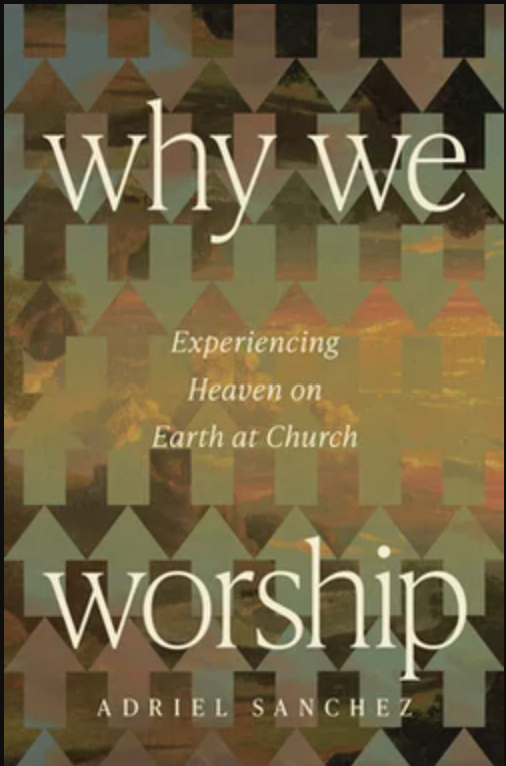
Adriel Sanchez’s Why We Worship enters a crowded conversation about Christian worship, but it does so from a somewhat different direction than many recent evangelical works. Rather than centering the discussion on musical style, congregational preference, technological excellence, or the perennial tension between traditional and contemporary forms, the book begins with a more fundamental theological question: what is actually happening when the church gathers? Sanchez answers by drawing upon the biblical imagery of sacred ascent. The assembled church approaches Zion, enters the presence of God, receives the gifts of Word and Table, and then returns to the world as a priestly and prophetic people whose lives have been reordered by worship.
This image of ascent gives the book its structure and much of its theological coherence. The opening section considers the church as a people moving toward the mountain of God. The central chapters explore what happens at the summit through the call to worship, confession, song, preaching, Communion, and benediction. The final movement brings the congregation back into ordinary life and vocation. In this sense, Why We Worship is not so much a manual for constructing worship services as it is an accessible biblical theology of Christian liturgy. Sanchez wants the reader to recover a conviction that has often become thin within modern evangelicalism: Sunday worship is not merely a gathering Christians arrange for themselves, but a response to the initiative of God, who calls his people into his presence.
That point is worth emphasizing because it places the book against several habits that have become almost instinctive within contemporary church culture. Worship can easily become something evaluated primarily through the categories of experience, preference, production, or effectiveness. The question becomes whether people were engaged, whether the music connected emotionally, whether the sermon held attention, or whether visitors felt comfortable. Sanchez does not dismiss those pastoral concerns, but he relocates them within a much larger theological reality. Christian worship begins before human response. God summons; the people answer. God speaks; the congregation listens. God gives; the church receives. Worship, then, is fundamentally responsive rather than self-generated.
Sacred Space and the Ascent of Worship
One of the more compelling elements of the book is its use of temple and mountain imagery. The tabernacle and Jerusalem temple are not treated simply as ancient religious structures but as earthly representations of a heavenly reality, sacred spaces in which creation, divine presence, priesthood, sacrifice, and human vocation converge. Sanchez’s approach sits comfortably within a substantial stream of contemporary biblical theology represented by G. K. Beale, L. Michael Morales, T. Desmond Alexander, and others who have drawn attention to the Eden-tabernacle-temple trajectory that runs across the canon.¹
The importance of that trajectory becomes clearer when Eden, Sinai, Zion, Hebrews, and Revelation are allowed to speak together. Eden itself carries features later associated with sanctuary and sacred mountain imagery. Rivers flow outward from the divine dwelling place, humanity serves within the garden, and Ezekiel 28 can describe Eden in relation to the “holy mountain of God.” Sinai becomes another site of divine encounter, a place where God descends and Israel is summoned upward, although access is carefully guarded. Zion and the temple continue this theology of divine dwelling and ordered approach. Hebrews 12 then announces that believers have come not merely to an earthly mountain but “to Mount Zion and to the city of the living God, the heavenly Jerusalem” (Heb 12:22).
There is also a wider ancient Near Eastern texture beneath these images that helps illuminate their significance. Temples throughout the ancient world commonly represented cosmic centers, places where divine and earthly realms were understood to intersect. Mesopotamian temple complexes and ziggurats participated in a broader cultural imagination in which height, sacred geography, divine presence, and royal authority were interconnected. Israel participates in some of this shared symbolic world while simultaneously resisting its theology. Yahweh is not a deity who can be maintained, manipulated, or localized through human ritual. Solomon’s declaration that even “heaven and the highest heaven” cannot contain God (1 Kgs 8:27) becomes especially significant when read against cultures in which temples could function as houses constructed for localized divine presence.
This background adds depth to Sanchez’s argument because biblical worship does not make God manageable. Quite the opposite occurs. Sacred space confronts the worshiper with the holiness, otherness, and gracious nearness of a God who chooses to dwell among his people while remaining utterly beyond human control. That biblical tension offers an important corrective to forms of worship that unintentionally reduce God to an atmosphere that can be generated through music, lighting, emotional intensity, or carefully managed liturgical movement.
The language of ascent, however, should remain in conversation with an equally prominent biblical movement: God comes down. Yahweh descends upon Sinai (Exod 19:18–20); divine glory fills the tabernacle (Exod 40:34–38) and later the temple (1 Kgs 8:10–11); the incarnation itself is the supreme movement of divine presence toward humanity; and Revelation reaches its culmination not with humanity permanently escaping upward but with the New Jerusalem descending from heaven to earth (Rev 21:2). The biblical story therefore includes both ascent and descent. God comes near so that humanity may approach. Heaven and earth are not finally separated but reconciled within the renewed creation.
This does not weaken the controlling metaphor of Why We Worship. It gives it greater canonical texture. Christian worship participates in an extraordinary meeting of movements: God graciously draws near, and humanity, in Christ, is brought into divine fellowship.
Leviticus, Sacrifice, and the Logic of Approach
The book’s interaction with Leviticus is particularly fruitful. Sanchez draws attention to the Hebrew title of the book, wayyiqrāʾ, “and he called,” and uses that opening word to reinforce the claim that worship begins with divine initiative. Israel does not simply devise a way into God’s presence. God calls, orders, provides, and makes approach possible.
Leviticus is therefore about much more than a collection of sacrifices. At its theological center stands a difficult question: how can a holy God dwell among a people who are vulnerable to impurity, sin, and death? The sacrificial system belongs within that larger drama of divine presence. Approach requires purification, atonement, mediation, holiness, and ultimately a reordered communal life. Worship is not merely ritual performance but participation in a world in which God is present at the center.
Sanchez makes imaginative use of the burnt offering, Hebrew ʿōlâ, connecting the terminology with the concept of “going up.” Morales has developed this motif substantially in his own work on Leviticus, particularly in relation to humanity’s return to divine presence.² The connection works well within Sanchez’s broader mountain theology, especially when sacrificial smoke, priestly movement, sacred geography, and the ascent toward God are considered together.
At times, however, the lexical observation risks carrying slightly more theological freight than a word by itself can support. The verb ʿlh certainly conveys ascent, and the offering “goes up” before God, but the fuller theology of sacrificial ascent comes from the ritual, spatial, and canonical context rather than from etymology alone. This is not a serious problem in the book so much as an example of a tendency that appears occasionally throughout it: the larger theological pattern is often persuasive even when the exegetical bridge could have been developed with a little more precision.
Still, the larger insight remains valuable. The Levitical world reminds modern readers that access to God is never casual in the biblical imagination. Grace makes approach possible, but grace does not make divine holiness trivial.
Revelation and the Shape of Heavenly Worship
Another creative feature of the book is its treatment of Revelation as something resembling a worship order. Revelation 1 situates John’s vision on the Lord’s Day, chapters 2–3 call the churches toward repentance and faithfulness, chapters 4–5 open heaven and reveal the throne room, the scroll is opened, songs and proclamations erupt around the Lamb, and the Apocalypse eventually moves toward the marriage supper and final blessing.
There is real theological value in reading Revelation this way. The book is saturated with worship. Incense, prayers, hymns, elders, altars, robes, temple imagery, heavenly creatures, repeated acclamations, and liturgical responses fill John’s vision. The suffering churches of Asia Minor are invited to see their earthly circumstances from the perspective of the heavenly throne. Rome may appear sovereign, but Revelation repeatedly relocates sovereignty around God and the Lamb.
It is probably best, however, to understand the “worship bulletin” idea as a theological analogy rather than as the literary architecture of Revelation itself. John was not encoding a first-century order of service into the Apocalypse, and the marriage supper in Revelation 19 is first an eschatological image before it becomes a source of Eucharistic resonance. The distinction is important because typological connections are often most persuasive when they are allowed to remain typological rather than being pressed into claims about original literary structure.
Even so, Sanchez succeeds in recovering something that many modern readings of Revelation miss. The Apocalypse is not primarily a chart for decoding the end of history. It is a book that teaches churches how to see reality and whom to worship while empires claim their allegiance.
Confession and the Formation of Christian Desire
The chapter on confession is among the more pastorally useful portions of the book because it recognizes that liturgy does more than transfer theological information. Repeated practices shape the imagination of a congregation. They teach Christians what to notice, what to love, what to lament, and how to understand themselves before God.
This places Why We Worship in productive conversation with Simon Chan and James K. A. Smith, although Sanchez approaches the matter more pastorally than philosophically.³ A congregation that regularly confesses sin develops a theological vocabulary for repentance, mercy, forgiveness, and reconciliation. A church that never confesses corporately may eventually find that these categories become increasingly difficult to articulate because its liturgical habits have ceased to rehearse them.
Isaiah 6 provides a particularly rich biblical pattern. Isaiah encounters divine holiness, recognizes his own uncleanness, receives cleansing, and is then commissioned. The movement is neither self-loathing nor therapeutic affirmation. It is revelation, confession, grace, and vocation. Matthew 5:23–24 similarly refuses to separate worship from reconciliation, while Paul’s instruction surrounding the Lord’s Table in 1 Corinthians 11 demonstrates that communal sin cannot simply be ignored in sacred practice.
At the same time, a helpful distinction remains between biblical theology and liturgical prescription. The New Testament strongly supports confession as part of Christian life and communal worship, but it does not clearly prescribe an identical corporate confession at the same point in every Lord’s Day gathering. Historic liturgies have often embodied sound biblical theology through such practices, yet the theological wisdom of a practice should not always be described as though it were a direct apostolic rubric.
That nuance matters particularly for churches emerging from low-church evangelical traditions, where recovering historic practices can occasionally turn into an overcorrection in which later liturgical patterns are retroactively read into the New Testament.
Singing, Allegiance, and the Divine Warrior
Sanchez’s discussion of congregational singing moves in an interesting direction by drawing upon biblical warfare imagery. Exodus 15 is simultaneously a song of worship and a victory hymn. The Psalms frequently portray Yahweh as king and divine warrior. In 2 Chronicles 20, singers move before Jehoshaphat’s army, while Revelation repeatedly places songs of praise alongside the conquest of the Lamb.
This material has an important ANE setting as well. Divine-warrior language, royal hymns, temple praise, and victory songs were common throughout Israel’s cultural environment. Israel does not invent those categories in isolation, but the biblical writers radically redirect them. Yahweh’s kingship relativizes every earthly empire, and the New Testament ultimately reveals divine victory in the crucified and risen Messiah.
That Christological development is essential. Without it, language about “worship as warfare” can easily drift toward contemporary ideas in which music itself is treated almost mechanically, as if sufficient intensity, volume, or spiritual enthusiasm could displace demonic forces from geographic territory. The New Testament offers a more demanding picture. Revelation’s conquering Lion appears as a slaughtered Lamb. Christian victory is therefore cruciform. Praise becomes an act of spiritual resistance because it publicly names the true king, refuses rival allegiances, and forms a people around the Lamb rather than around the liturgies of empire.
Seen this way, congregational song is far more significant than emotional preparation for preaching. Songs teach theology, preserve memory, confess allegiance, and form the identity of the gathered people.
Preaching and the Voice of God
The chapter on preaching reflects Sanchez’s Reformed commitments and provides another needed corrective to contemporary worship culture. The sermon is not an informational interruption between more experiential elements of the service, nor is it simply a motivational talk shaped loosely around biblical themes. Preaching belongs within worship because the congregation gathers to hear the Word of God proclaimed.
His resistance to Christless moralism is particularly welcome. Scripture cannot finally be reduced to a series of character lessons in which David teaches courage, Daniel teaches conviction, and Joseph teaches perseverance. Those themes may be present, but the canonical witness continually draws the reader into the larger redemptive drama that culminates in Christ.
There is, nevertheless, an important theological safeguard when speaking about hearing “God’s voice” through preaching. The authority of a sermon is derivative rather than inherent. A preacher does not possess canonical authority by virtue of occupying a pulpit. The church hears the Word of God through preaching insofar as the preacher faithfully bears witness to the scriptural text. Acts 17 provides a healthy model because proclamation can be received eagerly while still being examined in light of Scripture.
This is not a diminishment of preaching but one of its most important protections. The authority of Christian proclamation should remain tethered to the text rather than to personality, office, charisma, or institutional power.
Communion, Participation, and the Coming Feast
The treatment of Communion may be the strongest theological contribution of the book, particularly for readers formed within low-church evangelical settings. Sanchez resists the thin memorialism that has sometimes reduced the Lord’s Supper to little more than a symbolic reminder of an absent Christ. Instead, he places Communion within the larger biblical worlds of covenant, sacrifice, remembrance, participation, eschatology, and the work of the Spirit.
His discussion of anamnēsis is especially helpful. “Do this in remembrance of me” need not be heard as though Jesus were simply asking disciples to engage in private mental recollection. Biblical memorial language carries covenantal depth. Memorials bring God’s saving acts into the worshiping present and place the community again within the story those acts created.
First Corinthians 10:16 provides an even stronger anchor. Paul describes the cup and bread as koinōnia in the blood and body of Christ. Christian traditions have disagreed sharply over how Christ is present at the Table, but Paul’s language is difficult to collapse into mere mental recollection. Something participatory is happening.
At this point the book enters fruitful conversation not only with Reformed sacramental theology but also with voices such as Alexander Schmemann and the broader Christian tradition, where Eucharistic worship has consistently been understood as participation in Christ and anticipation of the age to come.⁴ The recovery of the epiclesis is particularly noteworthy because it places sacramental life within dependence upon the Holy Spirit rather than within any mechanical understanding of the elements themselves.
The connection between Isaiah 25, eschatological banquet imagery, victory over the enemies of God, and the marriage supper of the Lamb also gives Communion an important forward-looking dimension. The Table remembers the cross, but it does not only look backward. It stands between resurrection and consummation. The church eats and drinks while announcing that the crucified Christ has been vindicated and that the final feast is still coming.
John 6 deserves some caution here. The language of eating Christ’s flesh and drinking his blood became deeply Eucharistic within the early Christian tradition, but exegetes continue to debate how directly the discourse should be identified with the Lord’s Supper. It may be better to allow the Johannine language to retain both its emphasis on receiving Christ by faith and its unmistakable sacramental resonance rather than forcing the passage into a single later theological category.
Even with that qualification, this chapter is one of the book’s most important correctives. It invites evangelical readers to recover a Table that is simultaneously remembrance, participation, proclamation, thanksgiving, communion, and anticipation.
Descending the Mountain: Worship and Vocation
The ascent motif becomes most useful when Sanchez refuses to leave the church on the mountain. Worship does not terminate in an encounter, however profound. The congregation descends into neighborhoods, workplaces, families, relationships, and ordinary responsibilities as a people whose lives have been reordered around God.
First Peter 2 provides much of the biblical framework for this movement. The church is a “holy priesthood” and a “royal priesthood,” language that joins worship and witness rather than separating them. Priestly identity involves sacrifice, holiness, mediation, proclamation, mercy, prayer, and service.
Isaiah 6 again offers a beautiful pattern: the prophet sees, confesses, is cleansed, and is sent. The movement toward God eventually becomes movement toward the world. Christian worship that never produces compassion, reconciliation, justice, patience, hospitality, witness, and sacrificial love has failed to carry the worshiper very far into the character of the God being worshiped.
This becomes especially important when worship is considered alongside political power. The church’s public vocation is not strengthened when Christian identity is reduced to the acquisition of cultural control. Revelation offers another way. The Lamb conquers through faithful witness, suffering love, and resurrection. The priestly people of God are sent into the nations not merely to secure influence but to embody the life of another kingdom.
In Conversation with Contemporary Worship Scholarship
Within the wider landscape of worship studies, Why We Worship occupies a useful middle ground. Simon Chan’s Liturgical Theology offers a more developed ecclesiology of worship. James K. A. Smith explores the formative power of liturgical practice through the language of desire, habit, and cultural formation. Lester Ruth and Lim Swee Hong provide the historical genealogy necessary for understanding how the term “worship” came to be associated so strongly with congregational music in many Protestant contexts.⁵ Beale and Morales provide much of the temple and sacred-space theology that supports Sanchez’s ascent imagery, while Schmemann offers a broader sacramental vision in which worship participates in the life of the coming kingdom.
Sanchez does not attempt to match the technical depth of all these works, nor does he need to. The value of Why We Worship lies partly in its ability to gather conversations that often remain separated—biblical theology, sacramental theology, liturgical history, ecclesiology, mission, and pastoral practice—and place them within reach of the ordinary church reader.
Those already familiar with this scholarship will occasionally wish for slower exegetical development at several points. The mountain imagery could have benefited from a fuller ANE context, the Revelation material needs careful qualification, and some of the sacramental connections might have been strengthened by sustained engagement with competing interpretations. Even so, the overall theological architecture is compelling and, importantly, pastorally usable.
Conclusion: Worship That Reorders a Life
Perhaps the most important contribution of Why We Worship is its resistance to a church culture in which worship has become increasingly easy to evaluate according to the categories of consumption. We ask whether the music was good, whether the sermon was interesting, whether the service flowed, whether we felt something, whether we were comfortable, or whether the whole experience was worth coming back for next week. None of those questions are entirely meaningless, but they become dangerously small if they are allowed to define Christian worship.
The biblical vision is far stranger and far more beautiful. The church gathers because God has called a people to himself. Christians come carrying gratitude and sin, faith and doubt, joy and grief, maturity and immaturity. They confess, listen, sing, eat, drink, pray, receive blessing, and then return to lives that may look externally much the same as they did before they arrived. Yet worship assumes that something has happened in the meantime. The imagination has been re-centered. Allegiance has been rehearsed. Grace has been announced. The story of the world has been told again, and Christ has been named as Lord within it.
This is where the mountain image becomes especially useful pastorally. The goal is not to spend the entire Christian life attempting to preserve a mountaintop experience. Scripture rarely allows its people to remain on the mountain. Moses descends. Elijah returns. The disciples come down after the transfiguration. Isaiah is sent. Even the glory of the resurrection drives the disciples toward Jerusalem, Judea, Samaria, and the nations.
The test of worship, therefore, is not whether we managed to feel close to God for ninety minutes. It is whether the encounter with God begins to shape the way we descend.
Do we become easier to reconcile with? Are we slower to anger? Do we become more attentive to the lonely person standing at the edge of the room? Does the Table teach us to stop dividing people whom Christ has welcomed? Does confession make us less defensive when someone exposes our failures? Does hearing the Word make us more willing to obey when obedience is costly? Does singing about the Lamb slowly detach our hearts from the smaller kingdoms competing for our allegiance?
These are not secondary consequences of worship. They are among its fruits.
Romans 12 makes the connection explicit when Paul moves from the mercies of God into the call to present our bodies as a living sacrifice. The sanctuary expands into ordinary life. Worship continues in the marriage, at the workplace, around the dinner table, in forgiveness, generosity, sexual faithfulness, care for the poor, hospitality toward strangers, and courageous witness to Jesus. The gathered liturgy trains the church for this scattered liturgy of everyday faithfulness.
That may ultimately be where Sanchez’s book is most helpful. Why We Worship does not merely ask churches to reconsider what they do on Sunday mornings. It invites them to reconsider what sort of people Sunday worship is forming.
Pastors and worship leaders should probably ask more than whether the congregation sang loudly or whether the service landed emotionally. We might ask whether our people are learning the story of Scripture, whether they know how to confess without despair, whether they know how to receive grace without entitlement, whether the Table is teaching reconciliation, whether preaching is forming allegiance to Christ, and whether benediction is actually sending them into the world as people of peace.
Perhaps that is what it finally means to ascend Zion. We do not climb toward God in order to escape the world. We are drawn into the presence of God so that we may return to the world carrying something of his character with us.
And if our worship never makes us more truthful, more merciful, more faithful, more forgiving, more hospitable, more courageous, and more deeply committed to the way of Jesus, we may need to ask whether we have actually understood what worship is for.
Sanchez has written a helpful invitation to ask that question again.

Notes
- See G. K. Beale, The Temple and the Church’s Mission: A Biblical Theology of the Dwelling Place of God, New Studies in Biblical Theology 17 (Downers Grove, IL: InterVarsity Press, 2004); T. Desmond Alexander, From Eden to the New Jerusalem: An Introduction to Biblical Theology (Grand Rapids: Kregel Academic, 2008); and L. Michael Morales, Who Shall Ascend the Mountain of the Lord? A Biblical Theology of the Book of Leviticus, New Studies in Biblical Theology 37 (Downers Grove, IL: InterVarsity Press, 2015).
- Morales, Who Shall Ascend the Mountain of the Lord? Sanchez’s use of sacrificial ascent works particularly well alongside Morales’s larger reading of Leviticus as a movement toward restored access to divine presence.
- Simon Chan, Liturgical Theology: The Church as Worshiping Community (Downers Grove, IL: IVP Academic, 2006); James K. A. Smith, You Are What You Love: The Spiritual Power of Habit (Grand Rapids: Brazos Press, 2016).
- Alexander Schmemann, For the Life of the World: Sacraments and Orthodoxy (Crestwood, NY: St. Vladimir’s Seminary Press, 1973); Michael Horton, People and Place: A Covenant Ecclesiology (Louisville: Westminster John Knox, 2008).
- Lester Ruth and Lim Swee Hong, A History of Contemporary Praise & Worship: Understanding the Ideas That Reshaped the Protestant Church (Grand Rapids: Baker Academic, 2021).
- For the broader cosmic-temple trajectory from Eden through new creation, see Beale, Temple and the Church’s Mission.
- Hebrews 12:22–24 is particularly important for Sanchez’s argument because the author does not merely describe Zion as a future destination. The perfect verb proselēlythate portrays believers as those who have already “come” to Mount Zion, the heavenly Jerusalem, and the festal assembly.
- Chan’s account of ecclesial formation through worship provides an important conversation partner here because it resists treating liturgy as a secondary expression of an already fully constituted church. See Chan, Liturgical Theology, 41–66.
- Paul’s use of koinōnia in 1 Cor 10:16 remains one of the stronger New Testament challenges to purely memorialist interpretations of the Lord’s Supper. The text does not resolve every later sacramental debate, but it clearly presents the meal in participatory terms.
- For Revelation’s throne-room worship and temple imagery, see G. K. Beale, The Book of Revelation: A Commentary on the Greek Text, New International Greek Testament Commentary (Grand Rapids: Eerdmans, 1999). Sanchez’s use of Revelation as a liturgical pattern is most convincing when treated as theological correspondence rather than as a claim about the formal literary structure of the Apocalypse.
- Sanchez’s discussion of priesthood may also be placed alongside Hank Voss, The Priesthood of All Believers and the Missio Dei: A Canonical, Catholic, and Contextual Perspective, Princeton Theological Monograph Series 223 (Eugene, OR: Pickwick, 2016).
- Romans 12:1 is especially important for bringing the book’s final movement into focus. Paul’s description of embodied Christian existence as logikē latreia prevents Christian theology from placing an artificial boundary between liturgical worship and the life that follows it.

