
Emma M. Austin. Landscapes of Memory: The Old Testament’s Sensory Engagement with Nature. Foreword by Paul H. Wright. Downers Grove, IL: IVP Academic, 2026. 176 pp.
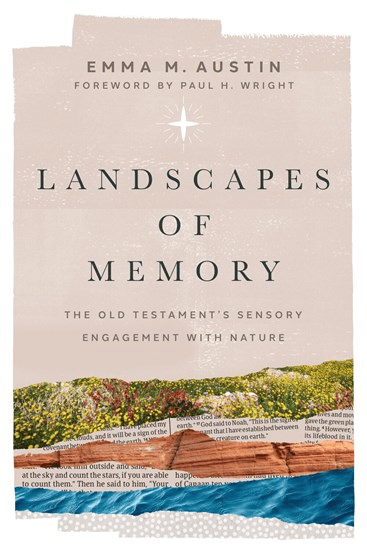
Emma M. Austin’s Landscapes of Memory begins with an observation that is easy to acknowledge but harder to work consistently into biblical interpretation: the world of the Old Testament was experienced bodily. Its first hearers knew the heat of the land, the relief of rain, the anxiety of drought, the difficulty of long travel, the sound of animals in the night, the smell of cultivated fields, and the visual force of a sky crowded with stars. Modern readers encounter all of these things in the text, but usually at a distance. What for an ancient audience belonged to ordinary experience often reaches us only as imagery. We know what a wilderness is lexically without necessarily knowing what it feels like to depend on water within one, and we understand that grass withers without necessarily seeing that image against the rapid seasonal transformation of the southern Levant. Austin’s contribution is to argue that these elements of the natural world should not be treated merely as scenery surrounding the theological message of Scripture. They frequently participate in the message itself, carrying memory, shaping imagination, and reminding Israel of encounters with God.
Austin develops this idea through the category of mnemonature, by which she describes the relationship between nature, sensory experience, and memory.¹ The terminology is her own, but the underlying argument stands within a substantial scholarly conversation. Walter Brueggemann famously demonstrated that “land” within Israel’s Scriptures is never simply territory but becomes gift, promise, inheritance, loss, exile, and hope. Ellen Davis has shown how profoundly agriculture and the rhythms of land shape Israel’s theological imagination, while Yael Avrahami’s study of sensory perception has helped recover the embodied character of biblical thought.² Austin’s work intersects with these conversations while pressing in a somewhat different direction. Her concern is not simply that nature means something, but that repeated encounters with the natural world may have helped biblical communities remember what God had said and done. A tree, a dry field, the stars, seasonal rain, a particular road, or even an animal could participate in a network of associations that extended well beyond a single literary image.
One of the strengths of Austin’s approach is that it pays attention to matters the biblical writers frequently leave unexplained because their audiences did not need them explained. Judges 6:11 offers a good example. Gideon is found threshing wheat in a winepress, a scene that can pass quickly in modern reading unless one understands that threshing normally required an exposed location where the wind could separate grain from chaff. A winepress was hardly the proper place for the task. Gideon’s behavior therefore communicates before he speaks. The Midianite threat has become so pervasive that ordinary agricultural life has been distorted, and Gideon is attempting to perform a public, wind-dependent activity in a concealed place. Cultural-background scholarship has long helped readers recover such information, but Austin’s method asks a further question: what would an audience accustomed to threshing floors and winepresses have sensed immediately upon hearing this description? Historical information explains the practice; sensory reconstruction helps recover the incongruity.
This distinction between knowing about the ancient world and imaginatively entering its physical texture becomes especially helpful in Austin’s treatment of Genesis. Her discussions of the rainbow in Genesis 9 and the stars in Genesis 15 provide some of the clearest examples of her central thesis. The rainbow is explicitly connected with covenant remembrance, while the stars become connected to God’s promise concerning Abram’s descendants. Readers naturally recognize the metaphor of innumerability in Genesis 15, but Austin encourages us to remain in the scene for a moment longer. Abram has already received the promise, yet the fulfillment appears increasingly improbable. Sarah remains barren, time is passing, and the promise is beginning to stand in tension with visible reality. God takes Abram outside and directs his attention toward the heavens. The stars are therefore not only an illustration of future descendants; they become attached to the promise itself. Abram will see them again. The natural world can continue to recall what was spoken after the divine speech has ended.³
That reading gains additional texture within the wider ancient Near Eastern environment. Celestial bodies throughout Mesopotamian cultures were associated with divine order, calendrical observation, omens, and the interpretation of human destiny. Austin is careful not to flatten Genesis into comparative mythology, but the broader background remains significant. In Genesis, the stars are not deities or autonomous powers determining Abram’s fate. They belong to the Creator who makes the promise. The heavens that surrounding cultures could read as sources of divine knowledge are relocated within Israel’s theology as creatures under YHWH’s authority and, in this particular narrative, as witnesses to his faithfulness.⁴ The theological point is strengthened rather than threatened by comparative study because Genesis participates in the symbolic world of the ancient Near East while simultaneously reconfiguring it.
Austin’s treatment of Abram’s movement through the land adds another dimension to this discussion. Genesis can make travel appear almost effortless because enormous distances are compressed into a few sentences: Abram departs, passes through a region, pitches a tent, builds an altar, moves again, goes down toward Egypt, and later returns. The reader turns a page more easily than Abram crossed the land. Austin slows the narrative down by asking what travel required in an ancient setting: water, animals, household movement, elevation changes, available roads, seasonal conditions, provisions, and exposure to danger. Her approach intersects naturally with historical geography and the work of scholars such as Yohanan Aharoni and David Dorsey, who have demonstrated how roads, routes, and terrain inform biblical narrative.⁵ Yet Austin is particularly interested in the bodily dimension of the journey. Abram’s response to God is not simply intellectual assent to a promise; obedience is expressed through movement. He leaves a known world and walks into an unknown one.
That observation fits well with Brueggemann’s work on the theological tension between landedness and landlessness.⁶ Abram is promised land long before he possesses it. In fact, much of the Abraham narrative is lived inside that tension. He travels through what has been promised without yet owning what has been promised, and the geography itself reinforces the theological shape of his life. Faith takes place between departure and possession. The roads, campsites, wells, and altars are not incidental to that story because the promise is being lived bodily before it is secured materially. Austin’s geographical sensitivity makes that familiar theological theme feel less abstract.
Her treatment of rain and drought develops the argument in another direction. Biblical readers know that Deuteronomy and the historical books associate rainfall with covenant blessing and drought with judgment, but modern readers in highly engineered environments can easily underestimate the immediacy of that language. In the ancient southern Levant, rain was not simply pleasant weather. Agricultural survival depended upon it. A failed rainy season could mean declining crops, empty cisterns, weakened animals, economic desperation, migration, famine, and death. When the biblical writers speak of the heavens being shut, therefore, the imagery is both theological and brutally practical.
This becomes particularly important in 1 Kings 17–18, where Elijah announces drought in a cultural environment in which Baal was associated with storm and fertility. The encounter on Mount Carmel is often remembered primarily as a contest involving fire from heaven, but the larger narrative has already turned the weather into a theological argument. The absence of rain raises the question of who truly governs the fertility of the land. Against the wider Canaanite world, YHWH’s sovereignty is demonstrated not through abstract theological claims alone but through the very natural processes over which Baal was believed to exercise authority. Austin’s emphasis on sensory and environmental experience allows the reader to feel more clearly what was at stake. The polemic is not simply about rival religious ideas. It concerns the conditions under which people survive.
Some of the richest exegetical material appears in Austin’s treatment of Jeremiah. The prophet repeatedly describes covenant judgment through the breakdown of creation: the land mourns, vegetation withers, birds disappear, the heavens darken, and the world begins to look increasingly uninhabitable. Jeremiah 4:23 is especially striking because the prophet looks upon the land and sees tohu wabohu, the same language used of the primordial earth in Genesis 1:2. The imagery is not simply one of destruction but of uncreation. Ordered creation is being reversed under the weight of covenantal collapse.
That pattern is well known within prophetic scholarship, yet Austin adds useful physical texture to it. Drought, dust, scorching winds, ruined fields, devastated landscapes, and darkened skies were not invented merely as poetic symbols. They belonged to the ecological world of the prophet and his audience. Robert Alter has consistently emphasized the concrete force of biblical imagery, and Austin’s work supports that literary instinct by reconnecting the imagery to lived environmental experience.⁷ Jeremiah’s language is powerful because it is both theological and recognizable. A land that once sustained life begins to look like a world moving backward toward chaos.
There is also an important theological implication here. The biblical writers do not generally imagine sin as a private interior problem disconnected from the rest of creation. Human faithlessness, social injustice, violence, failed leadership, idolatry, exile, and the condition of the land continually intersect. Modern readers often divide spiritual concerns from material ones far more sharply than the biblical text does. Jeremiah’s rhetoric resists that separation. Covenant disorder spreads outward, and the natural world becomes part of the prophetic witness against it.
Austin’s discussion of seasonal imagery makes a similar point on a smaller scale. Readers living in northern climates may instinctively associate summer with abundance and winter with barrenness, but those associations do not map neatly onto the ecology of the biblical world. Green vegetation follows the rains, while the intense heat of the dry season rapidly transforms the landscape. Biblical comparisons between human life and grass therefore emerge from an annually recurring visual experience. Grass flourishes and disappears. The image communicates transience because people repeatedly watched transience occur around them. The landscape provided its own vocabulary for mortality.
The treatment of animals works along the same lines. Lions, ravens, wild donkeys, ostriches, horses, and other creatures were not merely decorative additions to biblical poetry. Their behavior, danger, usefulness, unpredictability, or wildness could carry associations immediately recognizable to the audience. Austin is particularly effective when this insight reaches Job 38–41. The divine speeches in Job have long puzzled interpreters because Job’s questions concern justice, suffering, and the moral governance of the world, while YHWH responds by directing attention toward weather, stars, mountain goats, ravens, wild donkeys, ostriches, warhorses, Behemoth, and Leviathan. Scholars such as Carol Newsom and David Clines have explored how these speeches destabilize Job’s assumptions concerning the moral structure of creation.⁸ Austin’s method allows the creatures themselves to retain a greater degree of interpretive weight.
The world YHWH describes in Job is strikingly uninterested in organizing itself around human usefulness. Rain falls where no one lives. Wild animals inhabit places no one controls. Creatures reproduce without human supervision. Some animals are useful, some dangerous, some absurd, and some apparently impossible to domesticate. The point is not that human beings are insignificant, but that creation is larger than the human frame through which Job has understandably been interpreting his suffering. The world belongs to God before it belongs to us, and God’s delight in creation extends beyond what humans can control, explain, or exploit.
This is one of the areas where Landscapes of Memory becomes particularly valuable theologically. Western Christian interpretation can become highly anthropocentric, even when it intends to be biblical. We readily ask what a passage says about our identity, calling, suffering, salvation, or destiny. Job’s divine speeches resist that instinct by turning the reader outward. Austin’s sensory approach reinforces the same movement. Biblical interpretation occasionally requires us to stop asking what creation means for us long enough to recognize that the biblical writers also understood creation as belonging to God in its own right.
Within contemporary scholarship, Austin’s work sits naturally beside several related approaches without merely duplicating them. Brueggemann’s The Land remains a more expansive theological account of land as gift, promise, possession, loss, and hope. Ellen Davis’s Scripture, Culture, and Agriculture offers a more sustained agrarian and ethical reading, while Avrahami’s The Senses of Scripture provides a more technical treatment of sensory language and perception in the Hebrew Bible. Historical geographers provide greater topographical precision, and memory theorists such as Jan Assmann offer a denser conceptual framework for cultural remembrance. Austin’s strength lies in bringing several of these conversations together in a form that remains accessible to pastors, students, and serious readers who may not ordinarily enter all of those disciplines separately.⁹
There are, of course, limits to any attempt at sensory reconstruction. A modern reader standing in the Judean wilderness has not thereby entered Jeremiah’s consciousness, and contemporary travel through Israel, Palestine, or Jordan cannot reproduce ancient experience. Landscapes change, roads change, agricultural practices change, political realities change, and modern assumptions travel with us. The most responsible use of Austin’s method therefore comes when sensory observation is held together with textual work, archaeology, historical geography, ancient Near Eastern comparison, and careful exegesis. Austin generally handles that balance well. Mnemonature works best not as a substitute for historical interpretation but as a reminder that historical interpretation must include bodies, environments, and remembered experience.
Conclusion
What I appreciated most about Landscapes of Memory is that it gradually changes the way you read. I found myself slowing down at details I might previously have passed over: the condition of the ground, the direction of a journey, the absence of rain, the appearance of grass, the stars overhead, an animal mentioned almost casually in a poem. Austin has a way of reminding us that those details were often not casual at all. They belonged to a world people knew intimately, and God repeatedly met Israel within that world.
For pastors and teachers, I think there is something important here beyond a better method of interpretation. We spend a great deal of time teaching people to look for God in ideas, sermons, books, and explicitly religious moments, but Scripture often trains people to remember God through ordinary things. Abraham can look at the stars and remember a promise. Israel can see a rainbow and remember covenant. Rain can remind a community that life is received rather than manufactured. Withered grass can teach the brevity of human life. A wilderness can recall dependence. A road can become a testimony to obedience. Even the animals in Job can remind us that the world is much larger than the problems we are currently trying to solve.
There is something pastorally healthy about recovering that way of seeing. Most people will not spend their lives in seminar rooms, and very few will spend every day studying commentaries, but everyone lives somewhere. We wake beneath a sky, walk across ground, experience seasons, notice weather, hear birds, watch things grow and eventually die. The created world is still around us, even if modern life has made it easier to ignore. Austin’s book made me wonder whether part of discipleship involves learning to notice again.
That does not mean finding a hidden spiritual message in every sunset or turning nature into another form of divination. Scripture gives us something much more grounded than that. It teaches us that ordinary creation can become connected to remembered truth. Once God attached his promise to the stars for Abram, the stars could never be entirely ordinary again. Once Israel learned to associate wilderness with both testing and provision, wilderness carried memory. The natural world did not replace revelation; it helped people remember revelation.
Pastorally, that may be one of the most helpful implications of this book. There are seasons when people struggle to remember what God has said because their circumstances are telling them something different. Abram knew that experience. Jeremiah knew it. Israel knew it. Job certainly knew it. In those moments, faith often depends less upon discovering something new than upon remembering what has already been given. Scripture repeatedly ties that remembrance to things people can see, touch, walk through, and experience.
Perhaps we need more of that.
Perhaps the next time we stand beneath a clear night sky, feel the first rain after a long dry stretch, watch something green emerge from apparently dead ground, or walk through a season that feels more like wilderness than home, we might allow the world around us to remind us of truths we already know but have temporarily forgotten. God has been faithful before. We are creatures rather than masters. Life is received as gift. The world belongs to God. Promises sometimes require long journeys before they are fulfilled. And even when our own understanding becomes painfully small, God remains at work within a creation far larger than the part we can presently see.
Landscapes of Memory is ultimately valuable because it helps us read Scripture with more attention, but I think its deeper gift is that it may help us live with more attention as well. Austin reminds us that the biblical world was not merely a backdrop for encounters with God. It was one of the places where those encounters were remembered. That remains worth recovering.

Notes
- Emma M. Austin, Landscapes of Memory: The Old Testament’s Sensory Engagement with Nature (Downers Grove, IL: IVP Academic, 2026)
- Walter Brueggemann, The Land: Place as Gift, Promise, and Challenge in Biblical Faith, 2nd ed. (Minneapolis: Fortress, 2002); Ellen F. Davis, Scripture, Culture, and Agriculture: An Agrarian Reading of the Bible (Cambridge: Cambridge University Press, 2009); Yael Avrahami, The Senses of Scripture: Sensory Perception in the Hebrew Bible, LHBOTS 545 (London: T&T Clark, 2012).
- Austin, Landscapes of Memory, chap. 2. See also Emma M. Austin, “‘When I See . . . I Will Remember’: Exploring the Memorability of Rainbows and Stars in Genesis through Mnemonature,” Biblical Theology Bulletin 55 (2025): 184–98.
- Jeffrey L. Cooley, Poetic Astronomy in the Ancient Near East: The Reflexes of Celestial Science in Ancient Mesopotamian, Ugaritic, and Israelite Narrative (Winona Lake, IN: Eisenbrauns, 2013).
- Yohanan Aharoni, The Land of the Bible: A Historical Geography, trans. Anson F. Rainey (Philadelphia: Westminster, 1979); David A. Dorsey, The Roads and Highways of Ancient Israel (Eugene, OR: Wipf & Stock, 2018).
- Brueggemann, Land.
- Robert Alter, The Art of Biblical Poetry (New York: Basic Books, 1985); Walter Brueggemann, A Commentary on Jeremiah: Exile and Homecoming (Grand Rapids: Eerdmans, 1998).
- Carol A. Newsom, The Book of Job: A Contest of Moral Imaginations (Oxford: Oxford University Press, 2003); David J. A. Clines, Job 38–42, WBC 18B (Nashville: Thomas Nelson, 2011).
- Jan Assmann, Religion and Cultural Memory: Ten Studies, trans. Rodney Livingstone (Stanford, CA: Stanford University Press, 2006); Jeannine Marie Hanger, Engaging Jesus with Our Senses: An Embodied Approach to the Gospels (Grand Rapids: Baker Academic, 2024).

