
A Review of Jonathan R. Bailey, Dwelling in Christ: Discover the Threefold Path of Spiritual Transformation (Downers Grove, IL: IVP Formatio, 2026).
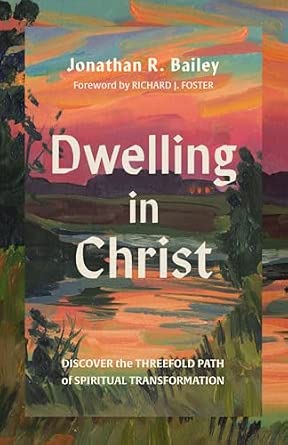
Jonathan R. Bailey’s Dwelling in Christ enters an increasingly crowded field of books on spiritual formation while managing to recover something many contemporary treatments have lost: the conviction that Christian transformation is not primarily an event to be experienced, a theological position to be affirmed, or a technique to be mastered, but a life to be inhabited. Bailey’s argument is deceptively simple. Christians are not merely converted to Christ; they are invited to become like Christ. That becoming ordinarily unfolds slowly, unevenly, relationally, and communally. To describe this process Bailey retrieves the ancient threefold way of purgation, illumination, and union, presenting it not as an esoteric mystical technology but as a grammar for understanding the ordinary Christian life.
Bailey writes within a recognizable stream of contemporary spiritual formation associated especially with Dallas Willard, Richard Foster, Renovaré, and the retrieval of historic Christian disciplines. Yet Dwelling in Christ is more than a repackaging of Willardian formation. Its deeper conversation partners include Gregory of Nyssa, John Climacus, Benedict of Nursia, the Desert Fathers and Mothers, Teresa of Ávila, Thomas à Kempis, Evelyn Underhill, Kallistos Ware, Thomas Merton, George MacDonald, and several voices from Eastern Christian spirituality. Bailey therefore occupies an interesting middle ground. This is not an academic monograph on ascetical theology, patristic anthropology, or participation in Christ. It is instead a pastoral retrieval of those traditions for Christians who may never read The Ladder of Divine Ascent, The Life of Moses, or The Interior Castle themselves. That accessibility is one of the book’s principal strengths.
From Conversion as Moment to Conversion as Way
The autobiographical opening is particularly effective. Bailey remembers repeatedly “getting saved,” responding to invitations, praying conversion prayers, and expecting these moments to produce an immediate transformation that never quite materialized. His concern is not to demean evangelical conversion or deny the significance of decisive encounters with Christ. Rather, he exposes the inadequacy of a Christianity that knows how to invite someone across the threshold but possesses little theology for the long hallway beyond it.
Here Bailey touches a significant weakness within some expressions of modern evangelicalism. The New Testament certainly contains decisive moments of repentance, baptism, reception of the Spirit, and allegiance to Jesus, yet its dominant language of discipleship is strikingly developmental: walk, follow, abide, grow, bear fruit, put off, put on, be renewed, become mature, run the race, endure, and be transformed. Conversion may have a beginning, but discipleship resists reduction to a beginning.
Bailey’s threefold way gives conceptual shape to that biblical instinct. Purgation concerns the relinquishment of distorted desires and attachments. Illumination involves an increasing awareness of God, ourselves, and the life toward which grace is drawing us. Union describes an ever-deepening participation in the divine life in which the human will is increasingly harmonized with the character and purposes of God. Importantly, Bailey refuses to turn these into rigid sequential stages. Purgation, illumination, and union overlap, recur, and spiral through the Christian life. One does not graduate permanently from purgation; old attachments may surface even amid considerable spiritual maturity. Likewise, moments of profound communion with God may occur surprisingly early in the journey.
This prevents the threefold way from becoming precisely the kind of formula Bailey is attempting to replace.
The progression also gives the book its elegant architecture. Purgation moves from quick fixes toward training, from certainty toward the mystery encountered through affliction, and from perfectionism toward patient progress in temptation. Illumination moves toward a rule of life, prayer, and humility. Union then redirects the mature Christian away from the need to be seen and toward seeing others, away from control and toward charity, and finally away from the illusion of spiritual arrival toward what Gregory of Nyssa described as epektasis, the endless movement of the creature into the inexhaustible life of God.
That final refusal of arrival may be the book’s most important contribution. Christian maturity, for Bailey, is not the point at which one finally becomes impressive. It is the point at which one increasingly forgets the need to be impressive at all.
Image, Likeness, and the Human Vocation
One of Bailey’s most compelling theological moves appears in his discussion of Genesis 1:26. Drawing particularly upon Kallistos Ware and the Eastern tradition, Bailey distinguishes between the divine image as gift and divine likeness as vocation: humanity begins in the image and journeys toward likeness. The image is given; likeness is developed.
This is historically rich Christian theology, though a careful exegetical distinction is useful. The Hebrew terms ṣelem (“image”) and dĕmût (“likeness”) in Genesis 1:26 should probably not be pressed into two entirely distinct anthropological categories on grammatical grounds alone. Ancient Near Eastern studies have increasingly emphasized the royal background of “image” language. Kings could function as images or earthly representatives of a deity; Genesis astonishingly extends this representative vocation to humanity as humanity.¹ Humanity is therefore not merely given some invisible metaphysical quality called the imago Dei. Humans are commissioned to image the Creator within creation.
This ANE texture actually strengthens Bailey’s formative vision.
If imaging God is a vocation rather than merely a possession, then Christlikeness concerns more than private moral improvement. Human beings become increasingly faithful images by representing God’s character and wise rule within the world. The movement from image toward likeness can therefore be understood canonically as the restoration of humanity’s original vocation. Purgation removes those allegiances and desires that deform the image; illumination teaches us to perceive creation and neighbor through the light of God; union increasingly conforms human action and desire to the self-giving life revealed in Christ.
Bailey’s emphasis on becoming “fully human” belongs naturally within this framework. Salvation is not God rescuing humans from humanity but restoring humanity to what humanity was created to become.
Dwelling, Temple, and Divine Presence
The title itself invites another biblical-theological layer that remains somewhat underdeveloped in the book. Bailey primarily uses “dwelling in Christ” relationally and spiritually. Yet Scripture possesses an enormous theology of divine dwelling that stretches from Eden through tabernacle and temple, into the incarnation, the Spirit-filled church, and finally the new creation.
Within the ancient world, temples represented the earthly dwelling places of divine presence. Israel shared this broad cultural vocabulary while simultaneously transforming it: YHWH could not be contained within a human structure (1 Kgs 8:27), yet God graciously chose to place his presence among his covenant people. The tabernacle thus becomes a portable Eden-like sanctuary; the Jerusalem temple becomes the concentrated locus of divine presence; prophetic hope anticipates the restoration and expansion of that presence; John presents Jesus himself as the true temple (John 2:19–21); Paul describes both the gathered church and the believer as God’s temple (1 Cor 3:16; 6:19); and Revelation culminates not in humanity escaping earth for heaven but in God’s dwelling descending to humanity until creation itself becomes sanctuary (Rev 21:1–3, 22).²
Read against this canonical trajectory, Bailey’s language of dwelling becomes even richer. Spiritual formation is not merely the effort to become a better religious person. It is life lived within the presence of God and increasingly permeated by that presence. The biblical movement is not simply humanity trying to ascend toward God but God coming to dwell with humanity and humanity being transformed because God has made his dwelling among and within them.
This also guards ascetical spirituality against becoming anthropocentric. Purgation, illumination, and union are never techniques by which human beings climb successfully into the divine realm. They are responses to divine initiative. Grace precedes the journey, accompanies the journey, and finally constitutes its destination.
The distinction matters. Christian ascent is possible only because God has first descended.
Participation and Union with Christ
Bailey’s treatment of union also resonates fruitfully with contemporary New Testament scholarship. Pauline theology in particular has experienced renewed interest in the participatory dimensions of salvation. Constantine Campbell has demonstrated the pervasive character of Paul’s “in Christ,” “with Christ,” incorporation, participation, and identification language; Grant Macaskill has argued that New Testament union should be understood covenantally and christologically, mediated through Jesus the covenant Messiah; Michael Gorman has pressed further into the participatory and cruciform dimensions of Pauline soteriology.³ Macaskill describes New Testament union as covenantal participation in the life of God mediated through Christ. Bailey’s language sits comfortably within this recovery. Christianity is more than believing truths about Christ. It involves participation in Christ.
John 15 therefore becomes particularly significant. The vine and branches do not present discipleship principally as imitation at a distance. Branches bear fruit because they abide (menō) in the vine. Likewise, Paul can speak of believers being crucified with Christ (Gal 2:19–20), dying and rising with Christ (Rom 6:1–11), being incorporated into Christ’s body (1 Cor 12:12–27), and being transformed “from glory to glory” by the Spirit (2 Cor 3:18). Participation precedes transformation. The branch becomes fruitful because it shares the life of the vine. This provides perhaps the strongest exegetical foundation for Bailey’s rejection of performance-based Christianity. Christian obedience is not an attempt to manufacture the life of Christ independently. It is the embodied manifestation of a life already being received from Christ.
Perfection, Teleios, and the Shape of Love
Bailey’s treatment of Matthew 5:48 is also pastorally valuable: “Be perfect, therefore, as your heavenly Father is perfect.” He rightly resists the common assumption that Jesus demands neurotic moral flawlessness. The immediate context is enemy-love: the Father gives sun and rain indiscriminately, and the disciples are called to embody that same boundary-breaking generosity.
A small exegetical qualification actually sharpens Bailey’s point. The Greek teleios should not be defined merely through an etymological relationship to telos, as though its lexical meaning were simply “fulfilling one’s purpose.” In context it carries the sense of completeness, maturity, or wholeness. Yet this makes Bailey’s theological conclusion stronger rather than weaker. Jesus is calling his followers toward an undivided love—a love that does not love friends while withholding itself from enemies. “Perfection” in Matthew 5 is the wholeness of a person whose love increasingly resembles the indiscriminate generosity of the Father. Formation, then, is not perfectionism. Perfectionism obsessively watches the self. Christlike maturity increasingly liberates the self to love the other.
This distinction runs throughout Dwelling in Christ and gives the book considerable pastoral power. The Christian who is constantly measuring his or her spiritual performance may appear serious about holiness while remaining profoundly self-absorbed. Bailey instead asks what would happen if holiness were measured less by spiritual self-consciousness and more by the increasing capacity to love. The question is worth lingering over.
Ancient Wisdom Without Antiquarianism
Bailey is particularly successful when introducing ancient Christian voices without treating antiquity as automatically authoritative. Gregory of Nyssa, Climacus, Benedict, the Desert Fathers and Mothers, à Kempis, Teresa, Fénelon, and Underhill appear as companions rather than museum exhibits. Bailey retrieves practices and categories because they help illuminate the journey toward Christlikeness.
In this respect, Dwelling in Christ belongs beside Richard Foster’s Celebration of Discipline and Dallas Willard’s The Spirit of the Disciplines and The Divine Conspiracy, though Bailey’s explicit threefold structure distinguishes his contribution. Evelyn Underhill’s Mysticism provides an obvious historical analogue, while Gregory’s Life of Moses and Climacus’s Ladder represent much older accounts of the soul’s ascent. Bailey himself acknowledges this lineage, including Dante and Bunyan among the spiritual itineraries that portray Christian existence as pilgrimage rather than static possession.
Yet his book remains thoroughly contemporary. Personal stories, failures, family life, suffering, prayer, ambition, the need for recognition, and ordinary relationships prevent the ancient vocabulary from drifting toward abstraction. This is important because Christian formation literature can sometimes make spiritual maturity sound strangely disembodied. Bailey repeatedly pulls it back toward the ordinary: listening to another person, becoming interruptible, relinquishing recognition, learning patience, establishing rhythms of prayer, loving the people immediately before us. The saint is not necessarily the spectacular Christian. The saint may simply be the person whose presence has become safe for others.
Pastoral Shepherding: From Producing Decisions to Forming People
For pastors and ministry leaders, this may be where Dwelling in Christ becomes most consequential. Much of modern ministry has been organized around moments: the salvation decision, the altar call, the baptism, the conference, the sermon series, the retreat, the emotional breakthrough, the new program. None of these things are inherently wrong. Scripture itself contains decisive moments. The danger comes when shepherds become skilled at producing moments but remain poorly equipped to accompany people through years.
Shepherding is necessarily slower. A shepherd cannot shout a sheep into maturity. A pastor cannot preach someone instantly through purgation, illumination, and union. Formation takes place through Scripture, Spirit, suffering, community, table, confession, correction, imitation, prayer, forgiveness, repeated obedience, and time. Bailey’s treatment of spiritual direction becomes particularly important here. Mature believers eventually become people capable of attending to others. The movement toward union is therefore not an escape into private mystical experience. Its fruit is relational. Those who dwell deeply in Christ become people capable of making space for another person’s life before God. This may offer a needed corrective to contemporary conceptions of pastoral leadership.
The New Testament shepherd is not primarily a religious entrepreneur, content producer, organizational executive, or platform personality. The shepherd knows the sheep (John 10). Elders live among the flock as examples capable of imitation (1 Pet 5:1–4). Paul can therefore tell communities not merely to believe what he teaches but to imitate the pattern of life they have witnessed in him (1 Cor 11:1; Phil 3:17; 4:9). Formation travels relationally.
Bailey’s discussion of mimēsis makes this point particularly well. People learn Christianity partly by inhabiting life beside people who have themselves learned Christ. The pastor’s life therefore inevitably becomes part of the congregation’s curriculum. That should both humble and sober anyone entrusted with shepherding. The question is no longer merely, Did I preach the correct sermon? It becomes:
What kind of people are we becoming together? Are our churches producing people who need to be noticed, or people capable of noticing others? Are we creating increasingly anxious religious performers, or men and women learning to rest in the life of Christ? Are we measuring maturity by biblical information, institutional loyalty, gifting, visibility, and activity—or by patience, courage, humility, reconciliation, generosity, enemy-love, faithfulness, and increasing freedom from the tyranny of self? And perhaps most searchingly: Would living closely beside the leaders of our churches actually help someone become like Jesus? That is the pastoral weight of Bailey’s project.
Conclusion
Dwelling in Christ is ultimately a hopeful book because it removes transformation from the frantic timetable of religious performance. Bailey reminds readers that Christian maturity is neither instantaneous nor mechanical. We are being formed within a relationship that precedes us, sustains us, and will finally outlast death itself. Purgation, illumination, and union are not techniques for becoming spiritually impressive; they describe the long schooling of desire through which grace teaches human beings how to love. There are places where the biblical theology could be developed further. The ANE and canonical background of divine dwelling could deepen the book’s central metaphor. Genesis 1’s image-language could be connected more explicitly to humanity’s representative vocation. Pauline participation could give the category of union a fuller exegetical scaffolding. Yet these are less deficiencies than openings created by a book that succeeds in making ancient Christian formation accessible again. Bailey has not written a technical theology of union with Christ, nor an exhaustive history of Christian spirituality. He has done something more pastoral. He has placed an old path back in front of ordinary Christians and invited them to walk it. For shepherds, that invitation may be especially timely.
The church does not merely need pastors capable of gathering crowds, explaining texts, defending doctrines, or leading organizations. It needs men and women who have remained with Christ long enough that his life has begun to become visible in theirs. It needs shepherds who understand that sanctification cannot be hurried, that suffering cannot always be explained, that people cannot be reduced to projects, and that maturity frequently looks less like certainty and more like patient, self-giving love.
Perhaps the great pastoral task, then, is not simply convincing people to come to Christ. It is teaching them how to dwell there. And then remaining beside them long enough that, together, we begin to look like the One in whom we dwell.

Notes
- John H. Walton, Ancient Near Eastern Thought and the Old Testament: Introducing the Conceptual World of the Hebrew Bible, 2nd ed. (Grand Rapids: Baker Academic, 2018).
- On the canonical development of the divine-dwelling motif, see G. K. Beale, The Temple and the Church’s Mission: A Biblical Theology of the Dwelling Place of God, NSBT 17 (Downers Grove, IL: InterVarsity Press, 2004);
- Constantine R. Campbell, Paul and Union with Christ: An Exegetical and Theological Study (Grand Rapids: Zondervan, 2012)
- Gregory of Nyssa, The Life of Moses, trans. Abraham J. Malherbe and Everett Ferguson, Classics of Western Spirituality (New York: Paulist Press, 1978).
- John Climacus, The Ladder of Divine Ascent, trans. Colm Luibheid and Norman Russell, Classics of Western Spirituality (New York: Paulist Press, 1982).
- Evelyn Underhill, Mysticism: A Study in the Nature and Development of Spiritual Consciousness (London: Methuen, 1911).
- Dallas Willard, The Spirit of the Disciplines: Understanding How God Changes Lives (San Francisco: Harper & Row, 1988)
- The threefold language of purgation, illumination, and union has a complex history and should not be imagined as a single rigid developmental scheme. Within the Christian mystical tradition, the three movements have often been understood as overlapping or mutually implicating rather than as strictly successive spiritual ranks. Bailey’s refusal to make them mechanically sequential is therefore one of the strengths of his retrieval.

