NOTE from Dr. Will Ryan: I’ve been spending a lot of time in the Psalms lately, and the deeper I go, the more I think we’ve often read them too clean—almost like every line is a direct “thus says the Lord.” But when you slow down, you realize you’re stepping into very real, very human prayers. David isn’t polished… he’s complicated, inconsistent at times, even a bit of a mess—and yet that’s exactly where the theology is happening. That tension is what’s been drawing me in. Writers like Walter Brueggemann (The Message of the Psalms) and John Goldingay (Psalms, Volume 1) have helped recover that—reminding us that these texts are meant to be prayed, wrestled with, and lived, not just systematized. So I was really interested to work through Duane Garrett’s Psalms 1–72 and see how he handled that same tension.
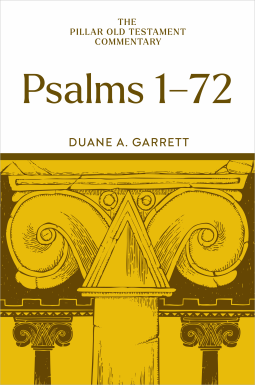
Duane A. Garrett’s contribution to the Pillar Old Testament Commentary series on Psalms 1–72 represents a mature and carefully executed work of exegetical restraint, literary sensitivity, and theological coherence. The volume exemplifies the best of the Pillar ethos: a sustained engagement with the Hebrew text, attentiveness to canonical shaping, and a refusal to collapse the Psalter into either purely devotional reflection or overly speculative critical reconstructions. Garrett’s work stands as a significant resource for pastors, scholars, and students seeking to read the Psalms as Scripture—historically grounded, literarily rich, and theologically generative.
Methodological Clarity and Restraint
One of the most commendable features of Garrett’s commentary is methodological clarity. He consistently resists the temptation to impose rigid form-critical classifications where the text itself resists such categorization. His treatment of Psalm 23 is emblematic: while often labeled a “psalm of trust,” Garrett notes that such a designation does not arise from the psalm’s formal structure but rather from its content, and thus should not be overly determinative for interpretation.¹ This measured approach reflects a broader hermeneutical discipline—Garrett allows the text’s poetic and theological movement to define its meaning rather than subordinating it to inherited scholarly categories.
In this respect, Garrett’s work may be fruitfully contrasted with earlier form-critical approaches, particularly those of Hermann Gunkel, who sought to classify psalms into fixed genres with corresponding Sitz im Leben.² While Gunkel’s contributions remain foundational, Garrett’s approach reflects a more textually grounded and canonically attentive posture, aligning more closely with recent movements in Psalms scholarship that emphasize literary shape and theological coherence.³
Literary Sensitivity and Structural Insight
Garrett’s literary attentiveness is particularly evident in his treatment of Psalm 23. Rather than reading the psalm as a loosely connected series of comforting images, he demonstrates its carefully structured progression. The psalm unfolds as a sequence of experiential affirmations: provision, restoration, guidance, protection, and ultimately vindication.⁴ Each clause functions as part of a cumulative theological confession rather than as an isolated metaphor.
Most notably, Garrett underscores the critical shift in imagery from shepherd (vv. 1–4) to host (vv. 5–6).⁵ This transition is not merely stylistic but theological. The psalmist moves from being guided through danger to being honored in the presence of enemies. Garrett’s insistence that the “table” is a literal table and not a metaphorical extension of shepherd imagery is particularly important.⁶ This observation corrects a common interpretive tendency to homogenize the psalm’s imagery and instead preserves its dynamic movement.
Here Garrett’s reading stands in productive dialogue with scholars such as Walter Brueggemann, who emphasizes the existential and theological tensions within the Psalter, though often with a more thematic and less textually granular focus.⁷ Garrett, by contrast, grounds his theological observations firmly in close textual analysis, allowing the structure of the psalm itself to carry theological weight.
Lexical Precision and Theological Depth
Garrett’s handling of key Hebrew terms demonstrates both philological care and theological sensitivity. His discussion of ṣalmāwet (“shadow of death”) in Psalm 23:4 is exemplary. While acknowledging the term’s metaphorical extension to “deep darkness,” he rightly insists that the semantic field retains the connotation of death itself.⁸ This preserves the existential gravity of the psalm: the danger faced by the psalmist is not merely psychological but potentially mortal.
Similarly, his treatment of the “rod” (šēbeṭ) and “staff” (mišʿenet) resists sentimental readings. These are not merely comforting symbols but instruments of protection and authority, reflecting the active involvement of YHWH in safeguarding his people.⁹ Such observations align with broader ANE conceptions of kingship and shepherding, wherein the shepherd’s role includes both care and defense.¹⁰
Garrett’s lexical work here may be compared with that of Hans-Joachim Kraus, whose commentary similarly attends to the theological significance of Hebrew terminology but often situates it more explicitly within cultic and historical reconstructions.¹¹ Garrett’s contribution lies in maintaining lexical rigor while integrating it seamlessly into a canonical and theological reading.
Canonical Function and Theological Trajectory
A further strength of Garrett’s commentary is his attentiveness to the canonical function of individual psalms. Psalm 23, for example, is not treated in isolation but as part of a broader theological trajectory within the Psalter. His observations implicitly resonate with the programmatic role of Psalms 1–2 as an introduction to the entire collection, wherein the way of the righteous is set in contrast to the way of the wicked.¹² Psalm 23 may thus be read as an embodiment of that righteous path—a lived experience of trust amid adversity.
Garrett’s handling of Psalm 22 further illustrates his canonical sensitivity. He carefully distinguishes between the historical experience of David and the later christological appropriation of the psalm, noting that while certain elements may find deeper fulfillment in the New Testament, the psalm itself arises from a concrete historical context.¹³ This balanced approach avoids both reductionism and overextension, allowing the psalm to function typologically without collapsing its original meaning.
In this regard, Garrett’s work aligns with scholars such as John Goldingay, who similarly emphasize the integrity of the psalm’s original context while acknowledging its ongoing theological significance.¹⁴ Yet Garrett’s prose remains more concise and his argumentation more tightly tethered to the textual details.
Theological Coherence and Pastoral Utility
Although firmly academic in tone, Garrett’s commentary consistently gestures toward theological coherence and pastoral application. His discussion of the concluding line of Psalm 23—“I will dwell in the house of YHWH”—is illustrative. He notes the textual and translational complexities, including the possibility that the verb may be read as “return” rather than “dwell.”¹⁵ This ambiguity, rather than being a problem, enriches the theological reading: the psalmist’s relationship with YHWH is characterized not by static residence but by ongoing return.
Such insights carry significant pastoral implications. The life of faith is not depicted as uninterrupted stability but as a continual reorientation toward God’s presence. Garrett’s ability to draw out these implications without lapsing into homiletical excess is a hallmark of the volume.
Conclusion
Garrett’s Psalms 1–72 ultimately serves the Church not merely as a technical resource, but as a faithful guide into the lived theology of Israel’s worship. What emerges from his careful work is not simply a clearer understanding of Hebrew poetry, but a renewed vision of what it means to walk with God in the midst of real life—through provision and lack, confidence and fear, clarity and ambiguity. His refusal to flatten the Psalms into either rigid categories or sentimental devotion allows them to speak with their full weight, forming both mind and heart.
There is a quiet integrity to Garrett’s approach that pastors and teachers will find deeply helpful. He does not rush the text, nor does he force it to answer questions it is not asking. Instead, he models a kind of patient attentiveness that invites the reader to listen—to the language, to the structure, and ultimately to the voice of God as it is mediated through the faithful witness of Scripture. In doing so, he helps recover the Psalms not as abstract theology, but as the language of prayer, struggle, trust, and worship for the people of God.
For the life of the Church, this is no small gift. In a time when Scripture is often either over-systematized or under-read, Garrett offers a path forward that is both intellectually responsible and spiritually nourishing. His work reminds us that the Psalms are not prescriptions to be dissected, but prayers to be inhabited. They give us words when we lack them, shape our affections, and anchor our trust in the character of YHWH—even when the path leads through darkness.
There is, throughout the volume, a steady confidence in the reliability and coherence of the biblical text, paired with a humility about the limits of our own interpretive control. That balance is deeply needed. It allows the Church to approach Scripture with both conviction and openness—trusting its witness while remaining attentive to its depth and complexity.
In the end, Garrett has given the Church something enduring: a commentary that can be studied with rigor, taught with confidence, and prayed with sincerity. It is the kind of work that does not draw attention to itself, but quietly strengthens the reader’s engagement with Scripture and, in doing so, deepens their communion with God.

Footnotes
- Duane A. Garrett, Psalms 1–72, Pillar Old Testament Commentary (Grand Rapids: Eerdmans, 2023), 245.
- Hermann Gunkel, The Psalms: A Form-Critical Introduction (Philadelphia: Fortress, 1967), 13–15.
- See, e.g., Gerald H. Wilson, The Editing of the Hebrew Psalter (Chico, CA: Scholars Press, 1985), 204–205.
- Garrett, Psalms 1–72, 246.
- Ibid., 249.
- Ibid.
- Walter Brueggemann, The Message of the Psalms (Minneapolis: Augsburg, 1984), 19–21.
- Garrett, Psalms 1–72, 249.
- Ibid.
- See ANET, “Hymn of Victory of Mer-ne-Ptah,” in James B. Pritchard, ed., Ancient Near Eastern Texts (Princeton: Princeton University Press, 1969), 378–79.
- Hans-Joachim Kraus, Psalms 1–59, trans. Hilton C. Oswald (Minneapolis: Fortress, 1993), 304–305.
- Cf. Gerald H. Wilson, Psalms Volume 1 (NIVAC; Grand Rapids: Zondervan, 2002), 123.
- Garrett, Psalms 1–72, 244.
- John Goldingay, Psalms, Volume 1 (Grand Rapids: Baker Academic, 2006), 45–46.
- Garrett, Psalms 1–72, 247.