
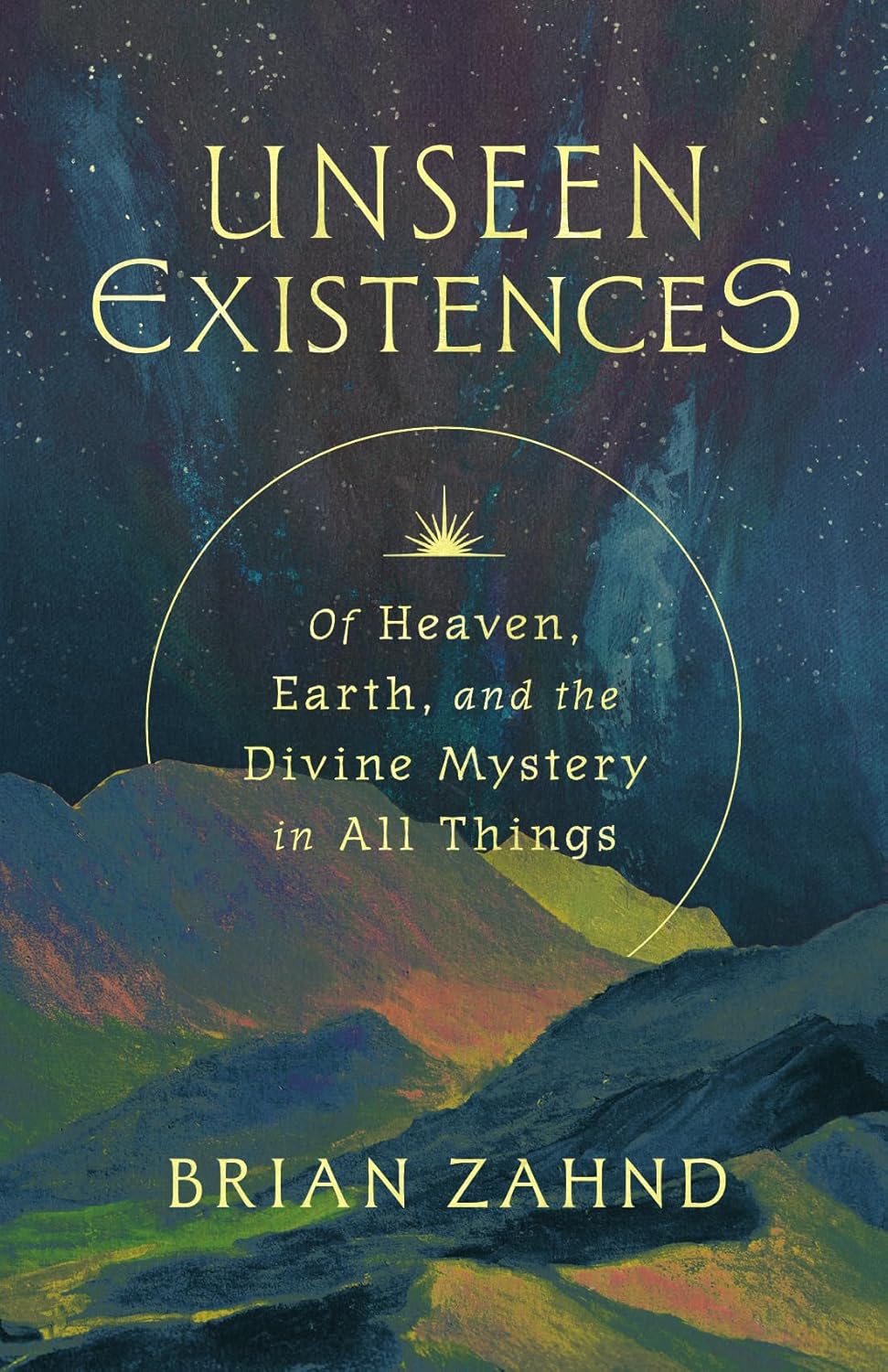
A faith starved of wonder becomes thin religion. My review of Unseen Existences explores how Brian Zahnd calls us back to beauty, mystery, and the nearness of heaven in Christ. If you’re weary of shallow Christianity, this may be the book you need right now.
Unseen Existences
Of Heaven, Earth, and the Divine Mystery in All Things
by Brian Zahnd
In Unseen Existences, Brian Zahnd offers what may be one of his most luminous and mature theological works to date. Written with the cadence of a poet, the instincts of a pastor, and the depth of a seasoned theologian, Zahnd invites readers to recover a sacramental imagination in an age flattened by materialism and utility. If many contemporary Christian books seek to make faith practical, Zahnd seeks something more urgent: to make faith beautiful again.
The central burden of the volume is clear from its opening pages. Zahnd contends that modern Western consciousness has become spiritually disenchanted, unable to perceive the invisible realities that earlier Christian generations assumed as basic to existence. In response, he calls readers back into a world where heaven is not merely a postmortem destination but an ever-present dimension of divine reality enfolded within creation.¹ This is not escapism, but retrieval. Zahnd’s project stands in continuity with the patristic and medieval tradition, where heaven and earth were understood as interpenetrating spheres rather than isolated realms.²
One of the great strengths of the book is Zahnd’s prose. Few contemporary theological writers combine accessibility and elegance so effectively. His sentences often read like homiletical meditations, yet beneath the warmth lies substantial intellectual architecture. Zahnd draws freely from Gregory of Nazianzus, Augustine of Hippo, Pope Benedict XVI, C. S. Lewis, Hans Boersma, and Rudolf Otto, weaving them into a coherent spiritual vision rather than deploying them as decorative citations.³ His use of these voices demonstrates that Christian reflection on transcendence is not nostalgic fantasy but part of the church’s deepest inheritance.⁴
Particularly compelling is Zahnd’s treatment of wonder. He argues that wonder is not childish naivete but a mode of spiritual perception, one dulled by modern reductionism. In a culture trained to explain everything and adore nothing, Zahnd insists that mystery is not the enemy of truth but one of its necessary companions.⁵ His reflections on beauty, mountains, liturgy, and incarnation become a sustained apologetic for reverence. Readers formed by mechanistic religion or sterile skepticism will find these chapters deeply refreshing.
Equally noteworthy is Zahnd’s Christological center. Though the book explores angels, heaven, mystery, pilgrimage, and unseen realities, it never dissolves into vague spirituality. Again and again, Zahnd returns to the incarnation: “the Word became flesh” as the supreme wonder through which all lesser wonders are interpreted.⁶ This grounding in Christ prevents the book from drifting into speculative mysticism. Heaven is meaningful because Christ has come from heaven and unites heaven and earth in himself.⁷
Zahnd also offers an implicit critique of both progressive secularism and reactionary fundamentalism. He challenges materialist assumptions on one side while exposing the shallow pragmatism of modern church culture on the other. His criticism of utilitarian sermons, politicized Christianity, and proof-text apologetics is incisive and timely.⁸ In this respect, Unseen Existences functions not only as spiritual theology but as cultural diagnosis.
If there is any limitation, it is one common to Zahnd’s corpus: his style often privileges evocative synthesis over rigorous analytical distinction. Readers seeking detailed metaphysical argumentation or sustained exegetical engagement with contested texts may desire more formal development. Yet this critique must be measured carefully. Zahnd is not writing scholastic manuals; he is attempting to awaken imagination and devotion. Judged by that aim, the book succeeds brilliantly.⁹
Indeed, what makes Unseen Existences so valuable is that it addresses a crisis many feel but cannot name. Contemporary people often possess information without wisdom, connectivity without communion, distraction without delight. Zahnd names this as disenchantment and responds with a distinctly Christian re-enchantment rooted in worship, wonder, sacrament, and the lordship of Christ.¹⁰
In the final analysis, Unseen Existences is one of Brian Zahnd’s finest achievements. It is pastoral without sentimentality, intellectual without pretension, mystical without vagueness, and prophetic without shrillness. Zahnd has written a book that reminds readers that the Christian faith is not merely about surviving the world, but learning to see it rightly. For those weary of thin religion and hungry for transcendence, this work will feel like water in a dry land.¹¹
It deserves a wide readership among pastors, students, and thoughtful laypersons alike. In an age that has forgotten heaven, Brian Zahnd teaches us again to look up.¹²
BUY HERE: https://a.co/d/08x0nYvp
Unseen Existences – InterVarsity Press

Notes
- Brian Zahnd, Unseen Existences (Downers Grove, IL: IVP, 2026), Prelude, 1–4.
- Ibid., 2–3.
- Ibid., 3–4.
- Ibid., chap. 1.
- Ibid., chap. 2, “Into the Wonder.”
- Ibid., 27–30.
- Cf. The Gospel of John 1:14.
- Zahnd, Unseen Existences, 10–16, 32–36.
- Ibid.
- Ibid., Prelude and chap. 1.
- Ibid., chaps. 1–2.
- Ibid., Conclusion.

