
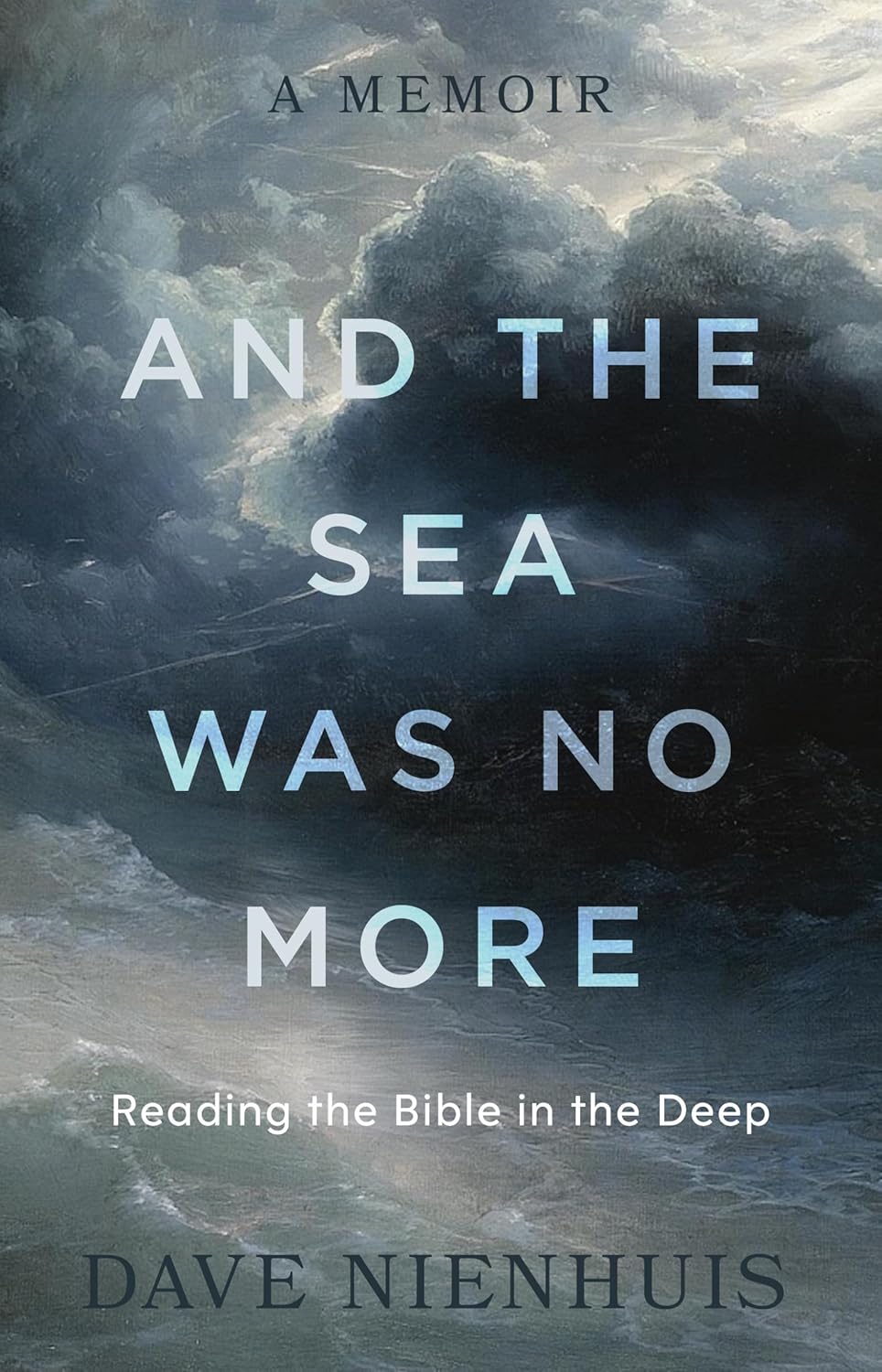
Some books inform the mind. Others steady the soul. And the Sea Was No More explores how Scripture speaks into chaos, suffering, and the deep waters of life with uncommon beauty and hope. If you’ve walked through storms, this book may help you see God there.
And the Sea Was No More: Reading the Bible in the Deep
by Dave Nienhuis (Author)
Wm. B. Eerdmans, 2026.
Dave Nienhuis’s And the Sea Was No More is a rare achievement: a work at once academically responsible, pastorally luminous, autobiographically vulnerable, and canonically ambitious. In an age where many books choose between scholarly rigor and existential relevance, Nienhuis refuses the dichotomy. He writes as a trained biblical scholar, yet also as one acquainted with panic, trauma, spiritual disorientation, and the long interior work of healing. The result is a volume that reads not merely as exegesis, nor merely as memoir, but as theological testimony shaped by the scriptural imagination.¹
The controlling metaphor of the book is “the Deep”—the sea as symbol of chaos, overwhelm, terror, death, and creaturely vulnerability. This motif is traced from Genesis through Revelation, culminating in the eschatological promise that “the sea was no more” (Rev 21:1).² Nienhuis’s central claim is not simplistic allegory. Rather, he argues that Scripture itself repeatedly uses waters, depths, floods, storms, and abyssal imagery as theological grammar through which suffering humanity may interpret existence.³ This insight is both exegetically persuasive and pastorally potent.
Canonical Symbolism and the Waters of Chaos
Nienhuis’s use of the sea motif stands firmly within established biblical scholarship. The primordial waters of Genesis 1, the Leviathan traditions of Job and Psalms, the Red Sea deliverance narrative, Jonah’s descent, the storm narratives of the Gospels, and Revelation’s sea-beast imagery all contribute to a rich symbolic network.⁴ John Walton and others have shown that ancient Near Eastern cosmologies often used watery chaos as shorthand for forces hostile to ordered life.⁵ Israel’s Scriptures do not simply mimic these traditions but radically subordinate chaos to the sovereignty of YHWH. Nienhuis draws fruitfully from this symbolic inheritance.
Yet one of the strengths of the volume is that the author never allows symbol to remain abstract. The “Deep” becomes a category for panic attacks, emotional collapse, shame, alienation, bodily dysregulation, and the sensation of drowning psychologically while remaining outwardly functional.⁶ This move places Nienhuis in fruitful conversation with trauma theologians such as Shelly Rambo, who argue that Christian theology must learn to speak meaningfully from within unresolved suffering rather than only after it.⁷
Memoir as Hermeneutical Method
The autobiographical material is not ornamental; it is hermeneutically generative. Nienhuis’s recollections of church life, fear-laden religious imagery, and later emotional breakdowns are woven into the interpretive process itself. For example, his chapter “This Do in Remembrance of Me” recounts a childhood encounter with sacred distance, ecclesial awe, and punitive fear before later re-reading sacrament and embodiment through grace.⁸ Such passages could have devolved into sentimentality. Instead, they function more like Augustine’s Confessions or Thomas Merton’s memoir-theology: personal history becomes a site where doctrinal language is tested.⁹ This methodological move is commendable. Too much academic theology speaks as if no body suffers, no memory trembles, and no child misheard the gospel. Nienhuis reminds readers that interpretation always happens in lived space.
Pauline Theology Reframed Through Descent and Participation
The most theologically generative portions of the work are arguably those engaging Paul. He highlights multiple Pauline images: ransom, gift, sacrifice, baptismal union, cruciform imitation, weakness, and participatory embodiment.¹⁰ In his chapter “At-One-Ment,” he argues that later atonement debates often isolate Pauline metaphors from their larger tapestry.¹¹ This is an important corrective. Here Nienhuis stands near scholars such as Michael Gorman, who has persuasively argued that Paul’s gospel is fundamentally participatory and cruciform.¹² The author’s treatment of Philippians 2 and Philippians 3 is particularly strong. Rather than reading resurrection power as triumphal ascent, he interprets Paul as calling believers downward into self-emptying love, where exaltation is God’s gift rather than human acquisition.¹³ His social reading of boasting, honor, and status in Roman culture is equally compelling.¹⁴ This aligns with work by Bruce Winter, David deSilva, and John Barclay regarding honor economies, patronage, and status negotiation in Pauline communities.¹⁵ Nienhuis perceptively shows that much modern religiosity still operates through curated success, image management, and spiritual boasting. The diagnosis is incisive.
Baptism, Embodiment, and the Dying Life
Several of the most memorable pages concern baptism and embodiment. Nienhuis reads Romans 6 not simply as doctrinal symbol but as the enactment of a recurring biblical pattern: descent preceding life, burial preceding rising, surrender preceding communion.¹⁶ Baptism becomes not only initiation but pedagogy—a lifelong pattern of dying and rising. Likewise, his reflections on bodily life as “living sacrifice” (Rom 12:1) are excellent.¹⁷ He rightly notes the paradox: sacrifice in Christian terms is not annihilation but animated self-offering. This echoes patristic and Pauline traditions in which holiness is not escape from embodiment but transformed bodily participation.¹⁸ Such themes are pastorally urgent. Many Christians have inherited dualisms in which the body is either idolized or ignored. Nienhuis offers a better path: embodiment as the place where grace is practiced, trauma is carried, breath is restored, and communion is learned.
Pneumatology and Cooperative Grace
One of the more refreshing dimensions of the book is its treatment of the Holy Spirit. Nienhuis rejects notions of divine possession or coercive spirituality. Instead, he describes the Spirit’s work as cooperative, relational, and interiorly strengthening.¹⁹ God acts for us in Christ and in us / with us by the Spirit. This is elegant theology. His exposition of Romans 8—Spirit-bearing witness, helping weakness, interceding with groans—is pastorally rich and exegetically grounded.²⁰ In many traditions the Spirit is reduced either to ecstatic spectacle or vague sentiment. Nienhuis recovers a Pauline pneumatology of companionship amid frailty.
Style and Literary Achievement
Stylistically, the prose is frequently beautiful. Nienhuis writes with a cadence uncommon in modern academic religion. Sentences are memorable without becoming ornamental. Images linger. The chapters often begin with conceptual clarity and end in contemplative resonance. This literary quality matters. Theology should not only be correct; it should be fittingly spoken. The structure also serves the argument well. Short titled chapters—“Weakness,” “Breathing,” “Baptism,” “Embodiment,” “Completing What Is Lacking”—allow readers to move through the work meditatively while still sensing cumulative coherence.²¹
Constructive Questions
No serious review should omit areas for further discussion. Specialists may desire more explicit engagement with contemporary trauma psychology in places where experiential claims are made. Others may wish for a more robust treatment of lament psalms or a fuller interaction with apocalyptic literature beyond Revelation 21. Some readers from confessional traditions may also want clearer ecclesiological implications: How should congregations concretely embody this theology of the Deep? Yet these are not defects so much as invitations. The book succeeds precisely because it opens further avenues of reflection.
Final Assessment
And the Sea Was No More is one of those uncommon works that scholars can respect and wounded readers can inhabit. It offers neither cheap optimism nor sterile technique. Instead, Nienhuis gives readers a scripturally saturated vision in which God meets human beings not only on mountaintops but in depths. He reminds the church that the Bible’s waters of chaos are not relics of ancient cosmology; they are mirrors of panic, grief, oppression, shame, and mortality. More importantly, he proclaims that the God who hovered over the waters, parted the sea, walked upon the waves, entered death, and raised Jesus from the abyss has not abandoned those who drown now. We warmly commend the volume to pastors, counselors, seminary students, spiritual directors, and all readers who suspect that faith must be able to breathe underwater before it deserves to be called hope.²²
Notes
- Dave Nienhuis, And the Sea Was No More (Grand Rapids: Eerdmans, 2026), 239.
- Nienhuis, Sea Was No More, 129.
- Nienhuis, Sea Was No More, 119.
- Nienhuis, Sea Was No More, 126.
- John H. Walton, Ancient Near Eastern Thought and the Old Testament (Grand Rapids: Baker Academic, 2018), 179.
- Nienhuis, Sea Was No More, 119.
- Shelly Rambo, Spirit and Trauma (Louisville: Westminster John Knox, 2010), 3.
- Nienhuis, Sea Was No More, 113.
- Augustine, Confessions, trans. Henry Chadwick (Oxford: Oxford University Press, 1991), 39.
- Nienhuis, Sea Was No More, 239.
- Ibid., 239.
- Michael J. Gorman, Apostle of the Crucified Lord (Grand Rapids: Eerdmans, 2004), 19.
- Nienhuis, Sea Was No More, 250.
- Ibid., 252–54.
- David A. deSilva, Honor, Patronage, Kinship & Purity (Downers Grove: IVP Academic, 2000), 23–95; John M. G. Barclay, Paul and the Gift (Grand Rapids: Eerdmans, 2015), 563.
- Nienhuis, Sea Was No More, 250.
- Ibid., 244.
- Irenaeus, Against Heresies 5.2.2.
- Nienhuis, Sea Was No More, 266.
- Ibid., 266.
- Nienhuis, Sea Was No More, 256.
- Cf. Jürgen Moltmann, The Crucified God (Minneapolis: Fortress, 1993), 204.
And the Sea Was No More: Reading the Bible in the Deep
by Dave Nienhuis (Author)
PRE-ORDER HERE: And the Sea Was No More: Reading the Bible in the Deep: Nienhuis, Dave: 9780802886149: Amazon.com: Books


