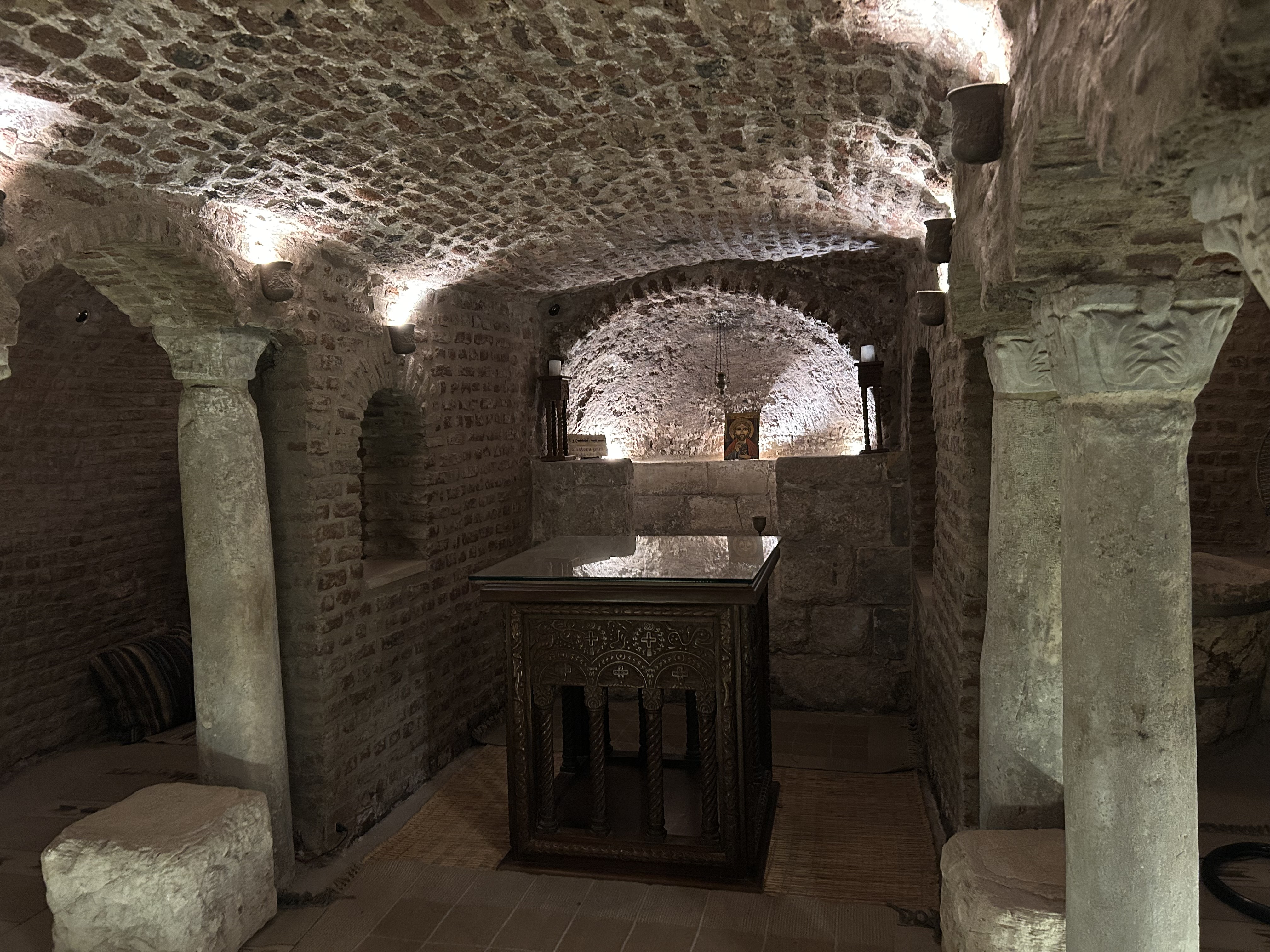
Jesus and Egypt

In Egypt today we visited several churches, one of which was The Church of Martyrs Sergius and Bacchus in The Cave, also known as the Abu Serga Church, and is one of the oldest Coptic Christian churches in Egypt, dating back to the 4th century.[1] Tradition holds that Saints Sergius and Bacchus Church was built on the spot where the Joseph, Mary, and the infant Jesus rested at the end of their journey into Egypt.

The flight into Egypt is a story told in Matthew 2:13–23 and in New Testament apocrypha. Soon after the visit by the Magi, an angel appeared to Joseph in a dream telling him to flee to Egypt with Mary and the infant Jesus since King Herod would seek the child to kill him.

You might remember, when the Magi came in search of Jesus, they went to Herod the Great in Jerusalem to ask where to find the newborn “King of the Jews”. Herod became afraid that the child would threaten his throne and sought to kill him (2:1–8). Herod initiated the Massacre of the Innocents in hopes of killing the child (Matthew 2:16). But an angel appeared to Joseph in a dream and warned him to take Jesus and his mother into Egypt (Matthew 2:13). Both Egypt and Judea were part of the Roman Empire, linked by a coastal road known as “the way of the sea”,[2] making travel between them easy and relatively safe.

After Herod passed, Joseph was told by an angel in a dream to return to the land of Israel. However, upon hearing that Archelaus had succeeded his father as ruler of Judaea he “was afraid to go there” (Matthew 2:22), and was again warned in a dream by God “and turned aside to the region of” Galilee. This is Matthew’s explanation of why Jesus was born in Bethlehem in Judea but grew up in Nazareth. Herod died is 4BC, which is stated by Matthew and affirmed by Josephus. Mary and Joseph return to Judah. This is the only time the Biblical Text uses the term “Judah” as a geographical place identifying Judah and Galilee. The text indicates that they first come to Judah but them quickly relocate to Galilee after learning that Archelaus had become the new king who was known to be violent and aggressive.

As an interesting rabbit hole, the beginning and conclusion of Jesus’ parable of the minas in the Gospel of Luke, chapter 19, may refer to Archelaus’ journey to Rome. Some interpreters conclude from this that Jesus’ parables and preaching made use of events familiar to the people as examples for bringing his spiritual lessons to life. Others read the allusion as arising from later adaptations of Jesus’ parables in the oral tradition, before the parables were recorded in the gospels.

Many would deduct the flight to Egypt to fulfill a prophecy by Hosea. Matthew’s use of Hosea 11:1 has been explained in several ways. A sensus plenior approach states that the text in Hosea contains a meaning intended by God and acknowledged by Matthew, but unknown to Hosea. A typological reading interprets the fulfillment as found in the national history of Israel and the antitypical fulfillment as found in the personal history of Jesus. Matthew’s use of typological interpretation may also be seen in his use of Isaiah 7:14 and 9:1, and Jeremiah 31:15. Some have pointed out that “Hosea 11.1 points back to the Exodus, where God’s ‘first-born son’ (Ex 4:22), Israel, was delivered from slavery under the oppressive Pharaoh. Matthew sees this text also pointing forward, when Jesus, the eternal first-born Son (Rom 8:29), is delivered from the tyrant Herod and later brought out of Egypt (2:21).”[3]

The Orthodox Study Bible states that the citation of Hosea 11.1 “refers first to Israel being brought out of captivity. In the Old Testament ‘son’ can refer to the whole nation of Israel. Here Jesus fulfills this calling as the true Son of God by coming out of Egypt.[4] The Anglican scholar N. T. Wright has pointed out that “The narrative exhibits several points of contact with exodus and exile traditions where Jesus’ infancy recapitulates a new exodus and the end of exile, marking him out further as the true representative of Israel.”[5]

The Masoretic Text reads my son, whereas the Septuagint reads his sons or his children;[6] I typically prefer the Septuagint but, in this case, the Masoretic seems more accurate. The Septuagint seeks to find agreement in the plurals of Hosea 11:2 they and them. I bring this up because Luke does not recount this story, relating instead that they went to the Temple in Jerusalem, and then home to Nazareth. However, both texts can be in Harmony without Luke mentioning the flight to Egypt. A theme of Matthew is likening Jesus to Moses for a Judean audience, and the Flight into Egypt illustrates just that theme.[7]

“[Joseph’s] choice of Egypt as a place of exile … was in line with the practice of other Palestinians who feared reprisals from the government; as a neighbouring country with a sizeable Jewish population it was an obvious refuge. And his subsequent avoidance of Judea under Archelaus, and expectation of safety in Galilee, accords with the political circumstances as we know them.”[8]

We also get some strange tales in the extra biblical apocropha. Jesus tames dragons, the trees bow to Him, and the story of the two thieves that later appear on the cross with Him. [9] These stories have certainly influenced Egypt and the Coptic Orthodox Church which was established by Mark, an apostle and evangelist, during the middle of the 1st century (c. AD 42).[10] There are a number of churches and shrines such as the one I visited today marking places where the family stayed.

There is another difficulty here that I should point out. Nazareth is not mentioned in the Old Testament, or by Josephus or any other rabbinical sources.[11] In other words, the quote, “he will be called a Nazarene” is that it occurs nowhere in the Old Testament, or any other extant source. In Judges 13:5 we see a similar clause of Samson but reads “nazirite.” Did Matthew suggest Jesus was intended to have been a Nazirite? Dis the text change and eventually the area became known as Nazareth? Jesus later would not match the description of a first century Nazarite so this has left scholars scratching their heads.

Much of Matthew was likely penned in Hebrew and when you translate this back to Hebrew you find a wordplay that I think answers our difficulty. Isaiah 11:1 states that there shall come forth a rod out of the stem of Jesse, and a Branch shall grow out of his roots:  the Hebrew for branch is נצר (netzer). The priestly clan of the “netzerites” possibly settled in the place which became known as Netzereth/ Nazareth. This leaves us clearly seeing that the title Nazarene alludes not so much to his town of origin as to his royal descent.

At any rate, I hope you enjoyed a venture into my mind and appreciate the way that I view history, theology, and a working through a better lens of agreement within the entire text taking into account several different textures of interpretation. I pray that it deepens your enthusiasm for the Word as it has moved me.

WORKS CITED:

  1. Sheehan, Peter (2015). Babylon of Egypt: The Archaeology of Old Cairo and the Origins of the City. Oxford University Press. pp. 35, 40. ISBN 978-977-416-731-7.
  2. Von Hagen, Victor W. The Roads that Led to Rome published by Weidenfeld & Nicolson 1967. p. 106.
  3. Ignatius Catholic Study Bible, New Testament (2010). San Francisco: Ignatius Press. p. 9. ISBN 978-1586174842
  4. The Orthodox Study Bible (2008). Nashville: Thomas Nelson. p. 1268. ISBN 978-0718003593
  5. Wright, N. T. and Michael F. Bird (2019). The New Testament in its World. London: SPCK; Grand Rapids: Zondervan Academic. p. 590. ISBN 978-0310499305
  6. Brenton’s Septuagint Translation of Hosea 11, accessed 4 December 2016
  7. Harris, Stephen L., Understanding the Bible. Palo Alto: Mayfield. 1985. “Matthew” pp. 272–285
  8. France, R. T. (1981). “Scripture, Tradition and History in the Infancy Narratives of Matthew”. In France, R. T.; Wenham, David (eds.). Gospel Perspectives: Studies of History and Tradition in the Four Gospels. Vol. 2. Sheffield (UK): JSOT Press. p. 257. ISBN 0-905774-31-0.
  9. The Gospel of Pseudo-Matthew at The Gnostic Society Library, Christian Apocrypha and Early Christian Literature
  10. Meinardus, Otta Friedrich August (1999). “The Coptic Church: Its History, Traditions, Theology, and Structure.”. Two Thousand Years of Coptic Christianity. American University in Cairo Press. p. 28. ISBN 9789774247576. JSTOR j.ctt15m7f64.
  11. Perkins, P. (1996). Nazareth. In P. J. Achtemeier (Ed.), The HarperCollins Bible dictionary, pp. 741–742. San Francisco: HarperCollins. ISBN 0-06-060037-3.
  12. Galilee Archived 9 May 2006 at the Wayback Machine.
Translations in Giza

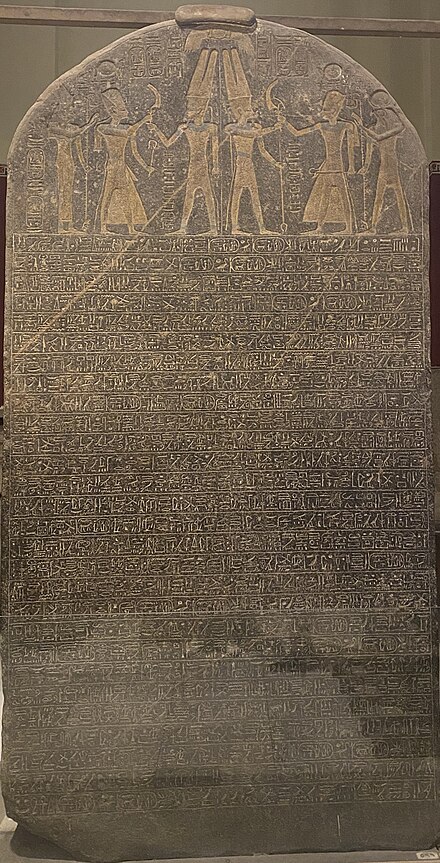
Today I was able to view the Merneptah Stele. This is a pretty big deal in my theological world. The Merneptah Stele, also known as the Israel Stele or the Victory Stele of Merneptah, is an inscription by Merneptah, a pharaoh in ancient Egypt who reigned from 1213 to 1203 BCE. It was discovered by Flinders Petrie at Thebes in 1896, and it is now housed at the Egyptian Museum in Cairo where I visited and was given hands on access to this today.[1][2]

A stele or stela (plural stelae) is a commemorative slab decorated with text and/or images. Ancient Egyptians erected stelae for many purposes including to document historical events, to record decrees (the Rosetta Stone is a famous example), and to remember the dead. [3] Such monuments were made by a variety of cultures in the ancient world, including the Assyrians, Maya, Greeks and Romans. The most common Egyptian term for a stela is wedj, which originally meant “command” and stems from wedj–nesu, “royal decree.” Various qualifiers could be used to further classify wedj, such as wedj-her-tash – “boundary stela” – or wedj-en-nekhtu – “victory stela.” [4]

The “victory stela” here has text engraved and is largely an account of Merneptah’s victory over the ancient Libyans and their allies, but the last three of the 28 lines (in the large photo you will view this as slightly darker colored) deal with a separate campaign in Canaan, then part of Egypt’s imperial possessions. It is sometimes referred to as the “Israel Stele” because a majority of scholars translate a set of hieroglyphs in line 27 as “Israel”. Alternative translations have been advanced but are not widely accepted.[5] The stele represents the earliest textual reference to Israel and the only reference from ancient Egypt. [6] It is one of four known inscriptions from the Iron Age that date to the time of and mention ancient Israel by name, with the others being the Mesha Stele, the Tel Dan Stele, and the Kurkh Monoliths.[7][8][9]

For reference here is the timeline of Pharoahs of Egypt before and after the Exodus: [10]

  • 1295 BCE – 1294 BCEThe reign of Ramesses I in Egypt.
  • 1294 BCE – 1279 BCEThe reign of Seti I in Egypt.
  • 1279 BCE – 1212 BCEReign of Ramesses II (The Great) in Egypt.
  • 1212 BCE – 1202 BCEReign of Merneptah in Egypt.

It was first translated by Wilhelm Spiegelberg.[11] Spiegelberg described the stele as “engraved on the rough back of the stele of Amenhotep III. The inscription says it was carved in the 5th year of Merneptah of the 19th dynasty. From a strictly historical perspective here us what scholars have noted. Egypt was the dominant power in the region during the long reign of Merneptah’s predecessor, Ramesses II, but Merneptah and one of his nearest successors, Ramesses III, faced significant invasions. Traditionally Egyptians only document the victories, not the losses. The final lines of this stele deal with a campaign or situation in the East. Traditionally the Egyptians had concerned themselves only with cities, so the problem presented by Israel is interesting in the ay it is breifly mentioned. Merneptah and Ramesses III were thought to have been fairly successful at fighting off their enemies, but history shows us that it is at this time that Egypt ceased to continue control over Canaan – the last evidence of an Egyptian presence in the area is the name of Ramesses VI (1141–1133 BC) inscribed on a statue base from Megiddo. [12]

In terms of translating the language, the “nine bows” is a term the Egyptians used to refer to their enemies;[13] Israel is clear in the transcription and was thought of as smaller units scattered throughout the region, –Canaan might here refer to the city of Gaza,[14] Based on their determinatives, Canaan referred to the land whilst Israel referred to the people.[15]

The line which refers to Israel is below (shown in reverse to match the English translation; the original Egyptian is in right-to-left script):

According to The Oxford History of the Biblical World, this “foreign people … sign is typically used by the Egyptians to signify nomadic groups or peoples, without a fixed city-state home, thus implying a seminomadic or rural status for ‘Israel’ at that time”.[16] The phrase “wasted, bare of seed” is formulaic, and often used of defeated nations – it usually would imply the people posed some sort of a threat to Egypt.[17] The Merneptah stele is considered to be the first extra-biblical reference to ancient Israel in ancient history and is widely considered to be authentic and providing historical information.[18][19]

There isn’t much scholarly disagreement on the interpretation. It is worth pointing out that in the 4th inscription the image I use above interprets seed/grain. In many other known stela inscriptions this notation meant that famine had come, and conflict resulted in another nation or peoples trying to “war” over Egypt’s grain stores. But in the ancient world this notation is much broader than that and simply means conflict. [20]

DOES THIS GIVE US A CLEAR DATE ON THE EXODUS?

Sadly, no. The dates of the Exodus are still largely inconclusive. Many have chimed in such as Flavius Josephus (c.70 CE), but unfortunately there are some things in Egyptian history that don’t seem to line up. The easiest explanation I have already implied. Most of the documentation of Egypt is in the form of “VICTORY” stela and they are just that, embellished records of victory, not failure. The pharaohs were known widely for covering their less than astounding feats. According to Biblical chronology, the Exodus took place in the 890th year before the destruction of the Temple by the Babylonians in 421 BCE (generally accepted date: 587 BCE). [21] This was 1310 BCE (1476 BCE). In this year, the greatest warlord Egypt ever knew, Thutmose III, deposed his aunt Hatshepsut and embarked on a series of conquests, extending the Egyptian sphere of influence and tribute over Israel and Syria and crossing the Euphrates into Mesopotamia itself. While it is interesting that this date actually saw the death of an Egyptian ruler – and there have been those who tried to identify Queen Hatshepsut as the Pharaoh of the Exodus – the power and prosperity of Egypt at this time is hard to square with the biblical account of the Exodus.

Some historians have been attracted by the name of the store-city Ramses built by the Israelites before the Exodus. They have drawn connections to the best-known Pharaoh of that name, Ramses II, or Ramses the Great, and set the Exodus around his time, roughly 1134 BCE (1300 BCE). [22] In order to do this, they had to reduce the time between the Exodus and the destruction of the Temple by 180 years, which they did by reinterpreting the 480 years between the Exodus and the building of the Temple (1 Kings 6: 1) as twelve generations of forty years. By “correcting” the Bible and setting a generation equal to twenty five years, these imaginary twelve generations become 300 years. Is this acceptable? Generations are fairly generic language in the Bible so there is some textual merit to do this. Others feel strongly that such “adjustments” of the Biblical text imply that the Bible cannot be trusted, Ramses 11 was a conqueror second only to Thutmose III. And as in the case of Thutmose III, the Egyptian records make it clear that nothing even remotely resembling the Exodus happened anywhere near his time of history. However, I come back to, the more powerful and well liked the rulers were, the greater power they had to dictate what was remembered of them. It is also worth noting that Egyptian dating is a disaster in the scholarly community. Few things agree.

Does this stone tell us who the Pharoah of the Exodus was? No; but perhaps it supplies you with a more educated proposition.

WORKS CITED

  1. Drower 1995, p. 221.
  2. Redmount 2001, pp. 71–72, 97.
  3. https://www.artic.edu/articles/824/reading-ancient-egyptian-art-a-curator-answers-common-questions
  4. https://arce.org/resource/stelae-ancient-egypts-versatile-monumental-form/
  5. Sparks 1998, pp. 96–.
  6. Hasel 1998, p. 194.
  7.  Lemche 1998, pp. 46, 62: “No other inscription from Palestine, or from Transjordan in the Iron Age, has so far provided any specific reference to Israel… The name of Israel was found in only a very limited number of inscriptions, one from Egypt, another separated by at least 250 years from the first, in Transjordan. A third reference is found in the stele from Tel Dan – if it is genuine, a question not yet settled. The Assyrian and Mesopotamian sources only once mentioned a king of Israel, Ahab, in a spurious rendering of the name.”
  8. Maeir, Aren. Maeir, A. M. 2013. Israel and Judah. pp. 3523–27, The Encyclopedia of Ancient History. New York: BlackwellThe earliest certain mention of the ethnonym Israel occurs in a victory inscription of the Egyptian king Merenptah, his well-known “Israel Stela” (c. 1210 BCE); recently, a possible earlier reference has been identified in a text from the reign of Rameses II (see Rameses I–XI). Thereafter, no reference to either Judah or Israel appears until the ninth century. The pharaoh Sheshonq I (biblical Shishak; see Sheshonq I–VI) mentions neither entity by name in the inscription recording his campaign in the southern Levant during the late tenth century. In the ninth century, Israelite kings, and possibly a Judaean king, are mentioned in several sources: the Aramaean stele from Tel Dan, inscriptions of Shalmaneser III of Assyria, and the stela of Mesha of Moab. From the early eighth century onward, the kingdoms of Israel and Judah are both mentioned somewhat regularly in Assyrian and subsequently Babylonian sources, and from this point on there is relatively good agreement between the biblical accounts on the one hand and the archaeological evidence and extra-biblical texts on the other.
  9. Fleming, Daniel E. (1998-01-01). “Mari and the Possibilities of Biblical Memory”. Revue d’Assyriologie et d’Archéologie Orientale92 (1): 41–78. JSTOR 23282083. The Assyrian royal annals, along with the Mesha and Dan inscriptions, show a thriving northern state called Israël in the mid—9th century, and the continuity of settlement back to the early Iron Age suggests that the establishment of a sedentary identity should be associated with this population, whatever their origin. In the mid—14th century, the Amarna letters mention no Israël, nor any of the biblical tribes, while the Merneptah stele places someone called Israël in hill-country Palestine toward the end of the Late Bronze Age. The language and material culture of emergent Israël show strong local continuity, in contrast to the distinctly foreign character of early Philistine material culture.
  10. https://www.worldhistory.org/timeline/pharaoh/
  11. Nestor 2015, p. 296.
  12. Drews 1995, pp. 18–20.
  13. William Museum, UK: Ancient Egypt
  14.  H. Jacob Katzenstein, ‘Gaza in the Egyptian Texts of the New Kingdom,’ Journal of the American Oriental Society, January-March 1982, Vol. 102, No. 1 pp. 111-113 pp.111-112
  15.  Smith 2002, p. 26.
  16. FitzWilliam Museum, UK: Ancient Egypt
  17. H. Jacob Katzenstein, ‘Gaza in the Egyptian Texts of the New Kingdom,’ Journal of the American Oriental Society, January-March 1982, Vol. 102, No. 1 pp. 111-113 pp.111-112
  18. Dever 2009, p. 89–91.
  19. Faust, Avraham (2016). Israel’s Ethnogenesis: Settlement, Interaction, Expansion and Resistance (reprinted ed.)
  20. Jones, Daniel (2003) [1917], Roach, Peter; Hartmann, James; Setter, Jane (eds.), English Pronouncing Dictionary, Cambridge University Press, ISBN 978-3-12-539683-8
  21. Contrary to the Jewish historical tradition, the generally accepted date is 166 years earlier, or 587 BCE (see “Fixing the History Books – Dr. Chaim Heifetz’s Revision of Persian History,” in the Spring 199.1 issue of Jewish Action). This difference applies to all Mesopotamian and Egyptian history prior to the Persian period. The dates for Egyptian history given in the history books are therefore off by this amount. For our purposes, we will use the corrected date followed by the generally accepted date in parenthesis.
  22. Some people have been excited about the generally accepted date for Ramses II coming so close to the traditional date for the Exodus. This is a mistake, as Egyptian and Mesopotamian histories are linked. If Ramses II lived c.1300 BCE, then the destruction of the Temple was in 587 BCE, and the Exodus was in 1476 BCE.

SHOT SHOW 2025

If you have been on x44 for very long, you know that I am an enthusiast of many dimensions. I am passionate about many things. I tend to be an all or nothing person. The WORD is the biggest love of my life followed closely my incredible wife and 4 boys and the communion of our “tribe.” My wife calls me the last renaissance man as I am “REALLY INTO” a lot of different things. I have always said I could live life 100 times and do something totally different each life and thoroughly enjoy every one of them. I think over the years I have earned more than 50 certifications such as EMT, AMGA MTN Guide, PADI, various canoe and kayaking certifications, PPA master photographer, A Th.D. Degree and many other credentialed things. But one of the things I have spent a life pursuing is shooting. My father was a writer for several gun magazines in the Peterson line. I grew up shooting competitively every week at the local range and have competed in nearly every NRA discipline, some at the national level. I have been sponsored by more companies than I can remember. About 15 years ago I opened a private NRA gun range that is one of my favorite things in life. My boys have grown up literally learning the ins and outs of the firearm world as they learned to tie their shoes and drive a tractor or motorcycle. It is second nature to our family. Most everyone knows of the NRA because of their legal initiatives, but less people have heard of the Firearm Industry Trade Association. The NSSF is an association “that leads the way in advocating for the industry and its business and jobs, keeping guns out of the wrong hands, encouraging enjoyment of recreational shooting and hunting and helping people better understand the industry’s lawful products.” [1] They put on a several shows but one of them is the SHOT SHOW which is only open to industry professionals. This is truly a MAN CARD lifetime bucket list item. It is amazing. This year here are some things that really stood out to me.

  1. Hk has a history of building the best. Those of you that know me well, know I own an arsenal of their products. I truly believe they are what you would choose if you could have anything, and your life depended on it. They are the number one choice of special forces and have been for many years across the globe. They came out with the HK 416 in the early 2000’s and it has been a stapple for many years. There have been some slight mods over the time but this year marks likely the biggest upgrade the line has seen, at least in the civilian market. “The MR556 A4 and MR762 A4 are the latest products released by HK-USA. The A4’s updated furniture and fully ambidextrous controls make it more user-friendly than ever. A new lifetime barrel bore guarantee, an HK first, reflects HK’s confidence in this no-compromise civilian product.” [2] The MR556 and MR762 are civilian versions of the HK416/417, as used by the U.S. military and other elite military and law enforcement organizations around the world. Although some these features have been available in European exchange, much of these options are new to the US market. For instance, previously you couldn’t get an HK 5.56 in a pistol platform in the US. The A4 series of firearms use the multi-lug, rotating bolt operated by a short-stroke gas-piston system of the original HK416/MR556 (still the best imho), housed in aluminum alloy upper and lower receivers. Beyond this, improvements abound. A new tensioning buffer improves fit between upper and lower receivers. The gas block is adjustable for both suppressed and unsuppressed usage (best on market imho). Controls include ambidextrous bolt release and magazine release buttons, as well as the safety lever with 45-degree throw, all of which are present on both sides of the receiver, and the charging handle is also ambidextrous. I could go on and on… but in brief, this new rifle has it all right out of the box. It’s a no frills no nonsense best option built (period) firearm. The CC9 is also worth mentioning. If you are looking for a CCW gun this is likely the one. The VP9 got an upgrade by way of the VP9A1 F and K models. In my mind the USP’s will always be king though.

2. Barrett has been a HUGE man card fan for many years. The ability to take out armored vehicles miles away using a $6 round is simply amazing. When they sold to the Australian defense contractor NIOA in 2023 I was concerned. I have owned many Barrett firearms over the years, and they continue to be one of my favorite items in the locker. Many know them for their 50 calibers which are amazing, but they also have a history in smaller arms. In 2008 they came out with the M468 which had some heating issues plaguing government contracts, but I owned one and it was super cool. It was a big heavy price of machinery. It felt like what a “real” army man should be using. It was replaced by the rec7. I have owned several of these as well and they continue to be one of my favorites. When the company was purchased, they halted production of rec7’s (partly to push MK22 production). I was worried. This year they were released again. Originally when the rec7 came out it was piston operated. I own a few of these and still prefer this system. But the new rec7 (DI for direct gas impingement) is all that is currently offered. To be clear I don’t think this is a big deal. I own both and can hardly tell the difference. This is also a pretty no frills basic “you want this one when your life depends on it” type rifle. The rifle features a mid-length direct impingement gas system, making it well-suited for suppressor use. The upper and lower receivers feature 7075-T6 aluminum construction. All aluminum components include a Type 3 Hardcoat anodizing. The rifle platform features a hammer-forged, chrome-lined barrel and Magpul furniture. An ALG QMS trigger and extended slimline Barrett handguard with M-LOK accessory mounting slots adds to the rifle’s appeal. [3] However, all that said, it is sort of a nothing special rifle. It is just bare bones cool, but that makes it timeless. This is one that will still be at the front of your safe in 50 years. If you own a 50 this also makes a great matching set. If you don’t own a B50 it might seem a bit to “poserish or wanna be.” IMHO it is one of the top mass manufactured rifles on the market and I am very happy to see it’s return. NOTE: This is an early photo, the production ones are significantly better branded and don’t look as generic as the photo below. See the image lower under Nightforce for the production image.

Of course, Barrett was also continuing to show off the MK22, and the MRADELR Rifle which if you haven’t looked into is pretty amazing. The MRADELR is a high quality, military tested, off-the-shelf, extreme long-range system with user changeable barrels and calibers. Designed to deliver precision typically achieved only by custom-built rifles. If you were going to war with a bolt gun, this is the one.

They also had a 3D printed Squad Support Rifle System (SSRS) at SHOT Show 2025. The SSRS is a revolutionary 30mm precision support rifle tailored for the U.S. Army’s Precision Grenadier System (PGS) program. Engineered to tackle modern battlefield threats, it excels in counter-defilade scenarios, neutralizing UAS, and engaging dismounted targets. The SSRS is poised to redefine squad-level firepower with unmatched lethality, versatility, and soldier safety. It was crazy cool! I can’t imagine having this kind of firepower in a lightweight personal sized package. You could take out a regiment from a mile away.

3. TRIJICON: These guys are amazing and it isn’t just because they put Bible verses on their products, although I do LOVE THAT!!! I still believe they make the overall best imaging products. Yes, I am a Nightforce fan (I will get to that) but If I could only choose one optic company this would be it. The RMR is tried and true, the ACOG/VCOG is tank like, and their OASYS thermal is still the best clip on out there and likely the overall singular best NV/Thermal option made. Yes, they are expensive, but again if you’re into the best or a true deployment “life depends on it” unit, these are likely what you’re going to choose. I own the exact setup below. The last three years I have walked around the show with the intent to seek out the best thermal option and for the third year in a row, this is the “BEST YOU CAN BUY” setup. I should also mention that they had perhaps the most convincing display I have ever seen showing the amount of real war abuse their products had taken, literally bullet holes in an ACOG and it was still functioning (not to mention it saved someone’s life from a headshot). That is impressive and defining. Most people don’t see the build benefits of the newer VCOG vs a traditional LPVO. If you aren’t “aware”, you might want to start noticing. This is the future.

4. Nightforce & the others: I am a major fan and own nearly every optic they make. They are just the best imho. Built for a war, proven, repeatable, sharp glass, great designs, unmatched aesthetics. I own them all. And I don’t just mean NF, I mean Schmidt and Bender, Vortex, and the others and I would hands down say NF is still the best. But I do think each has a place to shine. So let me break it down. As I mentioned above, I think Trijicon remains the upper tier across the board. If you want one optic company on all your stuff, they are the one and likely the overall toughest. S&B is awesome and for bragging rights. NF is the best in scopes. As a side note LPVO’s are still the thing for a one rifle do it all platform and the 1-8 ATACR is still the best (yes, I will get to the vortext 1-10). I own two 1-8 ATACR scopes, but that said, they are too big IMHO. The NX8 1-8 24 is smaller, lighter, cheaper, and makes more sense on a one and done rifle. This is the direction things are going. And I have to say, NF saw this a long time ago when they released the unfortunately discontinued 2.5-10 24 (not to be confused with the 42). If you can find this SOCOM relic used GET IT!!! Here is the Barrett rec7 mentioned above with the NF 1-8 24 which I would say is the best LPVO on the market and reasonably priced.

You can’t go wrong with Vortex. I love my Wisco brothers, the warranty, the excellent products. I have ZERO negative to say! These guys ROCK!!! The golden eagle dominates long range bench. The Vortex Razor HD Gen III 1-10×24 FFP is arguably the best LPVO. There I said it! The 1-10 is awesome but this thing is huge and heavy and looks good on an M110 (but then isn’t arguably enough). The best thing about the 5.56 platform is its small and light, this is too big of an optic. However, here is a military vortex 1-10 that is half the size of their civilian version. This is the future. If I could get this, I would!

One more thing. It came out a year ago, but the NF CFS 6-36×50mm F1 spotting scope is awesome. I switched years ago to a Canon IS 18x set of binoculars for watching my shots and this is the first spotting scope that I might “GO BACK” to. I was never impressed with the NF TS82 and I own the Vortex Razor HD 27-60×85 which is great, but here is the thing with these. A spotting scope at any power doesn’t work well past 1000 yards or so. Yeah, argue away, but they just don’t. So, at under 1000 yards an IS set of binoculars can’t be beat. Two eyes are wayyyyy better than 1. NF figured this out staying lighter and only going to the ultra-sharp 32 power. On paper the 60x vortex would be better, but not in real life. Anyone who has used “SHARP” glass knows this. There is still an argument for the Vortex 60x scope on a bench next to your Vortex Golden Eagle HD 15-60×52 scope; but not as strong of an argument as you would think if you used all of them and were truly unbiased. For shots at a mile plus you have to go with long range digital viewing and for anything 1000 or less there are lots of workable options. Oh yeah, did I mention the newer NF can be setup with thermal and NV as well as mounted next to your Kestrel? hmmmm

5: OTHER NOTABLES:

SIG is killing it right now! This contract wall says a lot. However, they have been plagued with problems for the last 5 years. The last 3 SIG items I have owned (365, BDX scopes, and Speer rifle) all left me with malfunctions that I decided in the end, I wouldn’t want to be second guessing if my life depended on it, and that’s what we are all training for right? They are still an amazing company, and I brag about the unrivaled acquisition time of the BDX scopes all the time. I also love the SIG color schemes.

This is Joe and Caleb from ammoracks.com. If you consider yourself an enthusiast, you need these! Can’t say enough about this company and their first year venture. WOW!!! AMAZING PRODUCT and their ideas moving forward are nothing less than incredible!

Hornady Match can’t be beat. You can argue with me all day, but you can’t possibly hand load to the tolerances they use. Yeah I still handload for special purposes occasionally but a lot less than I did 20 years ago thanks to Hornady! The cowboy in me loves my .280 Remington at 1000 yards but the tech fanatic in me loves watching what they are doing here. The fairly new 6 mm GT cartridge brings PRC-style competitors a smile. Conceived by George Gardner of GA Precision and Tom Jacobs of Vapor Trail Bullets is worth a look.

The Kimber 2K11 is a trendy 2011 platform. Available in three models – 2K11 OR, 2K11 Target OR, and 2K11 Target OI – this double-stacked pistol not only caught my eye with its aesthetics but also its features. If you want a piece of steel that shoots like a laser Kimber has always been the one, but this is their first techy offering and was much needed. These guys have been trying to keep up and I applaud them, love the k6s!

There are several guns that were hyped up that just aren’t my cup of tea such as the SNT Motiv K2S (a.k.a. Daewoo K2). I would say get a DS ARMS offering or an HK91 any day before you consider this. B&T makes cool stuff, so does Q but they are expensive and a bit toyish imo. Everyone loves the FLEX raider stuff and these guys rock but just give me a decent 9 and maybe a weapons light when it gets real. I don’t really like the hype, and I have never been into a bunch of junk getting in the way. I airsoft with a no sight rifle, shorts, sandals, and sunglasses and in a modern-day engagement (God forbid that ever happens) I would likely be wearing the same thing. Keep it simple and train for the reality. Daniel Defense has a new CCW style pistol, I am always hesitant of first year crossovers, but it looks good! I respect PSA and they had a full offering, but I just don’t really care for lower end stuff and in my mind, they will always be there, everything seems like a knockoff. Their Mixtape .338 ARC was pretty sweet though!!! Laugo Alien Remus was good to see. Aliens have had their issues, and I think the company is addressing it. When they work, they work REALLY WELL! The Henry Carbon Fiber was cool, it’s the hipster thing, not for me – Just give me my grandfather’s old wooden octagon barrel lever henry and I am happy, but to some this is the jewel of the show. Holosun went from being a cheap optic to one of the best in a few years and their NV/Thermal pistol and rifle options are incredible. If you aren’t up on this, you need to google it NOW! I love Staccato, the new HD P4 is a 9mm, steel-frame handgun that benefits from accepting Glock magazines. They needed to get creative, so this is great news! I sold my last Staccato 5 years ago after winning a handgun race and someone saying, “anyone could win with that gun!” I switched the next day to a G17 and never looked back, no one has made that statement since. This is still a great company, and I think the world of their products. It is also fun to carry something so cool! 20 years ago, it made more sense to own an STI or Staccato. You had to work on most guns to really get them to shoot. For the first 20 years of my shooting life, I bought a gun and 20 different brands of ammo expecting $500 worth of gunsmithing to come later; or you just bought and STI and called it quits! But now that is no longer the case. There are just too many great out of the box guns such as the HK VP9 match, the Sig Legions, and several others that shoot just as good for half the price. If you’re paying nor than $1500 for the base gun your likely just paying for bragging rights (and possibly aesthetics) today.

There are lots of great people at this show. Also, amazing displays, I am thankful for everything that goes into it. Some of the nicest people I have ever met. Triple Crown products has helped me out every year! THANK YOU! If you need clothing branded this is your team!

CONCLUSION:

Another amazing year! Thank you to everyone who makes this happen! Psalm 144:1 Praise be to the LORD my Rock, who trains my hands for war, my fingers for battle.

  1. https://www.nssf.org/
  2. https://hk-usa.com/heckler-koch-usa-introduces-all-new-mr-a4-series-rifles/
  3. https://athlonoutdoors.com/article/barrett-rec7-di-rifle/

Soteriology, Baptism, and Discipleship

When I was younger, I believed that theological “strength” meant to understand something so firmly that you never waiver from that stance. I think that is still true to much regard and it is important to know your essentials as a basis for your foundation of Truth. This likely includes doctrine on the Divinity of Jesus, the death, resurrection, ascension and throning of Jesus as king, the authority of Scripture, and other similar doctrinal positions. But I have found that on non-essential doctrine and the impact that it might have on your complete lens of scripture, that those in pursuit of the truth transparently guided by the Spirit will at some point be led to a better view. A dynamic open mind based on the wise counsel and discussion with others and guiding of the Spirit leads to deeper spiritual maturity. I don’t have much space left to “fight” over theology but am still incredibly passionate in my pursuit for scriptural depth and understanding.

I grew up believing in some sort of profession of the 4 spiritual laws that would then lead one to the act of baptism as an outward sign of giving their life to the Lord. Rallies that would stack up thousands of people at alter calls and then seemingly leave them hanging to figure it out. The last 50 years or so of evangelical Christianity has loved to brag about all the conversions that has produced at best nominal followers of Jesus and possibly even the results of Matt 7:23. Today I don’t necessarily disagree with that perspective (or give those that hold to it a difficult time); I believe there is a place and season for everything mentioned in the Word, but I think the Bible describes a different primary plan. Every time I hear of a church that is started with the main purpose or solely exists to “discover Jesus for the first time” I cringe. As I think there is a place for evangelism, I am not convinced that Jesus made that the main thrust of His ministry by example, or that the scriptures teach that the assembly of believers is the place for evangelism (wouldn’t that be a misnomer or contradiction of terms?). Jesus modeled by deeper discipleship. I see the “one night stand” soteriology (put another mark on the belt and move on mentality) as a result of our last centuries emphasis on momentary decisions that we refer to as being saved. I don’t see salvation as a line that signifies a moment of time that can simply be crossed, but rather a journey of sanctification. It is the life we live. I also think Jesus emphasized the life of dedicated discipleship of those fully given to Him, rather than mass conversion and especially without the emphasis of ever shepherding them to deeper convictions of life in Him. The scripture, both New and Old Testaments were never about kindergarten faith, but rather the deepest pursuit of devotion. To return to Edenic walking with God.

In Acts 8 we find a story of an Ethiopian Eunuch walking down the road and is approached by Phillip. As in most stories you have heard, this one also might require some deconstruction to find a better biblical narrative or interpretive message for us. The Eunuch is on the road because he is coming from worshipping in Jerusalem. He is reading a scroll of Isaiah 53. Consider these two things. First, it tells us he was devout and practicing already. Attending several week festivals was a practice for the faithful. The fact that he possessed a scroll of Isaiah is also fascinating. Perhaps it was on borrow from his Queen but likely not, it was probably his personal possession and required a great deal of his economic ability. This came at great cost in the first century. He knows the passage but is deep in study over it. His question is concerning a better interpretation.

What we come to is that baptism followed a conversion of not simply aligning the head and the heart with some ideology; but making an allegiant decision to change the course of your life and follow the way. Things have changed in the church over the last 2000 years. Baptism has become something for those that are convinced to believe in a pamphlet rather than the first century decision of joining the way and what that entailed. In the first century you left your former life and were baptized into a new way of life. You then left your former occupation (i.e. fisherman) and became a follower of Jesus as primary occupation. That was what it meant that Jesus now takes residence in your heart. That is why after Jesus is resurrected, He isn’t too happy with the disciples going back to fishing. Shouldn’t they know better after walking with Him for three years? But in the same way that they didn’t get it, that is also the problem with our current Christian culture, we still don’t get it. Today we might emphasize the importance to make a decision, and we often say it is a “life decision”, but certainly not to the weight of the first century. That’s why Nicodemus was wrestling with it. He knew the law well, he wasn’t at odds with the head and the heart, he was deciding whether he was going to give up everything he knew and had for a new life of minimal earthly materials and full devotion to this occupation of Jesus. Today we sort of leave that part out of joining the way of Jesus in our evangelistic pursuits. It wouldn’t sell very well. Giving up materialism in America to follow Jesus probably wouldn’t make for a lot of decisions under the light and laser show alter calls.

As I alluded to earlier. The assembly for the “body of believers” doesn’t really see like the right place for evangelism. It isn’t wrong (I don’t think), nut out of place or proportion. Even the fact that we have alter calls in church today is a bit counter to the biblical essence of the decision. We call the church the body of believers, yet we invite a bunch of non-believers to that body in hopes of making momentary decisions. Where did the invitation to love your neighbor in your home go? The church then becomes “the body of momentary decision makers and some that are still considering” rather than the body of Christ; we have to put on a show and water down the discipleship to change the motive. The Law actually described this as defilement. I might remind you that one of the primary directives was to not mix the temple areas with those that didn’t believe. That was strictly forbidden and had great consequences. When did we forget this? Is the modern church defiled and need to be cleansed according to the law that I will remind you Jesus followed to a “T.” Modern salvific thrusts of churchianity today even seem far from the life changing covenant community of the way of Jesus during the first century.

But don’t get me wrong, I do see willful individual decisions that need to be made in the New Testament. I have a place for it, but just don’t think it should be our main thrust or concern and especially within the assembly of believers. It has trumped the preeminent calling of Jesus to lead people into deeper waters. So, you are going to be surprised when I challenge you that there are really only three examples of momentary decisions in the biblical narrative and that is arguable at most. The best and perhaps only clear example we have in scripture for a radical momentary decision followed by baptism is of the Philippian Jailer in Acts 16. We have the thief on the cross but there isn’t baptism in that story and that one is complicated because it is still under the Old Covenant when most theologians would take an Apostle’s Creedal view that the thief died and went to paradise and Christ descended to preach giving those in “places of waiting” a last chance at salvation. Therefore, the thief’s salvation might be granted through the work of the cross running backward more than salvatory work post resurrection. It is also worth pointing out that the thief was likely Jewish and therefore would have been somewhat observant and at one in his life possibly even devout. Some have proposed that he might even be an example of one that left the faith and God then redeemed at his death bed in hopes of supporting a once saved always saved premonition; but to be clear, scripture doesn’t give us that, at least here. There is also the Syro-Phoenician woman, but she is even more complicated than the first two examples. There may be others, but they aren’t specifically mentioned in scripture. The great majority of baptism encounters we read (including Jesus Himself) come long after we would consider the point of adherence of the heart and mind. The examples of baptism largely teach that those baptized would have already been “saved” but are making a decision to leave their former way of life and completely follow Jesus. That’s radical. That’s what Jesus asked of the 12. He wanted them to leave everything on the beach and follow him not returning to their former lives. That’s still what He asks of us and biblically is still what signifies baptism.

Our culture gets it off -wrong maybe- we are baptizing baby Christians. In the Bible they baptized those ready to be all in, to go deep! To finally give up their entanglement to the world and serve one Master. The early Christians practiced a form of communal living, sharing their resources to ensure that no member was in need. Acts 4:32-35 describes this practice: “All the believers were one in heart and mind. No one claimed that any of his possessions was his own, but they shared everything they owned… There were no needy ones among them.”

In all of the biblical examples coming to this place took time, it wasn’t a momentary decision from an alter call. In fact the Eunuchs exclamation of “what prevents me from being baptized right now” should tell you that that was radical. The Centurian of Matthew 8:5-13 and Luke 7:1-10, that decision of “the greatest faith” likely cost him his life.

However, as a theologian who weighs every option and doesn’t like to leave any stone left unturned… Let me also give you the other side of the coin for consideration. It’s worth pointing out that the way of Jesus was new to mature Jews. That is what “THIS” baptism meant. That Jesus was your LORD. I can see how 2000 years later things would slightly change and that’s why I say I’m open to the current salvation crusades and alter calls in a place and season that we’re in. I have a place for it. In the first century the way was just found, we have had it for 2000 years. There is also the fact that we don’t have all of the story in the Bible. We don’t know if the Eunuch, Nicodemus, or the Centurian every became deep disciples. Church history and extra biblical sources alludes that they did, but the Bible doesn’t hold that for us. We are left to wonder. But I want to be clear here. When the Bible gives us something, an example a recipe or something to that type; we need to follow it. I have a little room for the evolution of church over 2000 years but not if it gets too far off the example given in scripture. If the scripture describes something that’s usually the way I wanna do it! I think there is some room to change with modernity but not a lot. The progression of the last 75 years to emphasize baby faith over deeper faith doesn’t seem scriptural and I think we need to find the roots of Christianity and the Way of Jesus back into our assembly of believers and who we are as occupational to the calling of our faith.

Fire sale salvation is based on an assumption that the primary goal of life is simply to attain something to get to heaven. It becomes ticket punching theology. Because of this, most western churches have become singularly interested in bringing people to a point of simple decision making and are happy to leave it at that. We have missed the compelling message of Jesus to deeply shepherd and disciple. All we are looking for is a verbal confession and once we get it, it’s time to move on to the next one. It almost is reduced to a competitive game of who can score the most. It devalues the gospel. Sure, we expect the Spirit to sort of take over, and He does… but we have hardly lived up to our end of the deal as the physical manifestation of the hands of Jesus. Can God use it? Absolutely, but I’m sure He desires more of us, and I believe scripture has made that clear. He always desires a better biblical directive and deeper actions of the heart from us.

We need to return to the covenant communities of the first century that made allegiant decisions that resulted in leaving the world and being immersed in the way of Jesus – (nothing else, no room for that “stuff”) an all in expression of devotion.

Foreword: Jesus The Great I Am – Ian Carlson

“Unless you can enter deeply into the mystery of the Incarnation, I’m afraid your Christianity will remain shallow, uninspiring and largely legalistic. You will essentially think that Christianity is about rules and rewards and where you go when you die. And in an increasingly secularized and pluralistic culture not too many people are interested in a legalistic afterlife religion. The best hope I know for presenting the gospel in a compelling way to a 21st century audience is to begin with….the beginning: The Incarnation. The breath-taking mystery of God joining us in our humanity.” [1]

Greg Boyd, has put it this way, “There is no denying that the Incarnation is paradoxical. It is hard, if not impossible, to conceive how a person could be, at one and the same time fully God and fully human. I don’t think this should surprise us too much, however. After all, we confront similar paradoxes in science as well as in our everyday life. For example, as I’m sure most of you have heard that physicists tell us that light has the property of waves in some circumstances and of particles in other circumstances, yet we have no way of understanding how this is possible. Even the nature of time and space is paradoxical if you think about it. We can’t conceive of time having a beginning, but neither can we conceive of it without a beginning. So too, we can’t conceive of space having an end, but we also can’t conceive of it not having an end. If things as basic to our experience as the nature of light, time and space are paradoxical, I don’t think we should find it too surprising that things surrounding God are mysterious.”

Paul declared that Jesus was nothing less than the very embodiment of all of God. This distinction of “all of God” is important for us to understand what it means for us to see Jesus and God rightly. Battling proto-gnostic teachers who were apparently presenting Christ alongside other manifestations of God, Paul declares “in Christ all the fullness of the Deity lives in bodily form” (Col. 2:9; cf. 1:19). His statement could hardly have been more emphatic:

All” (pan)—not some

“of the fullness” (plērōma)—not a part or an aspect

“of the Deity” (theotēs)—not a lesser divine being. [2]

As F.F. Bruce notes (regarding 1:19), Paul is asserting that, “all the attributes and activities of God—his spirit, word, wisdom and glory—are disclosed in [Christ].”[3] 

In other words, the fullness of God is revealed or embodied in Jesus. Jesus is the complete revelation of God in Word. Graeme Goldsworthy puts it this way, if “Jesus is the one mediator between God and man,” then Jesus himself must be “the hermeneutic principle for every word from God.”[4] It is also paramount to recognize that Christ is the “head” of the cosmos by which all reconciliation will come (Eph. 1:10; Col 1:19-20).

The Temple and YHWH’s return to Zion are the keys to gospel Christology. Focus on a young Jewish prophet telling a story about YHWH returning to Zion as judge and redeemer and then embodying it by riding into the city in tears, by symbolizing the Temple’s destruction, and by celebrating the final Exodus. He would be the pillar of cloud for the people of the new Exodus. He would embody in himself the returning and redeeming action of the covenant God. [5] Wright is suggesting, and I would agree that we are to read the Gospels as the Story of God’s returning to Israel, to Zion, to the Temple and Jesus is that presence of God

Regardless of your view of the atonement, such as Substitution, Satisfaction or Christus Victor; in all of them, Christ must be human in order for the sacrifice of the cross to be efficacious, for human sins to be “removed”, “cleansed”, “purified”, “covered”, and/or “conquered” (again depending on your atonement theology). This soteriological emphasis then gives way to the incarnation of the Son of God becoming a man so that he could save us from our sins. Therefore, the incarnation serves as a fulfilment of the love of God manifested and revealed in completeness as Jesus to be present and living amidst humanity, to “walk in the garden” with us.

Michael F. Bird shares this, “What we should take away is that in the unfolding story of the New Testament, the pre-incarnate Son who divested himself of divine glory in his incarnation is now fully invested by the Father with divine authority over every realm and every creature. What the Lord God of Israel does in creation and redemption is now, in some way, done through the lordship of Jesus Christ. When Jesus is named as “Lord” it is usually in the context of affirming that he carries the mantle of the Father’s authority and that he is the Father’s agent for rescuing Israel and putting the world to rights. Confession of Jesus as Lord was not a matter of mere assent or academic affirmation. It was a life and death issue. It meant standing up to the Caesar’s of the world who usurped for themselves the praise and power that rightly belonged to God. As Christians today, our highest vocation is to live our lives under the aegis of Jesus’ lordship and to make it clear to all that “this Jesus,” whom men and women reject, is Lord of all. What is more, the Lord Jesus will bring justice to our sin cursed earth and then flood the world with the shalom of heaven.” [6]

Before Christ passes, he shares with the remnant, his faithful disciples that he wants them to continue this oath of allegiance to a coming kingdom and that he will rule as the Lord of all regathering the nations to Him. And when he dies, no one can understand what has happened. We still struggle with this today. We don’t know the full work of the cross; we don’t need to. We know that it was the power to save. The veil separating humankind from God was torn and the cord fell once and for all. The blood of the cross would run both ways. The plan to enter into a holy covenant with God would be not only restored but made perfect. The new covenant was cut. The plan of redemption for all humankind fulfilled. Nothing more than obedient faith to walk with God would be asked for. This commitment would encompass all of life, the heart, mind, and soul. [7]

[1] brianzahnd.com/2008/12/son-of-adam/
[2] The Incarnation: Paradox & reknew.org/2017/01/jesus-center-scripture/
[3] F. F. Bruce, The Epistles to the Colossians, Philemon and to the Ephesians, NICNT (Grand Rapids: Eermans, 1984), 207.
[4] Gospel-Centered Hermeneutics, 252, cf. 62.
[5] N.T. Wright, The Historical Jesus and Christian Theology, Sewanee Theological Review 39, 1996.
[6] Reflections on Jesus as Lord, June 24, 2014 by Michael F. Bird
[7] Dr. Will Ryan, This is the Way of Covenant Discipleship, Crosslink Publishing 2021 Pgs. 82-83

the gospel

What is the gospel? Most people answering this would go right into soteriology and likely give you some step plan for salvation, the spiritual laws, the romans road or some other systematic cleverly devised way of super simplifying the message of Jesus. For nearly the last 2000 years this wasn’t the way people thought of the gospel. In the Bible we read stories of people considering “conversion” into the way of Jesus and it never comes off as some checklist. These plans are almost always laced with some kind of Penal Substitutionary theory of atonement and feel very bait and switch. If that was the intention of the text, wouldn’t one of the authors simply have given it to us? But we don’t get that. In fact, we don’t get anything in history close to this until perhaps the reformation with Luther and Calvin. But they wouldn’t be considered evangelists by today’s standards. It isn’t until many years after that when Moody, Billy Sunday, Charles Finney, Bill Bright, and Billy Graham that we really get the church wide view pushing decisions to follow Jesus and altar calls of momentary decision. If we go back to the pages of the Bible what we find is quite different. We see mind wrenching decisions of people determining whether they want to change their entire life to follow the way of Jesus. This is followed by being baptized into this way of life and then likely joining this “ALL IN” community to continue their immersion into discipleship. Jesus literally used the 12 as an example to step away from life as you know it and enter into a life of total commitment. This kind of a decision was intended to be pondered and your old life to be exchanged for a new one should you take the dip.

The Greek word εὐαγγέλιον originally meant a reward given to the messenger for good news (εὔ = “good”, ἀνγέλλω = “I bring a message”; the word “angel or messenger” comes from the same root) and later “good news” itself. The Bible records that Jesus sent out his disciples to evangelize by visiting people’s homes in pairs of two believers (cf. Luke 10:1–12).[1] In the same text, Jesus mentioned that few people were willing to evangelize, despite there being many people who would be receptive to his Gospel message.[2] In case you ever wondered this is why Mormons go door to door.

In 2017 Salvation by Allegiance Alone: Rethinking Faith, Works, and the Gospel of Jesus the King was released by Matthew W. Bates. Anytime something has “alone” in the title I am weary, but there was a lot of good in this book, Jesus is the anointed King of all creation, elevated to that position by God, evidenced by the resurrection.  As King, he has expectations for those who follow him.  As the verse in John 14 clearly demonstrates, commandments and/or devotion is central to these expectations. Allegiance entails obligatory obedience. I think Torah is important here and even though bates uses the word commandments I would take that more into devotion. He goes on to define the gospel by these points:

  1. a reiteration of his eight-point summary of the gospel, totally Trinitarian which is ok I guess…
  2. a statement that the Church needs to “stop asking others to invite Jesus into their hearts and start asking them to swear allegiance to Jesus the King”[3] Yep!
  3. a claim that “it is dreadfully wrongheaded to suggest that the gospel is best (or even adequately) proclaimed by actions unencumbered by words” . . . “the true gospel is not reducible to Christian activities.”[4] Totally Agree!
  4. a suggestion that the “Christian metanarrative” need only include the creation, the fall, the election of Israel, the gospel, the church and the future renewal [5] This one I see a bit differently
  5. a demand for discipleship: “The invitation to begin the journey of salvation can never be anything less than a call to discipleship, for nothing less will result in final salvation.”[6] YES!!! YES!!!
  6. a suggestion that saying the creeds (particularly the Apostle’s Creed) is the equivalent of saying the eight-points of the Trinitarian gospel as he outlines it. I can argue this one either way.

Where I mainly agree is on allegiance. In the first century you were allegiant to one and had no other masters. If you were loyal to Caesar there couldn’t be another. In my book, this is the way of covenant discipleship I devote an entire chapter to a better way of theologically framing the gospel. I will share some of that book at the bottom of this article. If you haven’t read it, I suggest starting there. My next suggestion would be The King Jesus Gospel: The Original Good released in 2016 by Scot McKnight (Author), N.T. Wright and Dallas Willard (Foreword).

Frank Viola also has a great handle on this. The New Testament calls Jesus an insurgent. He was an enemy of the State, accused of treason.

“They are all defying Caesar’s decrees, saying that there is another king, one called Jesus.”

The Insurgence, then, is the recovery of the titanic, earth-shaking, subversive gospel of the kingdom that got Jesus, John the Baptist, and the apostles in hot water. It’s a spiritual revolution against the world system that Jesus, John, and Paul speak against, and an utter and total allegiance to Jesus Christ and His alternative civilization called “the kingdom of God.”

But I still go down deeper trails… the gospel is combined in every word of the New Testament. The gospel isn’t a “plan” as much as it is a Person.

The gospel of God is “concerning His Son (Rom. 1:3).” It is the all-inclusive unveiling of God’s full counsel concerning His goodness, His will, His purpose, and His kingdom.

“The gospel is the work of God to restore humans to union with God and communion with others, in the context of a community, for the good of others and the world.”

– Scot McKnight, Embracing Grace

So then, what is the Gospel? This is pretty basic to Christianity, yet we have made it out to be so confusing. If we can’t answer this as Christians then what are we doing? Many of us understand part of the gospel, or understand part of the gospel to be the complete gospel. The Bible literally calls the gospel the “good news” and the word for that is euengelion. If you have never done a simple word study in the Greek, it is worth the investment to start here. This word is introduced at the announcement of Christ’s birth and carries forward to continue to be our calling as Christians. The word originally signifies the idea of good tidings, but as we work our way through the scripture, ironically what we refer to as “the gospels” or the books that tell the story of Jesus; we find that the word begins to take on a similar yet different meaning. We read passage like Mark 1:14:15, ‘The time has been fulfilled, and the kingdom of God has drawn near; repent and believe in the gospel’. Has the meaning of the word changed, stayed the same, or taken on a broader meaning?

The answer is in the covenants and the context of the entire lens of the Bible. When I say you can’t clearly understand the message of the Bible without understanding the covenant thinking, this is what I mean. Many have failed to see the gospel in the Old Testament and that is problematic to understanding the complete message of the overall gospel. In Galatians 3:8 we read, that God made a Covenant to Abraham. We usually call the this the Abrahamic covenant, but it is actually more clearly called the covenant of circumcision. Essentially the message from God to Abraham was that all nations would be blessed through his lineage. In the next chapter we are going to walk through this story, but for now let’s simply leave it that many generations went by and failed to live intimately with God. We see the fall in the garden, the flood, the tower of babel, God taking on Israel as His chosen people (or portion of all the world) and eventually they fail him too and he allows them to go into exile and judgment. But he doesn’t lose everyone throughout those years. Some remain faithful and some will return back to Him. The faithful are called the remnant. The Old testament closes with an idea that the Messiah will come to not only deliver the faithful remnant but possibly even the rest. Those that have fallen short (all of us in some way), and lost their allegiance will be given a chance to find their way back into this covenant of intimacy with God; to be let’s say, “adopted” into the kingdom. But as we read, we also find that even the remnant is blemished and (despite ritual yearly cleansing through faithful sacrifice) still will not “make the cut”; so not only is the good news for the unfaithful to return to faithfulness but even for the faithful to now be made complete. The good news is for everyone.

This plan by original design would be the greatest message to the earth; it would be the “good news” that the world needed to receive after the realization of knowledge that they had lost, or given up their right to the kingdom, by refusing God.

To the Jews, God’s chosen people, it meant a return from exile. To the gentiles, it meant a return or reclaiming by God of all people, the covenant of Abraham. To the spiritual beings, it meant that the fallen would be bound and a promise or covenant that ensured victory had been won. To all, it meant a return of the original plan to be in intimate relationship and walk with God in a covenant vocation with Him. We are all Lightbearers that eventually inherit a new Kingdom merged with the Heavenly realms and sacred space on the earth.

That is essentially the good news. We have been given the opportunity to be with God in intimate sacred living once again and all we have to do, is by our free will accept the new covenant that God is offering and live life in covenant with him, our spiritual family and our neighbor. But God isn’t just asking for a momentary decision, he is asking for us to follow Him as he has shown us; to literally give back all that he has offered in “life” and sacred living.

It isn’t a momentary decision of salvation, although salvation is a large part of it. It isn’t simply forgiveness of sins, although repentance for abandoning what was given to us is part of it. It isn’t the defeating of the fallen spiritual beings or the Satan figure, although them being bound is part of it. It isn’t going to church, but the church is the bride of the word and life. It isn’t even just the great announcement of the forever king; although all these things would culminate and bring life through that king. It isn’t merely allegiance, but this kind of sole allegiance would be necessary; and without it, the gospel won’t be found.

It comes down to the complete plan of the new covenant, eternal living life with God in His sacred kingdom. The story that starts with a sacred partnership in Eden has a plan to return to that way of walking in life with God almighty. A vocation of light, to be one with God almighty.

  1.  Rainer, Thom S. (1989). Evangelism in the twenty-first century: the critical issues. H. Shaw Publishers. p. 148. ISBN 978-0-87788-238-1.
  2. Muzorewa, Abel Tendekayi (December 1, 2005). Evangelism That Decolonizes the Soul: Partnership with Christ. Wipf and Stock Publishers. p. 9. ISBN 978-1-59752-445-2.
  3. [1]Matthew Bates, Salvation by Allegiance Alone, Chapter 8.
  4. [2]Ibid., p. 199.
  5. [3]Ibid., p. 200.
  6. [4]Ibid., p. 202.
  7. [5]Ibid., p. 210.

NATURAL ORDER

I want to talk about what is meant by God’s order, but before I do that, I want to guide you through a brief exegetical teaching through the text. When you hear the word order in relation to a biblical sense we have been conditioned to think about creation, law, hierarchy in the church and marriage, and perhaps even church discipline. Although it encompasses those things, I find it unfortunate that we start there, and therefore I feel we might need some deconstruction to get to good.

As I begin to read this in Hebrew the first thing that I notice in contrast to most English translations is the phrase “My prayer” is not found in the text. It isn’t a bad translation as I get the context leans that way but in Hebrew the verse better reads, “I will order toward you” which emphasizes a slightly different posture. Interesting the word prayer isn’t really there, perhaps a NT implication or even insertion. Prayer in the OT was a bit different than the way we understand it today. It was communal and far less personal (unless God appeared to you in a bush and orally spoke directly to you), after Jesus ascends to the throne and sends the Spirit to dwell in us and intercede, the biblical concept of prayer takes on a different form than what it had been considered over the last 2000 years or more. The way people thought of “prayer” in the OT may or may not be accurate. Are we just reading what they thought prayer was supposed to be perhaps based on what they knew of their former deities? Is this something that they got a bit off track with and Jesus sought to adjust or shed new light on? Perhaps, but perhaps not. Maybe our prayer should take a cue from the OT notions. When we read this verse in Hebrew form, we see that David isn’t talking about ritualistic prayer, or is he? He isn’t necessarily folding his hands and closing his eyes – but he is sort of. He is making a statement that if his life is in alignment with what is of God – TOV (creation order language), then he expects God to acknowledge and “DO THINGS” on his behalf. This may tie into the never-ending OT grappling over whether God was retributive or not, but it certainly had the trajectory of demonstrating the idea of devotion in connection to intimacy with the Lord. This connection over the years will then be attributed to the conjecture of relationship with the father in prayer. Some prayer is communal and some is personal.

Different people interact with God differently and perhaps in different seasons. Some say they don’t hear God and others act like God never stops screaming in their ear. How can the voice of God differ from person to person? Is it based on the posture of the heart, covenant faithfulness, gifting, seasons, understanding, choice, some sort of prejudice, or something completely different that is higher than our understanding? I believe that God is just that dynamic. I don’t know why He communicates differently to people and what it might be based on; I don’t always have the eyes of God. I believe Him to be Sovereign and know significantly more than we do in a much more complex grid. I am convinced that there are many things that influence this covenant relationship at a cosmic level. It is far bigger than simply me, and to think of my relationship with God (the creator of the universe) as doating on my every thought seems like a selfish notion. Does that view minimize a personal relationship or exemplify it?

God’s order is described in everything naturally defined by Yahweh and described generally as what is good (TOV). This is creation, the waters, the counting of the ark, the building of the temple, the pieces of firewood set in order for a sacrificial fire, showbread set out in two rows of six cakes on the gold table (Lev 24:8); seven altars set up by the pagan mantic Balaam (Num 23:4); stalks of flax arranged by Rahab for hiding the spies (Josh 2:6); a table prepared for dining (Ps 23:5; Isa 21:5); words produced for speaking (Job 32:14); a legal case developed for presentation (Job 13:18); etc. In II Sam 23:5 David exults in the covenant granted him by Yahweh, “for he has made with me an everlasting covenant, / ordered (ʿărûkâ) in all things and secure.[1] We see God’s order in many ways, but the common thread that binds seems to be that it is given as a framework for our devotion to Him. This intimate devotion that is often described as reading or memorizing scripture, devotional repetition, standards of practice and living, and so much more are all described as what it means to be defined as SET APART. That we are defined and claimed as part of God’s order not the chaos of the world.

What defines this? Covenant. Covenant is the secure, accessible, and recognizable attribute of everything good that God offers to us. It is the basis of all of our interaction with the LORD. Without covenant we are detached or separated from the creator and his ways. When David chooses every morning to be in order, he is making a statement about the balance of life and the posture of the heart. The Hebrew term בְּרִית bĕriyth for “covenant” is from a root with the sense of “cutting”, because pacts or covenants were made by passing between cut pieces of flesh of an animal sacrifice.[2] It meant something deep.

The New Covenant is a biblical interpretation originally derived from a phrase in the Book of Jeremiah and often thought of as an eschatological world to come related to the biblical concept of the Kingdom of God. Generally, Christians believe that the New Covenant was instituted at the Last Supper as part of the Eucharist, which in the Gospel of John includes the New Commandment.[3] A connection between the Blood of Christ and the New Covenant is portrayed with the saying: “this cup that is poured out for you is the new covenant in my blood”. Jesus is therefore the mediator of this New Covenant, and that his blood, shed is the required blood of the covenant. This is true looking back in both testaments and can be seen in all of the biblical covenants of the bible.

In the Christian context, this New Covenant is associated with the word ‘testament‘ in the sense of a ‘will left after the death of a person (Latin testamentum),[4] the original Greek word used in Scripture being diatheke (διαθήκη) which in the Greek context meant ‘will (left after death)’ but is also a word play having a dual meaning of ‘covenant, alliance’.[5] This notion implies a reinterpreted view of the Old Testament covenant as possessing characteristics of a ‘will left after death’ placing the old covenant, brit (בְּרִית) into a new application of understanding as revealed by the death, resurrection, ascension, and throning of CHRIST THE KING, JESUS. All things will forever connect at the covenants and be defined by the atoning accomplishments that transform into a covenant of eternity.

Order today might be better understood as a continually evolving algorithm based on the posture of your covenant faithfulness which, as I have described, is defined by many facets of devotion. Some may hear the audible voice of God more clearly while others simply see Him in every image. The revelation of God to us isn’t in a form of hierarchy. One form of transcendence doesn’t trump another. Who are we to judge anyway. But I do know that most of Christianity seems to be off course here. Rather than coming to the LORD as the cosmic wish granting genie in a bottle, let’s get back to biblical roots and think more covenantal and devotional based on the order that God modeled for us.

[1] Harris, R. L., Archer, G. L., Jr., & Waltke, B. K. (Eds.). (1999). Theological Wordbook of the Old Testament (electronic ed., p. 696). Chicago: Moody Press.

[2] Strong’s Concordance (1890).

[3] “Comparison of the two covenants mediated by Moses and the two covenants mediated by Jesus”. 25 September 2022. Archived from the original on 2022-09-28. Retrieved 2023-01-29.

[4]“testamentum: Latin Word Study Tool”. http://www.perseus.tufts.edu. Retrieved 2020-08-12.

[5] G1242 – diathēkē – Strong’s Greek Lexicon (KJV)”. Blue Letter Bible. Retrieved 2020-08-12.

guard your heart – garden language

Most of scripture was written thousands of years ago and orally (memorized) and handed down through generations then eventually (as technology gave way to) was put to script followed by scribes carefully debating every word. Somehow, perhaps miraculously, I believe the message has stayed whole, or within the ideals of inspiration. However, a bit like the telephone game spanning over generations and multiple language differences, study is necessary; and what the scripture describes as a sign of intimacy with God.

Matt 6:21 is a rough quote of Psalm 37:4, Delight yourself in the Lord, and he will give you the desires of your heart.” Often when we talk about what was written in the pages of old and emphasized by Jesus, we find a notion that everyone is on their own journey but at the end of the day the devotion of the heart is likely the measure of person before the Lord. Proverbs 4:23 plainly reads in most English translations something like, “above all guard your heart.”

The devotion of the heart is based on circular Hebraic thinking. Essentially if you train yourself to diligently pursue something spiritual, eventually it becomes you or what your life embodies. You are a representation of that which you (TRULY) love. God started this process by opening the invitation, you meet Him with offering your heart’s devotion (as a sacrifice placed on the altar), and then He bless and keeps you transforming your heart and giving you immeasurably more. The end result is a partnership similar to what was presented in Eden. But there is also a sense of opposites in this way of thinking too; it is contranym language; if your heart is in the world then that is the path you will walk.

Like so many, this verse is sometimes misunderstood, particularly the idea of “guarding.”

It doesn’t flow well but you can see the Hebrew carries a bit different rendering, in diligence or devotion, keep (guard, cultivate, condition) your heart out of or from the “spring” or the “issues of life.” When you break this down it gives you a different idea than we might get than thinking about simply “guarding” our heart.

  • Mismar (diligence): The Hebrew word “mishmar” primarily refers to a place or state of guarding or keeping watch. It can denote a physical location such as a prison or a figurative state of being under watch or custody. The term is used to describe both the act of guarding and the place where guarding occurs. In ancient Israel, the concept of guarding was integral to both religious and societal structures. The Levites, for example, were tasked with guarding the tabernacle and later the temple, ensuring that sacred spaces were protected. The idea of watchfulness extended to various aspects of life, including the protection of cities, the safeguarding of individuals, and the maintenance of moral and spiritual vigilance.
  • Nesor (keep):The Hebrew verb “natsar” primarily means to guard or keep something with care. It conveys the idea of protecting or preserving something valuable, often with a sense of vigilance and attentiveness. In the biblical context, it is frequently used to describe the act of keeping commandments, guarding one’s heart, or preserving knowledge and wisdom. In ancient Israelite culture, the concept of guarding or keeping was integral to daily life, whether it involved protecting physical possessions, maintaining the purity of religious practices, or upholding moral and ethical standards. The Israelites were often reminded to “natsar” God’s commandments as a sign of their covenant relationship with Him. This term reflects the broader Near Eastern understanding of stewardship and responsibility.
  • Libbeka (heart): n the Hebrew Bible, “leb” primarily refers to the heart, not just as a physical organ but as the center of human emotion, thought, will, and moral character. It encompasses the inner life of a person, including feelings, desires, intellect, and decision-making processes. The heart is seen as the seat of wisdom and understanding, as well as the source of moral and spiritual life. In ancient Hebrew culture, the heart was considered the core of a person’s being. Unlike modern Western thought, which often separates emotion and intellect, the Hebrew concept of the heart integrates these aspects. The heart is where one discerns truth, makes decisions, and experiences emotions. It is also the place where one encounters God and responds to His commandments. The heart’s condition is crucial in determining one’s relationship with God and others.
  • Mimmenu (out of it): The Hebrew preposition “min” is a versatile term used to denote separation, origin, cause, comparison, and time. It often indicates the point of departure or the source from which something originates. It can also be used in comparative contexts to express “more than” or “less than.” In ancient Hebrew culture, prepositions like “min” were crucial for conveying relationships between objects, people, and concepts. The use of “min” reflects a worldview that emphasizes origins and sources, which is consistent with the biblical emphasis on lineage, heritage, and divine causality. Understanding the use of “min” helps in grasping the relational dynamics present in biblical narratives and laws.
  • Towsowt (issues): The Hebrew word “totsaah” primarily refers to the concept of an “outcome” or “end result.” It can also denote an “exit” or “issue,” emphasizing the conclusion or result of a process or event. In the biblical context, it often relates to the outcomes of actions, decisions, or divine interventions. In ancient Hebrew culture, the concept of outcomes or results was significant, as it often reflected divine will or judgment. The Israelites understood that their actions, whether righteous or sinful, would lead to specific outcomes, which were seen as either blessings or curses from God. This understanding was deeply embedded in their covenant relationship with Yahweh, where obedience led to favorable outcomes, and disobedience led to adverse consequences. The “flowing spring” is a reference to the refining waters of Eden.
  • Hayyim (of life): The Hebrew word “chay” primarily denotes the state of being alive or living. It is used to describe living creatures, life itself, and sometimes metaphorically to refer to prosperity or vitality. In the Old Testament, “chay” is often used to contrast with death, emphasizing the dynamic and active nature of life. It can also refer to the quality of life, such as in expressions of well-being or flourishing. In ancient Hebrew culture, life was seen as a divine gift from God, and the concept of “chay” was deeply intertwined with the covenant relationship between God and His people. Life was not only a biological state but also a spiritual condition, reflecting one’s relationship with God. The Israelites understood life as a blessing and a sign of God’s favor, often associated with obedience to God’s commandments and the resulting peace and prosperity.