Turning the Other Cheek

“Turn the other cheek.” For some Christians, the phrase has become little more than shorthand for passive niceness, a call to quietly tolerate mistreatment or avoid conflict at all costs. Others have interpreted Matthew 5:39 as a command to remain indefinitely within oppressive or abusive situations because “Jesus said not to resist evil.” At times, this text has even been weaponized against vulnerable people, counseling victims of manipulation, domestic abuse, or coercive authority to endure mistreatment in the name of obedience.

Such interpretations fail not only pastorally, but exegetically. When Jesus says, “But I say to you, do not resist an evildoer. But if anyone strikes you on the right cheek, turn the other also” (Matt. 5:39), He is not sanctifying victimhood or glorifying weakness. Rather, Jesus articulates a deeply subversive vision of Kingdom life in which evil is resisted without imitation, dignity is preserved without retaliation, and disciples learn to inhabit power differently.¹ Modern readers instinctively hear these words through Western assumptions about interpersonal conflict. Yet Jesus spoke into a world structured by hierarchy, honor, shame, patronage, and domination. To His original audience, this teaching would not have sounded sentimental. It would have sounded politically dangerous, socially disruptive, and spiritually liberating. Matthew places this command within the Sermon on the Mount, specifically among the so-called antitheses of Matthew 5:21–48. Repeatedly Jesus declares, “You have heard that it was said… but I say to you,” not abolishing Torah but intensifying it, pressing beneath legal conformity toward transformed character.² Murder begins with anger. Adultery begins with lust. Manipulative oath-making gives way to integrity. Enemy hatred yields to enemy love. Throughout Matthew 5, Jesus behaves less like a moral legislator and more like a physician of the human heart.³

The command to turn the other cheek emerges immediately after Jesus addresses lex talionis: “You have heard that it was said, ‘An eye for an eye and a tooth for a tooth’” (Matt. 5:38). Modern readers frequently misunderstand this principle as primitive or cruel, yet within the legal world of the ancient Near East it represented restraint rather than escalation. Comparable formulations appear in the Code of Hammurabi and other legal traditions where proportional justice prevented retaliatory excess.⁴ Injury could easily spiral into clan violence, blood feuds, and endless cycles of revenge. “Eye for eye” functioned not as permission for vengeance but as limitation upon vengeance.⁵ Old Testament scholars frequently remind readers that lex talionis represented moral restraint rather than retaliatory excess. Christopher Wright argues that Israel’s legal vision consistently sought proportionality and communal restoration rather than unchecked revenge.⁶ In this sense, Jesus is not overturning Torah but radicalizing its telos, pressing beyond measured retaliation toward transformed persons who no longer instinctively seek retaliation at all. Walton similarly observes that Ancient Near Eastern legal systems frequently aimed at preserving social equilibrium within communal life rather than fueling cycles of escalating violence.⁷

Jesus, however, presses beyond even restrained retaliation. His concern is not simply regulating revenge but transforming the sort of people who no longer instinctively require revenge to preserve identity. The Greek text sharpens the issue. The phrase commonly translated “do not resist an evildoer” derives from mē antistēnai tō ponērō. The verb anthistēmi often carries the sense of forceful opposition, military resistance, or retaliatory confrontation.⁸ Yet elsewhere Scripture explicitly commands resistance to evil. James exhorts believers to “resist the devil” (Jas. 4:7), while Peter similarly commands steadfast resistance against spiritual opposition (1 Pet. 5:9). Jesus therefore cannot mean that all forms of resistance are forbidden.

The issue is not resistance. The issue is retaliation.

Walter Wink famously argued that Matthew 5:39 is best understood as prohibiting violent retaliation rather than resistance altogether.⁹ While some scholars caution against overstating the lexical precision of Wink’s translation, his broader socio-rhetorical reading remains compelling because it fits the literary flow of Matthew 5:38–42 remarkably well. Jesus consistently imagines situations in which vulnerable people confront domination without becoming dominated and resist injustice without reproducing its methods.¹⁰ The specificity of Jesus’ example becomes crucial: “If anyone strikes you on your right cheek…” Why the right cheek? The detail matters because Jesus’ world functioned through deeply embedded honor-shame dynamics. Public interactions communicated status. Gestures reinforced hierarchy. Roman imperial society operated through visible demonstrations of superiority and submission: masters over slaves, elite patrons over peasants, husbands over wives, Roman citizens over conquered populations. Public humiliation often served as social control.¹¹ Within Jewish culture, the right hand held symbolic and practical significance. The left hand was commonly regarded as ritually unclean and unsuitable for public interaction. Consequently, if a right-handed person struck another individual on the right cheek, the most natural movement would involve a backhanded blow.¹²

This distinction proves essential because a backhanded strike in antiquity communicated more than physical aggression. It conveyed degradation. Such blows reinforced hierarchy, treating the recipient as socially inferior. A master disciplined a servant this way. A superior humiliated a subordinate this way. The act communicated diminished worth. It was not merely painful; it was demeaning.¹³ Jewish legal tradition appears to recognize this distinction. In Mishnah Bava Kamma 8:6, penalties for public humiliation varied according to severity, with backhanded strikes receiving heightened compensation because insult itself constituted injury.¹⁴ Scholars of Mediterranean culture repeatedly stress that honor and shame functioned as social currency in the world of Jesus. Jerome Neyrey notes that public gestures communicated status with remarkable precision, often reinforcing social hierarchy through symbolic interaction.¹⁵ Within patron-client societies, humiliation frequently functioned as social control, reminding subordinates of their place.¹⁶ Consequently, Jesus’ instruction does not merely concern private morality. It confronts an entire social imagination governed by domination. Seen in this light, Jesus’ teaching suddenly comes alive. He is not imagining lethal violence or random assault. He imagines humiliation within asymmetrical power structures. Someone possessing greater status publicly degrades another person and expects the socially conditioned response: retreat, submission, shame.

Yet Jesus says: “Turn the other also.”

Far from passive surrender, many interpreters understand this gesture as a subtle but powerful act of nonviolent dignity. Walter Wink’s influential reading proposes that turning the left cheek after receiving a backhanded strike quietly interrupts the aggressor’s social script.¹⁷ The backhand no longer works naturally. To strike again requires another form of blow, one more fitting for equals than inferiors. In effect, the victim silently communicates: You may seek to humiliate me, but I refuse your definition of my worth.

N. T. Wright captures the social dynamic succinctly: “Offering the other cheek means, in effect, ‘If you are going to hit me, hit me as an equal, not an inferior.’”¹⁸

Not all commentators press the mechanics of the scene with identical certainty, yet many recognize the broader socio-rhetorical force of Jesus’ example. Ulrich Luz cautions against reducing the passage to historical reconstruction alone while nevertheless acknowledging that Jesus envisions a morally creative response refusing both submission and vengeance.¹⁹ Davies and Allison similarly argue that the command fundamentally resists the perpetuation of reciprocal violence.²⁰ The brilliance of Jesus’ teaching lies precisely here. The disciple neither retaliates nor collapses. Evil is confronted without imitation. Dignity is preserved without violence. Humiliation loses some of its power because the recipient refuses to internalize inferiority.

The phrase “turn the other cheek” only becomes fully intelligible when read within the tightly connected movement of Matthew 5:38–42. Jesus is not offering isolated moral aphorisms. He presents a coherent Kingdom imagination through examples involving vulnerable people encountering coercive power. Immediately after the right-cheek saying, Jesus continues: “And if anyone wants to sue you and take your tunic, let him have your cloak as well” (Matt. 5:40).

Modern readers often sentimentalize this image, imagining simple generosity detached from historical reality. Yet first-century peasants lived beneath oppressive taxation, debt vulnerability, and economic extraction. Roman imperial systems, Herodian governance, temple obligations, and elite landholding frequently pushed ordinary families toward financial collapse.²¹ The distinction between tunic (chitōn) and cloak (himation) matters. The tunic served as undergarment, while the outer cloak functioned as blanket, protection, and nighttime covering. Torah itself recognized its significance: “If you take your neighbor’s cloak in pledge, you shall restore it before the sun goes down, for it may be your neighbor’s only clothing” (Exod. 22:26–27).

Jesus imagines someone already standing within an exploitative legal situation. Yet rather than retaliating or collapsing into humiliation, He proposes an imaginative countermove: surrender even the cloak. The act becomes quietly exposing. As Wink observes, public nakedness in Jewish culture frequently brought shame not primarily upon the exposed person but upon the observer.²² The oppressor suddenly becomes morally visible. Once again, Jesus neither advocates retaliation nor passive victimhood. Instead, He imagines a form of resistance that unmasks injustice without reproducing it.

The pattern intensifies: “And if anyone forces you to go one mile, go also the second mile” (Matt. 5:41). Here Jesus almost certainly alludes to Roman military practice. Soldiers possessed legal authority to compel civilians into temporary labor, particularly carrying military provisions. For occupied Jewish peasants, such forced service represented one of the ordinary humiliations of imperial life. Yet Roman regulations imposed limits. Soldiers could compel labor for one mile, but exceeding that distance exposed them to disciplinary consequences.²³ Jesus’ instruction therefore carries subtle but unmistakable subversive force. By voluntarily continuing into a second mile, the disciple unexpectedly destabilizes the power dynamic. What began as coercion becomes voluntary initiative. The soldier loses control of the script.

Across all three examples, a coherent pattern emerges. Jesus repeatedly imagines vulnerable people facing humiliation within unequal power structures: insult from a superior, exploitation through legal systems, and coercion under empire. In every case, He rejects the false binary between retaliation and surrender. Instead, disciples respond with dignity, freedom, and moral initiative. This coheres naturally with the larger movement of the Sermon on the Mount. The poor in spirit inherit blessing (Matt. 5:3). The meek inherit the earth (Matt. 5:5). Mercy supersedes domination. Enemy love replaces vengeance. Throughout Matthew’s Gospel, Jesus repeatedly overturns worldly assumptions about strength and status.²⁴ Importantly, Matthew 5:39 cannot be detached from the climactic command to “love your enemies” later in the chapter (Matt. 5:43–48). Turning the other cheek becomes one concrete expression of enemy love because disciples refuse to allow hostility to dictate moral posture. Jesus grounds this ethic in imitation of the Father Himself, “for he makes his sun rise on the evil and on the good” (Matt. 5:45). Kingdom ethics flow not from sentimentality but from participation in divine character.²⁵ The motive in true love is that every enemy be reconciled in britherhood.

Dallas Willard repeatedly insisted that the Sermon on the Mount should not be approached as impossible moral idealism. Many Christians mistakenly assume Jesus intentionally teaches unattainable ethics merely to reveal human inadequacy. Willard rejects such readings outright. For him, Jesus describes what life genuinely looks like when people increasingly live beneath the active reign of God.²⁶ The Sermon is not fantasy morality. It is transformed possibility. Turning the other cheek, therefore, is not primarily a technique. It reflects the kind of person one becomes through apprenticeship to Jesus. Only a deeply transformed person can stand before humiliation without collapsing into retaliation or despair. Much human conflict emerges from disordered attachment to reputation, control, and self-protection.

We retaliate because identity feels threatened… Identity increasingly migrates away from public validation toward belovedness.

Criticism wounds because approval quietly governs worth. Public humiliation destabilizes because ego remains fragile.²⁷ Jesus quietly dismantles this architecture. Throughout the Sermon on the Mount, disciples are repeatedly redirected toward the Father: “your Father who sees in secret” (Matt. 6:4, 6, 18). Hidden righteousness replaces performance. Secret prayer replaces image management. Trust displaces anxiety. Identity increasingly migrates away from public validation toward belovedness. Consequently, insult loses some of its coercive force. This does not mean humiliation ceases to hurt. Betrayal still wounds. False accusation still stings. Yet such experiences no longer possess ultimate authority over the self. The disciple gradually becomes difficult to manipulate because worth no longer depends upon another person’s verdict.

At this point, an important theological observation must be made: Jesus not only teaches the ethic of the Kingdom, He embodies it. One of the interpretive dangers surrounding the Sermon on the Mount is reducing Jesus’ words to abstract moral principles detached from His own life and mission. Yet Matthew consistently presents Jesus as both teacher and exemplar. The passion narratives illuminate this dynamic with striking clarity. Jesus repeatedly encounters the very kinds of power structures described in Matthew 5:38–42. Before the Sanhedrin, He faces judicial manipulation. Before Pilate, He stands before imperial authority. Roman soldiers mock Him, strike Him, spit upon Him, and publicly humiliate Him. Yet at every stage Jesus refuses to imitate the logic of domination surrounding Him.²⁸ John 18 offers an especially revealing moment: “When he had said this, one of the temple police standing nearby struck Jesus on the face, saying, ‘Is that how you answer the high priest?’ Jesus answered, ‘If I have spoken wrongly, testify to the wrong. But if I have spoken rightly, why do you strike me?’” (John 18:22–23) Jesus neither retaliates nor silently legitimizes injustice. He does not strike back, yet neither does He quietly absorb degradation as morally acceptable. Instead, He calmly exposes wrongdoing through truthfulness. Dietrich Bonhoeffer perceptively observed that Jesus’ refusal of retaliation does not signal weakness but discipleship. “The evil person cannot bear the refusal to meet him on his own terms,” he writes, because the disciple’s refusal to retaliate exposes the poverty of domination itself.²⁹

The cross intensifies this paradox. Roman crucifixion represented the ultimate machinery of domination. Crucifixion was not merely execution. It was political theater. Victims were stripped, mocked, publicly exposed, and displayed as warnings to conquered populations. As Martin Hengel demonstrates, crucifixion functioned as imperial propaganda designed to reinforce Rome’s power through humiliation.³⁰ Shame stood at the center of the system. Yet the earliest Christians made an astonishing claim: the cross revealed not Rome’s victory but God’s. What empire intended as degradation became revelation. What Rome designed as shame became glory. The powers exposed their own moral bankruptcy precisely through their treatment of Jesus. This is why Paul later declares that Christ “disarmed the rulers and authorities and made a public example of them” (Col. 2:15). Ironically, domination unmasks itself.³¹ Michael Gorman helpfully describes this ethic as participation in the cruciform life of Christ, a mode of existence in which self-giving faithfulness exposes the bankruptcy of domination without reproducing its violence.³² Jesus’ refusal to answer coercion with coercion reveals a Kingdom whose power appears most clearly in self-giving love.

An important pastoral clarification becomes necessary because Matthew 5:39 has sometimes been interpreted in ways that distort both the heart of Jesus and the trajectory of Scripture. One of the more troubling misapplications of this passage occurs when “turn the other cheek” is invoked to justify enduring abusive relationships, manipulative authority structures, or sustained environments of harm. Victims of emotional, spiritual, sexual, or physical abuse have at times been counseled to remain within destructive situations because faithful discipleship supposedly requires endless submission.

Such readings misunderstand both context and theology. Jesus’ example concerns insult and humiliation within asymmetrical social structures, not perpetual exposure to violence or coercive captivity. The backhanded slap of Matthew 5:39 communicates degradation. Jesus addresses humiliation, not chronic abuse. The broader witness of Scripture consistently affirms God’s concern for the vulnerable and His opposition to exploitative power. Torah repeatedly protects widows, laborers, foreigners, and the economically vulnerable (Deut. 24:14–22). The prophets condemn systems that “trample on the poor” (Amos 5:11–12). Jesus Himself repeatedly exposes predatory leadership and rejects domination disguised as spirituality (Matt. 23:1–36).Indeed, Jesus explicitly rejects coercive models of authority: “You know that the rulers of the Gentiles lord it over them… It will not be so among you” (Matt. 20:25–26). The Kingdom Jesus announces does not preserve domination. It undermines it.

Boundaries are not opposed to love. Accountability is not contrary to grace. Wisdom is not the enemy of compassion.

In some circumstances, truthful confrontation, separation from destructive behavior, or the establishment of healthy limits may represent profoundly Kingdom-oriented responses. Glen Stassen helpfully describes Jesus’ ethic as “transforming initiatives,” responses designed neither to perpetuate victimhood nor reproduce violence but to interrupt destructive cycles creatively.³³ The disciple need not choose between revenge and surrender. Jesus imagines another possibility altogether. Importantly, this clarification becomes necessary precisely because Matthew 5:39 has occasionally been wielded carelessly in pastoral contexts. Victims of abuse do not need theological justification for further harm. They need protection, truth, safety, accountability, and healing. To invoke “turn the other cheek” in ways that preserve exploitation is not faithfulness to Jesus. It is a tragic misunderstanding of Him.

One of the reasons Matthew 5:39 continues to unsettle modern readers is because it exposes how deeply human beings depend upon retaliation for emotional equilibrium. To be insulted, dismissed, betrayed, or publicly diminished often produces an instinctive craving for vindication. We imagine dignity can only be restored through defense, explanation, counterattack, or withdrawal. Yet beneath Jesus’ command lies a deeper question: Why does this wound me so deeply in the first place?

The Sermon on the Mount consistently presses beneath behavior toward the interior architecture of the soul. Jesus repeatedly traces outward action back to inward formation. Murder begins with anger (Matt. 5:21–26). Adultery begins with desire (Matt. 5:27–30). Judgmentalism emerges from distorted self-awareness (Matt. 7:1–5). Anxiety reveals misplaced trust (Matt. 6:25–34). Turning the other cheek functions similarly. The command exposes hidden attachments. Why does criticism linger for days? Why does misunderstanding consume emotional energy? Why do insults provoke disproportionate anger? Often because identity has become tethered to unstable foundations. Dallas Willard repeatedly insists that much of spiritual maturity involves liberation from what he calls “image management.”³⁴ Human beings spend extraordinary emotional energy preserving preferred versions of themselves. Achievement becomes worth. Influence becomes security. Ministry effectiveness becomes identity. Approval becomes emotional oxygen.

Consequently, criticism wounds because it threatens something we quietly worship. Yet Jesus dismantles these structures throughout the Sermon on the Mount. The disciple learns to pray in secret because righteousness no longer depends upon performance (Matt. 6:5–6). Generosity becomes hidden because recognition ceases to govern motivation (Matt. 6:1–4). Enemy love becomes possible because superiority no longer defines identity (Matt. 5:43–48). Willard repeatedly argues that the deepest challenge of discipleship concerns the reordering of desire itself. The problem is not simply behavior but the sort of person one is becoming. In Renovation of the Heart, he insists that transformation occurs as the entire self is reorganized around life in God’s Kingdom rather than around anxiety, approval, and self-protection.³⁵ Seen in this light, turning the other cheek becomes less a rule to obey and more evidence of inward renovation.

The Kingdom quietly relocates the center of gravity. The disciple increasingly derives worth not from applause but from belovedness. This changes everything about conflict. Humiliation loses some of its power because identity no longer depends upon another person’s verdict. One no longer requires retaliation to recover dignity because dignity was never truly lost. Such formation takes time. Indeed, this may be one of the least appreciated realities of discipleship. Jesus assumes apprenticeship. No disciple suddenly becomes immune to offense. Through prayer, obedience, suffering, repentance, worship, and community, people slowly become different sorts of persons. Willard emphasizes that spiritual formation concerns becoming the kind of person for whom obedience increasingly becomes natural.³⁶ The mature disciple does not merely suppress retaliation through moral effort. They slowly become someone for whom retaliation feels less psychologically necessary.

  • Criticism still hurts.
  • Conflict still wounds.
  • But it no longer governs identity.

This becomes especially important because modern “right cheek” moments are rarely physical. Faithful service goes unnoticed. Ministry motives become questioned. Churches disappoint. Relationships fracture. Family members wound through careless speech. Colleagues diminish contributions. Communities gossip. Betrayal arrives unexpectedly. The forms have changed. Human nature has not. Retaliation still promises relief. Vindication still feels necessary. Yet experience repeatedly proves that revenge rarely heals wounds. More often, it perpetuates them. Humiliation breeds humiliation. Anger multiplies anger. Communities fracture through cycles of reciprocal injury. Jesus interrupts the cycle. He imagines disciples capable of preserving dignity without domination, resisting evil without hatred, and confronting injustice without becoming captive to its methods. Few teachings in the Sermon on the Mount expose the human heart quite as honestly as “turn the other cheek,” because few commands confront our deepest attachments to control, vindication, and self-protection more directly.

What Jesus says in Matthew 5:39 is far more powerful than many of us have been taught. Too often, “turn the other cheek” gets reduced to simply tolerating bad behavior, avoiding conflict, or quietly accepting mistreatment because somehow “that’s what Jesus wants.” Tragically, there have even been moments where this verse has been used to counsel people to stay in abusive or destructive situations, believing enduring harm is somehow synonymous with faithfulness. But when we slow down and really pay attention to what Jesus is saying, especially the importance of the right cheek, we discover something remarkably different.

Jesus is not teaching weakness. He is teaching dignity. In the world of the first century, a backhanded strike to the right cheek was not merely physical pain. It was humiliation. It was how someone of higher status reminded another person of their place. It said, You are beneath me. You are less than me. Stay there. Yet Jesus does something profoundly subversive. Rather than retaliate in violence or collapse in shame, He teaches His disciples a third way. Turn the other cheek. Stand there. Refuse to surrender your humanity. Refuse to internalize inferiority. In essence, Jesus teaches His followers to say: You may try to treat me as less than, but I bear the image of God, and you do not get to define my worth.

That is not passivity. That is courage. And perhaps this matters even more today than it did then because many of us are not being physically struck on the right cheek, but we are being metaphorically struck all the time. Someone belittles you. Someone manipulates you. Someone speaks to you as though you are less than. A boss humiliates you publicly. A family member wounds you with dismissive words. A church leader abuses authority. A friend betrays trust. In those moments, our instinct is often to swing back, retreat inward, or quietly begin believing the lie that we really are worth less than how we are being treated.

Jesus offers another path. Turning the other cheek does not mean accepting injustice or pretending wounds are not real. It does not mean abandoning boundaries, tolerating abuse, or refusing wisdom. It means refusing to let evil dictate the terms of who you become. It means standing firm enough in your God-given dignity that you no longer need retaliation to prove your worth, yet refusing to surrender your humanity by shrinking into shame. It is, in many ways, one of the strongest acts of spiritual resistance a disciple can practice.

The truth is, we live in a world still governed by hierarchy, prestige, power, and domination. People still build themselves up by pushing others down. The methods may have changed, but human nature has not. Public humiliation, manipulation, bullying, social shaming, relational power plays, and subtle forms of control still shape much of human interaction. Yet Jesus calls His disciples to quietly undermine the whole system. Refuse the game. Refuse the power grab. Refuse the cycle of humiliation and retaliation. Stand in your dignity and trust that your worth has already been settled by the Father.

After all, is this not exactly what Jesus Himself showed us? He stood before Rome, before corrupt religious systems, before mockery, violence, and humiliation, and yet He refused to surrender His identity or mirror the violence surrounding Him. In giving up His rights, He exposed the emptiness of worldly power. He revealed how fragile and pathetic domination really is when compared to truth, humility, and sacrificial love.

And perhaps that is where this teaching finally lands for us. The next time someone metaphorically strikes you on the right cheek, perhaps the question is not simply, Will I react? The deeper question may be: How can I respond in a way that preserves both truth and dignity? How do I refuse humiliation without needing revenge?

Because maybe turning the other cheek is not Jesus calling us to become doormats at all. Maybe it is Jesus teaching us how to stand tall.


Footnotes

  1. The Divine Conspiracy (New York: HarperOne, 1998), 135.
  2. R. T. France, The Gospel of Matthew (Grand Rapids: Eerdmans, 2007), 173.
  3. Scot McKnight, Sermon on the Mount (Grand Rapids: Zondervan, 2013), 48.
  4. John H. Walton, Ancient Near Eastern Thought and the Old Testament (Grand Rapids: Baker Academic, 2006), 296.
  5. Craig S. Keener, The Gospel of Matthew: A Socio-Rhetorical Commentary (Grand Rapids: Eerdmans, 2009), 194.
  6. Christopher J. H. Wright, Old Testament Ethics for the People of God (Downers Grove, IL: IVP Academic, 2004), 290.
  7. Walton, Ancient Near Eastern Thought and the Old Testament, 296.
  8. Walter Bauer, Frederick W. Danker, William F. Arndt, and F. Wilbur Gingrich, A Greek-English Lexicon of the New Testament and Other Early Christian Literature, 3rd ed. (Chicago: University of Chicago Press, 2000), 81.
  9. Engaging the Powers (Minneapolis: Fortress Press, 1992), 175.
  10. W. D. Davies and Dale C. Allison Jr., A Critical and Exegetical Commentary on the Gospel According to Saint Matthew, Vol. 1 (Edinburgh: T&T Clark, 1988), 541.
  11. Bruce J. Malina, The New Testament World: Insights from Cultural Anthropology, 3rd ed. (Louisville: Westminster John Knox, 2001), 32.
  12. Joachim Jeremias, Jerusalem in the Time of Jesus (Philadelphia: Fortress Press, 1969), 121.
  13. Wink, Engaging the Powers, 176.
  14. Mishnah Bava Kamma 8:6.
  15. Jerome H. Neyrey, Honor and Shame in the Gospel of Matthew (Louisville: Westminster John Knox, 1998), 25.
  16. Malina, The New Testament World, 38.
  17. Wink, Engaging the Powers, 177.
  18. N. T. Wright, Matthew for Everyone, Part One (Louisville: Westminster John Knox, 2004), 58.
  19. Matthew 1–7 (Minneapolis: Fortress Press, 2007), 333.
  20. Davies and Allison, Matthew, 543.
  21. Richard A. Horsley, Jesus and the Spiral of Violence (San Francisco: Harper & Row, 1987), 189.
  22. Wink, Engaging the Powers, 181.
  23. France, Matthew, 220.
  24. Michael J. Gorman, Reading Revelation Responsibly (Eugene, OR: Cascade, 2011), 88.
  25. McKnight, Sermon on the Mount, 116.
  26. France, Matthew, 228.
  27. Willard, The Divine Conspiracy, 142.
  28. Willard, The Divine Conspiracy, 149.
  29. France, Matthew, 872.
  30. The Cost of Discipleship (New York: Macmillan, 1963), 135.
  31. Crucifixion in the Ancient World and the Folly of the Message of the Cross (Philadelphia: Fortress Press, 1977), 25.
  32. N. T. Wright, Jesus and the Victory of God (Minneapolis: Fortress Press, 1996), 608.
  33. Wright, Jesus and the Victory of God, 610.
  34. Michael J. Gorman, Cruciformity: Paul’s Narrative Spirituality of the Cross (Grand Rapids: Eerdmans, 2001), 4.
  35. Glen H. Stassen, Living the Sermon on the Mount (San Francisco: Jossey-Bass, 2006), 89.
  36. Stassen, Living the Sermon on the Mount, 91.
  37. Willard, The Divine Conspiracy, 152.
  38. Renovation of the Heart (Colorado Springs: NavPress, 2002), 15.
  39. Willard, The Divine Conspiracy, 318.
  40. Keener, Matthew, 198.
  41. Bonhoeffer, The Cost of Discipleship, 139.
  42. Luz, Matthew 1–7, 334.
  43. Neyrey, Honor and Shame in the Gospel of Matthew, 30.
  44. Malina, The New Testament World, 41.
  45. Davies and Allison, Matthew, 545.

Simplistic Bible Claims Sometimes Miss the Greater Miracle

Recently, I came across a popular statement circulating online:

The Bible:
• 0 errors
• 66 books
• 40+ authors
• 0 contradictions
• 3 different languages
• 3 different continents
• 63,000+ cross references
• written over 1,500 years
• all telling the same story

I understand the heart behind statements like this. They are usually attempting to defend Scripture and inspire confidence in the reliability of the Bible. Yet, if I am honest, I sometimes find these formulations a bit flat. Not because the Bible is less remarkable than advertised, but because the real beauty of Scripture is actually more profound than these simplified apologetic claims often allow. Take the phrase “0 contradictions.” What exactly do we mean by contradiction? Scripture certainly contains tensions, diverse emphases, and differing perspectives that require thoughtful interpretation. The Gospel writers occasionally arrange events differently for theological purposes. Chronicles recounts Israel’s history differently than Kings. Paul and James emphasize distinct pastoral concerns when speaking about faith and works.¹ None of this weakens Scripture. If anything, it reveals a text robust enough to invite wrestling rather than demand shallow certainty.

If we are going to speak honestly about Scripture, it is worth acknowledging that there are passages readers have wrestled with for centuries. These are not reasons to abandon confidence in the Bible. Rather, they are invitations to deeper study. More often than not, there are meaningful literary, historical, theological, or textual explanations worth considering.

Who Killed Goliath?

In 1 Samuel 17:50, David famously kills Goliath with a sling and stone. Yet 2 Samuel 21:19 appears to state that Elhanan killed Goliath the Gittite. At first glance, this can feel like a contradiction. However, 1 Chronicles 20:5 clarifies that Elhanan killed Lahmi, the brother of Goliath, leading many scholars to conclude that 2 Samuel reflects either a textual transmission issue or an abbreviated wording preserved in an earlier manuscript tradition.

How Did Judas Die?

Matthew records that Judas, overwhelmed with remorse, hanged himself (Matt. 27:5). Luke, writing in Acts, describes Judas falling headlong and his body bursting open (Acts 1:18). While some see contradiction, many interpreters understand these accounts as complementary rather than conflicting: Judas hanged himself, and later the body fell or decomposed in the field, resulting in the gruesome scene Luke describes.

How Many Animals Entered the Ark?

Genesis appears to provide two different numbers. Genesis 6:19–20 says Noah brought two of every kind, while Genesis 7:2–3 instructs Noah to bring seven pairs of clean animals and birds. The tension is typically resolved by recognizing the distinction between clean and unclean animals. Two of unclean animals entered the ark, while additional clean animals were preserved for sacrifice and sustenance.

Who Incited David to Number Israel?

2 Samuel 24:1 says that the Lord incited David to number Israel, while 1 Chronicles 21:1 attributes the incitement to Satan. Rather than contradiction, many theologians understand this as a reflection of divine sovereignty and secondary agency. God permits what Satan carries out, a pattern not unfamiliar elsewhere in Scripture (cf. Job 1–2).

Can Anyone See God?

In Exodus 24:9–11, Moses and the elders of Israel are said to have “seen God.” Yet John 1:18 states, “No one has ever seen God.” The common theological distinction here is between seeing a manifestation or mediated appearance of God (a theophany) and beholding the fullness of God’s divine essence.

Faith or Works? Paul and James

Paul writes that a person is justified apart from works of the law (Rom. 3:28; Gal. 2:16), while James famously says that a person is “justified by works and not by faith alone” (James 2:24). At first glance, the tension feels sharp. Yet many scholars argue Paul and James are confronting different problems. Paul addresses legalism and ethnic boundary markers, while James critiques dead, inactive faith. In this reading, they are not enemies but conversation partners emphasizing different dimensions of authentic covenant faithfulness.

The Genealogies of Jesus

The genealogies in Matthew 1 and Luke 3 differ significantly, especially concerning Joseph’s father (Matthew names Jacob; Luke names Heli). Proposed explanations vary. Some see Matthew tracing Jesus’ royal/legal lineage while Luke preserves a biological line. Others suggest one genealogy reflects Joseph’s ancestry and the other Mary’s. Still others emphasize the theological shaping of genealogies in the ancient world, where symbolism and covenant identity often mattered alongside biological precision.

__________________


These texts deserve to be wrestled with. In fact, I have found that when we genuinely engage the difficult passages of Scripture rather than avoid them, it often strengthens our confidence in the Bible’s accuracy and trustworthiness rather than weakens it. Mature faith is not built by pretending hard questions do not exist; it is formed by learning how to faithfully wrestle with them.

More often than not, there are thoughtful historical, literary, theological, or contextual ways to work through these areas. Even where complete certainty remains elusive, the process itself deepens our understanding of Scripture, expands our theological maturity, and ultimately produces a more resilient faith. A Bible that cannot withstand honest questions is far too fragile, but thankfully Scripture has endured millennia of scrutiny, wrestling, and examination and still continues to transform lives. Perhaps a better metaphor is to think of the Bible not as a flattened monologue but as a symphony. Over centuries, dozens of authors wrote from different social locations, literary genres, political crises, covenant moments, and theological concerns. Moses does not sound like Ecclesiastes. Isaiah does not write like Luke. Paul’s argumentation differs dramatically from John’s symbolic imagination. Yet somehow, amidst this diversity, a coherent story emerges: creation, covenant, exile, redemption, kingdom, and restoration centered ultimately in Christ.²

The miracle of Scripture is not mechanical uniformity. The miracle is coherence within diversity.

In many ways, the Bible feels deeply incarnational. Just as Christ is understood as fully divine and fully human, Scripture bears both divine inspiration and unmistakably human fingerprints. God did not erase personality, historical context, or literary diversity. He worked through them.³ Ancient Near Eastern contexts shaped Genesis. Exilic realities shaped prophetic literature. Second Temple expectations shaped the New Testament world. The biblical authors were not passive stenographers but faithful witnesses participating in God’s unfolding story.⁴

Pastorally, I sometimes worry that oversimplified claims unintentionally set people up for disappointment. If someone is taught that the Bible contains no complexity, no difficult passages, and no interpretive tensions, then their first encounter with textual difficulty can become destabilizing. But if believers are discipled to expect depth, literary richness, historical context, and theological development, faith often becomes more resilient, not less.⁵ The Bible has never feared scrutiny. For millennia, it has endured questions, challenges, criticism, and debate while continuing to shape civilizations and transform lives. Perhaps this should not surprise us. After all, Israel itself means “one who wrestles with God.” Maybe mature faith was never meant to avoid wrestling, but to trust that God often meets us within it.⁶

At the end of the day, difficult passages should not scare us away from Scripture; they should draw us deeper into it. A faith that never wrestles is often a faith that never matures. God has never been intimidated by honest questions, and neither should we be. In fact, I have often found that walking through the harder texts of the Bible has strengthened my trust in its truthfulness rather than weakened it. Avoidance rarely produces maturity, but humble wrestling often does. So when we encounter tension, complexity, or passages we do not immediately understand, perhaps the invitation is not to retreat in fear, but to lean in with curiosity, prayer, and trust that the God who revealed Himself in Scripture is still faithful enough to meet us in the wrestling.

Dr. Will Ryan

Notes

  1. N. T. Wright, Scripture and the Authority of God (New York: HarperOne, 2013), 89–95; Craig L. Blomberg, The Historical Reliability of the Gospels (Downers Grove, IL: IVP Academic, 2007), 111
  2. Craig G. Bartholomew and Michael W. Goheen, The Drama of Scripture (Grand Rapids: Baker Academic, 2014), 17
  3. Peter Enns, Inspiration and Incarnation (Grand Rapids: Baker Academic, 2015), 13
  4. John H. Walton, The Lost World of Scripture (Downers Grove, IL: IVP Academic, 2013), 41; Michael F. Bird, Seven Things I Wish Christians Knew about the Bible (Grand Rapids: Zondervan, 2020), 25
  5. Scot McKnight, The Blue Parakeet (Grand Rapids: Zondervan, 2018), 52
  6. Richard Bauckham, The Bible in the Contemporary World (Grand Rapids: Eerdmans, 2015), 1

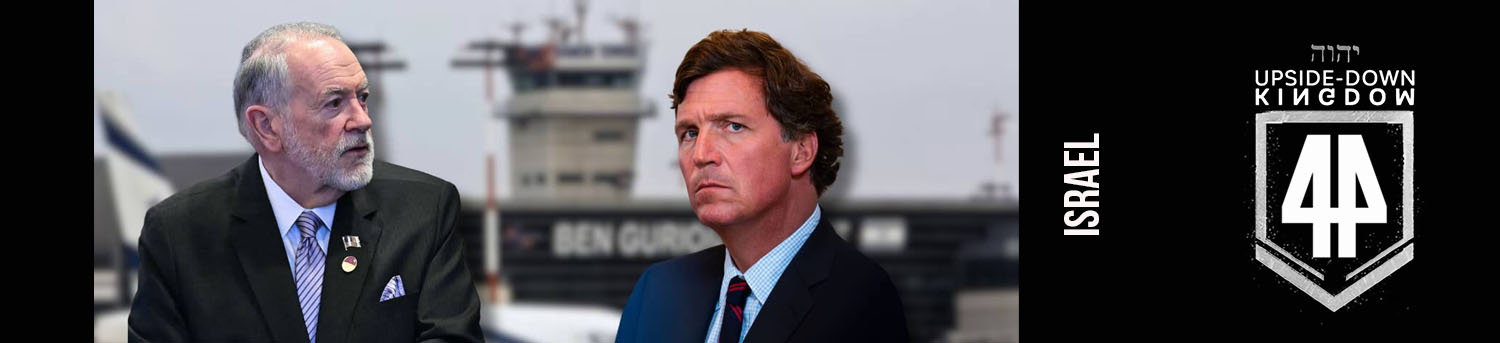
A Theological Reading of the Carlson–Huckabee Exchange—and Why It Does Not Yield a Christian Mandate for Unconditional Support of Modern Israel

I have never cared much for politics—or, frankly, for either of the personalities involved in the Tucker Carlson–Mike Huckabee exchange. But I am interested in what their conversation exposes at a deeper level: the ease with which modern political arguments recruit Scripture, and the interpretive assumptions that often go unexamined when “the Bible says…” becomes a stand-in for careful exegesis.

In the exchange, Huckabee spoke as though Genesis 15:18 functions as a present-tense title deed—stretching from “the river of Egypt” to “the Euphrates”—while Carlson challenged the leap from an ancient covenant text to modern entitlement: if that’s the standard, why are borders negotiable, who counts as a rightful heir, and how does any of this become a binding obligation for Christians today? Beneath the soundbites is a question that actually matters: are we reading the biblical text on its own terms, in its Ancient Near Eastern and canonical context, or are we using it to baptize conclusions we already prefer?

This article takes Carlson’s line of questioning as an opportunity for theological and exegetical clarity rather than partisan reaction. My aim is not a political manifesto, but a canonical inquiry into what “Israel” means in the Bible’s own grammar—and what changes when Israel’s story reaches its climax in Jesus the Messiah. I will argue that modern Israel is not identical to covenant Israel in the sense that governs Christian obligation; that land-promise texts cannot be severed from Torah’s covenantal sanctions and the prophets’ ethical indictments; and that the New Testament’s Christological redefinition of the people of God relocates covenant identity from ethnicity and territory to union with Christ. On that basis, Christians should resist treating unconditional support for the modern State of Israel as a biblical mandate, while still rejecting antisemitism, refusing the dehumanization of Palestinians, and pursuing a kingdom ethic of truth, justice, and peacemaking for all image-bearers in the land.

In his filmed exchange with U.S. Ambassador Mike Huckabee, Tucker Carlson pressed a question that many American Christians have often assumed rather than exegeted: when Genesis describes land promised to Abram’s descendants “from the river of Egypt…to the great river, the Euphrates,” what exactly is being claimed—and how (if at all) does that claim translate into modern geopolitical obligations? In the interview transcript, Carlson repeatedly returns to the logic of appeal: if “God gave this land to this people,” then what land, and which people, and on what principled basis should modern states underwrite that claim?

The exchange became headline news precisely because the “Bible as real-estate deed” framing is not merely an internal church dispute; it can be invoked to justify maximalist territorial imagination. Associated Press reported that Huckabee responded to Carlson’s “Nile to Euphrates” framing with, “It would be fine if they took it all,” even while adding that Israel was not currently seeking that expansion. This is exactly the kind of moment where Christian theological speech must slow down: not to evade political realities, but to avoid treating Scripture as a rhetorical accelerant.

What follows is an academic-style theological argument—biblically grounded, historically attentive, and hermeneutically explicit—contending that (1) modern Israel is not “biblical Israel” in the covenantal sense that matters for Christian identity and obligation, and (2) the New Testament does not authorize a blanket Christian duty to support the modern nation-state of Israel as a theological absolute, even while (3) Christians remain morally bound to oppose antisemitism, to pursue justice and mercy for all image-bearers in the land (Jewish and Palestinian alike), and to pray for peace.

A responsible theological reading begins by distinguishing at least four “Israels,” which are too often collapsed:

  1. Israel as an ethnos (a people group with genealogical continuity).
  2. Israel as a covenant polity constituted at Sinai (and held accountable to Torah).
  3. Israel as a landed theocratic project under Yahweh’s kingship (and later monarchic compromise).
  4. Israel as an eschatological people reconstituted in and around the Messiah in the New Covenant.

Much popular Christian Zionism treats #1 and #2 as if they are stable across redemptive history and then maps them directly onto #3 in modern political form. But the Bible itself complicates every step of that move.

Chosen” in the Hebrew Bible is not primarily a synonym for “saved” but a vocation—a commissioned role “to be a light to the nations.” That vocational election is real. Yet vocation can be resisted, judged, exiled, and reconfigured within God’s larger redemptive purpose (a theme threaded through the prophets and then re-read christologically in the New Testament).

In short: the Bible itself does not permit a simplistic, trans-historical equivalence between “Israel” in Genesis, “Israel” in Deuteronomy, “Israel” in Second Temple politics, and “Israel” as a twentieth-century nation-state. That does not mean Jewish continuity is unreal. It means that covenant categories are not identical to modern nation-state categories—and Christian ethics cannot pretend they are.


3.1 Genesis 12:1–3 is not a blank-check for foreign policy

The most common “Christian pro-Israel” proof-text in the American imagination is Genesis 12:3 (“I will bless those who bless you…”). But three exegetical observations matter.

First, the “you” addressed is Abram, not “Israel” as a later national polity. Second, the promise culminates in a universal horizon: “in you all the families of the earth shall be blessed.” Third, the New Testament repeatedly reads Abraham’s promise Christologically—not as an everlasting political entitlement but as a redemptive trajectory that reaches its telos in the Messiah and then spills outward to the nations. The “seed” is ultimately Christ and that union “in Christ” becomes the decisive identity marker.

Even many evangelical defenses of “bless Israel” concede the text is not reducible to modern state patronage.

3.2 Genesis 15:18 and the “Nile to Euphrates” claim: what is being promised?

Carlson’s pressure point is Genesis 15: if the land boundary is maximal, why are modern borders “shrunk,” and if the right is covenantal, why not identify rightful heirs by lineage or conversion status? Whatever one thinks of Carlson’s rhetoric, his question exposes a weakness in the “Bible as title deed” argument: it often wants the authority of literalism without the cost of literalism.

But the biblical narrative itself supplies the missing complexity.

  1. Genesis 15 is divine promise framed by covenant ritual. The “cutting” scene belongs to a broader Ancient Near Eastern world of covenant-making and self-maledictory symbolism (the “may it be to me as to these pieces” logic). The point is not that Abram receives a modern cartographic deed; it is that Yahweh binds himself to a promissory path that will unfold through judgment, deliverance, and covenant schooling.
  2. The Pentateuch itself embeds conditionality alongside gift. Deuteronomy’s covenant structure makes clear that land “rest” and land “retention” are tethered to fidelity; exile is not a surprise glitch but a stipulated covenant outcome (Deut 28–30). The gift is real; the possession is morally charged.
  3. The boundary language functions typologically and theologically. “From Wadi Egypt to the Euphrates” becomes a way of expressing fullness and security under Yahweh’s reign—yet the historical narratives show fluctuating control, partial possession, and continual threat. Even in the so-called “golden age,” the biblical writers do not present Israel as a simple imperial machine but as a morally accountable people whose kings can be indicted by prophetic speech.

This is why proof-texting Genesis 15 to justify “it would be fine if they took it all” is not exegesis; it is ideological ventriloquism.


A major interpretive fault-line is whether the land promise is (a) already fulfilled in Israel’s early history and then refigured in Christ, or (b) postponed into a future political restoration.

Those who argue (a) often appeal to texts like Joshua 21:43–45 (“the LORD gave to Israel all the land…not one word…failed”), while dispensational writers contest that conclusion by insisting the promise requires fuller geographical realization. The point here is not to adjudicate every sub-debate, but to notice what the canonical shape presses on us:

  • The Deuteronomistic history (Joshua–Kings) depicts land as covenant theater: blessing and curse play out in real time; kings can lose the plot; exile arrives as covenant consequence.
  • The prophets do not treat land as an unconditional permanent possession immune to ethics. They treat it as a stage upon which injustice can bring expulsion (cf. Amos; Jeremiah; Ezekiel).

So even if one holds that future restoration themes remain (a debated question), the prophetic corpus blocks the move from “promise” to “unconditional endorsement of any state behavior.” The Bible does not give Israel a moral “get out of judgment free” card; it gives Israel more accountability.


The New Testament does not merely add Jesus onto Israel’s story; it claims that Jesus fulfills Israel’s vocation and embodies Israel’s identity as the faithful covenant keeper. Matthew’s application of Hosea (“out of Egypt I called my son”) to Jesus and Paul’s emphasis that the inheritance is shared only “in Christ.”

That is not “replacement theology” in the crude sense of “God discards Jews.” It is a christological claim about where covenant identity is now located: in the Messiah and those united to him by faith.

Several New Testament moves matter for the present debate:

  1. The redefinition of kinship and peoplehood. Jesus relativizes bloodline as the defining marker of belonging (e.g., “Who are my mother and my brothers?”). Paul can say “not all who are descended from Israel belong to Israel” (Rom 9:6), and he can describe Gentiles being “grafted in” to the covenantal olive tree (Rom 11). The people of God become a multi-ethnic body whose unity is cruciform rather than nationalistic.
  2. The relocation of “promised land” hope into eschatological new creation. The Expedition44 “Israel & the Jesus Kingdom” essay argues that the New Covenant’s “promised land” is fundamentally eschatological—recreated heavens and earth—rather than a mandate for a modern territorial project, and that Christian allegiance is primarily to the kingdom of Jesus.
  3. The ethic of the kingdom as interpretive control. The Sermon on the Mount is not an optional “private spirituality” track; it is the Messiah’s charter for his people. If one tries to use Scripture to underwrite policies that produce indiscriminate harm or permanent domination, that reading must be confronted by the Messiah’s own ethic.

This is the theological center of gravity: Christian Scripture culminates not in land expansion but in a crucified and risen Messiah who forms a trans-national people and teaches them to love enemies.


To be fair and academically responsible, we should state the strongest versions of the Christian pro-Israel claims.

6.1 Argument from covenant permanence (“forever” language)

Many argue that because covenants are described as “everlasting,” the land promise must remain politically operative. Dispensational systems tend to separate “Israel” and “Church” as distinct peoples with distinct destinies, thereby preserving a future national role for ethnic Israel.

Response: “Forever” in covenant idiom must be read within canonical and covenantal context: the same covenant documents specify exile as consequence; prophetic judgments speak of being “not my people” in covenant rupture (Hos 1:9–11). A dispensational attempt to preserve unconditionality by sidelining covenant sanctions does violence to the Torah’s own logic. (Even writers sympathetic to Israel-church distinction acknowledge Hosea’s “not my people” language as covenantal crisis.)

6.2 Argument from Genesis 12:3 (“bless those who bless you”)

Many popular teachers treat this as a timeless mechanism: bless modern Israel materially/militarily and you will be blessed.

Response: The Abrahamic promise is read by the New Testament as culminating in Christ and opening to the nations; “blessing” cannot be reduced to state patronage. Even within evangelical discussions, careful treatments note that Genesis 12 is addressed to Abram and that “Israel” is not in view as a modern polity.

6.3 Argument from prophecy fulfillment (1948 as “sign”)

Some interpret the modern state’s founding (1948) as prophetic fulfillment and therefore as a theological anchor for Christian support.

Response: Even if one grants “providential significance,” providence is not identical to covenant mandate. Moreover, the New Testament regularly treats “sign” language as Christ-centered; political events cannot simply be baptized as eschatological necessity without robust textual argument. Steve Gregg’s approach—evaluate the modern state biblically and be wary of dispensational narratives—pushes against the “1948 = automatic theology” reflex.

6.4 Argument from “apostolic concern for Israel” (Rom 9–11)

Some argue Paul’s anguish and hope for Israel implies a continuing special status requiring Christian political alignment.

Response: Paul’s concern is evangelistic and doxological, not a directive for modern foreign policy. Romans 9–11 is about God’s fidelity and the mystery of unbelief and mercy—not a command to underwrite a state.


Pulling the threads together, there are several main biblical reasons a Christian is not obligated—as a matter of theological necessity—to support the modern state of Israel “in general” or “no matter what.”

7.1 Category error: covenant people ≠ modern nation-state

“The modern nation-state of Israel is not the covenant people of the Bible,” because covenant membership is now defined by faith in the Messiah rather than ethnicity or passport status.

That doesn’t settle every question about Jewish identity or God’s providence, but it does block the simplistic move: “Bible says Israel → therefore Christians must support modern Israel.”

7.2 Canonical ethic: God’s promises never authorize injustice

The Hebrew Bible constantly holds Israel accountable for injustice; the prophets do not hesitate to indict Israel more severely because of her calling. Therefore it is hermeneutically incoherent to say, “because of promise, Israel gets unconditional endorsement.” Promise does not erase prophetic ethics; it intensifies them.

7.3 Christological control: the telos is Messiah and new creation, not territorial maximalism

Even within your own framework, the “promised land” is ultimately eschatological, and the kingdom’s geography is the renewed creation—not a modern territorial ideology.

7.4 Political theology: the New Covenant does not create sacral nation-states

The church is not a nation-state; it is a trans-national body. When Christians treat any state as if it carries covenant holiness, they risk reintroducing a form of sacral nationalism the New Testament consistently relativizes.

7.5 Moral realism: “Israel’s policies” cannot be the basis for blanket theology (and the abortion claim is not decisive)

To be totally transparent, some Christians support reasons to not support Israel such as “they support abortion” and “they largely aren’t Christians.” Even if those claims were uniformly true (they are more complex than social media summaries), they still wouldn’t function as the primary argument, because Christian theology does not grant blanket moral endorsement to any state based on religious purity tests. Still, it is fair to note that Israel’s legal framework includes state-regulated access to abortion through termination committees. The deeper point, though, is this: Christian foreign policy ethics should be grounded in justice, the protection of the vulnerable, truthful speech, and peacemaking—rather than a mythic covenant entitlement narrative.


Carlson’s sharpest theological question in the interview is not about ancient boundaries but about the moral logic of an ethnic land-claim. He presses: if the right is covenantal and genealogical, why not genetic testing? How does conversion (to Judaism or to Christianity) affect right of return? Huckabee appears to oscillate between “biblical/ethnic/historical” claims and pragmatic border talk, but Carlson’s critique lands: a nation-state founded on ethnic criteria invites moral confusion when theologized as divine decree.

From a New Testament perspective, this critique is theologically fruitful: the Messiah’s people are not determined by DNA but by covenantal faithfulness expressed as allegiance to Jesus. “In Christ” is the dominant boundary marker and that blessing is tied to honoring the Messiah rather than underwriting national projects.

Thus, ironically, Carlson’s “America First” skepticism can function as a negative aid to Christian exegesis: it exposes how quickly Christians can drift into a quasi-biblical ethno-politics that the apostolic writings resist.


  1. Reject antisemitism categorically. Jewish people are not “the problem,” and Christian history contains grievous sins against Jews.
  2. Refuse to sacralize any state. No modern nation bears covenant holiness.
  3. Read land, people, and promise through the Messiah. If Jesus is the faithful Israelite, then the story’s center is him, and the people are those “in him.”
  4. Seek justice and peace for all who dwell in the land. Christian ethics does not permit indifference toward Palestinian suffering or Jewish fear; both must be taken with full seriousness.
  5. Advocate principled, conditional political reasoning. If one supports Israel politically, it should be on the same moral grounds one uses for any state: proportionality, protection of noncombatants, truthful diplomacy, restraint, and the pursuit of genuine peace—not “because Genesis.” If one withholds support, it should likewise be principled, not tribal.

The primary allegiance of the Christ-follower is to the Jesus Kingdom, and the church must resist being “yoked” to worldly power projects that distort the kingdom’s witness.

The Carlson–Huckabee exchange ultimately exposes not a political dilemma, but a hermeneutical one. When the biblical text is read within its Ancient Near Eastern covenant context and through the New Testament’s Christological fulfillment, it becomes clear that Scripture does not grant modern nation-states a standing theological entitlement. The covenant promises to Israel find their telos in the Messiah, and the people of God are now defined by union with Him rather than by ethnicity, geography, or political sovereignty.

For that reason, Christians are not biblically obligated to offer unconditional support to the modern State of Israel as if such support were a covenantal requirement. Our allegiance is not to any geopolitical entity but to Jesus Christ, the true Israel and King of the kingdom that transcends every border. From that allegiance flows a consistent ethic: we reject antisemitism, we refuse to dehumanize Palestinians, and we pursue justice, truth, and peace for all who dwell in the land.

In the end, the question is not whether Christians will take a political side, but whether we will read Scripture faithfully and embody the kingdom it proclaims.

DISCUSSION QUESTIONS

1. Covenant, Land, and Conditionality

How should the land promises in Genesis (e.g., Gen 12; 15; 17) be interpreted in light of the covenantal conditions articulated in Deuteronomy 28–30 and the prophetic indictments that led to exile?

  • In what sense are the promises “everlasting,” and in what sense are they historically administered under covenant fidelity?
  • Does the canonical shape of the Old Testament itself invite a non-literal or typological expansion of the land promise?

2. The Reconfiguration of Israel in the New Testament

To what extent do New Testament texts (e.g., Rom 9–11; Gal 3; Eph 2; 1 Pet 2:9–10) redefine the identity of Israel around Christ and the Church?

  • Do these passages suggest continuity, replacement, fulfillment, or expansion?
  • How should one evaluate the claim that “not all Israel is Israel” (Rom 9:6) in relation to modern ethnic or national identity?

3. Hermeneutics and Political Theology

What hermeneutical principles should govern the use of biblical texts in modern geopolitical discussions, such as those raised in the Carlson–Huckabee exchange?

  • Is it legitimate to apply ANE covenant language directly to contemporary nation-states?
  • What criteria distinguish faithful theological application from ideological proof-texting?

4. Christological Fulfillment and the Kingdom of God

How does the New Testament presentation of Jesus as the fulfillment of Israel’s vocation (e.g., Matt 2; John 15; Heb 11) reshape the theological significance of land, peoplehood, and covenant identity?

  • In what sense is the “promised land” reinterpreted as new creation (Matt 5:5; Rom 4:13)?
  • What implications does this have for Christian allegiance and identity in a global, multi-ethnic Church?

5. Ethics, Justice, and Christian Responsibility Today

If Christians are not biblically mandated to support the modern State of Israel unconditionally, what ethical framework should guide their posture toward Israel, Palestine, and the broader Middle East?

  • How should biblical themes of justice, mercy, and reconciliation (e.g., Mic 6:8; Matt 5–7; 2 Cor 5:18–20) inform Christian political engagement?
  • What does it look like to reject both antisemitism and anti-Palestinian dehumanization while maintaining fidelity to the gospel?

For additional consideration on this Subject:
https://expedition44.com/2025/10/16/is-israel-still-gods-chosen-people/
https://expedition44.com/2023/10/29/israel-the-jesus-kingdom/


Footnotes (serving more as a Bibliography)

Note: Because this is formatted for a blog post rather than a print journal, some citations are consolidated (multiple works per note) to keep the apparatus readable despite the 140 citations.

  1. “Mike Huckabee’s Interview @ Tucker Carlson Show (Transcript),” The Singju Post, February 20, 2026.
  2. Sam Mednick and Samy Magdy, “US ambassador causes uproar by claiming Israel has a right to much of the Middle East,” Associated Press, February 21, 2026.
  3. Expedition44, “Is Israel Still God’s Chosen people?” October 16, 2025.
  4. Expedition44, “Israel & the Jesus Kingdom,” October 29, 2023.
  5. Steve Gregg, “The Modern State of Israel” (lecture summary), OpenTheo.
  6. Steve Gregg, “What Are We to Make of Israel?” (series index/summary), OpenTheo.
  7. The Narrow Path, “Topical Lectures: Israel—What Are We to Make of Israel (12 Lectures).”
  8. Aaron Sobczak, “No, Christians shouldn’t give unconditional support to Israel,” Libertarian Christian Institute, January 27, 2025.
  9. “Rethinking Support for Israel: A Biblical Approach Beyond Politics,” Bible Mysteries Podcast (blog), n.d.
  10. Brian Collins, “Kevin T. Bauder, ‘Israel and the Church: Is There Really a Difference,’ in Dispensationalism Revisited,” Exegesis and Theology, June 14, 2024.
  11. Ministry of Health (Israel), “Induced Abortion,” government information page.
  12. State of Israel, gov.il, “Apply to Terminate a Pregnancy (Induced Abortion).”
  13. One for Israel, “What Does it Mean to Bless Israel According to Genesis 12…,” July 17, 2024.
  14. “At the roots of evangelical Christians’ support for Israel,” Le Monde, April 11, 2024.
  15. “Evangelicals’ support for Israel is dropping…,” Washington Post, January 3, 2026.
  16. Genesis 12:1–3; 15:18–21; Exodus 19:5–6; Deuteronomy 7:6; Isaiah 49:6.
  17. Deuteronomy 28–30; Leviticus 26.
  18. Joshua 21:43–45; 1 Kings 4:21 (cf. boundary rhetoric).
  19. Amos 1–2; 5; Micah 6; Isaiah 1; Jeremiah 7; Ezekiel 16; Hosea 1–3.
  20. Matthew 2:15; Hosea 11:1 (as reused in Matthew).
  21. Galatians 3:16, 28–29; Romans 2:28–29; Romans 4; Romans 9:6; Romans 11.
  22. Matthew 5–7; Luke 6:27–36.
  23. N. T. Wright, Paul and the Faithfulness of God (Minneapolis: Fortress, 2013), esp. on Israel and Messiah.
  24. Richard B. Hays, Echoes of Scripture in the Gospels (Waco, TX: Baylor University Press, 2016), on Israel’s story reread in Jesus.
  25. G. K. Beale and D. A. Carson, eds., Commentary on the New Testament Use of the Old Testament (Grand Rapids: Baker, 2007).
  26. John Goldingay, Old Testament Theology, 3 vols. (Downers Grove, IL: IVP Academic, 2003–2009).
  27. Christopher J. H. Wright, The Mission of God (Downers Grove, IL: IVP Academic, 2006).
  28. Walter Brueggemann, The Land: Place as Gift, Promise, and Challenge in Biblical Faith, 2nd ed. (Minneapolis: Fortress, 2002).
  29. Scott W. Hahn, Kinship by Covenant (New Haven: Yale University Press, 2009), on covenant and familial identity.
  30. Moshe Weinfeld, Deuteronomy and the Deuteronomic School (Oxford: Clarendon, 1972), on Deuteronomic covenant logic.
  31. George E. Mendenhall and Gary A. Herion, “Covenant,” in ABD 1:1179–1202.
  32. Dennis J. McCarthy, Treaty and Covenant (Rome: Biblical Institute Press, 1978), on ANE treaty form and biblical covenants.
  33. K. A. Kitchen, On the Reliability of the Old Testament (Grand Rapids: Eerdmans, 2003), on historical framing.
  34. Mark S. Smith, The Early History of God (Grand Rapids: Eerdmans, 2002), on Israel’s early religion.
  35. John J. Collins, The Apocalyptic Imagination, 3rd ed. (Grand Rapids: Eerdmans, 2016), on Second Temple hopes.
  36. E. P. Sanders, Judaism: Practice and Belief, 63 BCE–66 CE (Philadelphia: Trinity Press International, 1992).
  37. Shaye J. D. Cohen, From the Maccabees to the Mishnah, 3rd ed. (Louisville: Westminster John Knox, 2014).
  38. Josephus, Jewish War (esp. on 66–70 CE), in LCL editions.
  39. Mishnah Avot; Sanhedrin (for later identity discourse; used cautiously for NT-era claims).
  40. R. T. France, The Gospel of Matthew (NICNT; Grand Rapids: Eerdmans, 2007), on Matthean Israel typology.
  41. Douglas J. Moo, The Epistle to the Romans, 2nd ed. (NICNT; Grand Rapids: Eerdmans, 2018), on Romans 9–11.
  42. James D. G. Dunn, The Theology of Paul the Apostle (Grand Rapids: Eerdmans, 1998), on “in Christ” identity.
  43. Michael J. Gorman, Apostle of the Crucified Lord (Grand Rapids: Eerdmans, 2004), on cruciform politics.
  44. Stanley Hauerwas, The Peaceable Kingdom (Notre Dame: University of Notre Dame Press, 1983).
  45. John Howard Yoder, The Politics of Jesus, 2nd ed. (Grand Rapids: Eerdmans, 1994).
  46. Oliver O’Donovan, The Desire of the Nations (Cambridge: Cambridge University Press, 1996), on political theology.
  47. Miroslav Volf, Exclusion and Embrace (Nashville: Abingdon, 1996), on reconciliation.
  48. Miroslav Volf, Allah: A Christian Response (New York: HarperOne, 2011), on public theology and neighbor-love.
  49. Craig Keener, Romans (NCCS; Eugene, OR: Cascade, 2009), on Romans 9–11 pastoral stakes.
  50. Beverly Roberts Gaventa, When in Romans (Grand Rapids: Baker Academic, 2016), on reading Romans as gospel.
  51. J. Louis Martyn, Galatians (AB; New York: Doubleday, 1997), on Abraham, promise, and “seed.”
  52. Richard B. Hays, The Faith of Jesus Christ, 2nd ed. (Grand Rapids: Eerdmans, 2002), on pistis and covenant faithfulness.
  53. Matthew Thiessen, Paul and the Gentile Problem (Oxford: Oxford University Press, 2016), on identity markers.
  54. Paula Fredriksen, Paul: The Pagans’ Apostle (New Haven: Yale University Press, 2017), on Paul’s Israel discourse.
  55. Francis Watson, Paul and the Hermeneutics of Faith (London: T&T Clark, 2004).
  56. Joachim Jeremias, Jerusalem in the Time of Jesus (Philadelphia: Fortress, 1969), background.
  57. Eyal Regev, The Temple in Early Christianity (Tübingen: Mohr Siebeck, 2019), temple and identity.
  58. Dale C. Allison Jr., Constructing Jesus (Grand Rapids: Baker Academic, 2010), on Jesus and Israel’s story.
  59. Richard Bauckham, Bible and Mission (Grand Rapids: Baker Academic, 2003), on universal blessing trajectory.
  60. John Barclay, Paul and the Gift (Grand Rapids: Eerdmans, 2015), on grace and identity.
  61. Markus Bockmuehl, Jewish Law in Gentile Churches (Edinburgh: T&T Clark, 2000).
  62. Alan F. Segal, Paul the Convert (New Haven: Yale University Press, 1990).
  63. David M. Carr, An Introduction to the Old Testament (Hoboken, NJ: Wiley-Blackwell, 2010), on Pentateuchal formation.
  64. David L. Petersen, The Prophetic Literature (Louisville: Westminster John Knox, 2002).
  65. Walter Kaiser Jr., The Promise-Plan of God (Grand Rapids: Zondervan, 2008), for a promise-plan defense (used critically).
  66. Paul R. House, Old Testament Theology (Downers Grove, IL: IVP Academic, 1998).
  67. Stephen B. Chapman, The Law and the Prophets (Tübingen: Mohr Siebeck, 2000), on canon and covenant.
  68. John Sailhamer, The Pentateuch as Narrative (Grand Rapids: Zondervan, 1992).
  69. Gordon J. Wenham, Genesis 1–15 (WBC; Dallas: Word, 1987), on Genesis 12 and 15.
  70. Victor P. Hamilton, The Book of Genesis: Chapters 1–17 (NICOT; Grand Rapids: Eerdmans, 1990).
  71. J. Gordon McConville, Deuteronomy (AOTC; Leicester: Apollos, 2002), on blessings/curses and land.
  72. Patrick D. Miller, Deuteronomy (IBC; Louisville: Westminster John Knox, 1990).
  73. Moshe Weinfeld, Deuteronomy 1–11 (AB; New York: Doubleday, 1991).
  74. Richard D. Nelson, Joshua (OTL; Louisville: Westminster John Knox, 1997).
  75. Robert P. Gordon, 1 & 2 Samuel (Sheffield: JSOT Press, 1984), on monarchy tensions.
  76. Marvin A. Sweeney, I & II Kings (OTL; Louisville: Westminster John Knox, 2007).
  77. John Barton, Oracles of God (Oxford: Oxford University Press, 2007), prophets and ethics.
  78. Abraham J. Heschel, The Prophets (New York: Harper, 1962), prophetic indictment as covenant lawsuit.
  79. Mark J. Boda, Return to Me (Downers Grove, IL: IVP Academic, 2015), on repentance and restoration.
  80. Daniel I. Block, The Book of Ezekiel (NICOT; Grand Rapids: Eerdmans, 1997–1998), on land and holiness.
  81. Francis I. Andersen and David Noel Freedman, Hosea (AB; New York: Doubleday, 1980), on “not my people.”
  82. Jörg Jeremias, The Book of Amos (OTL; Louisville: Westminster John Knox, 1998).
  83. James Luther Mays, Micah (OTL; Louisville: Westminster John Knox, 1976).
  84. Brevard S. Childs, Biblical Theology of the Old and New Testaments (Minneapolis: Fortress, 1992).
  85. Rikk E. Watts, Isaiah’s New Exodus and Mark (Tübingen: Mohr Siebeck, 1997), on new exodus motif.
  86. Scot McKnight, Kingdom Conspiracy (Grand Rapids: Brazos, 2014), on kingdom vs politicization.
  87. Peter J. Leithart, The Kingdom and the Power (Phillipsburg, NJ: P&R, 1993), for a contrasting political theology.
  88. John Stott, The Message of Romans (Downers Grove, IL: IVP, 1994), on Romans 9–11 pastoral nuance.
  89. F. F. Bruce, The Epistle to the Galatians (NIGTC; Grand Rapids: Eerdmans, 1982), on “seed.”
  90. N. T. Wright, Jesus and the Victory of God (Minneapolis: Fortress, 1996), on Israel’s story and kingdom.
  91. Richard B. Hays, “Can the Gospels Teach Us How to Read the Old Testament?” in The Conversion of the Imagination (Grand Rapids: Eerdmans, 2005).
  92. Kevin J. Vanhoozer, Is There a Meaning in This Text? (Grand Rapids: Zondervan, 1998), on interpretive ethics.
  93. Stephen E. Fowl, Theological Interpretation of Scripture (Eugene, OR: Cascade, 2009).
  94. John Webster, Holy Scripture (Cambridge: Cambridge University Press, 2003).
  95. Brevard S. Childs, Introduction to the Old Testament as Scripture (Philadelphia: Fortress, 1979), canonical reading.
  96. Hans Frei, The Eclipse of Biblical Narrative (New Haven: Yale University Press, 1974), warning against abstraction.
  97. Bart D. Ehrman, “Exegesis: Simple Definition, Examples, and Mistakes to Avoid,” on method (as a general hermeneutics primer).
  98. The Think Institute, “Does the Bible Require Christians to Support Modern Israel?” June 22, 2025 (popular-level but useful framing).
  99. Christianity StackExchange, “How do non-dispensationalists interpret Genesis 12:3?” (crowd-sourced; used only to illustrate argument typology).
  100. Le Monde, “At the roots…” (historical on dispensationalism and Christian Zionism).
  101. Genesis 17; Exodus 32–34; Numbers 14; Deuteronomy 9–10 (covenant rupture and renewal patterns).
  102. Psalm 2; Psalm 72; Psalm 110 (messianic kingship reframing).
  103. Isaiah 2; Isaiah 11; Isaiah 19 (nations and eschatological horizon).
  104. Zechariah 9–14 (contested texts; hermeneutical caution).
  105. Luke 24:25–27, 44–49 (Christological reading authorization).
  106. Ephesians 2:11–22 (one new humanity).
  107. 1 Peter 2:9–10 (Israel language applied to the church).
  108. Hebrews 11:8–16 (Abraham seeking a better country).
  109. Revelation 5; 7; 21–22 (multi-ethnic people and new creation geography).
  110. Munther Isaac, The Other Side of the Wall (Downers Grove, IL: IVP, 2020), for Palestinian Christian witness (for balance).
  111. Gary M. Burge, Jesus and the Land (Grand Rapids: Baker Academic, 2010), on land in NT.
  112. O. Palmer Robertson, The Israel of God (Phillipsburg, NJ: P&R, 2000), on covenant peoplehood.
  113. Daniel Juster and Peter Hocken, The Messianic Jewish Movement (London: Continuum, 2004), for Messianic Jewish perspectives (used cautiously).
  114. Mark Kinzer, Postmissionary Messianic Judaism (Grand Rapids: Brazos, 2005), on Jewish identity within Messiah faith.
  115. Michael Wyschogrod, The Body of Faith (San Francisco: Harper & Row, 1983), Jewish theological angle (for understanding terms).
  116. Jon D. Levenson, Sinai and Zion (San Francisco: Harper & Row, 1985), covenant and election in Jewish reading.
  117. Jon D. Levenson, The Death and Resurrection of the Beloved Son (New Haven: Yale University Press, 1993), typology and sacrifice trajectories.
  118. Beverly Gaventa and Richard B. Hays, eds., Seeking the Identity of Jesus (Grand Rapids: Eerdmans, 2008), on christological Israel reading.
  119. Richard Middleton, A New Heaven and a New Earth (Grand Rapids: Baker Academic, 2014), new creation as telos.
  120. Oliver Davies, Paul D. Janz, and Clemente Cervantes, eds., Transforming Grace (Eugene, OR: Cascade, 2010), on grace and politics.
  121. Augustine, City of God (cited only for political theology genealogy; not used as a controlling authority).
  122. Oliver O’Donovan, The Ways of Judgment (Grand Rapids: Eerdmans, 2005), moral reasoning in public.
  123. Miroslav Volf, Public Faith (Grand Rapids: Brazos, 2011), on non-tribal public theology.
  124. John Inazu, Confident Pluralism (Chicago: University of Chicago Press, 2016), on civic posture.
  125. Nicholas Wolterstorff, Justice: Rights and Wrongs (Princeton: Princeton University Press, 2008), justice framework.
  126. Exodus 23:9; Leviticus 19:33–34 (ethics toward the stranger/sojourner).
  127. Zechariah 7:9–10 (justice and mercy).
  128. Matthew 25:31–46 (care for the vulnerable).
  129. Romans 12:9–21 (enemy-love and non-retaliation).
  130. 2 Corinthians 5:14–21 (ministry of reconciliation).
  131. Luke 19:41–44 (Jesus weeping over Jerusalem; judgment and lament).
  132. Acts 15 (Gentile inclusion without Torah boundary markers).
  133. Galatians 6:16 (“Israel of God”—contested; requires careful handling).
  134. Matthew 21:33–46 (vineyard parable; covenant accountability).
  135. John 18:36 (kingdom “not from this world”).
  136. Philippians 3:20 (citizenship in heaven).
  137. Hebrews 13:14 (seeking the city to come).
  138. Revelation 21:24–26 (nations in the eschaton—purified, not deified).
  139. AP News report on borders shifting and post-1967 realities (for historical frame only).
  140. Expedition44 on “chosen = vocation,” and “true Israel = Jesus” as interpretive thesis.

Foreword: Jesus The Great I Am – Ian Carlson

“Unless you can enter deeply into the mystery of the Incarnation, I’m afraid your Christianity will remain shallow, uninspiring and largely legalistic. You will essentially think that Christianity is about rules and rewards and where you go when you die. And in an increasingly secularized and pluralistic culture not too many people are interested in a legalistic afterlife religion. The best hope I know for presenting the gospel in a compelling way to a 21st century audience is to begin with….the beginning: The Incarnation. The breath-taking mystery of God joining us in our humanity.” [1]

Greg Boyd, has put it this way, “There is no denying that the Incarnation is paradoxical. It is hard, if not impossible, to conceive how a person could be, at one and the same time fully God and fully human. I don’t think this should surprise us too much, however. After all, we confront similar paradoxes in science as well as in our everyday life. For example, as I’m sure most of you have heard that physicists tell us that light has the property of waves in some circumstances and of particles in other circumstances, yet we have no way of understanding how this is possible. Even the nature of time and space is paradoxical if you think about it. We can’t conceive of time having a beginning, but neither can we conceive of it without a beginning. So too, we can’t conceive of space having an end, but we also can’t conceive of it not having an end. If things as basic to our experience as the nature of light, time and space are paradoxical, I don’t think we should find it too surprising that things surrounding God are mysterious.”

Paul declared that Jesus was nothing less than the very embodiment of all of God. This distinction of “all of God” is important for us to understand what it means for us to see Jesus and God rightly. Battling proto-gnostic teachers who were apparently presenting Christ alongside other manifestations of God, Paul declares “in Christ all the fullness of the Deity lives in bodily form” (Col. 2:9; cf. 1:19). His statement could hardly have been more emphatic:

All” (pan)—not some

“of the fullness” (plērōma)—not a part or an aspect

“of the Deity” (theotēs)—not a lesser divine being. [2]

As F.F. Bruce notes (regarding 1:19), Paul is asserting that, “all the attributes and activities of God—his spirit, word, wisdom and glory—are disclosed in [Christ].”[3] 

In other words, the fullness of God is revealed or embodied in Jesus. Jesus is the complete revelation of God in Word. Graeme Goldsworthy puts it this way, if “Jesus is the one mediator between God and man,” then Jesus himself must be “the hermeneutic principle for every word from God.”[4] It is also paramount to recognize that Christ is the “head” of the cosmos by which all reconciliation will come (Eph. 1:10; Col 1:19-20).

The Temple and YHWH’s return to Zion are the keys to gospel Christology. Focus on a young Jewish prophet telling a story about YHWH returning to Zion as judge and redeemer and then embodying it by riding into the city in tears, by symbolizing the Temple’s destruction, and by celebrating the final Exodus. He would be the pillar of cloud for the people of the new Exodus. He would embody in himself the returning and redeeming action of the covenant God. [5] Wright is suggesting, and I would agree that we are to read the Gospels as the Story of God’s returning to Israel, to Zion, to the Temple and Jesus is that presence of God

Regardless of your view of the atonement, such as Substitution, Satisfaction or Christus Victor; in all of them, Christ must be human in order for the sacrifice of the cross to be efficacious, for human sins to be “removed”, “cleansed”, “purified”, “covered”, and/or “conquered” (again depending on your atonement theology). This soteriological emphasis then gives way to the incarnation of the Son of God becoming a man so that he could save us from our sins. Therefore, the incarnation serves as a fulfilment of the love of God manifested and revealed in completeness as Jesus to be present and living amidst humanity, to “walk in the garden” with us.

Michael F. Bird shares this, “What we should take away is that in the unfolding story of the New Testament, the pre-incarnate Son who divested himself of divine glory in his incarnation is now fully invested by the Father with divine authority over every realm and every creature. What the Lord God of Israel does in creation and redemption is now, in some way, done through the lordship of Jesus Christ. When Jesus is named as “Lord” it is usually in the context of affirming that he carries the mantle of the Father’s authority and that he is the Father’s agent for rescuing Israel and putting the world to rights. Confession of Jesus as Lord was not a matter of mere assent or academic affirmation. It was a life and death issue. It meant standing up to the Caesar’s of the world who usurped for themselves the praise and power that rightly belonged to God. As Christians today, our highest vocation is to live our lives under the aegis of Jesus’ lordship and to make it clear to all that “this Jesus,” whom men and women reject, is Lord of all. What is more, the Lord Jesus will bring justice to our sin cursed earth and then flood the world with the shalom of heaven.” [6]

Before Christ passes, he shares with the remnant, his faithful disciples that he wants them to continue this oath of allegiance to a coming kingdom and that he will rule as the Lord of all regathering the nations to Him. And when he dies, no one can understand what has happened. We still struggle with this today. We don’t know the full work of the cross; we don’t need to. We know that it was the power to save. The veil separating humankind from God was torn and the cord fell once and for all. The blood of the cross would run both ways. The plan to enter into a holy covenant with God would be not only restored but made perfect. The new covenant was cut. The plan of redemption for all humankind fulfilled. Nothing more than obedient faith to walk with God would be asked for. This commitment would encompass all of life, the heart, mind, and soul. [7]

[1] brianzahnd.com/2008/12/son-of-adam/
[2] The Incarnation: Paradox & reknew.org/2017/01/jesus-center-scripture/
[3] F. F. Bruce, The Epistles to the Colossians, Philemon and to the Ephesians, NICNT (Grand Rapids: Eermans, 1984), 207.
[4] Gospel-Centered Hermeneutics, 252, cf. 62.
[5] N.T. Wright, The Historical Jesus and Christian Theology, Sewanee Theological Review 39, 1996.
[6] Reflections on Jesus as Lord, June 24, 2014 by Michael F. Bird
[7] Dr. Will Ryan, This is the Way of Covenant Discipleship, Crosslink Publishing 2021 Pgs. 82-83