Is Israel Still God’s Chosen people?

Yes, Israel was (and is) called God’s chosen people in Scripture—but what that means and how we understand it after Jesus is really important to clarify.
When God called Israel His “chosen people” in the Old Testament, it wasn’t primarily a statement about salvation. Rather, Israel was chosen (commissioned) for a vocation—to be a light to the nations (see Exodus 19:5–6; Deuteronomy 7:6; Isaiah 49:6). (You might see this as a regaining of the nations if you follow a Deuteronomy 32 worldview.) God gave them the Law (Torah), the covenants, and the promises, not as an end in themselves, but so that through them, the nations of the world would come to know and worship Yahweh. Paul puts it like this in Romans 3:2—that the Jews were entrusted with the oracles of God. In a sense, this was the calling of Adam and Eve and when they fall short, God commissions Israel in the same calling, nation that would be called commissioned as a holy royal priesthood to represent Yahweh to the rest of the fallen world.

But Israel consistently struggled to live out this calling. From nearly the beginning of the story the nation failed to honor Yahweh (golden calf incident) and instead of the entire nation (all 12 tribes) representing the Lord as priests, God adapted the plan and then called just the Levites to be His representatives as priests first to Israel in hopes of then commissioning the entire nation of Israel to the original plan and act as ambassadors of Yahweh. The Old Testament tells a story of covenant, failure, judgment, and hope for restoration. Israel continued to falter. They gave up their theocracy of one God – Yahweh to choose to be led by an earthly king. They drifted farther and farther from the plan until God finally hands them over to their own demise, the exile was a key turning point. Even after the return of the exile to Jerusalem, most scholars believe Israel never returned to the LORD. God longed for Israel to return to the true redemption and the coming of God’s kingdom. Unfortunately, Israel continued to fall short and not seem to live out their calling or commissioning.

Jesus enters the narrative with a similar mission. He doesn’t reject Israel’s story—He steps into it. He comes first to “the lost sheep of Israel” (Matt. 15:24), calling them back to their original vocation. He chooses twelve disciples, clearly symbolizing a reconstitution of the twelve tribes of Israel. This is not incidental—it’s Jesus claiming to be the one who restores and redefines Israel around Himself.

And here’s the key: Jesus is the faithful Israelite. He does what Israel failed to do. He keeps the covenant perfectly, walks in radical obedience, and fulfills Israel’s mission. He is the true Israel (see Matthew 2:15 where Hosea’s words originally spoken about Israel—”out of Egypt I called my son”—are applied to Jesus).

This is why Paul will later say in Galatians 3:16 that the promises were given not to “seeds” (plural) but to one “seed,” who is Christ. In other words, the inheritance of Israel is fulfilled in Jesus—and only those who are “in Him” share in that inheritance. That phrase—”in Christ”—is the dominant identity marker for believers in the New Testament. If Jesus is the true Israel, then those united to Him (Jew or Gentile) are the true people of God.

This point becomes even clearer when we revisit God’s original promise to Abraham in Genesis 12:3: “I will bless those who bless you, and whoever curses you I will curse.” This statement is often lifted out of its covenantal context and applied to modern nations or political support for Israel. However, the Hebrew grammar and narrative context show that the promise was made to Abram himself (the singular “you” in Hebrew, ʾotkha), not to a future geopolitical nation. God’s intention was not to privilege one ethnic group above all others but to initiate a redemptive mission through one man and his descendants—a mission that would culminate in Christ. The blessing is vocational, not nationalistic. Abram is chosen in order to be a blessing, that through him “all the families of the earth will be blessed.”

The apostle Paul interprets this precisely in Galatians 3:16, identifying the “seed” (zeraʿ) of Abraham as Christ Himself. This means that the covenant promise—“I will bless those who bless you”—finds its ultimate fulfillment in Jesus. The “you” now applies to Abraham’s true heir, the Messiah. Those who bless Him—who honor, trust, and align themselves with Jesus—receive the blessing of God; those who reject Him cut themselves off from that blessing. In this way, the Abrahamic covenant points forward to Christ as the locus of divine favor. To bless Abraham’s seed is to embrace the redemptive mission of God revealed in Jesus, and through faith in Him, we become participants in that same blessing.

Paul says Abraham was justified before circumcision (Rom. 4), showing that faith, not ethnicity, is the marker of God’s covenant people. He adds in Romans 2:28–29 that a true Jew is one inwardly, whose heart is circumcised by the Spirit. And in Galatians 3:28 he writes: “There is neither Jew nor Greek… you are all one in Christ Jesus.”

Ephesians 2 expands this beautifully. Paul says that Jesus has broken down the dividing wall and made one new humanity—no longer Jew and Gentile, but one body. Peter echoes this in 1 Peter 2, where he applies all the covenant titles once reserved for Israel (royal priesthood, holy nation, people of God) to the church made up of both Jews and Gentiles.

Paul also uses the metaphor of an olive tree in Romans 11: some natural branches (ethnic Israelites) were broken off because of unbelief, and wild branches (Gentiles) were grafted in. But it’s one tree. There aren’t two peoples of God. There is one new covenant community—those who are in Christ. It’s not about replacing Israel, but about fulfillment—where Jews and Gentiles together form the one people of God in Christ.

This helps clarify what Paul means in Romans 11:26 when he says, “all Israel will be saved.” We don’t believe he’s referring to a future mass conversion of ethnic Jews or suggesting two separate salvation paths. Rather, he’s speaking of the fullness of God’s people: both believing Jews and Gentiles who are part of the one tree through faith in the Messiah. This fits with Paul’s logic throughout Romans and with his statement in Galatians 6:16 that the church is “the Israel of God.”

God has always worked through covenants—and those covenants are centered on trust and faithfulness, not ethnicity alone. From the beginning, covenant relationship with God required loyal love. Even under the Mosaic covenant, Israel’s inclusion was contingent on obedience and faithfulness to Yahweh (Deut 28). Being born into Israel didn’t guarantee blessing—relationship and trust did. (Israelites were never automatically “saved.”) If there was any sense of salvation in the Old Testament it would be under the same “qualifications” as in the New Testament. What God was asking and promising for the faithful doesn’t change from the Old Covenants to the New Covenant.

The New Testament affirms this. While many modern Jews are physical descendants of Abraham, Paul is clear that physical descent is not enough. In Romans 9:6–8, he writes:

Paul emphasizes that covenant identity is now grounded in faith—just as it was with Abraham. As he puts it in Galatians 3:7:

So when we speak of the “people of God” today, we are not referring to a physical nation-state or ethnic group. We are speaking of those “in Christ”—those joined to the faithful Israelite, Jesus.

The modern nation-state of Israel is not the covenant people of the Bible. -If this is a new consideration for you, you might consider reading this article. Most of its citizens do not follow the Mosaic covenant, and the majority have rejected Jesus as Messiah. According to the New Testament, that places them outside of the renewed covenant family—not because of their ancestry, but because God’s covenant has always been about faith.

This doesn’t mean God has abandoned ethnic Jews. Paul says in Romans 11 that he hopes some of his fellow Jews will be provoked to faith. And many Messianic Jews (Jewish believers in Jesus) are part of the body of Christ. But the boundary marker is no longer ethnicity or Torah observance—it is faith in Jesus.

All of this leads us to say: the true Israel (or Israelite) is Jesus. And those “in Him,” whether Jew or Gentile, are heirs to the promises, the calling, and the covenant. God is not partial (and never has been, even with Israel as many gentiles were welcome to join them, a mixed multitude – Hebrew and gentile – left Egypt in the Exodus becoming “Israel”, and some even found themselves in the lineage of Christ Himself) —He welcomes all who come to Him through Christ.

We also need to think about our family in Christ as those that are allegiant to the New Covenant calling rather than those that are nationalistically / inter-nationalistically aligned with groups that subtly “claim to be allied with God” but are not living out the Way of Jesus or bearing fruit for the Kingdom of Christ. There is only one kingdom of Christ, and you can’t serve two masters. For generations many have claimed to be part of Israel or want to be somehow grafted into salvation but haven’t followed the devotion that God has desired and look nothing like Jesus or act in a way worthy of bearing His image. Jesus seemed to paint this picture vividly and make this very clear in the sermon on the Mount (Matthew 5-7).

This is not replacement theology.1 God has not rejected Israel and replaced her with or even outside of the church. Rather, the church is the fulfillment of Israel’s story (and Adam and Eve’s story for that matter) —expanded to include all nations through union with Jesus, the faithful Israelite, this was the plan of redemption that “all nations”, or everyone was offerred from the beginning. The promises of God have not been scrapped or reassigned; they find their “yes and amen” in Christ (2 Corinthians 1:20). The covenant people of God have always been marked by faith and loyalty to Him—and in the new covenant, that means allegiance and devotion to Yahweh through Jesus accepting and claiming that victory and receiving the gift of the Holy Spirit as a sign of the holy royal priesthood. Jew and Gentile together form the one new man, the reconstituted people of God.

  1. Replacement theology, doctrine holding that Christians have replaced the Jewish people as the chosen people of God or as the heirs of the divine-human covenant described in the Hebrew Bible. The theology is also referred to as supersessionism, in which Christianity is thought to have superseded Judaism. It is closely related to fulfillment theology, which holds that Christianity has fulfilled the divine promises signaled in the Hebrew Bible. These ideas appear to be suggested in some of the earliest Christian texts, such as writings of St. Paul the Apostle, and subsequent Christian theologians have strengthened the opposition of Judaism and Christianity in ways that have informed relations between Christians and Jews. In the 20th century many Christian theologians and even church doctrines replaced replacement theology with more-nuanced or inclusive models that support more-amicable interreligious relations.

    https://www.britannica.com/topic/Replacement-theology ↩︎

ALTD Weekend 51 and the desires of your heart

How can you pursue something if you don’t know where it is? That’s pretty much the core directive in spiritual discipline today. We want to follow Paul’s exhortation. We want to pursue righteousness. But when we look for the goal, we have no idea where it is, so we just keep kicking the ball down the road. I coach soccer and that is my greatest issue, players kicking the ball with no strategic direction. They don’t understand that sometimes the best plan is a back pass, or the need for a triangle pass, to get rid of the ball so you get it back in a better place.1 It doesn’t work for one person to dribble the ball 120 yards and shoot. You can have all the energy, skill, and desire in the world and that plan isn’t going to work.2

Have you ever paused to formulate your spiritual game plan? Anyone feel like my soccer players sometimes or perhaps the onlooking frustrated coach? Can you see this spiritually? Perhaps you have been part of it…

  • People that look exhausted when there are others standing right there with the desire and tools to help carry the weight?
  • People trying to accomplish things they don’t have the gifting for when there are others waiting right there that do?
  • Perhaps people getting way to sidetracked focusing on stuff that doesn’t matter because they don’t have the eyes to see, they need a friend’s eyes.
  • You ever watch someone that doesn’t know where the goal is? Maybe they just need a simple hand gesture. There it is – This is the way!

That is why we are a community, defined by what we are united for. This is and should be defined out of communion to God and mission with each other.

The Bible says here to Pursue after it. Spiritual discipline defines the identity of God is us.

Youthful lusts may not mean exactly what you think it means here, the Greek word is epithymias, or violent forces of compulsion. It is the strongest of Greek words. That is how young soccer players score goals. Older players want precisely calculate plans; young players crash in half out of control and might make an amazing dangerous play but it isn’t really what coaches are desirous of. The play may be wild and uncalculated but it also has won a game or two. Perhaps there is a season for both in the Christian life, but here the emphasis is on focus, determination and strategically assessing and calculating your spiritual plans. Yes God uses the wild plays but desires and wants us to also have a better plan of cultivation.

In Hebraic thought this is referred to as the yetzer ha’ra vs yetzer ha’tov – The inclinations of the heart, the decisive choices between what is good and what is of the world with both of them pulling at you. Ra can mean evil but it is usually more of desire for the world; Tov is good, or what God created for us, but often incomplete. He offers what is of Him and asks us then to partner with him which makes it complete.3

This is the energy of life, the passion to change your world, the reason for doing anything at all. In Christ. These things cannot be erased as long as you are breathing. In fact, we might even suggest that both the yetzer ha’ra and the yetzer ha’tov  is a gift from God, the essential motivating power of His Spirit breathed into you. The problem is not the forceful energy. The problem is direction.4

I was an ADD kid. You wouldn’t know it today unless you know me really well. I have never been medicated for it, but I have learned to control that spirit. I am still in process. (I am certainly not saying I am not an advocate of medication in this area though, I certainly am in some situations.) Has anyone ever picked up on this with me? Can I apologize to you for it… I am constantly busy. I can’t focus on one thing I need to have 44 different interactions going on at once. If you have ever tried to have more than a 2 minute focused conversation with me, you will know I can hardly do it. This has been my biggest blessing and biggest curse in life. What I have found is that it has been needed to be given to God 44 times a day. For me that was what it meant to take on the cross daily. Strategic thought every day. My ADD has caused some problems but it has also allowed me to accomplish great things when I make God the center. God uses me to move mountains and then my ADD looks more like a gift than a curse.

“Pursue after” is the Greek verb dioko. Amazingly, it is just as strong as epithymeo. It is translated “to impel, to persecute, to expel, to accuse, to follow zealously.” You see God gives us the passion that we can’t understand.

My favorite thing in life today is to wake up at 4am and spend 3 hours deeply meditating on the things of the Lord, writing, pondering, discussing, arguing with myself, pushing pulling. Sometimes I give in and just spend all day doing this! Thise are my favorite days.

I haven’t always been wired that way. Remember that ADD problem. There was a time where it seemed impossible to be in the word for 5 minutes! But I gave it to God and God turned my curses into blessings. I hated 9th grade grammar. Thats what my wife teaches BTW! How ironic. That was my least favorite class ever. The diagramming, the relationship of one word to another. I remember shouting out in the middle of class, WHO CARES at the top of my lungs one day and then was sent to the principal’s office. Well, I know God has a sense of humor because today one of my greatest joys is parsing words in Hebrew which isn’t a whole lot different than 9th grade English class. How can that be? And the love of my life teaches 9th grade grammar!

How do we get from where you are to where you want to be?

ONE STEP AT A TIME, ONE FOOT AFTER THE OTHER, STAY FOCUSED and 5 minutes becomes 10, then 20, then an hour, then a day or even three days… you get the point!

This is called DEVOTION.

Our life is the playing field of both the epithymeo and the dioko, the Yetzer ha’ ra and the tov. We are in the image of and God passionately creates, He brings His will into being, He fights for righteousness, He forcefully hunts down the faithful, He uses us to strive for the good? Isn’t God filled with desire? How could His breath in you be anything less? The difference is in the direction.5

Don’t destroy your passion! Don’t try to erase what the Spirit loaned to you. My life verse, Psalm 37:4 Why do you think God promises to give you the desires of your heart? So that you can live pabulum lives? He wants to put His desires into your heart so that all that rage for life will be directed toward His ends.

  1.  “In a globalised world, the football World Cup is a force for good”The Conversation. 10 July 2014. Archived from the original on 8 August 2014.  ↩︎
  2. Magnusen, Marshall J (June 2010). “Differences in Strength and Conditioning Coach Self-Perception of Leadership Style Behaviors at the National Basketball Association, Division I-A, and Division II Levels”Journal of Strength and Conditioning Research24 (6): 1440–1450. doi:10.1519/JSC.0b013e3181d321ecPMID 20453682S2CID 23289041. ↩︎
  3. Moshe Weinfeld (20 June 2005). Normative and Sectarian Judaism in the Second Temple Period. A&C Black. p. 200. ISBN 978-0-567-04441-9. ↩︎
  4. https://theeffectiveperspective.wordpress.com/2025/07/23/the-yetzer-ha-tov-and-yetzer-ha-ra-the-inner-battle-in-jewish-thought/ ↩︎
  5. May, Gerhard (2004). Creatio ex nihilo [Creation from nothing]. Continuum International. p. xii. ISBN 978-0-567-08356-2↩︎

The covenant and marriage

The goal of gathering information on this topic is that it might be activated and transformed continually to you. “Do or do not. There is no try” [1] You are a minister of the order of the holy royal priesthood, and your primary congregation is your spouse and family. “Many of the truths that we cling to depend on our point of view.” [2] In a marriage you always think your perspective is correct, yet if you are in a covenant relationship your spouse, your primary covenant relationship is based on the Lord [first]. Therefore, the Holy Spirit is commissioned through your spouse to give you the gift of a divine perspective when you aren’t able to see clearly yourself. There are a lot of repercussions today of the modern church not understanding ancient covenant language that have affected our marriages, family, and the body of Christ. I think we need a return to covenant faithfulness, and it starts with each of us in covenant relationship before the Lord, then to our marriage, families and unto the ends of the earth by discipleship.

Your marriage first has to be grounded individually in the love of Christ and then reflected towards your spouse. The word love in our culture is overworked and overlooked. An overworked word loses its meaning.  An overlooked word has no meaning at all. 

Love in the OT is a spontaneous feeling which impels to self-giving, to grasping that which causes it, or to pleasurable activity. It involves the inner person. Since it has a sexual basis, it is directed supremely to persons; love for things or acts has a metaphorical aspect. God’s love is correlative to his personal nature, and love for God is love first for his person and only then for his word or law. Yet even in the extended sense love has an element of fervor or passion except in the case of lesser objects. In the secular sphere love is for husband or wife, parents or children, friends, masters, servants, and social groups. This use is more common than the religious use and may thus be taken as the basis of interpretation. [4]

Does this come as a surprise that the Hebrew ahavah and its Greek correlate agape both have sexual roots? Consider for a moment that YHVH uses marriage and adultery as the paradigm examples of covenant relationship with Him.  It’s all about intimacy, ecstasy, bliss, jubilation and euphoria. It should be the ultimate metaphor of Joy.  Sex is likely the closest slice (or foreshadow) of heaven we will ever get, especially if it is performed in the light that God intended. I give “rapture” theology a hard time, but maybe we have similarly victimized agape by turning it into a set of proxy principles, a way of feeling religious virtue without ever taking off our clothes.  Arm’s-length intimacy isn’t found in Scripture. We have learned to view love in an incomplete form, and anything outside of Christ is incomplete.

The primary word for love in Hebrew is ahavah (אַהֲבָה). Ahavah conveys both human and divine love. It appears in a range of contexts, from romantic love (e.g., Jacob’s love for Rachel in Genesis 29:20) to the covenantal love between God and His people (e.g., Deuteronomy 7:7–8). Ahavah emphasizes action and commitment. This is evident in Deuteronomy 6:5: “Love the LORD your God with all your heart, with all your soul, and with all your strength.” Here, ahavah signifies an all-encompassing devotion rooted in faithfulness and obedience. [5]

Another significant Hebrew term is chesed (חֶסֶד), often translated as “loving-kindness” or “steadfast love.” While not synonymous with ahavahchesed communicates God’s covenantal loyalty and mercy, such as in Psalm 136, where the refrain declares, “His steadfast love endures forever.”

Together, ahavah and chesed demonstrate a love that is both relational and enduring. [6]

In covenant marriage, this multifaceted understanding of love calls for a life of devotion, selflessness, and community. By living out this love, we participate in the divine mission of bringing healing and reconciliation into our marriage, our families, and through discipleship, to the end of the broken world.

“[It is] a central scriptural teaching…that wherever anything wrong exists in the world, anything we experience as anti-normative, evil, distorted, or sick, there we meet the perversion of God’s good creation. It is one of the unique and distinctive features of the Bible’s teaching on the human situation that all evil and perversity in the world is ultimately the result of humanity’s fall, of its refusal to live according to the good ordinances of God’s creation. Human disobedience and guilt lie in the last analysis at the root of all the troubles on earth.” [7]

Consider now how frequently idolatry and sexual immorality appear in tandem throughout the biblical narrative (see Exodus 32, Isaiah 57:7-8, Hosea 4:12-14, 1 Corinthians 6:9-11, Galatians 5:19-21, Ephesians 5:5, Colossians 3:5, Revelation 2:14, 20, 21:25). 

“The link between idolatry and sexual immorality is established by the frequent use of ‘prostituting themselves’ or ‘adultery’ to describe Hebrew idolatry [in the Old Testament]. Israel’s unfaithfulness to God was not only a form of spiritual prostitution or adultery, but it also led to the physical acts themselves.” [8]

Sexual sin is merely a symptom of something else. Everything is turned upside down—splintered, deformed, and henceforth, death-dealing to our spirituality. The Greek pornea primary definition is adultery, but it has a secondary meaning of idolatry. It was connected to sexual practices involved in pagan worship. Among pagans, temple prostitutes and group orgies were a reality. The prophets Jeremiah and Ezekiel also employ this metaphor. Jeremiah 3:6-9 describes Israel’s idolatry as harlotry:

Similarly, Ezekiel 16 and 23 provide graphic depictions of Israel’s idolatry as adulterous behavior, emphasizing the betrayal of the covenant relationship.

The book of James further reinforces this concept by addressing the divided loyalties of believers. 

Here, the language of adultery is used to describe the spiritual unfaithfulness of aligning with worldly values over God’s commandments.

Throughout Scripture, idolatry is depicted as spiritual adultery which serves as a powerful reminder of the exclusive devotion God demands from His people. It highlights the seriousness of idolatry, not merely as a breach of religious practice but as a profound betrayal of the intimate relationship God desires with His followers. [9]

This is not really a post on a particular theology, I don’t really subscribe to much of any boxes to check in that regard, but since you might be wondering, I will expound here briefly. It then becomes very interesting that many scholars would say that God eventually “divorces” Israel for her unfaithfulness paving the way for the New Covenant for all to be grafted into the “body of Christ,” the “church” as the “new” bride of Christ. Although this is the heart of replacement theology and often argued (to may take the simple analogy too far), it is hard to deny that in a basic sense God has severed His relationship with unfaithful Israel and offered it to all who will accept Him. Where “replacement Theology” might be perceived as a bit “off” here is when you come to the realization that God’s plan through the Abrahamic Covenant was to redeem or reconcile all the nations. Israel would simply be that catalyst, and when they failed to follow through in their covenant mission, God simply adapted a plan for “all” to return to Him. However, this is splitting hairs as the plan of covenant relationship was always for those that made a personal decision and were willing to enter into allegiant obedience with Him. The offering simply started with all of Israel being chosen to receive a special favor of redemption through the Exodus to begin that process. to some regard special privilege as a nation was given to Israel as a whole but not to the extent of some magic tractor beam that some have made it out to sound like. The covenant relationship that God offers to anyone, Israel or those under the New Covenant was always prefaced by the need to enter into obedient relationship with Him. In that sense what God was looking for never changed from the former covenants to the New Covenant.

Covenant relationships form the backbone of many biblical narratives, embodying a commitment that goes beyond mere agreements to encompass mutual devotion and loyalty. These relationships, often likened to the bond between God and His people, reflect a profound level of trust and dedication. Within the context of marriage, the covenant relationship symbolizes a lifelong promise, where love is not merely an emotion but a steadfast commitment to uphold the precepts of the Lord as mosaic picture of sacrificial love and the essence of the Love of Jesus towards another. In a covenant relationship, love has always been characterized by unwavering faithfulness.

God’s covenant relationship with us is a metaphor of marital faithfulness.  It’s not just about sexual fidelity but sex has a very big role to play in this metaphor, so much so that idolatry is viewed in sexual terms.  We see this again when Paul chooses the Greek term katallasso as the verb about returning to the Lord. Katallasso means “to reconcile,” and is used in 1 Corinthians 7:11 about marriage reconciliation.  This Greek verb is the verb for marriage counseling.  It is the goal and the means by which estranged couples reunite.  And if Paul uses this verb as the actions required of broken marriages, how much more applicable is it when it comes to broken fellowship with the Great Lover His church. Pagans convert.  Jews returnThis message isn’t just for the married, it is also to those that have lost their covenant. Paul is reaching out to those who were once part of the fellowship but now don’t live like it.  This can be seen as directed towards Israel, but also anyone else who has strayed. Their error is divorcing God.  They knew God but they chose to live for their own agendas.  Perhaps today in our modern religious circles there are a lot more who need to be reconciled than we thought.  Perhaps the most important function of the “church” is “divorce counseling” with those who thought marriage to God only meant signing the contract. We have learned to treat this covenant like a contract of the world not a spiritual covenant. I have always had a hard time with evangelical crusades that emphasize the salvific concentration without the follow-up of deeper discipleship. It resembles a one-night stand kind of theology rather than a lifetime of faithful commitment.

For believers, covenant faithfulness involves a response to God’s steadfast love through obedience, worship, and devotion. The call to faithfulness is echoed in 1 Corinthians 4:2, “Now it is required of stewards that they be found faithful.” Christians are encouraged to live in a manner worthy of the calling they have received, reflecting God’s faithfulness in their relationships and commitments. When we fail to live intimately in the covenant that God offers to us it is describes with the same words as adultery and idolatry. In this sense casual Christianity equates with grounds for spiritual divorce. (I never knew you.) Yet God is pictured as a faithful partner that is always asking the unfaithful one to come back into lost devotion.

The Book of Hebrews exhorts believers to hold fast to their hope without wavering, for “He who promised is faithful” (Hebrews 10:23). This assurance of God’s faithfulness provides the foundation for a life of trust and perseverance in the covenant marriage and the Christian journey. That is the heart of the covenant. That we might be completely undivided to this journey of covenant faithfulness to the Lord and then to our spouse, our families, and unto the end of the world to those that are endeared together in this commissional calling. It is a return to Eden and beyond.

SPECIAL THANKS TO Krista Bensheimer and Steve and Kay Cassell who contributed to the article.

  1. Master Yoda – Star Wars Episode V: The Empire Strikes Back, George Lucas
  2. Master Yoda – Star Wars: Episode VI: Return of the Jedi, George Lucas
  3. Love & Respect: The Love She Most Desires, The Respect He Desperately Needs. Emerson Eggerichs. Nashville, TN: Nelson, Thomas Inc., 2004. 
  4. Kittel, G., Friedrich, G., & Bromiley, G. W. (1985). Theological Dictionary of the New Testament. Grand Rapids, MI: W.B. Eerdmans.
  5. Etymological Dictionary of Biblical Hebrew: Based on the Commentaries of Samson Raphael Hirsch
  6. ^IBID
  7. Albert M. WoltersCreation Regained: Biblical Basics for a Reformational Worldview, p. 46
  8. Dennis P. Hollinger, The Meaning of Sex: Christian Ethics and the Moral Life
  9. https://biblehub.com/topical/i/idolatry_as_spiritual_adultery.htm

Baptizing in the Jordan

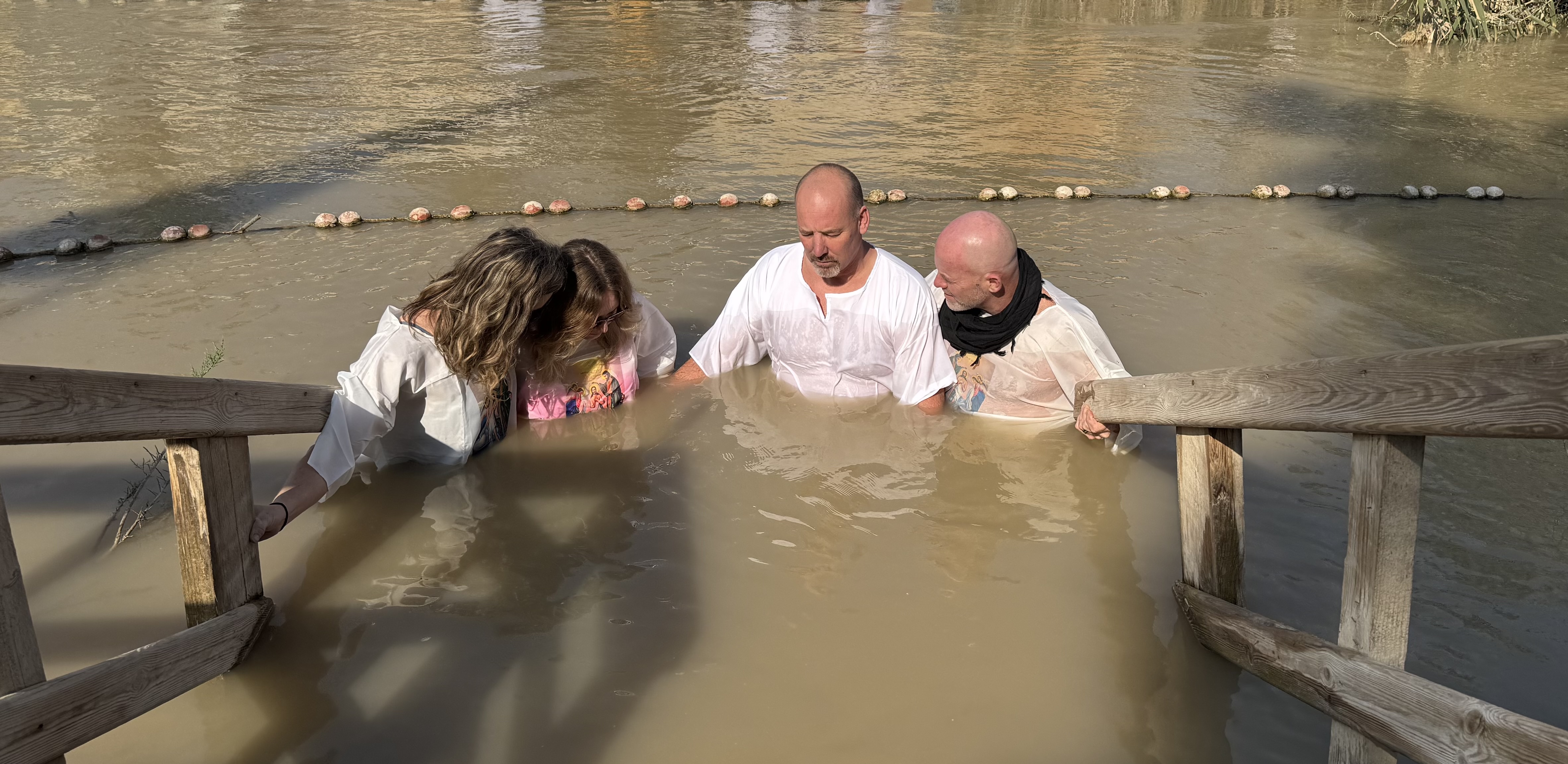
Today I (with help from my wife, Krista) had the incredible privilege of baptizing my good friends Mike and Gabby. Ironically, I just wrote a post on soteriology and baptism. If you haven’t read that, I would start there.

We haven’t always known where exactly Jesus was baptized. We don’t know where Eden was, or exactly where the ark landed, and this isn’t much different. The baptism of Jesus, the ritual purification of Jesus with water by John the Baptist, was a major event described in the three synoptic Gospels of the New Testament (Matthew, Mark and Luke).[1] It is considered to have taken place at what is modernly referred to as Al-Maghtas (also called Bethany Beyond the Jordan), located in Jordan. Al-Maghtas is Arabic: المغطس, al-Maġṭas, which means  ‘baptism’ or ‘immersion’, officially known to most (and on Google Earth and mentioned in the Bible) as the Baptism Site “Bethany Beyond the Jordan”, it is an archaeological World Heritage Site in Jordan, on the east bank of the Jordan River, reputed to be the location of the Baptism of Jesus by John the Baptist and venerated as such since at least the Byzantine period.[2] To be clear the exact location has changed due to recent archaeological finds.[3] This area includes two principal archaeological areas: the later remnants of a monastery on a mound originally known and believed to be Elijah’s Hill as a hermit dwelling.[4] The two areas are connected by a small stream that goes by John’s name.[5]

John anticipated a messianic figure greater than himself;[6] in the Gospels, he is portrayed as the precursor or forerunner of Jesus.[7] According to the Gospel of Matthew, Jesus himself identifies John as “Elijah who is to come”,[8] which is a direct reference to the Book of Malachi (Malachi 4:5),[9] as confirmed by the angel who announced John’s birth to his father, Zechariah.[10] According to the Gospel of Luke, John and Jesus were relatives.[11,12]

Some scholars think that John belonged to the Essenes, a semi-ascetic Jewish sect who expected a messiah and practiced ritual baptism.[13][14] John used baptism as the central symbol or sacrament[15] of his pre-messianic movement. Most biblical scholars agree that John baptized Jesus,[16][17] and several New Testament accounts report that some of Jesus’s early followers had previously been followers of John.[18] According to the New Testament, John was sentenced to death and subsequently beheaded by Herod Antipas around AD 30 after John rebuked him for divorcing his wife and then unlawfully wedding Herodias, the wife of his brother Herod Philip I. Josephus also mentions John in the Antiquities of the Jews and states that he was executed by order of Herod Antipas in the fortress at Machaerus.[18]

The Gospel of Mark introduces John as a fulfillment of a prophecy from the Book of Isaiah (in fact, a conflation of texts from Isaiah, Malachi and Exodus but that’s another post)[19] about a messenger being sent ahead, and a voice crying out in the wilderness. John is described as wearing clothes of camel’s hair, and living on locusts and wild honey. John proclaims baptism of repentance for the forgiveness of sin, and says another will come after him who will not baptize with water, but with the Holy Spirit.

The fourth gospel describes John the Baptist as “a man sent from God” who “was not the light”, but “came as a witness, to bear witness to the light, so that through him everyone might believe”.[20] John confirms that he is not the Christ nor Elijah nor ‘the prophet’ when asked by Jewish priests and Pharisees; instead, he described himself as the “voice of one crying in the wilderness”.[20]

The Gospels vary in their depiction of John’s relationship to Elijah. Matthew and Mark describe John’s attire in a way reminiscent of the description of Elijah in 2 Kings 1:8, who also wore a garment of hair and a leather belt. In Matthew, Jesus explicitly teaches that John is “Elijah who was to come” (Matthew 11:14 – see also Matthew 17:11–13); many Christian theologians have taken this to mean that John was Elijah’s successor. In the Gospel of John, John the Baptist explicitly denies being Elijah. In the annunciation narrative in Luke, an angel appears to Zechariah, John’s father, and tells him that John “will turn many of the sons of Israel to the Lord their God,” and that he will go forth “in the spirit and power of Elijah.”[21]

CONCLUSIVE THOUGHTS:

What “set apart” John was that he reminded people of Elijah. Did you ever wonder what that meant? I guess I just gave you a bunch of clues! Elijah was most significant as to have led a school of prophets known as “the sons of the prophets.”[22] Following Elijah’s ascension, his disciple and devoted assistant Elisha took over as leader of this school. After the time of Elisha Israel strayed and although rabbinical training excelled, the schools became very different from what Elijah had established. John was seeking to bring back the idea of living a life completely “SET APART” (Kadosh purification language) as to make way for the king. This is often overlooked particularly in western Evangelical Christianity, and it is very important. You see Jesus came to “complete” or align all things back to the intentions of the father. Jesus continues to call 12 disciples completely out of their former lives and accept new sacrificial lives totally committed to Him. He was the great example shepherded unto them. Jesus also embodies the example of being met by the spirit and later sending it to all who accept and are anointed and/or commissioned in this same way. He was baptizing those that radically sought to do the same; to completely give their life to the pursuant of devotionally following the Way of Jesus, the coming king. As I have made the point several times, we don’t baptize into this calling any longer. It has once again become lost as it had before John’s time. My prayer is that we will return to baptizing those ready to give their lives into complete devotion in allegiance to the king, leaving everything to follow Him.

WORKS CITED:

  1. The Gospel of Matthew by Daniel J. Harrington 1991 ISBN 0-8146-5803-2 p. 63
  2.  Bethany beyond the Jordan https://www.baptismsite.com/ Archived 2024-12-04 at the Wayback Machine on baptismsite.com, accessed February 2025
  3. Baptism Site “Bethany Beyond the Jordan” (Al-Maghtas) – UNESCO World Heritage Centre”. UNESCO. Archived from the original on 19 January 2017. Retrieved February 2025
  4. Tharoor, Ishaan (July 13, 2015). “U.N. backs Jordan’s claim on site where Jesus was baptized”. The Washington Post. Archived from the original on July 10, 2018.
  5. Funk, Robert W. & the Jesus Seminar (1998). The Acts of Jesus: the search for the authentic deeds of Jesus. San Francisco: Harper. “Mark”, pp. 51–161.
  6.  Meier, John (1994). Mentor, Message, and Miracles (A Marginal Jew: Rethinking the Historical Jesus, Vol. 2). Vol. 2. Anchor Bible. ISBN 978-0-385-46992-0.
  7. “Bible Gateway passage: Matthew 11:14 – New King James Version”. Archived from the original on 3 October 2019.
  8. Malachi 4:5–6
  9. “Bible Gateway passage: Luke 1:17 – New King James Version”. Bible Gateway. Archived from the original on 2 June 2007.
  10. “Bible Gateway passage: ΚΑΤΑ ΛΟΥΚΑΝ 1:36 – SBL Greek New Testament”. Archived from the original on 26 September 2019.
  11. “NETBible: Luke 1”. Archived from the original on 24 July 2020.
  12. Harris, Stephen L. (1985). Understanding the Bible. Palo Alto: Mayfield. p. 382
  13. Marshall, I. H.; Millard, A. R.; Packer, J. I., eds. (1988). “John the Baptist”. New Bible Dictionary (Third ed.). IVP reference collection. ISBN 978-0-85110-636-6.
  14. Edward Oliver James, Sacrament in Encyclopædia Britannica. Retrieved 20 May 2009, from Encyclopædia Britannica Online: https://www.britannica.com/EBchecked/topic/515366/sacrament 
  15. Croll, Charles (2019). John the Baptist: A Biography. Malcolm Down Publishing. pp. 127–149. ISBN 978-1-912863-15-0.
  16. Jesus as a figure in history: how modern historians view the man from Galilee. Mark Allan Powell, published by Westminster John Knox Press, p. 47 “Few would doubt the basic fact…Jesus was baptized by John”
  17. Harris, Stephen L. (1985) Understanding the Bible. Palo Alto: Mayfield John 1:36–40
  18. Flavius Josephus: Antiquities of the Jews Book 18, 5, 2 
  19. Carl R. Kazmierski, John the Baptist: Prophet and Evangelist (Liturgical Press, 1996) p. 31.
  20. John 1:6–8, John 1:19–23, Isaiah 40:3
  21. Luke 1:16–17
  22.  2 Kings 2:3

NATURAL ORDER

I want to talk about what is meant by God’s order, but before I do that, I want to guide you through a brief exegetical teaching through the text. When you hear the word order in relation to a biblical sense we have been conditioned to think about creation, law, hierarchy in the church and marriage, and perhaps even church discipline. Although it encompasses those things, I find it unfortunate that we start there, and therefore I feel we might need some deconstruction to get to good.

As I begin to read this in Hebrew the first thing that I notice in contrast to most English translations is the phrase “My prayer” is not found in the text. It isn’t a bad translation as I get the context leans that way but in Hebrew the verse better reads, “I will order toward you” which emphasizes a slightly different posture. Interesting the word prayer isn’t really there, perhaps a NT implication or even insertion. Prayer in the OT was a bit different than the way we understand it today. It was communal and far less personal (unless God appeared to you in a bush and orally spoke directly to you), after Jesus ascends to the throne and sends the Spirit to dwell in us and intercede, the biblical concept of prayer takes on a different form than what it had been considered over the last 2000 years or more. The way people thought of “prayer” in the OT may or may not be accurate. Are we just reading what they thought prayer was supposed to be perhaps based on what they knew of their former deities? Is this something that they got a bit off track with and Jesus sought to adjust or shed new light on? Perhaps, but perhaps not. Maybe our prayer should take a cue from the OT notions. When we read this verse in Hebrew form, we see that David isn’t talking about ritualistic prayer, or is he? He isn’t necessarily folding his hands and closing his eyes – but he is sort of. He is making a statement that if his life is in alignment with what is of God – TOV (creation order language), then he expects God to acknowledge and “DO THINGS” on his behalf. This may tie into the never-ending OT grappling over whether God was retributive or not, but it certainly had the trajectory of demonstrating the idea of devotion in connection to intimacy with the Lord. This connection over the years will then be attributed to the conjecture of relationship with the father in prayer. Some prayer is communal and some is personal.

Different people interact with God differently and perhaps in different seasons. Some say they don’t hear God and others act like God never stops screaming in their ear. How can the voice of God differ from person to person? Is it based on the posture of the heart, covenant faithfulness, gifting, seasons, understanding, choice, some sort of prejudice, or something completely different that is higher than our understanding? I believe that God is just that dynamic. I don’t know why He communicates differently to people and what it might be based on; I don’t always have the eyes of God. I believe Him to be Sovereign and know significantly more than we do in a much more complex grid. I am convinced that there are many things that influence this covenant relationship at a cosmic level. It is far bigger than simply me, and to think of my relationship with God (the creator of the universe) as doating on my every thought seems like a selfish notion. Does that view minimize a personal relationship or exemplify it?

God’s order is described in everything naturally defined by Yahweh and described generally as what is good (TOV). This is creation, the waters, the counting of the ark, the building of the temple, the pieces of firewood set in order for a sacrificial fire, showbread set out in two rows of six cakes on the gold table (Lev 24:8); seven altars set up by the pagan mantic Balaam (Num 23:4); stalks of flax arranged by Rahab for hiding the spies (Josh 2:6); a table prepared for dining (Ps 23:5; Isa 21:5); words produced for speaking (Job 32:14); a legal case developed for presentation (Job 13:18); etc. In II Sam 23:5 David exults in the covenant granted him by Yahweh, “for he has made with me an everlasting covenant, / ordered (ʿărûkâ) in all things and secure.[1] We see God’s order in many ways, but the common thread that binds seems to be that it is given as a framework for our devotion to Him. This intimate devotion that is often described as reading or memorizing scripture, devotional repetition, standards of practice and living, and so much more are all described as what it means to be defined as SET APART. That we are defined and claimed as part of God’s order not the chaos of the world.

What defines this? Covenant. Covenant is the secure, accessible, and recognizable attribute of everything good that God offers to us. It is the basis of all of our interaction with the LORD. Without covenant we are detached or separated from the creator and his ways. When David chooses every morning to be in order, he is making a statement about the balance of life and the posture of the heart. The Hebrew term בְּרִית bĕriyth for “covenant” is from a root with the sense of “cutting”, because pacts or covenants were made by passing between cut pieces of flesh of an animal sacrifice.[2] It meant something deep.

The New Covenant is a biblical interpretation originally derived from a phrase in the Book of Jeremiah and often thought of as an eschatological world to come related to the biblical concept of the Kingdom of God. Generally, Christians believe that the New Covenant was instituted at the Last Supper as part of the Eucharist, which in the Gospel of John includes the New Commandment.[3] A connection between the Blood of Christ and the New Covenant is portrayed with the saying: “this cup that is poured out for you is the new covenant in my blood”. Jesus is therefore the mediator of this New Covenant, and that his blood, shed is the required blood of the covenant. This is true looking back in both testaments and can be seen in all of the biblical covenants of the bible.

In the Christian context, this New Covenant is associated with the word ‘testament‘ in the sense of a ‘will left after the death of a person (Latin testamentum),[4] the original Greek word used in Scripture being diatheke (διαθήκη) which in the Greek context meant ‘will (left after death)’ but is also a word play having a dual meaning of ‘covenant, alliance’.[5] This notion implies a reinterpreted view of the Old Testament covenant as possessing characteristics of a ‘will left after death’ placing the old covenant, brit (בְּרִית) into a new application of understanding as revealed by the death, resurrection, ascension, and throning of CHRIST THE KING, JESUS. All things will forever connect at the covenants and be defined by the atoning accomplishments that transform into a covenant of eternity.

Order today might be better understood as a continually evolving algorithm based on the posture of your covenant faithfulness which, as I have described, is defined by many facets of devotion. Some may hear the audible voice of God more clearly while others simply see Him in every image. The revelation of God to us isn’t in a form of hierarchy. One form of transcendence doesn’t trump another. Who are we to judge anyway. But I do know that most of Christianity seems to be off course here. Rather than coming to the LORD as the cosmic wish granting genie in a bottle, let’s get back to biblical roots and think more covenantal and devotional based on the order that God modeled for us.

[1] Harris, R. L., Archer, G. L., Jr., & Waltke, B. K. (Eds.). (1999). Theological Wordbook of the Old Testament (electronic ed., p. 696). Chicago: Moody Press.

[2] Strong’s Concordance (1890).

[3] “Comparison of the two covenants mediated by Moses and the two covenants mediated by Jesus”. 25 September 2022. Archived from the original on 2022-09-28. Retrieved 2023-01-29.

[4]“testamentum: Latin Word Study Tool”. http://www.perseus.tufts.edu. Retrieved 2020-08-12.

[5] G1242 – diathēkē – Strong’s Greek Lexicon (KJV)”. Blue Letter Bible. Retrieved 2020-08-12.