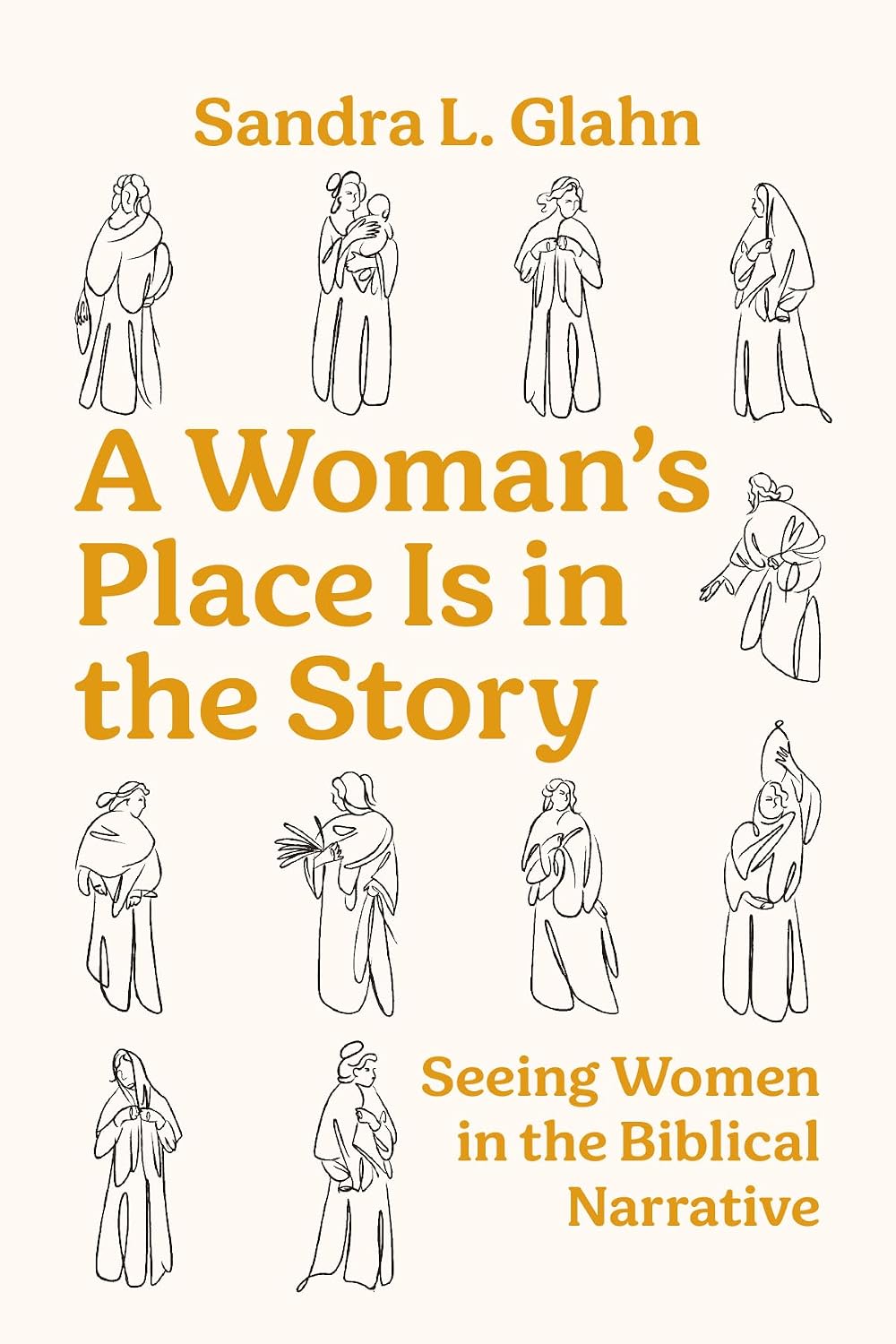
As I worked through Sandra Glahn’s A Woman’s Place Is in the Story, I kept coming back to a fairly simple but uncomfortable thought: sometimes we are not actually remembering the biblical story itself, but the version of the story that has been handed to us. After enough years of preaching, teaching, church culture, children’s Bible stories, commentaries, conferences, and familiar assumptions, we can begin to hear things in the text that the biblical writer never actually said. In the case of women in Scripture, Glahn’s concern is not simply that the church has overlooked a few important female characters. Her argument is more substantial than that. She is pressing the reader to consider whether the way we have traditionally framed the whole story has sometimes pushed women toward the edges even when the biblical authors themselves placed them much closer to the center.¹
That is what I appreciated most about the book. Glahn is not merely making an argument for greater inclusion by locating a few forgotten women and adding them back into the conversation. She is asking a hermeneutical question: are we actually reading these stories according to the way they were written? That takes the conversation beyond the usual arguments over office, authority, ordination, or a handful of disputed Pauline texts. Before we decide what women may or may not do in the church, we probably ought to take a more careful look at what women are already doing in the biblical narrative and, just as importantly, how the narrators themselves evaluate them. In that respect, Glahn’s work feels at home alongside Robert Alter and Meir Sternberg, whose studies of Hebrew narrative have reminded us that characterization, repetition, dialogue, narrative gaps, irony, and literary placement are not decorative features surrounding theology; they are often the very means through which the theology of the story is communicated.²
Tamar in Genesis 38 is a particularly good example. I have heard that chapter treated for years as though it were something of an awkward interruption in the Joseph story, almost as if Genesis wandered off topic for a moment before returning to Egypt in chapter 39. But once we begin paying attention to literary placement, the chapter becomes considerably more interesting. Judah has just participated in the betrayal and sale of his brother, and then the narrative turns immediately toward Judah’s own moral failure with Tamar. He withholds from her what he owes, and she eventually forces the truth into the open. The turning point is Judah’s own acknowledgment that she is more righteous than he is. When Judah appears again later in Genesis, something has changed. The brother who participated in selling Joseph is eventually willing to offer himself in place of Benjamin. Genesis 38 therefore looks less like an interruption and more like one of the places where Judah is being transformed. Tamar is not incidental to that transformation; in a meaningful sense she becomes one of its catalysts.
The ancient Near Eastern texture adds another important layer. Tamar is not operating within a modern world of autonomous relationships and individualized economics. Her life is embedded in kinship, household continuity, inheritance, offspring, widowhood, and the responsibilities of the patriarchal household. John Walton has repeatedly cautioned modern interpreters against treating the ancient world as though its social institutions functioned like our own, and that warning is particularly important here.³ Tamar’s actions remain provocative, but the social world of Genesis makes it increasingly difficult to portray her merely as a sexually questionable woman. She is a widow whose future has become precarious because Judah has failed to carry out an obligation that bears directly upon her place in the household and upon the continuation of the family line. The narrator ultimately allows Judah himself to pronounce the moral judgment. In cases like this, historical context does not explain the text away; it often strips away assumptions that later readers have unconsciously added to it.
I found myself thinking similarly when Glahn turned to Exodus 1–2. We naturally remember Moses as the great human figure in the confrontation with Pharaoh, but the resistance to Pharaoh begins before Moses ever walks into the royal court. Shiphrah and Puah refuse the king’s genocidal command. Moses’ mother preserves her son. His sister watches over him. Pharaoh’s own daughter ultimately participates in undermining her father’s decree. The literary irony is hard to miss once someone points it out: Pharaoh decides that the Hebrew boys are the threat and allows the girls to live, yet women repeatedly become the agents through whom his attempt to destroy Israel is frustrated.
There is another subtle narrative texture here that I think Glahn rightly invites us to notice. Exodus begins with shemot, “names,” and yet Pharaoh remains unnamed while Shiphrah and Puah are explicitly remembered. In the ideological world of the ancient Near East, kings are normally the people whose names endure. Royal inscriptions, monuments, dynasties, military accomplishments, and building projects all worked toward the preservation of royal memory. Yet Exodus turns that world upside down. The most powerful man in Egypt becomes simply “Pharaoh,” while two apparently insignificant Hebrew midwives are preserved by name within Israel’s sacred memory. This is exactly where literary reading and ancient cultural background belong together. Walton’s work on the conceptual world of the Old Testament and the broader cultural-background approach associated with scholars such as Craig Keener remind us that biblical texts constantly converse with the assumptions of the worlds in which they were written.⁴ In Exodus, that conversation becomes wonderfully subversive: empire decides who matters, but Israel’s God remembers differently.
The daughters of Zelophehad brought me back to the same observation. Mahlah, Noa, Hoglah, Milcah, and Tirzah are five names that many readers of Scripture could probably not retrieve without looking them up, and yet Numbers goes out of its way to preserve them. Their request in Numbers 27 can sound to modern ears like an early dispute over property rights, but that description is probably too thin. Land in Israel is tied to household, tribe, inheritance, ancestral continuity, and participation in the future of the covenant community. Their concern that their father’s name might disappear because he has no son is therefore not merely economic. They are asking whether their household will continue to have a place in Israel’s inheritance. Moses brings the matter before YHWH, and the divine response vindicates their claim and contributes to the development of Israel’s inheritance law. In other words, the narrative does not portray these women as troublesome exceptions to the system but as people whose discernment helps Israel more faithfully understand covenantal justice.
This also places Glahn in an interesting conversation with several recent books on women and Scripture. Nijay Gupta’s Tell Her Story operates primarily in the world of the New Testament and early Christianity, recovering women such as Phoebe, Prisca, Junia, and others whose leadership and ministry can disappear when the early church is reconstructed primarily through male figures.⁵ Cynthia Long Westfall’s Paul and Gender approaches the question from Pauline theology, rhetoric, social context, and linguistic analysis, while Philip Payne’s The Bible vs. Biblical Womanhood works directly through many of the passages traditionally used to construct gender hierarchy.⁶ Glahn is doing something slightly different from all three. She is not primarily beginning with the disputed “women in ministry” texts and then defending a position. She is stepping farther back and asking whether our entire biblical imagination has been shaped by the way we have selected, characterized, and retold these stories. I think that makes her book especially useful pastorally because it reaches readers before the argument becomes a debate over positions.
That same methodology becomes particularly important when we reach the Samaritan woman in John 4. Christian retellings have often supplied an extraordinary amount of information that John himself never gives us. She is frequently described as promiscuous, socially ostracized, and forced to collect water at noon because the other women of the village reject her. Yet John never says any of those things. Jesus says she has had five husbands and that the man she presently has is not her husband, but the Gospel does not tell us how those marriages ended. In a first-century world in which women generally possessed considerably less social and legal power within marriage, widowhood, divorce, repudiation, infertility, and economic vulnerability all become relevant possibilities. Craig Keener’s cultural-background work is particularly helpful here because it reminds interpreters that the social world surrounding the text must constrain our reconstruction rather than our modern assumptions filling in the gaps.⁷ This does not prove that the woman was morally innocent in every respect; it simply asks us not to convict her of sins the narrator does not identify.
What becomes far more interesting to me is John’s literary placement of the encounter. John 3 gives us Nicodemus: male, Jewish, educated, respected, religiously credentialed, and approaching Jesus in darkness. John 4 then places before us a Samaritan woman who occupies almost every opposite social category. Yet she enters into an extended theological conversation with Jesus, recognizes progressively more about his identity, and becomes instrumental in bringing her village toward him. Read alongside Nicodemus, the effect is difficult to miss. John appears to enjoy overturning the categories by which readers decide in advance who is most likely to understand Jesus. Glahn’s larger argument works particularly well here because the woman’s significance does not need to be imported into the story from a contemporary gender agenda. It is already built into John’s narrative architecture.
This is where I think A Woman’s Place Is in the Story makes its most enduring contribution. It is certainly a book about women, but underneath that it is really a book about how we read Scripture. It asks us to slow down long enough to distinguish the biblical narrator from the interpretive traditions we have inherited. That does not mean tradition is always wrong, nor does it mean every neglected woman must become the secret hero of her story. Jezebel, after all, really is condemned. But even there the question matters: what does the biblical text actually condemn her for? Her sins in Kings are tied to idolatry, royal abuse, murder, and the seizure of Naboth’s ancestral inheritance. Later Christian imagination has sometimes transformed “Jezebel” into a vaguely sexualized accusation directed toward manipulative, assertive, or powerful women. The distance between those two things is a reminder that interpretation can accumulate traditions that eventually feel biblical simply because we have repeated them long enough.
Conclusion: Telling the Story More Faithfully
The longer I sat with Glahn’s work, the more I found myself thinking beyond questions of interpretation and toward the actual life of the church. Hermeneutics never really stays in the classroom. The way we read Scripture eventually becomes the way we preach, the way we lead, the way we recognize gifting, the way we form young people, and even the way we imagine who God is likely to use. If we repeatedly tell the biblical story in a way that highlights male courage while overlooking female courage, celebrates male leadership while treating women as peripheral, or assigns motives to women that the text itself never gives them, those patterns eventually become part of the spiritual imagination of a congregation.
That is why I think A Woman’s Place Is in the Story is worth reading beyond the academic conversation. Pastors should read it. Teachers should read it. Men who have spent years teaching Scripture should read it. Women who have sometimes wondered whether there is really room for their voice in the story should read it. Not because every reader will agree with every interpretive conclusion, but because Glahn forces us to ask a more fundamental question: have we been telling the whole story?
For me, that connects deeply with what we have tried to pursue through Expedition 44. Discipleship is not simply collecting correct propositions. It is learning to see the world through the story of God and then allowing that story to reshape the way we live. Jesus was constantly restoring people whom religious systems had learned not to see. He noticed the woman touching the edge of his garment when everyone else saw only the crowd. He allowed Mary to sit in the posture of a disciple. He received theological confession from Martha. He entrusted resurrection witness to women whose testimony carried little public weight in their surrounding culture. Again and again, the kingdom seems to arrive through people whom others have pushed toward the margins.
That should make us careful about whom we overlook in our own churches.
There may be a woman sitting quietly in the congregation who sees something in the text the rest of us have missed. There may be a young girl growing up in the church who needs to hear not merely that she is valuable, but that women have always been woven into the redemptive story as prophets, patrons, witnesses, teachers, disciples, leaders, mothers, theologians, and courageous agents of God’s purposes. There may also be men whose own discipleship becomes richer when they learn to receive wisdom and leadership from sisters in Christ rather than instinctively assuming that spiritual authority always arrives through a male voice.
That is where Glahn’s book becomes more than a corrective. It becomes an invitation. Return to the text. Read more slowly. Notice who is named. Notice who speaks. Notice who sees what others miss. Notice who acts faithfully when the expected heroes fail. Notice where the narrator places moral weight. And then ask whether our churches are making room for the same kinds of people God consistently makes room for in Scripture.
I would recommend A Woman’s Place Is in the Story especially to pastors, ministry leaders, Bible teachers, and anyone involved in spiritual formation. Read it with an open Bible. Read it in conversation with the ancient world. Read it alongside the larger body of scholarship on women and Scripture. But perhaps most importantly, read it with your own church in mind. The goal is not to manufacture a different biblical story. The goal is to recover the one that is already there and then have the courage to let that story form our communities more faithfully.

Notes
- Sandra L. Glahn, A Woman’s Place Is in the Story (Downers Grove, IL: InterVarsity Press, 2026).
- Robert Alter, The Art of Biblical Narrative, rev. ed. (New York: Basic Books, 2011), esp. his discussions of repetition, characterization, dialogue, and narrative reticence; & Meir Sternberg, The Poetics of Biblical Narrative: Ideological Literature and the Drama of Reading (Bloomington: Indiana University Press, 1985).
- John H. Walton, Ancient Near Eastern Thought and the Old Testament: Introducing the Conceptual World of the Hebrew Bible, 2nd ed. (Grand Rapids: Baker Academic, 2018).
- Craig S. Keener, The IVP Bible Background Commentary: New Testament, 2nd ed. (Downers Grove, IL: IVP Academic, 2014).
- Nijay K. Gupta, Tell Her Story: How Women Led, Taught, and Ministered in the Early Church (Downers Grove, IL: IVP Academic, 2023).
- Cynthia Long Westfall, Paul and Gender: Reclaiming the Apostle’s Vision for Men and Women in Christ (Grand Rapids: Baker Academic, 2016)
- Keener, IVP Bible Background Commentary