
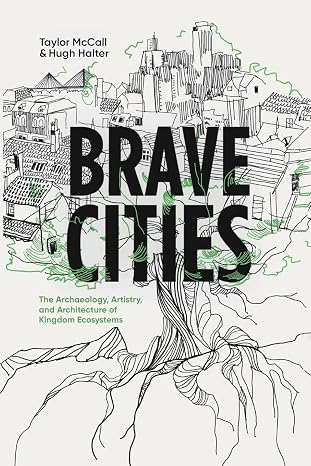
This is organic church, which is where much of my heart has been for years and where our TOV ministry continues to find its bearings. By “organic,” I do not mean unorganized, anti-leadership, or casually improvised. I mean a church whose life grows through relationships, shared tables, hospitality, mutual care, meaningful work, generosity, and the ordinary presence of Christians within their community. In that sense, Brave Cities: The Archaeology, Artistry, and Architecture of Kingdom Ecosystems by Taylor McCall and Hugh Halter felt deeply familiar. I recognized many of its longings, frustrations, and experiments because they resemble questions we have been asking at TOV: What happens when church is understood as a people rather than an event? How do we cultivate a community in which discipleship occurs throughout the week? Can meals, homes, businesses, friendships, work, service, and care for the vulnerable become part of the church’s shared life rather than activities orbiting a weekly service?
These questions are not new. Frank Viola began pressing many of them decades ago, first through his early work on house churches and later through Pagan Christianity?, written with George Barna, and Reimagining Church. Viola’s critique was directed toward the institutional habits Christians often assume are prescribed in the New Testament: professional clergy, passive congregations, sermon-centered gatherings, religious buildings, and highly programmed services. His constructive proposal was an organic expression of church in which every member participates and Christ, rather than a professional minister, functions as the community’s center.¹ Whatever one makes of every historical argument advanced by Viola and Barna, they helped a generation of Christians distinguish the church described in the New Testament from the ecclesiastical customs that developed around it.
Brave Cities belongs to this same broad conversation, although McCall and Halter move beyond the living room. Their vision is neighborhood-sized and eventually city-shaped. The subtitle identifies their concern as “the archaeology, artistry, and architecture of kingdom ecosystems.” Archaeology involves digging beneath inherited church forms to recover the kingdom beneath them. Artistry refers to the imagination needed to embody the gospel within a particular community. Architecture concerns the patient construction of relationships, spaces, businesses, homes, and economic practices through which communal life can develop.
That language matters because Brave Cities is not another manual promising reproducible church growth. Its opening image, “Music Not Math,” challenges the belief that ministry can be reduced to transferable formulas. The church is closer to a song than an equation. Its life cannot be produced simply by importing someone else’s methods, terminology, service order, or leadership structure. McCall and Halter encourage communities to listen carefully—to God, to one another, and to their particular place—and then to create faithfully within that setting. A coffeehouse may become important in one city, while a farm, home, school, trade, recovery ministry, athletic program, or shared business may become central somewhere else.
Alan Hirsch’s influence can be felt throughout this approach. His work has consistently called the Western church to recover its missional identity, apostolic imagination, and capacity to operate as a movement. In The Forgotten Ways, Hirsch described the church’s “apostolic genius” as something already present within its spiritual DNA, waiting to be reactivated.² Both The Starfish and the Spirit and Brave Cities draw from this movement-oriented stream. They distrust centralized control, emphasize the gifts and agency of ordinary believers, and view multiplication as something living systems do when they are healthy. Brave Cities, however, places more attention on the physical and economic ecology in which such a movement takes root.
The Soil Beneath the Church
One of the book’s controlling metaphors is soil. Modern agriculture can sometimes force crops from depleted land through chemicals, engineered seeds, and industrial techniques. Something may grow, but the ecosystem beneath it remains unhealthy. McCall and Halter use this as an image of churches that continue producing services, programs, attendance, and religious activity while the communal soil underneath them deteriorates.
Their point is not that Sunday gatherings are inherently harmful. They explicitly acknowledge that traditional, contemporary, house, digital, large, and small churches can all serve people faithfully. Their concern is what happens when the gathering becomes the controlling definition of church. Attendance then becomes the primary evidence of faithfulness, teaching becomes concentrated in a few professionals, and most members learn to receive ministry rather than participate in it. A church can maintain excellent weekly services while remaining relationally thin and largely disconnected from the suffering of its surrounding community.
The alternative proposed in Brave Cities is a “kingdom ecosystem.” Healthy soil contains thousands of organisms interacting in ways that sustain the whole environment. In the same way, a kingdom ecosystem includes disciples, homes, businesses, gathering spaces, friendships, mentoring relationships, acts of justice, shared resources, and places of hospitality. No single element is the church by itself. Together they form a web of life through which the reign of God becomes visible within a particular place.
This ecological language is helpful because it moves the conversation away from deciding which church model is universally correct. Models tend to be copied. Ecosystems must be cultivated. A model can be transported from one city to another with little regard for context; an ecosystem grows from the history, needs, gifts, wounds, and possibilities already present in a community. Lesslie Newbigin made a related argument when he described the congregation as the hermeneutic of the gospel—a community whose shared life interprets the good news before the watching world.³ The credibility of the church’s message is inseparable from the social life created by that message.
Disciples Before Churches
McCall and Halter repeatedly return to Jesus’ investment in people. Jesus did not begin with a building campaign, weekly attractional event, or fully formed institution. He formed disciples who learned his way of life while traveling, eating, serving, confronting evil, caring for the sick, and announcing the kingdom. The book compares disciples to a cover crop planted in depleted soil. Their presence gradually restores what has been damaged.
This is one of the strongest parts of Brave Cities. Discipleship is treated as a life shared rather than a curriculum completed. Teaching still matters, but it occurs within the movement of life. Parents do not ordinarily raise their children through one weekly lecture. They teach through conversation, correction, work, meals, conflict, questions, failures, celebrations, and ordinary experiences. McCall and Halter ask why spiritual formation should be imagined so differently.
Their concern resembles Robert Banks’s study of Paul’s churches as participatory communities in which spiritual formation occurred through mutual contribution rather than dependence upon a single religious professional.⁴ It also echoes the argument of Michael Frost and Alan Hirsch that the church is missionary by its very nature and must therefore form disciples capable of embodying the gospel outside ecclesiastical spaces.⁵
The book’s practical picture is compelling. Evangelism happens while coaching, working, drinking coffee, sharing a meal, operating a business, or listening to someone’s story. Teaching happens in homes, conversations, email exchanges, mentoring relationships, and gatherings where more than one person may contribute. Discipleship occurs while people work together and experience enough of one another’s real lives to see character revealed. The gospel becomes credible through proximity.
The book is especially perceptive in recognizing that transformation often occurs in moments of tension. People become open to change when the inadequacy of their present way of living can no longer be ignored. A struggling marriage, addiction, financial crisis, relational rupture, failure, or experience of grief may create an openness that a prearranged lesson does not. This does not make suffering good, nor should crisis be manipulated. It means that wise discipleship is attentive. It listens for the questions people are actually asking instead of forcing everyone through the same material at the same pace.
The Hammer, the Table, and the Grandmother
One of the more memorable sections of the book describes discipleship through three images: the hammer, the table, and the grandmother. The hammer represents work—the activity of building, creating, repairing, serving, and producing something useful. The table represents rest, remembrance, conversation, food, celebration, and belonging. The grandmother represents the steady wisdom of elders who have endured enough of life to remain calm when everyone else is frightened.
These images carry more substance than another ministry acronym. The hammer locates discipleship within meaningful work. People learn generosity, patience, integrity, endurance, reconciliation, and mutual submission when they build something together. The table gives that work a relational center. It creates space to tell stories, process failures, share Scripture, remember Jesus, and receive one another again. The grandmother keeps an energetic movement from becoming captive to the impulses of its most charismatic pioneer.
The book’s preference for grandmothers over formal elder boards is intentionally provocative. Its critique arises from observing leadership teams that protect institutions, preserve existing programs, and manage risk while remaining distant from the daily life of the community. There is truth in that criticism. Biblical eldership, however, should not be dismissed simply because many churches have embodied it poorly. The New Testament vision of eldership is relational, mature, hospitable, and exemplary. In fact, much of what McCall and Halter call “grandmothering” resembles the pastoral wisdom the New Testament expects from its elders. Their argument is strongest when heard as a recovery of lived spiritual maturity rather than a rejection of all recognizable leadership structures.
The same qualification applies to their treatment of teaching and sacraments. Brave Cities rightly opposes the monopolization of teaching by professionals and recognizes that God’s grace is encountered throughout ordinary life. Availability, neighboring, generosity, hospitality, shared meals, care for the poor, and communal rest can all become sacramental in a broad sense. Yet baptism and the Lord’s Supper retain a particular place within the church’s life because they are practices given to the community by Jesus and rooted in the gospel’s central story. Expanding our sacramental imagination need not require flattening every distinction between the sacraments and other faithful practices.
These are places where the book’s rhetoric occasionally moves faster than its historical or exegetical argument. Its account of the Reformation’s understanding of preaching, sacraments, and discipline is too compressed, and its dismissal of inherited church structures sometimes treats their abuses as though they were their essence. Even so, the criticism should not be brushed aside. Many congregations have reduced church life to listening to a sermon, receiving religious goods, and remaining accountable to an organization. Brave Cities is asking whether that can bear the full weight of the New Testament’s vision of a Spirit-filled people sharing life in Christ.
A Free-Market Church?
The most distinctive contribution of Brave Cities may be its treatment of economics. The authors question a financial model in which Christians give primarily to maintain buildings, salaries, programs, and centralized church infrastructure. They ask what might happen if more kingdom resources were invested in small businesses, intentional homes, community spaces, employment, sustainable ministries, and ventures addressing local suffering.
The phrase “free-market church” could easily be misunderstood. McCall and Halter are not simply baptizing capitalism or suggesting that churches operate as profit-seeking corporations. They envision a shared economy in which work, money, property, skills, businesses, and homes are stewarded for the good of the community. Their scriptural center is the economic imagination of Acts and Paul’s collection for Jerusalem: abundance meeting need so that the body experiences a form of equality.
Their distinction between charity and sustainability is valuable, although it should not be pressed too far. Emergency charity remains necessary. Hungry people need food before they need a business plan. Families in crisis sometimes need assistance without an immediate expectation of productivity. Yet the authors are correct that long-term care must take dignity, agency, employment, ownership, and sustainability seriously. Relief that never develops into relationship can preserve the distance between giver and recipient.
The economic vision of Brave Cities resembles John Howard Yoder’s description of the church as a visible social body whose shared practices offer the world an alternative politics. It also recalls Ched Myers’s work on Sabbath economics, particularly the biblical relationship between manna, Jubilee, debt, redistribution, and communal sufficiency.⁶ The church does not announce another way of life only through its preaching. Its handling of possessions, power, property, debt, work, and vulnerability reveals what it actually believes about the kingdom.
“Business is the mission” is one of the book’s more provocative claims. At its best, the statement means that honest work, excellent products, fair employment, beautiful spaces, and genuine care for customers are not secular activities that occasionally finance spiritual ministry. They can become part of the church’s public witness. A coffee shop does not become missional by placing Christian slogans on its cups. It becomes a kingdom expression when it offers good coffee, treats workers justly, knows its neighbors, creates belonging, and allows relationships to develop without turning people into evangelistic projects.
This vision has meaningful precedent in Christian history. Monastic communities joined prayer, hospitality, labor, agriculture, learning, and care for the poor. The Moravians developed businesses and trades that helped sustain a remarkable missionary movement. The Church of the Saviour in Washington, D.C., organized small, disciplined communities around particular callings and concrete forms of service. Mark Lau Branson and Dwight Friesen’s Churches, Cultures and Leadership similarly describes Christian leadership as participation in a network of relationships rather than control from the organizational center.⁷ Brave Cities gathers these instincts and applies them to the economic and communal realities of contemporary cities.
Apostolic Leadership and Its Costs
The final movement of the book focuses on “apostolicing,” the life of the pioneer servant. McCall and Halter describe apostolic people as starters, builders, cultural architects, and stewards who see possibilities before others do. They connect ideas, people, funding, work, and place. They often begin before permission is granted and continue through criticism, uncertainty, and personal sacrifice.
The book offers an important correction to church cultures that have concentrated almost entirely on shepherding and teaching gifts. Pastors and teachers are indispensable, but communities also need evangelists, prophets, and apostles. Paul’s language in Ephesians 4 describes these gifts as serving the maturity and ministry of the whole body. Apostolic leadership is therefore not a higher ecclesiastical rank. It is a pioneering function that helps the church cross boundaries, begin new work, and lay foundations upon which others can build.
McCall and Halter are candid about the costs. Pioneer leaders frequently carry financial uncertainty, criticism, spiritual opposition, and the pressure of holding a vision others do not yet understand. They may invest years of labor without owning what they have created or receiving adequate compensation. The book’s discussion of funding rightly asks donors to support character and calling rather than using money to control outcomes.
Some caution is still needed here. Suffering does not authenticate every vision, and criticism is not necessarily proof that a leader is pioneering faithfully. Apostolic language can become dangerous when it shields strong personalities from accountability or interprets every disagreement as religious resistance or spiritual warfare. The New Testament’s apostles were accountable to the gospel, to one another, and to the communities they served. Genuine pioneering leadership carries authority, but it also receives correction and makes room for communal discernment.
That caution does not diminish the book’s central insight. New work carries a cost, and many of the people who benefit from it will never see what was required to begin it. Churches should become better at identifying, supporting, protecting, and resourcing faithful pioneers—women and men capable of imagining forms of kingdom life that do not yet exist.
A Book for Builders
Brave Cities will resonate most deeply with people who already sense that the inherited forms of Western church life are too narrow for the kingdom they find in the New Testament. It is written for builders, hosts, entrepreneurs, artists, missionaries, neighborhood pastors, community developers, and spiritually restless people who cannot separate discipleship from the life of a city.
Readers looking for a complete ecclesiology will find places where the book needs more historical development and exegetical restraint. Its rhetoric sometimes paints institutional churches too uniformly, and a few of its biblical connections function more as evocative analogies than sustained interpretations. Yet the book does not claim to provide a complete theology of the church. It is trying to restore imagination. It asks Christians to stop measuring faithfulness primarily through attendance, budgets, buildings, and centralized programs and to look for fruit in transformed people, reconciled relationships, shared resources, meaningful work, hospitality, justice, and enduring love.
For those of us working within organic expressions of church, the book offers language for instincts we have carried for years. Church is cultivated in the soil of shared life. It grows through people who know one another well enough to carry burdens, speak truth, share meals, forgive offenses, recognize gifts, and remain together through difficulty. Its witness becomes tangible when the lonely receive family, workers recover dignity, homes become places of hospitality, resources circulate toward genuine need, and ordinary Christians discover that ministry has never belonged exclusively to religious professionals.
A Personal Word for TOV
This book reaches me personally because so much of what McCall and Halter describe is what we have been trying, however imperfectly, to cultivate at TOV. We gather around tables. We bring food. We share communion as part of an actual meal. Children remain close to the life of the community. Different people teach, lead worship, pray, serve, and open their homes. We carry one another through illness, loss, financial pressure, relational difficulty, and the ordinary weight of life. We have never wanted TOV to become another religious event that people attend while remaining strangers to one another. Our hope has been to become a spiritual family learning to follow Jesus together.
This is not a novel recipe invented by the organic-church movement. It is the pattern that repeatedly emerges from the New Testament. In Matthew 28:19, the controlling verb in Jesus’ commission is μαθητεύσατε (mathēteusate), “make disciples.” “Going,” “baptizing,” and “teaching” describe how that command is carried out. Jesus did not command his followers merely to gather audiences, deliver weekly lectures, construct religious buildings, or produce better worship services. He commanded them to form people who would learn his way and order their lives around everything he taught.
The noun μαθητής (mathētēs) means more than a student who acquires information. A disciple is an apprentice whose life is being reshaped through attachment to a teacher. That is why Jesus’ recurring invitation is ἀκολούθει μοι (akolouthei moi), “follow me.” Following involved physical proximity, observation, imitation, correction, participation, and eventually being sent to continue the work of the teacher. Jesus formed disciples on roads and shorelines, inside homes, around tables, among the sick, in conflict with religious authorities, and in the presence of the poor. His teaching was inseparable from the life through which it was demonstrated.
Acts 2:42–47 gives us a glimpse of what happened when that way of discipleship became communal. The believers “devoted themselves”—ἦσαν προσκαρτεροῦντες (ēsan proskarterountes)—to the apostles’ teaching, fellowship, the breaking of bread, and prayer. The verb προσκαρτερέω (proskartereō) conveys persistent attachment and continuing devotion. Luke is not describing four items placed into a weekly service order. He is describing a sustained way of life. Their devotion produced shared meals, prayer, generosity, gladness, public credibility, and material care so tangible that needs were addressed among them. Teaching remained essential, but it lived within fellowship. Communion took place around tables. Prayer accompanied shared life. Generosity moved possessions toward actual need.
The modern church has wandered a considerable distance from this pattern. Its evolution may have produced forms that are useful, sincere, and sometimes beautiful. I am not interested in declaring that everything developed after the first century is therefore illegitimate. Yet much of what we now call church does not seem to move with the relational flow of Jesus or the earliest Christian communities. We have become very good at gathering people who barely know one another, teaching people we may never share life with, and measuring participation without knowing whether anyone is becoming more like Christ. A person can attend faithfully for years while remaining lonely, unknown, materially burdened, and largely uninvolved in the lives of others.
The shepherding challenge is not simply to criticize that system. It is to recover the life we were given. If we are going to call one another disciples, we must become close enough to observe how each other follows Jesus. We must share enough life to recognize suffering before it becomes a crisis. We must create tables where confession is safe, correction is loving, forgiveness is practiced, and no one needs to pretend. We must know one another’s children, notice one another’s absence, carry one another’s burdens, and place our time, gifts, homes, and resources at the disposal of the kingdom. That is far more demanding than attending a service. It is also far closer to the life Jesus gave his disciples.
This is my prayer for TOV. I do not want us merely to grow larger; I want us to grow closer, deeper, and more faithful. I want our gatherings to remain an expression of the life we share rather than a substitute for it. I want our tables to remain open, our homes available, our children known, our resources shared, and our hearts tender toward those who arrive carrying wounds from religion, family, or life. I want us to become the kind of community in which people can encounter Jesus through Scripture, communion, friendship, work, hospitality, laughter, patience, and costly love.
I am deeply grateful to Taylor McCall and Hugh Halter for giving language to this hope. Brave Cities reminded me why this work matters and why it is worth the inconvenience, misunderstanding, sacrifice, and patience that genuine community requires. I finished the book grateful for those who have already helped build this life with us at TOV, hopeful about what God is still forming among us, and freshly committed to following Jesus together—not as consumers of a religious gathering, but as disciples, friends, servants, and family.

Notes
- Frank Viola and George Barna, Pagan Christianity? Exploring the Roots of Our Church Practices, rev. ed. (Carol Stream, IL: Tyndale Momentum, 2008) & Frank Viola, Reimagining Church: Pursuing the Dream of Organic Christianity (Colorado Springs: David C. Cook, 2008).
- Alan Hirsch, The Forgotten Ways: Reactivating Apostolic Movements, 2nd ed. (Grand Rapids: Brazos, 2016).
- Lesslie Newbigin, The Gospel in a Pluralist Society (Grand Rapids: Eerdmans, 1989), 222–33.
- Robert Banks, Paul’s Idea of Community: The Early House Churches in Their Cultural Setting, rev. ed. (Peabody, MA: Hendrickson, 1994).
- Michael Frost and Alan Hirsch, The Shaping of Things to Come: Innovation and Mission for the 21st-Century Church, rev. ed. (Grand Rapids: Baker Books, 2013).
- Ched Myers, The Biblical Vision of Sabbath Economics (Washington, DC: Tell the Word Press, 2001).
- Mark Lau Branson and Dwight J. Friesen, Churches, Cultures and Leadership: A Practical Theology of Congregations and Ethnicities, 2nd ed. (Downers Grove, IL: IVP Academic, 2023).

