
Surrender, Formation, and the Presence of the Bridegroom
“New Wine,” – soil must receive seed. Grapes must pass through the press. Vessels must be prepared before they can be filled. What God produces within a person is eventually poured out as an offering for others.[1] This draws on central language from Jesus’s teaching about new wine and wineskins in Matthew 9:14–17, Mark 2:18–22, and Luke 5:33–39. These sayings have often been detached from their Gospel setting and used to support almost any kind of religious change. New wine becomes a new ministry, worship style, spiritual movement, or church structure. Old wineskins become those who prefer established traditions.
Jesus’s meaning is richer than a general endorsement of change. His teaching concerns the arrival of the bridegroom, the formation of his disciples, and their capacity to participate in what God is doing through him. The issue is not whether new things are always better. Luke even records Jesus saying that the person accustomed to old wine will usually prefer it. The issue is whether those encountering Jesus can recognize the moment and become capable of carrying what his presence is producing.
Wine in Ancient Israel
Wine was woven into the agricultural, economic, and religious life of ancient Israel. A vineyard required cleared land, walls or hedges, pruning, protection, harvesting, and years of patient cultivation. Planting a vineyard expressed confidence that a family would remain in the land long enough to enjoy its fruit.
This explains why grain, wine, and oil frequently appear together as signs of covenant blessing (Deut 7:13; 11:14; Hos 2:8; Joel 2:19). To sit beneath one’s own vine and fig tree represented peace and freedom from oppression (1 Kgs 4:25; Mic 4:4). To plant a vineyard and have an enemy consume its fruit represented covenant judgment (Deut 28:30, 39). Wine was more than a beverage. It represented settled life, fruitful labor, communal joy, and the faithfulness of God.
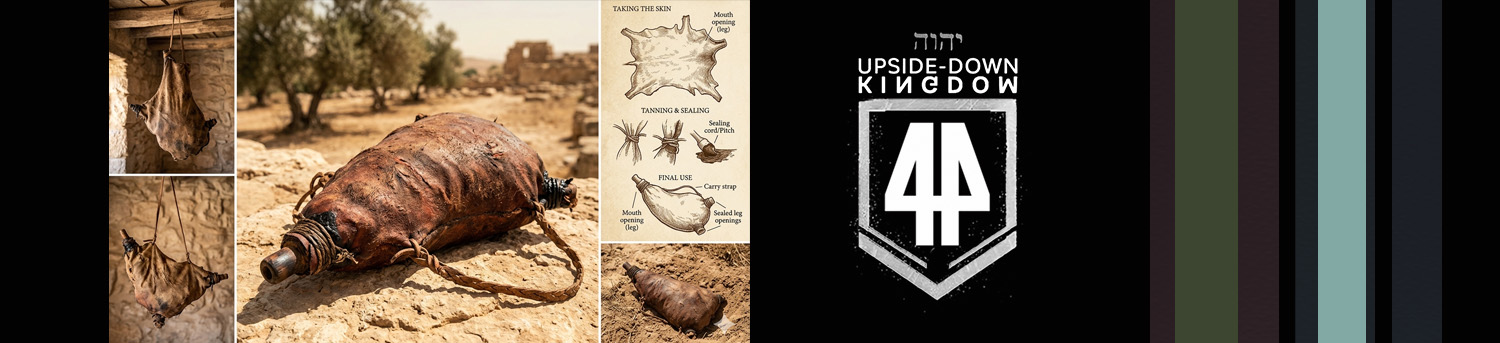
At harvest, grapes were brought to a winepress. Pressing installations discovered throughout Israel commonly include an upper treading floor connected to a lower collection vat. Workers crushed the grapes underfoot, and the juice flowed through channels into the basin. Further pressure could be applied to the remaining pulp and skins. Naturally occurring yeast began transforming the juice soon after pressing.[2] The pressure of fermentation required careful attention. Ancient wine was fermented, stored, and transported in several kinds of containers. Large ceramic jars were common, while skin containers were useful for smaller amounts and transportation. These wineskins were generally made from sheep or goat hides whose openings had been sewn or tied and whose seams were treated to reduce leakage.[3]
A new skin retained enough flexibility to accommodate the movement of young wine. An older skin could become dry, weakened, or rigid. If active wine were sealed inside it, the expanding contents could rupture the container. The result would be the loss of both the wine and the skin. Jesus’s audience did not need the image explained. It belonged to the ordinary agricultural world around them.
The Hebrew Language of Wine
The most common Hebrew word for wine is יַיִן, yayin. The term appears approximately 140 times in the Hebrew Bible and has cognates in several ancient Semitic languages. It generally describes fermented wine, although its quality and strength could vary considerably.[4] The Hebrew Bible presents yayin as both gift and danger (a contranym word). Wine gladdens the human heart in Psalm 104:15 and accompanies offerings in Exodus 29:40. Melchizedek brings bread and wine to Abraham in Genesis 14:18. Yet Noah’s drunkenness exposes his household to shame, while Proverbs warns that wine can master and deceive those who consume it without wisdom (Gen 9:20–27; Prov 20:1; 23:29–35). Wine intensifies the condition of its recipient. Within a feast it can express fellowship and joy. Without restraint it exposes disorder.
A second word, תִּירוֹשׁ, tirosh, is frequently translated “new wine.” It appears primarily in descriptions of agricultural produce and covenant abundance. The word may emphasize wine as the fresh yield of the vineyard, but it should not be equated automatically with modern, unfermented grape juice. Hosea 4:11 places yayin and tirosh together among substances capable of taking away understanding.[5] The word עָסִיס, asis, describes sweet or freshly pressed wine. Joel 3:18 declares that in the day of restoration the mountains will drip with it. Amos 9:13 uses similar language when the prophet envisions Israel’s renewed land producing such abundance that the one plowing will overtake the one harvesting.
This is the larger biblical background behind Jesus’s words. New wine carried associations of harvest, restoration, celebration, and the promised renewal of Israel. When the prophets imagined the age of salvation, they often pictured wine flowing freely. Isaiah 25:6 describes YHWH preparing a feast of rich food and aged wine for all peoples. Amos imagines mountains dripping with sweet wine. Joel connects flowing wine with the day when God restores his people. Jesus did not invent a new spiritual symbol unrelated to Israel’s Scriptures. He announced that Israel’s long-awaited hope was beginning to appear in his ministry.
New Wine and Fresh Skins
The Greek wording of the Synoptic sayings contains an important distinction. The wine is οἶνος νέος, oinos neos, while the skins are ἀσκοὶ καινοί, askoi kainoi. The adjective neos commonly describes something young or recent. The wine is new because it has been newly produced and is still developing. The adjective kainos often emphasizes freshness in character or condition. The distinction should not be treated as absolute, since the meanings overlap, but Jesus’s wording is fitting. Young wine requires fresh skins capable of moving with it.[6] The container does not create the wine. It receives, protects, and carries it. Its value is determined by its ability to serve what has been placed within it. In Matthew’s version, appropriate skins allow “both” the wine and the wineskins to be preserved. Preservation is the goal.
Luke describes what happens when the vessel cannot accommodate the wine. The wine bursts the skins, spills out, and is lost. The tragedy involves more than damage to the container. What the vessel was intended to preserve is also wasted. This gives the saying a more serious meaning than a call for innovation. Churches, traditions, leadership structures, worship practices, and ministries are all vessels. They can preserve and distribute the life of the kingdom, but none of them is the kingdom itself. A new structure that fails to preserve the wine is no better than an old structure that ruptures under its pressure.
The Bridegroom and the Question of Fasting
The discussion begins when people ask why John’s disciples and the Pharisees fast while Jesus’s disciples eat and drink. Fasting was an established Jewish practice associated with repentance, mourning, crisis, and longing for God’s intervention. The question was reasonable. Why did the disciples of Jesus appear less disciplined than other serious religious communities? Jesus responded with the image of a wedding. Wedding guests do not fast while the bridegroom is with them. A time of separation will come, and then they will fast. For the present, the bridegroom has arrived and the appropriate response is celebration. The bridegroom language carries considerable theological weight. Israel’s prophets described YHWH as the husband of his covenant people (Isa 54:5–8; 62:4–5; Hos 2:14–23). By placing himself in the role of the bridegroom, Jesus identifies his ministry with the promised restoration of God’s relationship with Israel.[7] This is why the new wine belongs to a wedding. Jesus is healing the sick, forgiving sins, welcoming social outsiders, and eating with tax collectors. The kingdom is entering places where religious respectability did not expect to find it. The presence of Jesus has changed the meaning of the moment.
Fasting remains appropriate, but its meaning must now be determined in relation to him. The disciples will fast when the bridegroom is taken away. Their fasting will no longer be an undefined religious exercise. It will express longing for the bridegroom and the completion of his kingdom. The new wine therefore represents the messianic reality arriving through Jesus. Forgiveness is being announced. Outcasts are being restored. A renewed covenant community is forming around the Messiah. These developments create pressure against social and religious boundaries that cannot contain them.
Old Wineskins and the Danger of Supersessionism
Christian interpreters have sometimes identified the old wineskins with Judaism and the new wine with Christianity. According to this reading, Jesus came to replace the obsolete religion of Israel with a new religion called Christianity. This interpretation forgets that everyone participating in the discussion is Jewish. Jesus, his disciples, John’s disciples, and the Pharisees are engaged in an internal Jewish conversation about faithful practice. Jesus is not rejecting Israel’s Scriptures. He is interpreting Israel’s story around his own messianic vocation. The language of a new covenant also comes from Israel’s prophets. Jeremiah promises that YHWH will make a new covenant with the house of Israel and the house of Judah, writing his instruction upon their hearts (Jer 31:31–34). Ezekiel describes God cleansing his people, giving them a new heart, and placing his Spirit within them (Ezek 36:25–27). Newness means that Israel’s God is acting faithfully to restore his people.
Luke adds a saying that prevents readers from treating everything old as evil: “No one after drinking old wine desires new, for he says, ‘The old is good’” (Luke 5:39). This may describe the natural human preference for what is familiar. It may also acknowledge that old wine possesses genuine value. Either way, Jesus is not promoting novelty as a spiritual virtue.[8] A similar image appears in Pirkei Avot 4:20, where teachers and students are compared to old and new wine contained in old and new vessels. The Mishnah was compiled after the New Testament period, so the saying cannot be assumed to provide the direct background to Jesus’s teaching. It does demonstrate that Jewish teachers could use wine and vessels to discuss formation, receptivity, age, and wisdom without assigning a fixed moral value to everything old or new.[9]
An old wineskin is therefore not simply an old church, an inherited liturgy, or an older generation. Young people can become rigid. New ministries can become possessive and controlling. A contemporary church can protect its methods as fiercely as the institution it once criticized. Freshness is measured by receptivity to Jesus. A suitable wineskin remains capable of being corrected, stretched, and formed by the life of the kingdom.
Crushing, Formation, and Surrender
Crushing and pressing emerges naturally from the winepress, but it must be handled carefully. Scripture sometimes uses the winepress as an image of judgment. Joel 3:13 summons the nations to the press because their wickedness is great. Isaiah 63 portrays the divine warrior with garments stained from treading the nations. Revelation later draws upon the same prophetic imagery (Rev 14:19–20; 19:15). Pain should not be romanticized as though every wound were directly inflicted by God. Abuse, injustice, illness, betrayal, and grief are not good simply because something may eventually be learned through them. The Psalms of lament give wounded people permission to protest, grieve, and ask why God seems absent.
The gospel reveals a God who enters suffering. Jesus does not stand at a safe distance from the crushing. He is betrayed, rejected, beaten, crucified, and buried. Resurrection does not declare death good. It reveals that death cannot prevent God from bringing life. Surrender, then, is not passive submission to every demand made by a religious leader. Christian surrender is yieldedness to Jesus. The hands shaping the vessel bear the wounds of the crucified Messiah. He forms people for life, communion, and service. The crushing is never the final purpose. Grapes are pressed so that wine can be produced and shared. The vessel is filled so that it can eventually pour out what it has received.
Make Us Vessels
The vessel language of the song also recalls Jeremiah’s vision of the potter reshaping clay in his hands (Jer 18:1–6). Isaiah calls God the potter and Israel the clay (Isa 64:8). Paul describes believers as fragile earthen vessels carrying extraordinary treasure so that the power will be recognized as belonging to God rather than to them (2 Cor 4:7). A vessel does not exist to admire its own fullness. Paul describes his life as being poured out like a drink offering for the faith of others (Phil 2:17; 2 Tim 4:6). What he receives from Christ becomes something he gives for the church.
This movement from receiving to giving provides an important framework for discipleship. A renewal weekend may become a concentrated space of confession, healing, communion, and renewed calling. The talks, music, testimonies, palanca, silence, and table conversations can prepare people to recognize that the bridegroom is near. They cannot manufacture the presence of Christ. They serve that presence. The weekend is also not the completion of discipleship. Participants return to their homes, churches, relationships, responsibilities, and unresolved circumstances. The lasting evidence of new wine will not be the intensity of a weekend response. It will appear in the fruit that follows: a softened heart, a courageous apology, a restored relationship, a growing hunger for Scripture, greater generosity, patient faithfulness, and an increasing resemblance to Jesus.
The deepest prayer of Weekend 53 may not be, “God, give us something new.” God has already given himself to us in Jesus and poured out his Spirit upon his people. The more searching prayer is, “Make us capable of carrying what you give.” Make us receptive to your presence. Make us flexible under the pressure of grace. Teach us to honor what came before without demanding that you act only as you have acted before. Free us from protecting religious structures after they have ceased to serve your kingdom. Form us into a community that welcomes those whom Jesus welcomes.
A wineskin never creates the wine. It receives it, stretches around it, and preserves it until the appointed time. Then it opens, and what it has carried is poured out for others. This is where the image finally leads. Jesus takes the cup and shares it with his disciples. Wine becomes a sign of covenant, communion, sacrifice, and the kingdom that will one day be fully revealed. The life received from Christ becomes a life shared around his table. The bridegroom is among us. The feast has begun. The wine is meant to be shared.
Conclusion: When the New Wine Leaves the Weekend
The prayer for new wine is a courageous prayer because it gives Jesus permission to change more than our circumstances. It invites him to search the places within us that have become rigid, guarded, wounded, or resistant. Most of us want the fruit of transformation, but we are less certain about the surrender that makes transformation possible. We want peace without releasing control, reconciliation without having the difficult conversation, freedom without naming what has bound us, and resurrection without entering the places where something old must finally die.
Jesus meets us there with patience. He does not shame the brittle places within us. He knows how they formed. Some of our defenses were built in seasons when we were trying to survive. Some of our habits grew from disappointment. Some of our hardness began as an attempt to protect a heart that had been wounded too many times. The Shepherd does not approach those places with condemnation. He comes with truth, tenderness, and healing. He shows us that what once protected us may now be preventing us from receiving the life he wants to give.
Becoming a fresh wineskin does not mean erasing your story. Jesus does not discard your history, personality, questions, or scars. He redeems them. The resurrected Christ still carried his wounds, but those wounds no longer represented the victory of death. They had become witnesses to the faithfulness of God. In the same way, surrender allows Jesus to take the places that once testified only to pain and make them testimonies of grace.
For some, the invitation of this weekend will be to forgive. Forgiveness does not pretend that the wound was insignificant. It does not eliminate healthy boundaries, excuse abuse, or instantly restore trust. Forgiveness releases the right to remain the judge and places justice into the hands of God. It loosens the grip that another person’s actions have maintained over your inner life. Sometimes forgiveness is spoken through tears. Sometimes it must be chosen many times before the heart catches up with the decision. Even then, every act of forgiveness creates space where new wine can begin to breathe.
For others, the invitation will be to receive forgiveness. Many people believe that Jesus forgives sinners in general while quietly wondering whether he has forgiven them in particular. They carry old shame into every new season. They assume that their worst moment is the truest thing about them. But the gospel does not announce that Jesus will tolerate you once you have punished yourself sufficiently. It announces that Christ has come near, entered your darkness, carried your sin, defeated the powers that held you, and opened the way home. Repentance is not crawling back to an angry God. It is turning toward the Father who has already come looking for you.
Some will need to release control. Control often disguises itself as responsibility. We tell ourselves that everything depends upon us because trusting God feels too uncertain. We manage people, anticipate every possible failure, and carry burdens that were never given to us. Eventually the soul becomes exhausted from trying to occupy a position that belongs only to God. Surrender does not mean that we stop caring or acting responsibly. It means that we obey faithfully while allowing God to remain God. We tend the vineyard, but we cannot command the rain. We prepare the vessel, but we cannot manufacture the wine.
Others may need to recover their voice. Perhaps someone taught you that humility meant silence or that submission meant disappearing. Perhaps your gifts were ignored because you did not fit someone else’s expectations. The Spirit does not fill people so they can remain hidden forever. He gives gifts for the strengthening of the body. Your voice does not need to sound like anyone else’s voice. Your testimony does not need to resemble anyone else’s story. The question is whether you will offer what God has placed within you. A quiet word spoken in obedience can carry more life than a loud word spoken for attention.
There may also be relationships that require attention when the weekend ends. New wine will eventually press against old patterns of avoidance. If the Spirit brings someone to mind, do not dismiss it as an interruption. Pray about the next faithful step. Make the call. Write the letter. Ask the question. Listen without preparing your defense. Confess your part without explaining it away. Reconciliation requires the participation of more than one person, so not every relationship can be immediately restored. You can still choose honesty, humility, forgiveness, and peace on your side of the relationship.
Do not despise small beginnings. Spiritual transformation is often quieter than we expect. We look for a dramatic moment while God begins with one honest confession, one surrendered habit, one act of generosity, or one conversation we have avoided for years. Fruit grows slowly because it is alive. A manufactured appearance can be produced quickly, but genuine formation takes time. The Father is not impatient with the pace of healthy growth.
This is why you will need community after the weekend. A wineskin is a communal image before it becomes an individual one. Jesus did not call isolated believers to manage private spiritual experiences. He gathered disciples around a table and taught them to carry one another. We need people who will remind us what God has done when our emotions change. We need friends who can celebrate our growth without flattering us, correct us without controlling us, and sit with us when there are no simple answers. Do not leave this weekend with only a memory. Leave with names, relationships, and a willingness to be known.
You should also expect resistance. A meaningful encounter with God does not remove every temptation, heal every wound overnight, or answer every question. The days following a spiritual high can feel surprisingly ordinary. That does not mean the weekend was false or that God has withdrawn. New wine develops in hidden places. What began in a moment must be carried through prayer, Scripture, communion, repentance, service, and life with the church. The work of grace continues when the music has stopped and no one is watching.
Guard what God has entrusted to you, but do not clutch it. The wine was never meant to remain sealed forever. Whatever Jesus heals in you can become a place from which you help another person heal. The comfort you have received can become comfort for someone who is grieving. The freedom you have found can become hope for someone still hiding. Your story does not make you the Savior. It allows you to point more honestly toward the one who saved you.
When you return home, ask yourself a few simple questions. What is Jesus asking me to release? Whom is he asking me to forgive? Where is he calling me to tell the truth? What gift have I kept hidden? What relationship needs a faithful next step? Where have I confused control with responsibility? How can what God has given me become life for someone else?
Do not try to answer every question at once. Begin where the Spirit has placed his finger. Obedience is often one clear step before it becomes a visible journey.
The bridegroom has not invited us to a weekend of temporary inspiration. He has invited us into his life. He is forming a people who know how to feast in his presence, fast in their longing, remain faithful through suffering, welcome the outsider, forgive as they have been forgiven, and pour themselves out in love.
So bring Jesus your whole life. Bring him the fruitful places and the barren ones. Bring him your confidence and your fear, your joy and your disappointment, your obedience and your resistance. Bring him what is still tender and what has become hard. You do not have to arrive already transformed. You only need to stop hiding from the one who transforms.
May Jesus soften what has become rigid, heal what has been wounded, and strengthen what has grown weak. May he free us from religious performance and form within us the quiet faithfulness of genuine disciples. May our homes become places of peace, our churches become tables of belonging, and our lives become vessels of his presence.
And when he pours new wine into us, may we have the courage to receive it, the patience to carry it, and the love to pour it out for others.

Notes
- Hillsong Worship, “New Wine”, There Is More (Hillsong Music, 2018).
- Carey Ellen Walsh, The Fruit of the Vine: Viticulture in Ancient Israel (Harvard Semitic Monographs 60; Winona Lake, IN: Eisenbrauns, 2000), 35 & Patrick E. McGovern, Ancient Wine: The Search for the Origins of Viniculture (Princeton: Princeton University Press, 2003), 167
- David Van Limbergen et al., “Making Wine in Earthenware Vessels: A Comparative Approach to Roman Vinification,” Antiquity 98 (2024): 361
- Ludwig Koehler, Walter Baumgartner, and Johann Jakob Stamm, The Hebrew and Aramaic Lexicon of the Old Testament, trans. and ed. M. E. J. Richardson, 5 vols. (Leiden: Brill, 1994–2000), 2:406
- Hans-Jürgen Fabry, “תִּירוֹשׁ,” in Theological Dictionary of the Old Testament, ed. G. Johannes Botterweck, Helmer Ringgren, and Heinz-Josef Fabry, trans. David E. Green, 16 vols. (Grand Rapids: Eerdmans, 1974–2018)
- Frederick William Danker, ed., A Greek-English Lexicon of the New Testament and Other Early Christian Literature, 3rd ed. (Chicago: University of Chicago Press, 2000), 497
- A. Kee, “The Old Coat and the New Wine: A Parable of Repentance,” Novum Testamentum 12 (1970): 13
- m. Avot 4:20. The comparison is valuable as a later Jewish parallel, but its dating requires caution when reconstructing the immediate historical background of Jesus’s saying.

