Thanksgiving = OPEN HANDS

Prayers of thanks and special thanksgiving ceremonies are common among most religions after harvests and at other times of the year.1 Most people don’t realize that the Thanksgiving holiday’s history in North America is actually rooted in English traditions dating from the Protestant Reformation.2 Special thanksgiving religious services became mandatory by law during the reign of Henry VIII.3  Before 1536 there were 95 Church holidays, plus every Sunday, when people were required to attend church and forego work. The Puritan party in the Anglican Church wished to eliminate all Church holidays apart from the weekly Lord’s Day, including the traditional church feasts (now typically associated with ancient Judaism) which is what started the protest reformation, or “protesting” of the church married government.

So fast forward about 100 years later and you get to the story that you probably thought started Thanksgiving. Thirty-eight English settlers aboard the ship Margaret arrived by way of the James River to Charles City County, Virginia on December 4, 1619. The landing was immediately followed by a religious celebration, specifically dictated by the group’s charter from the London Company, in accordance with the English government mandates still in effect described in the paragraph above. The charter declared, “that the day of our ships arrival at the place assigned for plantation in the land of Virginia shall be yearly and perpetually kept holy as a day of thanksgiving to Almighty God.”4 Sometimes, I think wouldn’t it be great if our government had that kind of admiration for the Lord, maybe they did at one time. But as history would show, even the conservative Christians still had their sum of issues with that government, and rightly so.

You might have made the connection above; the church of England was actually mandating the celebration of the Biblical feasts given in the Torah to Israel. Which is bizarre to us today, the government in the 1500’s was actually mandating people by law to follow the Bible. I actually don’t like much of any government stipulations telling us what we can and can’t do, but this is still very interesting to me.

Sukkot, also known as the Feast of Tabernacles or Feast of Booths, is a Torah-commanded  observance celebrated for seven days, beginning on the 15th day of the month of Tishrei. It was one of the three Pilgrimage Festivals on which Israelites were commanded to make a pilgrimage to the Temple in Jerusalem. Biblically an autumn harvest festival and a commemoration of the Exodus from Egypt.5

The names used in the Bible is specifically “Festival of Ingathering” or “Harvest Festival”, חַג הָאָסִיף, and “Festival of Booths”  חג הסכות, this corresponds to the double significance of Sukkot. The one mentioned in the Book of Exodus is agricultural in nature—”Festival of Ingathering at the year’s end” (Exodus 34:22)—and marks the end of the harvest time and thus of the agricultural year in the Land of Israel. The more elaborate religious significance from the Book of Leviticus is that of commemorating the Exodus and the dependence of the Israelites on the will of God (Leviticus 23:42–43). They describe the same observed festival.6

Over the years, Thanksgiving has traditionally become celebrated much later than Sukkot (which was October 7-13 this year, Thanksgiving in the US is the last Thursday in November) and has thus likely separated any sort of comparison or association of the two within the Evangelical United States. But the idea of inviting your family and guests to your Thanksgiving feast and taking on a mindset of Gratitude certainly originated in the Bible around this feast.7

The Hebrew word sukkoṯ is the plural of sukkah (‘booth’ or ‘tabernacle’) – we might simply call these tents in English. As stated in Leviticus these were the fragile dwellings in which the Israelites dwelled during their 40 years of travel in the desert after the Exodus from slavery in Egypt. The Lord resided their with them as an image of enduring faithfulness. For the last several thousand years, throughout those observing the Biblical holiday, meals are eaten inside the sukkah and many people sleep there as well. Within traditional Judaism, this is a mitzvah, or commandment, to ‘dwell’ in the sukkah. There was also an emphasis (as with all the Biblical feasts) to pass this on orally and in spirit to your children.

This brings us to Thanksgiving celebrated in modern America. What do we do with it? Do we make it about Jesus? Well, if you are a devout follower shouldn’t everything be about Jesus? Do we take advantage of the world celebrating a theme that clearly originated in the Bible to invite those into our home and show them the Love of Jesus? That sounds like a great idea, doesn’t it? At least Thanksgiving unlike Christmas and Easter isn’t steeped in all sorts of pagan religion; there is a great argument that it is primarily of Biblical origins.

And I shall lift up my hands to Your commandments, which I love; and I will meditate on Your statutes.  Psalm 119:48  NASB

Lift up my hands – וְאֶשָּׂ֚א כַפַּ֗י אֶל־מִ֖צְו‍ֹתֶיךָ אֲשֶׁ֥ר אָהָ֗בְתִּי וְאָשִׂ֥יחָה בְחֻקֶּֽיךָ

Miṣwâ, is a command language, if your faithful, you do this. Ahēb, to love (“that I love”), and śîaḥ, to meditate (but not silently, aloud in communal part).  The verb is nāśāʾ, to lift, carry, or take.  But there is no nun in the form in this verse. That is strange, but it is because the future tense drops the nun and becomes (first person singular) אֶשָּׂא.  So, we have אֶשָּׂא preceded by the prefixed vav.  And that means it should be “I lifted up my hands.”  The psalmist isn’t anticipating a future gesture of gratitude to God for His commandments.  He has already made the gesture, just as in the previous verse, he has already delighted in the fatherly order God provided. The psalmist certainly believes in this as a command to generations that follow. There are several Torah verses that seem to imply this was perceived as a soft command by Yahweh but we don’t really every get this directly from His hand. Therefore, it hasn’t carried over to evangelical Christianity in that way, although it is certainly counted in the 613 laws. That should hit you a little harder next time you’re in church and people are raising their hands in praise. And some people would believe that Paul was reiterating the keeping of this command in 1 Timothy 2:8 which also takes a similar imperative.

This text finishes with the words “hands” (kappa – kap). Palm of the hand is the best translation here, but kap is also used of hands spread out in prayer in Ex 29:25 and Isa 1:15. “8  The psalmist chooses a rather rare word to describe hands instead of the usual word yad to make sure that we pause and reflect upon a more specific act. 

Palms upward is a gesture for receptive gratitude. So as long as you are thinking about this next time you worship, to be precise, your hands are not together like you’re praying on your knees or at the table, not straight up over your head like your praying for fire from heaven, not clenched like the Pharisee, but open to receive which really meant hear according to the Shema – in a submissive posture, and perhaps not even extended above one’s head. This is the posture of a grateful servant who has received something wonderful and valuable from a loving master. 

Many scholars believe that Jesus was alluding to this in Matt 6:5. The NIV reads,

But when you read the Greek, you will notice that the phrase “standing to pray” comes off as idiomatic. In Greek the words “standing and receive” are connected when is used by Jesus in a clever word play. Standing shouldn’t be read as the emphasis of the verse. The emphasis is posture, but you can see how that then becomes a play on words. Jesus hits it on the head, their “uprightness” was likely showing in their posture of hands “standing” over their heads, it wasn’t a picture of humble submission. Or they were upright not kneeling hands out of submission to the Lord. In other words, you receive what God has for you in submission with a humble heart posture of gratitude. If you miss this, the world is your reward. I also don’t believe the hermeneutic leads us to legalism over the posture of our body or hands, but rather the aims at the heart. Some believe that Jesus here was reminding the church that his mission was humble and as that of a lowly shepherd, not high in the sky as a luminary or god over them. His mission was to invite the world to join this humble calling steeped in devotion. Perhaps the first century religious culture had lost their humble approach to the Lord, and this was in part the emphasis of Jesus. The “euangelion” that brought salvation, freedom and peace wrapped in humility the world couldn’t fathom.

Hands outstretched, palms open to Jesus shows Gratitude bathed in submission and brings devotion ushering heaven to earth.

Brian Zahnd recently challenged some TKC students to return to a humble place of more traditional humility of prayer and worship before the LORD.
  1. Hodgson, Godfrey (2006). A Great and Godly Adventure; The Pilgrims and the Myth of the First Thanksgiving. New York: Public Affairs. p. 212ISBN 978-1586483739. ↩︎
  2. Baker, James W. (2009). Thanksgiving: The Biography of an American Holiday. UPNE. ISBN 978-1-58465-801-6. ↩︎
  3. Forbes, Bruce David (October 27, 2015). America’s Favorite Holidays: Candid HistoriesUniversity of California Press. p. 155. ISBN 978-0-520-28472-2. ↩︎
  4. Alvin J. Schmidt (2004). How Christianity Changed the WorldZondervanISBN 9780310264491Archived from the original on January 17, 2023. ↩︎
  5. Farber, Zev. “The Origins of Sukkot”http://www.thetorah.com. ↩︎
  6. Rubenstein, Jeffrey L. (2020). “The Origins and Ancient History of Sukkot”. A History of Sukkot in the Second Temple and Rabbinic Periods. Brown Judaic Studies. ↩︎
  7.  “The Ushpizin”Library. Chabad. October 20, 2024. ↩︎
  8. Archer, G. L. (1999). 1022 כפף. In R. L. Harris, G. L. Archer Jr., & B. K. Waltke (Eds.), Theological Wordbook of the Old Testament(electronic ed., p. 452). Moody Press. ↩︎
Are you leaving Jesus on the Cross?

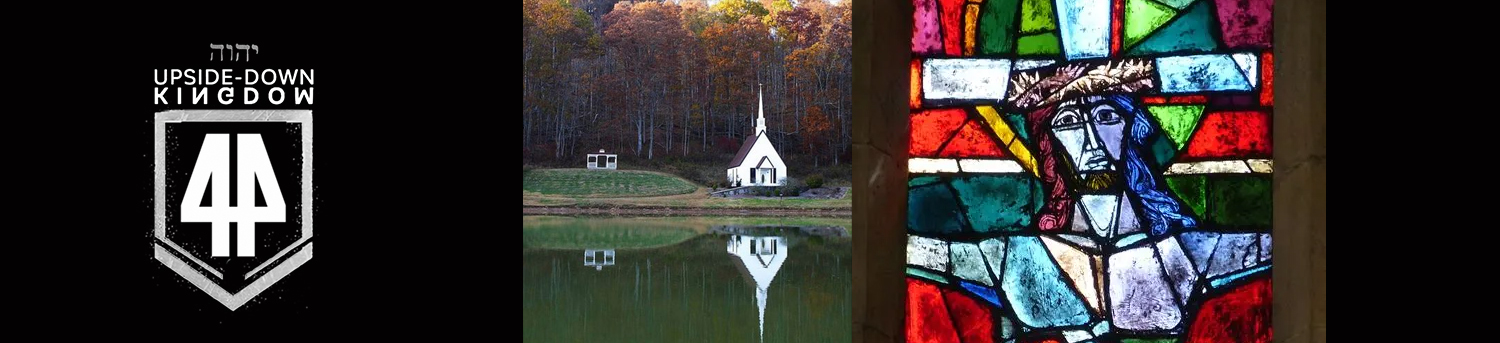
Anyone else sometimes feel like our laser and lightshow, skinny jeans and smoke machine Christian culture has sort of lost the sacred approach that seems to be so rich to the textures of the Bible? One prominent blogger says, “My Father’s House Shall be a House of… Entertainment?”1 I agree with much of his sentiment. I grew up attending the classic white steepled church adorned by stained glass telling the story of the covenant community that had faithfully gone before us, and I have to say when I return to a more traditional looking church building there is just something that feels more sacred than the auditoriums parading led walls bigger than the strip of Las Vegas. But perhaps even more than a steeple and stained glass, I long for an antiquated upper room with a table set for me.2 But at the same time, I love the diversity of the church and find a place for nearly every recipe of the faith.

Recently TKC students went to a Brian Zahnd Prayer school. Brian started in the Jesus Movement3 and shifted into Word of Faith.4 From there he had a deeper bought with Theology and found himself turning back the pages to a more conservative Anglican5, or Eastern Orthodox6 approach. Amongst other things he brought back the liturgy7 into his prayers. One of the other things that you will see in his church is a return to icons8, specifically Jesus on the cross. Before I go any further, I love Brian Zahnd. If you have a chance to attend one of his prayer schools, you will be immensely blessed. I can’t recommend the school or any of his soon to be 12 books enough. All of it is life changing and will bear great fruit for the kingdom.

As much as I LOVED THIS endeavor, I have to admit, I still found myself struggling with the longer liturgy, iconography, beads, repetition and chants (and I chant in Hebrew regularly). I know so many people that were “saved” from all of this. There are some things about the more liturgical experiences I love, and some things that I don’t. I love the sacred approach and the stressing of Biblical theology; but I also don’t want to harness or put the moving of the Holy Spirit in a box (which to be clear I don’t think Brian does.) I also have never felt good about iconography that leaves Jesus on the cross.

I agree with his quote. In fact, I think it is right on. But I am not sure I want to “stay” there or make that my dwelling place. I feel like to do so sort of takes a perspective similar to when those of the reformed mindset that get so bound by total depravity (and the other TULIP ideology)9 that they can never emerge from that mindset, affirm their new life and identity in Christ and live in victorious sanctified life here and now bringing Heaven to earth – in the words of NT Wright.10

As I write this, I am asking myself (as all good theologians should do)11 to be unbiased and consider what is the best approach according to the scripture and the revelation of Jesus Christ. I will invite you to a Mars Hill experience12 with me. Let’s consider the tough questions. Why focus on the image of Jesus on the cross? Some would say we are leaving Jesus on the cross, not celebrating the triumph of the resurrection ascension and enthronement of Jesus that is the completed image of living a complete sanctified life.13

Others will say the cross by itself is an abstraction of Jesus.14

To say it a different way… A beaten, humiliated man dying on a cross doesn’t seem like we “picked a winner…”15 But as you likely know if you are reading this, that is the worlds way of thinking. We as Christian’s see the beauty in the humble sacrifice (Beauty will save the world) and see that through Him the meek will inherit the earth. This is upside down or backwards kingdom ideology – the first shall be last kingdom that Expedition 44 has become known for. Christ (the meek) inherited the earth & we are sons and daughters of God and therefore we also inherit His kingdom. We lead humbly from beneath in peace. Jesus’ way of leading puts devotion and service ahead of prominence and power. This perspective aligns with the concept of servant leadership, where the leader serves others rather than seeking to dominate or assert authority over people. 16

Yes, I know all of that and do my best to live it out. In the same way, I can see how the image of Christ on the cross is a great iconic missional reminder of what we should be doing each and every day.

However, with all that said, so much of the voice of Jesus and message that follows is to claim the full revelation of Jesus which is post enthronement -His spirit poured out into us that we might represent the One that has “won” or “championed” the world.17

Please don’t get me wrong, I don’t think the kick butt Jesus icon18 works. I even sometimes struggle with the battle language in Christianity (when the battle belongs to the Lord not us); but Jesus is both the Lion and the Lamb. Let’s not lose sight of either.

My primary problem with leaving Jesus on the cross is that scripture tells me that my identity isn’t in my former defeated person but is now grafted into the glory of the enthroned Christ. In some ways I see the transformation of the cross as a caricature or mosaic (comparison image) of my personal transformation enthroned by Him as a royal holy ruler -not defeated. To leave Christ on the cross doesn’t seem to match the thrust of 2 Corinthians 5 following my example to be like Jesus in total transformation.19

The Greeks believed that peace (eirḗnē) was simply the small intermission between war (pólemos) and war was (and possibly should be) the natural state of the world.20  This Greek idea stands in opposition to shālôm, the Hebraic idea of well-being that was and is the intended condition of humanity.  shālôm is the gift of YHVH. But shālôm is not just the peace between the wars, but the balance that found revelation in Jesus Christ Himself. “Peace I leave you, My peace I give you; not as the world gives, do I give to you.  Do not let your hearts be troubled, nor fearful” (John 14:27 NASB). 

I want to dwell on the complete revelation of Jesus, that is a balance of the cross and the enthroned king.

Will Ryan Th.D.

  1. https://jaronalexander.medium.com/skinny-jeans-and-smoke-machines-11e3d6ee28b ↩︎
  2. Cambridge Bible for Schools and Colleges on Acts 1, “The eleven were the tenants of the upper room, to which the other disciples resorted for conference and communion”. ↩︎
  3. Bustraan, R. A. (2014). The Jesus People Movement: A Story of Spiritual Revolution Among the Hippies. Wipf & Stock Publishers. ISBN 978-1620324646. ↩︎
  4. Harrison, Milmon F. (2005). Righteous Riches: The Word of Faith Movement in Contemporary African American Religion. Oxford: Oxford University Press. ISBN 9780195153880. ↩︎
  5. “What it means to be an Anglican”Church of England. Archived from the original on 30 August 2011. ↩︎
  6. “The Orthodox Faith – Volume I – Doctrine and Scripture – The Symbol of Faith – Resurrection”http://www.oca.org. ↩︎
  7. Baldovin, John F., SJ (2008) Reforming the Liturgy: a Response to the Critics. The Liturgical Press ↩︎
  8. Erwin Panofsky, Studies in Iconology: Humanistic Themes in the Art of the Renaissance. Oxford 1939. ↩︎
  9. Sproul, R. C. (2016). What Is Reformed Theology?: Understanding the Basics. Grand Rapids, Michigan: Baker Books. p. 32. ISBN 978-0-8010-1846-6. ↩︎
  10. Van Biema, David (7 February 2008). “Christians Wrong About Heaven, Says Bishop”Time. Archived from the original on 9 February 2008. ↩︎
  11. Kogan, Michael S. 1995. “Toward a Jewish Theology of Christianity.” Journal of Ecumenical Studies 32(1):89–106.  ↩︎
  12. Bruce, F.F. The Acts of the Apostles. The Greek Text with Introduction and Commentary. 2nd Ed. (Grand Rapids: Eerdmans, 1952). 335. ↩︎
  13. Philip Edgecumbe HughesA Commentary on the Epistle to the Hebrews, p. 401, 1988: “The theme of Christ’s heavenly session, announced here by the statement he sat down at the right hand of God, .. Hebrews 8:1 “we have such a high priest, one who is seated at the right hand of the throne of the Majesty in heaven”)” ↩︎
  14. Clark, Elizabeth Ann (1999). Reading Renunciation: Asceticism and Scripture in Early Christianity. Princeton: Princeton University Press. ISBN 978-0-691-00512-6. ↩︎
  15. Leithart, Peter (July 1995). “When the Son Is Glorified”Biblical Horizons75. Retrieved 3 May 2012. ↩︎
  16.  Ignatius of Antioch. The Epistle of Ignatius to Polycarp. IV. ↩︎
  17. https://www.faiththeevidence.com/faith-evidence-blog-_1/jesus-our-champion ↩︎
  18. https://thinkchristian.net/jesusfreaks-butt-kicking-christ ↩︎
  19. Dallas Willard – Renovation of the Heart proposes that the human self is made up of several interrelated components: one’s spirit, i.e. one’s “heart” or “will”; one’s mind, or the collection of one’s thoughts and feelings; the body; one’s social context; and one’s soul. Willard argues that one’s identity is largely a function of how those components are subordinated to one another, and whether the whole is subordinated to God. Willard argues that popular rejection of subordination to God and the dominance of the body and feelings has resulted in addictions and futile pursuits of stimulation for the body or feelings. Willard argues that the subordinated alignment of one’s being can be corrected through apprenticeship to Jesus Christ, which renovates one’s heart. ↩︎
  20. Josephus, Jewish War, 1.370 (Loeb ed.) ↩︎

Foreword: Jesus The Great I Am – Ian Carlson

“Unless you can enter deeply into the mystery of the Incarnation, I’m afraid your Christianity will remain shallow, uninspiring and largely legalistic. You will essentially think that Christianity is about rules and rewards and where you go when you die. And in an increasingly secularized and pluralistic culture not too many people are interested in a legalistic afterlife religion. The best hope I know for presenting the gospel in a compelling way to a 21st century audience is to begin with….the beginning: The Incarnation. The breath-taking mystery of God joining us in our humanity.” [1]

Greg Boyd, has put it this way, “There is no denying that the Incarnation is paradoxical. It is hard, if not impossible, to conceive how a person could be, at one and the same time fully God and fully human. I don’t think this should surprise us too much, however. After all, we confront similar paradoxes in science as well as in our everyday life. For example, as I’m sure most of you have heard that physicists tell us that light has the property of waves in some circumstances and of particles in other circumstances, yet we have no way of understanding how this is possible. Even the nature of time and space is paradoxical if you think about it. We can’t conceive of time having a beginning, but neither can we conceive of it without a beginning. So too, we can’t conceive of space having an end, but we also can’t conceive of it not having an end. If things as basic to our experience as the nature of light, time and space are paradoxical, I don’t think we should find it too surprising that things surrounding God are mysterious.”

Paul declared that Jesus was nothing less than the very embodiment of all of God. This distinction of “all of God” is important for us to understand what it means for us to see Jesus and God rightly. Battling proto-gnostic teachers who were apparently presenting Christ alongside other manifestations of God, Paul declares “in Christ all the fullness of the Deity lives in bodily form” (Col. 2:9; cf. 1:19). His statement could hardly have been more emphatic:

All” (pan)—not some

“of the fullness” (plērōma)—not a part or an aspect

“of the Deity” (theotēs)—not a lesser divine being. [2]

As F.F. Bruce notes (regarding 1:19), Paul is asserting that, “all the attributes and activities of God—his spirit, word, wisdom and glory—are disclosed in [Christ].”[3] 

In other words, the fullness of God is revealed or embodied in Jesus. Jesus is the complete revelation of God in Word. Graeme Goldsworthy puts it this way, if “Jesus is the one mediator between God and man,” then Jesus himself must be “the hermeneutic principle for every word from God.”[4] It is also paramount to recognize that Christ is the “head” of the cosmos by which all reconciliation will come (Eph. 1:10; Col 1:19-20).

The Temple and YHWH’s return to Zion are the keys to gospel Christology. Focus on a young Jewish prophet telling a story about YHWH returning to Zion as judge and redeemer and then embodying it by riding into the city in tears, by symbolizing the Temple’s destruction, and by celebrating the final Exodus. He would be the pillar of cloud for the people of the new Exodus. He would embody in himself the returning and redeeming action of the covenant God. [5] Wright is suggesting, and I would agree that we are to read the Gospels as the Story of God’s returning to Israel, to Zion, to the Temple and Jesus is that presence of God

Regardless of your view of the atonement, such as Substitution, Satisfaction or Christus Victor; in all of them, Christ must be human in order for the sacrifice of the cross to be efficacious, for human sins to be “removed”, “cleansed”, “purified”, “covered”, and/or “conquered” (again depending on your atonement theology). This soteriological emphasis then gives way to the incarnation of the Son of God becoming a man so that he could save us from our sins. Therefore, the incarnation serves as a fulfilment of the love of God manifested and revealed in completeness as Jesus to be present and living amidst humanity, to “walk in the garden” with us.

Michael F. Bird shares this, “What we should take away is that in the unfolding story of the New Testament, the pre-incarnate Son who divested himself of divine glory in his incarnation is now fully invested by the Father with divine authority over every realm and every creature. What the Lord God of Israel does in creation and redemption is now, in some way, done through the lordship of Jesus Christ. When Jesus is named as “Lord” it is usually in the context of affirming that he carries the mantle of the Father’s authority and that he is the Father’s agent for rescuing Israel and putting the world to rights. Confession of Jesus as Lord was not a matter of mere assent or academic affirmation. It was a life and death issue. It meant standing up to the Caesar’s of the world who usurped for themselves the praise and power that rightly belonged to God. As Christians today, our highest vocation is to live our lives under the aegis of Jesus’ lordship and to make it clear to all that “this Jesus,” whom men and women reject, is Lord of all. What is more, the Lord Jesus will bring justice to our sin cursed earth and then flood the world with the shalom of heaven.” [6]

Before Christ passes, he shares with the remnant, his faithful disciples that he wants them to continue this oath of allegiance to a coming kingdom and that he will rule as the Lord of all regathering the nations to Him. And when he dies, no one can understand what has happened. We still struggle with this today. We don’t know the full work of the cross; we don’t need to. We know that it was the power to save. The veil separating humankind from God was torn and the cord fell once and for all. The blood of the cross would run both ways. The plan to enter into a holy covenant with God would be not only restored but made perfect. The new covenant was cut. The plan of redemption for all humankind fulfilled. Nothing more than obedient faith to walk with God would be asked for. This commitment would encompass all of life, the heart, mind, and soul. [7]

[1] brianzahnd.com/2008/12/son-of-adam/
[2] The Incarnation: Paradox & reknew.org/2017/01/jesus-center-scripture/
[3] F. F. Bruce, The Epistles to the Colossians, Philemon and to the Ephesians, NICNT (Grand Rapids: Eermans, 1984), 207.
[4] Gospel-Centered Hermeneutics, 252, cf. 62.
[5] N.T. Wright, The Historical Jesus and Christian Theology, Sewanee Theological Review 39, 1996.
[6] Reflections on Jesus as Lord, June 24, 2014 by Michael F. Bird
[7] Dr. Will Ryan, This is the Way of Covenant Discipleship, Crosslink Publishing 2021 Pgs. 82-83

2024 KINGDOM SERIES PT 1 VOTING

You have been told your entire life that good Christians should “do their job” and vote. That is the mainstream evangelical Christian view. However, everyone knows “that guy” who seems to be a great Jesus follower and has either totally politically checked out to go live like a monk or perhaps has just convinced himself that the way of the cross isn’t to become “overly” politically aligned as a Christian. To most in the first category the second two positions may also seem “un-Christian.” Nilay Saiya in his global politics of Jesus [1] describes these three positions as the Patriot position or Christianism believing it is your biblical responsibility to vote (7 mountain mandate type of thinking), the second position he describes as the pietists position or detachment such as the first century Essene community; and the last being that of the prophetic witness position describing more of an exilic position of speaking truth passively as a witness. Perhaps there is a time, a calling, or season for all three in your life dependent on each specific situation and your personal position, but as with most issues pertaining to our modern lives, the word of God is not silent here. Let’s see what it says.

Global Christianity – What we all agree on

As with all x44 articles the intended audience here is those that are “all in” for Jesus. For the most part here is what the all in community agrees on. Jesus inaugurated a new kingdom and set apart nation. There is nothing that Jesus talked about. After his resurrection and victory over death on the cross, Jesus assumed the throne in the heavens and sent His spirit to dwell in us. This kingdom is here and now as well as described as coming (eschatologically.) To be clear, the Bible treats this kingdom as a rival kingdom to the other kingdoms of the world using phrases like, “you can’t serve two masters.” The definition given of those that are not in alignment with this ideology is that of “an enemy” to His kingdom even describing some that claim to be His followers as lukewarm unequivocally stating that “He never knew you,” which seemingly describes those that do not follow his commands to leave their formal world behind and live in complete devotion to Him. As strange or counter cultural as it may be, the hope of this kingdom is that the “enemies” might be reconciled by these “good neighbors faithful to Jesus” and eventually won over and shepherded into obedience into the Jesus kingdom. We are told eschatologically that Jesus will eventually wipe away all the other kingdoms of the world. In this nation Christ alone is King.

To those in the original intended first century audience this word certainly would have been received as traitorous and blasphemy towards the Roman empire and the emperor, which is (in part), why Jesus was crucified and explains the sign over his head. Nevertheless, entering into the Kingdom and coming into belief in and agreement with the terms of the king is how salvation is achieved. The Bible describes this decision of our heart and mind as being born into new life, we are then dead to our old ways. We gain citizenship to this new kingdom (Phil 3:20) and should no longer desire or pursue our former life. We are dead to it in every way. We willingly and full accept the call then to function as ambassadors of the new kingdom towards those still dying in the old rival kingdoms of the world as we now happily exist as foreigners or exiles dwelling in our former broken world which scripture describes to be ruled by Satan. The Jesus kingdom is characterized and embodied by those who serve others not themselves, those with the desire to love their enemies and turn the other cheek in grace and mercy shepherding and winning them over them to a better more beautiful way of life. As ambassadors to the pagan nations, we are the physical manifestation of Jesus to our world. In this way, Christians are called to pledge their allegiance to God and his Kingdom, not to any worldly nation, government, political party, flag, or ideology. One of the main tasks of a Christian is to live set-apart which means separated. Separated from what? The world. To live wholly devoted and undefiled for Jesus.

Of course, 2000 years later some circumstances might complicate, cloud, or entangle your thinking. Paul was a part of three kingdoms, he maintained Jewish citizenship, Roman citizenship and was certainly fully devoted primarily to the Kesus kingdom. Most Jesus followers didn’t have a “vote” in Rome; yet today our Rival nation asks us what we think by casting a vote. It is actually pretty amazing that the evil empire allows Christians a vote. In many ways every decision you make is a “vote” of some sort.

Patriotism doesn’t necessarily mean you love the evil satanic ongoings of our government and Washington DC, although it certainly can and often does; but the better idea is that you love the people of the nation and the soil by which it is represented. Godly presence means that the land you inhabit became sacred space unto the Lord. Eventually all the land and world will be won back for the Lord and consecrated back to Him. Do we start now? Isn’t that what we are supposed to be doing?

The enemy is willing to give you a “place” at his table, should you take it? Would Jesus have eaten at that table? Obviously, peoples answer to these questions, even based on scripture and interpretation will vary. Jesus “entertained” the table but not the rival kingdom.

Christian Patriotism

As much as this is the mainstream view and what most Americans believe the Bible teaches, the exegetical “proof” (IMHO) is slim if there at all. However, those that believe that the Bible aligns with casting a vote for your government make a rather convincing philosophical argument. Some of the founding fathers truly believed and sought after creating a platform of government in America by which Godly principles and Godly men could lead our country. Charles Finney, John Adams, John Jay, and Samuel Adams are amongst my favorites that I truly believe were “all in” seekers of the Jesus kingdom, but my verdict is out on the other 55 people in that “boarded up” room. If you haven’t listened to our Expedition 44 interview with Michael Gaddy, I would encourage you to give it a listen. In one regard you might not care what the founding fathers said or thought or might believe that only 4-5 of the founding fathers were postured towards the kingdom. What they say isn’t God’s voice to you and therefore you might think is largely irrelevant to you. But that view might seem to take on a selfishly driven perspective of historical learning.

There are a few ideas in the Bible that might promote such a dual citizenship. Matthew 22:37-40 tells us to Love God and our neighbor. If we truly want the best for our neighbor, wouldn’t we exercise our influence against the evil atrocities of the world and government? But if your already not a great neighbor and you use this passage to justify voting as helping your neighbor then you have some “order issues” or might be guilty of doing something you are accusing others of (ie being a hypocrite and we all know that isn’t helping the body of Christ with their “image”.)

Others might cite Romans 13:8 or I Tim 2:1-4 or even Gal 6 as having influence in our world. The New Testament is filled with examples of Godly people who do not obey the government. As there is a conversation of the narrative and the authors personal opinion coming out in their writings. The bible makes it very clear to follow Jesus first and foremost. Paul himself, the author of the letter to the Romans, disobeyed the government on numerous occasions. Paul uses the word ‘hypotassō,’ which gets translated as “subject.” Paul could have used the word ‘hypakouō’ which means ‘obey,’ but he doesn’t. This difference in words is important.

One of the problems with this view is political corruption. Does your vote even matter? Personally, probably not, but collectively -Yes (is hard to argue). Much of the Biblical theme dwells on the communal body of Christ making a kingdom difference in the world we live in.

Piety / Detachment

When you start asking questions like, whose table are you eating from, or whose flag are you flying, or who are you “in bed with,” you might understand the current political problems of potentially aligning with any system of the world. You also might find an issue with casting a vote for someone you don’t think is a good person, or should we be voting for anyone that isn’t directly part of the Jesus kingdom? (But then the issue comes that if you think this way then no Christian would ever be in a place to vote.) Are you voting for the lesser of two evils – well then, you’re still voting for evil? How does that work as a Christian? There are many Biblical reasons why some have decided to simply not be “aligned” with any system of the world and remain “checked out” of that world and only interested in the happenings of the Jesus Kingdom. The Essenes were an entire first century culture that chose to go this way. Some conservative Baptists also have made choices like this. Most of the prophets were aligned this way and John the Baptist seems to also be described in a similar historical context. Rather than get wrapped up in the ways of the world and their ongoings maybe it would just be better to exit that arena and completely focus all of your time treasure and talent on the kingdom of Jesus? Sounds sort of Biblical, doesn’t it?

Prophetic Witness

This seems to be where Jesus hung out. Tends be personified by a pacifistic voice. It finds its basis by taking exilic language and applying the “babylon” thinking to the context of our current situation.

Beginning with Moses, God appoints several figures to act as Prophets. Walter Bruggemann, asserts that the task of the prophetic is to nurture, nourish, and evoke a consciousness and perception alternative to the consciousness and perception of the dominant culture around us. Prophets speak truth to power—yes, but they are also there to remind the people of God who they are and to speak as one of the Spirit. [2] As Christians we have been commissioned to make disciples, not political leaders. We have sacrificed our witness at the altar of power. We are Kingdom people— Kingdom of God. We are not empire people.

THE WRAP UP

I echo the call of Bryan Zhand: The entire creation is groaning for the Sons and Daughters of God to reveal themselves (Romans 8:19). [3] Some would argue that we can’t escape the “politics” of the world around us, and maybe we shouldn’t be trying to. Our politics (if any) must understand the Kingdom of God first and the politics of Jesus is our platform. As I began stating, the body of Christ has many dynamics. Those that are part of the same body read and interpret the same text differently. They see the ongoings of the world and the way Jesus interests through different lenses. Time and situations are constantly shifting. What you couldn’t or wouldn’t consider or justify last year you might this. We should all be in a state of rethinking and reconsidering truly what Jesus would do in each and every situation. Edification is sometimes supporting your brothers and sisters in Christ when you might not fully get them. Seasons change, people change, but God’s character is unchanging, and his ways are always faithful to us despite our broken ways.

  1. https://academic.oup.com/book/43046
  2. The Prophetic Imagination by Walter Brueggemann
  3. https://brianzahnd.com/2007/04/creation-and-covenant/