
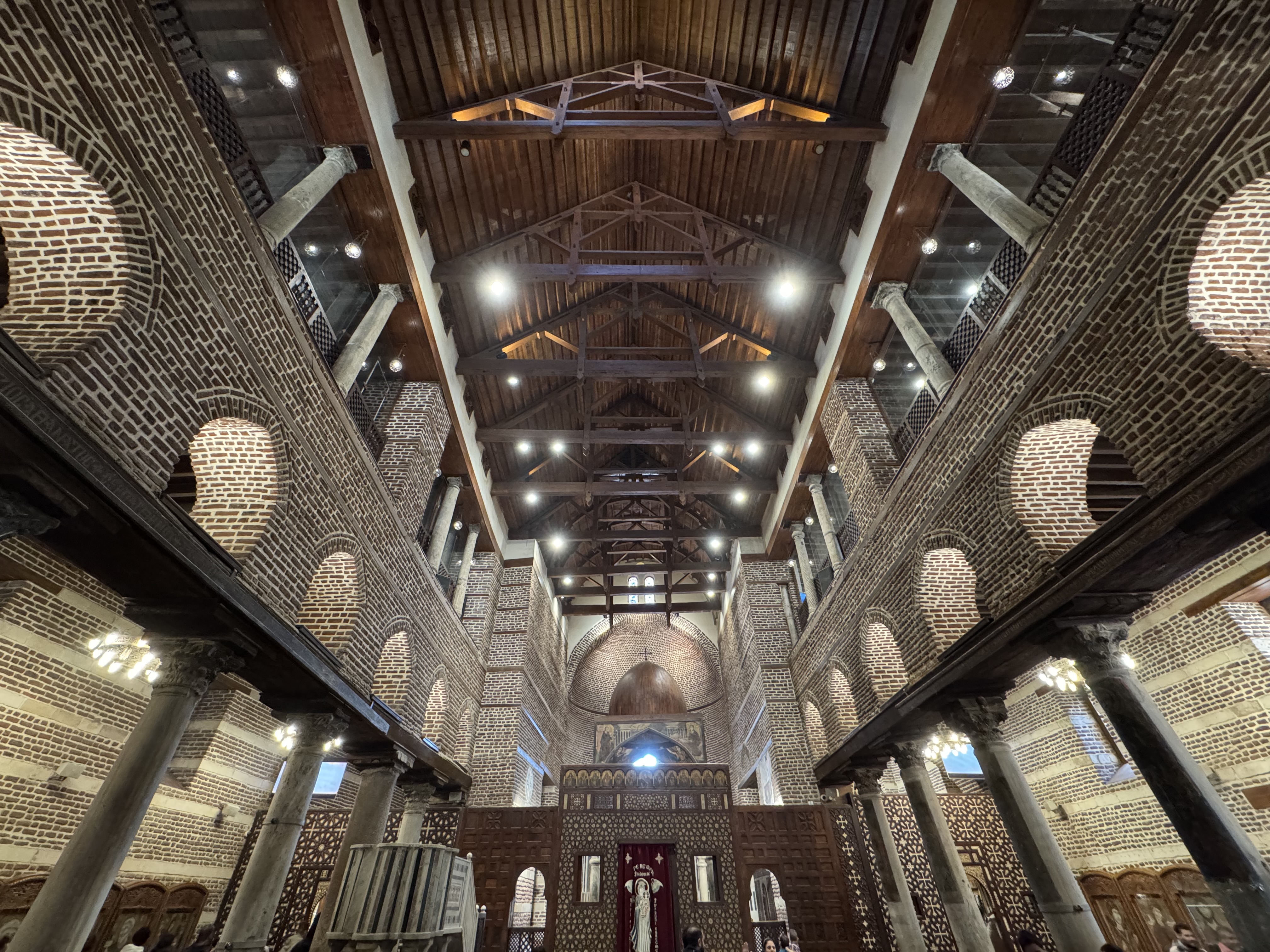
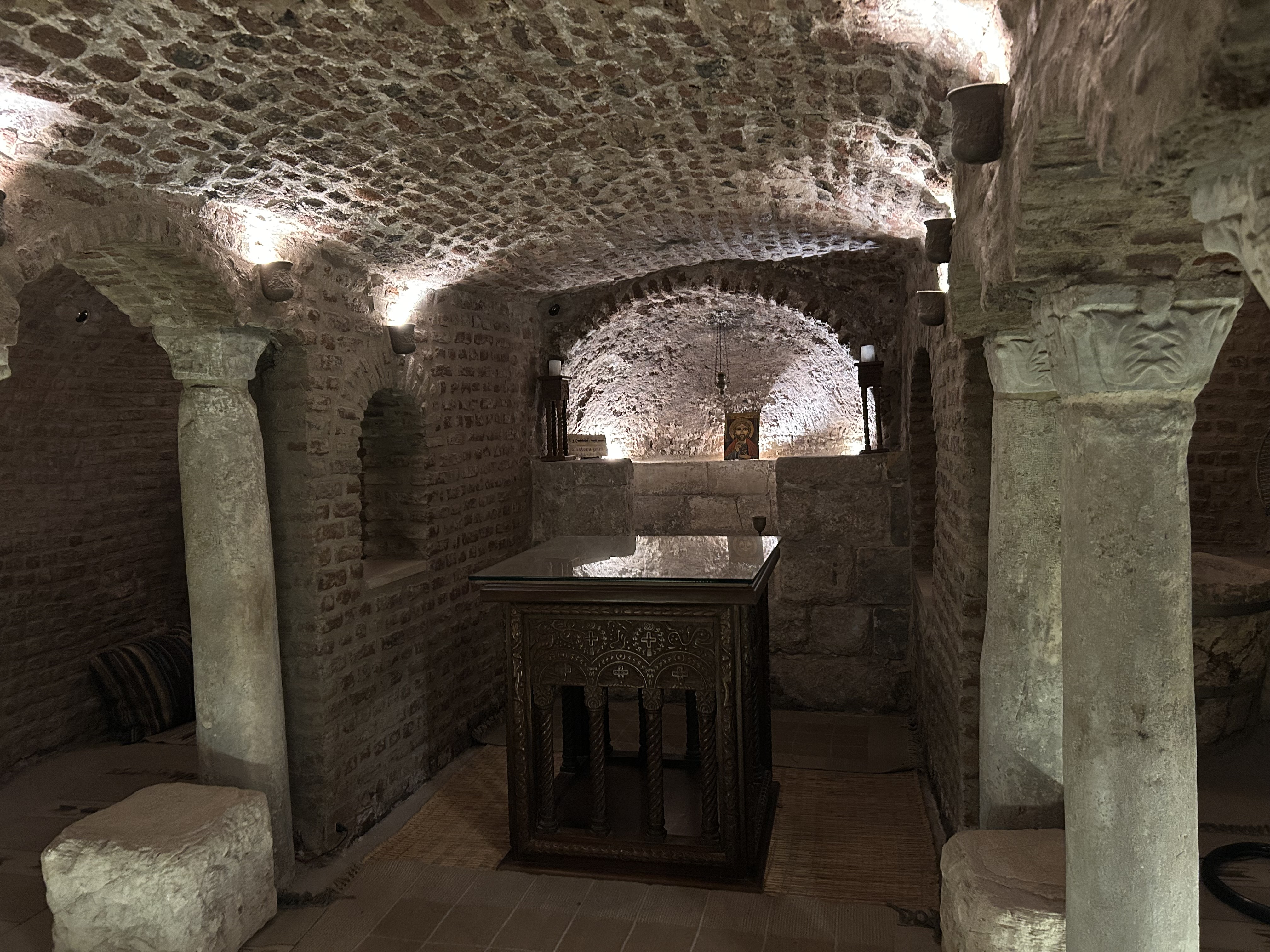
In Egypt today we visited several churches, one of which was The Church of Martyrs Sergius and Bacchus in The Cave, also known as the Abu Serga Church, and is one of the oldest Coptic Christian churches in Egypt, dating back to the 4th century.[1] Tradition holds that Saints Sergius and Bacchus Church was built on the spot where the Joseph, Mary, and the infant Jesus rested at the end of their journey into Egypt.
The flight into Egypt is a story told in Matthew 2:13–23 and in New Testament apocrypha. Soon after the visit by the Magi, an angel appeared to Joseph in a dream telling him to flee to Egypt with Mary and the infant Jesus since King Herod would seek the child to kill him.
You might remember, when the Magi came in search of Jesus, they went to Herod the Great in Jerusalem to ask where to find the newborn “King of the Jews”. Herod became afraid that the child would threaten his throne and sought to kill him (2:1–8). Herod initiated the Massacre of the Innocents in hopes of killing the child (Matthew 2:16). But an angel appeared to Joseph in a dream and warned him to take Jesus and his mother into Egypt (Matthew 2:13). Both Egypt and Judea were part of the Roman Empire, linked by a coastal road known as “the way of the sea”,[2] making travel between them easy and relatively safe.
After Herod passed, Joseph was told by an angel in a dream to return to the land of Israel. However, upon hearing that Archelaus had succeeded his father as ruler of Judaea he “was afraid to go there” (Matthew 2:22), and was again warned in a dream by God “and turned aside to the region of” Galilee. This is Matthew’s explanation of why Jesus was born in Bethlehem in Judea but grew up in Nazareth. Herod died is 4BC, which is stated by Matthew and affirmed by Josephus. Mary and Joseph return to Judah. This is the only time the Biblical Text uses the term “Judah” as a geographical place identifying Judah and Galilee. The text indicates that they first come to Judah but them quickly relocate to Galilee after learning that Archelaus had become the new king who was known to be violent and aggressive.
As an interesting rabbit hole, the beginning and conclusion of Jesus’ parable of the minas in the Gospel of Luke, chapter 19, may refer to Archelaus’ journey to Rome. Some interpreters conclude from this that Jesus’ parables and preaching made use of events familiar to the people as examples for bringing his spiritual lessons to life. Others read the allusion as arising from later adaptations of Jesus’ parables in the oral tradition, before the parables were recorded in the gospels.
Many would deduct the flight to Egypt to fulfill a prophecy by Hosea. Matthew’s use of Hosea 11:1 has been explained in several ways. A sensus plenior approach states that the text in Hosea contains a meaning intended by God and acknowledged by Matthew, but unknown to Hosea. A typological reading interprets the fulfillment as found in the national history of Israel and the antitypical fulfillment as found in the personal history of Jesus. Matthew’s use of typological interpretation may also be seen in his use of Isaiah 7:14 and 9:1, and Jeremiah 31:15. Some have pointed out that “Hosea 11.1 points back to the Exodus, where God’s ‘first-born son’ (Ex 4:22), Israel, was delivered from slavery under the oppressive Pharaoh. Matthew sees this text also pointing forward, when Jesus, the eternal first-born Son (Rom 8:29), is delivered from the tyrant Herod and later brought out of Egypt (2:21).”[3]
The Orthodox Study Bible states that the citation of Hosea 11.1 “refers first to Israel being brought out of captivity. In the Old Testament ‘son’ can refer to the whole nation of Israel. Here Jesus fulfills this calling as the true Son of God by coming out of Egypt.[4] The Anglican scholar N. T. Wright has pointed out that “The narrative exhibits several points of contact with exodus and exile traditions where Jesus’ infancy recapitulates a new exodus and the end of exile, marking him out further as the true representative of Israel.”[5]
The Masoretic Text reads my son, whereas the Septuagint reads his sons or his children;[6] I typically prefer the Septuagint but, in this case, the Masoretic seems more accurate. The Septuagint seeks to find agreement in the plurals of Hosea 11:2 they and them. I bring this up because Luke does not recount this story, relating instead that they went to the Temple in Jerusalem, and then home to Nazareth. However, both texts can be in Harmony without Luke mentioning the flight to Egypt. A theme of Matthew is likening Jesus to Moses for a Judean audience, and the Flight into Egypt illustrates just that theme.[7]
“[Joseph’s] choice of Egypt as a place of exile … was in line with the practice of other Palestinians who feared reprisals from the government; as a neighbouring country with a sizeable Jewish population it was an obvious refuge. And his subsequent avoidance of Judea under Archelaus, and expectation of safety in Galilee, accords with the political circumstances as we know them.”[8]
We also get some strange tales in the extra biblical apocropha. Jesus tames dragons, the trees bow to Him, and the story of the two thieves that later appear on the cross with Him. [9] These stories have certainly influenced Egypt and the Coptic Orthodox Church which was established by Mark, an apostle and evangelist, during the middle of the 1st century (c. AD 42).[10] There are a number of churches and shrines such as the one I visited today marking places where the family stayed.
There is another difficulty here that I should point out. Nazareth is not mentioned in the Old Testament, or by Josephus or any other rabbinical sources.[11] In other words, the quote, “he will be called a Nazarene” is that it occurs nowhere in the Old Testament, or any other extant source. In Judges 13:5 we see a similar clause of Samson but reads “nazirite.” Did Matthew suggest Jesus was intended to have been a Nazirite? Dis the text change and eventually the area became known as Nazareth? Jesus later would not match the description of a first century Nazarite so this has left scholars scratching their heads.
Much of Matthew was likely penned in Hebrew and when you translate this back to Hebrew you find a wordplay that I think answers our difficulty. Isaiah 11:1 states that there shall come forth a rod out of the stem of Jesse, and a Branch shall grow out of his roots: the Hebrew for branch is נצר (netzer). The priestly clan of the “netzerites” possibly settled in the place which became known as Netzereth/ Nazareth. This leaves us clearly seeing that the title Nazarene alludes not so much to his town of origin as to his royal descent.
At any rate, I hope you enjoyed a venture into my mind and appreciate the way that I view history, theology, and a working through a better lens of agreement within the entire text taking into account several different textures of interpretation. I pray that it deepens your enthusiasm for the Word as it has moved me.





WORKS CITED:
- Sheehan, Peter (2015). Babylon of Egypt: The Archaeology of Old Cairo and the Origins of the City. Oxford University Press. pp. 35, 40. ISBN 978-977-416-731-7.
- Von Hagen, Victor W. The Roads that Led to Rome published by Weidenfeld & Nicolson 1967. p. 106.
- Ignatius Catholic Study Bible, New Testament (2010). San Francisco: Ignatius Press. p. 9. ISBN 978-1586174842
- The Orthodox Study Bible (2008). Nashville: Thomas Nelson. p. 1268. ISBN 978-0718003593
- Wright, N. T. and Michael F. Bird (2019). The New Testament in its World. London: SPCK; Grand Rapids: Zondervan Academic. p. 590. ISBN 978-0310499305
- Brenton’s Septuagint Translation of Hosea 11, accessed 4 December 2016
- Harris, Stephen L., Understanding the Bible. Palo Alto: Mayfield. 1985. “Matthew” pp. 272–285
- France, R. T. (1981). “Scripture, Tradition and History in the Infancy Narratives of Matthew”. In France, R. T.; Wenham, David (eds.). Gospel Perspectives: Studies of History and Tradition in the Four Gospels. Vol. 2. Sheffield (UK): JSOT Press. p. 257. ISBN 0-905774-31-0.
- The Gospel of Pseudo-Matthew at The Gnostic Society Library, Christian Apocrypha and Early Christian Literature
- Meinardus, Otta Friedrich August (1999). “The Coptic Church: Its History, Traditions, Theology, and Structure.”. Two Thousand Years of Coptic Christianity. American University in Cairo Press. p. 28. ISBN 9789774247576. JSTOR j.ctt15m7f64.
- Perkins, P. (1996). Nazareth. In P. J. Achtemeier (Ed.), The HarperCollins Bible dictionary, pp. 741–742. San Francisco: HarperCollins. ISBN 0-06-060037-3.
- Galilee Archived 9 May 2006 at the Wayback Machine.





 EXPEDITION 44