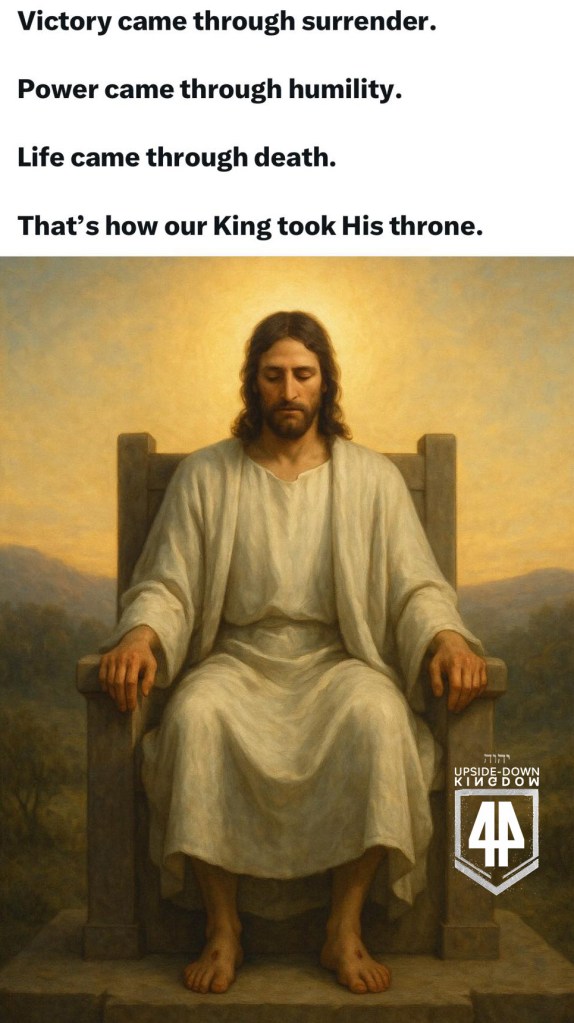
Every year at Easter I practically have an aneurism from all the poor (or I should say Calvinistic) theology from the pulpit and social media. So much of what is shared and taught from mainstream Christians is Calvinistic Reformed Theology, but usually the person sharing has no idea, and most of them don’t realize just how reformed their language is. A friend posted this image over Easter, and it got me thinking about it. I agree with him that Calvinism is based on ideas that seem opposite to the humility of Jesus to the cross. For instance, as he points out, Calvinism sees sovereignty through or by control, victory needing irresistibility, and salvation as something predetermined and unilateral.
Here are some things that show Christ’s atoning work through the death, resurrection, and ascension as being very opposite of Calvinistic rhetoric, both TULIP and PSA (or ransom theories.)
Jesus emphasized victory through turning the other cheek or extreme surrender, this is referred to theologically as displaying “power under.” Calvinism is prefaced on the idea that God’s power is best shown through assertive dominance and total “power over.” Jesus’ life shows humility revealing that God doesn’t need to coerce to reign.
The very heart of Calvinism and its so-called “glory of God” is often defined by control, while the cross redefines glory as self-emptying love.
Jesus’ life through death shows that the cross was about love, restoration, and healing through self-sacrificial grace. Calvinism displays the cross as a legal hostage exchange but somehow Jesus gets away without actually paying anything and not having to serve any penal sentence. Calvinism frames this as if Jesus gives his life but then He somehow gets it back. They say it is such a great exchange but is really? 1 life for all of humanity? Wouldn’t anyone make that exchange if it were true. I think it greatly devalues what Jesus does through the cross. That sort of sounds like what we define as the world’s sense of trickery or thievery not honest sacrificial grace. This kind of purchase sounds more like a back-alley exchange than a picture of truth and unfailing love. Calvinism robs the beauty of Jesus’ mission.
Calvinism frames God as planning from the beginning of time to sacrifice Jesus as a debt to be paid. Jesus (who I will remind you is God in the Trinity) asks his father if there is any other way. This shows God uses what the world did to Jesus for unthinkable victory, He didn’t orchestrate it. To this note, some would say that Calvinism frames God as a “cosmic child abuser.”
From the beginning pages of the Bible God’s nature is described by His own decree as “merciful and gracious, slow to anger, and abounding in steadfast love [hesed] and faithful” Yet through the cross, Calvinism defines God by pouring out His wrath on His son, turning His face on Jesus as the cross, and the need to make a deal with the Devil. These seem at odds.
Calvinism communicates that Jesus was stricken by God at the cross and that God left Jesus at the cross turning His back on Him, a better theology shows God in perfect unity with the son as 2 Cor 5:19 assures us that God was in Christ reconciling the world to himself. God was pleased to heal Him. By Healing His son, raising Him from the dead He accomplishes something great, He heals the nations.
Jesus is enthroned by humility and exhibits His power under; Calvinism is defined by coercion and control over.
Calvinism presses down to restrict, dominate, control, and subdue, while Jesus shows us how to humbly serve -even to death. Calvinism demeans, Jesus empowers; Calvinism controls, Jesus frees; Calvinism functions in superiority, Jesus functions in humility. The heart of Calvinism is rooted in pride exerting power over, but the heart of Christ exerts humility and calls for power under.
The idea or doctrine of separation from God is often misunderstood within current evangelical Christianity. Make no mistake, humanity continues to make choices to be separated from God, but I would venture to say most Christians have an inaccurate view of this separation. Adam and Eve’s sin separated them from the life that the tree gave but it didn’t necessarily separate them from God. At that moment death was passed on, but not their original sin. And to be clear fellowship with God was also not lost as you often hear! That is the continual message of God to His people. He still desires to walk with them. If you remember in the garden, He didn’t walk with them 100% of the time (Genesis 3 alludes to this.) It is true that Adam and Eve were “removed” from the garden, which was God’s domain; and then placed or led back down to lower or common earth and guards were placed at the entrance as to not allow them back into Eden.
In a basic sense humanity at that moment was separated from God. If my kids are fighting, I separate them (and often relocate them) but that doesn’t mean that my intent is to sever the relationship, I am merely changing their space. After the fall what changed is that from this point on God would have to go to people and meet the people where they were, rather than the people naturally dwelling in God’s sacred space -Eden. Metaphorically, instead of my kids playing in my room I have to go visit them in their room. In this sense there was a type of “separation” but not inability. Perhaps it would make the relationship more difficult but, but the intent certainly was not to sever, quite the opposite actually. This understanding is important when forming your “separation theology” and your basis for understanding the character of God to Humanity.
Similarly, after the fall, to Israel He was a cloud and “walked” with them similar to the way that he walked with Adam and Eve in the garden, that aspect of their relationship to God wasn’t lost, it was always offered and up to humanity to accept or reject. The intent and purpose that God started in the Garden to walk with his royal priesthood didn’t change after the fall, it just “distanced” the plan.
One thing that is very important that few have come to realize is that today, through Jesus we are actually better off or closer is distance or proximity than Adam and Eve were in this sense of walking with God, this is the heart of the new covenant -we have His Spirit residing in us continually as we are His temple. Jesus not only returned us to what we had in Eden but perfected it. Does He come and go such as described in Genesis 3? No, He is always with us, we are promised that time and time again as the core of who and what His Spirit offers to us. We may receive a fresh anointing (and that may be up to your theology here); but make no mistake, He never leaves us. I am not really even comfortable saying that we are or were temporarily separated from God as I truly see the Spirit continually meeting the most broken people in the most broken places. (I will remind you that after the fall God still sent his presence to reside with people.) Today, God and His spirit are continually available to us, but we also still have to make the cognitive choice to enter into that walk. That’s always been the choice of humanity -choose to walk with God or choose to be separated (live divided or rival) from Him. That is the core of our free will. Adam and Eve’s banishment from the garden did a lot of things theologically, but to say that it separated (severed) us from the presence of God, as a lot of doctrines would understand it -seems to be theologically inaccurate. The offer from God to continue fellowship with Him strongly continued after the garden. In fact, that may actually be the central theme of all of scripture!!! One of the main character attributes of God is the desire to continue walking with everyone that would enter into a covenant with Him. He would continue to be faithful to that relationship when others would be unfaithful.
Separation from God is theologically defined as “Hell”. One of the issues that people have a hard time understanding is that our English translations use only one word for “hell” when there are several words that described slightly different contexts of what our one word meant in both the Old Testament and the New Testament in Hebrew and Greek. The great majority of the time we see the English word Hell translated in our Bibles it is the Geek word “Gehenna” describing more of a loose “hell on earth” separation from God. Gehenna was an actual place in the ancient world. The Valley of Hinnom, Gehinnom or Gehenna is a historic valley surrounding Jerusalem from the west and southwest that has acquired various theological connotations, including as a place of divine punishment, in Jewish eschatology. The term Gehenna in the first century was regularly used as an idiom for something like “the other side of the tracks” (Matthew 5, 10, 18, 23 as well as Mark 9 and other places). in this way when the word hell was used it had a metaphorical sense similar to what we might say as “life is hell.” But I also would say we have to be careful here as the implication was that these places were thought of as being “far from God” but that isn’t necessarily accurate. Jesus actually spent a good deal of time in these darker places. In other words, the world would say that God may be separated from these places but God, especially through His son doesn’t seem to be bound by any kind of separation to them. In this sense as I express early, Jesus regularly met people in “their hell.”
There is also a parallel to this way of thinking in most of the early church creeds in the understanding that after Jesus’ crucifixion he descended into the depths to “meet people in their hell” and possibly regain the lost keys of life and offer them to those in that place that was formerly “separated from Him. I would venture to say that Jesus’ theology would be consistent having the same or very similar requirements to these “souls” that we are given in the rest of the scripture and particularly the new covenant. Interesting to think that a large part of Jesus’ mission was to again offer this kind of relational life in the afterworld to those that seemingly rejected it (or had never had the chance perhaps) to now accept that relationship.
In some cases (similar to those listed above) and in the OT, the realm of the dead is the Hebrew word sheol often translated as hell. The New Testament Greek equivalent to sheol is hades. In the New Testament, this is only found a few times such as in Matt 16 when the “gates of Hades” was used as a colloquial Jewish phrase for death and a reference of the fallen spiritual beings in a Deuteronomy 32 worldview sense. Surprisingly, the least used term for Hell in the Bible is the one most people think of the most “as hell”, and is translated as the lake of fire, mentioned only in Revelation 19:20 and 20:10, 14-15, and takes on the traditional view of the “final hell”, for what seems to be the destiny of both fallen spiritual beings (to which it was created by original intent) and human beings that have not chosen to accept and live for God – this is an eschatological state of judgement.
However, in some way, all the translated types of hell seem to describe a condition of being separated from God.
In conclusion, traditionally we have misinterpreted separation to be something that was put between us and our relationship with God in Eden, yet the Bible doesn’t say that. God’s intimate and vivacious pursuit to walk or have intimate relationship with us is tied closely to His character and thus never changes. Through Jesus we are actually closer in proximity to Have His spirit in our Hearts than what was first given at Eden. God’s pursuit to have intimate communion with us is stronger and closer than ever before.



 EXPEDITION 44