
Expedition 44 founders, Dr. Matt and Dr. Ryan have a book coming out in 2025 entitled Principalities, Powers, and Allegiances which deals in large part with the interpretation of Romans 13. Its rather scholarly so let me give an overview in fairly plain words. If you want to work through 1300 references and do your due diligence on the subject, well then, you will need to wait for the 300-page book!
As we approach texts such as Romans 13, theologians categorize them in two ways- submission and conflict. The submission texts of Romans 13:1-7 and 1 Peter 2:13-17 use the language of submission or subjection to authorities and have been used to frame a potentially positive view of the government and kingdom structures in the world. Though we show in our book that not all interpret these texts in that manner. Runge summarizes this submission approach to these texts saying,
Paul’s rationale for obedience has nothing to do with the rulers’ godliness, competence, or any other qualification. Instead, his call for submission to their authority is grounded in God’s authority. The only authorities that exist are the ones whom God has placed there, according to His sovereign plan… Although Paul is silent regarding unjust rulers, Peter is not. Peter describes an example of subjecting oneself to a master even if he is unjust (1 Pet 2:18–19). He takes the position that even in the face of unjust authority, it is still better to submit.[1]
The conflict text we examine in our forthcoming book is Revelation 13 and is often based on anti-imperial sentiments. The thrust to the interpretation of this text is based on which theological school one lands in when approaching the letter of Revelation. If one places this as purely future events then it has little bearing on how one views government in the present, especially if the church will be “raptured” at the time of the “Beast’s Government”: a “revived Roman empire,” according to some futurist interpretations.[2] (Namely dispensationalism views such as the popular pre-tribulation view.) Other approaches to this passage see this as something from the past yet can be applied to all believers of all times within the view that the Bible was written for us but not to us. In that perspective, it was written to seven churches in Asia Minor in the first century as the primary audience and it must have meant something for them in the first century context of the Roman empire and the emperor cult. Putting it purely in the future removes those churches from the context because they are purely an allegory of church history eras.[3]
For this article, we will only be looking at Romans 13, but I would be remise if I didn’t point out it’s context and relationship to other similar texts within the lens of scripture.
CONTEXT OF ROMANS 13
Whenever you dive into exegesis context is king (well actually Jesus is king, but you know what I mean!) As I indicate above, we need to first determine who was the intended audience and how would they have taken the text, epistle, message, or letter. Once you figure that out than “maybe” you can apply it to your own situation. (This hermeneutic is often referred to as textures of interpretation.) Romans was likely written while Paul was staying in the house of Gaius in Corinth. The epistle was probably transcribed by Paul’s amanuensis Tertius and is dated AD late 55 to early 57. We are told in certain textual variants including subscripts explicitly mentioning Romans 16 that it was delivered by Phoebe who was a Deacon. This letter likely would have been distributed in a similar fashion to the rest of the NT letters in a teaching / preaching style by the one making the delivery to a circuit of communities. Phoebe lived in Cenchreae, a port town near the city of Corinth. Corinth was where Paul was staying when he wrote the letter to the Romans.
It is important to remember that Romans was written before Paul went to prison and many scholars believe it to have been that catalyst that sent him that way with language very much asserting authority to King Jesus which was deemed as rival to the emperor of Rome. Romans is written at the End of Claudius’ edict after he evicted Jews or Jewish leaders in 49 AD. In 54 AD Claudius dies and Nero takes the throne asserting his uncle Claudius to be an “idiotes” and welcomed back everyone to Rome. This would seem to be a very political move to boost popularity towards his goal of building the empire, rather than a direct support towards Christians. We would assert this by seeing that within a few short years he begins to persecute Christians throwing lavish garden parties that are lit by the ambience of Christians dipped in tar and set on fire. Josephus would go on to note “in the name of Christus” as coding that led to disturbances between Nero and Christianity. Although some of the Epistle of Romans seems to almost carry a secret code as to not bring imminent wrath from Nero, it still clearly states that Jesus is king (and not Nero) flying directly in the face of the empire. I don’t think anyone would argue that it was enough to have gotten Paul on the Roman radar to be in trouble as he had been sent to prison because he was accused by the governor of Syria of acts of violence in 52 AD. We get no record of Paul doing anything violent, but opposing Rome by your speech was often treated as treason and dealt with in the same sense as violent rebellions. Make no mistake, he was viewed as an insurgent by Roman authorities on multiple occasions.
There is also a power shift in the church transitioning from Jew and Gentile creating the context of the struggle of the book of Romans. The theme of the strong and weak is perhaps viewed as Paul’s main mission in Rome to live out the gospel of unity. Paul has a greater vision and is preparing for His mission to Spain asking them to live in unity as he starts to take the gospel to the end of the earths. His message takes on the persona of, “If we can’t get it right here how are we going to go to reach the people at the ends of the earth?“
ROMANS 1:1-4 starts right out by saying JESUS IS KING (JESUS IS LORD CAESAR IS NOT) stating that Paul is a Bondservant of Christ (the king, the anointed one). This is first century “doulos” language setting apart Paul as a willing “slave” for the gospel. It is important to note that these would certainly have been interpreted as “anti” words in regard to a Roman national political kingdom. The text uses the term “son of God” which is a title for caesar as well as “curios” as the title for Lord demanded as a “self-title” by the emperor.
When you approach this book from a Deuteronomy 32 worldview, Romans 1:21-23 frames humans as image bearers that rejected God and results in God handing them over to their own desires or consequences (which is the biblical definition of God’s wrath.) In a similar understanding, Yahweh appoints Elohim over each nation to be cultivated by a spiritual being and that spiritual being essentially “falls” as they allow themselves to be worshipped in the place of Yahweh. They “take the praise” and become another god before Yahweh and become the “household” image if idolatry. Humanity rejects God and God hands the people and the fallen spiritual being over to the “world” and those principalities. The Romans text uses the Greek word paradidomi which specifically draws on the fact that they were handed over to “sin and death” which are seen as demonic “powers” that the world serves. Romans then makes the assertion that because we serve KING JESUS, we are no longer to be slaves to these demonic forces. The author of Romans then projects Nero as aligned with the demonic forces and those that stand with Jesus as RIVAL to those powers in their own kingdom of Jesus. This is partly where we get the idea of re-vival – we are working against the “rival” world (those not in allegiant faith to Jesus) to take back what was lost and reclaim them solely for JESUS and His kingdom.
It is also important to understand the basic outline of Romans:
- ROMANS 1-4 is one literary unit – Christ is King, and Jesus makes a way for everyone to Him
- ROMANS 5-8 We are slaves to sin and can be set free and delivered into becoming part of Christ’s kingdom (EXODUS MOTIF)
- Romans 6 Baptism – the RED SEA is seen as a victory over the spiritual beings that seek to enslave us to the powers, principalities, and kingdoms of this earth
- Romans 7 is the Law (Jew / Gentiles see differently but need unity, they are part of the same Jesus kingdom and need to be in spiritual alignment)
- Romans 8 Restoring the promise land and framing a return to Edenic thinking
- Romans 9-11 goes into Jewish ancestry matters which may not mean much to us today, but was crucial to the grafting of the new covenant kingdom church (ALL ISRAEL)
- Romans 12-16 one literary unity tied into together. As basic as it sounds, hermeneutically we shouldn’t read Romans 13 without 12 first; and certainly, shouldn’t be forming doctrines based on one line pull phrases. According to Hermeneutic laws, we need to read Romans 12 with 13. Romans 12 serves as a pre-context to everything established in chapter 13.
The basis of ROMANS 12 is to be a Living sacrifice; don’t be conformed to the world but be transformed to the way of Christ and unified in His kingdom. At the end of the chapter Paul basically summarizes the sermon on the mount. This is the Jesus Manifesto and charge to live for CHRIST ALONE. This is “love in action” verbiage aimed straight at the church. It answers the question of “How does the church deal with those outsides of the church or in the rival empire?” It is exilic language reminiscent of Jeremiah 29.
THERE IS A LEGITIMATE QUESTION AS TO THE PRIMARY TARGET OF ROM 12-13
There is obviously some empirical language as I described with the opening words of Romans directly and emphatically targeting CAESAR himself, but much of this is also likely aimed at local government. The target doesn’t really matter much IMO, other than the impact of those desiring theologically to apply the text to local and/or national government. There is an argument for 2 voices, but I lean towards local authority. I might even say that in the end where I land is that the text is a call for discipleship under the way of Jesus. There may or may not be two voices but if you arrive where I have, it doesn’t really matter. Romans isn’t seeking to give us a full theology of the state or federal government. Some want to revolt, and others are deciding if they should pay the local dues or not, Paul is more concerned about the overall picture or the way of Jesus.
Rome had smaller government entities entrusted to local magistrates and each city would try to “outdo” the next in their adulterated loyalty displays to the emperor. As we read between the lines, (which again was likely necessary in the dispersing of this letter), we get the idea that Christians weren’t to participate in these sorts of things. They likely were encouraged by those in the church (right or wrong) to stop paying “taxes” or “dues” that supported the local corrupt tax collectors and the near worship of the emperor. This was largely because these dues for civic upkeep often went directly to the neighborhood shrine that honored (worshipped) the emperor and/or local gods. When Christians refused to participate it was seen as unpatriotic to ROME and the emperor. However, it was clear that most Christians weren’t “not paying dues” as a direct act of anarchy or rebellion, but rather the simple fact that their allegiance was simply to a different King. Christians often believed they were called to live in the shadow of the empire but not by the ways of the empire.
N. T. Wright [4] notes that Romans is:
…neither a systematic theology nor a summary of Paul’s lifework, but it is by common consent his masterpiece. It dwarfs most of his other writings, an Alpine peak towering over hills and villages. Not all onlookers have viewed it in the same light or from the same angle, and their snapshots and paintings of it are sometimes remarkably unalike. Not all climbers have taken the same route up its sheer sides, and there is frequent disagreement on the best approach. What nobody doubts is that we are here dealing with a work of massive substance, presenting a formidable intellectual challenge while offering a breathtaking theological and spiritual vision.
Textually, Romans 13:1–7 is a fragment dealing with obedience to earthly powers is considered by some, for example James Kallas,[5] to be an interpolation.[6] Even Paul Tillich (who is known for His excellent book on systematic theology that I don’t agree with), along with the great majority of evangelical scholars, accepts the historical authenticity of Romans 13:1–7, but claims it has been misinterpreted by churches with an anti-revolutionary bias:
One of the many politico-theological abuses of biblical statements is the understanding of Paul’s words [Romans 13:1–7] as justifying the anti-revolutionary bias of some churches, particularly the Lutheran. But neither these words nor any other New Testament statement deals with the methods of gaining political power. In Romans, Paul is addressing eschatological enthusiasts, not a revolutionary political movement.[7]
CHIASTIC PATTERN
It may not come as a surprise to most, but the book of Romans contains several chiastic patterns in order to aid its readers in the learning of the most important message of all time: The good news of Jesus Christ. Chiasmus is an inverted parallelism; it presents a series of words or ideas followed by a second presentation of similar words or ideas, but in reverse order. The Old Testament has hundreds of chiasms (the book of Isaiah alone has more than one hundred), varying in length from four lines to entire chapters. The most obvious sense of this might simply be referring to the outline above to which the beginning chapters and end chapters are both to be seen as bookends of the literary unit. On the surface this chiasm may not seem very profound, but it actually teaches an important truth about family togetherness—and about families centering themselves in the temple. However, it isn’t always clear why the author wrote in chiasmus and how our interpretation should or might be influenced by the literary device. Perhaps the repetition of words in balanced, symmetrical structures encourages and enhances learning and memorization. Also, repetition of key points or themes emphasizes the crux of a prophetic message. Finally, chiasmus encourages reading of important texts by making them aesthetically pleasing to the reader. Could a word have been chosen over another because of rhythmic value? Perhaps. Could an emphasis be understood as a contranym or need for repetition? Perhaps. All of these things should go into your textual criticism as a texture of interpretation for faithful understanding and application. Here is the chiastic structure of our text as the larger sections and smaller sections follow this style. I will leave interpretive deductions to you. It would certainly help to read this in Greek if you are able.
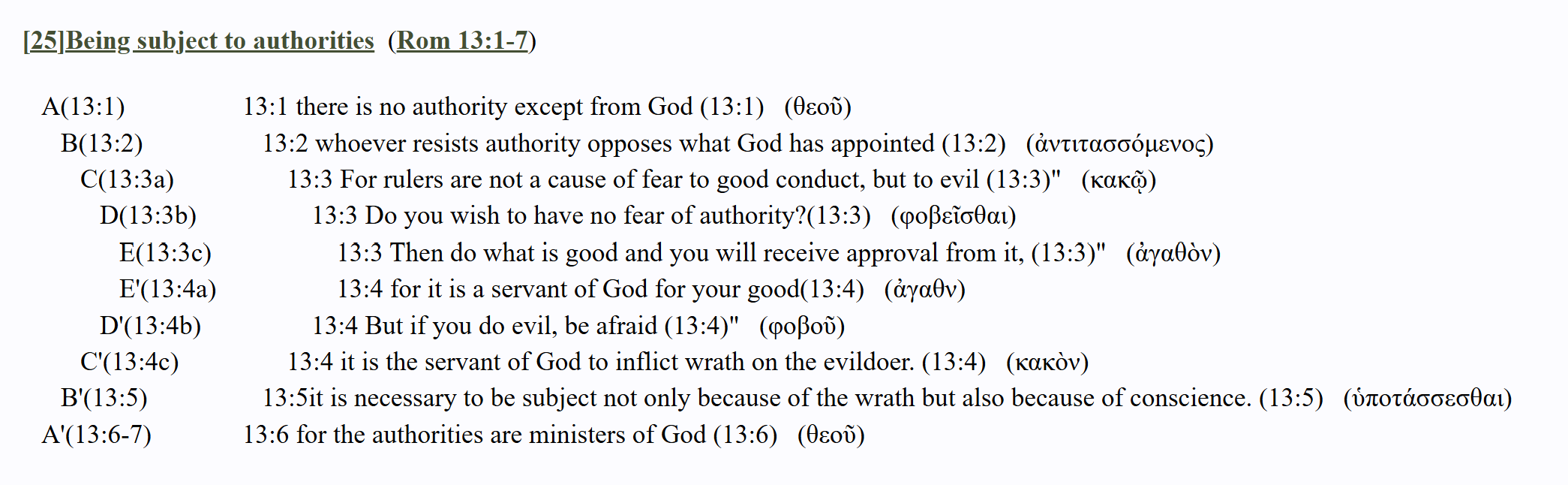
ROMANS 13:1-2
It is interesting that Romans 13 comes right out referring to governing authorities as those who have power over you. The transliteration gloss of our English word “authority” is the Greek “exousia” which I want to point out is Paul’s word for the fallen spiritual beings, the principalities and powers, or what we more modernly refer to as demons. Of course, the phrase takes on other dimensions in other parts of scripture, but here I would argue for a Hebraic use of the terminology. Essentially, he is calling the kingdoms of the world, their governments and magistrates that rule over everyone demonic. (Dionysius Halicarnassus 8, 44; 11, 32 also suggests this). I Corinthians 2 uses this same language under the same pretenses. The Authority is God’s. “let us be subject” is the Greek hupotassó from which tasso takes on a passive tense and comes from a military “filing” or order. In other words, our God is in order over the rulers but isn’t putting a stamp of approval on their actions. It is similar to a librarian ordering books (you might even say having power over their ability to influence) but not by being the author of all of them. In the same way, God hands over nations to be managed by the spiritual beings or sons of God which eventually continues through their falling away but God isn’t morally approving anything that they have done, God lines them up or simply uses them by divine purpose in many ways regardless of their proclivity towards Him. Perhaps we need to identify this as a tool that God allows and possibly uses but not “ordains”; or perhaps we just need to “leave it alone” with the understanding that His ways are higher than ours and are quite dynamic. God used Babylon to punish pagan nations, but obviously the way that Babylon does this isn’t natively of GOD. God isn’t aligned in it (and we shouldn’t be either.) God allows them, but doesn’t set them into place. That isn’t his character. We are reminded of this by Hosea 8:4 -“They [Israel] have set up kings but not by me.” What Romans is asserting is that all authority is from God and this bold statement was certainly viewed as undermining Caesar’s power. Paul was boldly proclaiming that Caesar HAS NO REAL AUTHORITY. God is the one with power not Caesar. We are reminded of this order as it very much takes on Genesis 1:1 language and therefore suggest a theological consistent view over the lens of scripture.
BE SUBJECT AND RESIST is a word play in Greek. Both words, hypotassesthō and antitassomenos are Hapax legomenon’s (which I state for your consideration). They are in the perfect active participle which means they are past and coming into future. We are certainly charged with an overtone to not be a poor witness or ambassadors of Jesus (and to protect the witness of the kingdom community).
Submit here is again hupotasso. To be clear it doesn’t mean to “obey.” It means to voluntarily yield or put in a line (words of order). Ephesians 5 says submit to one another out of reverence to Christ. 1 Peter suggests that submission was for GOD’s sake. Paul could have used the Greek work hupakouó which was the more common word to “OBEY”, but he doesn’t, instead he uses a word for submit. Paul reserves the word “OBEY” for GOD ALONE.
We may need to take into consideration the context of Romans 12 from the beginning. There are Christians mixed with Jews and Zealots trying to fight to take back Jerusalem by robbing temples and all kinds of crazy stuff. Paul in Romans 2 seems to be speaking against this. Don’t cause trouble, be self-sacrificial as Jesus was on the cross. You overcome by winning them over through LOVE. Perhaps the Christians (Jews and gentiles) in Rome were looking back on their brethren starting to get a bit “crazy” or “un-Ruly” in Jerusalem wondering if they should follow suit and Paul seems to starkly say “no.”
I need to also point out the contranym language that could be influenced by the chiastic structure but maybe not. Lots of people in the Bible are disobeying the government in the name of God. Mary and Joseph flee disobeying Herod, in Acts 9 and in II Corinthians 11 Paul seems to be boasting about disobeying the government on multiple occasions (although this can be argued.) But to be clear, we don’t get the fight back language from Paul. If you think scripture suggests or is telling you to fight back or take a stand politically elsewhere in the Bible you are welcome to try to deduct that, but hermeneutically this passage (and all of Romans) textually doesn’t give you that. That wasn’t Paul’s view, even in the midst of revolt and anarchy at the time this was written. It would have been very easy for him to suggest such a thing or action of that nature if that was his intention, but it simply isn’t there. Not many years later, the Christian zealots go to war against Rome which even included the ESSENES, some of whom seemed to be very pacifistic (and likely listened to Paul’s words here) while others were literally preparing for war wanting God to send down hellfire and brimstone and legions of angels against the Romans which obviously God didn’t do. He didn’t do it at the cross, why would people think he would do it now? Seems like 2000 years later people are still thinking that way despite the words of both Jesus and Paul. (And I own a gun range, so I sort of wish that’s the way Jesus operated, but He doesn’t. That sword in the book of Revelation isn’t what you want it to be!)
In Peter, (which our book really gets into) he says they’re appointed to praise good deeds and punish evil deeds. In other words, political rulers might or might not uphold righteousness or justice, but it isn’t within God’s direct hand. When people wrong other people, the government should punish them, but God’s retributive justice isn’t on the line.
ROMANS 13:3-5
Allegiance to Christ might look like opposition to the world. Acts 5 says we must obey Christ; in other words, we are living this denial of the world out because of our submission to Christ, not simply because we want to be rebellious towards the world. This looks like a community next to or within Babylon but as a light showing a better more beautiful way. We are active in our love for our enemies and praising those who persecute them, this is the main thrust of what it means to be a prophetic witness.
Perhaps the term “BEARING THE SWORD” in our age derails people. For instance, Wayne Grudem who is a statist says, “sword in the hands of a good government is God’s designated weapon to defeat evil doers.” On the other hand, Preston Sprinkle says, “Using Romans 13:3 isn’t to be used as God’s way of ruling the world is out of context for a warfare policy or policing nations of the world. This isn’t a chapter on How God rules the world.” I would tend to personally to say that exegetically Sprinkle is significantly more faithful to the text here. I see God allowing the sword to be used by a government but not charging or designating it.
The sword was not about capital punishment in Romans or Revelation and to make such conclusions would be require a good amount of theological gymnastics. We simply don’t have grounds to go that way within the text. I am aware that some have tried to make this point by saying things such as pointing out that criminals were typically executed by beheading with a sword (crucifixion was reserved for the worst criminals of the lowest classes); but it is a stretch to things that the exegesis of the text suggests this (whether you think the Bible suggests this theology in other places or not.) Brian Zahnd has an excellent POST on this and is a quick read.
There is also a consideration that the sword (Greek machaira) could be coded for first century language referring to the local magistrate or tax police. The Greek word means judicial authority. We have to remember this is an HONOR/SHAME society (not guilty innocent society as we are in the West). It is also worth exploring the term used for governing authorities sometimes translated as “minister of God for your good.” The Greek is diakonos and is used by Paul referring to those using their gifts in the church. But the word itself doesn’t seem to take on good or evil, consider more like a chaos monster. It is a device that can go either way. (It isn’t the fork that makes people fat.) If we parse the word into the Hebrew equivalent, we find that OT pagan nations are referred to by the same Hebrew word. In Isaiah 44 it is used to describe the king of Persia. In Jeremiah 27 and 43 it is said of Nebuchadnezzar and in Isaiah 10 it describes the nation of Assyria. These are PAGAN DICTATORS. God uses them as instruments of his hand, but God doesn’t approve of their measures and certainly hasn’t “commissioned,” “anointed,” or “ordained” them. I will also remind you that ministers aren’t always good guys. Sometimes they are evil. So, at the very least we have no grounds to use this verse to defend entanglement of the state. God’s way was theocracy which resulted in a KING JESUS covenant and kingdom. Man’s ways were to establish kings and rulers in the place of what God says is His.
“When Paul adds the thought that these people are appointed by God to their position of authority, he simply cannot have in mind the empire or the hierarchy of government. Interpreting his words in that way would require us to set aside everything we know about the Tanakh’s treatment of evil or idolatrous rulers. How can we imagine that Paul ignores the stories of Daniel and the Israelites in captivity, or the verdicts God ascribes to many of the kings of Israel? Is Paul asserting that God’s judgment on these men in power is misplaced? Are we ready to endorse them as God’s choices for leadership when God Himself describes them as wicked?” – Mark Nanos, The Mystery of Romans (Fortress Press, 1996).
The Greek word used for sword is machairan and is the equivalent of the Hebrew word used to describe the knife used in circumcision (Joshua 5:2), the sacrificial knife used in the offering of Isaac (Genesis 22:6) and a small dagger (Judges 3:16). It is not the Greek word used to describe the typical military sword of the Roman soldiers. Furthermore, this term is used symbolically for a sign of judicial authority in Roman law which would make the understanding of local authorities or magistrates more fitting. As I suggested earlier, Paul may be using the word as a metaphor for disciplinary action of the synagogue authorities.
ROMANS 13:5
Subjection is usually glossed as yielding or submitting because of conscious sake. Peter uses this as a synonym of allegiance to God’s kingdoms as loyalty language, it is a life aligned towards God. Peter says we are allegiant to a different king so live at peace! The word conscience in 13:5 is the same word used for allegiance in 1 Peter 3.
ROMANS 13:6-7
We see the word for servants/ministers again and I will remind you to interpret as tools of God, not positive or negative. Taxes here seems to be a general toll tax for goods. It is likely linked to the local magistrate or community and perhaps in alignment with the enshrined idolatry towards the gods or emperor. Give unto Caesar what is Caesar’s and to God what is God. There is an argument that all of money is the world’s here, but that’s a different article. Sticking to the immediate text we can deduct that we are to give yourself wholly to God, this is a hyper link (remez) to what Jesus said regularly. We fear God alone. Honor all people in the image of God.
The government is simply a tool that God may use; as in the OT when He used pagan nations as a tool. (Think of it as a stop gap until we are completely reconciled to new life in Him.) Furthermore, God does not set up or pick leaders of the world. Hosea and 1 Samuel 8 explicitly say this. He actually sees it as a rejection of Himself. “Render” is a hyperlink to render unto Caesar which is about giving Cesar his stupid coin, but you belong to God. His image is on you. Romans13:8 pretty much defeats a nationalist reading of Rom 13. If a Christian wants to do and enforce most of the things in those seven verses.
Christians subvert in love not rebellion.
Theologian Greg Boyd notes:
It was never God’s goal to have humans rule other people. Governments are God’s concession to human sin. They are now a practical necessity in the world, and God uses them to further his purposes (Rom. 13:1-6). But this doesn’t mean that God approves of them … The Kingdom of God, on the other hand, is based on people trusting God as their sole ruler. Kingdom people are therefore to place no more trust or confidence in governments than Jesus did – which is none. If a government’s laws happen to be consistent with the rule of God, we obey them. If they’re not, we follow the example of Jesus and disobey them (cf. Ac. 5:39). But either way, it’s clear that our behavior isn’t dictated by what government says, but by what God says.
DISCIPLESHIP & SHEPHERDING
The application of this project and or any other endeavor for the church should be seen primarily in the distinctness of the kingdom of God. This is a foundational aspect of discipleship. What should be gleaned from our exploration of the biblical narrative is that God’s people are to be disentangled from the world and live in the way of Jesus- as a prophetic witness to the world in the way of the faithful witness.
When the Deuteronomy 32 Worldview is applied to political discipleship and allegiances it should deemphasize political involvement and national allegiances with the world and promote deeper wholehearted devotion to the true king- Jesus. This does not deter from our commitment to love our neighbors outside the church. The kingdom is seen as a light to the nations, living in the way of the king and by the law of the king. It is called to be distinct but not removed – being “Exiles in Babylon” working by the Spirit to re inherit the disinherited people of the nations. This narrative approach sees the Edenic bookends of the Bible as the ideal. In the beginning we saw humanity as kings and priests in Eden and we see the same picture at the end of the Bible when heaven comes to earth after Babylon and the Powers are destroyed.
Although there are numerous passages on discipleship and shepherding, Matthew 28 and the great commission seems to always be the one used to promote such a thing, and rightly so. Perhaps one of my pet peeves is when people misquote the text to say that we are called to “disciple the nations.” Perhaps it is a matter of mincing words, but the text of the great commission is about discipling people not kingdoms (ethnos not bassilas.) People of all tongues and tribes specifically. This isn’t talking about their systems, empires, or borders; it means people. To interpret ethnos as nation states is a hermeneutical gross misinterpretation and unfaithful to the text.
CONCLUSION
Since the beginning of time the Bible tells us we are caught in a spiritual war within the cosmos and we are the central figures of the battle, the segullah (God’s set apart). Perhaps spiritual warfare looks different today than during the freeing of the Israelites in Egypt, but perhaps not.
God’s intimate and vivacious pursuit to walk or have intimate relationship with us is tied closely to His character and thus never changes. God’s pursuit to have intimate communion with us is stronger and closer than ever before.
We are designed in the image of God and thus we are designed to bring forth life in everything that we do, yet if we are not allowing God to do the work beginning on the inside of our minds and hearts, lasting fruit cannot be produced.
The sin of Adam and Eve separated humanity from the tree of life but God is still offering the relationship that He had with them in Eden and actually desires a better way, not to just occasionally walk with you as He did with Adam and Eve in Eden, but through Jesus now offers even more, He wants to never leave you, to continually reside in your heart as you become His temple being the very physical manifestation of the presence of God to those you interact with. Yes, the world has been taken over by evil, but you represent light and have the power to make the presence that you fill sacred to make what is broken healed. You are the source of God to renew the Earth. You no longer live under a curse, but the power of the LORD is in you. Choose this day to no longer live in sin and dwell richly in the presence of the LORD. (1 Jn 3:6-9, 1 Jn 5:18, Rom 8:11, Gal 2:20, Col 1:27, I Peter 2:8-9, Eph 3:17, 2 Thess 1:10, 2 Cor 5:17.)
_________________________________________

Written in first person by Dr. Will Ryan with the research and auspice of Dr. Matt Mouzakis
1. Steven E. Runge, High Definition Commentary: Romans (Bellingham, WA: Lexham Press, 2014), 227; 230
2. Gregg, Steve, Revelation: Four Views Commentary, (Nashville, Thomas Nelson, 2013), 335
3. See Harold Hunter, Revelation, (Evansville, IN, Trinity Press, 2002), 13 as an example.
4. Leander E. Keck and others, eds., The New Interpreter’s Bible: A Commentary in Twelve Volumes (Nashville: Abingdon Press, 2002) 395
5. Romans 13:1–7 an Interpolation? — The Sword and the Ploughshare”. April 24, 2014. Archived from the original on April 24, 2014.
6. “Review of the book Paul and Empire – Religion and Power in Roman Imperial Society (Edited by Richard A. Horsley)”. Archived from the original on April 20, 2013. Retrieved November 1, 2012.
7. Paul Tillich, Systematic Theology, volume 3 (University of Chicago Press: 1963), p. 389.



 EXPEDITION 44