Education was a big deal the first century. The command to “teach your children” first appeared in Deuteronomy as part of what later became the Shema – the most central of Jewish prayers (prayed 3x daily). Rabbinic literature is filled with references to schools and schooling and to teaching and learning taking place at all levels, and for all ages from the youngest children through adulthood. Jews are often known as “The People of the Book.” Jewish life is lived according to texts, commentary, and interpretation of those texts. The varied methods of teaching them include instructive, experiential, argument, and discussion. [1]
Bet Sefer – “House of the Book” (Ages 6-10yrs) [2]
In the Jewish culture of Jesus’ day kids were taught the Torah (first 5 books of the Bible) in the local Synagogue (church) beginning at the age of 6. They had classes 5 days a week just like we do today. By the time they were about 10 years old, they had memorized all of the Torah – the first five books of the Bible. These classes were called “Bet Sefer.” Anyway, most Jewish kids were pretty well finished with school after this and went home to learn the family trade – like fishing or carpentry or something like that.
Bet Talmud – “House of Learning” (Ages 10-14yrs) [2]
The best of the best among them were allowed to continue in school in something called “Bet Talmud.” Here, they studied all of the Hebrew Scriptures (Our Old Testament) and memorized all of them between the ages of 10-14. During this time, students also learned the Jewish art of questions and answers. Instead of answering with an answer, they were taught to answer with another question. In this way, students could demonstrate both their knowledge and their great regard for the Scriptures. They were taught to always be curious about the Scriptures.
Look at how Jesus was described as a young boy in Luke 2:46-47 – “After three days they found him in the temple courts, sitting among the teachers, listening to them and asking them questions. Everyone who heard him was amazed at his understanding and his answers.”
Bet Midrash – “House of Study” [2]
Very few of these students ever made it this far. For the few who did there was still another set of classes called “Bet Midrash.” This meant you were on track to become a Rabbi. To become a Rabbi you had to first train under a Rabbi, to walk their every step. The rabbi would grill you and ask you all kinds of questions, because he was trying to find out if you were good enough to be his student. He wanted to know if you knew enough, but even more importantly, if you could be like him in all areas of your life. If he decided that he didn’t think you could do it, then he would tell you to go back to the family business. It was very rare, but if he thought highly enough of you, he would become your teacher, and it would be your goal to become like him in every way. You would agree to take on his “beliefs” and his interpretations of the scriptures. This was called his “yoke” and he would say to you, “come follow me.” The disciple’s (also called “talmudim”) job was to become like the rabbi in every way. If the rabbi was hurt and had a limp, you might see his healthy disciples walking behind him (in his footsteps or “in the dust” of the rabbi) with a limp.
To this description their arose a Hebrew Idiom, “May you be covered in the dust of the Rabbi” and the source of this saying is the Mishnah, Avot 1:4. (The Mishnah is a collection of rabbinic thought from 200 BC to 200 AD that still forms the core of Jewish belief today.) The quotation is from Yose ben Yoezer (yo-EHZ-er). He was one of the earliest members of the rabbinic movement, who lived about two centuries before Jesus:
Let thy house be a meeting-house for the wise; and powder thyself in the dust of their feet; and drink their words with thirstiness. [3]
These teachers were called “sages” before 70 AD (hakamim, or “the wise”). After that the title “rabbi” began to be used. [4] The middle line is sometimes translated as “sit amid the dust of their feet,” and understood as being about humbly sitting at the feet of one’s teacher to learn from him.
When we catch up with Jesus in Matthew 4:18-22 and 16:13-20 He is walking beside the Sea of Galilee, and sees two brothers; Simon called Peter and his brother Andrew. They were fishing.
As Jesus was walking beside the Sea of Galilee, he saw two brothers, Simon called Peter and his brother Andrew. They were casting a net into the lake, for they were fisherman. “Come, follow me, ” Jesus said, “and I will make you fishers of men.” At once they left their nets and followed him. Matthew 4:18-20
What has always struck me as interesting in regard to this text is that they left what they were doing at once. No delay, they just dropped everything and followed.
Going on from there, he saw two other brothers, James son of Zebedee and his brother John. They were in a boat with their father Zebedee, preparing their nets. Jesus called them, and immediately they left the boat and their father and followed him. Matthew 4:21-22
No questions asked, they just left. They didn’t help their father bring in the boat or finish the day of work or anything…they left immediately.
Why? In hindsight we can say, “well it was Jesus, of course they would follow him.” But while Jesus was well known at this point, He may have been considered just another rabbi and I’m sure he wasn’t considered the son of God at this point by these people. So, what caused them to drop everything and leave?
Well, the answer is that every kid in the first century dreamed of being great. And great in Judeo Rome meant either a roman Centurian or a Rabbi.
When my oldest son Ty was about 4, we would ask him what he wanted to be when he grew up. He would say a “garbage man photographer.” We would laugh and joke saying things like, “wow this kid is really aiming for the stars!” Not a garbage man, not just any kind of photographer, a very specific one, a garbage man photographer! Ok so not every kid may have wanted to be a Rabbi or a Centurian, but the great majority of them dreamed that one day that is what they would become! They dreamed of this day.
No you have also probably read my book or heard me teach that when you harmonize the gospels you find out that Jesus actually called the disciples three different times. The first two they followed Him for a few days and then went back to what they did… they went fishing… That was the normal way to follow a Rabbi. But Jesus was asking for something different than other Rabbi’s of the day, He was asking for something that He still asks of us today… to Follow him and never go back to our former life. To be completely consumed by the Rabbi. THAT WAS RADICAL FOR HIS DAY AND IT IS STILL RADICAL TODAY! The third time Jesus calls them they get the picture.
But let me clarify something that is astounding here. Usually in Rabbinical training when students were chosen by the Rabbi, they were around 14 years old. The Rabbi has watched them, and you might even say known them intimately for 10 years. That’s why he could choose them. Thats how they made the cut. They spent 10 years convincing the Rabbi they were worth it to him. But you see here Jesus is setting the tone for a backwards kingdom dynamic. This is profound… He can choose them without ever meeting them because He is God. He already knows them more intimately than any Rabbi with 10 years or more knowledge would ever know them. And what is even more profound is that He is choosing them not based on their merit, but on His; their value was in Him. Today your kingdom value isn’t in your doing but according to the purpose that God has already manifested in you. You have been called because God already believes you are worthy of the mission. That was why the YOKE OF JESUS was described as EASY!
That is the beginning of their calling into Rabbinical training, now let’s fast forward to a couple years later. I call these Jesus’ field trips. I have an extensive article about one of these when Jesus takes them to check out some pigs. Remember when you were a kid, and you went to school and then you heard you were going on a field trip, and it was amazing? You didn’t care where you were going, wherever it was, whatever you were going to do, it was way better than school right?
Well in this particular instance with Jesus that might not actually be the case. You see in Matthew 16:13 it says, “When Jesus came to the region of Caesarea Philippi”. We have to go back to 15:21 and we read “Leaving that place, Jesus withdrew to the region of Tyre and Sidon” to figure out how far they walked to go on this field trip. Jesus and his disciples would have traveled by boat from Magadan to Bethsaida. Bethsaida is located on the northern shore of the Sea of Galilee. This body of water is nearly 700 ft below sea level. From there, they likely spent some days making the 25 mile ascent to Caesarea Philippi, which was located at an elevation 1,150 ft above sea level. It is referred to as Mt Hermon.
In other words, this might not have been such a great field trip, or maybe it was? It was a 25 mile hike up a mountain in a day. (Reminds me of our Eagle Trek days at my local Grade school doing the 20+ mile hike around Lake Geneva.)
This is also where I have to hold myself back because I could talk for days on this part, let me try to hold back my enthusiasm and keep this brief.
At Caesarea Philippi, Jesus and his disciples would have seen the largest rock formation in Israel with pagan statues and at least fourteen temples in the background. In Old Testament times, Caesarea Philippi, then known as Banias, sat at the foothills of Mount Herman. The early Canaanites worshiped Baal at Banias, and prisoners were thrown into the “Gates of Hell”, to determine guilt for a crime. Ferocious waters gushed from a very large spring of this limestone cave. In ancient times, the water was fast-moving and would have propelled the bodies over the rocks, and death was nearly guaranteed but if they survived – well then, they were thought to have not been guilty of the crime accused of. Eventually, the cult of Baal was replaced with the worship of Greek fertility gods and Caesar but still carried negative connotations.
To the ancient Greeks who settled in this area, the cave at Caesarea Philippi was the gate to the underworld, where fertility gods dwelt during the winter and then returned to the earth each spring. The people also believed the cave held the “Gates to Hades.” The idea of these Greek fertility Gods is laced in the idea that fallen spiritual beings would “take” humans by their lustful desires. If you know anything about Greek mythology you know this sexuality of the “gods” was rampant. But it goes back even further than that.
The location of Caesarea Philippi is significant because the entire region was considered the domain of the Nephilim and their disembodied spirits. That is where the Greek mythology of the “gods” gets its roots. Mount Hermon was ground zero for the Genesis 6 transgression and where we are told in 1 Enoch that the fallen elohim made their pact to take human women. Additionally, this is also the location where King Jereboam constructed his adulterous center of worship.
At the time of Jesus, the most important god in Caesarea Philippi was Pan, the Greek god of shepherds and the wild. Pan’s hindquarters, legs, and horns are like that of a goat, while his upper body was of a man. The Greeks believed Pan was born in this cave, and he is often associated with music and fertility. Each spring, the people of Caesarea Philippi engaged in wicked deeds, including prostitution and sexual interaction between humans and goats to entice the return of Pan.
13 When Jesus came to the region of Caesarea Philippi, he asked his disciples, “Who do people say the Son of Man is?” 14 They replied, “Some say John the Baptist; others say Elijah; and still others, Jeremiah or one of the prophets.” 15 “But what about you?” he asked. “Who do you say I am?” 16 Simon Peter answered, “You are the Messiah, the Son of the living God.” 17 Jesus replied, “Blessed are you, Simon son of Jonah, for this was not revealed to you by flesh and blood, but by my Father in heaven. 18 And I tell you that you are Peter,[b] and on this rock I will build my church, and the gates of Hades[c] will not overcome it. 19 I will give you the keys of the kingdom of heaven; whatever you bind on earth will be[d] bound in heaven, and whatever you loose on earth will be[e] loosed in heaven.” 20 Then he ordered his disciples not to tell anyone that he was the Messiah.
Back up to where I started, when the disciples were called, Jesus was able to choose them because their identity was already in Him. Remember that? Three years later, at Caesarea Philippi, Jesus wanted each disciple to fully understand His identity, not only God the Father’s. For three years, the disciples had heard his teachings and witnessed his healing ministry, but Jesus wasn’t just a miracle worker and healer. He wanted to be certain these disciples understood his complete, divine nature and to know the sovereignty of his Father’s kingdom was available for everyone to experience for all time.
Now, imagine Jesus standing at a distance, looking at this cliff with the pagan statues in the niches. Since this was a pagan “red light zone or the other side of the tracks,” He then said to Peter and his disciples, “And I tell you, you are Peter, and on this rock, I will build my church, and the gates of hell shall not prevail against it.” He was contrasting the most notorious powers of the day with the power that was soon to be infused in them.
This day in Caesarea Philippi is when Jesus founded his church. His church would symbolically be built on the “rock” of Caesarea Philippi, one then filled with niches for pagan idols and where ungodly beliefs and values dominated. This huge rock’s destiny was like so many ancient tells in Israel: to be crushed and destroyed as rabble, and where God’s kingdom would be built on its ruins.
It is a story of victoriously taking what was broken and worthless, even corrupt and breathing new life into it. The regrafting of the world for the kingdom of Jesus.
This is similar to Christ’s message about the temple in 70AD. That’s a bit later in the book of Matthew.
Matthew 24:1-2 : “As Jesus left the temple and was walking away, His disciples came up to Him to point out its buildings. ‘Do you see all these things?’ He replied. ‘Truly I tell you, not one stone here will be left on another; every one will be thrown down.'”
You see Jesus didn’t need what the world had or has. He was defining a new covenant. Today we aren’t looking for a new temple to be built because we are the temple. His identity is in us. The purpose and plan is right here in our hearts and it isn’t so much of our work, but Christ in us.
He’s telling the disciples that they are going to help Christ build the church among those types of people. He’s not focusing all His attention on the religious people hanging out in the synagogues. The plan is through the least of these, the meek. That is the backwards kingdom.
Jesus had given Peter a new name, “Petros,” meaning a single stone. This is a terrific wordplay “Petra,” means a massive rock or formation; fixed, immovable, enduring – yet they were looking at the Mt Hermon, the biggest place of Evil and He says, they will not prevail. It is backwards thinking. The least of these.
In the ancient world, gates were defensive structures to keep the unwanted out, but they were also where the city courts were in session. They were where the wise men gathered to make decisions that would influence the rest of the city, it was the place where decisions were made to go to battle.
Are you following me… He is gathering His people at the gates to say you’re going to make a difference that is going to revolutionize the world and the kingdom of Jesus. And part of this is battle language against the principalities but it’s not really your battle – your identity, your presence, your power is mine. You are the temple of the Holy Spirit you are my ambassador. You don’t have to do much – It is Me in you that is going to get the job done. But the relationship of grace is somewhat reciprocal. A response is part of the covenant relationship. I need you to put one foot in front of the other and walk to the front line of the battle. My yoke is easy but you have to walk intimately with me in deep devotion.
Jesus is still calling today. He’s calling you! You see, upon that rock, the people in your city, your school, your work, your circle of friends, He wants to use you to build His church. And not even the gates of hell can get in the way, because God Himself has empowers you to make it happen. But it all comes back to you – right where you are. Christ is walking down the beach towards you. He’s calling out, “Come and follow me.” What will your answer be? Can you follow those feet?
MAY YOU BE COVERED IN THE DUST OF YOUR RABBI!
May you be consumed to the Core.
This is a PDF small group discussion to accommodate this article.
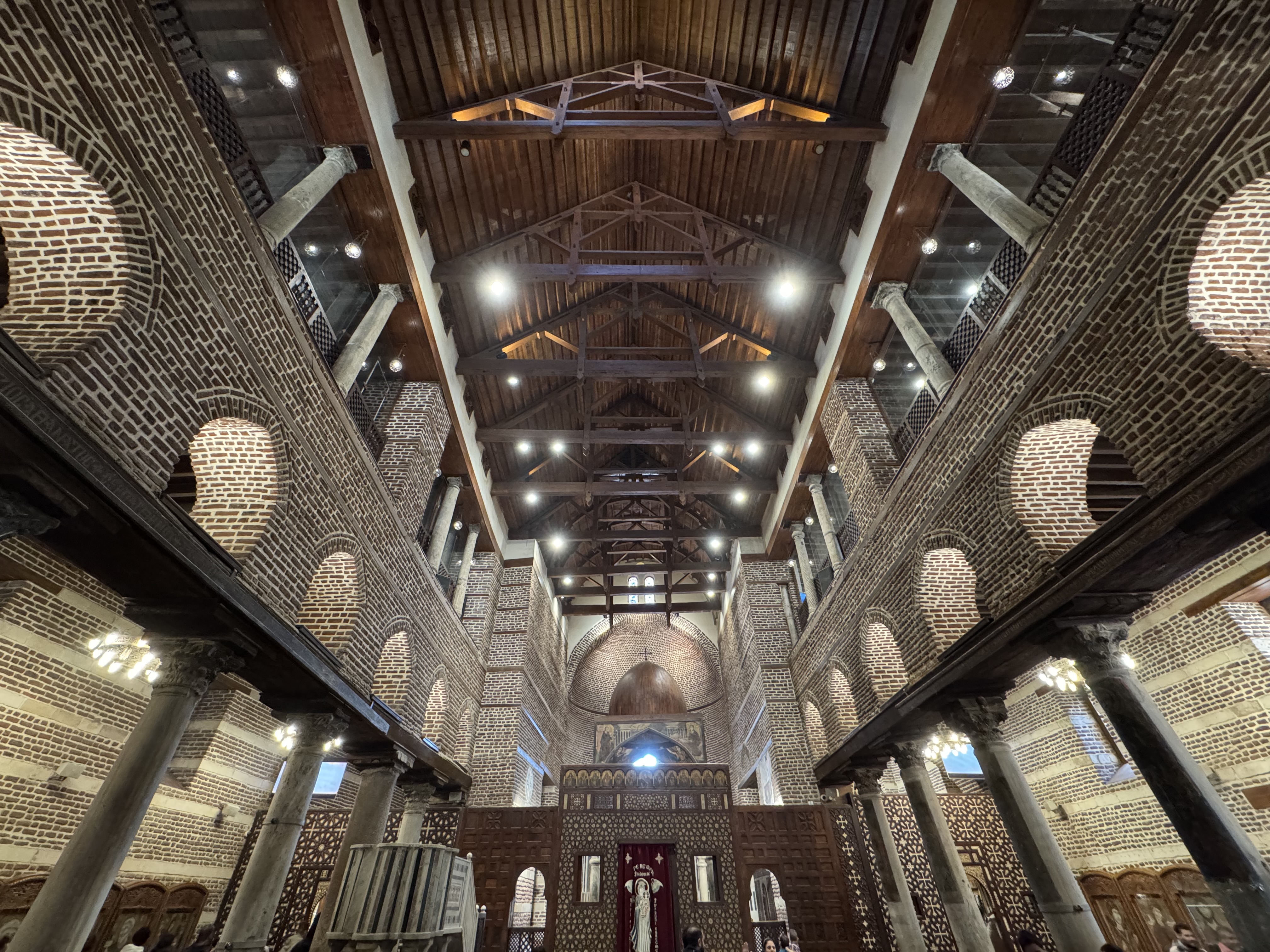
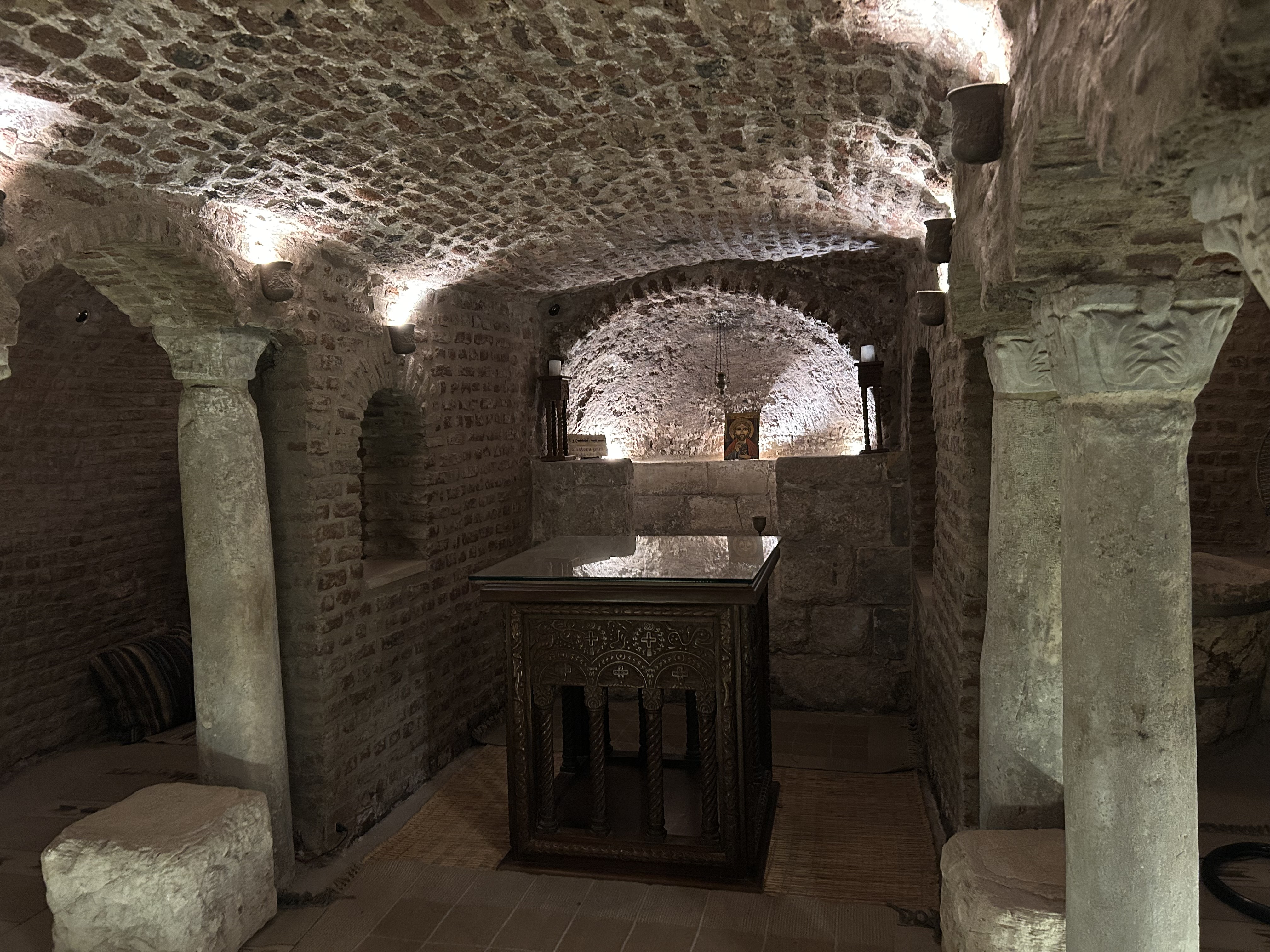
In Egypt today we visited several churches, one of which was The Church of Martyrs Sergius and Bacchus in The Cave, also known as the Abu Serga Church, and is one of the oldest Coptic Christian churches in Egypt, dating back to the 4th century.[1] Tradition holds that Saints Sergius and Bacchus Church was built on the spot where the Joseph, Mary, and the infant Jesus rested at the end of their journey into Egypt.
The flight into Egypt is a story told in Matthew 2:13–23 and in New Testament apocrypha. Soon after the visit by the Magi, an angel appeared to Joseph in a dream telling him to flee to Egypt with Mary and the infant Jesus since King Herod would seek the child to kill him.
You might remember, when the Magi came in search of Jesus, they went to Herod the Great in Jerusalem to ask where to find the newborn “King of the Jews”. Herod became afraid that the child would threaten his throne and sought to kill him (2:1–8). Herod initiated the Massacre of the Innocents in hopes of killing the child (Matthew 2:16). But an angel appeared to Joseph in a dream and warned him to take Jesus and his mother into Egypt (Matthew 2:13). Both Egypt and Judea were part of the Roman Empire, linked by a coastal road known as “the way of the sea”,[2] making travel between them easy and relatively safe.
After Herod passed, Joseph was told by an angel in a dream to return to the land of Israel. However, upon hearing that Archelaus had succeeded his father as ruler of Judaea he “was afraid to go there” (Matthew 2:22), and was again warned in a dream by God “and turned aside to the region of” Galilee. This is Matthew’s explanation of why Jesus was born in Bethlehem in Judea but grew up in Nazareth. Herod died is 4BC, which is stated by Matthew and affirmed by Josephus. Mary and Joseph return to Judah. This is the only time the Biblical Text uses the term “Judah” as a geographical place identifying Judah and Galilee. The text indicates that they first come to Judah but them quickly relocate to Galilee after learning that Archelaus had become the new king who was known to be violent and aggressive.
As an interesting rabbit hole, the beginning and conclusion of Jesus’ parable of the minas in the Gospel of Luke, chapter 19, may refer to Archelaus’ journey to Rome. Some interpreters conclude from this that Jesus’ parables and preaching made use of events familiar to the people as examples for bringing his spiritual lessons to life. Others read the allusion as arising from later adaptations of Jesus’ parables in the oral tradition, before the parables were recorded in the gospels.
Many would deduct the flight to Egypt to fulfill a prophecy by Hosea. Matthew’s use of Hosea 11:1 has been explained in several ways. A sensus plenior approach states that the text in Hosea contains a meaning intended by God and acknowledged by Matthew, but unknown to Hosea. A typological reading interprets the fulfillment as found in the national history of Israel and the antitypical fulfillment as found in the personal history of Jesus. Matthew’s use of typological interpretation may also be seen in his use of Isaiah 7:14 and 9:1, and Jeremiah 31:15. Some have pointed out that “Hosea 11.1 points back to the Exodus, where God’s ‘first-born son’ (Ex 4:22), Israel, was delivered from slavery under the oppressive Pharaoh. Matthew sees this text also pointing forward, when Jesus, the eternal first-born Son (Rom 8:29), is delivered from the tyrant Herod and later brought out of Egypt (2:21).”[3]
The Orthodox Study Bible states that the citation of Hosea 11.1 “refers first to Israel being brought out of captivity. In the Old Testament ‘son’ can refer to the whole nation of Israel. Here Jesus fulfills this calling as the true Son of God by coming out of Egypt.[4] The Anglican scholar N. T. Wright has pointed out that “The narrative exhibits several points of contact with exodus and exile traditions where Jesus’ infancy recapitulates a new exodus and the end of exile, marking him out further as the true representative of Israel.”[5]
The Masoretic Text reads my son, whereas the Septuagint reads his sons or his children;[6] I typically prefer the Septuagint but, in this case, the Masoretic seems more accurate. The Septuagint seeks to find agreement in the plurals of Hosea 11:2 they and them. I bring this up because Luke does not recount this story, relating instead that they went to the Temple in Jerusalem, and then home to Nazareth. However, both texts can be in Harmony without Luke mentioning the flight to Egypt. A theme of Matthew is likening Jesus to Moses for a Judean audience, and the Flight into Egypt illustrates just that theme.[7]
“[Joseph’s] choice of Egypt as a place of exile … was in line with the practice of other Palestinians who feared reprisals from the government; as a neighbouring country with a sizeable Jewish population it was an obvious refuge. And his subsequent avoidance of Judea under Archelaus, and expectation of safety in Galilee, accords with the political circumstances as we know them.”[8]
We also get some strange tales in the extra biblical apocropha. Jesus tames dragons, the trees bow to Him, and the story of the two thieves that later appear on the cross with Him. [9] These stories have certainly influenced Egypt and the Coptic Orthodox Church which was established by Mark, an apostle and evangelist, during the middle of the 1st century (c. AD 42).[10] There are a number of churches and shrines such as the one I visited today marking places where the family stayed.
There is another difficulty here that I should point out. Nazareth is not mentioned in the Old Testament, or by Josephus or any other rabbinical sources.[11] In other words, the quote, “he will be called a Nazarene” is that it occurs nowhere in the Old Testament, or any other extant source. In Judges 13:5 we see a similar clause of Samson but reads “nazirite.” Did Matthew suggest Jesus was intended to have been a Nazirite? Dis the text change and eventually the area became known as Nazareth? Jesus later would not match the description of a first century Nazarite so this has left scholars scratching their heads.
Much of Matthew was likely penned in Hebrew and when you translate this back to Hebrew you find a wordplay that I think answers our difficulty. Isaiah 11:1 states that there shall come forth a rod out of the stem of Jesse, and a Branch shall grow out of his roots: the Hebrew for branch is נצר (netzer). The priestly clan of the “netzerites” possibly settled in the place which became known as Netzereth/ Nazareth. This leaves us clearly seeing that the title Nazarene alludes not so much to his town of origin as to his royal descent.
At any rate, I hope you enjoyed a venture into my mind and appreciate the way that I view history, theology, and a working through a better lens of agreement within the entire text taking into account several different textures of interpretation. I pray that it deepens your enthusiasm for the Word as it has moved me.
WORKS CITED:
Sheehan, Peter (2015). Babylon of Egypt: The Archaeology of Old Cairo and the Origins of the City. Oxford University Press. pp. 35, 40. ISBN 978-977-416-731-7.
Von Hagen, Victor W. The Roads that Led to Rome published by Weidenfeld & Nicolson 1967. p. 106.
Ignatius Catholic Study Bible, New Testament (2010). San Francisco: Ignatius Press. p. 9. ISBN 978-1586174842
The Orthodox Study Bible (2008). Nashville: Thomas Nelson. p. 1268. ISBN 978-0718003593
Wright, N. T. and Michael F. Bird (2019). The New Testament in its World. London: SPCK; Grand Rapids: Zondervan Academic. p. 590. ISBN 978-0310499305
Brenton’s Septuagint Translation of Hosea 11, accessed 4 December 2016
Harris, Stephen L., Understanding the Bible. Palo Alto: Mayfield. 1985. “Matthew” pp. 272–285
France, R. T. (1981). “Scripture, Tradition and History in the Infancy Narratives of Matthew”. In France, R. T.; Wenham, David (eds.). Gospel Perspectives: Studies of History and Tradition in the Four Gospels. Vol. 2. Sheffield (UK): JSOT Press. p. 257. ISBN 0-905774-31-0.
The Gospel of Pseudo-Matthew at The Gnostic Society Library, Christian Apocrypha and Early Christian Literature
Meinardus, Otta Friedrich August (1999). “The Coptic Church: Its History, Traditions, Theology, and Structure.”. Two Thousand Years of Coptic Christianity. American University in Cairo Press. p. 28. ISBN 9789774247576. JSTOR j.ctt15m7f64.
Perkins, P. (1996). Nazareth. In P. J. Achtemeier (Ed.), The HarperCollins Bible dictionary, pp. 741–742. San Francisco: HarperCollins. ISBN 0-06-060037-3.
Galilee Archived 9 May 2006 at the Wayback Machine.




 EXPEDITION 44