Every February 14 many Christians and non-Christians alike pause to celebrate love—often through candy, flowers, heart-shaped cards, and candlelight dinners. But beneath the commercial veneer lies a rich tapestry of history, cultural adaptation, and theological meaning that invites careful reflection for the church—one rooted not simply in sentiment, but in Scripture and the long witness of Christian faith.
1. The Historical Palimpsest of Valentine’s Day
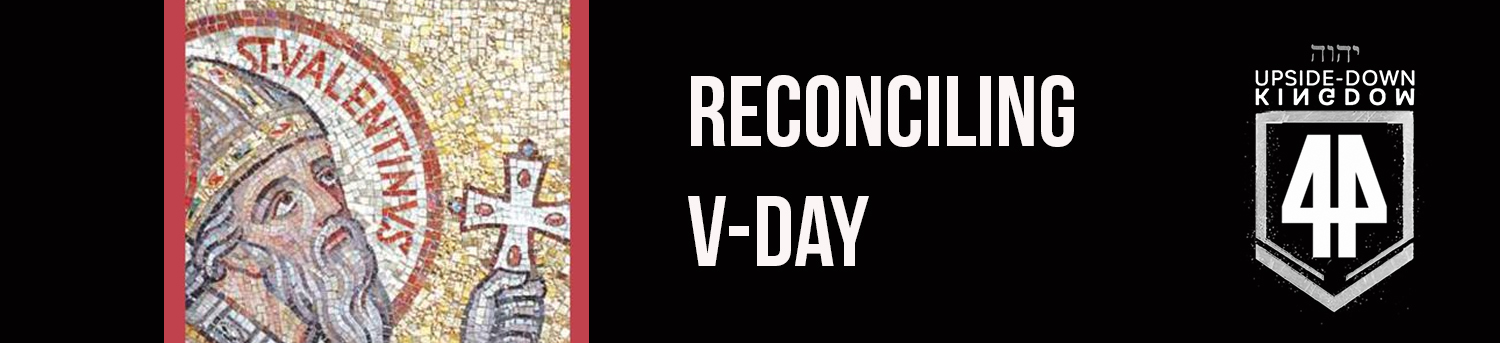
Some scholars would identify at least three such figures known in martyrologies, with one tradition holding that a Roman priest named Valentine in the third century defied an imperial edict against Christian marriage to marry couples in secret—a testament to his defense of Christian marriage and pastoral courage.
By the fifth and sixth centuries, February 14 was established in the liturgical calendar as the feast of St. Valentine, though the medieval church did not associate this date with romantic love until much later. In time, festivals of courtly love and poetic traditions such as Chaucer’s Parliament of Fowls would fold romantic symbolism into the date long after its ecclesiastical origins ended.
It is essential sociologically to recognize that Valentine’s Day—as celebrated today—is a layered cultural artifact: part hagiographic remembrance, part medieval romance, part commercialized modern ritual. None of these layers originate in biblical revelation, yet all reflect ways humans seek to articulate love within their cultural context.
2. Scripture and the Semantics of Love
Most people are aware that the Bible does not mention Valentine’s Day; nowhere is it regarded as a holy day per se. Its absence places the observance in the category of Christian freedom described in Romans 14:5–6, where Paul writes that believers may regard certain days differently, and whether one observes them or not, it should be “in honor of the Lord.”
What Scripture does offer is a rich, nuanced theology of love. In biblical Greek there are multiple terms for love—agapé (self-giving, covenantal love), philia (brotherly affection), eros (romantic desire, depicted especially in Song of Songs), and storge (familial love). While eros itself does not appear in the New Testament theological lexicon, the Song of Songs—a book of the Hebrew Bible—celebrates sensual and relational love within the covenant of marriage.
The apostle Paul’s famous discourse in 1 Corinthians 13 reframes love as a moral and spiritual virtue defined not by transient feeling but by patient covenantal commitment, self-giving service, and endurance. Jesus Himself states the core of the law: to love God with all one’s heart and to love one’s neighbor as oneself (Mark 12:30–31).
This emphasis locates the core of biblical discourse not in romantic expression alone, but in covenantal fidelity, sacrificial love, and the self-giving love revealed supremely in Christ’s death and resurrection.
3. Early Church and the Appropriation of Culture
From a socio-rhetorical perspective, the early church was adept at incarnating its message within existing cultural frameworks without compromising its core message. The apostle Paul became “all things to all people” to win some to Christ (1 Corinthians 9:22).
Christian appropriation of certain dates or customs has always been contested. The church’s decision to commemorate saints and martyrs on specific feast days was not intended to canonize secular customs, but to sanctify memory in ways that pointed beyond worldly spectacle to Christ’s kingship and the communion of saints.
In this light, Valentine’s Day can serve as a cultural locus for Christians to articulate biblical love — not simply by embracing its commercial trappings uncritically, nor by rejecting all contact with culture out of fear of syncretism, but by discerning how Christ’s love reshapes human practices. As Paul counsels, “Test everything; hold fast to what is good.” (1 Thessalonians 5:21)
4. Theological Reframing: Love as Witness
Rather than delegating Valentine’s Day to either celebration or avoidance, Christians can use the occasion as an invitation to reflect on biblical love as witness—not only within marriage, but within the body of Christ and the broader world.
A socio-rhetorical reading invites us to see Valentine’s Day less as an externally mandated Christian feast and more as a rhetorical opportunity—a moment when society’s focus on love can be redirected toward the love that God enacts in Christ. Such love is measured not by roses and chocolates, but by the sacrificial gift of Christ and the mutual love of believers that testifies to His presence (John 13:35).
Conclusion: Love in Context
Valentine’s Day is not inherently Christian because it emerged from early church commemoration or medieval romantic tradition. Nor is it inherently pagan because of its layered history. It is imperatively a moment for Christians to practice discernment, to ask how the gospel reframes the season of love, and to embody sacrificial, covenantal love in ways that reflect God’s love for the world.
As we remember St. Valentine—a figure united by courage and fidelity to Christ—and reflect on the biblical narrative of love from Genesis to Revelation, may our practice of love be shaped by agapé above all else, rooted in Scripture and enacted in service.
Discussion Questions
How does an awareness of the historical development of Valentine’s Day influence (or not) how we celebrate love as Christians?
In what ways does the biblical concept of agapé challenge modern expressions of romantic love?
How can Christians use cultural observances like Valentine’s Day as platforms for gospel witness without syncretizing their faith?
What does Song of Songs teach us about the place of romantic love within God’s broader design for relationships?
How might Paul’s teaching in Romans 14 apply to disagreements within the church over celebrating Valentine’s Day?
Bibliography
Armstrong Institute. “Valentine’s Day—in the Hebrew Bible?” (ArmstrongInstitute.org)
BibleInspire.com. “Valentine’s Day Biblical Meaning: What Christians Need to Know.”
“Valentine’s Day.” Wikipedia (overview of historical development).
Song of Songs. Wikipedia (literary and canonical context).
DISCLAIMER: I am just going to warn you; this post is going to be all over the place. Squirrel – ADD post? But if you know me at all you likely are used to this sort of thing and might even still “love” it. Either way, hang in there, it all comes together in the end.
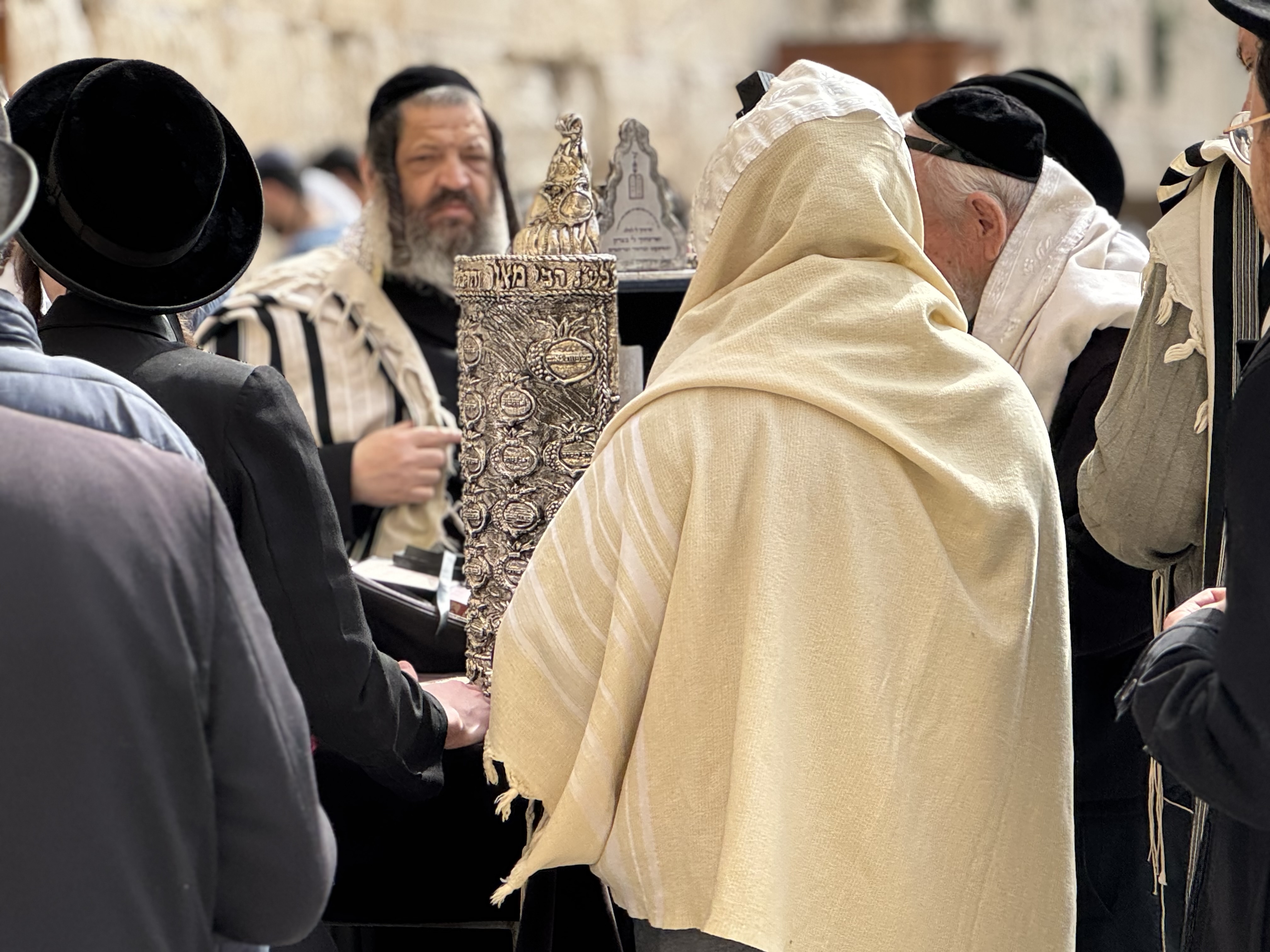
If you have been around Christianity for much time at all you have probably seen a ceremonial ram’s horn or shofar and wondered what it meant. I’ll admit, the average Christian is confused about the Old Covenant and what from it might still be relevant to them. In fact, most Christians don’t really know what to do with or what to make of anything “Torah” related. To most modern Christians, “relics” left over from the ancient world just seem a bit weird when brought back into modern Christianity. [1] However, I believe the still serve a great purpose.
SHOULD CHRISTIANS STILL OBSERVE TORAH?
Is there a place for these things (relics) or even the “Torah as law” to modern Christianity? I could spend pages making great arguments to several different views, but I will just leave you with a couple sentences that summarize my basic thoughts. Are you asking the right question? First, Jesus followed the Torah to the fullest extent, and we are to be like Jesus. Second, if the Scriptures show that Paul, an apostle personally trained by Jesus, was still Torah observant some 25 years after his conversion (and the adoption of the New Covenant) doesn’t that mean something? Yet on the flip side, Jesus’ death and resurrection clearly released us from the law, it came right from Paul’s mouth himself and not just once but three times in Galatians, Romans, and Ephesians. Sounds like something important enough to state 3x over. Is Paul confused? Nope. So, then we have other things to consider. The Torah was essentially a stop gap to keep people of Yahweh righteous and on track until the Messiah could reconcile things left undone within the Old Covenant. It was given to “better” keep people on track. Couldn’t we still use that today? The weird thing is Torah (law) could never fully be followed; the goal was to simply follow it the best you could. Some would even say it was similar to a speed limit today. It was to be “loosely” followed. It was more about the heart. But if God gave it as a “recipe” to stay in devotion to God before the cross it might still, at the very least, be a good idea or practice for us today.
THE SYMBOLS OF THE TORAH
The Shofar is just one of the many symbols of the Torah. Christianity has several symbols and the one you likely understand the most in the New Covenant is the cup and the bread of communion. It is a symbol that should remind you of a great deal of what you believe. It is a remez. Remez is a Hebrew word that means “hint” or “suggestion.” In the context of the Bible, remez refers to a teaching technique where a word or phrase hints at something more profound, often pointing to a larger scriptural context such as an entire teaching. Jesus used this a lot. Think of it as saying a word that brings foundation to many things that would be basic to the belief you’re addressing that encapsules all things to be considered. You might think of a shofar the same way, a basic remez of covenant. Here are a couple of the verses that talk about the shofar that I want to make note of and consider.
Also seven priests shall carry seven trumpets of rams’ horns in front of the ark; then on the seventh day you shall march around the city seven times, and the priests shall blow the trumpets. Joshua 6:4 NASB
How blessed are the people who know the joyful sound! O Lord, they walk in the light of Your countenance. Psalm 89:15 NASB
What is the cry of the shofar? It is the sound of sanity in a world gone mad. God enters the tragic nothingness of human life and proclaims unity (covenant) with Him in the Torah, which is not, by the way, simply the list of 613 commands. The Torah is the narrative of all these men and women who encounter the abyss, who tread the path of annihilation and meaninglessness but still find a God who cares. Hear the shofar and rejoice. [2] The shofar should be a symbol that reminds (remez) you of covenant faithfulness both old and new. Why we have decided to regularly practice communion but have mostly put aside other reminders of our covenant such as foot washing and the shofar (and possibly others) are beyond me. Too many have forgotten the shofar, and I think we would do well to bring it back.
BAD GRAMMAR MYSTERY
Joshua 6:4 is interesting, as it is a grammatical nightmare. There are a few places in the Old Testament where we find what appears to be poor Hebrew grammar, albeit mostly strategic, and this is one of them. I don’t want to get off here, but it is interesting so I will take a moment – The numeral 7 in Hebrew is the word shiva. Almost all Hebrew nouns have a gender form, in this case, the masculine form ends in the letter chet; the feminine form ends in ayin. In most cases, according to Hebrew grammar, the ending of the numeral matches the gender of the modified noun. So, if the noun (like trumpets or day or times) is masculine, the numeral is masculine; if the noun is feminine, the numeral is feminine. Thats just basic Hebrew grammar. But in this verse, it is different. It resembles someone that doesn’t know English trying to say a sentence where the pronouns don’t line up. The word for “seven” is feminine, but the plural noun has a masculine ending, similarly, the word for “day” is yom, a masculine term, but the term for “seventh” is in the feminine form. essentially “seven times,” is all mixed. “Times” is paʿamim, the plural of paʿam, a masculine noun. But here the word for “seven” is feminine. It looks like a hot mess. As I mentioned before, we have seen this in other places in the Bible such as Joshua 1:8 and Genesis 1:26 and both do the same thing, but it becomes a recognizable word play. The problem is that this one is a mystery to everyone. It doesn’t seem to make sense. What do we do with it? I don’t know. It is very strange singular instance – perhaps a mystery. Hidden code, deeper meaning, scribal mistake (highly doubtful.) I have a notion, but I am going to keep it to myself. You will have to figure out your own solution.
ABOUT THE SHOFAR
The shofar is blown in synagogue services on Rosh Hashanah and at the end of Yom Kippur; it is also blown every weekday morning in the month of Elul running up to Rosh Hashanah. [3] Shofars come in a variety of sizes and shapes, depending on the choice of animal and level of finish. [4] The first instance we have is in Exodus 19, the blast of a shofar emanating from the thick cloud on Mount Sinai makes the Israelites tremble in awe. The shofar was used to announce the new moon [5] and the Jubilee year. [6] The first day of Tishrei (now known as Rosh Hashana) is termed a “memorial of blowing”, [7] or “day of blowing”, [8] the shofar. Shofars were used for signifying the start of a war. [9] They were also employed in processions [10]as musical accompaniment, [11] and were inserted into the temple orchestra by David. [12] According to the Talmud, a shofar may be made from the horn of any animal from the Bovidae family except that of a cow, [13] although a ram is preferable. [14] The one who blows (or “blasts” or “sounds”) the shofar is termed the ba’al tokeah or ba’al tekiah (lit. “master of the blast”). Being a ba’al tekiah is an honor as He represents the covenant community of the Lord.
MEANINGS OF THE SHOFAR
As, I mention earlier, the shofar is a symbol of remez that should remind people of many Biblical things. In biblical times it was a reminded of covenant with Yahweh. If I had to pick one definition that is what I would go with. But it symbolizes a lot more than that. The Shofar has been sounded as a sign of victory and celebration from battles of ancient antiquity to modernity. For instance, Jewish elders were photographed blowing multiple shofars after hearing that the Nazis surrendered on 8 May 1945. Because of its inherent ties to the Biblical Days of Repentance and the inspiration that comes along with hearing its piercing blasts, the shofar is also blown during prayer services called during times of communal distress. [15] On Yom Kippur, jubilee years, and New Year’s Day the shofar is often sounded. At times of victory the shofar is sounded. At special days such as to announce sacrifice, the shofar is sounded. The shofar was commonly taken out to war so the troops would know when a battle would begin. The person who would blow the shofar would call out to the troops from atop a hill. All of the troops were able to hear the call of the shofar from their position because of its distinct sound. As you see, it carries varied meaning. Once my son blew it in the middle of the day and naturally our entire family congregated to the living room, asking what was happening. In Bible times, that was the natural response… something was happening, and it had to do with Yahweh!
The shofar has always been a sign & symbol of those in covenant community with Yahweh. It has also been a sound that signifies an alignment with Him. It may be seen as a symbol or representation of desire, recognition, or praise from humanity to our covenant father.
Hebrew: יום תרועה, lit. ‘yom teruˁah’, Numbers 29:1
Joshua 6:4; Judges 3:27; 7:16, 20
2 Samuel 6:15; 1 Chronicles 15:28
Psalm 98:6; compare Psalm 47:5
Psalm 150:3
Rosh Hashanah, 26a. Although Maimonides ruled differently (Mishneh Torah Hilchot Shofar 1:1: “…the shofar with which they make the blast, whether on Rosh Hashanah or the Yovel, is the curved horn of sheep. Now all [other] horns are invalid, except the horn of a sheep…”), the custom of Israel was to make use of other horns, and not only that of the ram (the male sheep). Some would use the horn of the wild goat (Walia ibex) on Rosh Hashanah, while others made use of the long, spiraling horn of the kudu antelope because of its deep, reverberating sound. Compare the teaching of Rabbi Isaac b. Judah ibn Giat, who wrote: “All shofars are valid, excepting that of a cow since it is a [solid] horn. Said Rabbi Levi: ‘The shofar of Rosh Hashanah and of Yom Kippurim are curved, while those of the entire year are straight, and thus is the Halacha.’ Why is it that they blow with a shofar of a ram on Rosh Hashanah? Said the Holy One, blessed be He: ‘Blow before me the shofar of a ram so that I might remember on your behalf the binding of Isaac the son of Abraham, and I impute it over you as if you had bound yourselves before me.’…” (Rabbi Isaac ibn Giat, Sefer Shaarei Simchah (Me’ah She’arim), vol. 1, Firta 1861, p. 32 [Hebrew])
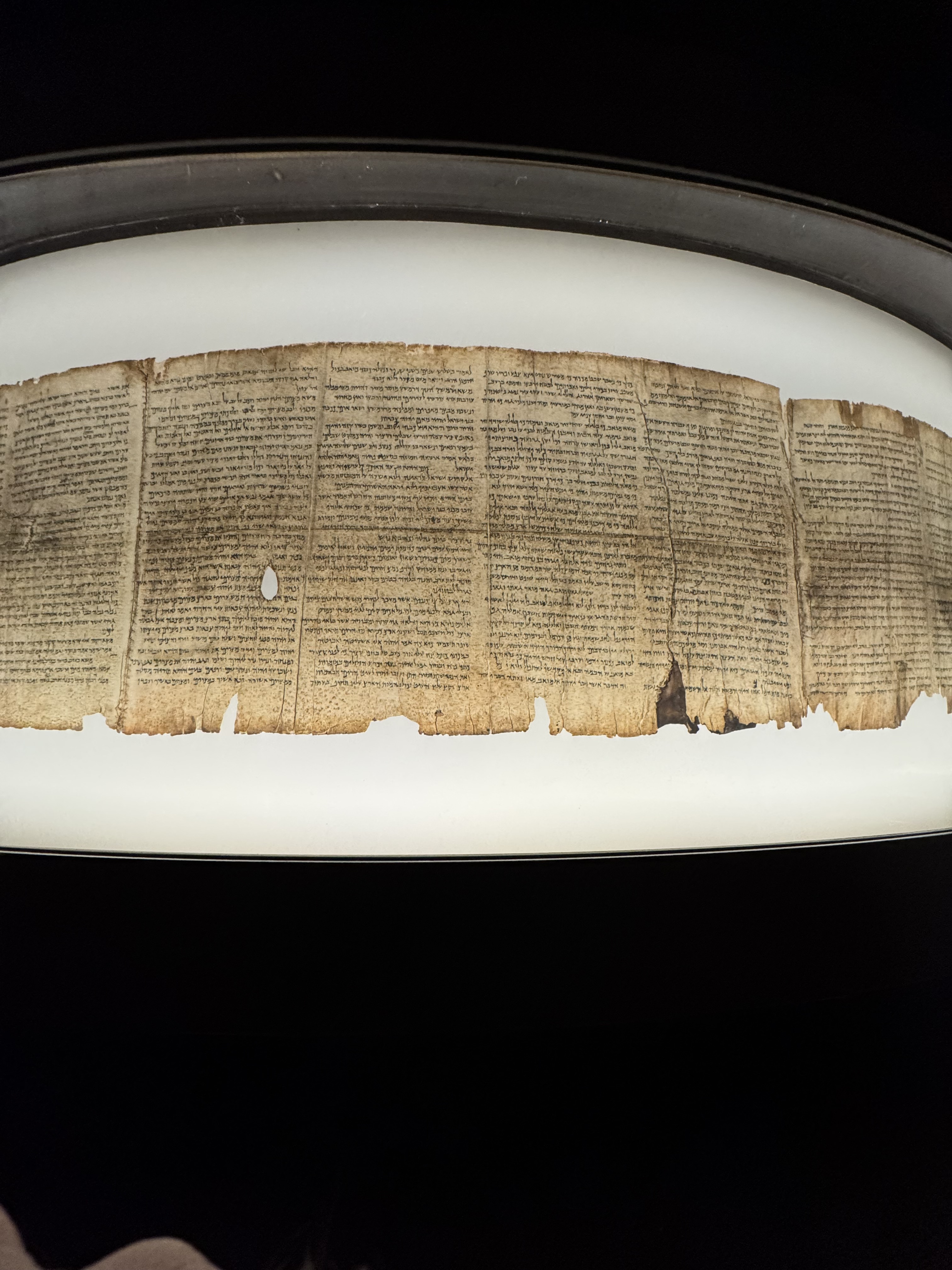
Today was a life milestone. I visited the home of the Dead Sea Scrolls. I have dreamed of this since I was young. As I would love to tell you everything I know about them, I think I will keep this to a brief introduction.
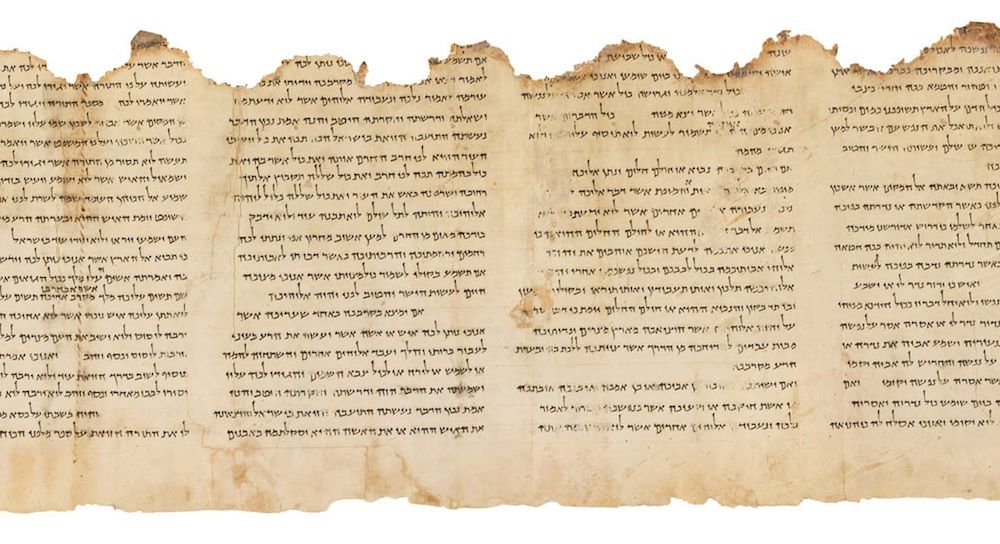
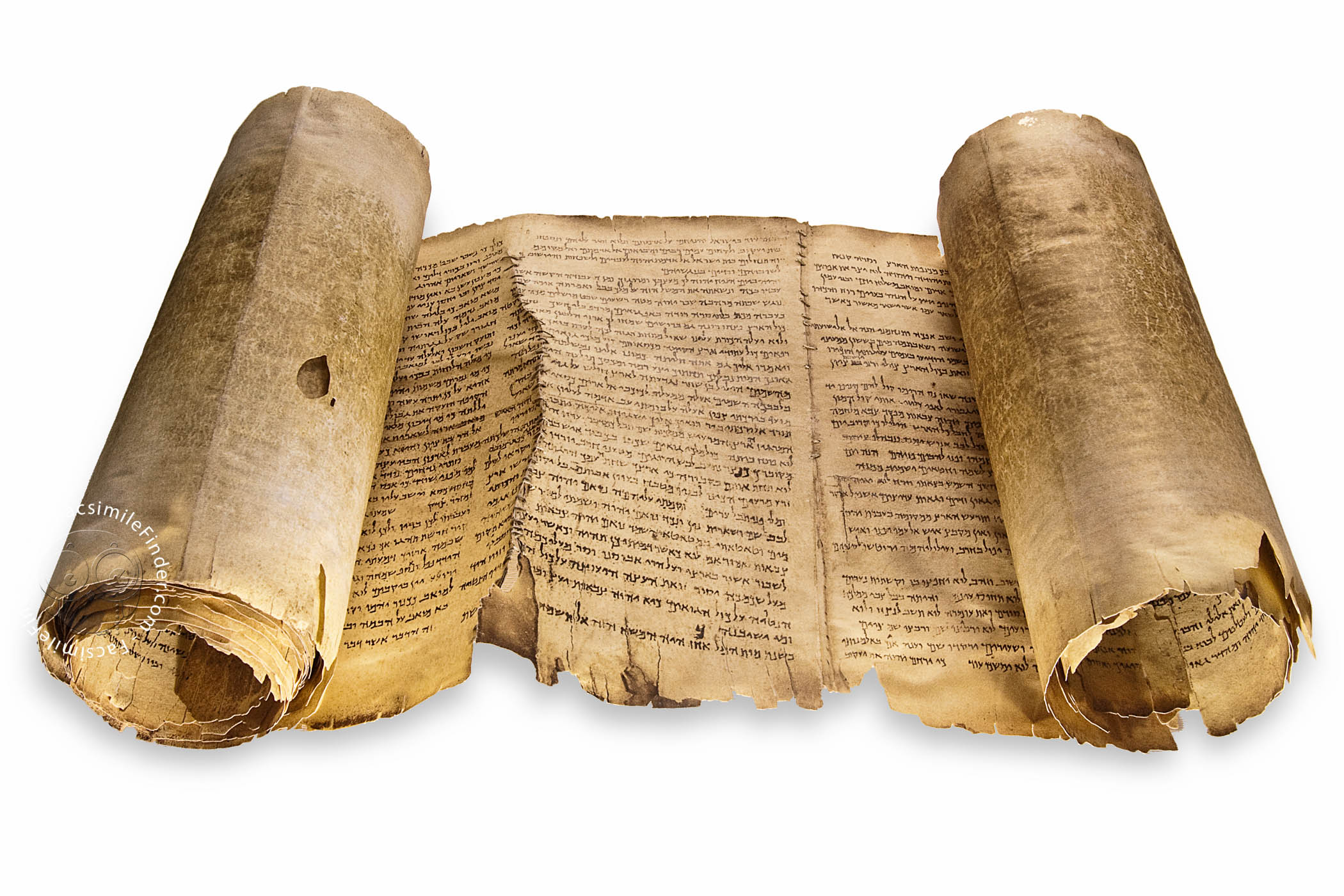
The Dead Sea Scrolls, also called the Qumran Caves Scrolls, are a set of ancient Jewish manuscripts (some original biblical texts) from the Second Temple period. They were discovered over a period of 10 years, between 1946 and 1956, at the Qumran Caves near Ein Feshkha in the West Bank, on the northern shore of the Dead Sea. These date back to the third century BCE.[1]
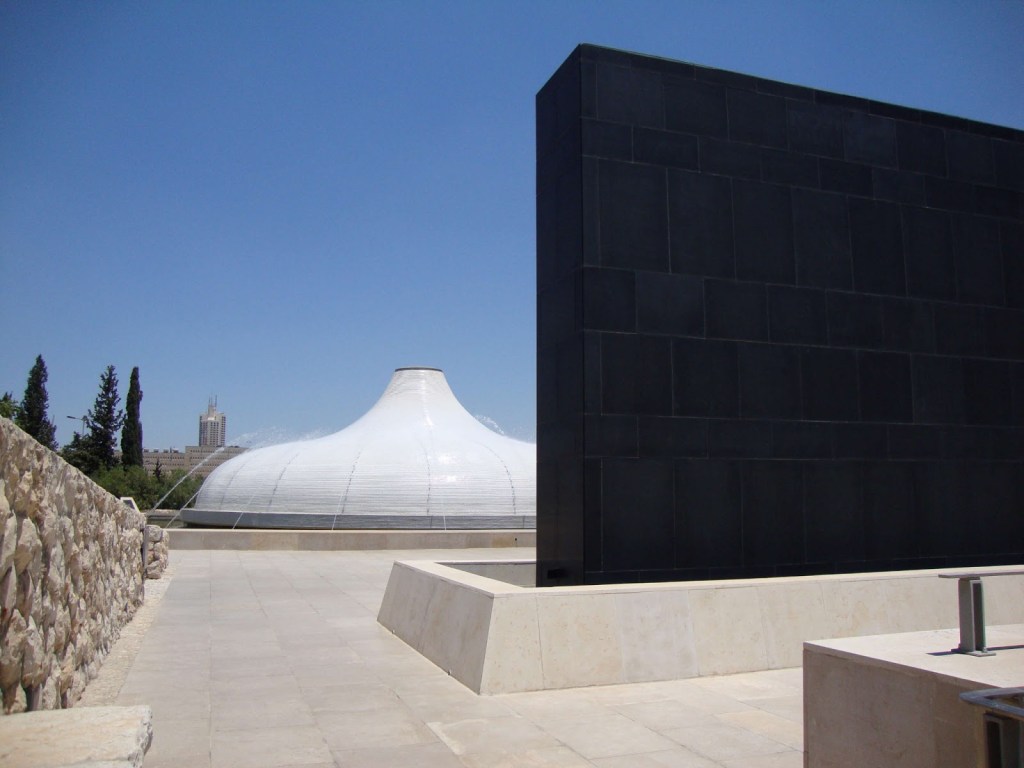
The Shrine of the Book was built as a repository for the first seven scrolls discovered at Qumran in 1947. The unique white dome embodies the lids of the jars in which the first scrolls were found. This symbolic building, a kind of sanctuary intended to express profound spiritual meaning, is considered an international landmark of modern architecture. Designed by American Jewish architects Armand P. Bartos and Frederic J. Kiesler, it was dedicated in an impressive ceremony on April 20, 1965.
The contrast between the white dome and the black wall alongside it alludes to the tension evident in the scrolls between the spiritual world of the “Sons of Light” (as the Judean Desert sectarians called themselves) and the “Sons of Darkness” (the sect’s enemies). The corridor leading into the Shrine resembles a cave, recalling the site where the ancient manuscripts were discovered. [12]
2017 marks the 70th anniversary of the discovery of the Dead Sea Scrolls. Long story short, in late 1947 a young Bedouin boy tossed a stone into a cave, heard the clink of breaking pottery, and would later scramble in to find the tattered remains of ancient scrolls from the centuries leading up to and after the Common Era. If this modern story of ancient discoveries is new to you, you’ve got to ask a very important question. Why does any of this matter today?
These are the oldest Biblical manuscripts that we have and therefore have made us consider the texts of our later translations of the Bible. [2] Today I visited the Shrine of the Book Museum in Jerusalem where the Dead Sea Scrolls and fragments are located and are now mostly the property and heritage of Judaism.[4] There are 981 different manuscripts (discovered in 1946/1947 and in 1956) from 11 caves,[5] in Qumran in the eastern Judaean Desert in the West Bank.[6] Archaeologists have long associated the scrolls with the ancient Jewish sect known as the Essenes, although some recent interpretations have challenged this connection and argue that priests in Jerusalem or other unknown Jewish groups wrote the scrolls.[7][8]
Most of the scrolls are in Hebrew, with some written in Aramaic and Greek.[9] The texts are written on parchment, some on papyrus, and one on copper.[10] The scrolls cover a wide range of topics and genres. The biblical scrolls include texts from every book of the Old Testament, with the possible exception of Esther. Other scrolls are Jewish sectarian writings, administrative documents, deeds of sale, and even divorce and marriage records. Despite the name, the majority of the scrolls are preserved as fragments, small scraps of what were once larger scrolls and documents. While some scrolls are several feet long, many smaller fragments are no larger than a fingertip. To date, more than 25,000 fragments have been discovered, and extensive work has gone into combining, preserving, translating, and studying these various fragments.[11]
The Dead Sea Scrolls shed light on the period between Alexander the Great’s conquest of Palestine in 332 BCE through the Great Revolt, which ended in 73 CE, with an emphasis on the period from the Maccabean Revolt (168–164 BCE) through the turn of the century. However, in order to fully comprehend the Qumran sect, the reasons for its establishment, and its unique character, one must study Judaism and Jews in the Second Temple Period. It is essential to understand the political realities, external influences, and theology of the time. The Second Temple period, or Second Commonwealth, began in 538 BCE with a declaration by Cyrus the Great, king of Persia and Media, that the Jews could return to the Land of Israel and rebuild their Temple. The Temple and the city of Jerusalem were rebuilt by the year 515 BCE, and, in contrast to the First Commonwealth, the high priest became the secular as well as religious authority. This system of government lasted into the Hasmonean period and became an object of protest in the Dead Sea Scrolls, as well as in other literature of the period. [13]
The scrolls gave historians great insight into the ancient forms of these languages, and they also changed the way scholars studied the Old Testament. For example, the scroll with the most complete version of the book of Psalms had about 40 psalms, including three that were previously unknown. One of these unknown psalms was a “plea for deliverance,” which made note of “evil incarnation.” The Dead Sea Scrolls provide evidence of the diversity of religious thought in early Judaism and the Hebrew Bible’s text development. They revealed the psalms were once sequenced in a different order. This was interesting to scholars because the texts had long been so uniform, and seeing flexibility with the wording and organization was stunning. Few people, however, were able to read and analyze the texts. The Dead Sea Scrolls were long hidden away until they were “liberated” in the 1990s. [14] Later that year, the Biblical Archaeology Society was able to publish the “Facsimile Edition of the Dead Sea Scrolls”, after an intervention of the Israeli government and the IAA.[15] In 1991 Emanuel Tov was appointed as the chairman of the Dead Sea Scrolls Foundation, and publication of the scrolls followed in the same year. Researchers at Hebrew Union College in Cincinnati, Ohio, Ben Zion Wacholder and Martin Abegg, announced the creation of a computer program that used previously published scrolls to reconstruct the unpublished texts.[16] Officials at the Huntington Library in San Marino, California, led by head librarian William Andrew Moffett, announced that they would allow researchers unrestricted access to the library’s complete set of photographs of the scrolls. In the fall of that year, Wacholder published 17 documents that had been reconstructed in 1988 from a concordance and had come into the hands of scholars outside of the international team; in the same month, there occurred the discovery and publication of a complete set of facsimiles of the Cave 4 materials at the Huntington Library. Thereafter, the officials of the IAA agreed to lift their long-standing restrictions on the use of the scrolls.[17]
If you keep a close eye on the footnotes of your Bible, you’ll see a number of places where the words of modern translations are different than those read by your parents or grandparents. One of the reasons for this is that we know more about ancient scribal culture and have access to hoards more biblical manuscripts today than we ever have. This means the textual foundation under the hood of most any contemporary translation is better than it has ever been. Whether you’re a fan of the NIV, NRSV, ESV, or ABC-123, each new edition involves incremental change to the actual words on the page.
But this sword cuts in both directions. While we have far more evidence to work with, if the Scrolls taught us anything about Old Testament scripture, it is generally true that the older the manuscripts the more varied they become. Simply put: human scribes were not photocopiers and no two manuscripts are the same. Scribes copied texts but also interpreted them. That was their job. It wasn’t trickery or introducing error at every turn. This often resulted in slow growth of biblical texts with manuscripts having relatively modest variations in content. A word here, a phrase there, and in some cases, more than one edition of a book circulated. To many modern readers, this might sound like a major problem. I’d rather see it as an opportunity. An opportunity for artful restoration of a text that is both ancient and sacred. Let me show you what I mean.
I really like the way RELEVANT handles this:
Have you ever been reading the Old Testament and then, wham!, some guy shows up in the story and starts gouging out people’s eyeballs? I have, very alarming. (Gotta love the Old Testament though, so old school!) Of course, I’m talking about the incident that plays out in 1 Samuel 10-11, just after Saul became Israel’s first king. In most ancient manuscripts and modern Bible translations, chapter 10 ends with a statement of a small group uttering lack of confidence in Saul’s ability to defeat the Ammonites (1 Sam 10:27). Chapter 11 then opens with the sudden introduction of an Ammonite king named Nahash, who insists on only making a treating with the Israelites so long as he can gouge out each and all’s right eyeball (1 Sam 11:1-2). Not only is this a bad deal, its super confusing in the context of the narrative. Why? Something is missing.
At least seven copies of the book of Samuel were found among the Dead Sea Scrolls. One of these, known as 4QSamuala, just happens to be the oldest known manuscript of the book in existence (dated to around 50-25 BCE). In this version of the text, we find a full paragraph tucked in between the end of chapter 10 and beginning of chapter 11. The translation of this Dead Sea Scroll reads as follows:[Na]hash king of the [A]mmonites oppressed the Gadites and the Reubenites viciously. He put out the right [ey]e of a[ll] of them and brought fe[ar and trembling] on [Is]rael. Not one of the Israelites in the region be[yond the Jordan] remained [whose] right eye Naha[sh king of] the Ammonites did n[ot pu]t out, except seven thousand men [who escaped from] the Ammonites and went to [Ja]besh-gilead.
What we have here is essentially a cut scene seemingly lost in the generations of copying all other biblical manuscripts. From this content, we learn who this Nahash figure is and why he had the sadistic penchant for collecting eyeballs. Incidentally, the ancient Jewish historian Josephus also seems to have been aware or this detail as he hints at it in his own retelling of Saul’s life (Antiquities 6.5.1). This is the single largest difference discovered when the biblical Dead Sea Scrolls were compared with all previously known witness to the Old Testament. The spectrum of other variations revealed by the scrolls ranges from the spelling of terms, to added/omitted words, or even sentences. While many common Bible translations have dabbled in the Dead Sea Scrolls and included new readings, to date the NRSV is the only one bold enough to integrate the reading described here in 1 Samuel.
The Dead Sea Scrolls are important for a number of reasons. First, they shed light on an otherwise known Jewish group. Actually, the people who wrote the Scrolls never refer to themselves as Jews. They are intriguingly vague about their identity. Second, the Scrolls indicate that certain books of the Bible were more popular than others, a conclusion we could draw similarly from the New Testament quotations of the Old Testament. Third, the use of the Old Testament as an authoritative source for biblical interpretation and personal and community life matches material from the New Testament as well. Finally, the discovery of the Dead Sea Scrolls allows us to access Old Testament manuscripts more than 1,000 years older than we previously possessed. Before the discovery of the Scrolls, the oldest complete manuscript of any Old Testament book dated to the 10th century A.D. To be clear, if Moses wrote the Pentateuch in circa 1400 B.C., then our earliest copy of his complete work in Hebrew dated 2,400 years after it was written! It is with justification that the Dead Sea Scrolls are considered by many the most important biblical archaeological discovery of all time.[19]
WORKS CITED:
“The Digital Dead Sea Scrolls: Nature and Significance”. Israel Museum Jerusalem. Retrieved 4 November 2023.
Lash, Mordechay; Goldstein, Yossi; Shai, Itzhaq (2020). “Underground-Archaeological Research in the West Bank, 1947–1968: Management, Complexity, and Israeli Involvement”. Bulletin of the History of Archaeology.
Duhaime, Bernard; Labadie, Camille (2020). “Intersections and Cultural Exchange: Archaeology, Culture, International Law and the Legal Travels of the Dead Sea Scrolls”. Canada’s Public Diplomacy. Palgrave Macmillan Series in Global Public Diplomacy. Cham: Springer International Publishing. p. 146
“Hebrew University Archaeologists Find 12th Dead Sea Scrolls Cave”. The Hebrew University of Jerusalem. Archived from the original on 2 June 2017.
Donahue, Michelle Z. (10 February 2017). “New Dead Sea Scroll Find May Help Detect Forgeries”. nationalgeographic.com. Archived from the original on 15 June 2018.
Ofri, Ilani (13 March 2009). “Scholar: The Essenes, Dead Sea Scroll ‘authors,’ never existed”. Ha’aretz. Archived from the original on 6 January 2018.
Golb, Norman (5 June 2009). “On the Jerusalem Origin of the Dead Sea Scrolls” (PDF). University of Chicago Oriental Institute. Archived (PDF) from the original on 10 June 2010.
Vermes, Geza (1977). The Dead Sea Scrolls. Qumran in Perspective. London: Collins. p. 15.
McCarthy, Rory (27 August 2008). “From papyrus to cyberspace”. The Guardian. Archived from the original on 22 December 2016.
“Copies of Dead Sea Scrolls To Go Public – Release Would End Scholars’ Dispute'”. The Seattle Times. 22 September 1991. Archived from the original on 21 October 2013
HUC-JIR Mourns Dr. Ben Zion Wacholder, Hebrew Union College – Jewish Institute of Religion, 31 March 2011, archived from the original on 18 November 2015
“Dead Sea Scrolls”. Encyclopædia Britannica. Archived from the original on 12 April 2009.
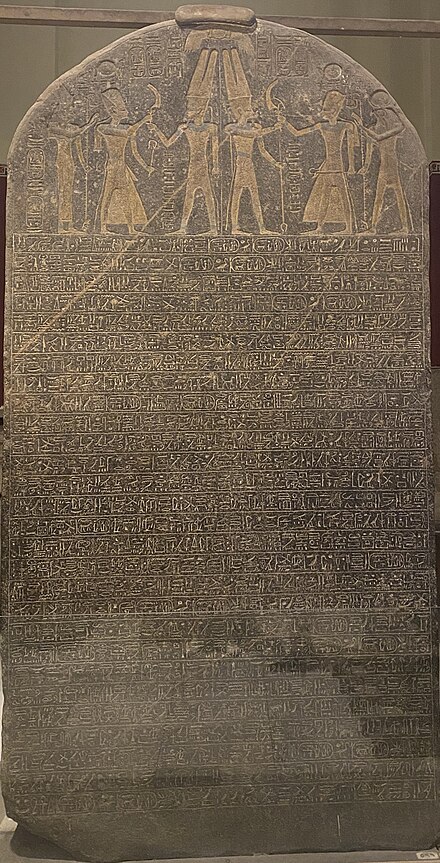
Today I was able to view the Merneptah Stele. This is a pretty big deal in my theological world. The Merneptah Stele, also known as the Israel Stele or the Victory Stele of Merneptah, is an inscription by Merneptah, a pharaoh in ancient Egypt who reigned from 1213 to 1203 BCE. It was discovered by Flinders Petrie at Thebes in 1896, and it is now housed at the Egyptian Museum in Cairo where I visited and was given hands on access to this today.[1][2]
A stele or stela (plural stelae) is a commemorative slab decorated with text and/or images. Ancient Egyptians erected stelae for many purposes including to document historical events, to record decrees (the Rosetta Stone is a famous example), and to remember the dead. [3] Such monuments were made by a variety of cultures in the ancient world, including the Assyrians, Maya, Greeks and Romans. The most common Egyptian term for a stela is wedj, which originally meant “command” and stems from wedj–nesu, “royal decree.” Various qualifiers could be used to further classify wedj, such as wedj-her-tash – “boundary stela” – or wedj-en-nekhtu – “victory stela.” [4]
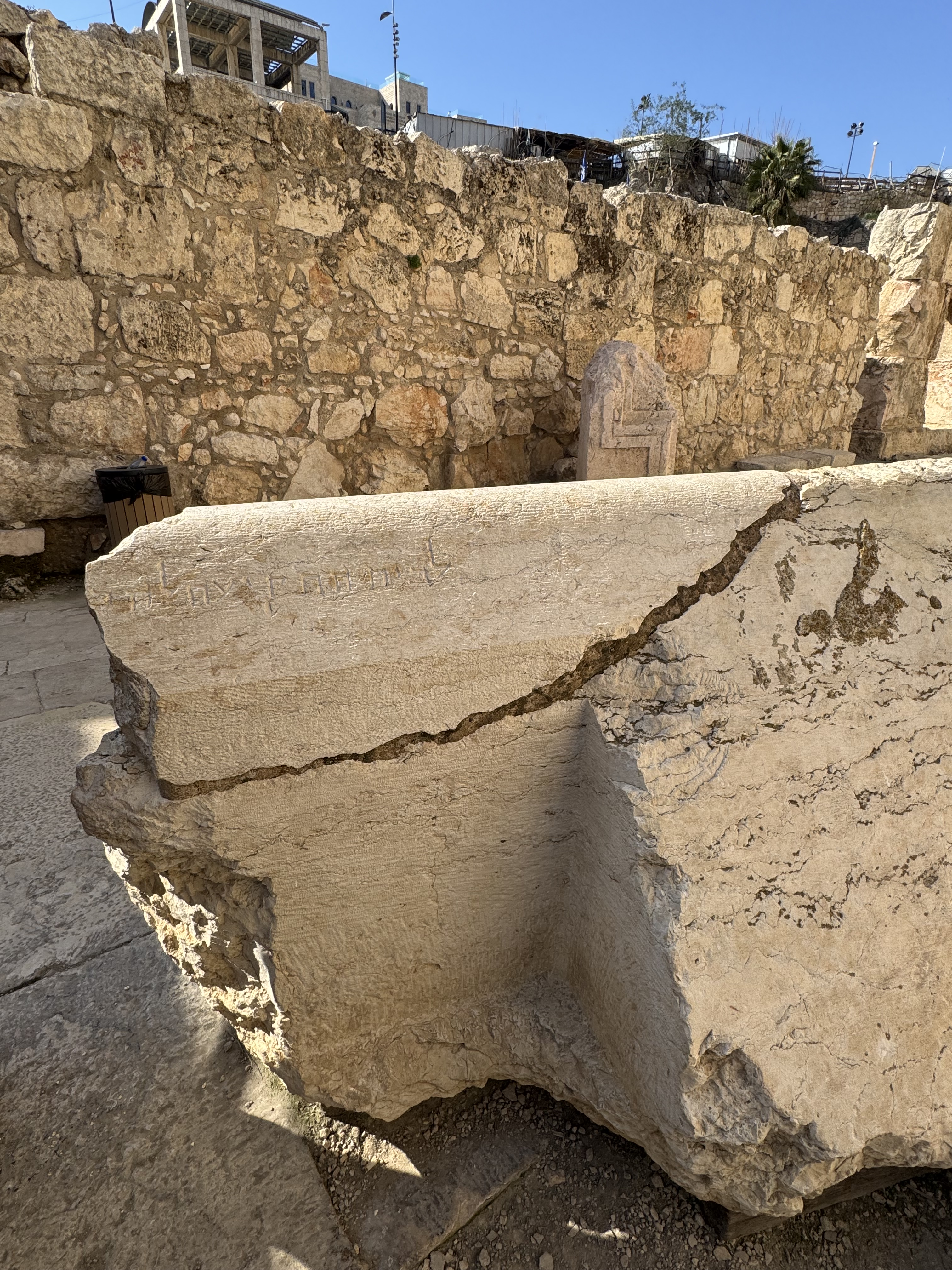
The “victory stela” here has text engraved and is largely an account of Merneptah’s victory over the ancient Libyans and their allies, but the last three of the 28 lines (in the large photo you will view this as slightly darker colored) deal with a separate campaign in Canaan, then part of Egypt’s imperial possessions. It is sometimes referred to as the “Israel Stele” because a majority of scholars translate a set of hieroglyphs in line 27 as “Israel”. Alternative translations have been advanced but are not widely accepted.[5] The stele represents the earliest textual reference to Israel and the only reference from ancient Egypt. [6] It is one of four known inscriptions from the Iron Age that date to the time of and mention ancient Israel by name, with the others being the Mesha Stele, the Tel Dan Stele, and the Kurkh Monoliths.[7][8][9]
For reference here is the timeline of Pharoahs of Egypt before and after the Exodus: [10]
1295 BCE – 1294 BCEThe reign of Ramesses I in Egypt.
1294 BCE – 1279 BCEThe reign of Seti I in Egypt.
1279 BCE – 1212 BCEReign of Ramesses II (The Great) in Egypt.
1212 BCE – 1202 BCEReign of Merneptah in Egypt.
It was first translated by Wilhelm Spiegelberg.[11] Spiegelberg described the stele as “engraved on the rough back of the stele of Amenhotep III. The inscription says it was carved in the 5th year of Merneptah of the 19th dynasty. From a strictly historical perspective here us what scholars have noted. Egypt was the dominant power in the region during the long reign of Merneptah’s predecessor, Ramesses II, but Merneptah and one of his nearest successors, Ramesses III, faced significant invasions. Traditionally Egyptians only document the victories, not the losses. The final lines of this stele deal with a campaign or situation in the East. Traditionally the Egyptians had concerned themselves only with cities, so the problem presented by Israel is interesting in the ay it is breifly mentioned. Merneptah and Ramesses III were thought to have been fairly successful at fighting off their enemies, but history shows us that it is at this time that Egypt ceased to continue control over Canaan – the last evidence of an Egyptian presence in the area is the name of Ramesses VI (1141–1133 BC) inscribed on a statue base from Megiddo. [12]
In terms of translating the language, the “nine bows” is a term the Egyptians used to refer to their enemies;[13] Israel is clear in the transcription and was thought of as smaller units scattered throughout the region, –Canaan might here refer to the city of Gaza,[14] Based on their determinatives, Canaan referred to the land whilst Israel referred to the people.[15]
The line which refers to Israel is below (shown in reverse to match the English translation; the original Egyptian is in right-to-left script):
According to The Oxford History of the Biblical World, this “foreign people … sign is typically used by the Egyptians to signify nomadic groups or peoples, without a fixed city-state home, thus implying a seminomadic or rural status for ‘Israel’ at that time”.[16] The phrase “wasted, bare of seed” is formulaic, and often used of defeated nations – it usually would imply the people posed some sort of a threat to Egypt.[17] The Merneptah stele is considered to be the first extra-biblical reference to ancient Israel in ancient history and is widely considered to be authentic and providing historical information.[18][19]
There isn’t much scholarly disagreement on the interpretation. It is worth pointing out that in the 4th inscription the image I use above interprets seed/grain. In many other known stela inscriptions this notation meant that famine had come, and conflict resulted in another nation or peoples trying to “war” over Egypt’s grain stores. But in the ancient world this notation is much broader than that and simply means conflict. [20]
DOES THIS GIVE US A CLEAR DATE ON THE EXODUS?
Sadly, no. The dates of the Exodus are still largely inconclusive. Many have chimed in such as Flavius Josephus (c.70 CE), but unfortunately there are some things in Egyptian history that don’t seem to line up. The easiest explanation I have already implied. Most of the documentation of Egypt is in the form of “VICTORY” stela and they are just that, embellished records of victory, not failure. The pharaohs were known widely for covering their less than astounding feats. According to Biblical chronology, the Exodus took place in the 890th year before the destruction of the Temple by the Babylonians in 421 BCE (generally accepted date: 587 BCE). [21] This was 1310 BCE (1476 BCE). In this year, the greatest warlord Egypt ever knew, Thutmose III, deposed his aunt Hatshepsut and embarked on a series of conquests, extending the Egyptian sphere of influence and tribute over Israel and Syria and crossing the Euphrates into Mesopotamia itself. While it is interesting that this date actually saw the death of an Egyptian ruler – and there have been those who tried to identify Queen Hatshepsut as the Pharaoh of the Exodus – the power and prosperity of Egypt at this time is hard to square with the biblical account of the Exodus.
Some historians have been attracted by the name of the store-city Ramses built by the Israelites before the Exodus. They have drawn connections to the best-known Pharaoh of that name, Ramses II, or Ramses the Great, and set the Exodus around his time, roughly 1134 BCE (1300 BCE). [22] In order to do this, they had to reduce the time between the Exodus and the destruction of the Temple by 180 years, which they did by reinterpreting the 480 years between the Exodus and the building of the Temple (1 Kings 6: 1) as twelve generations of forty years. By “correcting” the Bible and setting a generation equal to twenty five years, these imaginary twelve generations become 300 years. Is this acceptable? Generations are fairly generic language in the Bible so there is some textual merit to do this. Others feel strongly that such “adjustments” of the Biblical text imply that the Bible cannot be trusted, Ramses 11 was a conqueror second only to Thutmose III. And as in the case of Thutmose III, the Egyptian records make it clear that nothing even remotely resembling the Exodus happened anywhere near his time of history. However, I come back to, the more powerful and well liked the rulers were, the greater power they had to dictate what was remembered of them. It is also worth noting that Egyptian dating is a disaster in the scholarly community. Few things agree.
Does this stone tell us who the Pharoah of the Exodus was? No; but perhaps it supplies you with a more educated proposition.
Lemche 1998, pp. 46, 62: “No other inscription from Palestine, or from Transjordan in the Iron Age, has so far provided any specific reference to Israel… The name of Israel was found in only a very limited number of inscriptions, one from Egypt, another separated by at least 250 years from the first, in Transjordan. A third reference is found in the stele from Tel Dan – if it is genuine, a question not yet settled. The Assyrian and Mesopotamian sources only once mentioned a king of Israel, Ahab, in a spurious rendering of the name.”
Maeir, Aren. Maeir, A. M. 2013. Israel and Judah. pp. 3523–27, The Encyclopedia of Ancient History. New York: Blackwell. The earliest certain mention of the ethnonym Israel occurs in a victory inscription of the Egyptian king Merenptah, his well-known “Israel Stela” (c. 1210 BCE); recently, a possible earlier reference has been identified in a text from the reign of Rameses II (see Rameses I–XI). Thereafter, no reference to either Judah or Israel appears until the ninth century. The pharaoh Sheshonq I (biblical Shishak; see Sheshonq I–VI) mentions neither entity by name in the inscription recording his campaign in the southern Levant during the late tenth century. In the ninth century, Israelite kings, and possibly a Judaean king, are mentioned in several sources: the Aramaean stele from Tel Dan, inscriptions of Shalmaneser III of Assyria, and the stela of Mesha of Moab. From the early eighth century onward, the kingdoms of Israel and Judah are both mentioned somewhat regularly in Assyrian and subsequently Babylonian sources, and from this point on there is relatively good agreement between the biblical accounts on the one hand and the archaeological evidence and extra-biblical texts on the other.
Fleming, Daniel E. (1998-01-01). “Mari and the Possibilities of Biblical Memory”. Revue d’Assyriologie et d’Archéologie Orientale. 92 (1): 41–78. JSTOR 23282083. The Assyrian royal annals, along with the Mesha and Dan inscriptions, show a thriving northern state called Israël in the mid—9th century, and the continuity of settlement back to the early Iron Age suggests that the establishment of a sedentary identity should be associated with this population, whatever their origin. In the mid—14th century, the Amarna letters mention no Israël, nor any of the biblical tribes, while the Merneptah stele places someone called Israël in hill-country Palestine toward the end of the Late Bronze Age. The language and material culture of emergent Israël show strong local continuity, in contrast to the distinctly foreign character of early Philistine material culture.“
H. Jacob Katzenstein, ‘Gaza in the Egyptian Texts of the New Kingdom,’ Journal of the American Oriental Society, January-March 1982, Vol. 102, No. 1 pp. 111-113 pp.111-112
Smith 2002, p. 26.
FitzWilliam Museum, UK: Ancient Egypt
H. Jacob Katzenstein, ‘Gaza in the Egyptian Texts of the New Kingdom,’ Journal of the American Oriental Society, January-March 1982, Vol. 102, No. 1 pp. 111-113 pp.111-112
Jones, Daniel (2003) [1917], Roach, Peter; Hartmann, James; Setter, Jane (eds.), English Pronouncing Dictionary, Cambridge University Press, ISBN 978-3-12-539683-8
Contrary to the Jewish historical tradition, the generally accepted date is 166 years earlier, or 587 BCE (see “Fixing the History Books – Dr. Chaim Heifetz’s Revision of Persian History,” in the Spring 199.1 issue of Jewish Action). This difference applies to all Mesopotamian and Egyptian history prior to the Persian period. The dates for Egyptian history given in the history books are therefore off by this amount. For our purposes, we will use the corrected date followed by the generally accepted date in parenthesis.
Some people have been excited about the generally accepted date for Ramses II coming so close to the traditional date for the Exodus. This is a mistake, as Egyptian and Mesopotamian histories are linked. If Ramses II lived c.1300 BCE, then the destruction of the Temple was in 587 BCE, and the Exodus was in 1476 BCE.
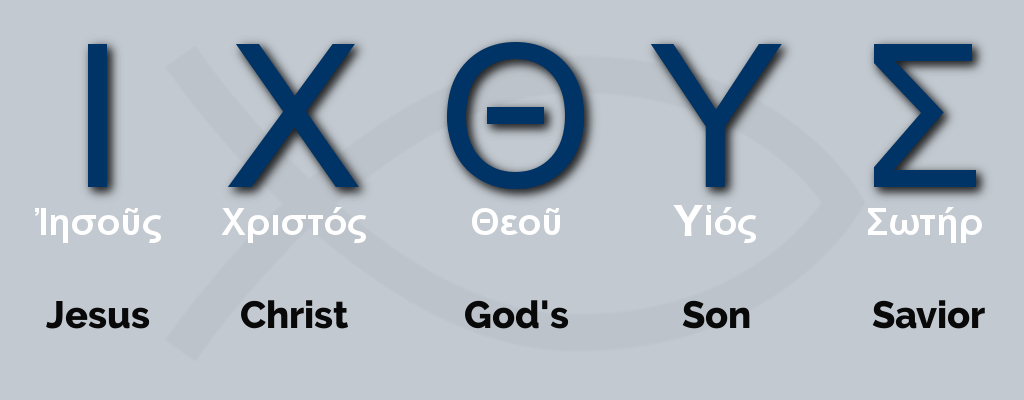
Is Christmas Pagan? Well sort of yes, sort of not. It’s a great discussion. I’ll frame it first like this as an easy reference. Some Christians are triggered when people say XMASS instead of Christmas, saying things like your taking “Christ” out of Christmas. Well actually X has been a symbol for Christ since at least His death. IXOYE, the Christian Fish Symbol, (ichthus) means “Jesus Christ God’s Son Savior” in Greek. Christ in Greek starts with the X symbol or character. Since Greek is more Biblically correct than English XMass may actually be a more Bible way of saying Christmas than “Christmas” is. As I will go on to show. It is really a similar argument with Christmas as a whole. Is it Pagan? Well yea, there are some pagan things, are we taking back what is Biblical (Christ and celebrating His birth) as ambassadors of truth? Yea I hope so! In that way some of this gets a bit dicey and comes down to how you’re going to think about it or frame it. I love it that the world celebrates the Birth of Jesus! But I want my readers to work through this on your own, so as usual, nothing is spoon fed. Here are some notes, good luck!
Dec 25, -“unconquered son” (Christians stole this day from the Pagans) Not really. There is no reason to conflate some pagan festivity no one cares about with Christmas. If there was a conspiracy back in the fourth Century, then St. Augustine would likely have said something about it. What he did say was that when the barbarians came to sack Rome, they left the churches alone, out of respect for traditions that were foreign to them, but which they could see were clearly holy.
It likely is a result of mixed Jews and Christians trying to figure out how to be unified in the first few centuries after Christ. Some are aware that during the reformation England banned Christmas in 1647 in some part because of connections to paganism. But the reformation had a lot of problems this really shouldn’t surprise anyone. The accusation that Christmas was usurped from Sol Invictus is probably a result of works of the puritans of the 16/17th Century England.
In America Christmas was banned between the years of 1659-1681. Christmas as we know it really didn’t start happening until the late 1800’s and even then, it was foreign to most people. Puritans then where preaching and distributing literature denouncing such celebration. Christmas really became what we think of it today, when in 1843 Charles Dickens wrote “A Christmas Carol”.
If we look at the outlook of the early Western Church (and by Western, I mean both the Latin Catholics and the various Eastern Orthodoxies) towards pagan life and rituals in general, its abundantly clear that they saw it with utter disgust.
Incensing is also interesting. In the Torah it signified holiness, yet later within some orthodoxy it is outright condemned. For them, it was nothing more than a pagan remnant that would defile Christianity, if adopted. Lactantius, the 4th Cent. Christian writer and one of Constantine’s main advisers condemns it in his book Institutiones Divinae. Hippolytus of Roma omits the use of incense entirely in his work, Apostolic Traditions. Of course, Constantine was a mess.
Accusing the Roman Church of usurping/adopting an entire pagan festival and rebranding it as Christmas to gain pagan converts, when it was repulsed by something so frivolous as a stick of incense which it perceived to be pagan, is in the realm of the absurd.
The Roman Empire wasn’t the only place with Christians in the 4th Century. There is no evidence that Sol Invictus was observed anywhere outside of the borders of the Roman Empire. Earliest record of Sol Invictus being celebrated on the 25th of December is from AD354. There is little evidence to suggest it was celebrated before 4th Century in Rome. But we know that the Syriac Christians were already celebrating Christmas (although it was considered a minor feast leading up to Epiphany) in the last week of their season of Subbara, which falls on December in the Gregorian Calendar – this practice dates from at least the mid-4th Century.
During the early centuries AD, the Jews clearly did not give Hanukkah much importance, as the Mishnah obviously omits it. Neither does Hanukkah have any theological connotations – after all, it’s kept for the memory of the Maccabees. Christianity had no need to find a replacement for an obscure Jewish holiday. But I do agree that some Christian communities, especially the ones with Jewish origins, like the Christians of St’ Thomas of Kerala, do observe some rituals reminiscent of Hanukkah. But they do it in the week of Epiphany, not the week of Christmas.
Christ was likely born on Sep 11, 3bc – Yes, I know some think 4BC was the death of Herod but that is definitely not concrete.
It was winter, and the Festival of the Dedication of the Temple was being celebrated in Jerusalem. Jesus was walking in Solomon’s Porch in the Temple, when the people gathered round him and asked, “How long are you going to keep us in suspense? Tell us the plain truth: are you the Messiah?” – John 10: 22 The Hanukkah festivals that Jesus likely took part in was similar enough to Christmas in ritual and custom to assume that early Christians continued with the festival in honor of the birth of Jesus – that might well have fallen on the same day of the year.
The Feast of the Lights (Hanukkah or ‘Festival of Dedication’) took place for two days on the twenty-fifth and twenty-sixth days of Kislev starting with the lighting of candles on the evening of the twenty-fourth. (The Judaic month of Kislev is almost the same as December.) Candles were then lit for a further six or possibly eight days. The specific reason for the festival of Hanukkah is to celebrate the victory of the Maccabees over the Seleucids and the result of that victory, which was the re-dedication of the altar in the Temple after three years when no services took place. In general, it celebrates religious freedom, the light that was lit in Israel for all people, and the spread of that light throughout the world.
The date was of particular importance in the Greek /Roman calendar and in the calendars of many of the ancient societies. On or roundabout this day the star Sirius (the brightest of all stars) that flies behind the earth in its path around the Milky Way is right overhead at midnight. When Sirius is overhead at midnight it means that the sun is at its furthest south and that summer is coming again. For this reason, the date had been associated in many ancient and not so ancient religions with the birth of a god or a new period of religion. It was therefore no accident that Antiochus Epiphanes offered the first sacrifice to Zeus Olympios in the Temple on this date in 167 BCE. It was intended to show that a new period of rule of the Greek gods over the land had begun. Judah Maccabeus would have been fully aware of this and made sure that the first Hanukkah also fell on 25 December 164 (165) BCE to counter the Greek claim. (Now upon the same day that the strangers profaned the Temple, on the very same day it was cleansed again, even the five and twentieth day of the same month, which is Kislev – II Maccabees 10: 5)
Persia was different from the other countries in their beliefs around Sirius and used the star to make predictions. This is based either on changes in color (white, blue, emerald) the star undergoes (in the past there were times when it has appeared red) or on the positional shift in relation to the background stars due to the gravitational influence of a white dwarf companion star. Because these changes are minute and dependent on great knowledge, it is no surprise that nobody, but the Magi noticed them. (This would explain why Herod and the scribes did not notice it. If a huge comet hung over Bethlehem, millions of people would have turned up, as they were strong believers in the magic of stars.)
Because it is closely linked with the Feast of the Tabernacles (Succoth), so close that it is even called that in some communities as an interchangeable title; and now we see that that ye keep the Feast of Tabernacles in the month Kislev – II Maccabees 1: 9. To the original promise made in the desert by the festival of Sukkoth (that one day Israel would no longer live in tents but in houses) the important facet of lights were added. With the rededication of the Temple, came the profound moment of the lighting of the candelabra. They made also new holy vessels, and into the temple they brought the candlestick . . . and the lamps that were upon the candlestick they lighted, that they might give light in the temple – I Maccabees 4: 49 – 50. Josephus said (Antiquities of the Jews, 12: 7: 7), and from that time to this we celebrate this festival, and called it Lights. I suppose the reason was, because this liberty beyond our hopes appeared to us; and that thence was the name given to that festival.
The festival is supposed to be a happy time in accordance with I Maccabees 4: 59 – the days of the dedication of the altar should be kept in their season from year to year by the space of eight days, from the five and twentieth day of the month Casleu, with mirth and gladness. From the earliest, the festivalgoers bare branches, and fair boughs, and palms also, and sang Psalms – II Maccabees 10: 7.
Israel in winter is green as this is the time of the rains and what snow there is (if at all) quickly melts. Bringing greenery into the home therefore has nothing to do with the pagan midwinter festival but with the promise made in the desert and celebrated during the Feast of the Tabernacles.
The twenty-fifth of December (Kislev) that became important to Christianity together with joyous songs and the Christmas tree and lights all originated in Hanukkah.
Dies Natalis of Sol Invictus, or that is the birthday of the unconquerable sun. It is also called Saturnalia as it Honors the deity Saturn. Saturn was worshiped for agricultural purposes. This was later celebrated by the Romans as Dies Natalis of Sol Invictus. It celebrated the renewal of light and the coming of the new year. What day was it celebrated on? You guessed it December 17-23 and 25. Saturnalia was celebrated with feasting, partying, and gifts. Saturnalia
As the Roman empire came under Christian rule pagan holidays were added to help convert pagans to Christianity. You see this mainly under emperor Constantine’s rule. The people whom the Romans conquered had their “religion” and celebrations added to the Romans celebrations.
The names of Saturnalia where later changed to take on a more Christian aspect. The church commemorated December 25 as Jesus’s birthday. The church got pagan converts, and the pagans simply got to keep their holidays.
NOTE: The best general and easily understood book I have yet seen on ‘Jewish’ holidays is ‘Guide to Jewish Holy Days’ by Hayyim Schauss, published in paperback by Schocken Books of New York in 1962.
Here is more on Christmas: Unfortunately, the churches audio video was not great, but it still has some good content.
















 EXPEDITION 44