Messianic Seder

The Passover elements symbolize God’s character and retell the story of our liberation from the forces of the fallen world.

Passover is a beautiful and highly symbolic celebration. More than any other festival (right or wrong), it has been at the heart of the universal Jewish experience, helping to form the core of spiritual identity and pointing inexorably toward the hope of Israel’s salvation.1

Each year the date of Passover slightly changes on the Gregorian calendar. The Haggadah (Hebrew: הַגָּדָה, “telling”; plural: Haggadot) is a foundational Jewish text that sets forth the order of the Passover Seder. According to post second temple Jewish practice, reading the Haggadah at the Seder table fulfills the mitzvah incumbent on every Jew to recount the Egyptian Exodus story to their children on the first night of Passover.2 You may or may not want to partake in it considering that! (More on that at the end of the article.) As I have previously written, the Passover teaching is intrinsically intended to be simple enough for children, and if you were raised with it each year hearing the story and going through this motion, you would think that, even though it may actually seem complex to a non-Torah observant evangelical. The seder dinner is based on Passover and Passover was the simple feast of the seven. But since the other feasts are now not typically observed sometimes the seder dinner becomes more complex attempting to try to make the Passover feast encompass the content of all the feasts. This is a bit unfortunate. The Passover is aimed at families considering a personal commitment to Yahweh’s covenant offered to them. I am going to write this from an already/now perspective giving you the historical symbolism impacted already by the work of Jesus through His death, resurrection and ascension as it relates to us today. Lastly, if you haven’t read this article, please do so first. 3 Personally, I am always amazed walking through a seder dinner how everything so richly points to Jesus yet so many of those that partake refuse Him.
Much of the seder dinner is based on tradition not the Bible. This is a biblical struggle. You also have the issue that second temple Judaism made a lot of rules which is what Jesus spoke very harshly against – That is actually what the temple cleansing was about in large part. So, I have crafted a presentation based on a better understanding and education. What do we take away and what do we leave behind? Below is the typical Seder order, however – I don’t really think a lot of the traditional seder is scriptural and thus think some of it could and should be left out. I think a better aim of the seder is to teach the symbolism of the Old Testament as it may relate to the Messiah which is what I aim at here. I also would not get caught up in needing to do things exactly as they are scripted. The was never the heart of the text or the biblical intent of reembrace of Passover. The seder should be light, fun, and simple. Made for children! The remembrance of Passover to the people of Israel in many ways was a foreshadow to the remembrance of communion in the New covenant.

The original intent of early Passover was to pass on to your children orally what is important and “SETS APART” your family. IT was not only a time for the stories of God’s covenant faithfulness but also brought a sense of spring cleaning spiritually to begin your year on track with the LORD. This is a great thing. I would encourage you to partake with your family in a similar sense. Maybe you tell the story of “passing over” or maybe you spiritually just use the meal to discuss Jesus over everything for your family and how important that is “YEAR after YEAR for you and your family.

Order of the Seder
NameMeaning
KADDESHKiddush (1st cup of Wine)
URECHATZWash hands, before eating Karpas
KARPASEat parsley dipped in salt water
YACHATZBreak the middle matzah – hide the Afikoman
MAGGIDThe telling of the story of Passover (2nd cup of Wine)
RACHTZAHWash hands before the meal
MOTZIBlessing for “Who brings forth”, over matzah
MATZAHBlessing over matzah
MARORBlessing for the eating of bitter herbs
KORECHEat matzah with bitter herbs & charoset
SHULCHAN ORECHPassover Dinner
TZAFUNEat the Afikomen
BARECHBlessings after the meal (3rd and 4th cups of Wine)
HALLELRecite the Hallel, Psalm of praise
NIRTZAHNext year in Jerusalem – conclusion of the Seder
Song of RejoicingSong of Rejoicing (technically, this is after Seder)

Traditionally a woman would light the candles and begin the chant. But you can make a joke that perhaps a manchild or manwoman will do, in Hebrew the word for Man or husband is a contranym and can mean a a man of valor, champion, expert, counselor or great hunter, but it can also find an opposite meaning such as manchild or woman like man, oppressor, adulterer, or general offender. That’s why for centuries the idiom has shown woman rolling their eyes and saying “eeeesh” when a man does something childlike.  אִישׁ Transliteration: iysh Pronunciation: eesh

The Haggadah means “the telling” and has been passed over generation to generation for thousands of years. But again, I would not emphasize that as I believe it might be grounds to be “off course” for a Jesus follower. You could begin with reading Matthew 5:17-20.

LEADER: God is holy, and we cannot enter His presence with sin. He established the sacrificial system to cleanse us of our sin. Yeshua is the ultimate sacrifice, so we can be in God’s presence. May we all be sanctified through the blood of the Lamb, Yeshua.

You can begin the celebration with this chant:

Bondage and Exodus

Hebrew Scriptures: Exodus 12:24–27. The nation of Israel is commanded to celebrate the Passover as a yearly ordinance to remember how God has dealt faithfully with them and preserved them. The emphasis is that they will individually be covenant keepers and that that notion leads their families and becomes communal to the larger context of the body [of Christ]. This is the foreshadow of New Covenant communion as we remember how Jesus fulfilled what was started here.

New Testament: John 8:36. Believers in Jesus recognize that God has extended salvation to all nations; through the salvific power of Yeshua’s blood, we are set free from the bondage of sin. Jesus is the Redeemer of humanity. (“All nations” is really a remembrance of the Feast of Tabernacles but as I mentioned earlier gets thrown in the pot with a seder dinner as the other feasts are slowly forgotten.) This starts with a personal covenant commission that we are the personal manifestation of the hands and feet of Jesus to regain ourselves, our families, our church body, and eventually the nations, but Passover emphasizes the aspect of personal reflection. The other feasts emphasized some of the other things, but because in our modern age the Passover is likely the only feast still exercised all of these things in the other feasts may be emphasized.

The Ceremonial Cups

Hebrew Scriptures: The original Passover makes no mention of a cup. Yet throughout the Hebrew Scriptures, the cup is often used as a symbol of both God’s covenant and provision.

Rabbinic Tradition: The four cups represent the four phrases in Exodus 6:6–7: “I will bring you out”; “I will deliver you”; “I will redeem you”; “I will take you to be my people.” First is the Kiddish Cup (the Cup of Sanctification), followed by the Cup of Plagues, the Cup of Redemption, and lastly, the Cup of Hallel (the Cup of Praise). The Mishnah, instructs those celebrating to drink from the cup four times during the Passover seder (Pesahim 10:1). 

New Testament: At the Last Supper, Jesus raised the cup before the supper (Luke 22:17–18), and the cup after the supper (the Cup of Redemption), when he said, “This cup that is poured out for you is the new covenant in my blood” (Luke 22:20). This is the covenant promised to us by God when He said He would establish a new covenant with His people (Jeremiah 32:38–40). Paul tells us that the communion cup represents the blood of Messiah (1 Corinthians 10:16). The Hallel Psalms sung during the Cup of Hallel were likely sung by the disciples after dinner. Read more about the Passover cups and their significance in the Last Supper.

Jesus declared that this new covenant would be poured from the cup of salvation in His blood. The cup of redemption stood for more than the Hebrews’ escape from Egypt; it stood for the plan and purpose of God for all the ages. Judgment and salvation, wrath (impeding in 70AD) and redemption are brought together in the mystery of one cup, explained by the Messiah in that upper room. Jesus was not speaking of the cup in a purely symbolic manner. He was describing events that would soon occur in His own life. He also reflected this the day before at the triumphal entry when he wept.

Please fill your cup. Let us lift our cups, the Cup of Sanctification, and bless the Lord for His abundant giving.

Ba-rukh a-tah A-do-nai E-lo-hey-nu Me-lekh ha-‘o-lam bo-rey pri ha-ga-fen. 

Blessed are you, O Lord our God, Ruler of the Universe, who creates the fruit of the vine.

(Drink the first cup of wine.)


READER: (Psalm 24:1-6)

[1] The earth is the LORD’s, and everything in it,
       the world, and all who live in it;
[2] for he founded it upon the seas
       and established it upon the waters.
[3] Who may ascend the hill of the LORD?
       Who may stand in his holy place?
[4] He who has clean hands and a pure heart,
       who does not lift up his soul to an idol
       or swear by what is false.
[5] He will receive blessing from the LORD
       and vindication from God his Savior.
[6] Such is the generation of those who seek him,
       who seek your face, O God of Jacob.

LEADER: Let us wash our hands. As we wash, let us renew our commitment to God to have “clean hands and a clean heart”. (This is KIPPER cleansing language. John Walton’s Lost World of Torah has an excellent section on this.)

Ba-rukh A-tah A-do-nai E-lo-hey-nu Me-lekh ha-‘o-lam a-sher kid-sha-nu B’-mitz-vo-tav v’-tzi-va-nu ahl na-tie-lat ya-da-yim. 

Blessed are you, O Lord our God, King of the Universe, who has sanctified us by your commandments, and has commanded us to wash our hands.

LEADER: We will take the parsley, called kar-pas and we will dip it into the salt water. We do this to symbolize the tears and pain of the Israelites. After the following prayer, take the parsley and dip it into the salt water and remember that even though we have painful circumstances in our lives, we will always have the hope of God to free us from our tribulations.

Hebrew Scriptures: Karpas (Hebrew: כַּרְפַּס) refers to the vegetable, usually parsley or celery, that is dipped in liquid and eaten. The karpas do not appear in the early celebrations of Passover. So do you even want to do this? Maybe maybe not. Perhaps use it to emphasize a conversation on balance. The greens represent life. But before we eat them, we dip them into salt water, representing the tears of life. The karpas are dipped in salt water to represent and remind us that the lives of the Israelite slaves were immersed in tears. By dipping, we are also reminded that a life without redemption is a life drowned in tears. This message still takes on Biblical messages. You could ask your family where similar messages are later found in the text.

Ba-rukh a-tah A-do-nai E-lo-hey-nu Me-lekh ha-‘o-lam b-orey pri ha-‘a-da-mah. 

Blesssed are you, O Lord our God, Ruler of the Universe, who creates the fruit of the earth.

(Dip the parsley in the salt water twice, then eat it.)

LEADER: (Take three matzohs and put them in the matzoh pouch, one per section.)

Take your matzah pouch (a napkin works fine) and three slices of matzah and put one matzah in each section. In a moment we will break the middle one.

Matzah – The Unleavened Bread

Hebrew Scriptures: The “unleavened bread” is the last of the three items commanded for the Passover in Exodus 12:8, typically called matzah.

Rabbinic Tradition: The unleavened bread recalls the haste with which the Israelites fled Egypt. The impending Egyptian army did not allow Israel to wait for their bread to rise. We recall the escape from Egypt for the seven days of Passover as it is traditional to abstain from leaven.

New Testament: Jesus equates the matzah with his body at the Last Supper with his disciples (Luke 22:19). He broke the bread and distributed it to his disciples saying, “This is my body, which is [broken] for you” (1 Corinthians 11:24). Today, matzah is often used as a communion element to remember Jesus’ sacrifice. The matzah is meant to remind us that Yeshua’s body was broken. Interestingly, the modern way of producing matzah causes it to be striped and pierced. Some Jewish believers see this as a kind of “visual midrash” that reminds us that the Messiah’s body was “striped” (Isaiah 53:5, KJV) and “pierced” (Zechariah 12:10; Revelation 1:7). Matzah has always been made with holes and stripes. It still gets me that traditional Jews don’t see Jesus every time they pick up one of these crackers. How can you miss what is right before your eyes?

Further, just as leaven causes bread to rise, sin puffs us up. At Passover, we remove all leaven from our homes, not only in memory of the haste with which we departed Egypt, but also as a symbol of removing sin from our lives. The apostle Paul charges us to: “Cleanse out the old leaven that you may be a new lump, as you really are unleavened. For Christ, our Passover lamb, has been sacrificed” (1 Corinthians 5:7). Passover is the first of the festivals and seen as spiritual spring cleaning. Jesus’ mission was all about sacrificial humility. The triumphant entry and resurrection where the greatest display of humility in History. I urge you to take on this same attitude of Christ. (Phil 2:5-11)

The three matzahs represent the patriarchs: Abraham, Isaac, and Jacob. However, why would we break the matzah representing Isaac? Abraham offered his son Isaac at the a-ke-dat Yitz-chak,the binding of Isaac, but Isaac was not broken. *This is complex, I don’t suggest bringing this up unless you’re going to do it justice to the nature of God. This article will help. Another explanation offered is that the three matzahs represent God, Israel and the Jewish people. Again, why break the matzah representing Israel and that one only? The broken piece is called “the bread of affliction.”

With this thought in mind, the story of our fall into sin and eventual redemption wasn’t highlighted by pretty songs and peaceful prayers. It climaxed with an ugly death on the cross and a miraculous resurrection.

Continuing with the seder, The Hebrew scriptures say Adonai e-chad u-sheh-mo e-chad, “The Lord is One and His Name is One.”

The word e-chad carries with it the concept of some sort of plural aspect. Also, the Hebrew scriptures refer to God as Elohim, a plural form. Perhaps the three ma-tzot hint at the triune nature of God–a single indivisible spirit who manifests to us as our Father, and as Yeshua, the Mashiach, the living Torah, the Word of God and Son of God, and also as Ruach HaKodesh, the Holy Spirit of God. Perhaps the middle matzah is broken to remind us of what Yeshua, the Bread of Life, endured to be our ki-pur-ah, the sacrifice that atoned for our sins.

(Remove and break the middle matzah in two relatively equal pieces.)

We now break the middle piece, the bread of affliction. We will eat one half and the other half is called the a-fi-ko-men, [ah-fee-KOH-men] the dessert.

(Wrap the afikomen in a cloth or put it in the afikomen pouch.)

I will hide the afikomen and later the children can try to find it to return it for a reward.

Afikoman (Mishnaic Hebrew: אֲפִיקִימוֹן ʾăpîqîmôn; meaning “that which comes after” or “dessert”)5, the second (middle) piece of unleavened bread (the afikomen) is taken from the matzah tosh (special pouch with three compartments for each of the three pieces of matzah) during the Seder. The matzah is removed and broken, and then the broken piece is wrapped in the cloth and becomes the afikomen that is hidden from view. It is essentially broken and tucked away until dessert.

The afikomen was not part of the original Passover described in the Old Testament. You could avoid it, or you could share that. While the traditional meaning of afikomen is “dessert,” afikomen is actually a Greek word meaning the “coming one,” and is a clear reference to the Messiah.6  As believers in Jesus, we know that our Messiah’s sinless body was “broken” in death, wrapped in a cloth, hidden in burial, and then brought back by the power of God.

LEADER:
 Let us fill our cups a second time. A full cup is a sign of joy and on this night we are filled with joy in remembrance of God’s mighty deliverance. We must also remember the great sacrifice at which redemption was ransomed. Lives were sacrificed to bring the Israelites out of the bondage of Egypt. (This might be a good opportunity to talk about the biblical definition of Ransom as compared to what “ransom theories” attempt to turn it into.) Will Hess’ book Crushing the Great Serpent: Did God Punish Jesus? will help you greatly with this discussion.7

LEADER:
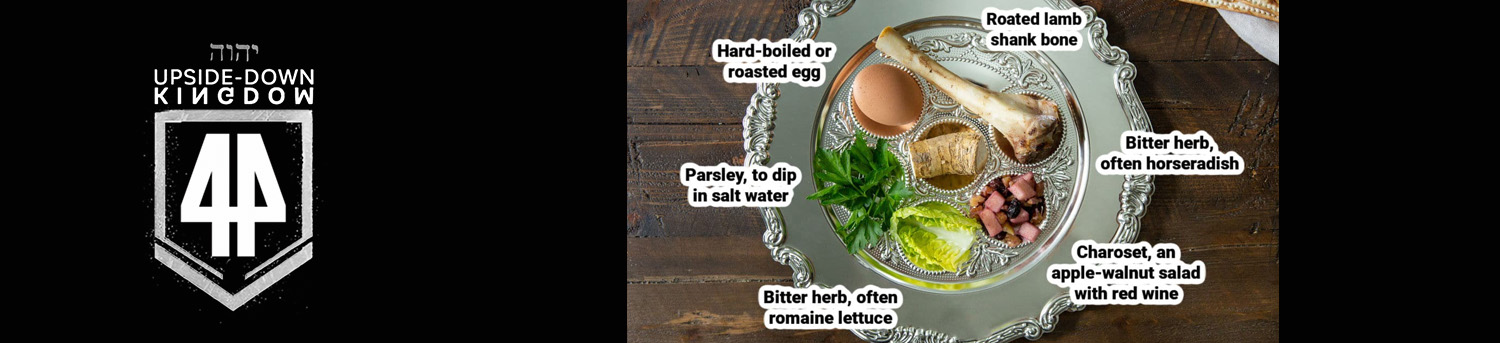
PASSOVER: It is God that we honor in remembering that He passed over the houses of the children of Israel in Egypt when He struck the Egyptians. (Lifting the shank bone of a lamb) The shank bone reminds us of the lamb whose blood marked the doors of the Israelites. We read in Exodus that the lamb was to be without defect, brought into the household and cared for. It was then at twilight, the fourteenth day of the month, that the Israelites were to slaughter the lamb and put the blood on the sides and tops of the doorframes. God gave His people instructions that only through obedience would they be spared from the angel of death. Isaiah told of the coming Messiah, that He would be led like a lamb to the slaughter. We know that Yeshua was our final blood atonement so that we would be freed from the bondage of sin and we would be passed over from death. “Worthy is the Lamb, who was slain, to receive power and wealth and wisdom and strength and honor and glory and praise!” (Revelation 5:12)

LEADER: MATZAH (Lifting the other half of the Middle Matzah): Why do we eat this unleavened bread? The dough did not have time to rise before God revealed Himself to them and redeem them. As it is written: With the dough they had brought from Egypt, they baked cakes of unleavened bread. The dough was without yeast because they had been driven out of Egypt and did not have time to prepare food for themselves. (Exodus 12:39)

LEADER: MAROR (Lifting the Bitter Herb): Why do we eat bitter herb? We eat bitter herb because of the hardship that the Israelites had to bear. As it is written: They made their lives bitter with hard labor in brick and mortar and with all kinds of work in the fields; in all their hard labor the Egyptians used them ruthlessly. (Exodus 1:14)

The Maror

Hebrew Scriptures: Maror (Hebrew: מָרוֹר mārōr) are the bitter herbs eaten at the Passover Seder in keeping with the biblical commandment “with bitter herbs they shall eat it.” (Exodus 12:8).8

Rabbinic Tradition: The maror represents the bitterness of Egyptian slavery. Each Passover, as we eat the maror, we remember the toil and burden of slavery that our ancestors endured. The natural reaction to eating the bitter herbs (usually fresh ground horseradish) is to cry, which is a physical reminder of the sadness of life without redemption.

New Testament: In John 13:26 at the Last Supper, Jesus says, “‘He it is, to whom I shall give a sop, when I have dipped it.’ And when he had dipped the sop, he gave it to Judas Iscariot, the son of Simon” (King James Version). While this is often translated as the unleavened bread that is dipped, it could also be the bitter herbs, since after the first cup, the Passover ceremony commences with bitter herbs dipped into a vinegar sop (karpas). But this seems like a stretch. This is actually one of the reasons who I believe the LAST SUPPER was not a Passover meal. Jesus was a VERY observant Jew. If this was a Passover meal you would think that at least one of the synoptics would have mentioned it or recorded it that way. Passover is mentioned 29 times in 27 verses in the New Testament but never once at any mention of the Last Supper.

LEADER: (Lifting the egg) The egg has also been added to the Seder. It is called kha-hi-hah, a name signifying the special holiday offering. The egg was added during the Babylonian period. The egg does not have a great significance in the Seder other than reminding us of our Jewish heritage and the many obstacles that have been overcome throughout the years. NOTE: Some Christians will identify with a since of Dispensational Zionism and Israel here, I don’t.

The Beitzah

Hebrew Scriptures: The “roasted egg” (beitzah) does not appear in the Hebrew Scriptures as it remembers the destruction of the Temple. Beitza (Hebrew: ביצה) (literally “egg”, named after the first word) is a tractate in Seder Mo’ed, dealing with the laws of Yom Tov (holidays). 9

Rabbinic Tradition: The beitzah represents the renewal of life. Unconsumed, it represents the discontinued korban chagigah (“festival sacrifice”) that was offered at the Temple in Jerusalem. The egg evokes the idea of mourning over the destruction of the Temple and our inability to offer sacrifices at Pesach. However, (this doesn’t make much sense to me) in contemporary Judaism, the beitzah is consumed at the contemporary Seder as an “appetizer,” and is dipped in salt water to symbolically grieve the destruction of the Temple. So are we going to eat the egg? Hmmmm

The traditional Jewish problem: With no Temple, no altar, and no sacrifice, how is it possible to atone for sins? The rabbis say that forgiveness from sin is obtained through repentance, prayer, and good deeds. But the Law of Moses states that atonement must be made through blood, and our good deeds can’t save us. Of course, if you believe is Jesus, you see Him and the sacrifice at the cross as the once and for all atoning work. But you might just want to leave the egg out. What I have done is sometimes leave a few of the eggs “raw not hard boiled” and let someone bight into it to which I can have a conversation pertaining to the problem of the egg discussion in the seder!

The Charoseth

Hebrew Scriptures: Charoset is a sweet, dark-colored mixture of finely chopped fruits and nuts.10 According to the Talmud, its color and texture are meant to recall mortar (or mud used to make adobe bricks), which the Israelites used when they were enslaved in Ancient Egypt, as mentioned in Tractate Pesahim 116a of the Talmud. The charoseth is not specifically mentioned in the Old Testament. The symbolism might be that even the most difficult circumstances of our lives are sweetened by the promise of future redemption.11 But if you’re going to leave anything out this is the first thing I would cut.

LEADER: And now we bless our second cup of wine, the cup of plagues.

ALL: Ba-rukh a-tah A-do-nai E-lo-hey-nu Me-lekh ha-‘o-lam bo-rey pri ha-ga-fen. Blesssed are you, O Lord our God, Ruler of the Universe, who created the fruit of the vine.

(Drink the second cup of wine.)

LEADER: Let us now eat and remember the grace, mercy and love that God has for each of us, for He sent Yeshua, our Messiah, to be our Passover Lamb. We too, like the Israelites released from the bondage of slavery, can be saved from the bondage of sin.

The Lamb

Hebrew Scriptures: Exodus 12:5, 8, 46. The lamb is one of the three items to be eaten at the Passover meal. In the original Passover in Egypt, the entire lamb was central to the observance. The Israelites took the lamb, sacrificed it, placed the blood of the sacrifice on the doorposts of their homes, and then ate the lamb as their main course. At the first Passover, the angel of death “passed over” the homes marked by the blood of the lamb during the final plague.

The word used today for the lamb “shankbone,” zeroa12, is used not only to remind us of the Passover lamb but also as a symbol of God’s “outstretched arm” with which He delivered us from Egypt (Exodus 6:6). The same word (zeroa) is used to pose a question in Isaiah 53, a key Messianic prophecy: “Who has believed what he has heard from us? And to whom has the [zeroa] [in English ‘arm’] of the LORD been revealed?” (v. 1). Then Isaiah continues in verse 2, “For he …” (seemingly now speaking of the arm as a person). Isaiah then goes on to describe the servant who would suffer and die for the sin of his people “like a lamb that is led to the slaughter” (v. 7).

New Testament: Jesus is understood to be the Passover Lamb who was slaughtered to take away the sins of the world (1 Corinthians 5:7). John the Baptist affirmed this when he saw Jesus and said of him, “Behold, the Lamb of God, who takes away the sin of the world!” (John 1:29).

(Eat the broken half-Matzah with Maror and Charoset.)

LEADER: (Lifting the afikomen) We will now eat the afikomen, the dessert. The taste of the afikomen should linger in our mouths. It is about the afikomen that Yeshua said “This is my body given for you; do this in remembrance of me.” (Luke 22:19) The Passover can not be completed without the afikomen, nor can our redemption be complete without Yeshua, the Bread of Life, our Messiah!

ALL: Ba-rukh A-tah A-do-nai El-o-hey-nu Me-lekh ha-‘o-lam ha-mo-tzi le-khem min ha-‘a-retz. Blessed are You, O Lord our God, King of the Universe, who brings forth bread from the earth.

(All eat the Afikoman)

LEADER: Let us fill our cups for the third time this evening. (Lifting the cup) This is the Cup of Redemption, symbolizing the blood of the Passover Lamb. It was the cup “after supper”, which Yeshua identified himself — “This cup is the new covenant in my blood, which is poured out for you.” (Luke 22:20)

ALL: Ba-rukh A-tah A-do-nai E-lo-hey-nu Me-lekh ha-‘o-lam bo-rey pri ha-ga-fen. Blesssed are you, O Lord our God, Ruler of the Universe, who created the fruit of the vine.

(Drink the third cup of wine.)

LEADER: (Lifting the extra cup for Elijah) The theme of this part of the Haggadah before the meal was the redemption of the Israelites from Egypt. In keeping with tradition, we now move to the Messianic redemption. (The 4th cup)

LEADER: Let us fill our cups, the Cup of Praise and give thanks to God!

Ba-rukh A-tah A-do-nai E-lo-he-ynu Me-lekh ha-‘o-lam bo-rey pri ha-ga-fen. 

Blessed are you, O Lord our God, Ruler of the Universe, who created the fruit of the vine.

(Drink the fourth cup of wine.)

LEADER: (Can read Psalm 136)

LEADER: [12] Therefore, since we have such a hope, we are very bold. [13] We are not like Moses, who would put a veil over his face to keep the Israelites from gazing at it while the radiance was fading away. [14] But their minds were made dull, for to this day the same veil remains when the old covenant is read. It has not been removed, because only in Christ is it taken away. [15] Even to this day when Moses is read, a veil covers their hearts. [16] But whenever anyone turns to the Lord, the veil is taken away. [17] Now the Lord is the Spirit, and where the Spirit of the Lord is, there is freedom. [18] And we, who with unveiled faces all reflect the Lord’s glory, are being transformed into his likeness with ever-increasing glory, which comes from the Lord, who is the Spirit. (2 Corinthians 3:12-18)

LEADER: We have now finished our Passover Seder. We are all called to live the Sh’ema — to love the Lord our God with all our heart, soul and might, and to treat others with kindness.  Seek a relationship with God, not a “religion”.

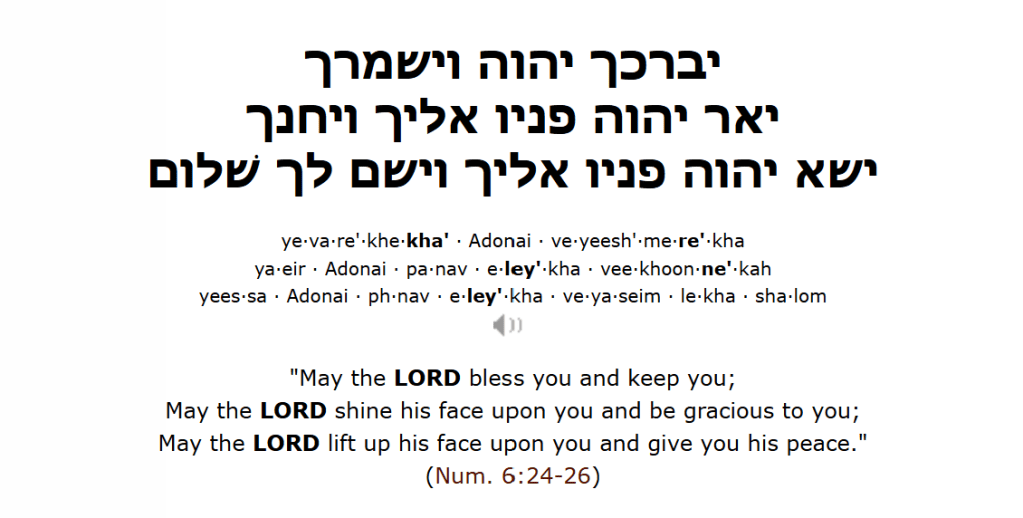
It is fun here to memorize the Aaronic priestly blessing13 in Hebrew and chant or sing it over the people at the table. You could start with having a kid blow a shofar and use a tallit over your head as you commission your family for the year.

WRITERS BEWARE:

Now that we have approached the end of this post. (I am glad you made it.) I want to finish by saying that I have actually only participated in a few seder dinners throughout my life. I thought that might surprise you after just reading this. As with anything, there is some good to be gleaned but also some concern and things to be aware of or even avoid.

The Hebrew Roots movement should concern you. But that isn’t what this post is about. Neither is it about Talmudic Judaism, which should also concern you. Even second Temple late Rabbinical Judaism was largely what Jesus was cleansing the temple of and should concern you. So, my emphasis in anything but particularly the conversation at hand, a Seder dinner, is to stay Biblical. Stick with the text. As you just read my hesitancy in celebrating a Seder dinner is much of it has left the context of scripture and joined “tradition.” It was actually difficult to write all of the NON-Biblical parts of this dinner. Personally, I think they are best avoided, but I still have a place for the biblical aspects of the seder dinner. It is not the authentic Judaism of Moses, Abraham, or the Old Testament prophets. Instead, it represents a later development that might lack elements of the priesthood, temple, and sacrifices central to Abrahamic and Mosaic faith.

I am always careful in devotion toward the Lord to stay balanced on the Word of the Lord. The evolution of commentary is beneficial yet also scary. “I have the right to do anything,” you say—but not everything is beneficial. “I have the right to do anything”—but not everything is constructive. Syncretism, which is a blending of what is true and elements of what we have added should always be a concern.

My hesitancy with the seder dinner is similar to my feelings concerning most modern religious practice. Does it conflate the truth of the gospel? In regard to the seder dinner, I would consider it much like any other theological construct formed after the early church. There may be a need to glean. After the destruction of the Second Temple in 70 AD, the biblical Passover could no longer be observed as prescribed. Without a temple, priesthood, or altar, the sacrificial system ceased. In response, Jewish leaders developed Rabbinic Judaism, a new framework based on oral traditions later codified in the Mishnah (c. 200 AD) and Talmud (c. 500 AD).14 This tradition reimagined Passover as the Seder, a ritual meal with symbolic foods, prayers, and readings, centered on the Haggadah, a text outlining the order of the service. The earliest Haggadah texts date to the 2nd–3rd centuries AD, reflecting a post-temple adaptation designed to preserve Jewish identity in the absence of sacrifice.15

As I have shown above, much of the seder points to Jesus, but some of the roots don’t. I will remind you that Jesus was an observant Jew and commanded us to follow His examples. After the destruction of the Temple much of the Christian community (Paul) remained observant. There were Jews that were Messianic and Jews that weren’t and they continued to practice in similar ways.

To simply say we shouldn’t partake may be a double standard. As I mentioned, remembering Passover in Israel is a foreshadow to communion in the New Covenant. The disposable cups and tiny crackers are hardly adequate of what communion means before the lord (and when was the last time you washed someone’s feet); quite frankly this minimal “remembrance” might even be offensive to Jesus. Christians didn’t start practicing communion as a quick cup of juice and bite of bread distinct act of worship in the church service until 1891.16 Let that sink in for a minute. Most Christians aren’t going to have a problem with quickly partaking every week before they run off to worship the football game because they are embracing the good. God honors steps of goodness towards Him, but we still need to be careful here and teach scriptural truths. Seder is similar. In fact, a Biblical Seder is likely a better “do this in remembrance” than passing tiny cups will ever be. Just because it isn’t practiced as well as it could be (and is sometimes misused) doesn’t mean a Christian should just simply not do it.

Jesus followers need to seek some balance within the world they live in and the manner that Christianity has evolved to a modern world. Live redeemed as a recreated spiritual being whose place is now not of this world. But as long as you live in the physical world, you’re going to need a balancing act. The Seder like so many other religious traditions is a product of a religious system that emerged after Christ’s fulfillment. Should you partake? That is up to you and your family. I have found that I want to celebrate what is good, that which is TOV, and in my sanctification process, I begin to leave behind what is constructed of the world. I personally have found fruit and redemptive work in teaching a “better” Seder. Maybe you will too, or maybe in your season it is best to leave it alone. Both might be good options or relevant to your situation and season. Only you can decide. And what was meant to be simple has become complex.

Conclusion

Passover is not a stand-alone example of God’s redemptive power. God has continually and faithfully delivered His people. The Passover symbols remind us of God’s continued presence with us and the hope we have in Messiah.

ENDNOTES

This article has been adapted by permission from my good friends at JEWS FOR JESUS. When I attended Moody Bible Institiute in the early 1990’s MBI was one of the centers for Jews for Jesus and I enjoyed a rich friendship with their ministry.

  1. https://jewsforjesus.org/learn/the-passover-symbols-and-their-messianic-significance ↩︎
  2. Glatstein, Daniel (13 March 2023). Rav Daniel Glatstein on the Haggadah (1st ed.). Mesorah Publications Ltd. ↩︎
  3. https://expedition44.com/2025/04/15/understanding-the-biblical-lens-of-the-cross-and-the-timeline-of-the-resurrection-holy-week/ ↩︎
  4. https://www.compellingtruth.org/unleavened-bread.html ↩︎
  5. So spelled and vocalized in de Rossi 138 (Parma A) and Kaufmann A50; also spelled אפיקמון in the Cambridge manuscript and by Joseph Ashkenazi  ↩︎
  6. Traditionally, the word is explained as “dessert” or “that which comes later.” The late Jewish scholar David Daube, professor of law at the University of California, Berkeley, and others have more recently defended the explanation that it is derived from the Greek afikomenos, “the coming one.” See David Daube, Collected Works of David Daube, vol. 2, New Testament Judaism, ed. Calum Carmichael (Berkeley: The Robbins Collection, 1992), 425; Deborah Bleicher Carmichael, “David Daube on the Eucharist and the Passover Seder,” Journal for the Study of the New Testament 42 (1991), 45–67. ↩︎
  7. https://www.amazon.com/Crushing-Great-Serpent-Punish-Jesus/dp/B0DGJJJ1V5 ↩︎
  8.  “Seder Preparations – Jewish Tradition”yahadut.org↩︎
  9.  Steinsaltz, Rabbi Adin Even-Israel; Society, The Aleph (2014-04-01). “The Aleph Society- Let My People Know”The Aleph Society↩︎
  10.  “Seder Preparations – Jewish Tradition”yahadut.org ↩︎
  11. Joan Alpert (2013-03-25). “The sweet story of Charoset”. Moment. ↩︎
  12. “The Shank Bone (Zeroah)”http://www.chabad.org. ↩︎
  13. https://hebrew4christians.com/Blessings/Synagogue_Blessings/Priestly_Blessing/priestly_blessing.html#loaded ↩︎
  14. https://hope4israel.org/the-sacrificial-system/ ↩︎
  15. Glatstein, Daniel (13 March 2023). Rav Daniel Glatstein on the Haggadah (1st ed.). Mesorah Publications Ltd. ↩︎
  16. https://www.thejenkinsinstitute.com/blog/2020/4/presenting-the-communion-a-history-and-a-question ↩︎

Tracing the steps of The Rabbi

Our trip to Israel was truly incredible. I have created a virtual tour re-stepping our journey as if you were one of the 12. This post will seek to deliver a theologian’s skeptical and deep look into the probable path of Jesus. It is a virtual tour of the steps He walked and will serve as a great tour guide to perhaps the best understanding of what really took place 2000 years ago. Blessings.

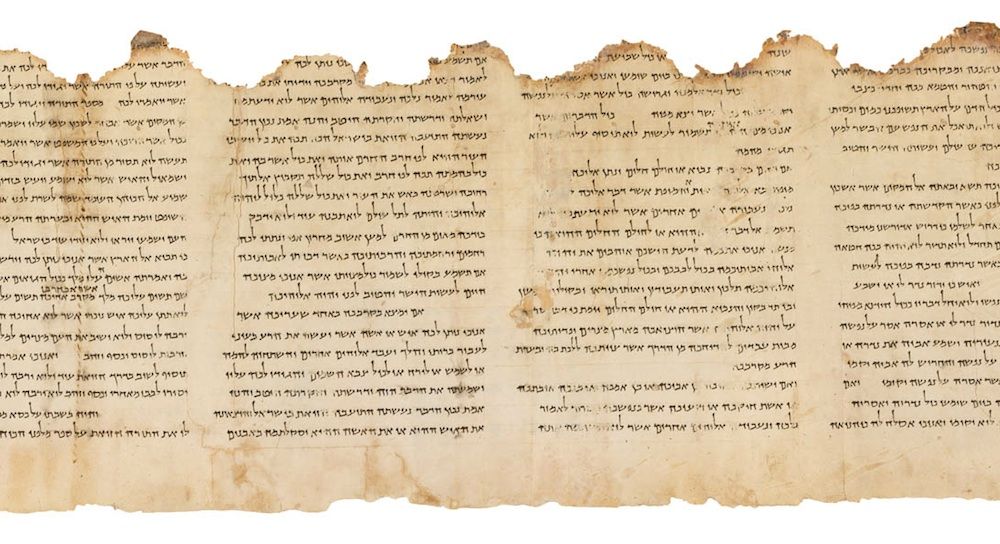
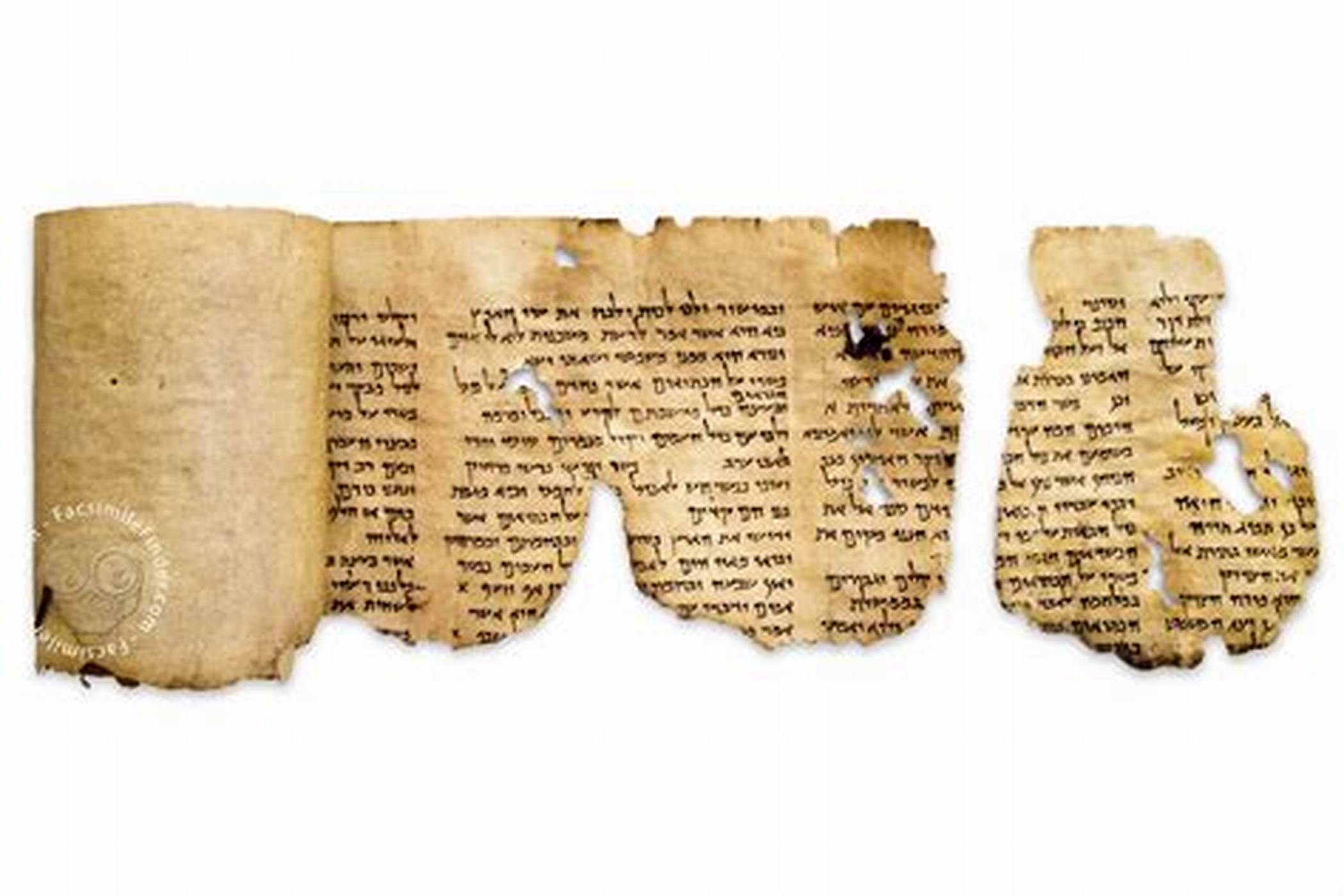
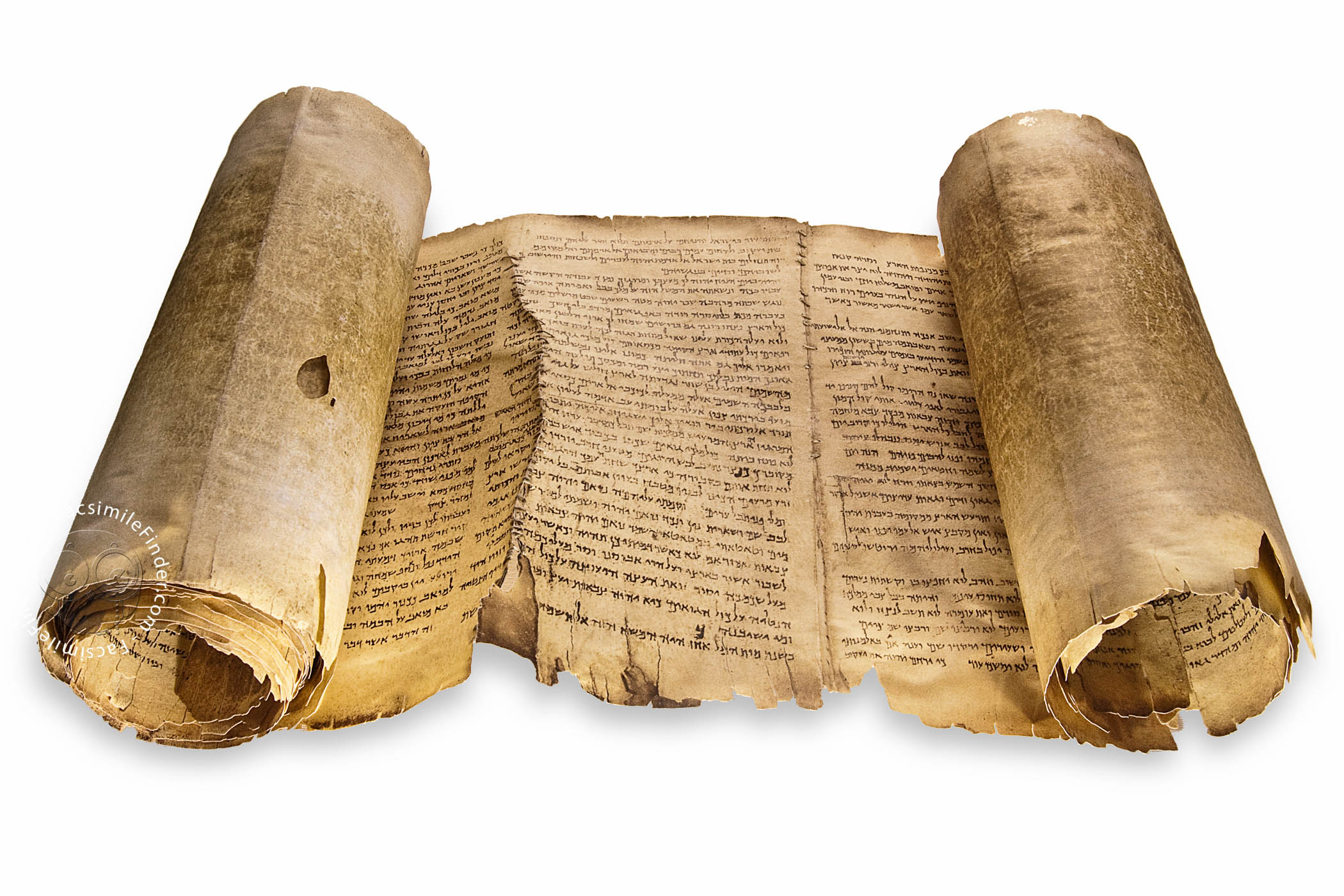
The Dead Sea Scrolls, also called the Qumran Caves Scrolls, are a set of ancient Jewish manuscripts from the Second Temple period. They were discovered over a period of 10 years, between 1946 and 1956, at the Qumran Caves near Ein Feshkha in the West Bank, on the northern shore of the Dead Sea. Dating from the 3rd century BCE to the 1st century CE,[3] the Dead Sea Scrolls include the oldest surviving manuscripts of entire books later included in the biblical canons, including deuterocanonical manuscripts from late Second Temple Judaism and extrabiblical books. At the same time, they cast new light on the emergence of Christianity and of Rabbinic Judaism.[4] Almost all of the 15,000 scrolls and scroll fragments are held in the Shrine of the Book at the Israel Museum located in Jerusalem.

Owing to the poor condition of some of the scrolls, scholars have not identified all of their texts. The identified texts fall into three general groups:

  1. About 40% are copies of texts from Hebrew scriptures.
  2. Approximately 30% are texts from the Second Temple period that ultimately were not canonized in the Hebrew Bible, such as the Book of Enoch, the Book of Jubilees, the Book of Tobit, the Wisdom of Sirach, Psalms 152–155, etc.
  3. The remainder (roughly 30%) are sectarian manuscripts of previously unknown documents that shed light on the rules and beliefs of a particular sect or groups within greater Judaism, such as the Community Rule, the War Scroll, the Pesher on Habakkuk, and The Rule of the Blessing.[5]

Here is an entire article from our trip on the Dead Sea Scrolls.

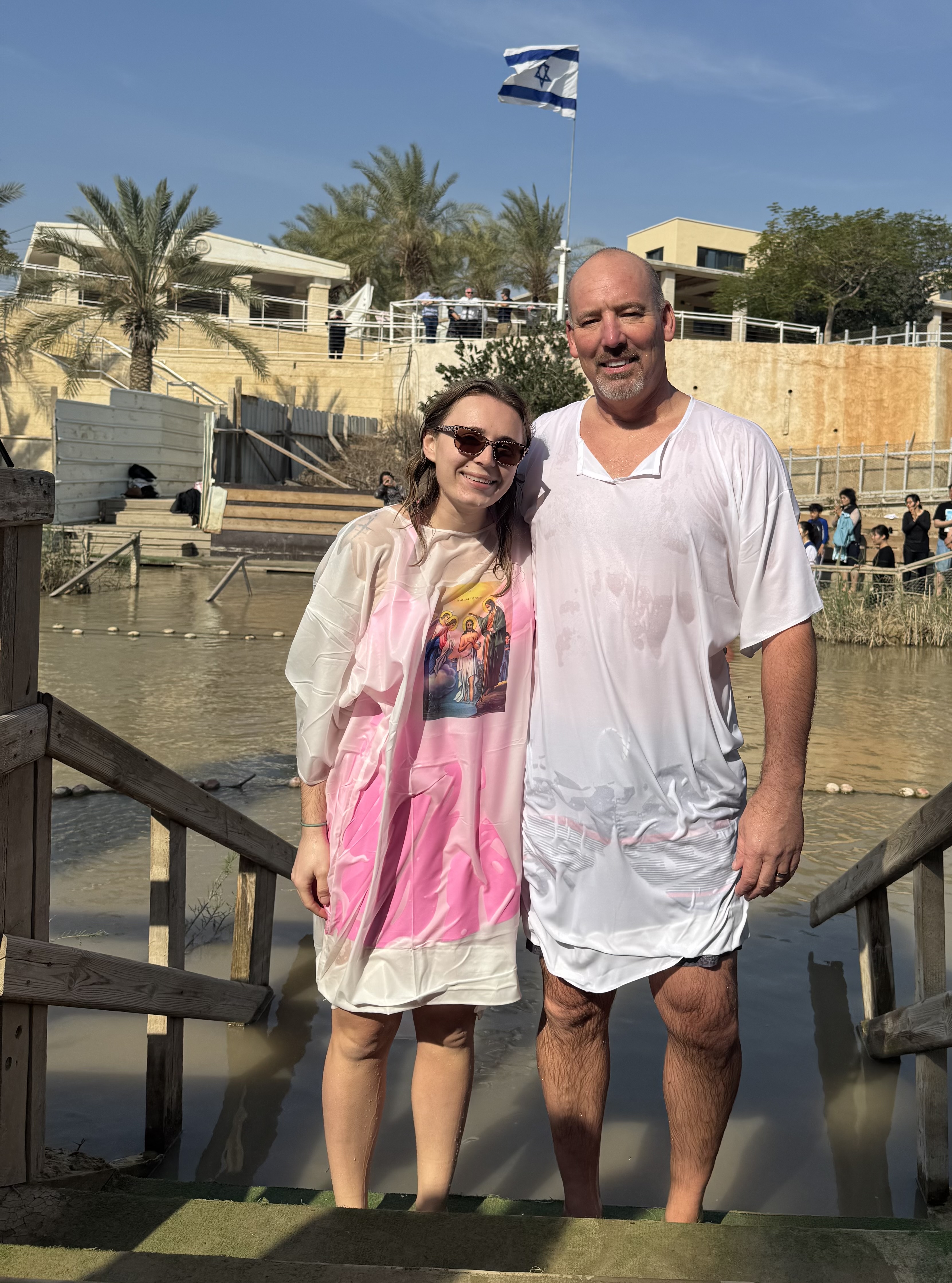
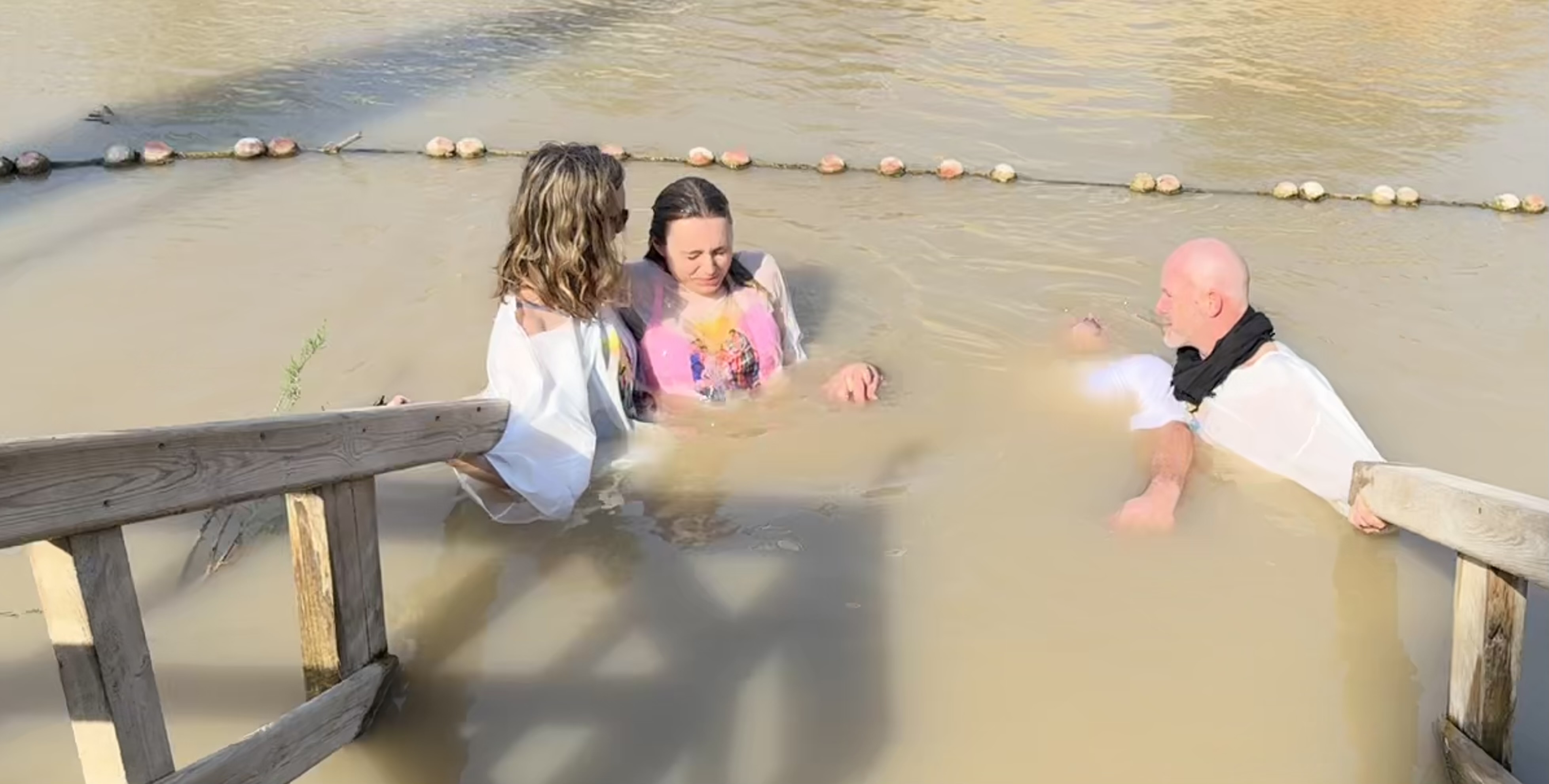
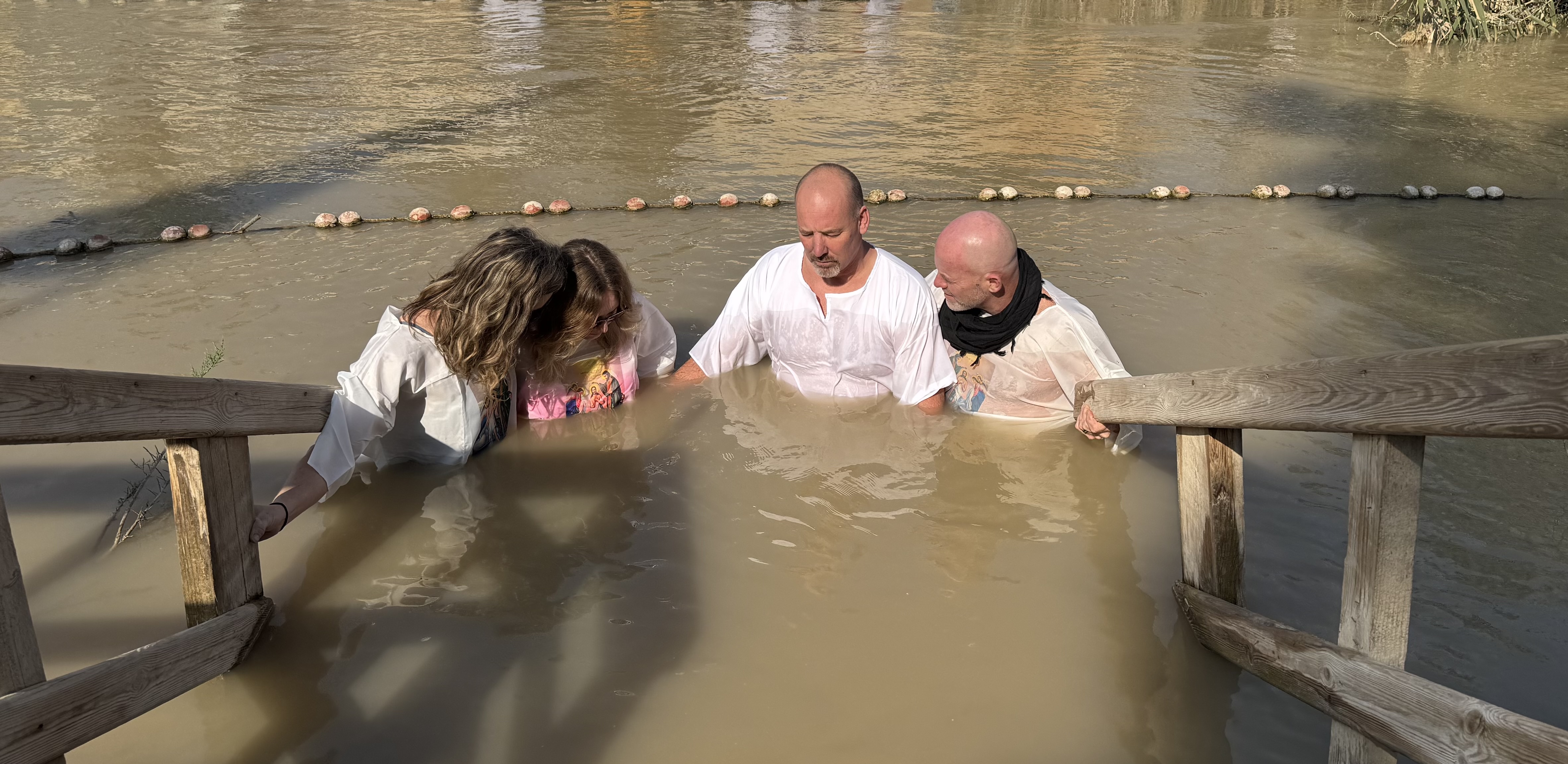
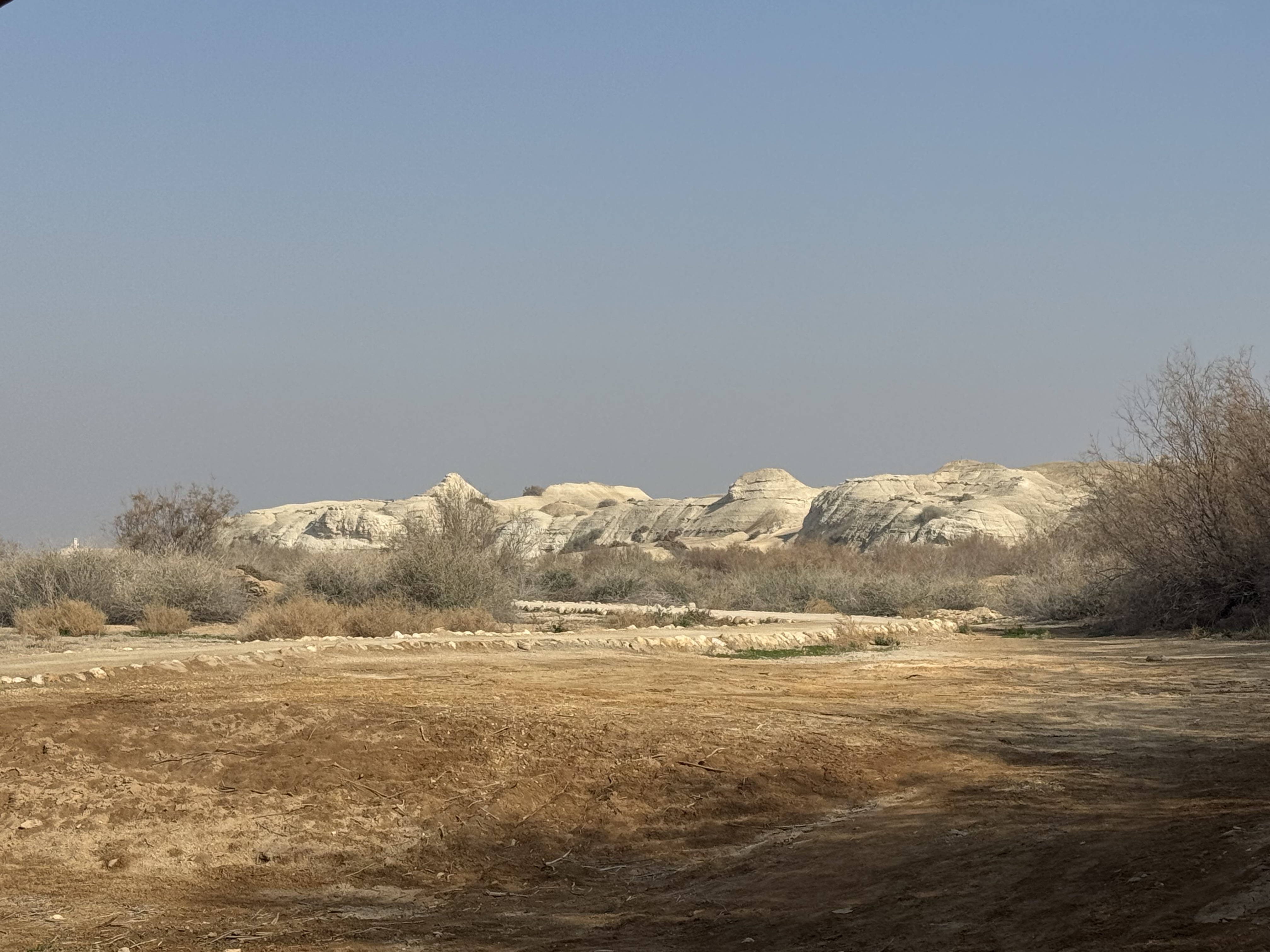
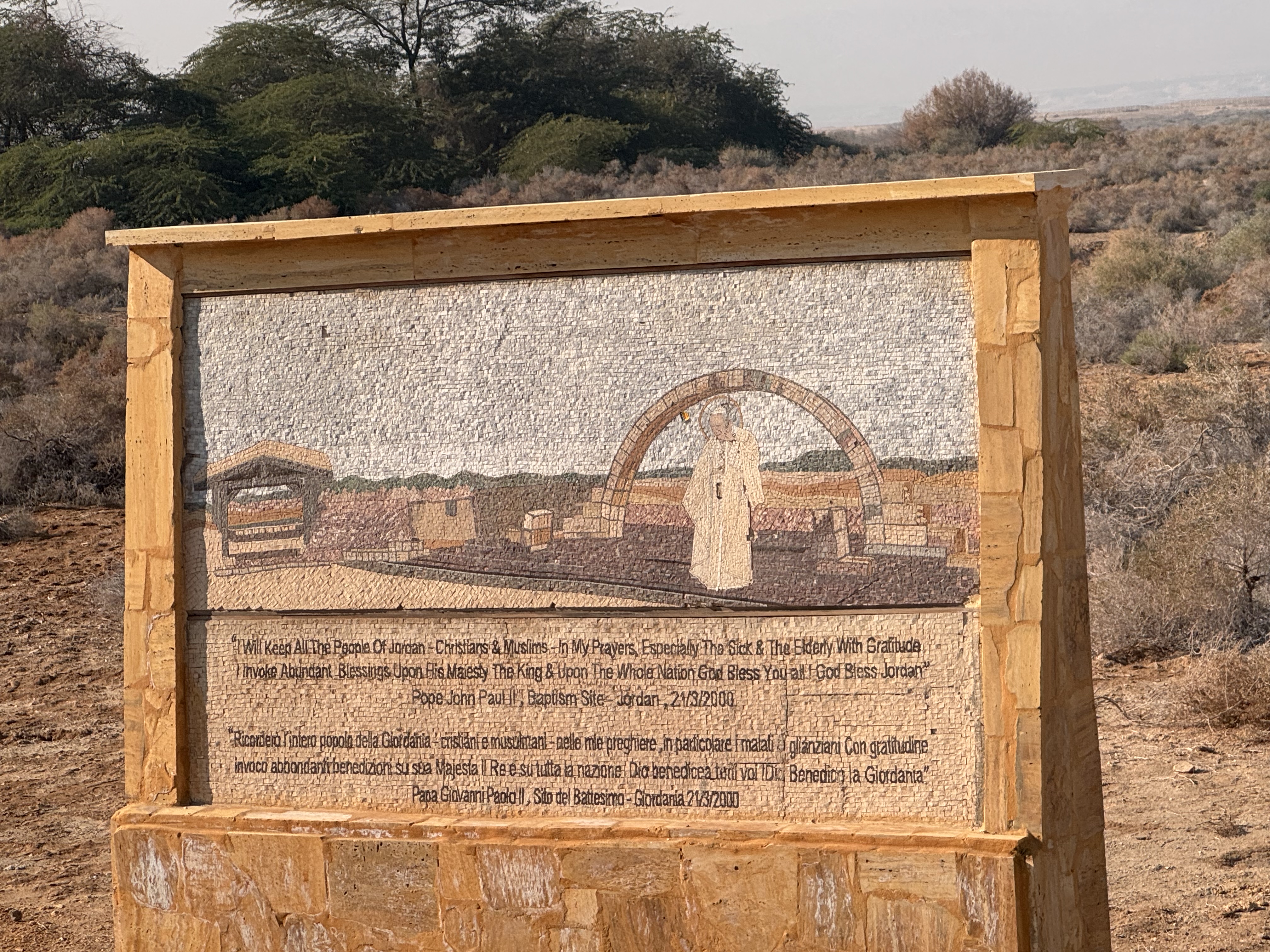
The baptism of Jesus, the ritual purification of Jesus with water by John the Baptist, described in (Matthew, Mark and Luke). It is considered to have taken place at Al-Maghtas, the Gospel of John (John 1:28) states that John was baptizing in “Bethany Beyond the Jordan.” This site was found following UNESCO-sponsored excavations.[6] I wrote a dedicated article to this as well. The river has always been small… more of a stream than a river and I am betting the baptismal site accessed from both the Israel side and Jordan side has been excavated to be more of a “pond” for baptisms. The bottom is clay muck and is quite dirty. If you approach from the Israel side, you won’t see what was likely the Jordan than John and Jesus used as it is dried up now. If you come from the Jordan side, you will walk past the former path of the river (now hardly a stream) and see the place that was very likely the exact spot. But getting baptized in the actual spot isn’t an option anymore and the place accessible from both Israel and Jordan will be close enough for most.

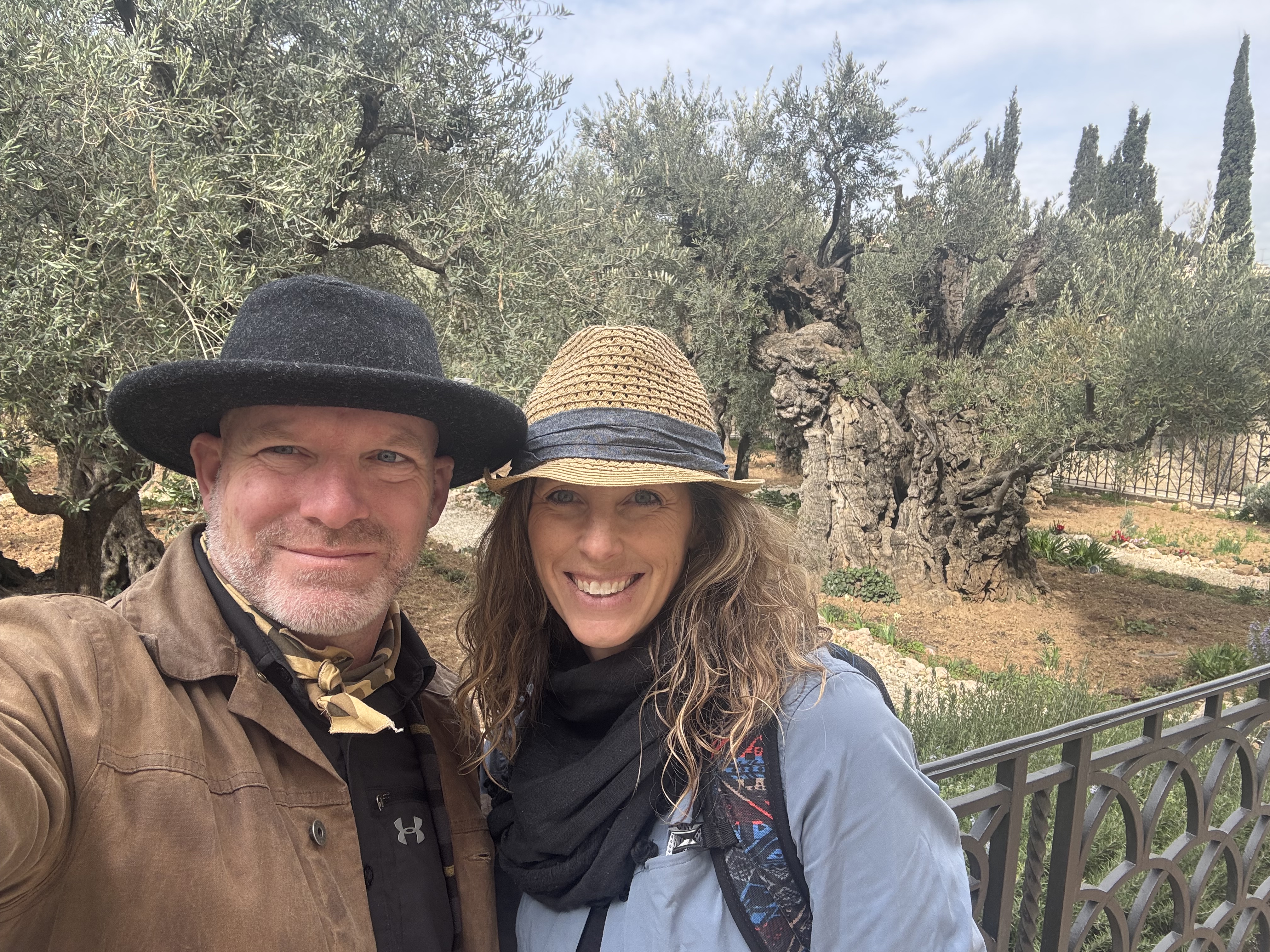
This is Gethsemane the garden at the foot of the Mount of Olives in East Jerusalem, where, according to the four Gospels, Jesus Christ underwent the Agony in the Garden and was arrested before his crucifixion. Currently, there are several small olive groves in church property that has been upkept by the Franciscans. Mark and Matthew record that Jesus went to “a place called the oil press (Gethsemane)” and John states he went to a garden near the Kidron Valley. Modern scholarship acknowledges that the exact location of Gethsemane is unknown.[1] I would propose that it was actually slightly higher closer to where we were parked where there is now a gravesite (See photo). Eight ancient olive trees growing in the Latin site of the garden may be 900 years old.[2]

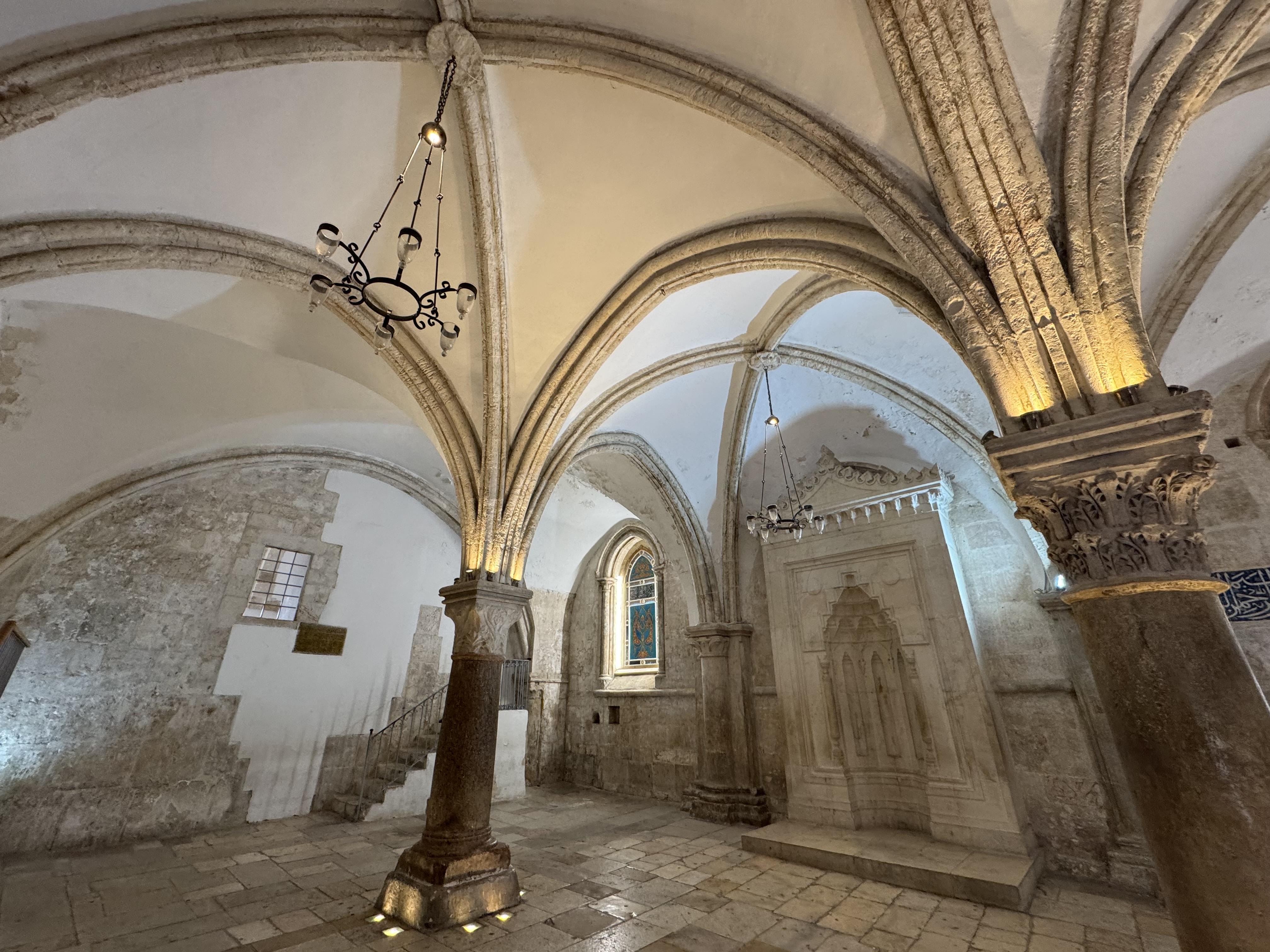
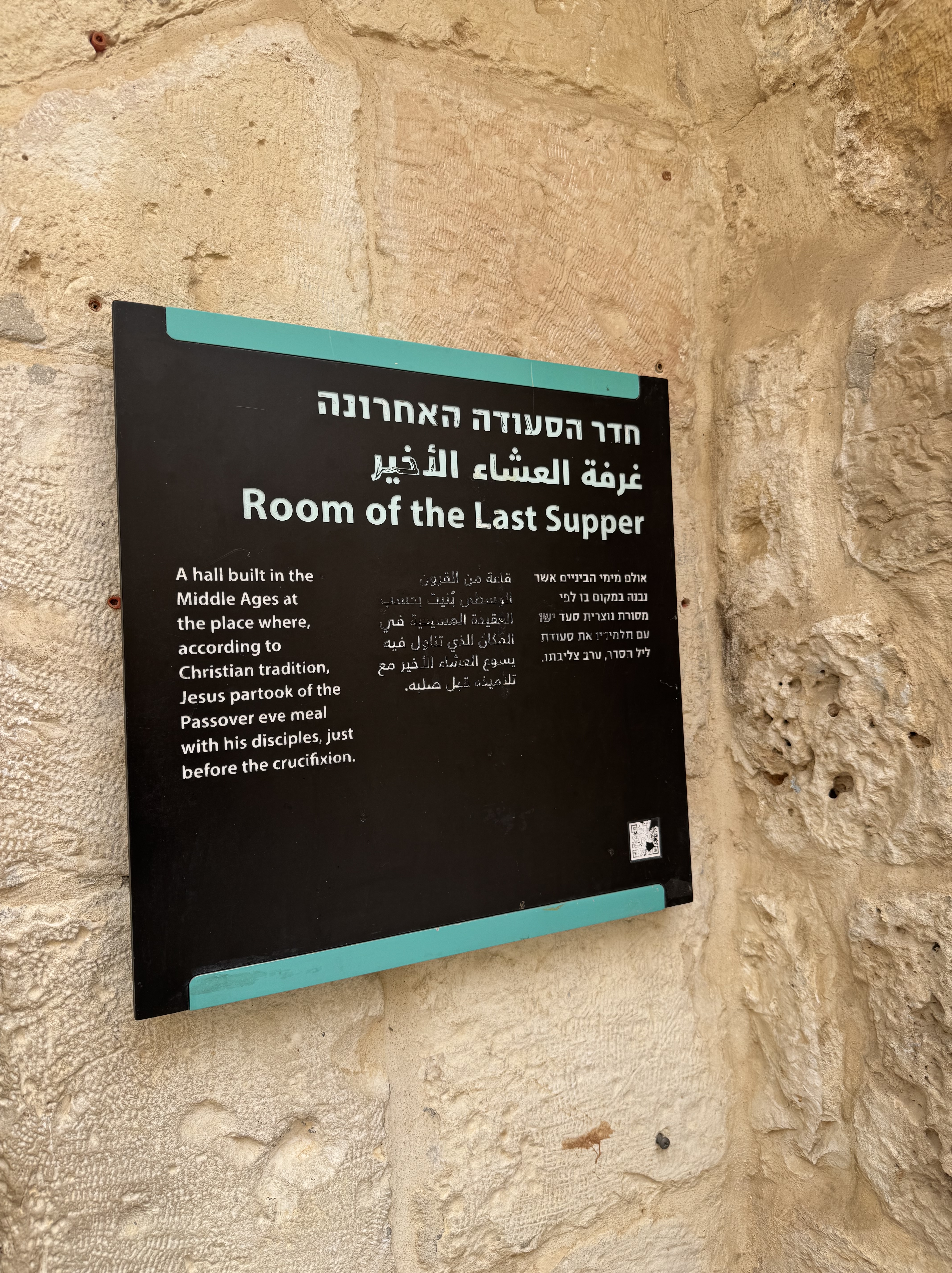
The Cenacle, also known as the Upper Room (from the Koine Greek anagaion and hyperōion, both meaning “upper room”), is a room in Mount Zion in Jerusalem, just outside the Old City walls, traditionally held to be the site of the Last Supper, the final meal that, in the Gospel accounts, Jesus held with the apostles.

The Cenacle was a place in which the apostles continued to gather after the Last Supper, and it was also the site where the Holy Spirit alighted upon the twelve apostles on Pentecost, Matthias having been “numbered with the eleven apostles” to replace Judas in Acts 1:25.[7] The site is administered by the Israeli authorities, and is part of a building holding what is known as “David’s Tomb” on its ground floor, although that may be more controversial.

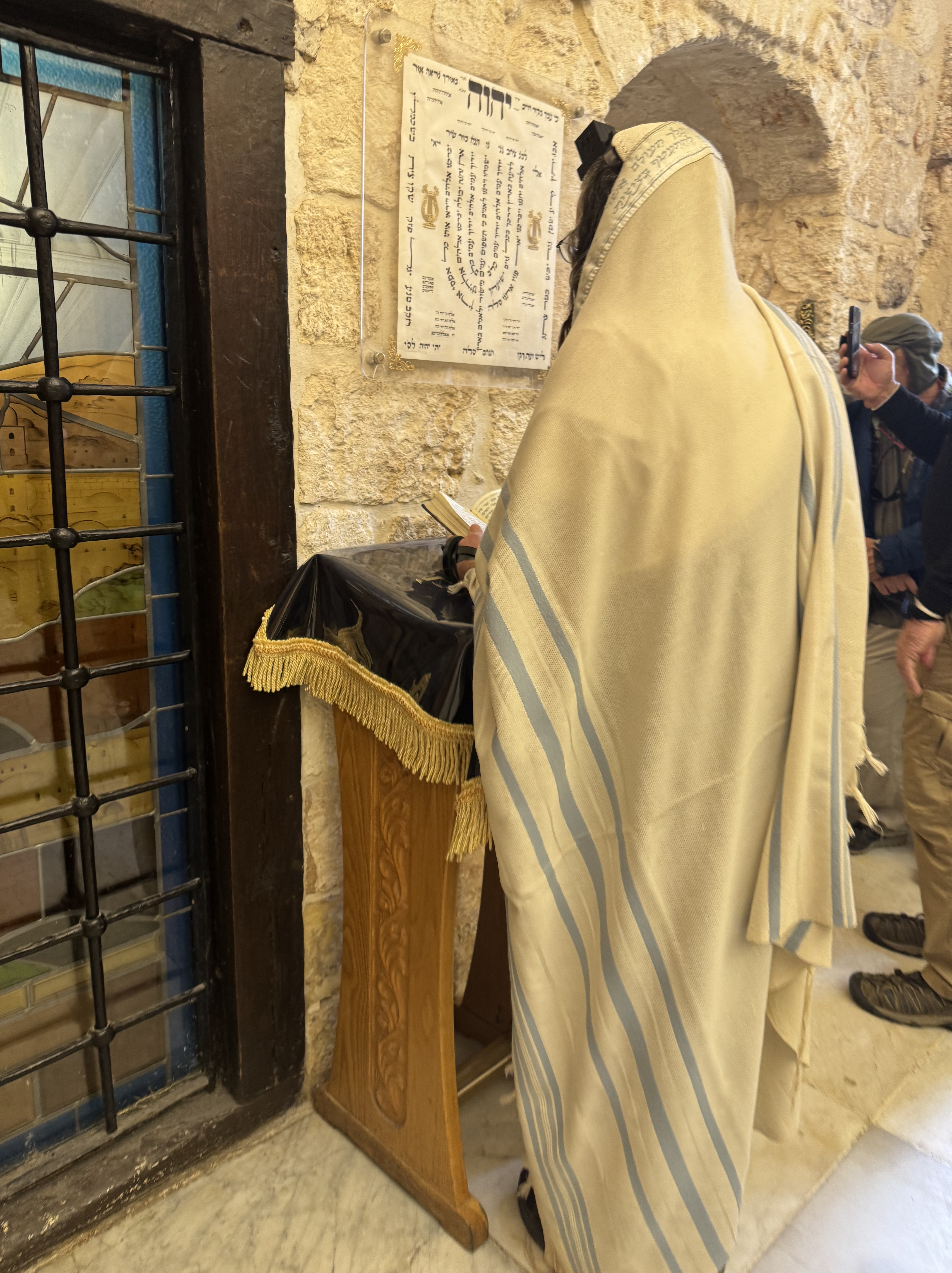
David’s Tomb is a site that, according to a Medieval (9th century) tradition, is associated with the burial of the biblical King David.[8] Images are above, however, historians, archaeologists and theological scholars do not consider the site to be the actual resting place of King David.[8] I would suggest that since the area known today as Mount Zion was not part of inhabited Jerusalem in King David’s time (tenth century BCE) that he was not buried there. Rather, King David was buried in the southeastern area of Jerusalem’s real Old City, which is located to the south of the Temple Mount and Dung Gate and is known today as the City of David. Joel Kramer also makes a convincing argument here.

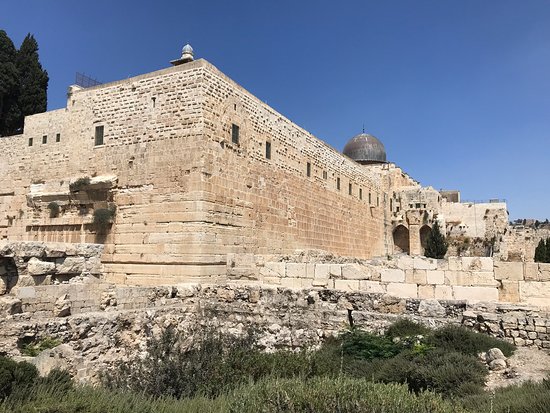
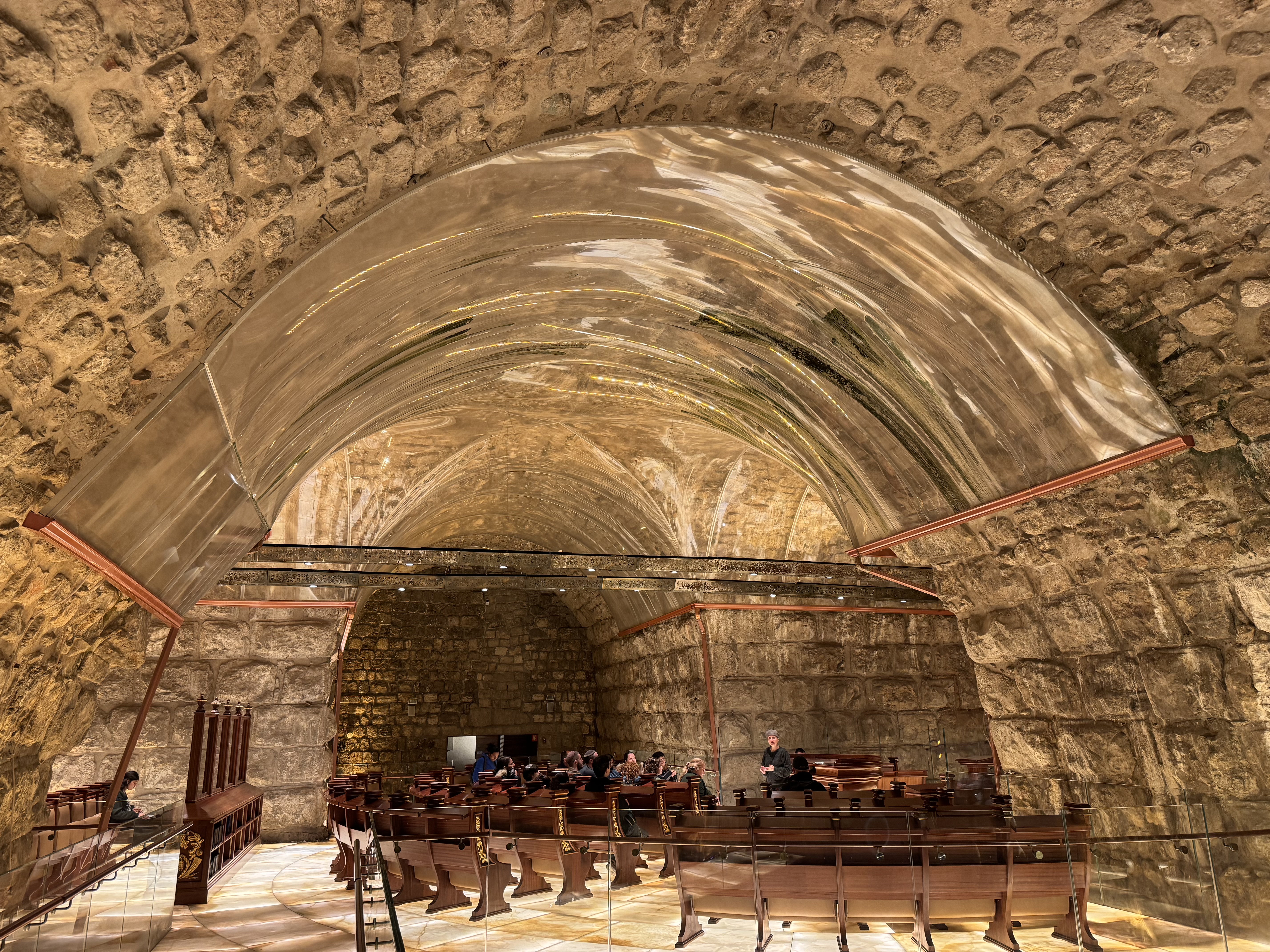
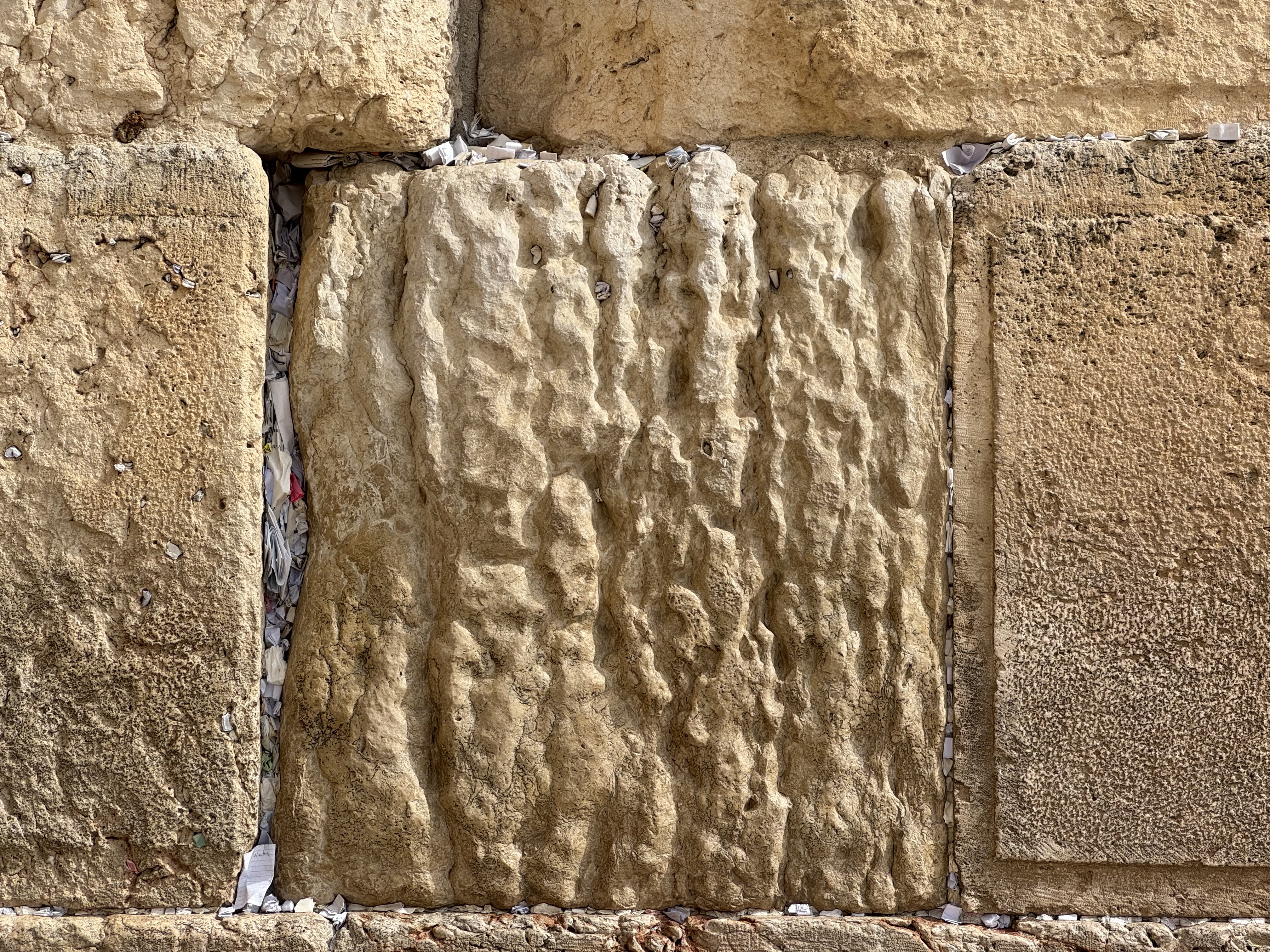
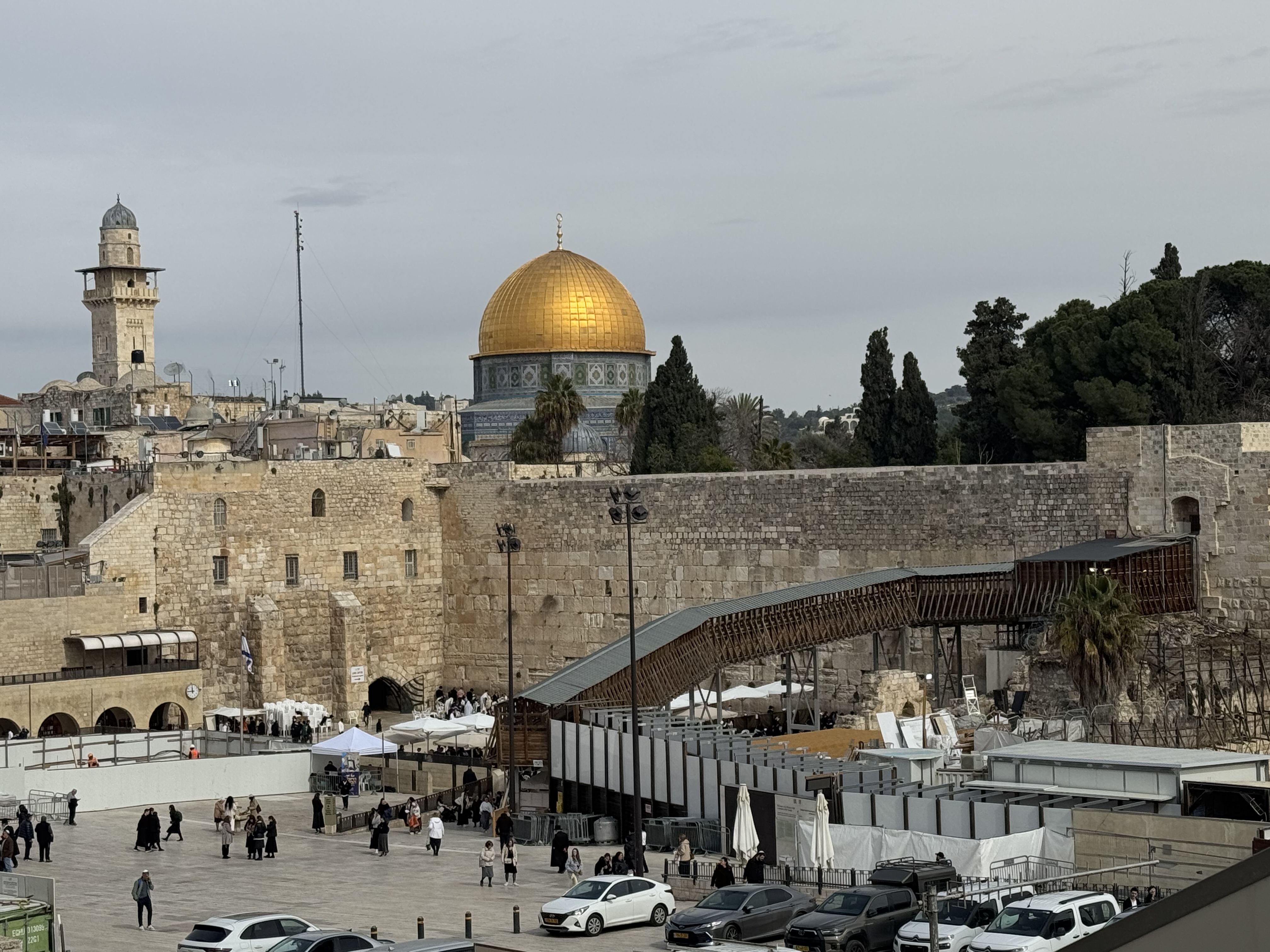
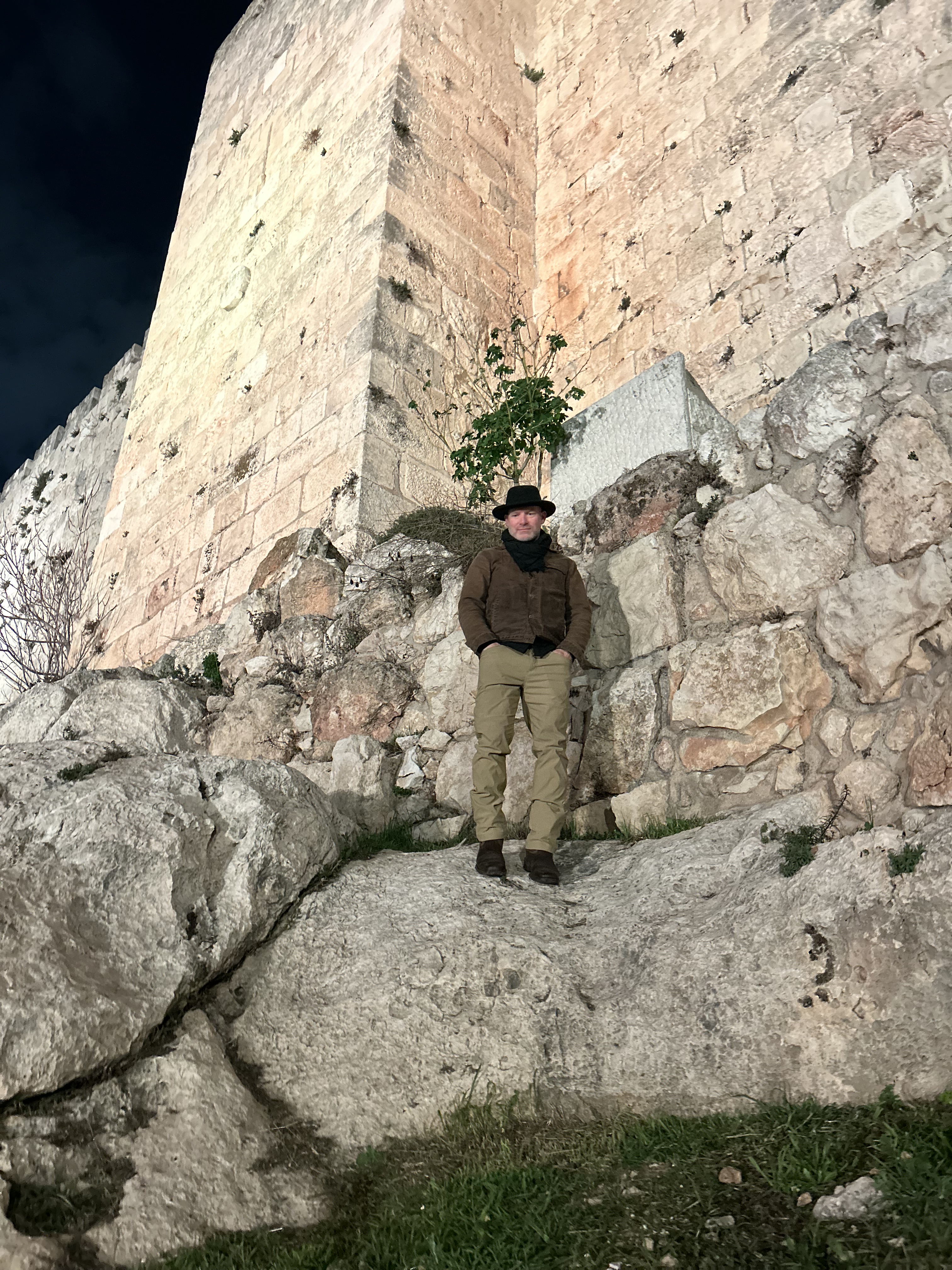
The Western Wall is an ancient retaining wall of the built-up hill known to Jews and Christians as the Temple Mount of Jerusalem. Its most famous section, known by the same name, often shortened by Jews to the Kotel or Kosel, is known in the West as the Wailing Wall. In a Jewish religious context, the term Western Wall and its variations is used in the narrow sense, for the section used for Jewish prayer; in its broader sense it refers to the entire 488-metre-long (1,601 ft) retaining wall on the western side of the Temple Mount. At the prayer section, just over half the wall’s total height, including its 17 courses located below street level, dates from the end of the Second Temple period, and is believed to have been begun by Herod the Great.[10] The very large stone blocks of the lower courses are Herodian, the courses of medium-sized stones above them were added during the Umayyad period, while the small stones of the uppermost courses are of more recent date, especially from the Ottoman period.

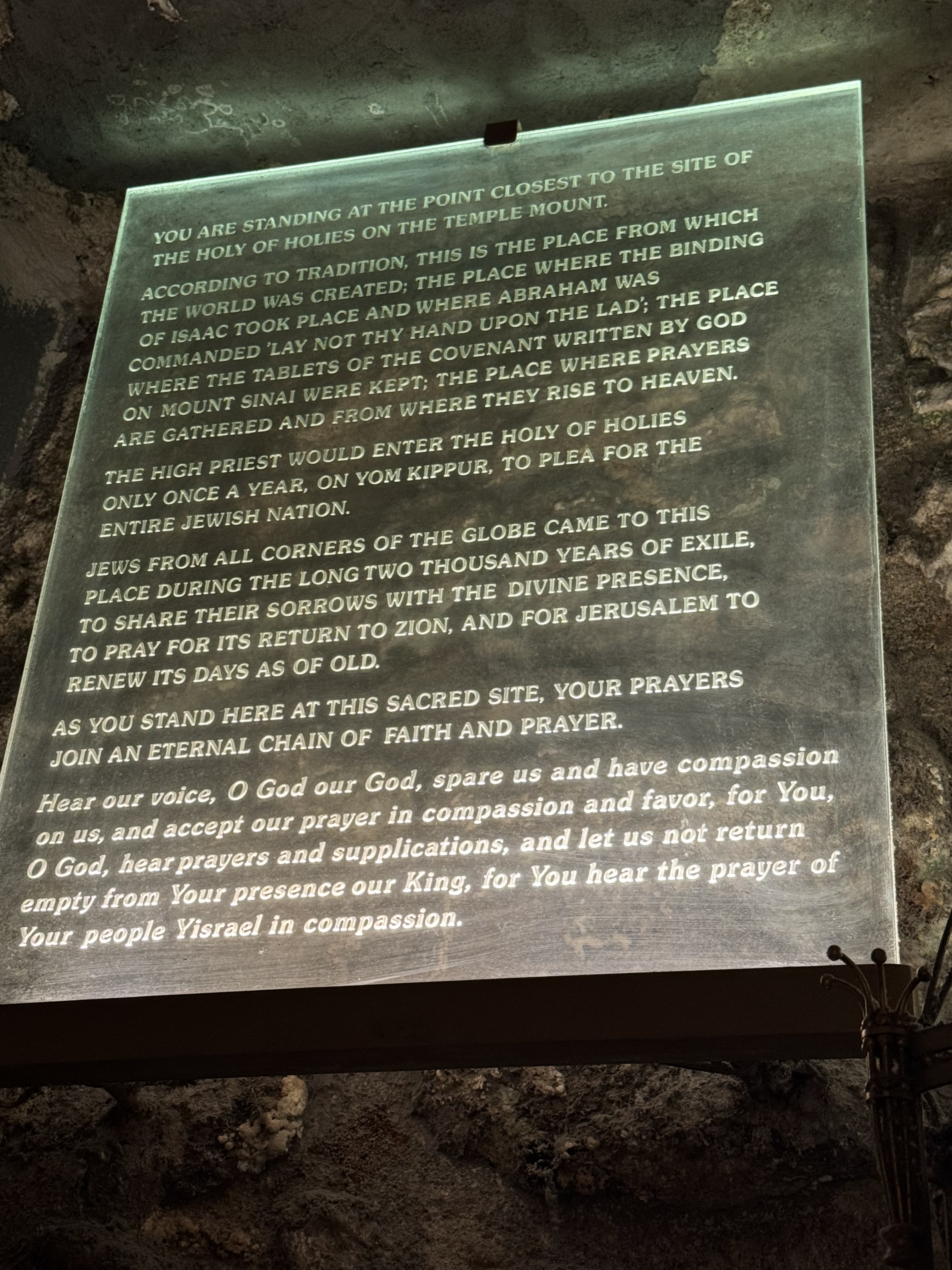
The Western Wall plays an important role in Judaism due to it being part of the man-made “Temple Mount”, an artificially expanded hilltop best known as the traditional site of the Jewish Temple. Because of the Temple Mount entry restrictions, the Wall is the holiest place where Jews are permitted to pray outside the Temple Mount platform, because the presumed site of the Holy of Holies, the most sacred site in the Jewish faith, presumably lies just above and behind it. The original, natural, and irregular-shaped Temple Mount was gradually extended to allow for an ever-larger Temple compound to be built at its top.

With the rise of the Zionist movement in the early 20th century, the wall became a source of friction between the Jewish and Muslim communities, the latter being worried that the wall could be used to further Jewish claims to the Temple Mount and thus Jerusalem. During this period outbreaks of violence at the foot of the wall became commonplace, with a particularly deadly riot in 1929 in which 133 Jews and 116 Arabs were killed, with many more people injured. After the 1948 Arab–Israeli War the eastern portion of Jerusalem was occupied by Jordan. Under Jordanian control Jews were completely expelled from the Old City including the Jewish Quarter, and Jews were barred from entering the Old City for 19 years, effectively banning Jewish prayer at the site of the Western Wall. This period ended on June 10, 1967, when Israel gained control of the site following the Six-Day War. Three days after establishing control over the Western Wall site, the Moroccan Quarter was bulldozed by Israeli authorities to create space for what is now the Western Wall plaza.[11]

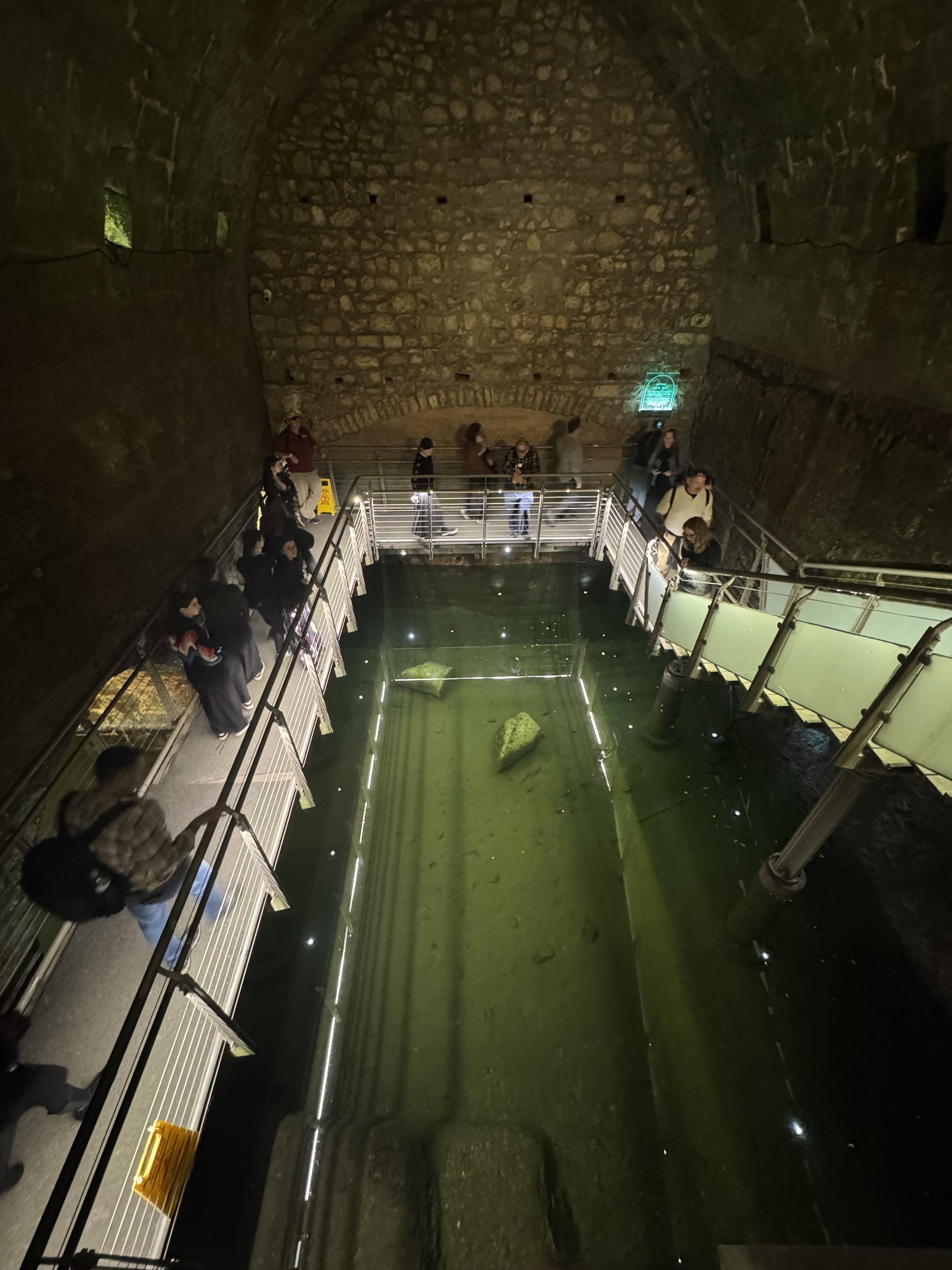
The wall and Temple Mount area is 30-40 feet higher than it was during the time of Jesus and has been built over many times. You can still walk the “tunnels” which show you the original wall.

I wrote an article on this one here. Here is an excerpt…

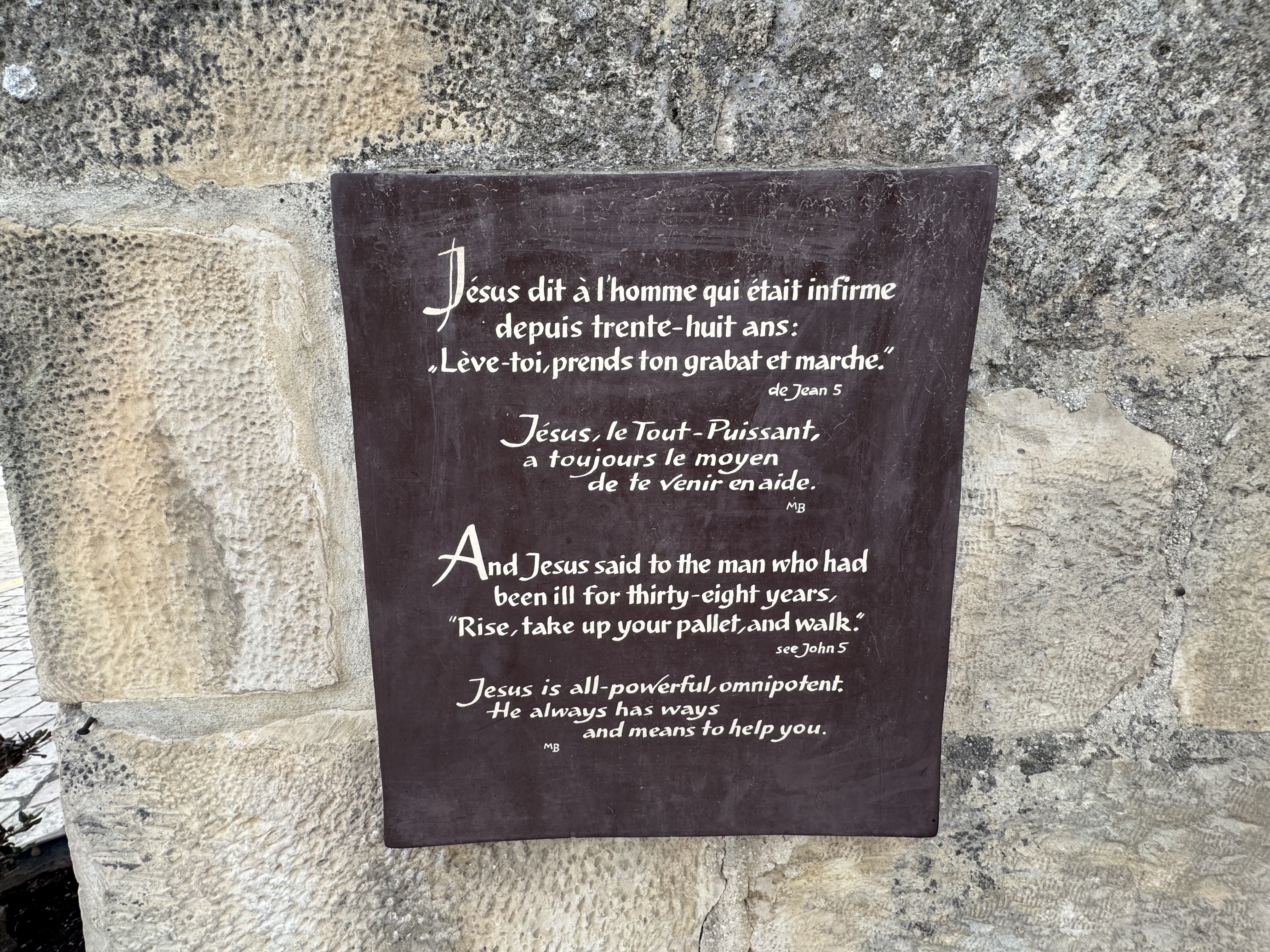
In John 5 we find Jesus, the great physician, engaged with a man who is physically unwell. The Pool of Bethesda is referred to in John 5:2 when Jesus heals a paralyzed man at a pool of water in Jerusalem, described as being near the Sheep Gate and surrounded by five covered colonnades or porticoes. I saw this today and it came to life. (It is also sometimes referred to as Bethzatha[12] and is now established in the current Muslim Quarter of the city, near the Church of St. Anne, which was excavated in the late 19th century.

The name of the pool in Hebrew is Beth hesda (בית חסד/חסדא) which is a bit ambiguous and could mean “house of mercy”[13] or “house of grace” likely due to the invalids waiting to be healed.[14][15][16]IN Greek it reads Βηθεσδά (Bethesda),[17] appearing in manuscripts of the Gospel of John, include Βηθζαθά[18] (Beth-zatha = בית חדתא[19]) as a derivative of Bezetha, and Bethsaida (not to be confused with Bethsaida, a town in Galilee), although the latter is considered to be a metathetical corruption by Biblical scholars.[20] Franz Delitzsch suggests this is a Mishnaic Hebrew loanword from the Greek estiv/estava, that appropriately referred to stoa (στοά).[21] That would seem to fit here. As I mentioned earlier, when you visit this in person you are looking down into a deep hole. This is because over 2000 years nearly 40 feet of fill has been added to nearly the entire Temple mount. Until the 19th century, there was no conception for the existence of such a pool. The Pool of Bethesda almost took on a mystical or magical persona similar to the fabled fountain of youth. However, Conrad Schick in 1872 was permitted to conduct research on the Temple Mount, which was generally off limits to non-Muslims.[22] He discovered a large tank situated about 100 feet (30 m) north-west of St. Anne’s Church, which he contended was the Pool of Bethesda. Further archaeological excavation in the area, in 1964, uncovered the remains of the Byzantine and Crusader churches, Hadrian’s Temple of Asclepius and Serapis, and the small healing pools of an Asclepeion, the second of the two large pools, and the dam between them.[23] It was discovered that the Byzantine church had been built in the very heart of Hadrian’s temple and contained the healing pools.[24] Essentially, when you see this in person as it was excavated, it comes to life. You see the gentle steps for the inflicted, and the way around them. You see how it was likely off the beaten bath and in the bad part of town.

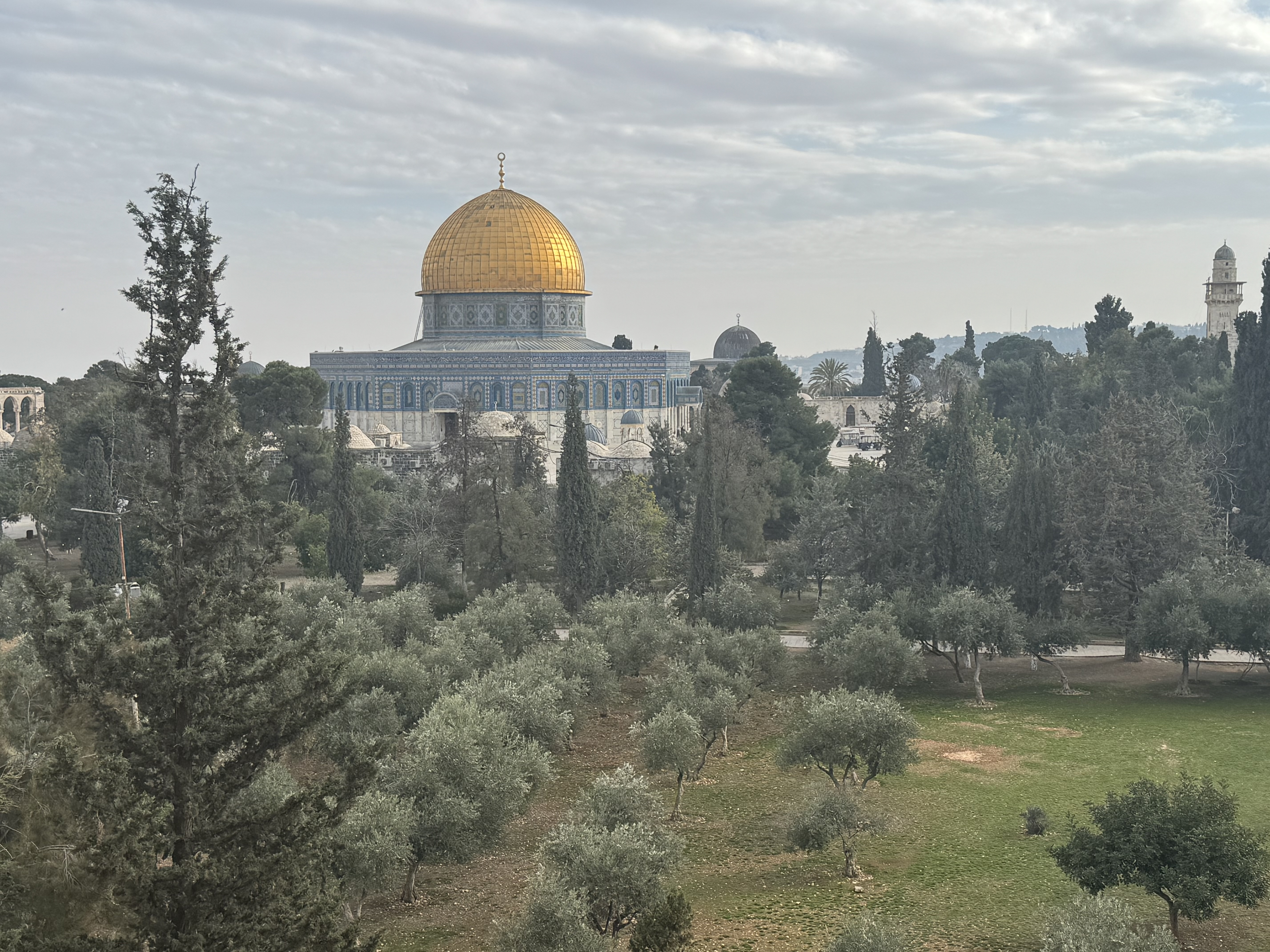
The Dome of the Rock is an Islamic shrine at the center of the Al-Aqsa mosque compound on the Temple Mount in the Old City of Jerusalem. It has been situated on top of the site of the Second Jewish Temple (built in c. 516 BCE to replace the destroyed Solomon’s Temple and rebuilt by Herod the Great), which was destroyed by the Romans in 70 CE. The original dome collapsed in 1015 and was rebuilt in 1022–23.

The Foundation Stone (or Noble Rock) that the temple was built over bears great significance in the Abrahamic religions as the place where God created the world as well as the first human, Adam.[26] It is also believed to be the site where Abraham attempted to sacrifice his son, and as the place where God’s divine presence is manifested more than in any other place, towards which Jews turn during prayer. The site’s great significance for Muslims derives from traditions connecting it to the creation of the world and the belief that the Night Journey of Muhammad began from the rock at the center of the structure.[27] It has been called “Jerusalem’s most recognizable landmark”[28] along with two nearby Old City structures: the Western Wall and the “Resurrection Rotunda” in the Church of the Holy Sepulchre.

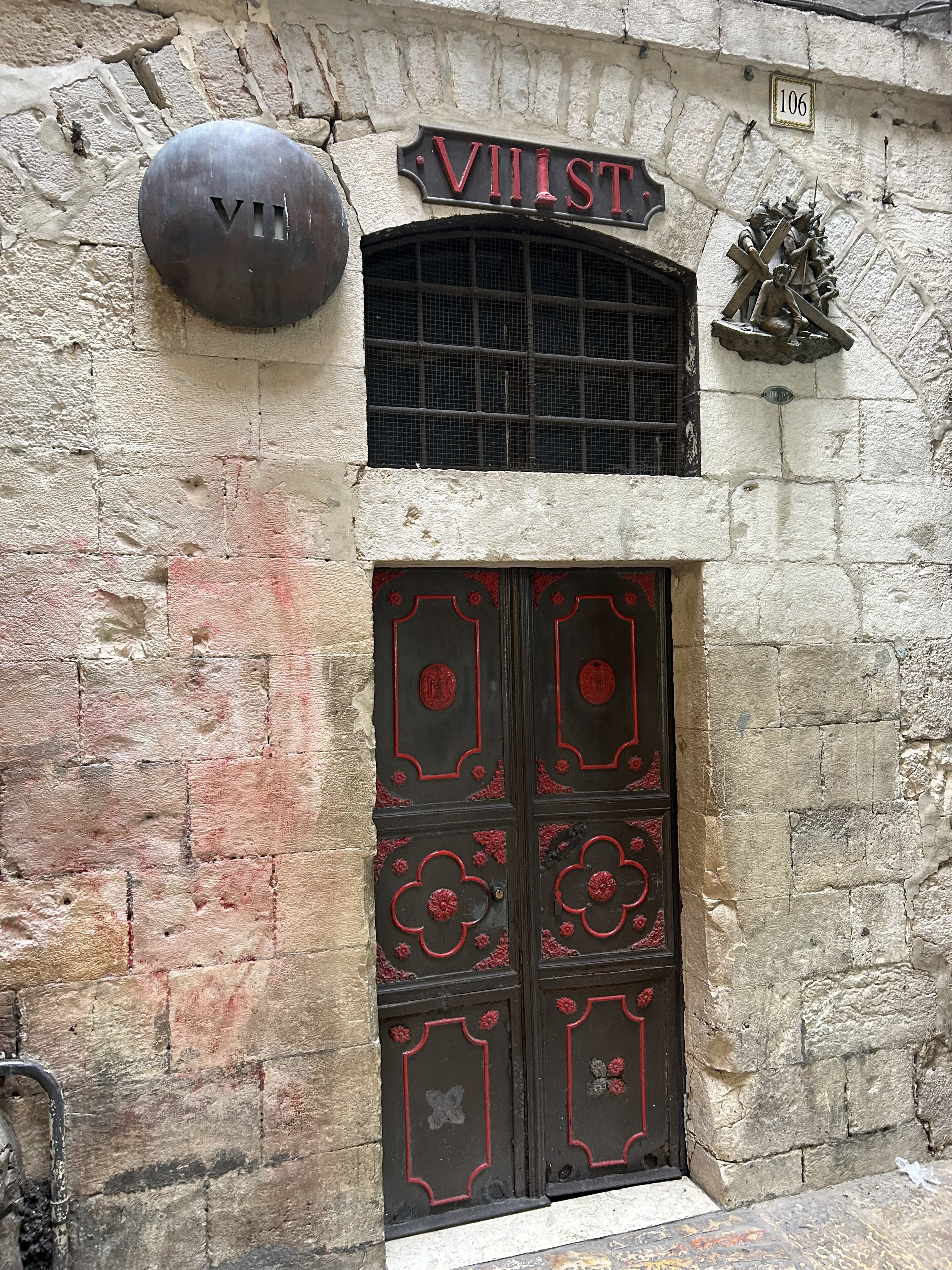
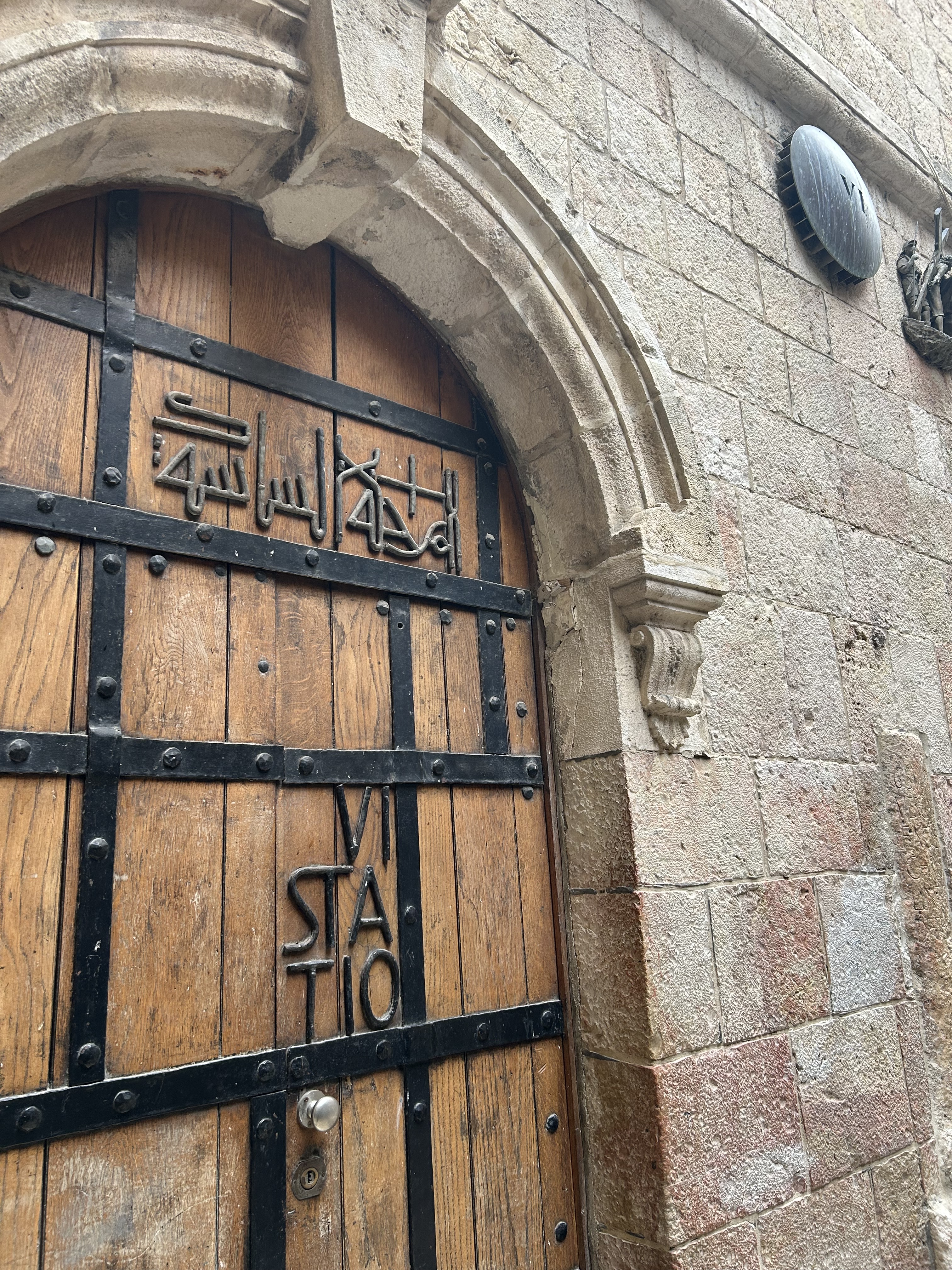
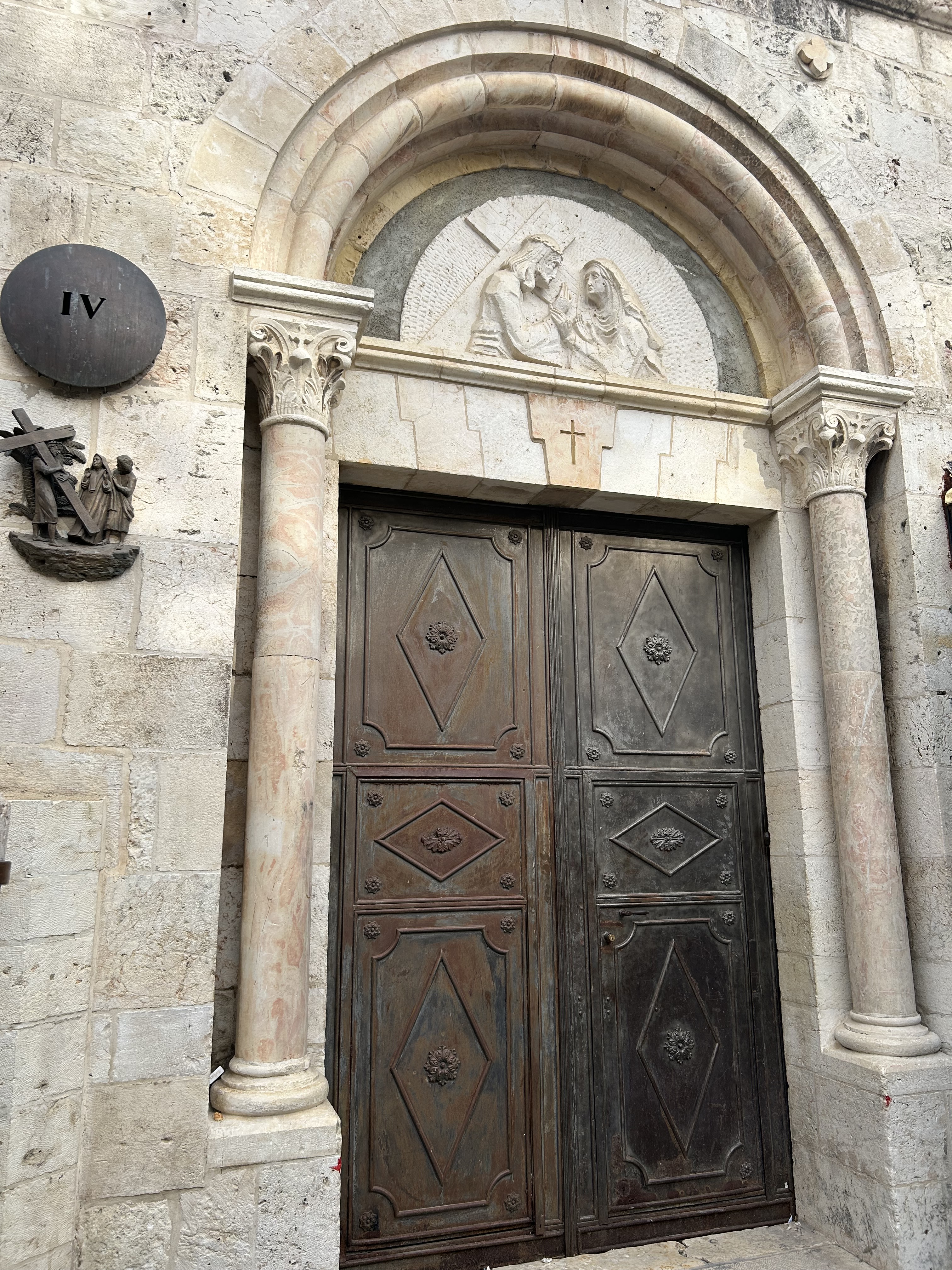
The Stations of the Cross or the Way of the Cross, also known as the Way of Sorrows or the Via Crucis, are a series of images depicting Jesus Christ on the day of his crucifixion and accompanying prayers. The stations grew out of imitations of the Via Dolorosa in Jerusalem, which is a traditional processional route symbolizing the path Jesus walked to Mount Calvary. The objective of the stations is to help the Christian faithful to make a spiritual pilgrimage through contemplation of the Passion of Christ. However, the stations are mainly Catholic relics and aren’t biblical to much if any degree and therefore I cringe even writing this. I highly doubt this was the path of Jesus. But I thought I should show you some pictures.

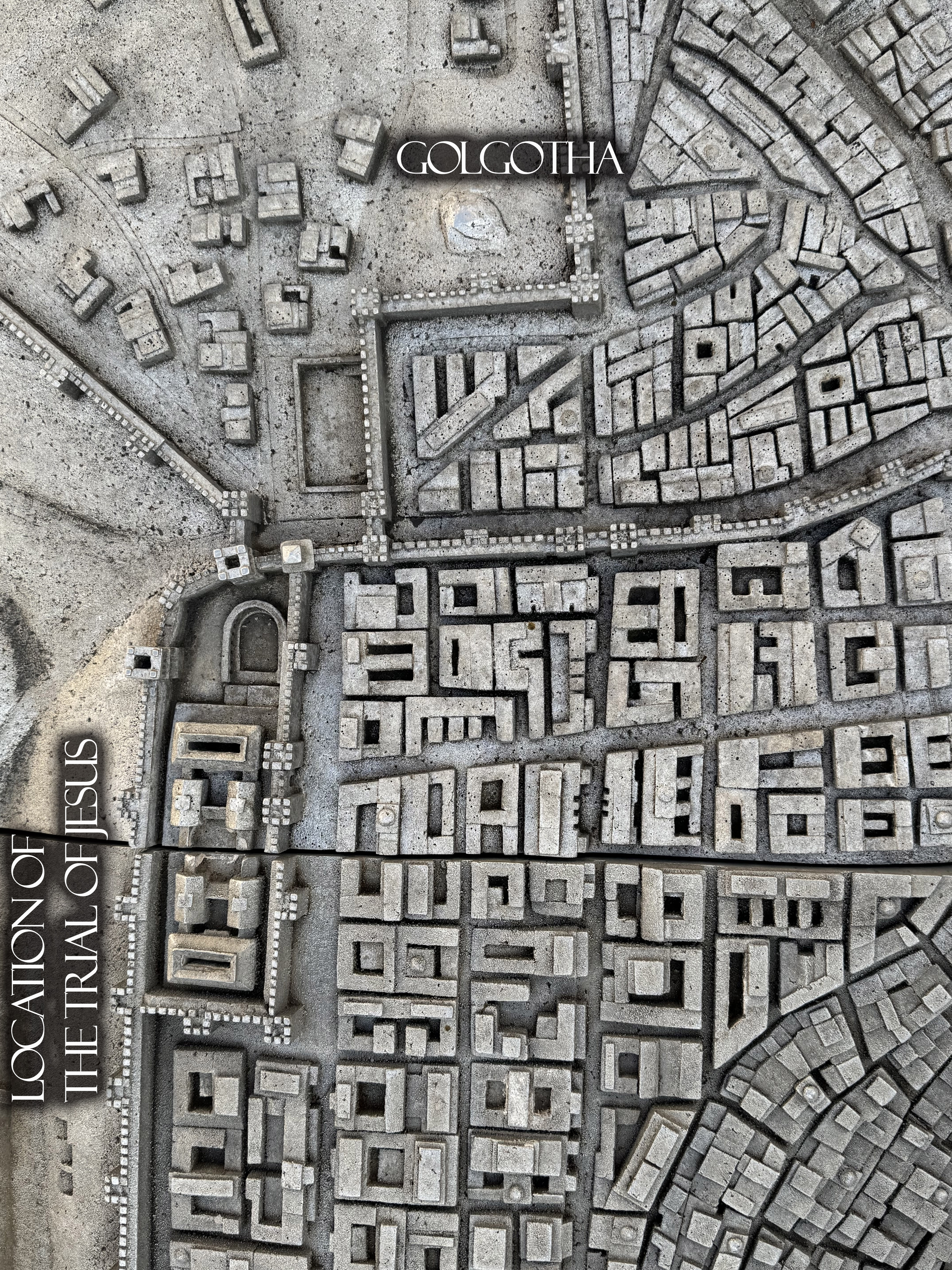
As I can imagine you’re asking, what was the path of Christ, here is an overview of where he was tried and the likely place of Golgotha which I will get to. If you look at the outer gate where Jesus was tried you can see there are several ways they could have taken to get to Golgotha, none of which line up with the advertised tourism path!

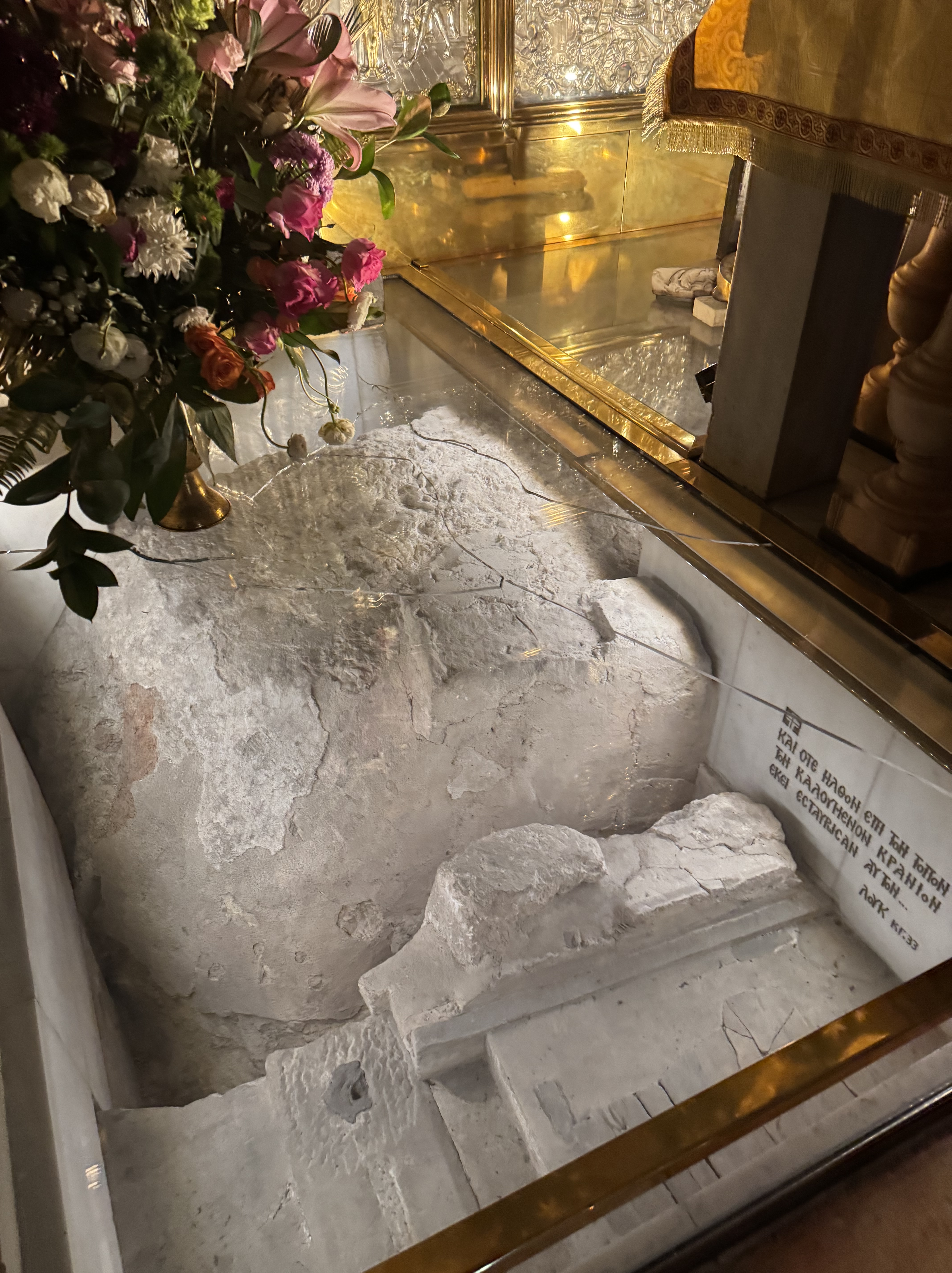
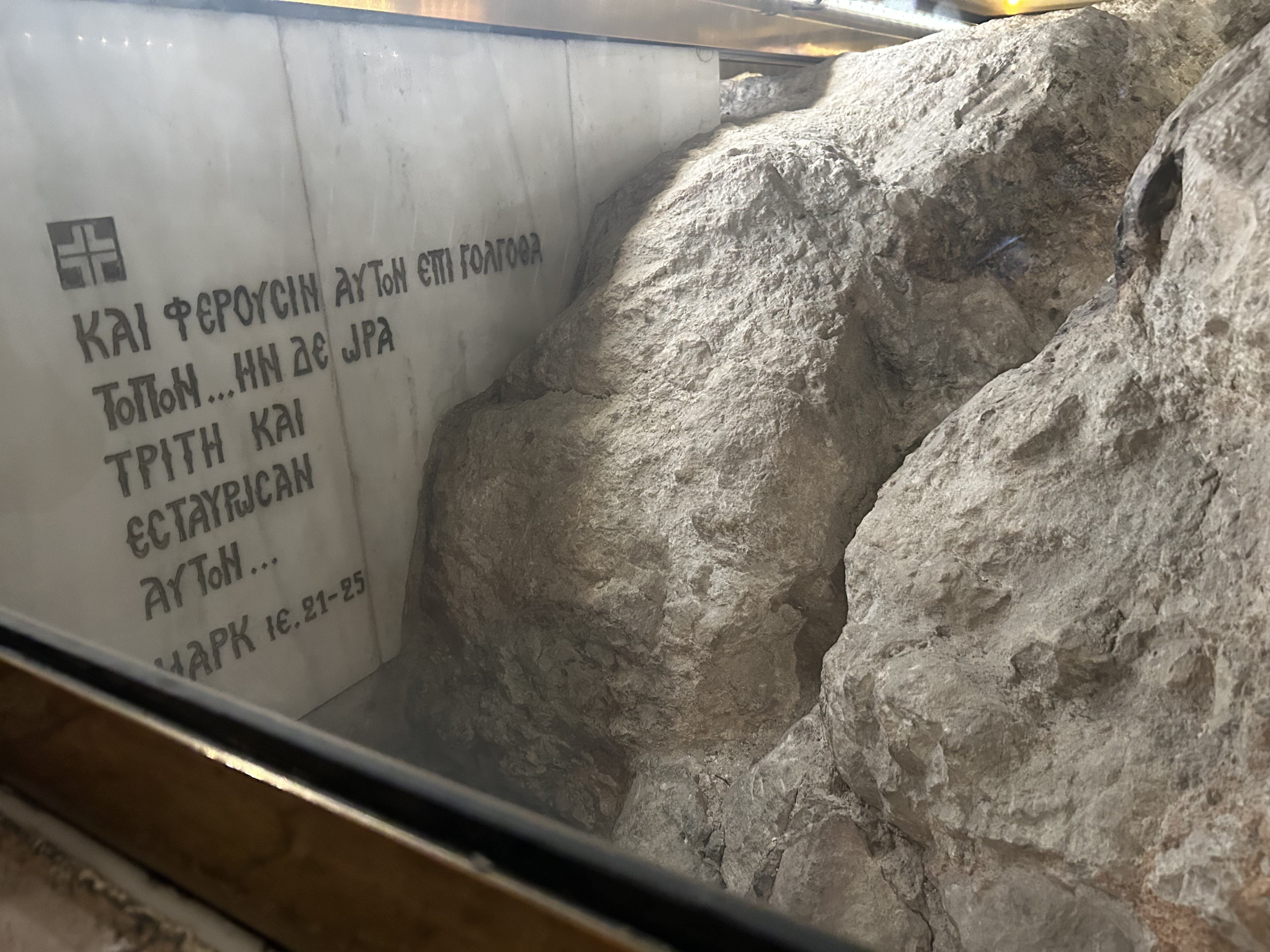
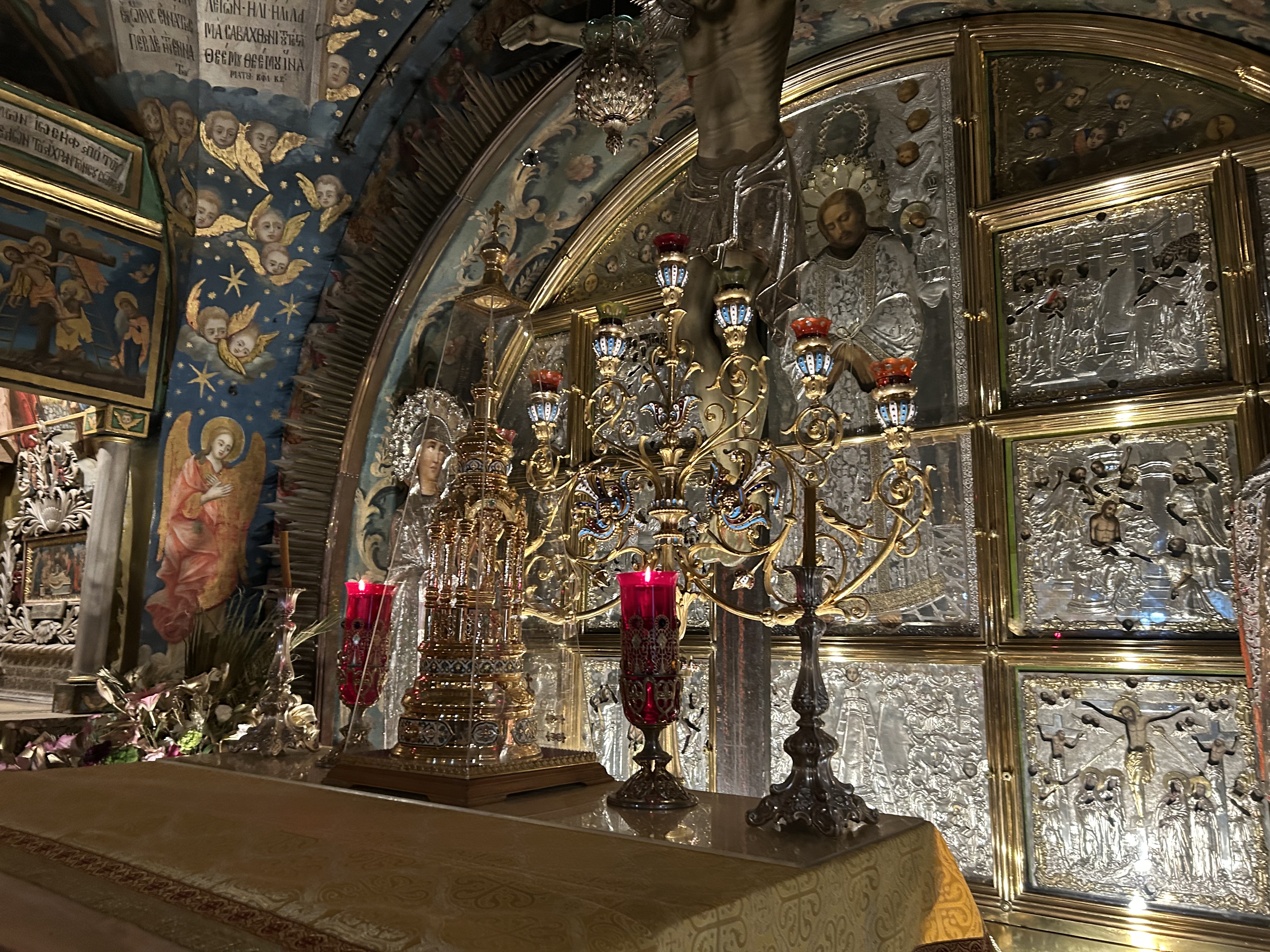
Calvary or Golgotha was a site immediately outside Jerusalem’s walls where Jesus was crucified. The exact location of Calvary has been traditionally associated with a place now enclosed within one of the southern chapels of the multidenominational Church of the Holy Sepulchre, a site said to have been recognized by the Roman empress Helena, mother of Constantine the Great, during her visit to the Holy Land in 325.

Other locations have been suggested: in the 19th century, Protestant scholars proposed a different location near the Garden Tomb on Green Hill (now “Skull Hill”) about 500 m (1,600 ft) north of the traditional site and historian Joan Taylor has more recently proposed a location about 175 m (574 ft) to its south-southeast. There is a bus station there now.

I would propose this to be the actual site, (not the bus station location which looks like a skull in the rocks; but would suggest in was a little farther back than the rock they propose.

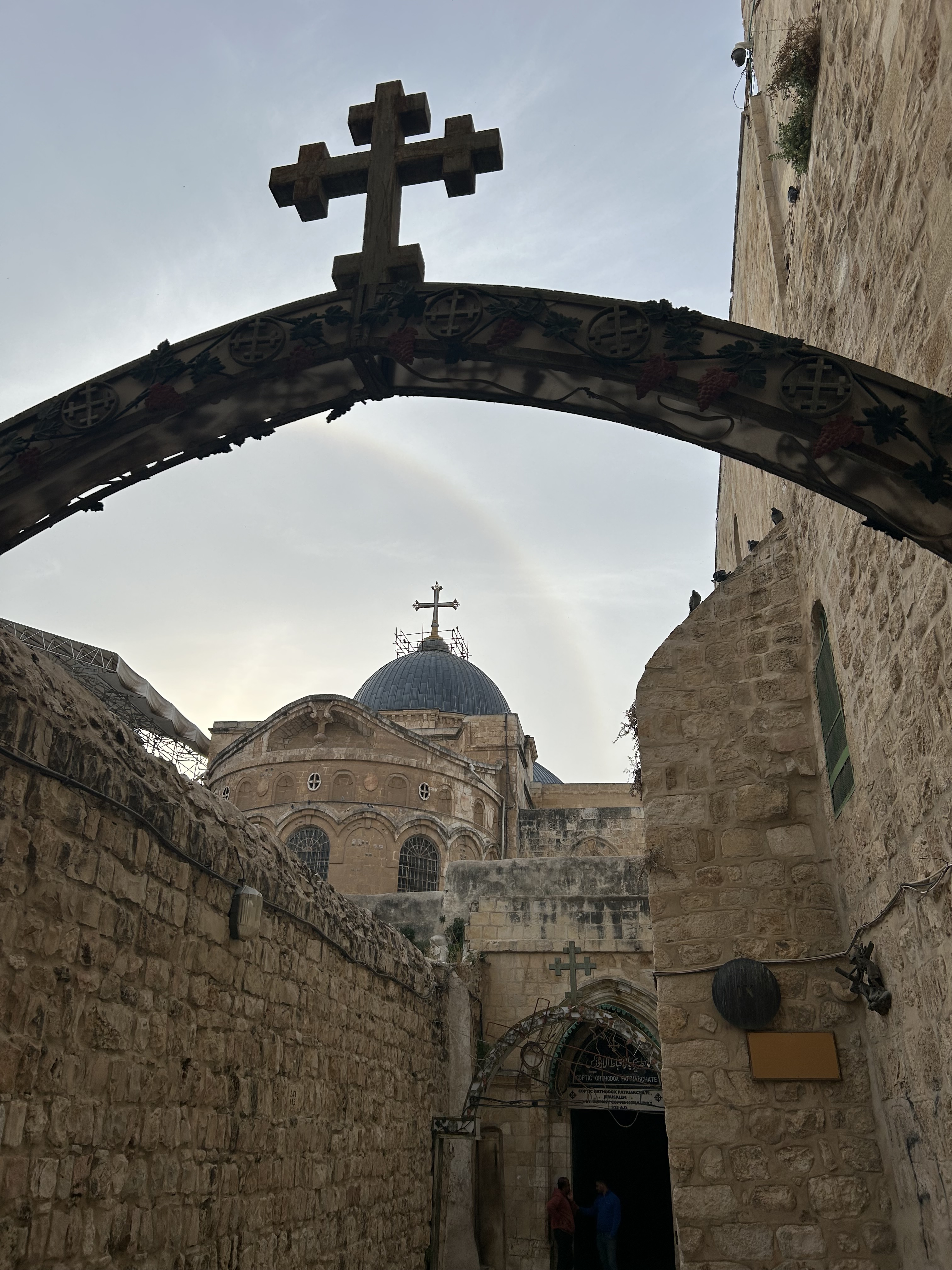
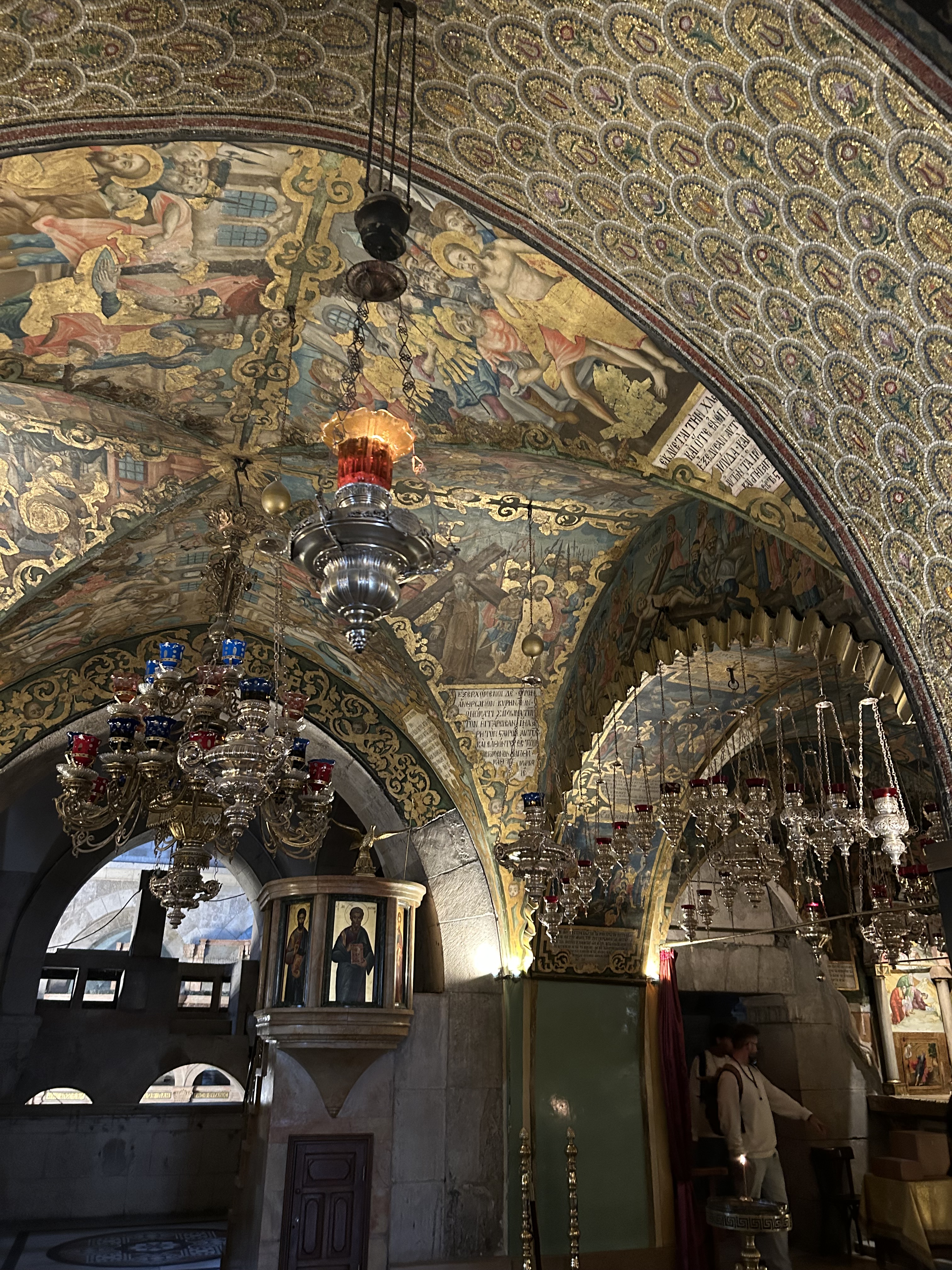
The Church of the Holy Sepulcher is a church in the Christian Quarter of the Old City of Jerusalem.[29] It contains, according to traditions dating back to the fourth century, the two holiest sites in Christianity: the site where Jesus was crucified,[30] at a place known as Calvary (or Golgotha), and Jesus’s empty tomb, where he is believed by Christians to have been buried and resurrected.[31]

The marble covering protecting the original limestone slab upon which Jesus was thought to have been laid by Joseph of Arimathea. This is just one of several arguments supporting the identification of tomb of Jesus at this site.[32] You can see a photo of Krista and Gabby standing by another tomb (which was close to the site, but we know is NOT the tomb of Jesus. I would propose that the actual tomb was closer to these.

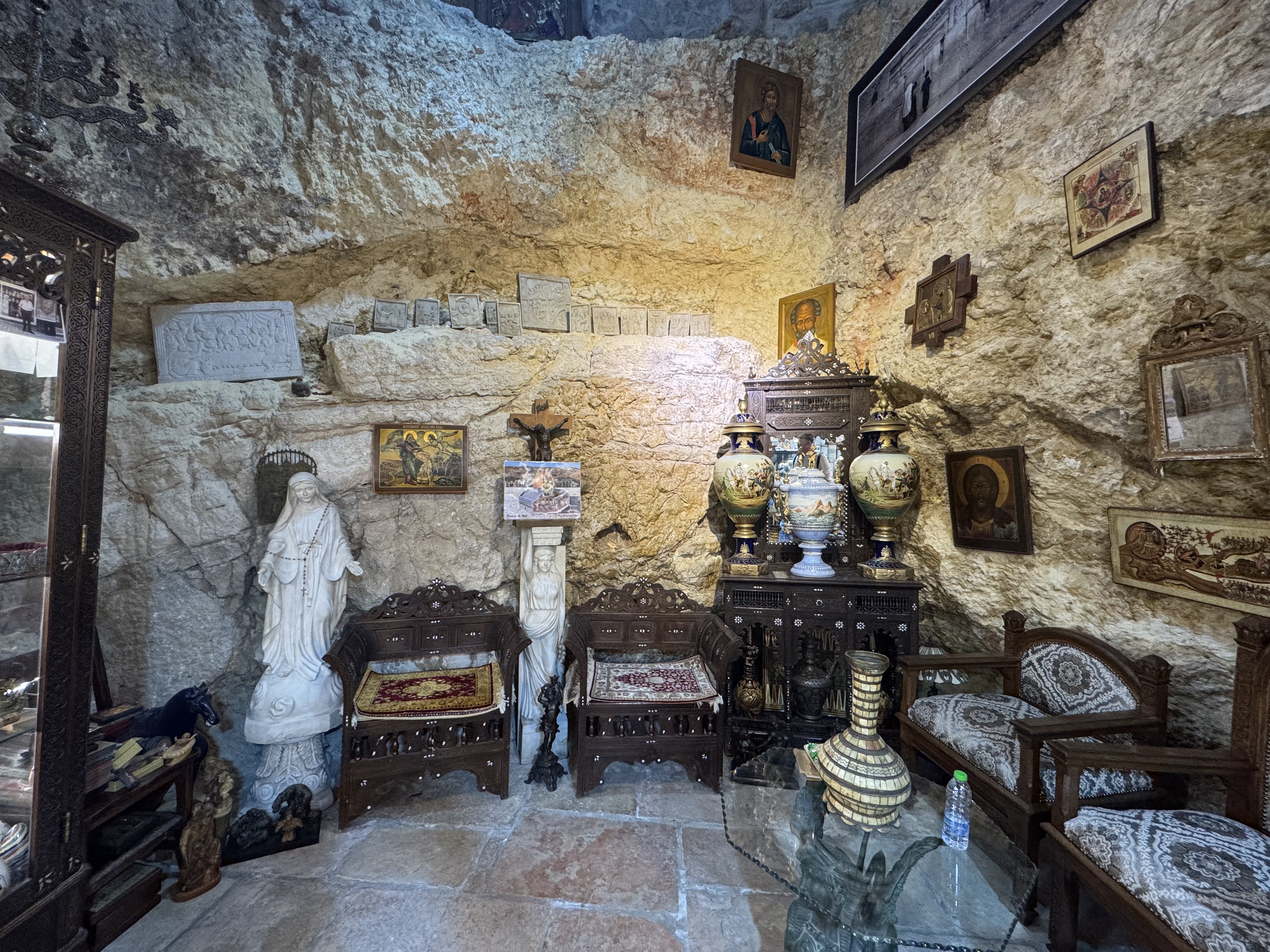
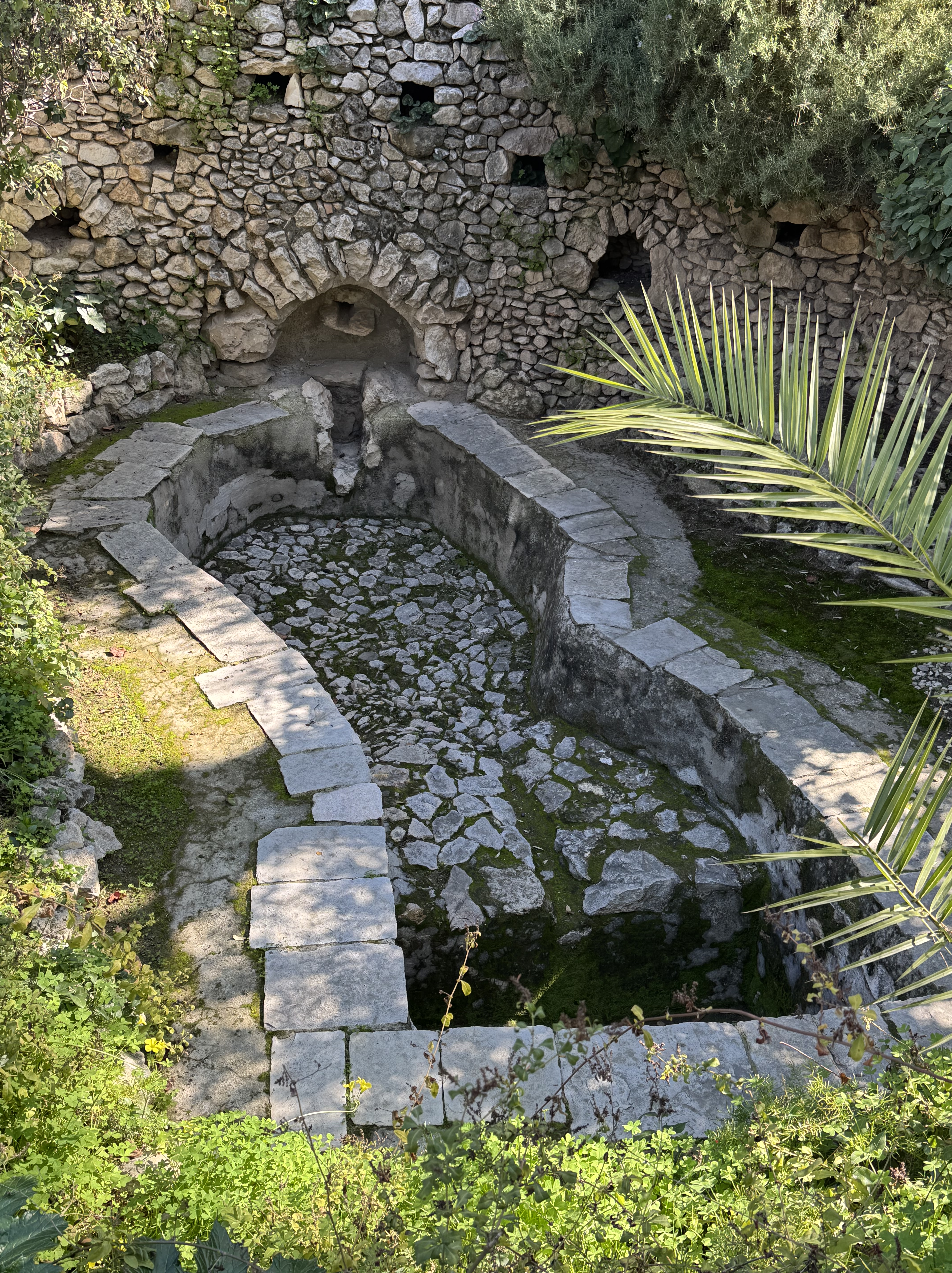
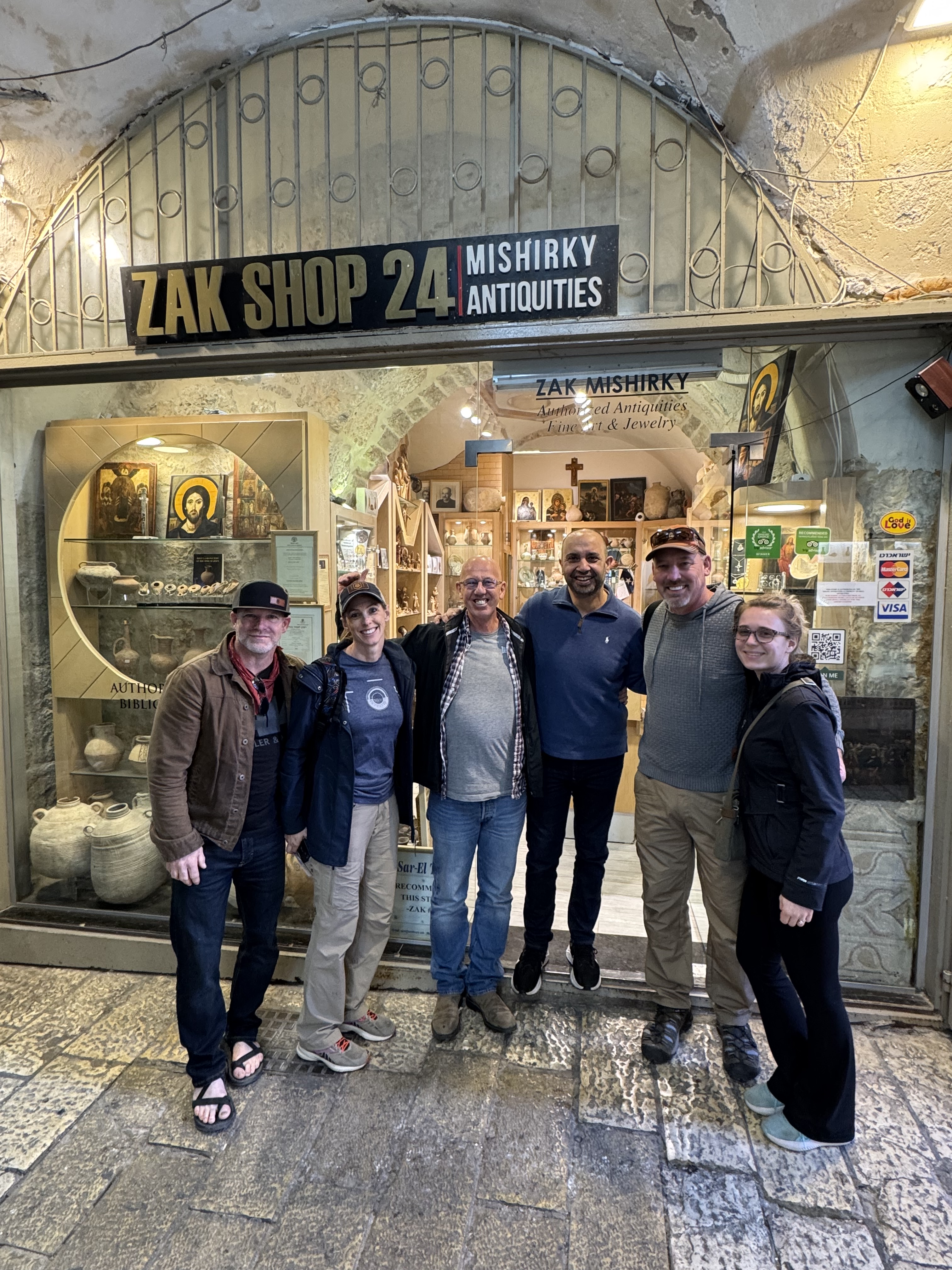
For the record, I do not think this is the location of the burial, but it was beautiful, and the gift store is worth looking at as it is Messianic. They also have a wine press (pictured) that is pretty sweet! On the same note, make sure you stop at Zak’s which is close to the garden tomb!!!

Shimon Gibson was part of a team that excavated the remains of a gate in the western wall which would have led into Herod’s palace complex. He believes it to match the Biblical data and be the place Pilate passed sentence on Jesus. He describes their findings:

“The discovery of a well-defended gateway…which has an inner courtyard paved with flagstones and with a rocky outcrop on one side corresponds perfectly with the situation of the place of the Roman tribunal as suggested by Josephus [in the account of Gessius Florus] and John. Hence, while it is a fair assumption the gate was used mainly as a private entrance into the Praetorium, this does not exclude public activities from taking place inside the gate and within the large courtyard situated between the walls. Indeed, this spot would have been ideal as a place for proclamation and public trials, and crowd control would have been pretty easy owing to the fact that it was so well defended.” [33]

Leen Ritmeyer, on the other hand, believes this gate probably led into the soldiers’ barracks, not into the part of the palace where Pilate resided. Furthermore, he points out that the tribunals could be located inside the palace complex accessible from inside the city, where people could witness (or sometimes be forced to witness) the Roman governor’s judgements.[34] Presumably there would have been an entrance to Herod’s palace inside the city as well. Trials were traditionally done ofr thousands of years in Israel and other cities at the gates. Other scholars have suggested that there was a public square outside the eastern entrance to Herod’s palace. John’s account implies that Pilate went in and out of his residence multiple times (Jn 18:29, 33, 38; 19:4) to speak with Jesus in private and then speak to the Jews who were waiting outside. I think this gate is the most valid option.

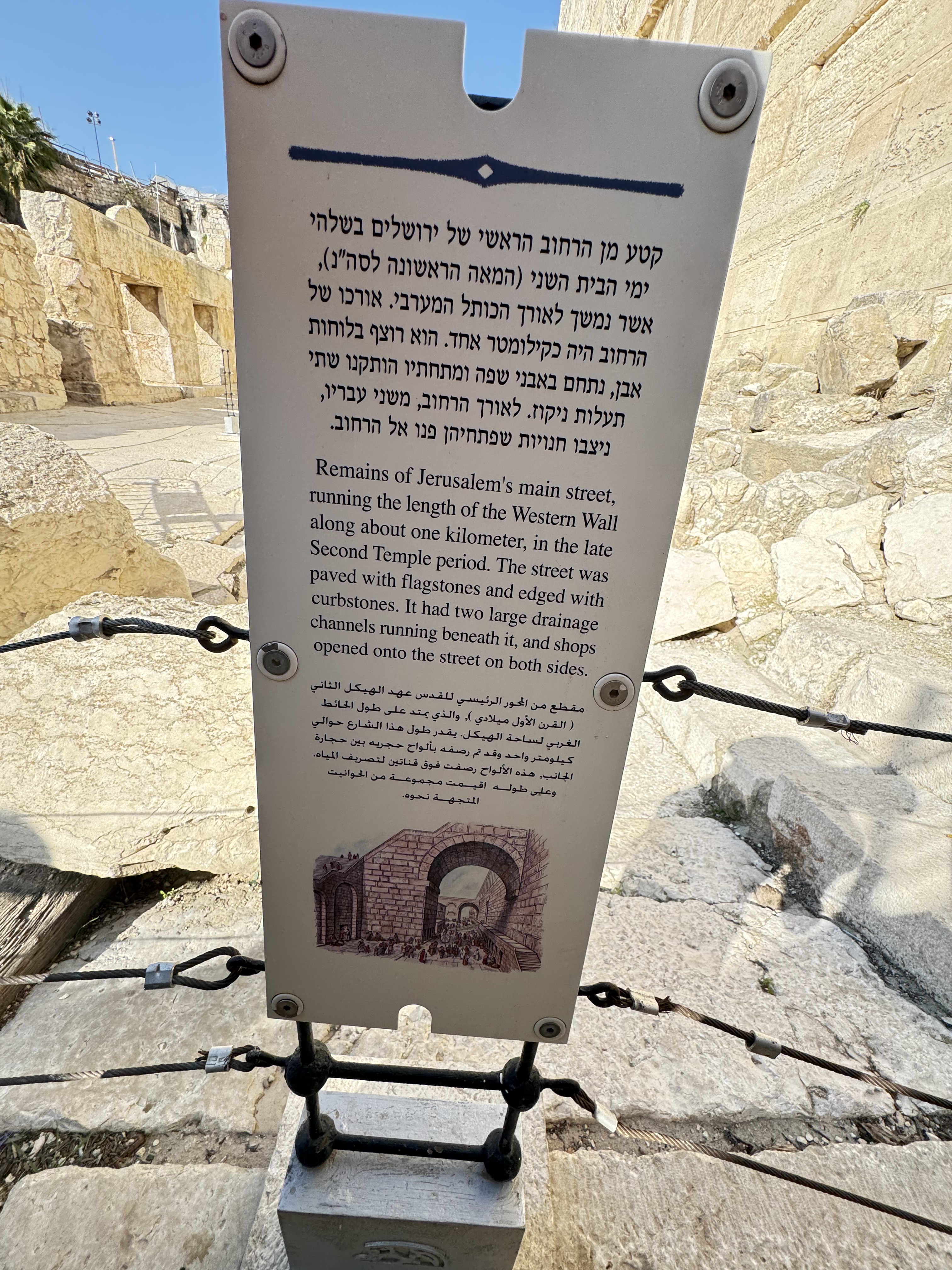
You can see the street where Jesus would have walked and the ruins of Herod’s temple in 70ad. The siege of Jerusalem in 70ad was the decisive event of the First Jewish–Roman War (66–73 CE), a major rebellion against Roman rule in the province of Judaea. After months of conflict, the Romans breached the city’s defenses, culminating in the destruction of the Second Temple, the razing of the city, and the mass killing, enslavement and displacement of its inhabitants. The siege marked the effective end of the Jewish revolt and had profound political, religious, and cultural implications for the Jewish people as well as broader historical consequences.

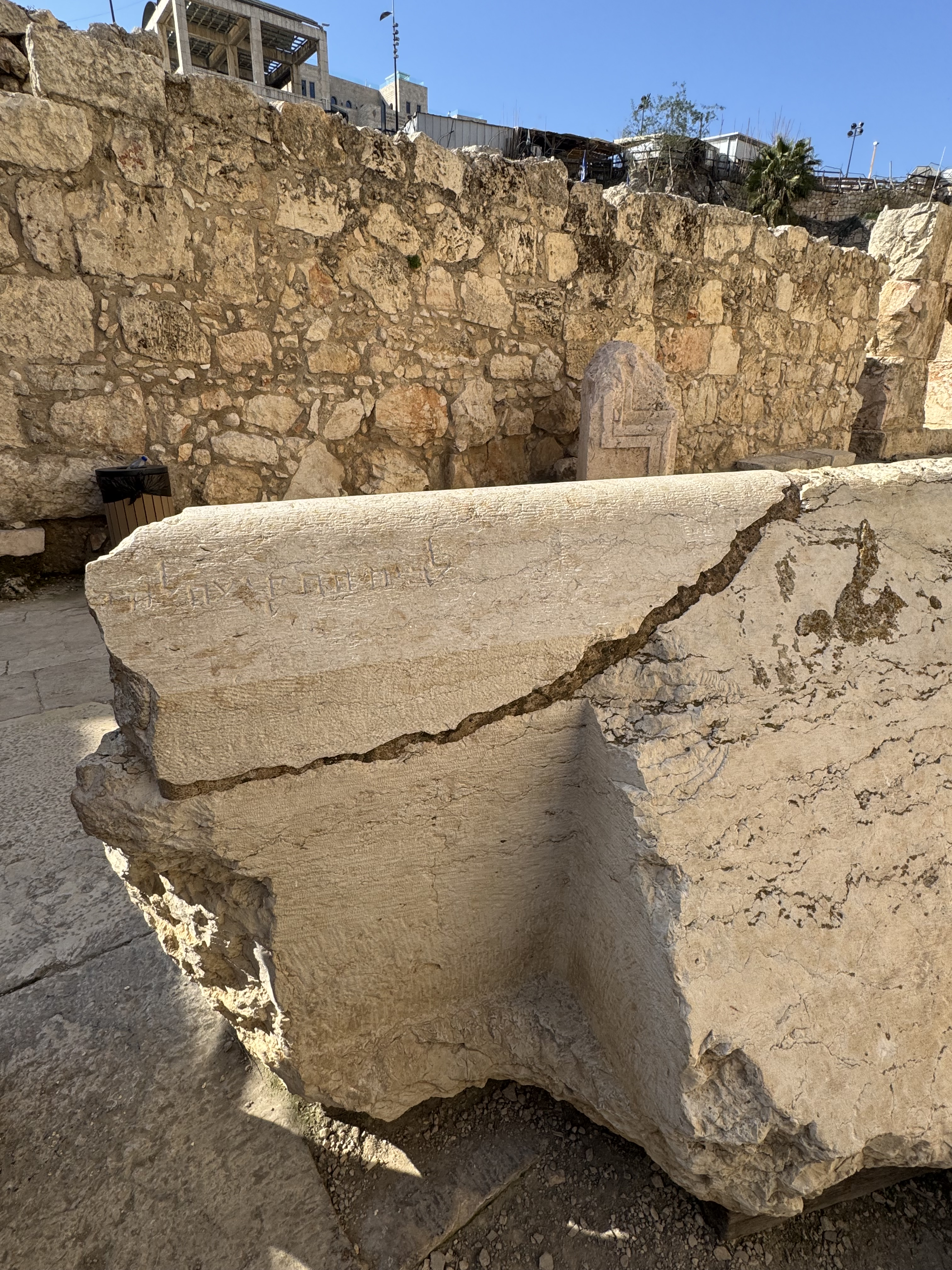
According to Josephus, on Av 9th/10th (late August), a Roman soldier hurled a burning piece of wood into the northern chamber, igniting a fire that ultimately consumed the entire temple structure. As the temple burned, chaos erupted in its courtyards. The Romans then moved to systematically destroy the rest of the Temple Mount, razing the remaining porticoes, treasuries, and gates. The soldiers carried their military standards into the temple court, offering sacrifices before them. Jesus’ prophecy about the destruction of the Temple in Jerusalem was fulfilled at this time. You can still see the huge boulders that are the remains of the temple that once stood on the mount. To be clear all of the temple was destroyed as Jesus said would happen. The mount was left intact. [35-39 summarized]

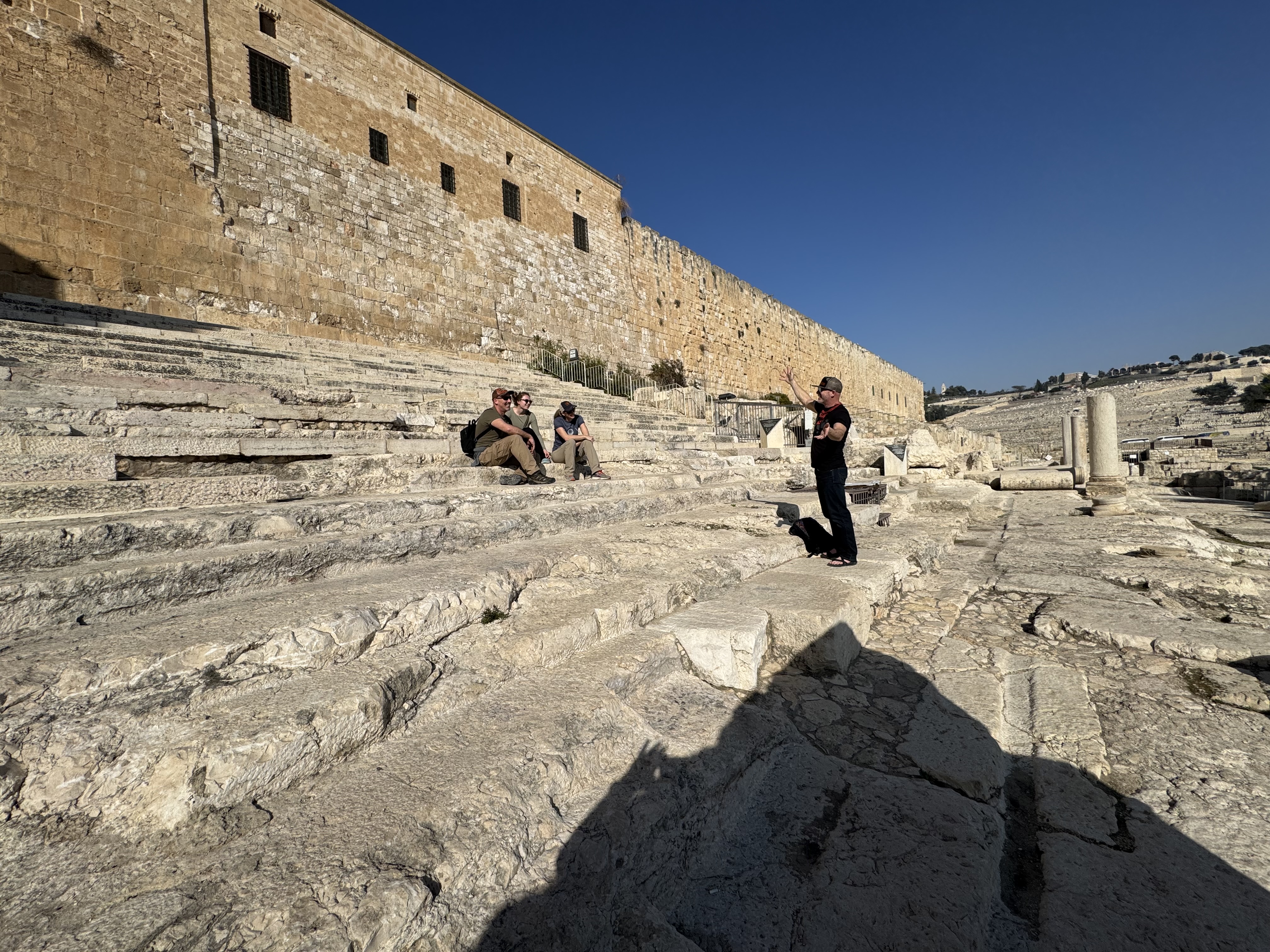
The Huldah Gates were one of the Gates of the Old City of Jerusalem leading into the Jerusalem Temple compound in the Hasmonean period and were named as such in the Mishnah.[40] The steps at the gate were a public forum where Jesus would have taught as a Rabbi.

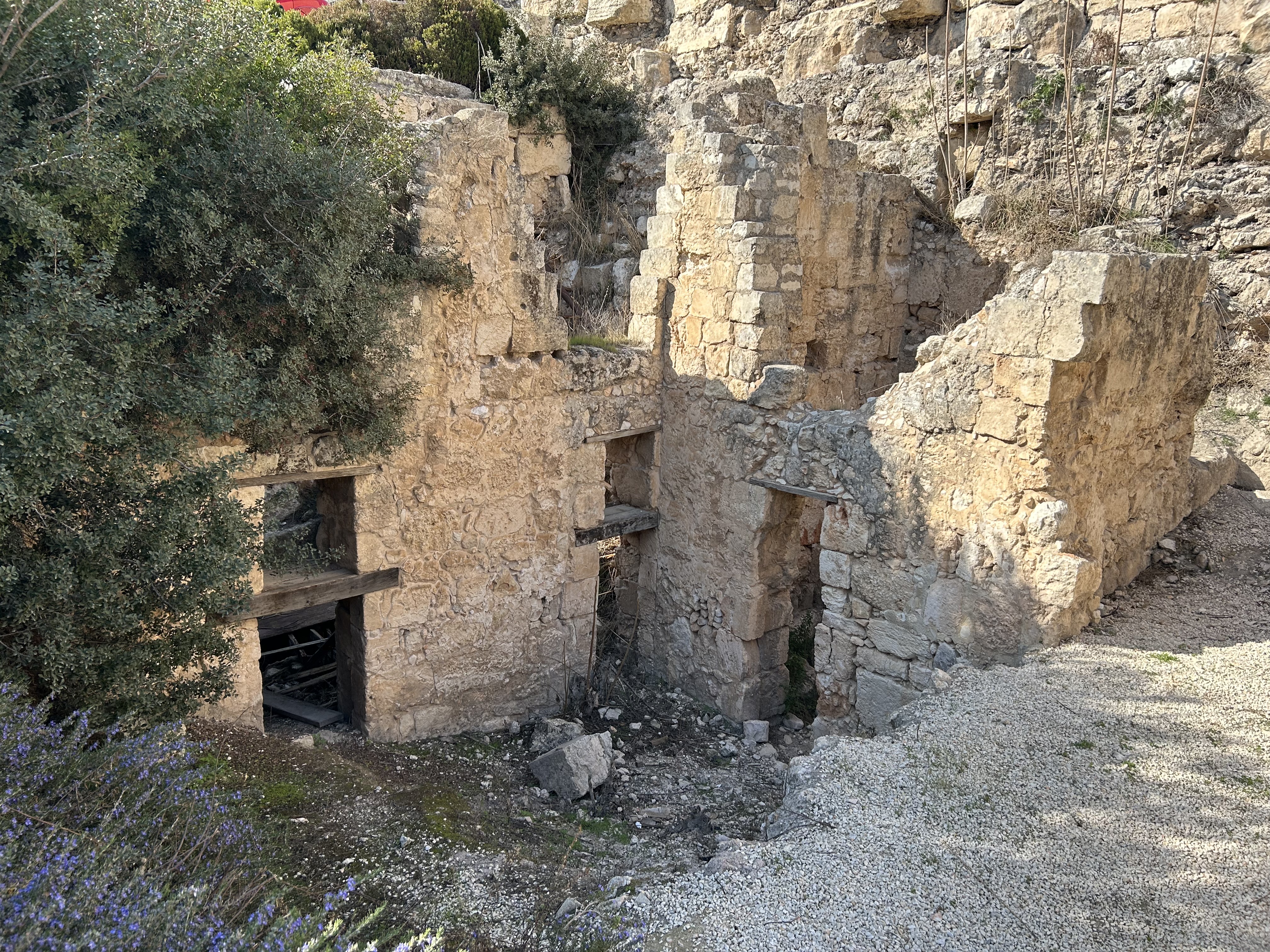
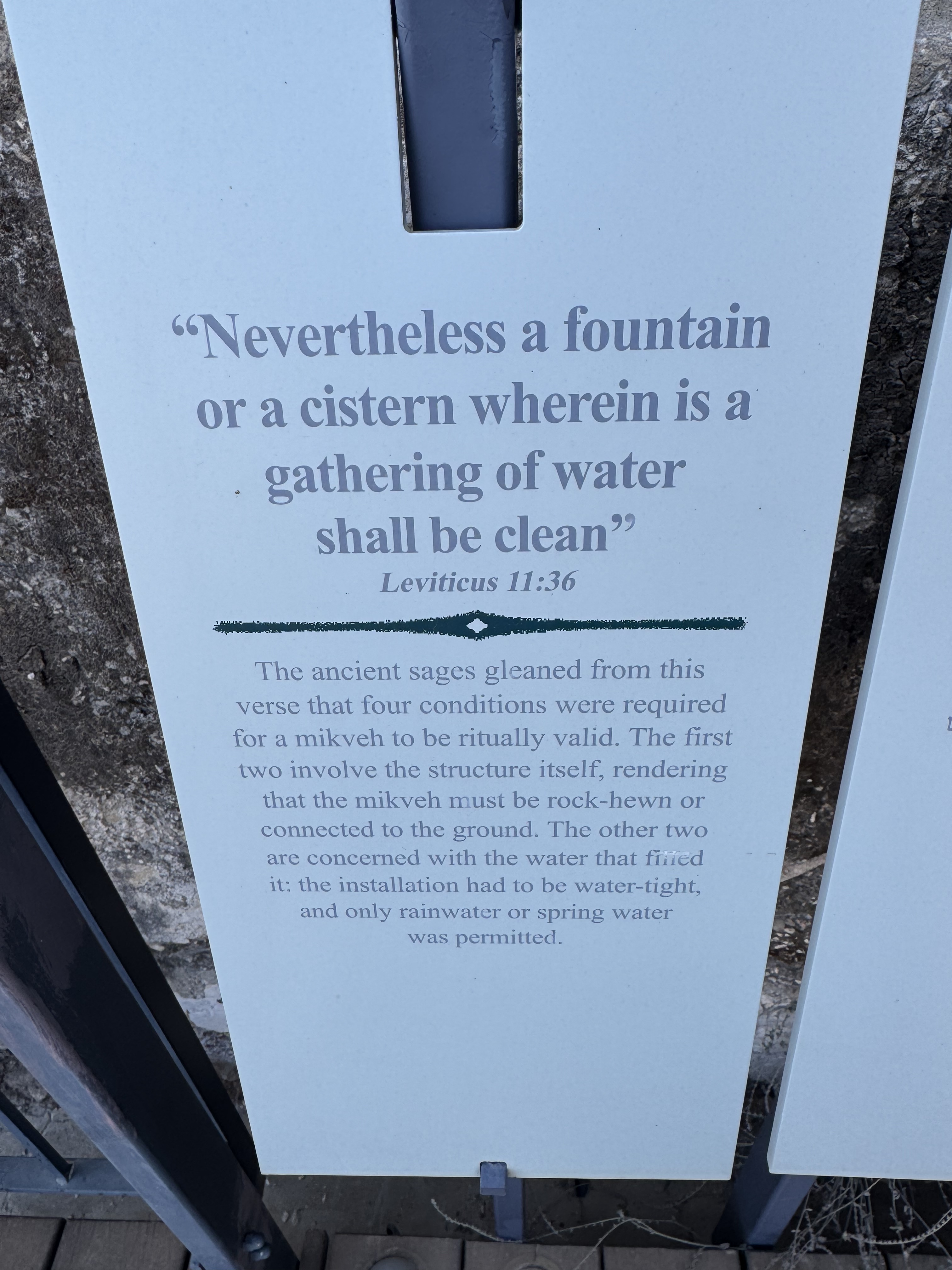
Close to here is the Ophel Mikveh Trail which was a series of ritual bath stations used before entering the temple. There are also several thorn bushes that still grow.

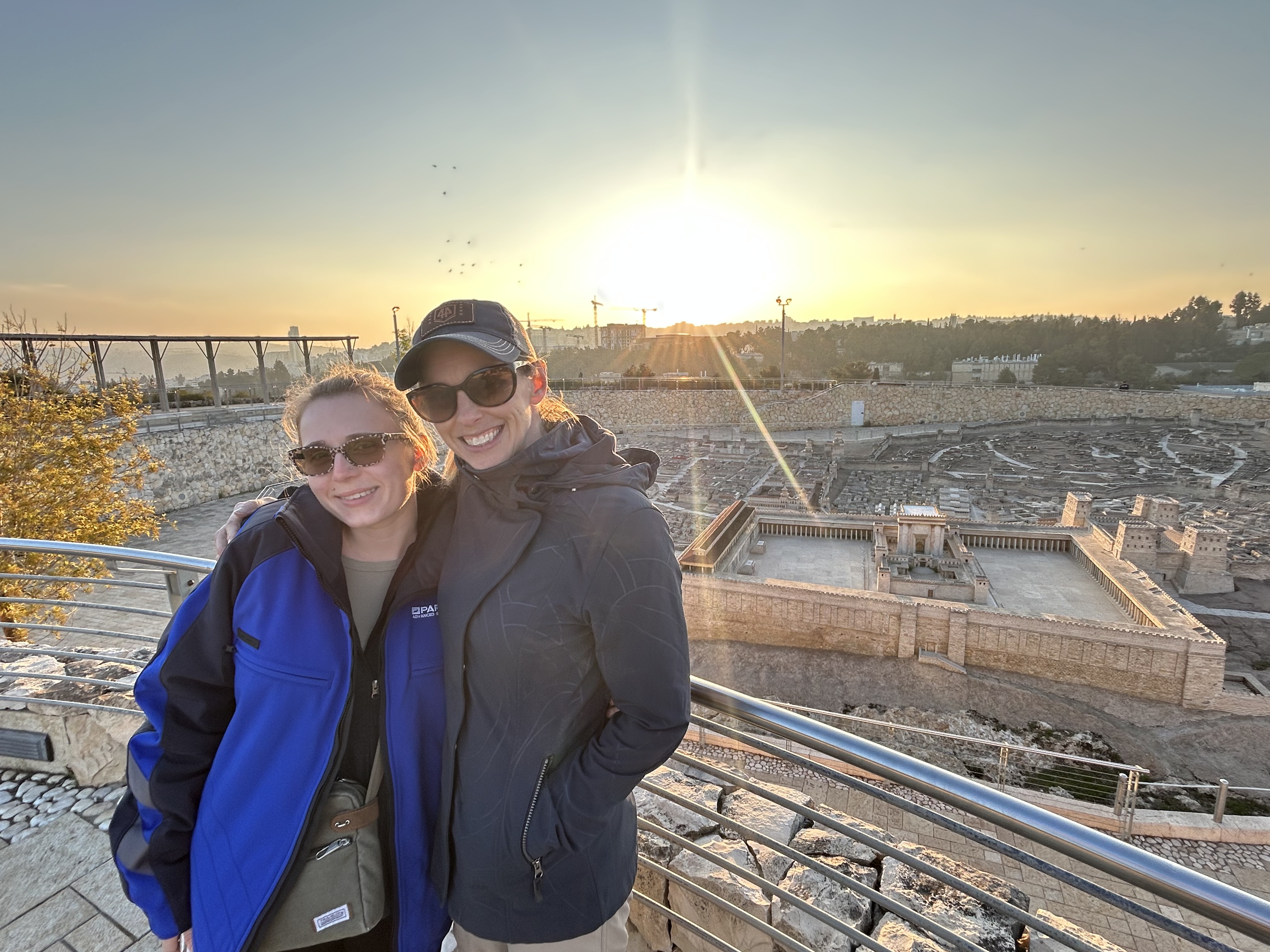
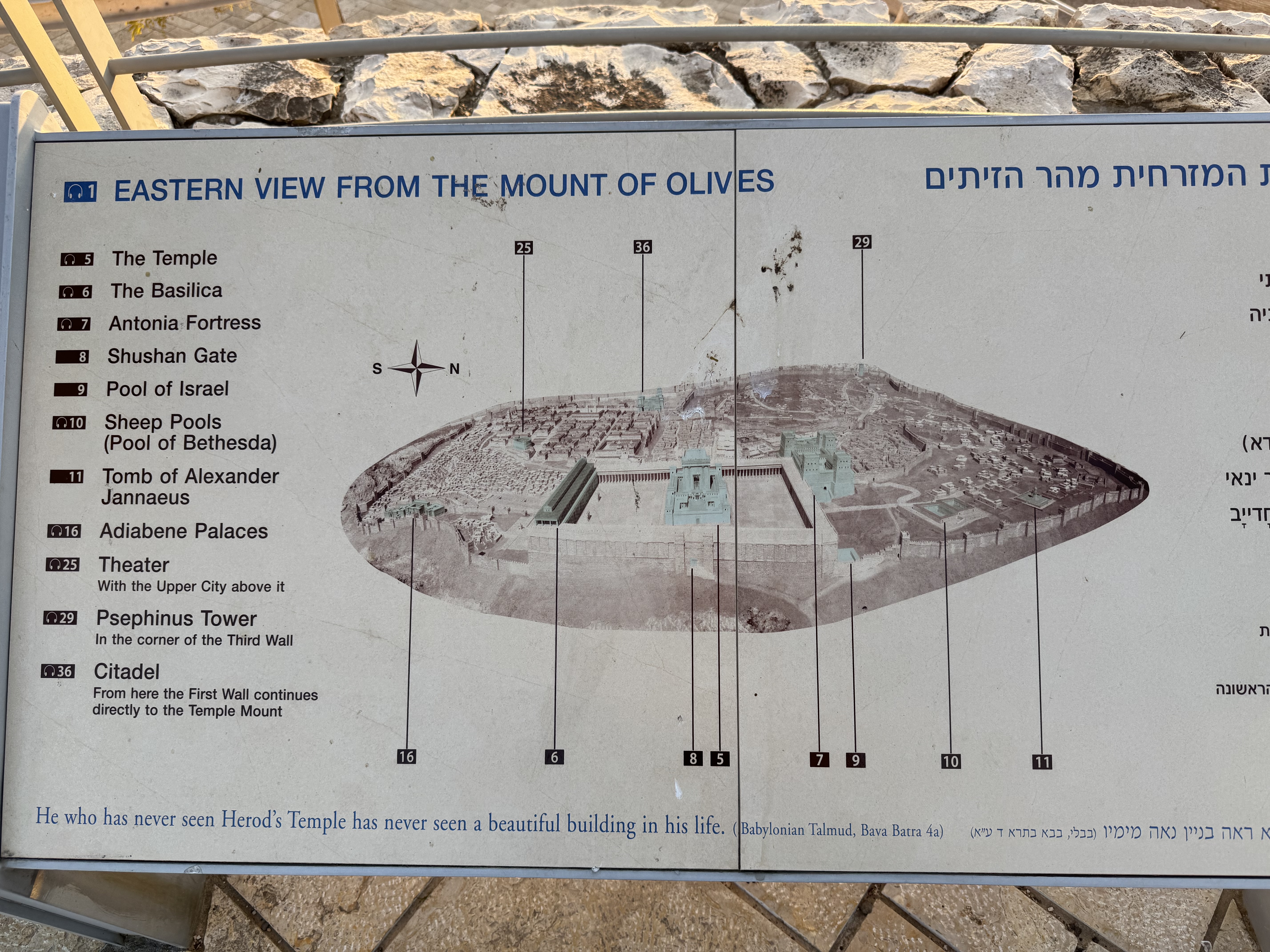
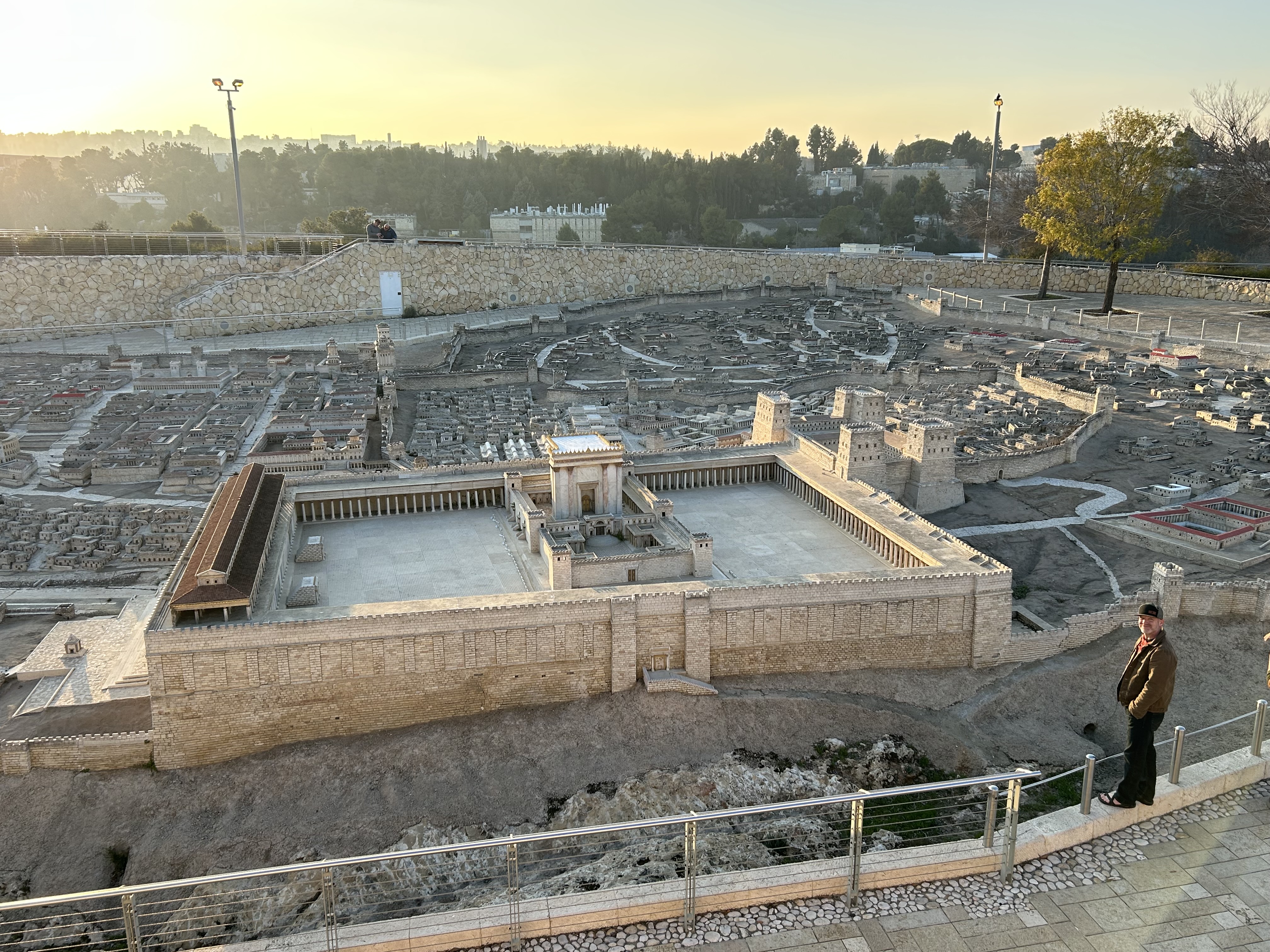
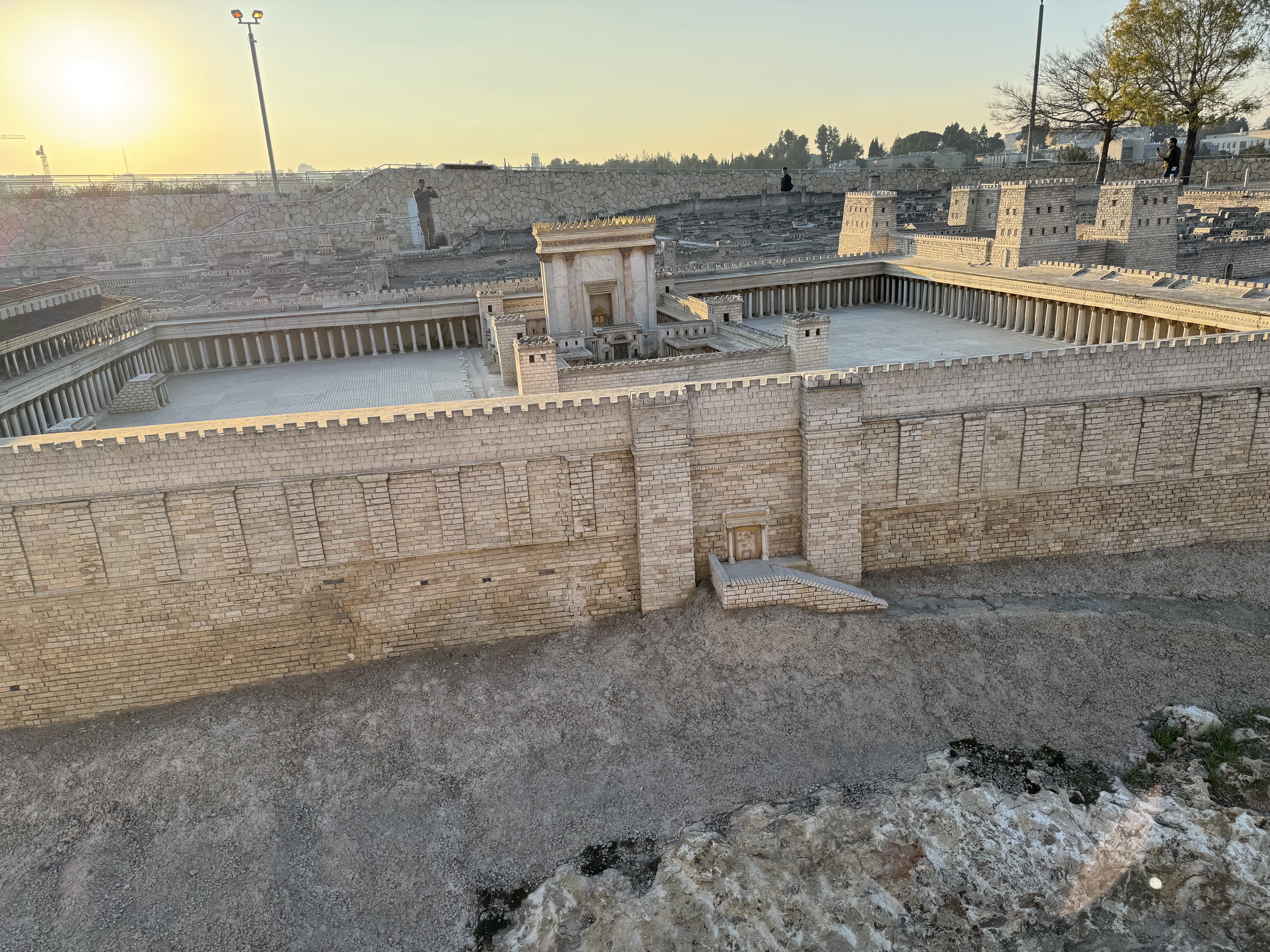
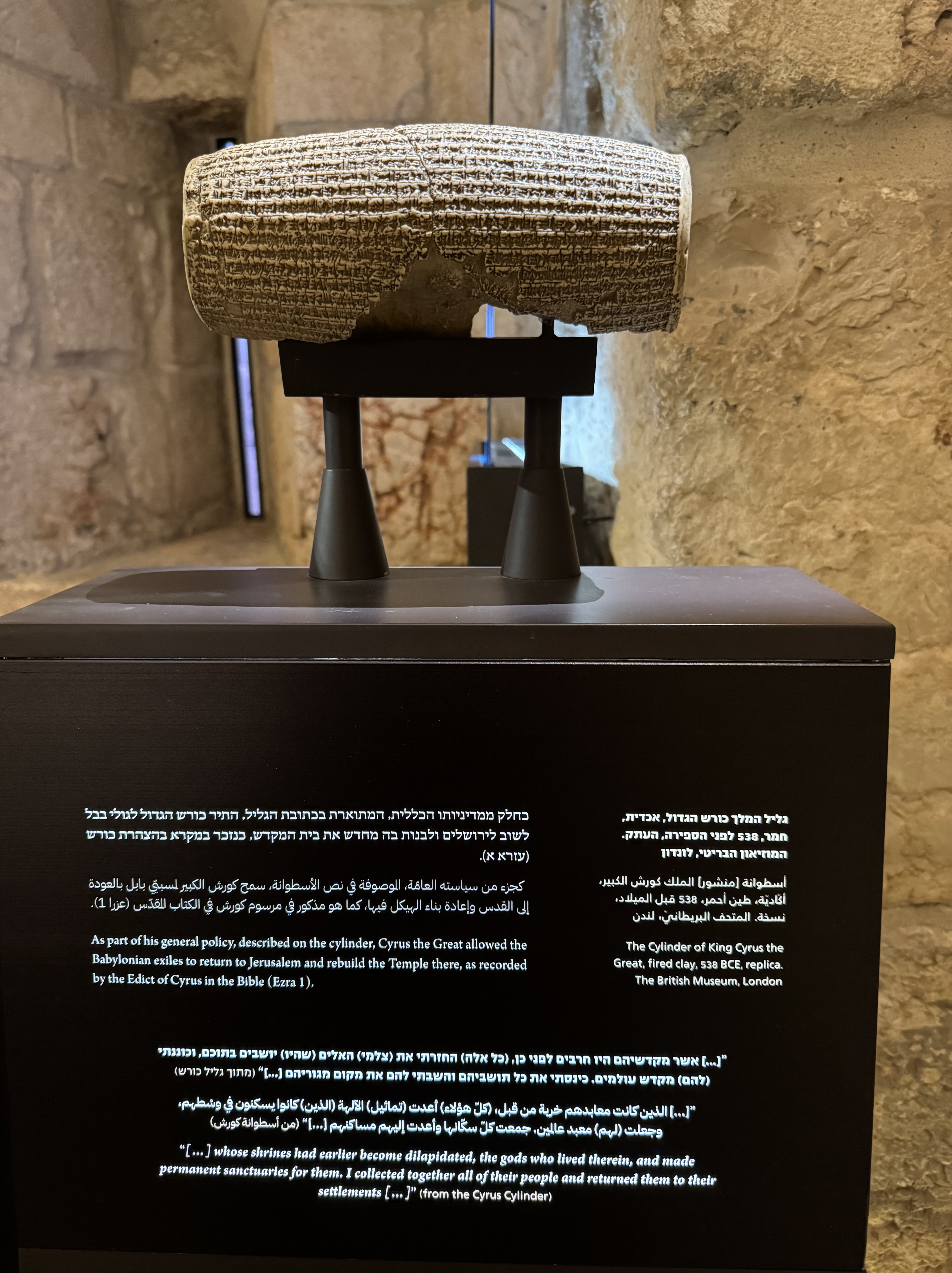
The Dead Sea Scrolls are housed in the Shrine of the Book, which is a wing of the Israel Museum in the Givat Ram neighborhood of Jerusalem. It is also worth seeing the 1/50th scale model of Jerusalem in the 2nd Temple period. This will very much help you conceptualize the steps of Jesus.

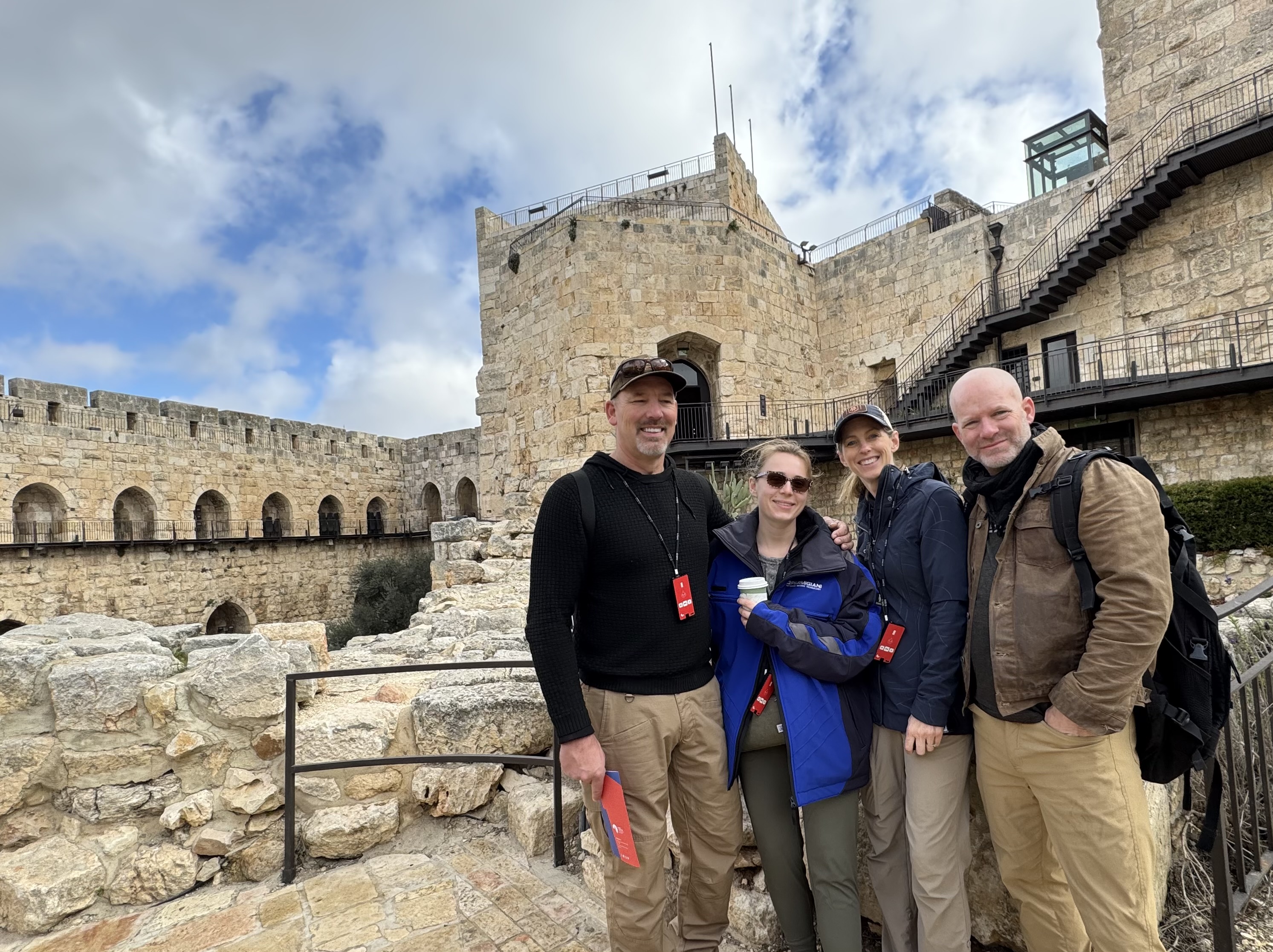
The Tower of David is worth seeing. The Tower of David archaeological excavations reveal the city’s evolution across 3,000 years. For thousands of years, the city’s rulers resided here. Within these walls, Hezekiah’s soldiers built a wall, the Hasmoneans launched ballistas, Herod erected a magnificent palace, zealots fought during the revolt, a crusader dug a tunnel, the Mamluks built a minaret, and Allenby stood on the citadel’s steps. In every era, the importance and beauty of this place was recognized. As Ronald Storrs, the first British Governor of Jerusalem, put it, “This is the most beautiful spot in the city!”

Follow a Rabbi, drink in his words, and be covered with the dust of his feet. —Ancient Jewish Proverb

The message of Scripture is as relevant to us today as it was when given at the time of Christ. In Christ’s time, the decision to be His disciple meant total commitment. Jesus was with the disciples and asked them to be with Him (Mark 3:13–19, John 13:15). They were to be “with” Him (Mark 3:13–19), to follow Him (Mark 1:16–20), to live in Him (John 8:31), and to imitate His actions (John 13:13–15). All of these descriptions are pictures of deep devotion to Jesus.

Today the best phrase we have for this might be “complete obsession.” We think of this when a young person starts dating someone. At first, they are totally obsessed.

Remember when Peter learned to walk on water in Matthew 14? He wanted to believe that he could be like Jesus, and he could—he just needed to start by holding the hand of Jesus. I love Jesus’s simple response to Peter’s doubt: “Why did you doubt?” (14:31). In other words, “Why did you doubt I could empower you to be like me?” The calling here seems so simple, yet even Peter wasn’t quite there.

Today, we seem to be an entire church that has simply sunk beneath the water. As a communal Christian culture of devoted disciples, we must take on a better mindset of discipleship. We must believe and live out the calling to be a wholly devoted disciples of Jesus, believing that He has empowered and filled us with His Spirit so that we can be like Him and be used as the very image of Christ to the world. We need to passionately ask for the hand of God to pull us into Him; to be mediators to others so they too might receive the hand of Jesus in their lives. Essentially, we need to model what passion in Jesus looks like. Did you ever notice that when something is modeled well, people have a desire for it? You might even find people who begin to be obsessed with things that are modeled well. In many ways this describes our humanity, but this is also a picture of how Jesus meets us where we are and pulls us into Him.

What does it mean to pursue Jesus in an American culture? We must be faithful in His time, in the waiting. We should meditate on His Word and imitate His life. The calling of the church today and the mission of disciples is to fulfill the cosmic calling of priesthood: to bring the people to the hand of God and God’s hand to the people as mediators and pictures of Christ. This is a lifelong investment. Devotion has never meant presenting someone with the plan of salvation in a few easy steps; it means being fully immersed with them each and every day as you disciple them to conform to the image of Christ. It is a commitment to deep, personal mentoring. That strategy, blessed by God’s Spirit, radically changed the world in the first few centuries, and it still has the same power today.

One of the major strategies of Jesus was to transform people from pagan culture to kingdom culture. And that strategy, by God’s blessing, would change the most pagan of cultures. Today, that is still the plan for discipleship. We must be passionate in our devotion by following Jesus’s example. The calling of discipleship wasn’t one of casual Christianity, or even to simply set your firstfruits aside for God: The disciple was all in. A disciple is obsessed with Jesus.

What does this obsession with Jesus look like today in our culture? Is the primary goal of your life to passionately and energetically disciple your own family and then those around you? Do you have twelve or seventy invested in a deep relationship, rooted in teaching? Is your complete strategy in life to bring others into deeper, more fervent discipleship? What would the American church look like if we took on this mindset of deep, passionate discipleship? More importantly, what would your life look like? What would your journey be?


  1. The Complete Gospels: Annotated Scholars Version. 1994, Polebridge Press. p. 108, note on Matthew 26:36
  2. Paul Maier In the Fullness of Time
  3. Lash, Mordechay; Goldstein, Yossi; Shai, Itzhaq (2020). “Underground-Archaeological Research in the West Bank, 1947–1968: Management, Complexity, and Israeli Involvement”. Bulletin of the History of Archaeology30
  4. “Dead Sea Scrolls | Definition, Discovery, History, & Facts | Britannica”. http://www.britannica.com.
  5. Abegg, Jr., Martin; Flint, Peter; Ulrich, Eugene (2002). The Dead Sea Scrolls Bible: The Oldest Known Bible Translated for the First Time into English. San Francisco: Harper. pp. xiv–xvii. 
  6. Staff writers (28 July 2011). “Israel will reopen (Israeli) site of the baptism of Jesus”. AsiaNews.it
  7. Cambridge Bible for Schools and Colleges on Acts 1, accessed 24 September 2016: “The eleven were the tenants of the upper room, to which the other disciples resorted for conference and communion”.
  8. Kershner, Isabel (May 26, 2014). “Mass on Mount Zion Stirs Ancient Rivalries”. New York Times.
  9. Zivotofsky, Rabbi Dr Ari (May 15, 2014). “Where is King David Really Buried?”. Jewish Press.
  10. “The Temple Mount in the Herodian Period (37 BC–70 AD)”. Biblical Archaeology Society. July 21, 2019.
  11. Peters 1984 “One of the best documented endowments, one that embraced the entire quarter of Western Muslims or Maghrebis”.
  12. John 5:2: Contemporary English Version
  13. Easton’s Bible Dictionary.
  14. “Bethsaida (the pool)”. Catholic Encyclopedia.
  15. International Standard Bible Encyclopedia (1995), on sheep gate and on sheep market.
  16. D. A. Carson, The Gospel according to John (1991), p. 241.
  17. https://skipmoen.com/2009/02/do-you-want-to-be-well/
  18. Textus Receptus.
  19. Tischendorf and WH.
  20. Revised Standard Version marginal note to John 5:2.
  21. “Bethsaida”. newadvent.org. Retrieved 6 October 2010.
  22. Delitzsch, F. 1856. “Talmudische Studien, X. Bethesda”, Zeitschrift für die gesamte lutherische Theologie und Kirche.
  23. August Strobel, Conrad Schick: ein Leben für Jerusalem; Zeugnisse über einen erkannten Auftrag, Fürth: Flacius-Verlag, 1988, p. 44. ISBN 3-924022-18-6
  24. https://en.wikipedia.org/wiki/Pool_of_Bethesda#cite_note-Rex-18
  25. https://en.wikipedia.org/wiki/Pool_of_Bethesda#cite_note-Wahlde2006-17
  26. Carol Delaney, Abraham on Trial: The Social Legacy of Biblical Myth, Princeton University Press 2000 p.120.
  27. M. Anwarul Islam and Zaid F. Al-hamad (2007). “The Dome of the Rock: Origin of its octagonal plan”. Palestine Exploration Quarterly139 (2): 109–128.
  28. Goldberg, Jeffrey (29 January 2001). “Arafat’s Gift”. The New Yorker. Archived from the original on 14 July 2015.
  29. “Complete compendium of Church of the Holy Sepulchre”. Madain Project
  30. McMahon, Arthur L. (1913). “Holy Sepulchre”. In Herbermann, Charles (ed.). Catholic Encyclopedia. New York: Robert Appleton Company.
  31. “Church of the Holy Sepulchre, Jerusalem”. Jerusalem: Sacred-destinations.com. 21 February 2010. 
  32. https://dannythedigger.com/holy-sepulchre-jesus-burial/
  33. Gibson, Shimon, The Final Days of Jesus: The Archaeological Evidence. (San Francisco: HarperOne, 2009) 104-105.
  34. Leen Ritmeyer, Personal Communication, April 6, 2022.
  35. Schäfer, Peter (2003). The History of the Jews in the Greco-Roman World: The Jews of Palestine from Alexander the Great to the Arab Conquest. Routledge.
  36. Schwartz, Seth (2006). “Political, social, and economic life in the Land of Israel, 66–c. 235”. In Katz, Steven T. (ed.). The Late Roman-Rabbinic Period. The Cambridge History of Judaism. Vol. 4. Cambridge University Press. pp. 23–52. 
  37. Schaper, Joachim (1999). “The Pharisees”. In Horbury, William; Davies, W. D.; Sturdy, John (eds.). The Early Roman Period. The Cambridge History of Judaism. Vol. 3. Cambridge University Press. pp. 402–427. 
  38. Schwartz, Seth (2014b). The Ancient Jews from Alexander to Muhammad. Cambridge University Press. 
  39. Sivan, Hagith (2008). Palestine in Late Antiquity. Oxford University Press. 
  40.  Encyclopædia Judaica (ed. 1972), vol. 15, pp. 963-4

Renouncing the World for sole allegiance to Jesus and His Kingdom

“So therefore, any one of you who does not renounce all that he has, cannot be my disciple.” – Luke 14:33

If you know me at all, you know that I am an “ALL IN” guy for the Kingdom who believes we shouldn’t be holding anything back for Jesus. Luke 14 calls us to be rival to anything that opposes Jesus, but with the context that even our enemies might be won over to Him.

“RENOUNCE ALL” – Jesus had some “HARD SAYINGS” but this one might take the cake! Today in our American Christianity or churchianity paradigm we seem to just simply ignore this one! This flies in the face of health and wealth prosperity preaching seeming to identify that perhaps Christians should sell everything (Christ’s words to the rich young ruler and the Acts 2 mindset) and live as paupers for the kingdom. And to be clear, I do think it takes on that tone.

But let’s take a closer look, in Greek the phrase is ouk apotassetai, which literally would be to “not place in order from”. What’s very interesting to me is in the New Testament every single time the verb apostasso is used it is in the middle voice. I would venture to say this is the only treatment of a verb this way in the entire text. It is very rare and unusual, so it makes me take special interest and ask why? When we say to “not renounce” something then, it takes a sense of “to place in order away from myself”. Understanding the literal translation of the Greek phrase means that when we read paying attention to the grammar of the Greek language you come out understanding that the mindset is to restructure or reorder, we give up chaos for order to come to proper balance in the kingdom. A life of shalom. So, if I had to translate the middle voice thought into this (as some translations like NT Wright’s have attempted) it might better read, “No one can be my disciple who does not take up the proper priorities in terms of possessions for Godly order over the world’s chaos.” Of course that doesn’t read well! Furthermore, the middle voice almost always implies that Christ is taking the action for us, that it is something out of your control once you come to the posture called for, usually devotion but in this case is actually a step more than that -it leans towards the harder definition of Jesus into discipleship. (What seems to follow the progression of fan > follower > disciple.)

If you don’t take on the posture of Jesus with your worldly things you can’t possibly enter into Jesus’ definition of discipleship. They must be renounced or completely re-ordered. So, the takeaway is what you can’t do is keep the prioritization of the world and still attest to be on the track to discipleship.

Everything is His and if you attest to be “all in”, than nothing should be your own. That’s why tithing in the New Covenant is a hard conversation. Tithing along with the Torah in the Old Testament was to be a stop gap until all things could be reconciled by Jesus. Now that “WE” have Jesus everything is His. If your on track your not thinking Tithe or Torah your thinking everything! (YOUR LIFE) Nothing is your stuff or your time. And the path to sanctification is more of Him and His kingdom ways and less of your world ways. A complete transformation that finishes eschatologically (but in que on this world) with you being made completely into the image of Jesus.

You don’t need to “create time or space” for Jesus if all of your time and space is for Jesus. You no longer have claim to anything of the world, YOU HAVE RENOUNCED THAT NOTION!

If you catch yourself beginning to collect things for your earthly storehouse that has no place for kingdom endeavors your posture for the kingdom is out of balance. You are mis-stepping the path of discipleship. The text says anyone off course can’t be my disciple. Do you want to be a disciple? Are you willing to come to a complete posture before the Lord to enter this covenant? Are you willing to “give up” everything to be a disciple?

One reason generations are disengaging from the church is because of the mixed messages the church has sent for years. Many people have become disillusioned with the division in the American church and one of the reasons is because we’ve exchanged a biblical gospel that exalts Jesus above everything in the world for an American (progressive) gospel that prostitutes Jesus for the sake of comfort, control, power, politics and prosperity in this world. I’m compelled to pray, God, we want to renounce it all. I pray that we don’t settle as disciples of Christ. I pray that we might be in absolute devotion to Jesus’ deeper covenant relationship both in this life and eschatologically in the coming kingdom.

In the last 10 years there have been several books written that speak to this:

  • Will Ryan – This is the Way (Series)
  • Boyd – The Myth of a Christian Nation
  • Zahnd – Postcards from Babylon
  • Bates – Salvation By Allegiance Alone 
  • Sprinkle – Exiles: The Church in the Shadow of Empire (Church in the Shadow of Empire)
  • Wright & Bird – Jesus and the Powers: Christian Political Witness in an Age of Totalitarian Terror and Dysfunctional Democracies
  • Platt – Don’t Hold Back: Leaving Behind the American Gospel to Follow Jesus Fully 
  • But before all of these there was a classic called – Persecution in the Early Church, A Chapter on the History of Renunciation, by Herbert B. Workman, in 1906

The opening pages of the New Covenant declared this same philosophy by Holy Cannon. John the Baptist was the precursory proclaimer of this truth as ‘the voice of one crying in the wilderness, prepare the Way of the Lord’. The explosive scene that his ministry encapsulated could be summarized by the title we all know him by: The Baptiser.

Matthew 3:1-3

In those days John the Baptist came, preaching in the wilderness of Judea and saying, “Repent, for the kingdom of heaven is near.” This is he who was spoken of through the prophet Isaiah:

This message was approved by Heaven through the institution of baptism as an expression of forsaking all other allegiant positions as a returning to the One True and Living God. His message was demonstrated by a public display of that newfound loyalty through the waters of baptism signifying a washing away of the old for the embracing of the new. This message spread like wildfire among the religious Jews and even impacted the gentile population in their midst.

In keeping with the divine purposes of his message, he adamantly declared that those wishing to embrace this new allegiant life (the path to discipleship) MUST renounce all other places of faith and fully submit to the Kingdom life.

A requirement for John was the ‘produced fruit’ consistent with a changed heart. John was not looking for new FaceBook subscribers, or popularity in his ministry… the purpose was to transform lives. This was accomplished through radical, immediate, and noticeable lifestyle reflections consistent with true, sincere, and authentic repentance. What John was doing, and ultimately what Jesus declared in His Gospel, would find direct and deadly conflict with the hierarchy of Judaism and the control of the Roman system. So deadly in fact, both John and Jesus were martyred for their unified message.

In a life application aspect what John was requiring was real, daily change. The tax collectors were told to stop their extortion. The soldiers were commanded to treat others with respect and to cease being bullies for personal gain. The religious were charged with throwing away their masks of self-righteousness and hypocrisy and embracing a non-legalistic view of worship.

For us today, this message should still resonate as loudly and powerfully. What should we cast aside for the throne of Jesus in our soul to be unchallenged? Where in our hearts, attitudes, finances, relationships, and time are we being prodded by this message of complete allegiance do we find the world challenging the supremacy of Christ?

______________________________________________________________

During the first few centuries a great conflict arose between Rome and those obedient to Yahweh. By Roman theory, the national state was the one sole society that must engross (take up, control) every interest of its residents: religion, social, political and humanitarian. In other words, the state should be the supreme authority in one’s life. Romans wanted Christians to take their part as loyal citizens of the empire, discharging the dues, performing the obligations of a citizen, displaying complete loyalty. The Christian replied, “We worship no other.”

Under Rome, all new “societies” were required to obtain a charter or permission from the emperor or from the senate. If the group was not granted permission under the state, they were considered “rival” to the state. The extreme penalty was treason, punishable by death. Christians were not persecuted because of their creed, but because of the absoluteness of the Christian faith. 


To say that Jesus is Lord was a statement against the empire. “No King but Jesus” became the rallying cry of the true believer and also the last words of many persecuted and martyred Christians.

The Jewish–Roman wars were a series of large-scale revolts by the Jews (and / or Christians) of Judaea and the Eastern Mediterranean against the Roman Empire between 66 and 135 CE. [1] These wars were in large part over the “kingship” of the peoples. Could Rome demand sole authority? Although the Diaspora of the Jews started many years before this, the Jewish–Roman wars had a devastating impact on the Jewish people, transforming them from a major population in the Eastern Mediterranean into a dispersed and persecuted minority. [2] Most scholars would consider this charge of Jews and Christians to not give allegiance to Rome over God and / or Jesus as the major distinguishing feature of what defined an all-in follower of God or Jesus. The First Jewish-Roman War culminated in the destruction of Jerusalem and other towns and villages in Judaea, resulting in significant loss of life and a considerable segment of the population being uprooted or displaced. Those who remained were stripped of any form of political autonomy. Subsequently, the brutal suppression of the Bar Kokhba revolt resulted in even more severe consequences. Judea witnessed a significant depopulation, as many Jews were killed, expelled, or sold into slavery. [4]

Jews were banned from residing in the vicinity of Jerusalem, after the central worship site of Second Temple Judaism, the Second Temple in Jerusalem, was destroyed by Titus’s troops in 70 CE. [5] The destruction of the Temple led to a transformation in Jewish religious practices, emphasizing prayer, Torah study, and communal gatherings in synagogues outside of Jerusalem. This pivotal shift laid the foundation for the emergence of Rabbinic Judaism, which has been the dominant form of Judaism since late antiquity, after the codification of the Babylonian Talmud. [6] But this also gave way to the rise or continuation of Christianity. As Rabbinical Judaism spiraled down, Christianity rose up taking on many of the same “anti-empirical” thoughts towards the ruling over them and their religion by Rome. Perhaps more than before Christians were now vowing allegiance to Jesus over any other form of worldly government. Persecution has always had a purifying effect on the true people of God.

By the third century, emperors were realizing that the Church was not a mere body of anarchists to be rooted out wherever necessary. The Church was fast becoming a rival organization of growing strength and power. The aggressiveness of Christ’s followers was viewed by Rome as a very real threat to their worldwide domination.

By the middle of the third century, the more energetic rulers organized efforts to crush out the Church by the use of all the resources of the state. The police measures taken at Antonines (Roman Emperors who ruled between 138 and 180: Antoninus Pius and Marcus Aurelius) gave place to a civil war without quarter (mercy offered). But, unlike all other civil wars, only one side was armed. Strange to say, this was the side that was ultimately defeated. On the one hand were the immense resources of the Empire, centralized in one supreme will. On the other side was the PASSIVE RESISTANCE OF CHRIST’S FOLLOWERS, making the state’s massive recourses useless. The Christians were a peculiar people, with peculiar views of their own. They wore no distinctive garb (clothing: outward appearance) in the world, yet they were definitely not of the world. “We are supposed to live aloof from crowds,” said Tertullian, an early Church leader. [7] Their opponents phrased the matter differently. They are “a people who separate themselves and break away from the rest of mankind.”

The pacifistic early church Christians seem to have gotten Jesus words a bit “more right” compared to the war mongers of 70 AD. It was hard to find an occupation in which the Christian could engage without compromising with idolatry. Some said that if they did not compromise, they would be cut off from every means of livelihood. Tertullian replied that, “faith must despise starvation as much as it despises death.” [8] But the more the Christians prospered, the more their neighbors “hated them” or perhaps “grew envious of them.” The Christians professed, “nothing was more alien to them than politics.” [9]

In practice, Christianity and the Empire proved fundamentally antagonistic. They were rivals in conception and method. Each claimed to be a kingdom of universal sway; each created a Church of universal obligation, each demanded absolute loyalty to its supreme lord. Between Caesar and Christ there could be no compromise. [10]

BART D. EHRMAN

Persecution was the direct outcome of the Christian doctrine of RENUNCIATION. To renounce meant to disown, reject and disclaim. The early Christians were renouncing their allegiance to the Roman Empire and denying any connection to it. In other words, the Christian ceased to be his own master, ceased to have his old environment, ceased to hold his old connections with the state. In everything, he became the bond-servant to Jesus Christ. In everything he owed his supreme allegiance and fealty (loyalty) to the new empire with Jesus Christ as Head. “We engage in these conflicts as men whose very lives are not our own… We have no master but God,” said Tertullian. [11]

Scriptures for further study and consideration:

_____________________________________________________________________

Written by Dr. Will Ryan and Dr. Steve Cassell

Works Cited:

  1. Bloom, J.J. 2010 The Jewish Revolts Against Rome, A.D. 66–135: A Military Analysis. McFarland.
  2. Hitti, Philip K. (2002). Hitti, P. K. Gorgias Press. ISBN 9781931956604. Archived from the original on 15 April 2021. Retrieved 28 July 2022.
  3. Schwartz, Seth (2014). The ancient Jews from Alexander to Muhammad. Cambridge. pp. 85–86. ISBN 978-1-107-04127-1. OCLC 863044259.
  4. Taylor, J. E. (15 November 2012). The Essenes, the Scrolls, and the Dead Sea. Oxford University Press.
  5. Armstrong (2011). Jerusalem: One City, Three Faiths. p. 163.
  6. Karesh, Sara E. (2006). Encyclopedia of Judaism.
  7.  Harrison, Peter (June 2017). “‘I Believe Because it is Absurd’: The Enlightenment Invention of Tertullian’s Credo”. Church History.
  8. Gonzáles, Justo L. (2010). “The Early Church to the Dawn of the Reformation”. The Story of Christianity. Vol. 1. New York: HarperCollins Publishers. 
  9. This translation was created in conjunction with the Patristics Project at Faulkner University.
  10. Bart D. Ehrman is the author of The Triumph of Christianity and the author or editor of more than 30 books, including the New York Times bestsellers Misquoting Jesus and How Jesus Became God. Ehrman is a professor of religious studies at the University of North Carolina, Chapel Hill, and a leading authority on the New Testament and the history of early Christianity.
  11. Tertullian: Douglas Powell, Tertullianists and Cataphrygians, Vigiliae Christianae 29 (1975)

Exegesis VS Eisegesis and Mark 8:15

“Watch out—beware of the yeast of the Pharisees and the yeast of Herod.” 

One of my gifts is tearing into the text. I have spent a lifetime looking at the Word of God and learning to explore everything the text has to offer. I typically prefer a socio-rhetorical “textured” approach of exegesis, if you aren’t familiar with this term Vernon K. Robbins book, “Exploring the Texture of Texts” [1] or Fee and Stuart’s “How to read the Bible for all it’s worth” [2] are both great places to start.

Eisegesis and exegesis are two different styles of interpreting the Bible. “Eisegesis” lately has almost turned into a bad word within theology while “exegesis” has become the cool thing! There is a place for both.

Exegesis is a method of interpreting the Bible that focuses on drawing meaning from the text itself, using a succinct method of interpretation such as historical, cultural, and literary context to understand the author’s intended meaning and the mindset towards the intended audience. (That is the textured approach I describe above).

A good Eisegesis, on the other hand, is taking the text or Biblical subject matter (often topical), considering the exegesis of appropriate texts and applying a commentary or insight to the teaching based on one’s own ideas, beliefs, doctrines, and theology. Unfortunately, most Eisegesis is not “good” eisegesis as most commonly they forget to start with an exegesis – it can be a person’s commentary without due diligence to the text. I have often said when you take the TEXT out of its CONTEXT all you have left is a CON. The result is often simply making out the word of God to say whatever the person wants it to say or fits their agenda and is sometimes referred to as “proof-texting.”

While exegesis is considered the more academically valid approach to interpreting the Bible, eisegesis is valuable to bring an application to the audience in the present tense setting. In certain instances, the minister may need to make the text more potentially relevant to their congregation by drawing parallels between the biblical text and the current cultural, social, or (possibly) political environments and perspectives. (Based on the exegesis of the text, how does this subject or topic apply to us and our current environment.) This subject matter is debatable as most scholars have very little room for eisegesis and conversely some pastors have never truly learned to exegete the text but might be masters of eisegesis while walking a slippery line of possibly proof-texting.

Every good exegesis starts with the original language.

+ Watch out is one word in Greek, which is horate or ‘orate in Greek. This is one situation where it helps to know a little Greek. When I read this, I first take note of the use of the root word ‘orate.  It means “beware.” But what I first recognize (that you might not uncover in an interlinear) is that it isn’t a regularly used word to describe “beware”. Jesus could have used the most common word prosécho̱ which means watch, watch out, notice, look after, look out, or perhaps fylássomai apó, or na fovásai. In fact, if you were to just simply go to google and type in “what is the Greek word for beware” you wouldn’t find the word ‘orate at all. It was a very rare choice within the language and quite strategic. It’s a strong appeal for intense scrutiny. Jesus uses this term several times in a sense of extreme warning such as in Luke 12:15 to be on your guard. When a strong word is used it usually carries strong implications. So, I am going to be looking further in the verse to find these pointers. One more thing to note, the sentence starts out with the word, in Greek the first word often emphasizes the subject matter, it is a way of getting your mind to focus on what’s important or telling you what not to miss here. In some ways it resembles an exclamation point in English.

+ The next word is “take heed” which is the single word / verb blepó. This is similar to the first word and is the use of Hebraic reiteration. In other words, He isn’t just using ‘orate – the strongest word for beware, but then even reiterates the idea! This is a form of artistic emphasis. This is the same word used in Matthew 11:4 for hear “and see.” It is also used and translated by the NASB and most frequently in all capitals letters to show enunciation in Mark 8:18 “DO YOU NOT SEE? The emphasis of linking ‘orate with blepó is the strongest language found in the New Testament and comes right from the lips of Jesus. Do I have your attention yet?

+ The next word we come to is likely the heart of his message and in English we read the word “leaven.” In Greek the word is zumé. Jesus often uses words with multiple meanings and that is what is happening here. In the first century they didn’t have the medical understanding we have today. Bread was important to Jesus (bread of life, bread and water etc.). At every level people understood that leaven was used to make bread rise and often gave way to a better taste ( i.e. giving into something that felt good), the connotation was that it is simply part of most people’s lives (but took on some negative implication). Jews didn’t partake in “rising bread” during Passover – they didn’t use leaven. This was a commitment to being set apart and undefiled. You see leaven is actually yeast and yeasts are technically an infection. Yeasts are eukaryotic, single-celled microorganisms classified as members of the fungus kingdom. Yeast converts carbohydrates to carbon dioxide and alcohols through the process of fermentation. The products of this reaction have been used in baking and the production of alcoholic beverages for thousands of years. [3]

As an example of eisegesis, let me expound on a cultural dynamic to this text. In the first century when you got an infection it was serious. It could end up leading to a slow painful death. Life was pictured by bread but also by the blood. I won’t let your minds wonder too far but yeast infected the blood and they knew that they were familiar with that understanding and the words of Jesus to infer this. There is also a meaning to be found in the way that the leaven of bread or the bumps of an infection rise up on your skin. There could be an implication of alcohol too, that a little soon turns into too much and leads to sin.

As you can see, a good eisegesis should lead you full circle back to agreement of the exegesis of the text. You can see that here agreeing with my eisegesis as Strong’s suggests:

2219 zýmē – leaven (yeast); (figuratively) the spreading influence of what is typically concealed (but still very dramatic). Leaven is generally a symbol of the spreading nature of evil but note the exception at Lk 13:20:21 (parallel Mt 13:32,33).” In the first century, infection often could lead to a slow grueling death that not only affected you but would require care givers to look after you. It was thought of as a selfish accusation of not caring about the ramifications of your actions. Alcoholism in the first century often took on the same selfish persona.

https://biblehub.com/greek/2219.htm [4]

I don’t want to get too sidetracked on unleavened bread, but as an example of continued eisegesis I also want you to completely understand the reasoning and implications. You will notice that a good eisegesis still takes into account the exegesis of other scriptures within the lens of your topic. The Israelites were to eat the Passover lamb “with unleavened bread” (Ex.12:8). They also were to remove all leaven from their homes and eat unleavened bread for an additional seven days: “On the first day you shall remove leaven from your hous-es. For whoever eats leavened bread from the first day until the seventh day, that person shall be cut off from Israel” (v. 15). Traditionally there is also a sense that he Jewish people “came out of the land of Egypt in haste” (Dt. 16:3) and had no time to wait for their bread to rise. So the Passover holiday commemorates the Exodus with unleavened bread. To be clear, unleavened bread is only avoided for these 8 days around Passover. But simply because God doesn’t forbid it the rest of the time didn’t mean that it was “good” or tov or recommended. There are different theological takes on this. Some would say it was “allowed” or “acceptable”, others would say that God set the “ideal” and that partaking of at any time was frowned on, while some arrive at everything in moderation. Interesting how this conversation ties very similarly into a modern discussion of Christians and alcohol.

In most cases, the eisegesis will result in a relevant modern cultural message very similar to the exegesis of the text to its original intended audience. In this case, however, you cut it, leaven is associated with sin. Jesus wanted His followers to be different. He wanted them to be holy. The apostle Paul wrote, “Do you not know that a little leaven leavens the whole lump?” (1 Cor. 5:6). A tiny bit of yeast can produce two large loaves of bread. Leaven permeates the other ingredients, begins to ferment, and expands. Sin is similar. It begins small, like a little germ or infection, then grows bigger and bigger. In many cases, it can totally overtake an individual. God required His people to eat unleavened bread for eight days to remind them that they were to be separate from the world, set apart from sin, debt, and transgression. God had redeemed them from bondage in Egypt and wants you to live redeemed and sanctified -free from the bondage of the world. This is the exodus motif we read of repeatedly in the Bible and is why Jesus sets the path for what is called a “New Exodus.” It was a continual (in your face every day) reminder that they were to be given solely to God and that their kingdom is that of Jesus not of the world.

Do you see the circular connection between a good exegesis and eisegesis?

+ Then we are told that the leaven picture connects to the “pharisees.” This is where your theology connects to the entire lens. What have you learned elsewhere in your exegesis? This is archetype language. An archetype is an example of something. Abraham is an archetype of great faith, Job righteousness, and here Jesus identifies the pharisees, a group that should be the best of Godly people because of their religious knowledge as actually being possibly the worst; or the archetypical example of people that personify sin. This is contranym language. They should be the most holy, yet by allowing their sin to take root and grow they have become the worst; people that claim God yet do not know Him. They were “puffed up” people. The were full of pride. Pharisee” is derived from the Aramaic term, peras (“to divide and separate”). This literally refers to a “separatist“; hence, a Pharisee was supposed to be someone “separated from sin“; but Jesus is actually saying they are the worst of the sinners, don’t let yourself slip into that kind of sin. According to Josephus [5] they numbered more than 6,000. They were bitter enemies of Jesus and his cause; and were in turn severely rebuked by him for their avarice, ambition, hollow reliance on outward works, and affectation of piety in order to gain notoriety: Matthew 3:7; Matthew 5:20; Matthew 7:29.

An important part of both exegesis and eisegesis is asking then, how do these connect and what can I take away and apply to myself?

Lastly, we have Herod. This one is harder, you can’t just pull up an interlinear and find the answer -we actually have to think about it and possibly to some research (perhaps more eisegesis). What was Jesus saying by tying in Herod? Herod Antipas was the son of King Herod who executed all the children in Bethlehem as you might remember from the Christmas story timeline. He did this to find Jesus and put Him to death. Consider this for a minute. Herod was fanatical about power; he had his own children killed in order to preserve his throne.  This Herod was the one who imprisoned John the Baptist. You probably remember that John spoke out against him because Herod stole his brother’s wife and was living in adultery.  John called him out for the sin rising in his life that was generally kept secret “under the covers” or “in the darkness” we often say. But John exposed his private sin and brought it to the light of the public. What Jesus is saying is that Herod let leaven creep into his life and became a terrible person as a continual result (another archetype of the most sinful of people). This is a stark warning to not act on letting sin seep into the darker places of your life thinking that no one knows about them. God sees people for who they are from the inside. This becomes a very intelligent word play as the sexual ramifications also affect the blood which lead to life or death.

In the end the simple phrase speaks volumes. In Hebraic terms this is referred to as a technique that was later called remez. It was eloquent for rabbis in teaching to use part of a Scripture passage or an idiom in a discussion, assuming that their audience’s knowledge of the Bible would allow them to deduce for themselves the fuller meaning of the teaching. Jesus, who possessed a brilliant understanding of Scripture and strong teaching skills, used this method often.

Lastly, asking the hard questions is important. Have I been biased based on anything? Are there other considerations that I have left out? In this case, you may know that I don’t like politics! I don’t have alot of room for this thought but if I am truly going to be unbiased, I need to consider every aspect. In this case part of my exegesis and eisegesis is going to be phoning a friend. My good friend Steve Cassell is “in” the middle of the Christian political world. I asked him to comment on what the political ramifications might imply from this text today.

In our modern context, how would Jesus’ warning about the leaven of Herod be in view today? I acknowledge the tenuousness of this topic because of how polarizing and offensive any political commentary can be in today’s modern and delicate version of Christianity. Yet the weightiness of the Master’s warning cannot be neglected by us who hold vigorously to the Truth as a remnant people.

In Jesus’ day, Herod also represented the chief political figure of the established governmental system that affected every person’s life. Politics touches us all whether we want it or not. Even within the Jewish system, there was a large segment of confessing ‘Herodians’ (Mk 3:6, 12:13, Mt 22:16) who were those who believed that part of the spiritual ‘reformation’ of their culture was to be done through supporting political systems. How parallel for progressives today. One of the present-day dangers of the ‘leaven of Herod’ is those wrongly, yet likely well-intended, believers who fervently adhere to thinking that a righteous government will somehow bear the fruit of righteous people. That potential is reserved ONLY for the King and His Kingdom to produce. It is a subtle trap that has caught and bloated vast swaths of Americans today and it is in danger of leavening the whole lump of the Body of Christ which is the loaf that was baked in the fire and oil of the atonement and Holy Spirit. 

-Dr. Steve Cassell

This is just an example of a very simple text but is serves to give you a better idea of what the text should mean to us today. It also may give you an idea of what you should be getting out of a text and how much room you have for application to yourself or current environment.

  1. Vernon K. Robbins. Exploring the Texture of Texts: A Guide to Socio-Rhetorical Interpretation. Valley Forge, Pennsylvania: Trinity Press International, 1996.
  2. Gordon Fee and Douglas Stuart, How to Read the Bible for All It’s Worth (Zondervan, 1981; 2014 reprint) 
  3. Legras JL, Merdinoglu D, Cornuet JM, Karst F (2007). “Bread, beer and wine: Saccharomyces cerevisiae diversity reflects human history”
  4. https://biblehub.com/greek/2219.htm
  5. Josephus (Antiquities 17, 2, 4)