
The fourth night vision of Zechariah introduces us to Joshua (יְהוֹשֻׁעַ, yĕhôšuaʿ), the high priest of the postexilic community. His name, derived from the divine name Yahweh and the Hebrew root yšʿ (to save or deliver), communicates the idea that Yahweh saves. It is essentially the same name borne by Jesus, appearing in the Septuagint as Iēsous (Ἰησοῦς). For the original audience, the name would also recall Joshua son of Nun, who led Israel into the promised land. Here, another Joshua stands at the threshold of Israel’s restoration, representing a people returning from exile and facing the question of whether they might once again participate in the sacred presence of Yahweh.¹
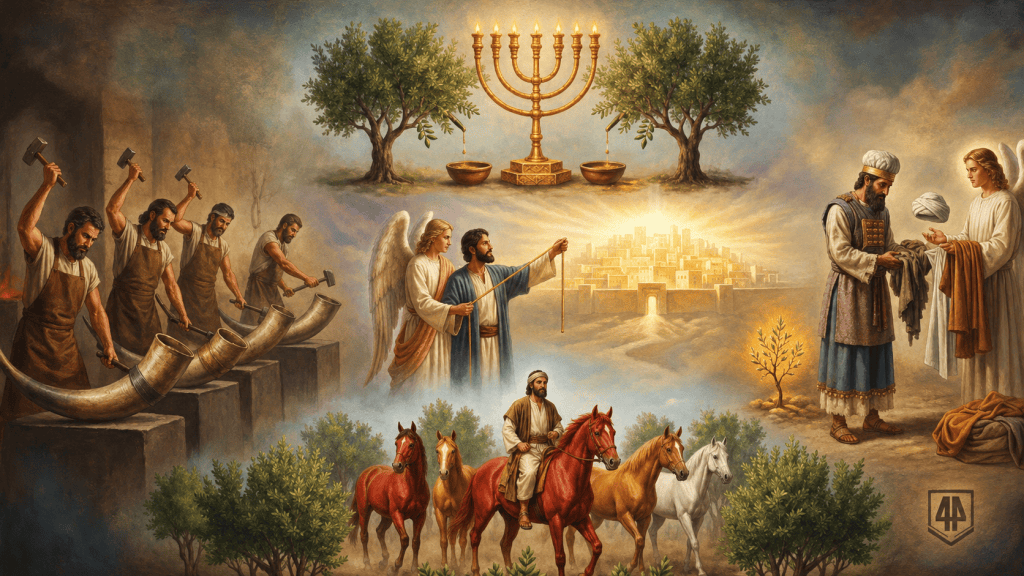
The Defilement of Sacred Space
The Hebrew description of Joshua’s garments in Zechariah 3:3 is considerably more offensive than most English translations communicate. The expression bĕgādîm ṣôʾîm (בְּגָדִים צוֹאִים) describes garments soiled with language associated with human excrement. The contemporary English equivalent might be closer to describing someone as wearing clothes covered in “dung”. While we cannot establish that the Hebrew constituted profanity in the modern sense, its imagery is deliberately repulsive. According to Deuteronomy 23:12–14, human excrement was to be removed from the camp precisely because Yahweh walked among his people. Its presence was incompatible with sacred space. Yet here, the very person entrusted with maintaining the holiness of that space has become its embodiment of defilement.²
Joshua is not a pagan standing outside the covenant community; he is its highest religious representative. The original audience would have recognized the theological scandal of the imagery. The priesthood, and by extension the community it represented, stood before Yahweh utterly incapable of establishing its own holiness. Interestingly, Yahweh neither disputes the evidence nor requires Joshua to demonstrate his repentance before intervening. There is no recorded confession, apology, or act of restitution. The reason given for silencing the accuser is Yahweh’s election of Jerusalem (3:2). The restoration originates in the character and covenant faithfulness of God rather than the demonstrated righteousness of the priest.
The Crown of Restoration
Perhaps the most beautiful element of the vision occurs when Zechariah himself intercedes, requesting that a clean turban be placed upon Joshua’s head. The Hebrew ṣānîp (צָנִיף) is not the conventional designation for the high priest’s turban, miṣnepet, found in the Torah. Rather, it carries associations with dignity, righteousness, and potentially royal authority. In Job 29:14, righteousness and justice are compared to a robe and turban, while Isaiah 62:3 describes restored Jerusalem as a crown of beauty and a royal diadem in the hand of Yahweh.³
The traditional priestly headdress carried a golden plate bearing the inscription qōdeš laYHWH (קֹדֶשׁ לַיהוָה), “Holy to Yahweh” (Exod 28:36–38). Interestingly, Exodus associates this golden plate with bearing the iniquity connected to Israel’s sacred offerings. It is also described as a nēzer, a sacred diadem or crown of consecration (Exod 29:6; 39:30). Although Zechariah does not explicitly mention the golden inscription, the restoration of Joshua’s headpiece would naturally evoke this priestly imagery. The very person who embodied everything incompatible with holiness is now publicly identified with it. Yahweh does not simply tolerate Joshua’s presence; he restores his dignity, identity, and capacity to participate in sacred vocation.
Atonement Without a Transaction
Yahweh declares in verse 4, heʿĕbartî mēʿāleykā ʿăwōnekā (הֶעֱבַרְתִּי מֵעָלֶיךָ עֲוֹנֶךָ), literally, “I have caused your iniquity to pass away from you.” The removal of the garments becomes the visible expression of divine forgiveness. The imagery is fundamentally restorative and purificatory rather than penal.
There is no sacrifice narrated, no transfer of punishment to another party, and no payment made within the vision. This does not settle every biblical question about atonement, but it demonstrates that biblical forgiveness encompasses far more than a penal transaction. Indeed, the passage presents a considerable challenge to any formulation of penal substitutionary atonement (PSA) that insists God cannot forgive iniquity without first exacting its corresponding punishment. Yahweh freely removes what separates Joshua from sacred communion. The judicial setting resolves itself through cleansing and restoration rather than retributive satisfaction.
The Circularity of Covenant Relationship
Following Joshua’s cleansing, Yahweh presents him with two covenantal conditions:
אִם־בִּדְרָכַי תֵּלֵךְ
ʾIm-bidrākay tēlēk — If you walk in my ways.
וְאִם אֶת־מִשְׁמַרְתִּי תִשְׁמֹר
Wĕʾim ʾet-mišmartî tišmōr — And if you keep my charge.
The vocabulary of guarding or keeping (šāmar) recalls the original human vocation in Eden (Gen 2:15) and its subsequent expression within the Levitical priesthood (Num 3:7–8). Joshua is being invited back into the sacred responsibilities for which humanity was created.⁴ The significance lies in the relational sequence: Yahweh extends grace, grace makes restoration possible, restoration invites allegiance, and faithful allegiance sustains participation in the covenant relationship. God initiates this relational movement through his own compassion and mercy, not Joshua’s merit. Repentance and faithful living are therefore not the purchase price of divine grace but the appropriate response to its reception.
The Stone with Seven Eyes
The single stone bearing seven eyes in verse 9 further develops the restoration imagery. The Hebrew ʾeben (אֶבֶן) denotes a stone, while ʿayin (עַיִן) ordinarily signifies an eye, although some interpreters understand it here as a facet. Inscribed stones and foundation deposits were familiar features of Mesopotamian temple construction, often communicating royal dedication, divine authorization, and protection. Jonathan Yogev has also proposed a fascinating connection to Babylonian ritual and the iconography of the Sibittu, a collective of seven divine beings whose symbolism would have been familiar to returning Babylonian exiles.⁵
Although the precise identity of the stone remains debated, Zechariah 4:10 identifies the seven eyes with Yahweh’s oversight of the entire earth. For the original audience, the imagery would communicate that Jerusalem’s restoration was undertaken under the comprehensive authority and watchfulness of Yahweh, rather than the authority of Babylonian or Persian gods. The removal of Joshua’s iniquity anticipates the removal of the iniquity of the entire land in a single day. John later appropriates this imagery in Revelation 5:6, identifying the seven eyes of the Lamb with the seven spirits of God sent throughout the earth.
A Pastoral Reflection on Shepherding
I wonder how often those of us entrusted with shepherding the people of God have inadvertently assumed the position of the accuser rather than that of the prophet. Zechariah sees the same offensive garments that the adversary sees, yet his response is to participate in the restorative work of Yahweh by asking that a crown be placed upon Joshua’s head. What would our churches look like if we learned to see people through the restorative imagination of God? This does not mean overlooking sin, abandoning accountability, or prematurely returning someone to leadership. Rather, it means recognizing that the purpose of biblical correction is ultimately restoration to communion with God and his people. Perhaps the greater measure of our maturity as shepherds is not how effectively we identify the filth in someone’s life, but how faithfully we participate in their cleansing, healing, and formation into the likeness of Jesus. The vision ends, after all, not with a courtroom verdict but with an invitation to sit together beneath the vine and fig tree. This is what the kingdom looks like when mercy has accomplished its intended work.

Notes
- Francis Brown, S. R. Driver, and Charles A. Briggs, A Hebrew and English Lexicon of the Old Testament (Oxford: Clarendon, 1907), s.v. “יְהוֹשֻׁעַ”; cf. Matt 1:21.
- Brown, Driver, and Briggs, Hebrew and English Lexicon, s.vv. “צֹאִי” and “צֹאָה”; cf. Deut 23:12–14; Ezek 4:12–15.
- Carol L. Meyers and Eric M. Meyers, Haggai, Zechariah 1–8, AB 25B (Garden City, NY: Doubleday, 1987), 192; Mark J. Boda, “Oil, Crowns and Thrones: Prophet, Priest and King in Zechariah 1:7–6:15,” JHS 3 (2001), article 10. The extent of the royal associations of ṣānîp remains debated.
- Michael Segal, “The Responsibilities and Rewards of Joshua the High Priest according to Zechariah 3:7,” JBL 126 (2007): 717–34.
- Jonathan Yogev, “The Seven Eyes of God,” VT 69 (2019): 307–19, https://doi.org/10.1163/15685330-12341354.

