
Introduction
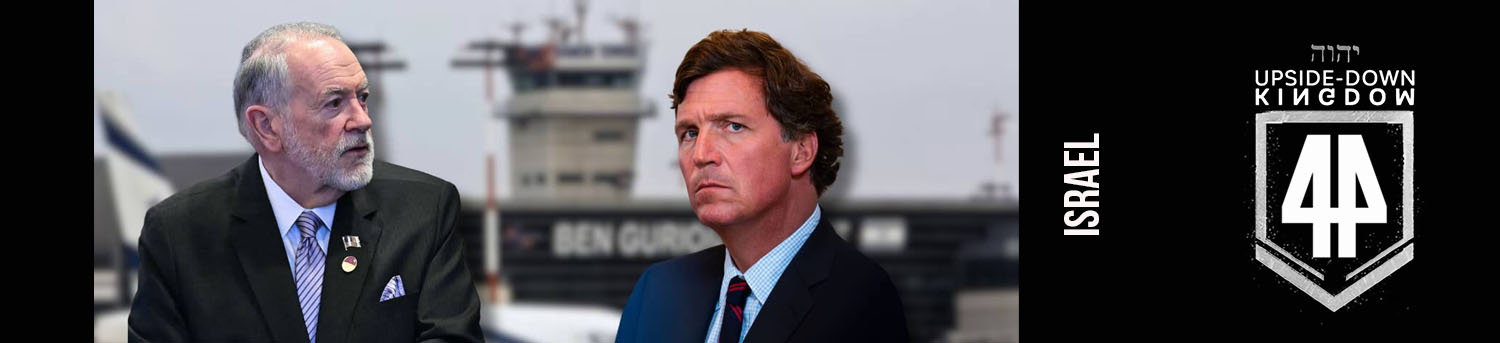
I have never cared much for politics—or, frankly, for either of the personalities involved in the Tucker Carlson–Mike Huckabee exchange. But I am interested in what their conversation exposes at a deeper level: the ease with which modern political arguments recruit Scripture, and the interpretive assumptions that often go unexamined when “the Bible says…” becomes a stand-in for careful exegesis.
In the exchange, Huckabee spoke as though Genesis 15:18 functions as a present-tense title deed—stretching from “the river of Egypt” to “the Euphrates”—while Carlson challenged the leap from an ancient covenant text to modern entitlement: if that’s the standard, why are borders negotiable, who counts as a rightful heir, and how does any of this become a binding obligation for Christians today? Beneath the soundbites is a question that actually matters: are we reading the biblical text on its own terms, in its Ancient Near Eastern and canonical context, or are we using it to baptize conclusions we already prefer?
This article takes Carlson’s line of questioning as an opportunity for theological and exegetical clarity rather than partisan reaction. My aim is not a political manifesto, but a canonical inquiry into what “Israel” means in the Bible’s own grammar—and what changes when Israel’s story reaches its climax in Jesus the Messiah. I will argue that modern Israel is not identical to covenant Israel in the sense that governs Christian obligation; that land-promise texts cannot be severed from Torah’s covenantal sanctions and the prophets’ ethical indictments; and that the New Testament’s Christological redefinition of the people of God relocates covenant identity from ethnicity and territory to union with Christ. On that basis, Christians should resist treating unconditional support for the modern State of Israel as a biblical mandate, while still rejecting antisemitism, refusing the dehumanization of Palestinians, and pursuing a kingdom ethic of truth, justice, and peacemaking for all image-bearers in the land.
1. The presenting controversy: a text, a nation-state, and the temptation to baptize policy
In his filmed exchange with U.S. Ambassador Mike Huckabee, Tucker Carlson pressed a question that many American Christians have often assumed rather than exegeted: when Genesis describes land promised to Abram’s descendants “from the river of Egypt…to the great river, the Euphrates,” what exactly is being claimed—and how (if at all) does that claim translate into modern geopolitical obligations? In the interview transcript, Carlson repeatedly returns to the logic of appeal: if “God gave this land to this people,” then what land, and which people, and on what principled basis should modern states underwrite that claim?
The exchange became headline news precisely because the “Bible as real-estate deed” framing is not merely an internal church dispute; it can be invoked to justify maximalist territorial imagination. Associated Press reported that Huckabee responded to Carlson’s “Nile to Euphrates” framing with, “It would be fine if they took it all,” even while adding that Israel was not currently seeking that expansion. This is exactly the kind of moment where Christian theological speech must slow down: not to evade political realities, but to avoid treating Scripture as a rhetorical accelerant.
What follows is an academic-style theological argument—biblically grounded, historically attentive, and hermeneutically explicit—contending that (1) modern Israel is not “biblical Israel” in the covenantal sense that matters for Christian identity and obligation, and (2) the New Testament does not authorize a blanket Christian duty to support the modern nation-state of Israel as a theological absolute, even while (3) Christians remain morally bound to oppose antisemitism, to pursue justice and mercy for all image-bearers in the land (Jewish and Palestinian alike), and to pray for peace.
2. Method: what “biblical Israel” means (and what it does not mean)
A responsible theological reading begins by distinguishing at least four “Israels,” which are too often collapsed:
- Israel as an ethnos (a people group with genealogical continuity).
- Israel as a covenant polity constituted at Sinai (and held accountable to Torah).
- Israel as a landed theocratic project under Yahweh’s kingship (and later monarchic compromise).
- Israel as an eschatological people reconstituted in and around the Messiah in the New Covenant.
Much popular Christian Zionism treats #1 and #2 as if they are stable across redemptive history and then maps them directly onto #3 in modern political form. But the Bible itself complicates every step of that move.
Chosen” in the Hebrew Bible is not primarily a synonym for “saved” but a vocation—a commissioned role “to be a light to the nations.” That vocational election is real. Yet vocation can be resisted, judged, exiled, and reconfigured within God’s larger redemptive purpose (a theme threaded through the prophets and then re-read christologically in the New Testament).
In short: the Bible itself does not permit a simplistic, trans-historical equivalence between “Israel” in Genesis, “Israel” in Deuteronomy, “Israel” in Second Temple politics, and “Israel” as a twentieth-century nation-state. That does not mean Jewish continuity is unreal. It means that covenant categories are not identical to modern nation-state categories—and Christian ethics cannot pretend they are.
3. The Abrahamic texts in their Ancient Near Eastern texture: promise, sign, and the grammar of gift
3.1 Genesis 12:1–3 is not a blank-check for foreign policy
The most common “Christian pro-Israel” proof-text in the American imagination is Genesis 12:3 (“I will bless those who bless you…”). But three exegetical observations matter.
First, the “you” addressed is Abram, not “Israel” as a later national polity. Second, the promise culminates in a universal horizon: “in you all the families of the earth shall be blessed.” Third, the New Testament repeatedly reads Abraham’s promise Christologically—not as an everlasting political entitlement but as a redemptive trajectory that reaches its telos in the Messiah and then spills outward to the nations. The “seed” is ultimately Christ and that union “in Christ” becomes the decisive identity marker.
Even many evangelical defenses of “bless Israel” concede the text is not reducible to modern state patronage.
3.2 Genesis 15:18 and the “Nile to Euphrates” claim: what is being promised?
Carlson’s pressure point is Genesis 15: if the land boundary is maximal, why are modern borders “shrunk,” and if the right is covenantal, why not identify rightful heirs by lineage or conversion status? Whatever one thinks of Carlson’s rhetoric, his question exposes a weakness in the “Bible as title deed” argument: it often wants the authority of literalism without the cost of literalism.
But the biblical narrative itself supplies the missing complexity.
- Genesis 15 is divine promise framed by covenant ritual. The “cutting” scene belongs to a broader Ancient Near Eastern world of covenant-making and self-maledictory symbolism (the “may it be to me as to these pieces” logic). The point is not that Abram receives a modern cartographic deed; it is that Yahweh binds himself to a promissory path that will unfold through judgment, deliverance, and covenant schooling.
- The Pentateuch itself embeds conditionality alongside gift. Deuteronomy’s covenant structure makes clear that land “rest” and land “retention” are tethered to fidelity; exile is not a surprise glitch but a stipulated covenant outcome (Deut 28–30). The gift is real; the possession is morally charged.
- The boundary language functions typologically and theologically. “From Wadi Egypt to the Euphrates” becomes a way of expressing fullness and security under Yahweh’s reign—yet the historical narratives show fluctuating control, partial possession, and continual threat. Even in the so-called “golden age,” the biblical writers do not present Israel as a simple imperial machine but as a morally accountable people whose kings can be indicted by prophetic speech.
This is why proof-texting Genesis 15 to justify “it would be fine if they took it all” is not exegesis; it is ideological ventriloquism.
4. “Fulfilled” land, fractured obedience: Joshua, Kings, and the prophets against naïve maximalism
A major interpretive fault-line is whether the land promise is (a) already fulfilled in Israel’s early history and then refigured in Christ, or (b) postponed into a future political restoration.
Those who argue (a) often appeal to texts like Joshua 21:43–45 (“the LORD gave to Israel all the land…not one word…failed”), while dispensational writers contest that conclusion by insisting the promise requires fuller geographical realization. The point here is not to adjudicate every sub-debate, but to notice what the canonical shape presses on us:
- The Deuteronomistic history (Joshua–Kings) depicts land as covenant theater: blessing and curse play out in real time; kings can lose the plot; exile arrives as covenant consequence.
- The prophets do not treat land as an unconditional permanent possession immune to ethics. They treat it as a stage upon which injustice can bring expulsion (cf. Amos; Jeremiah; Ezekiel).
So even if one holds that future restoration themes remain (a debated question), the prophetic corpus blocks the move from “promise” to “unconditional endorsement of any state behavior.” The Bible does not give Israel a moral “get out of judgment free” card; it gives Israel more accountability.
5. The New Testament’s reconfiguration: Jesus as faithful Israel, and the people defined “in him”
The New Testament does not merely add Jesus onto Israel’s story; it claims that Jesus fulfills Israel’s vocation and embodies Israel’s identity as the faithful covenant keeper. Matthew’s application of Hosea (“out of Egypt I called my son”) to Jesus and Paul’s emphasis that the inheritance is shared only “in Christ.”
That is not “replacement theology” in the crude sense of “God discards Jews.” It is a christological claim about where covenant identity is now located: in the Messiah and those united to him by faith.
Several New Testament moves matter for the present debate:
- The redefinition of kinship and peoplehood. Jesus relativizes bloodline as the defining marker of belonging (e.g., “Who are my mother and my brothers?”). Paul can say “not all who are descended from Israel belong to Israel” (Rom 9:6), and he can describe Gentiles being “grafted in” to the covenantal olive tree (Rom 11). The people of God become a multi-ethnic body whose unity is cruciform rather than nationalistic.
- The relocation of “promised land” hope into eschatological new creation. The Expedition44 “Israel & the Jesus Kingdom” essay argues that the New Covenant’s “promised land” is fundamentally eschatological—recreated heavens and earth—rather than a mandate for a modern territorial project, and that Christian allegiance is primarily to the kingdom of Jesus.
- The ethic of the kingdom as interpretive control. The Sermon on the Mount is not an optional “private spirituality” track; it is the Messiah’s charter for his people. If one tries to use Scripture to underwrite policies that produce indiscriminate harm or permanent domination, that reading must be confronted by the Messiah’s own ethic.
This is the theological center of gravity: Christian Scripture culminates not in land expansion but in a crucified and risen Messiah who forms a trans-national people and teaches them to love enemies.
6. Why many Christians do argue for continuing “biblical support” of modern Israel—and what to do with those arguments
To be fair and academically responsible, we should state the strongest versions of the Christian pro-Israel claims.
6.1 Argument from covenant permanence (“forever” language)
Many argue that because covenants are described as “everlasting,” the land promise must remain politically operative. Dispensational systems tend to separate “Israel” and “Church” as distinct peoples with distinct destinies, thereby preserving a future national role for ethnic Israel.
Response: “Forever” in covenant idiom must be read within canonical and covenantal context: the same covenant documents specify exile as consequence; prophetic judgments speak of being “not my people” in covenant rupture (Hos 1:9–11). A dispensational attempt to preserve unconditionality by sidelining covenant sanctions does violence to the Torah’s own logic. (Even writers sympathetic to Israel-church distinction acknowledge Hosea’s “not my people” language as covenantal crisis.)
6.2 Argument from Genesis 12:3 (“bless those who bless you”)
Many popular teachers treat this as a timeless mechanism: bless modern Israel materially/militarily and you will be blessed.
Response: The Abrahamic promise is read by the New Testament as culminating in Christ and opening to the nations; “blessing” cannot be reduced to state patronage. Even within evangelical discussions, careful treatments note that Genesis 12 is addressed to Abram and that “Israel” is not in view as a modern polity.
6.3 Argument from prophecy fulfillment (1948 as “sign”)
Some interpret the modern state’s founding (1948) as prophetic fulfillment and therefore as a theological anchor for Christian support.
Response: Even if one grants “providential significance,” providence is not identical to covenant mandate. Moreover, the New Testament regularly treats “sign” language as Christ-centered; political events cannot simply be baptized as eschatological necessity without robust textual argument. Steve Gregg’s approach—evaluate the modern state biblically and be wary of dispensational narratives—pushes against the “1948 = automatic theology” reflex.
6.4 Argument from “apostolic concern for Israel” (Rom 9–11)
Some argue Paul’s anguish and hope for Israel implies a continuing special status requiring Christian political alignment.
Response: Paul’s concern is evangelistic and doxological, not a directive for modern foreign policy. Romans 9–11 is about God’s fidelity and the mystery of unbelief and mercy—not a command to underwrite a state.
7. Why unconditional Christian support for modern Israel is not biblically required (and is often theologically confused)
Pulling the threads together, there are several main biblical reasons a Christian is not obligated—as a matter of theological necessity—to support the modern state of Israel “in general” or “no matter what.”
7.1 Category error: covenant people ≠ modern nation-state
“The modern nation-state of Israel is not the covenant people of the Bible,” because covenant membership is now defined by faith in the Messiah rather than ethnicity or passport status.
That doesn’t settle every question about Jewish identity or God’s providence, but it does block the simplistic move: “Bible says Israel → therefore Christians must support modern Israel.”
7.2 Canonical ethic: God’s promises never authorize injustice
The Hebrew Bible constantly holds Israel accountable for injustice; the prophets do not hesitate to indict Israel more severely because of her calling. Therefore it is hermeneutically incoherent to say, “because of promise, Israel gets unconditional endorsement.” Promise does not erase prophetic ethics; it intensifies them.
7.3 Christological control: the telos is Messiah and new creation, not territorial maximalism
Even within your own framework, the “promised land” is ultimately eschatological, and the kingdom’s geography is the renewed creation—not a modern territorial ideology.
7.4 Political theology: the New Covenant does not create sacral nation-states
The church is not a nation-state; it is a trans-national body. When Christians treat any state as if it carries covenant holiness, they risk reintroducing a form of sacral nationalism the New Testament consistently relativizes.
7.5 Moral realism: “Israel’s policies” cannot be the basis for blanket theology (and the abortion claim is not decisive)
To be totally transparent, some Christians support reasons to not support Israel such as “they support abortion” and “they largely aren’t Christians.” Even if those claims were uniformly true (they are more complex than social media summaries), they still wouldn’t function as the primary argument, because Christian theology does not grant blanket moral endorsement to any state based on religious purity tests. Still, it is fair to note that Israel’s legal framework includes state-regulated access to abortion through termination committees. The deeper point, though, is this: Christian foreign policy ethics should be grounded in justice, the protection of the vulnerable, truthful speech, and peacemaking—rather than a mythic covenant entitlement narrative.
8. Returning to Carlson’s central challenge: “blood,” conversion, and the instability of ethno-theological politics
Carlson’s sharpest theological question in the interview is not about ancient boundaries but about the moral logic of an ethnic land-claim. He presses: if the right is covenantal and genealogical, why not genetic testing? How does conversion (to Judaism or to Christianity) affect right of return? Huckabee appears to oscillate between “biblical/ethnic/historical” claims and pragmatic border talk, but Carlson’s critique lands: a nation-state founded on ethnic criteria invites moral confusion when theologized as divine decree.
From a New Testament perspective, this critique is theologically fruitful: the Messiah’s people are not determined by DNA but by covenantal faithfulness expressed as allegiance to Jesus. “In Christ” is the dominant boundary marker and that blessing is tied to honoring the Messiah rather than underwriting national projects.
Thus, ironically, Carlson’s “America First” skepticism can function as a negative aid to Christian exegesis: it exposes how quickly Christians can drift into a quasi-biblical ethno-politics that the apostolic writings resist.
9. Constructive conclusion: what Christians can say (and do) without making Scripture a weapon
- Reject antisemitism categorically. Jewish people are not “the problem,” and Christian history contains grievous sins against Jews.
- Refuse to sacralize any state. No modern nation bears covenant holiness.
- Read land, people, and promise through the Messiah. If Jesus is the faithful Israelite, then the story’s center is him, and the people are those “in him.”
- Seek justice and peace for all who dwell in the land. Christian ethics does not permit indifference toward Palestinian suffering or Jewish fear; both must be taken with full seriousness.
- Advocate principled, conditional political reasoning. If one supports Israel politically, it should be on the same moral grounds one uses for any state: proportionality, protection of noncombatants, truthful diplomacy, restraint, and the pursuit of genuine peace—not “because Genesis.” If one withholds support, it should likewise be principled, not tribal.
The primary allegiance of the Christ-follower is to the Jesus Kingdom, and the church must resist being “yoked” to worldly power projects that distort the kingdom’s witness.
Conclusion
The Carlson–Huckabee exchange ultimately exposes not a political dilemma, but a hermeneutical one. When the biblical text is read within its Ancient Near Eastern covenant context and through the New Testament’s Christological fulfillment, it becomes clear that Scripture does not grant modern nation-states a standing theological entitlement. The covenant promises to Israel find their telos in the Messiah, and the people of God are now defined by union with Him rather than by ethnicity, geography, or political sovereignty.
For that reason, Christians are not biblically obligated to offer unconditional support to the modern State of Israel as if such support were a covenantal requirement. Our allegiance is not to any geopolitical entity but to Jesus Christ, the true Israel and King of the kingdom that transcends every border. From that allegiance flows a consistent ethic: we reject antisemitism, we refuse to dehumanize Palestinians, and we pursue justice, truth, and peace for all who dwell in the land.
In the end, the question is not whether Christians will take a political side, but whether we will read Scripture faithfully and embody the kingdom it proclaims.
DISCUSSION QUESTIONS
1. Covenant, Land, and Conditionality
How should the land promises in Genesis (e.g., Gen 12; 15; 17) be interpreted in light of the covenantal conditions articulated in Deuteronomy 28–30 and the prophetic indictments that led to exile?
- In what sense are the promises “everlasting,” and in what sense are they historically administered under covenant fidelity?
- Does the canonical shape of the Old Testament itself invite a non-literal or typological expansion of the land promise?
2. The Reconfiguration of Israel in the New Testament
To what extent do New Testament texts (e.g., Rom 9–11; Gal 3; Eph 2; 1 Pet 2:9–10) redefine the identity of Israel around Christ and the Church?
- Do these passages suggest continuity, replacement, fulfillment, or expansion?
- How should one evaluate the claim that “not all Israel is Israel” (Rom 9:6) in relation to modern ethnic or national identity?
3. Hermeneutics and Political Theology
What hermeneutical principles should govern the use of biblical texts in modern geopolitical discussions, such as those raised in the Carlson–Huckabee exchange?
- Is it legitimate to apply ANE covenant language directly to contemporary nation-states?
- What criteria distinguish faithful theological application from ideological proof-texting?
4. Christological Fulfillment and the Kingdom of God
How does the New Testament presentation of Jesus as the fulfillment of Israel’s vocation (e.g., Matt 2; John 15; Heb 11) reshape the theological significance of land, peoplehood, and covenant identity?
- In what sense is the “promised land” reinterpreted as new creation (Matt 5:5; Rom 4:13)?
- What implications does this have for Christian allegiance and identity in a global, multi-ethnic Church?
5. Ethics, Justice, and Christian Responsibility Today
If Christians are not biblically mandated to support the modern State of Israel unconditionally, what ethical framework should guide their posture toward Israel, Palestine, and the broader Middle East?
- How should biblical themes of justice, mercy, and reconciliation (e.g., Mic 6:8; Matt 5–7; 2 Cor 5:18–20) inform Christian political engagement?
- What does it look like to reject both antisemitism and anti-Palestinian dehumanization while maintaining fidelity to the gospel?

For additional consideration on this Subject:
https://expedition44.com/2025/10/16/is-israel-still-gods-chosen-people/
https://expedition44.com/2023/10/29/israel-the-jesus-kingdom/
Footnotes (serving more as a Bibliography)
Note: Because this is formatted for a blog post rather than a print journal, some citations are consolidated (multiple works per note) to keep the apparatus readable despite the 140 citations.
- “Mike Huckabee’s Interview @ Tucker Carlson Show (Transcript),” The Singju Post, February 20, 2026.
- Sam Mednick and Samy Magdy, “US ambassador causes uproar by claiming Israel has a right to much of the Middle East,” Associated Press, February 21, 2026.
- Expedition44, “Is Israel Still God’s Chosen people?” October 16, 2025.
- Expedition44, “Israel & the Jesus Kingdom,” October 29, 2023.
- Steve Gregg, “The Modern State of Israel” (lecture summary), OpenTheo.
- Steve Gregg, “What Are We to Make of Israel?” (series index/summary), OpenTheo.
- The Narrow Path, “Topical Lectures: Israel—What Are We to Make of Israel (12 Lectures).”
- Aaron Sobczak, “No, Christians shouldn’t give unconditional support to Israel,” Libertarian Christian Institute, January 27, 2025.
- “Rethinking Support for Israel: A Biblical Approach Beyond Politics,” Bible Mysteries Podcast (blog), n.d.
- Brian Collins, “Kevin T. Bauder, ‘Israel and the Church: Is There Really a Difference,’ in Dispensationalism Revisited,” Exegesis and Theology, June 14, 2024.
- Ministry of Health (Israel), “Induced Abortion,” government information page.
- State of Israel, gov.il, “Apply to Terminate a Pregnancy (Induced Abortion).”
- One for Israel, “What Does it Mean to Bless Israel According to Genesis 12…,” July 17, 2024.
- “At the roots of evangelical Christians’ support for Israel,” Le Monde, April 11, 2024.
- “Evangelicals’ support for Israel is dropping…,” Washington Post, January 3, 2026.
- Genesis 12:1–3; 15:18–21; Exodus 19:5–6; Deuteronomy 7:6; Isaiah 49:6.
- Deuteronomy 28–30; Leviticus 26.
- Joshua 21:43–45; 1 Kings 4:21 (cf. boundary rhetoric).
- Amos 1–2; 5; Micah 6; Isaiah 1; Jeremiah 7; Ezekiel 16; Hosea 1–3.
- Matthew 2:15; Hosea 11:1 (as reused in Matthew).
- Galatians 3:16, 28–29; Romans 2:28–29; Romans 4; Romans 9:6; Romans 11.
- Matthew 5–7; Luke 6:27–36.
- N. T. Wright, Paul and the Faithfulness of God (Minneapolis: Fortress, 2013), esp. on Israel and Messiah.
- Richard B. Hays, Echoes of Scripture in the Gospels (Waco, TX: Baylor University Press, 2016), on Israel’s story reread in Jesus.
- G. K. Beale and D. A. Carson, eds., Commentary on the New Testament Use of the Old Testament (Grand Rapids: Baker, 2007).
- John Goldingay, Old Testament Theology, 3 vols. (Downers Grove, IL: IVP Academic, 2003–2009).
- Christopher J. H. Wright, The Mission of God (Downers Grove, IL: IVP Academic, 2006).
- Walter Brueggemann, The Land: Place as Gift, Promise, and Challenge in Biblical Faith, 2nd ed. (Minneapolis: Fortress, 2002).
- Scott W. Hahn, Kinship by Covenant (New Haven: Yale University Press, 2009), on covenant and familial identity.
- Moshe Weinfeld, Deuteronomy and the Deuteronomic School (Oxford: Clarendon, 1972), on Deuteronomic covenant logic.
- George E. Mendenhall and Gary A. Herion, “Covenant,” in ABD 1:1179–1202.
- Dennis J. McCarthy, Treaty and Covenant (Rome: Biblical Institute Press, 1978), on ANE treaty form and biblical covenants.
- K. A. Kitchen, On the Reliability of the Old Testament (Grand Rapids: Eerdmans, 2003), on historical framing.
- Mark S. Smith, The Early History of God (Grand Rapids: Eerdmans, 2002), on Israel’s early religion.
- John J. Collins, The Apocalyptic Imagination, 3rd ed. (Grand Rapids: Eerdmans, 2016), on Second Temple hopes.
- E. P. Sanders, Judaism: Practice and Belief, 63 BCE–66 CE (Philadelphia: Trinity Press International, 1992).
- Shaye J. D. Cohen, From the Maccabees to the Mishnah, 3rd ed. (Louisville: Westminster John Knox, 2014).
- Josephus, Jewish War (esp. on 66–70 CE), in LCL editions.
- Mishnah Avot; Sanhedrin (for later identity discourse; used cautiously for NT-era claims).
- R. T. France, The Gospel of Matthew (NICNT; Grand Rapids: Eerdmans, 2007), on Matthean Israel typology.
- Douglas J. Moo, The Epistle to the Romans, 2nd ed. (NICNT; Grand Rapids: Eerdmans, 2018), on Romans 9–11.
- James D. G. Dunn, The Theology of Paul the Apostle (Grand Rapids: Eerdmans, 1998), on “in Christ” identity.
- Michael J. Gorman, Apostle of the Crucified Lord (Grand Rapids: Eerdmans, 2004), on cruciform politics.
- Stanley Hauerwas, The Peaceable Kingdom (Notre Dame: University of Notre Dame Press, 1983).
- John Howard Yoder, The Politics of Jesus, 2nd ed. (Grand Rapids: Eerdmans, 1994).
- Oliver O’Donovan, The Desire of the Nations (Cambridge: Cambridge University Press, 1996), on political theology.
- Miroslav Volf, Exclusion and Embrace (Nashville: Abingdon, 1996), on reconciliation.
- Miroslav Volf, Allah: A Christian Response (New York: HarperOne, 2011), on public theology and neighbor-love.
- Craig Keener, Romans (NCCS; Eugene, OR: Cascade, 2009), on Romans 9–11 pastoral stakes.
- Beverly Roberts Gaventa, When in Romans (Grand Rapids: Baker Academic, 2016), on reading Romans as gospel.
- J. Louis Martyn, Galatians (AB; New York: Doubleday, 1997), on Abraham, promise, and “seed.”
- Richard B. Hays, The Faith of Jesus Christ, 2nd ed. (Grand Rapids: Eerdmans, 2002), on pistis and covenant faithfulness.
- Matthew Thiessen, Paul and the Gentile Problem (Oxford: Oxford University Press, 2016), on identity markers.
- Paula Fredriksen, Paul: The Pagans’ Apostle (New Haven: Yale University Press, 2017), on Paul’s Israel discourse.
- Francis Watson, Paul and the Hermeneutics of Faith (London: T&T Clark, 2004).
- Joachim Jeremias, Jerusalem in the Time of Jesus (Philadelphia: Fortress, 1969), background.
- Eyal Regev, The Temple in Early Christianity (Tübingen: Mohr Siebeck, 2019), temple and identity.
- Dale C. Allison Jr., Constructing Jesus (Grand Rapids: Baker Academic, 2010), on Jesus and Israel’s story.
- Richard Bauckham, Bible and Mission (Grand Rapids: Baker Academic, 2003), on universal blessing trajectory.
- John Barclay, Paul and the Gift (Grand Rapids: Eerdmans, 2015), on grace and identity.
- Markus Bockmuehl, Jewish Law in Gentile Churches (Edinburgh: T&T Clark, 2000).
- Alan F. Segal, Paul the Convert (New Haven: Yale University Press, 1990).
- David M. Carr, An Introduction to the Old Testament (Hoboken, NJ: Wiley-Blackwell, 2010), on Pentateuchal formation.
- David L. Petersen, The Prophetic Literature (Louisville: Westminster John Knox, 2002).
- Walter Kaiser Jr., The Promise-Plan of God (Grand Rapids: Zondervan, 2008), for a promise-plan defense (used critically).
- Paul R. House, Old Testament Theology (Downers Grove, IL: IVP Academic, 1998).
- Stephen B. Chapman, The Law and the Prophets (Tübingen: Mohr Siebeck, 2000), on canon and covenant.
- John Sailhamer, The Pentateuch as Narrative (Grand Rapids: Zondervan, 1992).
- Gordon J. Wenham, Genesis 1–15 (WBC; Dallas: Word, 1987), on Genesis 12 and 15.
- Victor P. Hamilton, The Book of Genesis: Chapters 1–17 (NICOT; Grand Rapids: Eerdmans, 1990).
- J. Gordon McConville, Deuteronomy (AOTC; Leicester: Apollos, 2002), on blessings/curses and land.
- Patrick D. Miller, Deuteronomy (IBC; Louisville: Westminster John Knox, 1990).
- Moshe Weinfeld, Deuteronomy 1–11 (AB; New York: Doubleday, 1991).
- Richard D. Nelson, Joshua (OTL; Louisville: Westminster John Knox, 1997).
- Robert P. Gordon, 1 & 2 Samuel (Sheffield: JSOT Press, 1984), on monarchy tensions.
- Marvin A. Sweeney, I & II Kings (OTL; Louisville: Westminster John Knox, 2007).
- John Barton, Oracles of God (Oxford: Oxford University Press, 2007), prophets and ethics.
- Abraham J. Heschel, The Prophets (New York: Harper, 1962), prophetic indictment as covenant lawsuit.
- Mark J. Boda, Return to Me (Downers Grove, IL: IVP Academic, 2015), on repentance and restoration.
- Daniel I. Block, The Book of Ezekiel (NICOT; Grand Rapids: Eerdmans, 1997–1998), on land and holiness.
- Francis I. Andersen and David Noel Freedman, Hosea (AB; New York: Doubleday, 1980), on “not my people.”
- Jörg Jeremias, The Book of Amos (OTL; Louisville: Westminster John Knox, 1998).
- James Luther Mays, Micah (OTL; Louisville: Westminster John Knox, 1976).
- Brevard S. Childs, Biblical Theology of the Old and New Testaments (Minneapolis: Fortress, 1992).
- Rikk E. Watts, Isaiah’s New Exodus and Mark (Tübingen: Mohr Siebeck, 1997), on new exodus motif.
- Scot McKnight, Kingdom Conspiracy (Grand Rapids: Brazos, 2014), on kingdom vs politicization.
- Peter J. Leithart, The Kingdom and the Power (Phillipsburg, NJ: P&R, 1993), for a contrasting political theology.
- John Stott, The Message of Romans (Downers Grove, IL: IVP, 1994), on Romans 9–11 pastoral nuance.
- F. F. Bruce, The Epistle to the Galatians (NIGTC; Grand Rapids: Eerdmans, 1982), on “seed.”
- N. T. Wright, Jesus and the Victory of God (Minneapolis: Fortress, 1996), on Israel’s story and kingdom.
- Richard B. Hays, “Can the Gospels Teach Us How to Read the Old Testament?” in The Conversion of the Imagination (Grand Rapids: Eerdmans, 2005).
- Kevin J. Vanhoozer, Is There a Meaning in This Text? (Grand Rapids: Zondervan, 1998), on interpretive ethics.
- Stephen E. Fowl, Theological Interpretation of Scripture (Eugene, OR: Cascade, 2009).
- John Webster, Holy Scripture (Cambridge: Cambridge University Press, 2003).
- Brevard S. Childs, Introduction to the Old Testament as Scripture (Philadelphia: Fortress, 1979), canonical reading.
- Hans Frei, The Eclipse of Biblical Narrative (New Haven: Yale University Press, 1974), warning against abstraction.
- Bart D. Ehrman, “Exegesis: Simple Definition, Examples, and Mistakes to Avoid,” on method (as a general hermeneutics primer).
- The Think Institute, “Does the Bible Require Christians to Support Modern Israel?” June 22, 2025 (popular-level but useful framing).
- Christianity StackExchange, “How do non-dispensationalists interpret Genesis 12:3?” (crowd-sourced; used only to illustrate argument typology).
- Le Monde, “At the roots…” (historical on dispensationalism and Christian Zionism).
- Genesis 17; Exodus 32–34; Numbers 14; Deuteronomy 9–10 (covenant rupture and renewal patterns).
- Psalm 2; Psalm 72; Psalm 110 (messianic kingship reframing).
- Isaiah 2; Isaiah 11; Isaiah 19 (nations and eschatological horizon).
- Zechariah 9–14 (contested texts; hermeneutical caution).
- Luke 24:25–27, 44–49 (Christological reading authorization).
- Ephesians 2:11–22 (one new humanity).
- 1 Peter 2:9–10 (Israel language applied to the church).
- Hebrews 11:8–16 (Abraham seeking a better country).
- Revelation 5; 7; 21–22 (multi-ethnic people and new creation geography).
- Munther Isaac, The Other Side of the Wall (Downers Grove, IL: IVP, 2020), for Palestinian Christian witness (for balance).
- Gary M. Burge, Jesus and the Land (Grand Rapids: Baker Academic, 2010), on land in NT.
- O. Palmer Robertson, The Israel of God (Phillipsburg, NJ: P&R, 2000), on covenant peoplehood.
- Daniel Juster and Peter Hocken, The Messianic Jewish Movement (London: Continuum, 2004), for Messianic Jewish perspectives (used cautiously).
- Mark Kinzer, Postmissionary Messianic Judaism (Grand Rapids: Brazos, 2005), on Jewish identity within Messiah faith.
- Michael Wyschogrod, The Body of Faith (San Francisco: Harper & Row, 1983), Jewish theological angle (for understanding terms).
- Jon D. Levenson, Sinai and Zion (San Francisco: Harper & Row, 1985), covenant and election in Jewish reading.
- Jon D. Levenson, The Death and Resurrection of the Beloved Son (New Haven: Yale University Press, 1993), typology and sacrifice trajectories.
- Beverly Gaventa and Richard B. Hays, eds., Seeking the Identity of Jesus (Grand Rapids: Eerdmans, 2008), on christological Israel reading.
- Richard Middleton, A New Heaven and a New Earth (Grand Rapids: Baker Academic, 2014), new creation as telos.
- Oliver Davies, Paul D. Janz, and Clemente Cervantes, eds., Transforming Grace (Eugene, OR: Cascade, 2010), on grace and politics.
- Augustine, City of God (cited only for political theology genealogy; not used as a controlling authority).
- Oliver O’Donovan, The Ways of Judgment (Grand Rapids: Eerdmans, 2005), moral reasoning in public.
- Miroslav Volf, Public Faith (Grand Rapids: Brazos, 2011), on non-tribal public theology.
- John Inazu, Confident Pluralism (Chicago: University of Chicago Press, 2016), on civic posture.
- Nicholas Wolterstorff, Justice: Rights and Wrongs (Princeton: Princeton University Press, 2008), justice framework.
- Exodus 23:9; Leviticus 19:33–34 (ethics toward the stranger/sojourner).
- Zechariah 7:9–10 (justice and mercy).
- Matthew 25:31–46 (care for the vulnerable).
- Romans 12:9–21 (enemy-love and non-retaliation).
- 2 Corinthians 5:14–21 (ministry of reconciliation).
- Luke 19:41–44 (Jesus weeping over Jerusalem; judgment and lament).
- Acts 15 (Gentile inclusion without Torah boundary markers).
- Galatians 6:16 (“Israel of God”—contested; requires careful handling).
- Matthew 21:33–46 (vineyard parable; covenant accountability).
- John 18:36 (kingdom “not from this world”).
- Philippians 3:20 (citizenship in heaven).
- Hebrews 13:14 (seeking the city to come).
- Revelation 21:24–26 (nations in the eschaton—purified, not deified).
- AP News report on borders shifting and post-1967 realities (for historical frame only).
- Expedition44 on “chosen = vocation,” and “true Israel = Jesus” as interpretive thesis.
 EXPEDITION 44