Is it time to start writing a War Scroll yet?

Recent developments within American political life raise serious theological and pastoral concerns, particularly when Christian language and symbols are invoked to legitimize the exercise of state power. When sectors of evangelical and fundamentalist Christianity publicly align themselves with coercive or dehumanizing immigration enforcement practices, such alignment risks distancing Christian witness from the ethic and teachings of Jesus himself (Matt 7:15–20; Luke 4:18–19).

This week, 37-year-old Alex Jeffrey Pretti, an intensive care nurse from Minneapolis, was shot and killed by federal agents during an immigration enforcement operation on January 24, 2026. Pretti was well-known locally as a VA hospital ICU nurse with no serious criminal history. Bystander video analyzed by news outlets appears to show Pretti holding only a phone and not a weapon before being sprayed with a chemical agent, tackled to the ground, and then shot by agents. Footage suggests that one of the agents appears to remove a handgun from the struggle just moments before shots are fired. As many as 10 shots can be heard in the clip that captured the event. Federal officials have said that agents fired in what they described as defensive action after Pretti allegedly approached with a handgun and resisted disarmament; local authorities have confirmed he was a lawful gun owner with a permit to carry. The shooting has sparked protests and intense public scrutiny over the handling of the incident and the actions of federal forces in Minneapolis. Perhaps we don’t know all of the story; it is hard to tell if Alex was just being tackled by several government officials or if he was part of the struggle. So far in the footage, we can’t see what was happening up close. But all of this seems excessive and out of line.

Regardless of whether Alex was resistant, as an ardent constitutional 2A supporter and owner of an NRA gun range, this has me considering a revolution. I have taught History at many educational levels. The American Revolution emerged from a growing conviction that British authority had become unjust and tyrannical. Colonists faced taxation without representation, loss of local self-governance, standing armies enforcing civil law, economic restrictions, and denial of due process. Influenced by the Enlightenment and biblical ideas of God-given rights, many concluded (right or wrong) that when government violates its covenant to protect liberty, resistance becomes morally justified. Minnesota is getting dangerously close to the similarities of the Boston Massacre, which occurred on March 5, 1770. Could we be six years away from a Civil War revolution?

I recognize how complex these conversations are. Unlike some voices on my side who completely reject any connection to the MAGA movement, I do not. In fact, I can see certain elements of Christian language and symbolism appearing in our government. Yet, these are often eclipsed by hypocrisy and rhetoric that conflict with biblical teaching. I sometimes smile, but the reflection behind it remains sorrowful.

I don’t watch the news much anymore; I have decided it isn’t good for my desire to be completely kingdom-minded. So, when I get too enthralled with discussions like this, I am thankful that my pastoral senses kick in (likely the Holy Spirit) and I remember the Jesus that I am faithfully in covenant with never called for the faithful to start that sort of a revolution. In fact, the political climate of Jeremiah was likely significantly worse, with sons and daughters taken into slavery by the coming empire, and Jeremiah’s words were strikingly calm,

Recently you may have observed that federal recruitment materials have, at times, incorporated Scripture and explicitly religious language. The concern is not merely that biblical texts appear in public discourse, but that such language is deployed by agencies tasked with the use of force. As David Wehner argues, when Immigration and Customs Enforcement frames its mission in theological terms, it implicitly communicates that its actions carry divine sanction. In one regard, isn’t this good? Is the government finally trying to align with the path of the scripture?

One of several example of this can be found in the September 2025, (a now-renamed) U.S. Department of War social media account that posted a video showing military personnel with overlaid Bible text:

“Be strong and of good courage. Do not be afraid, nor dismayed. For the Lord your God is with you, wherever you go.”Joshua 1:9

In the 1920s and 1930s, elements within the German Evangelical Church aligned themselves with nationalist ideology through the Deutsche Christen (“German Christians”) movement. Christian theology was reshaped to support political aims, including the construction of a “heroic” and racially reimagined Jesus, detached from his Jewish identity and biblical context (Heschel, The Aryan Jesus). While contemporary America is not equivalent to Germany under National Socialism, Dietrich Bonhoeffer’s warning remains instructive: when the church confuses loyalty to Christ with loyalty to political power, it ceases to function as the church at all (Ethics; Letters and Papers from Prison).

From a discipleship perspective, the central question is not partisan but Christological: What does faithfulness to Jesus require when power is exercised in ways that harm the vulnerable? The New Testament consistently places the treatment of the stranger, the poor, and the powerless at the center of faithful obedience (Matt 25:31–46; Lev 19:33–34; Heb 13:2).

The Gospels portray Jesus as resisting coercive power, refusing to dehumanize opponents, and explicitly rejecting the use of divine authority to justify domination (Luke 22:25–27; John 18:36). Any policy or practice that undermines human dignity must therefore be assessed not merely by its legality, but by its conformity to the character of Christ (Hauerwas, The Peaceable Kingdom).

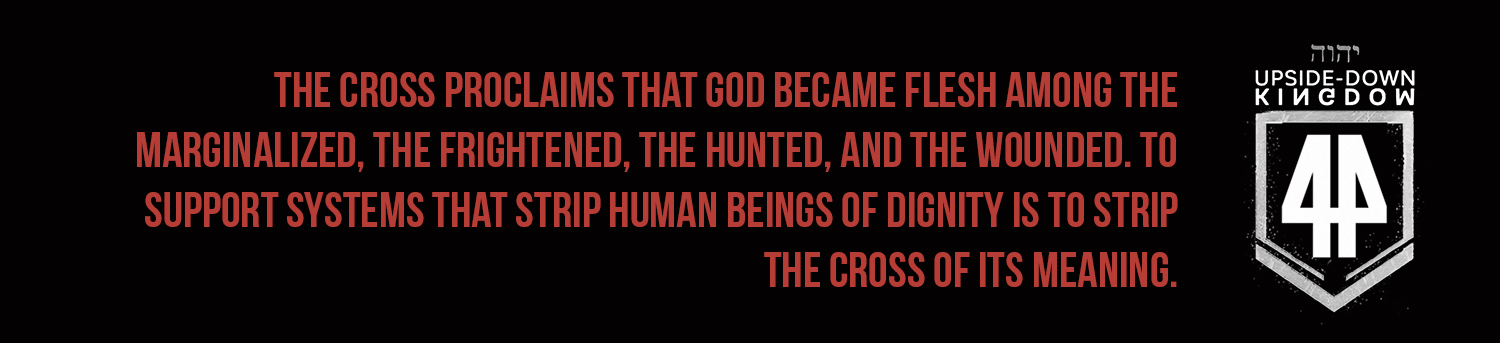
At the center of Christian confession stands the claim that God became flesh among the marginalized, the displaced, and the suffering (John 1:14; Luke 2:7). Faithfulness to Christ calls the church not to baptize power, but to bear witness to a kingdom that restores dignity, practices mercy, and speaks truth—even when doing so is costly.

I believe our government has drifted far from the ethics of Jesus. The way power is being exercised in the name of immigration enforcement (as well as other ideals) is not consistent with the character of Christ.

It is not Christlike to use children as instruments of coercion or entrapment. It is not Christlike to publicly humiliate an elderly citizen—forcing him out into freezing conditions in his underwear. It is not Christlike to fire on unarmed protesters at close range. It is not Christlike to detain human beings in degrading, inhumane conditions. It is not Christlike to tear gas a family’s vehicle and send three children, including an infant, to the hospital. And it is not Christlike to terrorize immigrant communities, communities of color, or anyone else, for that matter.2

Make no mistake, America is not a “Christian nation” nor was that ever the intent. Yet the way many Christians behave in public life today resembles something far closer to a distorted form of Christianity than to the faith of Jesus. In many cases, authoritarian power is being legitimized by a misuse of Christian language and symbols.

When Christianity is weaponized for political control, it becomes something other than the gospel. When the name of Jesus is invoked to justify fear, exclusion, or violence, the message of the cross is compromised. And when Christians remain silent—or worse, defend policies that dehumanize and brutalize others—we betray the very gospel we claim to uphold.


  1. Jeremiah 29:5-7 ↩︎
  2. @Benjamin Cremer ↩︎

Bibliography

  1. Bellah, Robert N. “Civil Religion in America.” Daedalus 96, no. 1 (1967): 1–21.
  2. Bonhoeffer, Dietrich. Ethics. Minneapolis: Fortress Press, 2005.
  3. Bonhoeffer, Dietrich. Letters and Papers from Prison. New York: Touchstone, 1997.
  4. Hauerwas, Stanley. The Peaceable Kingdom. Notre Dame: University of Notre Dame Press, 1983.
  5. Heschel, Susannah. The Aryan Jesus: Christian Theologians and the Bible in Nazi Germany. Princeton: Princeton University Press, 2008.
  6. The Bible, New Revised Standard Version.
  7. Wehner, David. “The MAGA Jesus.” The Atlantic.

NOTE:

The title of this article is a bit tongue and cheek; I do not believe the War Scroll was aligned with the view of Jesus in any way. I hope you are able to pick up on the hyperbole. The War Scroll, found among the Dead Sea Scrolls at Qumran, is a detailed eschatological text attributed to the Essenes, a Jewish sect living in the area during the Second Temple period. It describes a final, cosmic battle between the “Sons of Light” (the righteous community) and the “Sons of Darkness” (their enemies, including the forces of evil and oppressive nations). The scroll outlines military organization, strategy, and rituals, presenting the war as part of God’s ultimate plan to purify Israel and establish divine rule. Scholars view it as reflecting the Essenes’ apocalyptic worldview and their belief in an imminent, divinely guided victory over evil.

Comments Off on Is it time to start writing a War Scroll yet? Posted in ADVENTURE

GENESIS 17 AND THE COVENANT

From the beginning, Scripture uses marriage as a central metaphor for the deep intimacy God desires with His people. It is the closest human image of the nearness and unity God longs to share with us. This is why Christ describes the church as His bride, expressing His desire for a relationship with His body. Throughout the Old Testament, God continually pursues His people, making a way back to them even when they break covenant. The central theme of the entire narrative of the Bible is God’s desire to intimately dwell with us.

Many can recall moments in their marriage when everything seemed perfectly aligned—when joy was intense and love felt effortless. Those moments are gifts, brief glimpses of heaven touching earth. They reflect, in part, the kind of covenantal intimacy God desires with His people and with a husband and wife together: a union strengthened as a cord of three strands, bound by God Himself.

As I write, my wife and children are on a mission trip, and I’m home alone for the first time in nearly 25 years of marriage. It feels strange. There are some benefits—quiet, a clean house, no hectic evenings or morning routines—but the house feels empty. I miss my family. With extra time on my hands, I find myself remembering the best moments of our life together. Even in the hard times, we shared joy. I don’t know how I will handle empty nesting when that day comes, but this short season alone has helped me re-gather what is most dear.

I think every marriage could benefit from that kind of intentional pause. As my time apart grows, I’m becoming more purposeful in praying for them, thinking about what I want to emphasize when they return and what truly defines our family. I’m asking: What is God doing in our lives, and where have we missed His plan?

In Genesis 17, God renames Abram and Sarai as Abraham and Sarah, marking a defining moment in the covenant. These name changes are not merely symbolic but carry deep theological, linguistic, and cultural meaning. While Abraham’s renaming often receives greater attention, Sarah’s change is equally significant, affirming her essential role as matriarch within God’s covenant promises.

The name אַבְרָם (Avram) means “exalted father.” In Genesis 17:5, God changes his name to אַבְרָהָם (Avraham), meaning “father of a multitude,” expanding his identity to encompass many nations. This shift highlights the covenant’s widened scope.

I realize most of my readers will not know Hebrew but look closely at the differences in the Hebrew spelling. The added letter ה (he) is significant. It appears in God’s name Yahweh (יהוה), symbolizing divine presence and creative power. Its inclusion marks God’s direct involvement in Abraham’s calling and, in Hebraic tradition, echoes the five books of the Torah, linking Abraham to God’s covenantal law. Even the sound of the name changes: the sharp ending of Avram gives way to the openness of Avraham, reflecting his transformation from a local patriarch into a figure of global promise. The same change happens with Sarai. The names שָׂרָי (Sarai) and שָׂרָה (Sarah) share the root שָׂר (sar), meaning “ruler” or “princess,” and both convey strength and authority. Sarai likely means “my princess,” with the possessive ending tying her role closely to Abraham’s household. Sarah, without that ending, signals a broader calling. Like Abraham, Sarah receives the letter ה (he), associating her name with God’s blessing and promise. Her renaming reveals her identity not merely as Abraham’s wife but as a matriarch of nations and kings. The shift from י (yod) to ה (he) reflects this expansion—from a limited, familial role to a universal one—while the softer sound of Sarah mirrors the widening scope of her influence. Essentially, both names are changed by simply adding the Hebrew letter that signifies God Himself residing in them.

Today we have the advantage of seeing the Bible in its full narrative, but Abraham and Sarah did not. They did not fully understand God’s unfolding plan, which is why Scripture highlights their remarkable faith. Genesis 17 is one of the earliest indications of God’s desire to dwell within His people. In a powerful way, the name changes of Abraham and Sarah symbolize God’s presence being placed within them.

Yet the story is not complete without Jesus. Regardless of which atonement theory one holds, we all agree that Christ’s death, resurrection, ascension, enthronement, and the sending of the Spirit are essential to fulfill what began with that simple name change. In Christ, we see the ultimate fulfillment of God dwelling in us—not merely as a promise, but as a reality.

This is why the New Testament speaks so clearly about being “dead to self” and alive in Christ. Paul writes that our old self was crucified with Him so that sin might be rendered powerless (Romans 6:4–7). We are called to put off the old self and put on the new, created to be like God in true righteousness and holiness (Ephesians 4:22–24). “I have been crucified with Christ,” Paul declares, “and it is no longer I who live, but Christ lives in me” (Galatians 2:20). This transformation is not merely moral improvement but a radical renewal: we are no longer conformed to the world but transformed by the renewing of our minds (Colossians 3:10). Indeed, “if anyone is in Christ, he is a new creation; the old has passed away” (2 Corinthians 5:17).

These passages show that the promise of God dwelling within us, first hinted at in Abraham and Sarah’s name changes, finds its full expression in Christ—where the old self is crucified and the new self is born. Perhaps today you need to consider inserting the ה into your names together!

He (pronounced in English as hey) ה is the fifth letter of the Hebrew alphabet. The letter ה (he) is formed from a ד (dalet) and a י (yud). The dalet, composed of horizontal and vertical lines, represents the physical world—its breadth and height, material space and structure. The yud, the small detached element, symbolizes God and the spiritual realm. Together, they form the heh, expressing the union of the material and the divine. In this way, God calls those in whom He dwells to sanctify the physical world by filling it with spirituality and Godliness. We are His ambassadors, sent to reclaim creation and restore the holiness lost when humanity left Eden.

The top horizontal line of the ה represents thought and points toward equality. From the beginning, God’s design for male and female reflects this equality, though it was fractured at the Fall. Still, we are called to restore God’s ideal. In the future renewed creation, equality and righteousness will be fully realized. Yet the horizontal line that unites Abraham and Sarah may suggest that God’s ideal can begin to take shape even now, sooner than we often expect. God’s ideal plan is for a husband and wife to edify one another in unison.

The debate between complementarianism and egalitarianism often depends on how key biblical passages are interpreted. Some verses emphasize equality in creation, while others appear to assign distinct roles for men and women in the church. Commonly cited texts include Genesis 1:27, Galatians 3:28, 1 Timothy 2:11–15, and 1 Corinthians 14. I will revisit some of these later, but regardless of where you land, I believe we can agree that when we humbly live out our callings with God at the center, the debate becomes less crucial, and the outcomes are remarkably similar. These passages are frequently used by both sides, but their meaning depends heavily on context, audience, and intended purpose. Evaluating them requires careful consideration of the broader biblical narrative.

So much of this conversation can be seen in the Hebrew Grammar of this passage. In the ה, the shorter, detached left leg represents action. Its separation highlights the difficulty of translating right thoughts and words into deeds. The gap reminds us that action requires effort and intention. Without action, thought and speech remain incomplete—leaving only the dalet, symbolizing spiritual emptiness.

As the fifth letter of the Hebrew alphabet, ה has traditionally been linked to the five levels of the soul—nefesh, ruach, neshamah, chayah, and yechidah. In Hebrew thought, these elements tend to represent who a person “really” is. The fifth tier, yechidah, signifies union and represents the deepest part of the soul. This level is often described as the pintele Yid, the indestructible divine spark within every image bearer. It is a spark that can never be extinguished or corrupted, and it remains the eternal bond that unites us with God. The pintele Yid is also the source of mesirat nefesh, or self-sacrifice. When Christ takes up dwelling in us, we should take on Christ’s sense of humble self-sacrifice (Romans 12:1). The bond between a Christian and God is intrinsic and unbreakable, anchored in the pintele Yid.

Her first name Sarai in Hebrew (שָׂרַי, “my princess”), meant princess and could have denoted her as an Egyptian princess which Gen 12:11-20 might allude to; but later she is *renamed by the Lord because of her faith as Sarah (שָׂרָה, which also meant “princess”, but is slightly different. In Hebrew text also has a number correlation and often means something. This is a form of numerology. Regarding Sarah’s name change, the Yod (whose numerical value is 10) was “taken” from Sarai and divided into two Heys (whose numerical value is 5). Half was given (by God) to form the name Sarah and the other half was given to form the name Abraham (from Abram). The implication was that she was already “whole” or “complete” which later is described by Jesus as “perfection” being what believers can attain to in the way they are made new in Christ. In this thinking, Abraham was not complete and needed something from her to be returned to the complete or equal state. There is a sense of “reversing hermon” going on here if you speak that language. It is a reverse of the God taking something from Adam to make Eve; for Abraham to be reinstated, Sarah would have to give something from herself. That is why if you don’t read this in Hebrew you can’t truly understand the implications of Hebrews 11 and why Sarah is actually considered “THE” true heroine of faith (Heb. 11:11) and Abraham isn’t mentioned. Is your mind blown yet? Essentially, at this point in the Timeline what God was attempting to accomplish in Sarah was to re-establish the royal priesthood that had been lost in the fall. Perhaps she thought Issac was the one that would bring life, and perhaps that was God’s plan that men then continued to mess up. The woman began the fall, but man has sustained it. Together in covenant relationship through a strand of three cords we can restore it, but will we get there and when?

(The above paragraph is an excerpt from an earlier x44 post. If you haven’t read the PART 1 and 2 of the Expedition 44 posts of the Akedah or binding of Isaac, you may want to read those posts. You can find them using the search bar to the upper right of this post.)

The renaming of Abraham and Sarah reveals them as equal partners in God’s covenant. Although Abraham often receives greater attention, Genesis 17 clearly affirms Sarah’s central role. God’s promise that she would be “a mother of nations” and that “kings of peoples shall come from her” parallels Abraham’s calling, showing that she fully shares in the covenant. Both receiving the letter ה underscores their shared participation in God’s blessing and purpose.

This shared status challenges ancient cultural norms that minimized women’s significance. By renaming Sarah and granting her covenantal promises, God elevates her beyond the domestic sphere. Her name, “princess” (שָׂרָה), signals real authority—later demonstrated in decisive moments such as the sending away of Hagar and Ishmael (Gen 21:10–12).

Sarah’s renaming is especially powerful because she was barren (Genesis 11:30). In her time, not having children was a source of shame, but God turns her from an outsider to a mother of nations. Her laughter in Genesis 18:12, often considered doubt, can also show her surprise at God’s bold promise—a barren woman giving birth to kings. This shows how God picks unlikely people, like Moses or David, to do great things.

Sarah’s influence goes beyond Israel. In Galatians 4:22–31, Paul calls her the mother of the “children of promise,” contrasting her with Hagar. In 1 Peter 3:6, she’s a model of faith. Her name, שָׂרָה, becomes a symbol of strength and hope. Some would even deduce from these passages that she might even be credited with greater faith than Abraham.

There are many deeper details in this text that I won’t address here, but the central theme from Genesis to Revelation is clear: God desires to dwell within us. He wants our marriages to be holy and intimate, reflecting—but never fully replacing—our deepest union with Him. What would a marriage look like if the distractions and compromises of the world were set aside, and a couple pursued the purpose God always intended for them? This is the heart of what it means to be in Covenant with the almighty God. That we may be fully devoted to image Him as He resides in us. And your marriage partner is God’s gift of grace to this plan.

MATT 13:44 Hidden Treasure Discussion

In Matthew 13, Jesus tells a series of parables that He calls “the secrets of the kingdom of heaven.” Through these 7 stories, Jesus reveals how God’s kingdom is at work in the world right now.

The kingdom of heaven is God’s rule and authority breaking into ordinary human life. These parables show how that kingdom has been unfolding since Jesus’ first coming and how it will continue to grow—often quietly, patiently, and unexpectedly—until He returns.

The first four parables in Matthew 13 were spoken publicly by the Sea of Galilee. A large crowd gathered, so Jesus taught from a boat just offshore. These parables were meant for everyone to hear.

But the parable of the treasure hidden in the field begins a second group of teachings. Though given on the same day, these parables were spoken privately, after Jesus and His disciples went back into the house. Matthew tells us they were addressed to the disciples alone—and that detail matters. 4 parables to the public seekers and 3 to his disciples starting with this one; the parable of the hidden treasure, the parable of the pearl of great price, and the parable of the dragnet. 

Together, all seven parables reveal the work of the kingdom, but this shift from public teaching to private instruction reminds us that deeper understanding comes through closeness and commitment to Jesus.

It could be a picture of Israel1 – Chosen and then buried until the second coming (dispensationalism) – As I see the correlation, I am not sure I see the theology of Jesus actually being the one to intentionally “cover” or bury Israel. Also, the context of the other parables doesn’t seem to match up with this interpretation exactly, it seems like a reach.

Some have recognized the correlation to the 7 churches John writes about in revelation and believe that this story is a precursor to his letter to them years later.2

  • Ephesus (Revelation 2:1–7): known for having laboured hard and not fainted, and separating themselves from the wicked; admonished for having forsaken its first love (2:4)
  • Smyrna (Revelation 2:8–11): admired for its tribulation and poverty; but for which it is foretold that it will suffer persecution (2:10)
  • Pergamon (Revelation 2:12–17): located in a city where ‘Satan’s seat’ is; needs to repent of allowing false teachers. Admonished for eating “food sacrificed to idols” and “sexual immorality”. (2:16)
  • Thyatira (Revelation 2:18–29): known for its charity, whose “latter works are greater than the former”; admonished for tolerating the teachings of a false prophetess.
  • Sardis (Revelation 3:1–6): admonished for being spiritually dead even though it had a false public reputation of “being alive”. Cautioned to fortify itself and return to God through repentance (3:2–3)
  • Philadelphia (called Alaşehir since 1390; Revelation 3:7–13): known as steadfast in faith, keeping God’s word and enduring patiently (3:10)
  • Laodicea on the Lycus, near Denizli (see Laodicean Church) (Revelation 3:14–22): called lukewarm and insipid; described as fiscally wealthy but spiritually poor. (3:16)

Can you identify which one of these churches lines up with this parable? It is Sardis. Most “Christians” are soiled (dead), but there is a faithful remnant that is alive. 500 years before John’s “revelation of Jesus” letter was written, Sardis was one of the most powerful and richest cities in the region. But it weakened through moral failures and was conquered by both the Persian and Grecian empires because it “fell asleep.” When the invaders were climbing the hill to attack the city they uncovered the red soil. It was said that someone rain into the palace and yelled “RED” and the rulers took no heed thinking they were impenetrable falling back asleep and were overcome by the morning. That is where the soliloquy “CODE RED” emerged from.3

Let’s consider the text a bit more in depth.

KINGDOM OF HEAVEN – The “Kingdom of God” and its equivalent form “Kingdom of Heaven” in the Gospel of Matthew is one of the key elements of the teachings of Jesus in the New Testament. The Gospel of Mark indicates that the gospel is the good news about the Kingdom of God. The term pertains to the kingship of Christ over all creation.4 

TREASURE – This to represent the free gift of the gospel. Some struggle here with finding something in a filed. We want to think in modern Western terms. Who owns a found treasure? The government? If you keep it is it stealing? I will remind you that we need to first understand the way the intended audience would have understood this within their culture before you apply it to your world. In the ancient world fields were gleaned by the destitute allowed to “work” the remains of the field. Remember Ruth? Ruth is allowed to glean in the fields as part of the Mosaic Law, which mandated that farmers leave some of their harvest for the poor and sojourners (Leviticus 19:9-10, Deuteronomy 24:19). Many people buried their “wealth” in Bible times as they did not trust it from thieves in their residence when they were away or would leave it as an investment for later. Much of this treasure became lost. The parables reference this and the idea of lost things in other places of scripture such as the prodigal son. Common law dictated that if you found treasure like this you could keep it.5 In other words, don’t get hung up in the story with the morality of keeping hidden treasure, give Jesus the benefit of the doubt that there were no questionable ethics going on within the narrative.

The treasure is Jesus and free gift that He has brought from heaven to earth to us, it was intended to remain hidden but to be brought to the lite and shared for the betterment of others. This is a picture of the sort of kingdom prosperity God offers, not established from a worldly perspective or gain, but as an experience to truly experience what is worth from a kingdom perspective.

BUY THE FIELD – This is a harder one. Some have deduced the idea of earthly wealth prosperity thinking here. They use this as an angle to buy and control the world or nations. I don’t think the text suggest that, in fact quite the opposite. That notion seems to actually be very counter to the thrust of the narrative. This act illustrates the joy and dedication required to embrace spiritual wealth over worldly possessions. The parable emphasizes that the Kingdom of Heaven is worth everything, and believers are called to prioritize it above all else. The pursuit of righteousness is costly in some regard and requires strategic stewardship.

JOY – The biblical definition of joy says that joy is a feeling of good pleasure and happiness that is dependent on who Jesus is rather than on who we are or what is happening around us. Joy comes from the Holy Spirit, abiding in God’s presence and from hope in His word.

Biblical joy can be a confusing thing, especially since it’s something that doesn’t come just in the best of times. Because it is dependent on who Jesus is and God’s presence in us as the Holy Spirit, biblical joy is accessible to us even in the worst of times, and it can never be taken away from us. In Jesus’ upside-down kingdom sometimes joy even comes in tribulation.

“So also you have sorrow now, but I will see you again, and your hearts will rejoice, and no one will take your joy from you.” —John 16:22 ESV

The Bible is full of stories of real people’s brokenness and hardships, yet somehow it is also filled with songs of praise to God and stories of incredible hope and joy. A central theme to the kingdom of God is that Jesus came that we might have Joy in abundance.

Today, we can find true, lasting joy in God’s word and by asking the Holy Spirit for help. Because of this, biblical joy is accessible to us even in the worst of times and is found in having a relationship with our Savior, Jesus Christ – THE TREASURE OF LIFE. I pray that you find this treasure, live it out as part of the devoted remnant and bear the fruit of this gift with others in your life.

Feel free to download and use this discussion guide for you small group.

  1. https://www.raystedman.org/new-testament/matthew/the-case-of-the-buried-treasure ↩︎
  2. Hemer, Colin J. The Letters to the Seven Churches of Asia in Their Local Setting (JSOT Press, 1989), p. 283 ↩︎
  3. Briant, Pierre (January 2002). From Cyrus to Alexander: A History of the Persian Empire. Eisenbrauns. p. 36. ISBN 9781575061207. ↩︎
  4. France, R. T. (2005). “Kingdom of God”. In Vanhoozer, Kevin J.; Bartholomew, Craig G.; Treier, Daniel J.; Wright, Nicholas Thomas (eds.). Dictionary for Theological Interpretation of the Bible. Grand Rapids: Baker Book House. pp. 420–422. ISBN 978-0-8010-2694-2. ↩︎
  5. Oras, Ester (2012), “Importance of terms: What is a wealth deposit?”, Papers from the Institute of Archaeology22: 61–82, doi:10.5334/pia.403
    . ↩︎
Comments Off on MATT 13:44 Hidden Treasure Discussion Posted in ADVENTURE