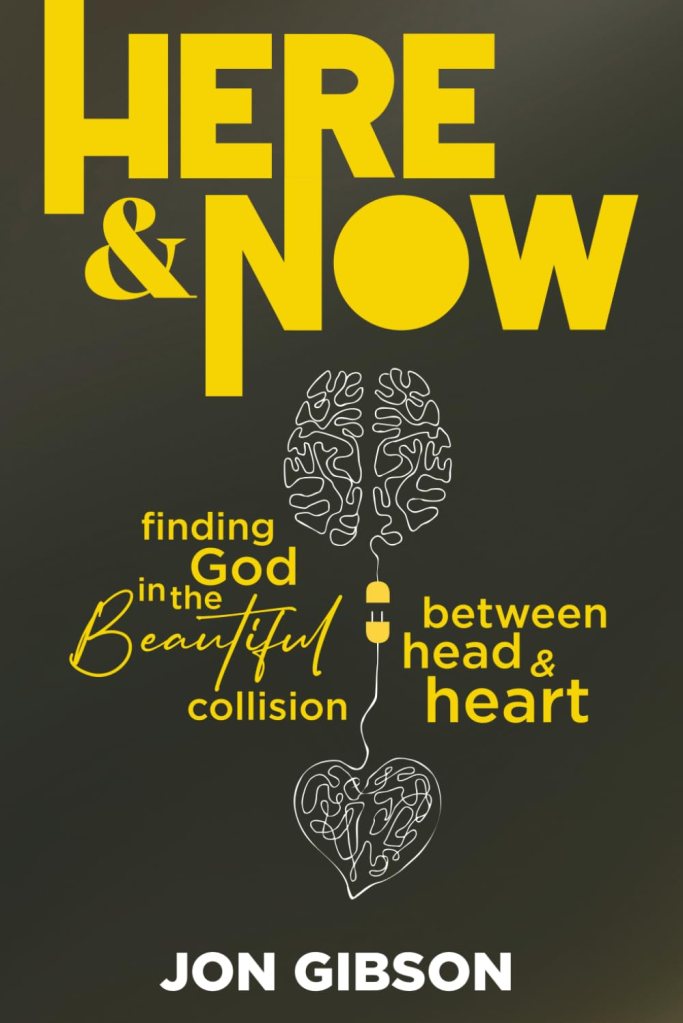
I had the honor of writing the foreword for this book. I have written the forewords for over a dozen books in the last few years, but this one was different. I was given a pre-release copy to read and make “theological suggestions” and ended up falling in love with it. It is the only book I have ever approached the author and “asked” for consideration to write the foreword for. I truly believe this book will profoundly change your life.
I write a good amount of book reviews, and I decided that I am simply going to be a cheerleader from the sidelines on this review. Not because I don’t want to dive into every discussion, but because I truly want to not determine the course of impact this book will have on you. I believe it touches everyone slightly differently. So rather than tell you precisely what I think is best about it, or how it impacted me or should impact you – I just want to convince you that you need to read it and leave it up to the Holy Spirit to determine the impact it will have on your life.
This is a masterpiece. Digestible and easily applicable, no matter what your situation is, or what stage of life you are in. It is a reflective and deeply personal journey. Have you wondered if your course is slightly off? Are you really living the meaningful fulfilling life that God desires and intended for you? Jon has a way of getting to the root of the most personal topics and providing concrete, approachable ways to address them. He also has a gift for framing things in ways you would never think of but draws the reader into the sacred places and beautiful moments of their lives. The very introspective, passionate, & compassionate author will give you much to reflect on in your physical and spiritual relationships and life perspectives. This is a very easy and enlightening book to read and extremely practical on how to hear the voice of God for the situations you are facing now and to seek God’s face for his plans for your future. One of the strengths of the book is its clarity and simplicity in presenting profound spiritual truths. Jon emphasizes that everyone has a purpose in life, which is ultimately found in a personal relationship with God that dives into practical and inspirational stories painting great mosaics of what it means and looks like to find the love, grace, compassion and mercy of the father in everyday interactions. Have you experienced God moving with you in real time?
The church needs this book. Buy a copy for yourself and a friend.
This Friday night at TOV we are having Eden to Eden back! One of the things they are known for is their psalming. Psalming has a rich past in devotional and spiritual meditation to Yahweh. Hebrew psalming is a type of cantillation1, the Hebrew term te’amim describes the manner of reciting or singing verses from the Bible and specifically in this case, the Psalms.2 It is becoming more popular in organic praise and worship settings and is often connected with inviting the Holy Spirit to indwell the natural spontaneity of devotional and meditational song.
In Hebrew there are special signs or marks printed in the Masoretic Text of the Bible, to complement the letters and vowel points. These marks are known in English as ‘accents’ (diacritics), ‘notes’ or trope symbols3. The musical motifs associated with the signs are known in Hebrew as niggun or neginot.4
There are multiple traditions of cantillation. Within each tradition, there are multiple tropes, typically for different books of the Bible and often for different occasions. For example, different chants may be used for Torah readings on Rosh Hashana and Yom Kippur than for the same text on a normal Shabbat.
In Evangelical Christianity cantillation is known mostly when Bible verses are restated in modern praise and worship music and are simply referred to as praise and worship songs. However, when these songs literally reiterate scripture, they certainly should be considered te’amim.
Phonetics
Most cantillation signs are written on the consonant of the stressed syllable of a word. This also shows where the most important note of the musical motif should go.5
A few signs always go on the first or last consonant of a word. This may have been for musical reasons, or it may be to distinguish them from other accents of similar shape. For example, pashta, which goes on the last consonant, otherwise looks like kadma, which goes on the stressed syllable.6
Music
Cantillation signs guide the reader in applying a chant to Biblical readings. This chant is technically regarded as a ritualized form of speech intonation rather than as a musical exercise like the singing of metrical hymns: for this reason, Jews always speak of saying or reading a passage rather than of singing it. However, most people observing for the first time would understand it to be no different to a scripturally based praise and worship song.
Psalms, Proverbs and Job
The system of cantillation signs used throughout the Tanakh is replaced by a very different system for these three poetic books. Many of the signs may appear the same or similar at first glance, but most of them serve entirely different functions in these three books. The short narratives at the beginning and end of Job use the “regular” system, but the bulk of the book (the poetry) uses the special system. For this reason, these three books are referred to as sifrei emet (Books of Truth), the word emet meaning “truth”, but also being an acronym (אמ״ת) for the first letters of the three books (Iyov, Mishle, Tehillim).7
In Christian missionary uses
The Jewish-born Christian convert Ezekiel Margoliouth translated the New Testament to Hebrew in 1865 with cantillation marks added. It is the only completely cantillated translation of the New Testament. The translation was published by the London Society for Promoting Christianity Amongst the Jews.8
Understanding the Psalms as Music
The Book of Psalms also known as the Psalter, is the first book of the third section of the Tanakh (Hebrew Bible) called Ketuvim (‘Writings’), and a book of the Old Testament.9
The book is an anthology of Hebrew religious hymns. In the Jewish and Western Christian traditions, there are 150 psalms, and several more in the Eastern Christian churches.10 The book is divided into five sections, each ending with a doxology, a hymn of praise. There are several types of psalms, including hymns or songs of praise, communal and individual laments, royal psalms, imprecation, and individual thanksgivings. The book also includes psalms of communal thanksgiving, wisdom, pilgrimage, and other categories.
Many of the psalms contain attributions to the name of King David and other Biblical figures, including Asaph, the sons of Korah, Moses, and Solomon. Davidic authorship of the Psalms is not accepted as a historical fact by modern scholars, who view it as a way to link biblical writings to well-known figures; while the dating of the Psalms is “notoriously difficult”, some are considered preexilic and others postexilic.11 The English-language title of the book derives from the Greek word psalmoi (ψαλμοί), meaning ‘instrumental music’, and by extension referring to “the words accompanying the music”.12
In Christian prayer and worship
New Testament references show that the earliest Christians used the Psalms in worship, Paul the Apostle quotes Psalms (specifically Psalms 14 and 53, which are nearly identical). Several conservative Protestant denominations sing only the Psalms (some churches also sing the small number of hymns found elsewhere in the Bible) in worship.
Psalming in modern praise and worship
There are some challenges to modern day Western Church psalming. Psalms don’t rhyme, they use forms such as acrostics that are foreign to pop music, and they certainly don’t fit neatly into the verse/chorus/bridge patterns used in pop. This may mean that the composer of modern psalm songs needs to stretch both biblical text and musical idiom so they can meet. In this way, they may not be word for word, that really wasn’t the intention of the text to the original audience any way. As some more traditional or Rabbinic forms may take offense to modern evangelical psalming, there isn’t necessarily a right or wrong cantillation; in fact, quite the opposite – most modern musicians would say, let the Holy Spirit move and abound. In this way gifts of tongues may often be part of the utterance.
Jeffrey Burns, The Music of Psalms, Proverbs and Job in the Hebrew Bible (Jüdische Musik 9), Wiesbaden: Otto Harrassowitz, 2011, ISBN344706191X. ↩︎
Jacobson, Joshua (2017). “CHAPTER ONE CANTILLATION.” Chanting the Hebrew Bible (Second, Expanded ed.). Web: The Jewish Publication Society. p. 2. ↩︎
The article on “Cantillation” in the Jewish Encyclopedia shows tunes for “Prophets (other readings)” for both the Western Sephardi and the Baghdadi traditions. ↩︎
Lier, Gudrun, “The Revia in the Context of Decoding Masoretic Accents”, Journal of Semitics, 2011, Vol 21/1, pp. 28-51. ↩︎
For a full study see Israel Yeivin, Cantillation of the Oral Law. Leshonenu 24 (1960), pp. 47-231 (Hebrew). ↩︎
Mazor, Lea (2011). “Book of Psalms”. In Berlin, Adele; Grossman, Maxine (eds.). The Oxford Dictionary of the Jewish Religion. Oxford University Press. ISBN978-0-19-973004-9. ↩︎
Kselman, John S. (2007). “Psalms”. In Coogan, Michael David; Brettler, Marc Zvi; Newsom, Carol Ann (eds.). The New Oxford Annotated Bible with the Apocryphal/Deuterocanonical Books. Oxford University Press. ISBN978-0-19-528880-3. ↩︎
Murphy, Roland E. (1993). “Psalms”. In Coogan, Michael D.; Metzger, Bruce (eds.). The Oxford Companion to the Bible. Oxford University Press. ISBN978-0-19-974391-9. ↩︎
Q: I have a question regarding Israel. Would Israelites still be considered God’s chosen people or would that have changed with Jesus’s atoning works?
Yes, Israel was (and is) called God’s chosen people in Scripture—but what that means and how we understand it after Jesus is really important to clarify.
When God called Israel His “chosen people” in the Old Testament, it wasn’t primarily a statement about salvation. Rather, Israel was chosen (commissioned) for a vocation—to be a light to the nations (see Exodus 19:5–6; Deuteronomy 7:6; Isaiah 49:6). (You might see this as a regaining of the nations if you follow a Deuteronomy 32 worldview.) God gave them the Law (Torah), the covenants, and the promises, not as an end in themselves, but so that through them, the nations of the world would come to know and worship Yahweh. Paul puts it like this in Romans 3:2—that the Jews were entrusted with the oracles of God. In a sense, this was the calling of Adam and Eve and when they fall short, God commissions Israel in the same calling, nation that would be called commissioned as a holy royal priesthood to represent Yahweh to the rest of the fallen world.
But Israel consistently struggled to live out this calling. From nearly the beginning of the story the nation failed to honor Yahweh (golden calf incident) and instead of the entire nation (all 12 tribes) representing the Lord as priests, God adapted the plan and then called just the Levites to be His representatives as priests first to Israel in hopes of then commissioning the entire nation of Israel to the original plan and act as ambassadors of Yahweh. The Old Testament tells a story of covenant, failure, judgment, and hope for restoration. Israel continued to falter. They gave up their theocracy of one God – Yahweh to choose to be led by an earthly king. They drifted farther and farther from the plan until God finally hands them over to their own demise, the exile was a key turning point. Even after the return of the exile to Jerusalem, most scholars believe Israel never returned to the LORD. God longed for Israel to return to the true redemption and the coming of God’s kingdom. Unfortunately, Israel continued to fall short and not seem to live out their calling or commissioning.
Jesus enters the narrative with a similar mission. He doesn’t reject Israel’s story—He steps into it. He comes first to “the lost sheep of Israel” (Matt. 15:24), calling them back to their original vocation. He chooses twelve disciples, clearly symbolizing a reconstitution of the twelve tribes of Israel. This is not incidental—it’s Jesus claiming to be the one who restores and redefines Israel around Himself.
And here’s the key: Jesus is the faithful Israelite. He does what Israel failed to do. He keeps the covenant perfectly, walks in radical obedience, and fulfills Israel’s mission. He is the true Israel (see Matthew 2:15 where Hosea’s words originally spoken about Israel—”out of Egypt I called my son”—are applied to Jesus).
This is why Paul will later say in Galatians 3:16 that the promises were given not to “seeds” (plural) but to one “seed,” who is Christ. In other words, the inheritance of Israel is fulfilled in Jesus—and only those who are “in Him” share in that inheritance. That phrase—”in Christ”—is the dominant identity marker for believers in the New Testament. If Jesus is the true Israel, then those united to Him (Jew or Gentile) are the true people of God.
This point becomes even clearer when we revisit God’s original promise to Abraham in Genesis 12:3: “I will bless those who bless you, and whoever curses you I will curse.” This statement is often lifted out of its covenantal context and applied to modern nations or political support for Israel. However, the Hebrew grammar and narrative context show that the promise was made to Abram himself (the singular “you” in Hebrew, ʾotkha), not to a future geopolitical nation. God’s intention was not to privilege one ethnic group above all others but to initiate a redemptive mission through one man and his descendants—a mission that would culminate in Christ. The blessing is vocational, not nationalistic. Abram is chosen in order to be a blessing, that through him “all the families of the earth will be blessed.”
The apostle Paul interprets this precisely in Galatians 3:16, identifying the “seed” (zeraʿ) of Abraham as Christ Himself. This means that the covenant promise—“I will bless those who bless you”—finds its ultimate fulfillment in Jesus. The “you” now applies to Abraham’s true heir, the Messiah. Those who bless Him—who honor, trust, and align themselves with Jesus—receive the blessing of God; those who reject Him cut themselves off from that blessing. In this way, the Abrahamic covenant points forward to Christ as the locus of divine favor. To bless Abraham’s seed is to embrace the redemptive mission of God revealed in Jesus, and through faith in Him, we become participants in that same blessing.
Paul says Abraham was justified before circumcision (Rom. 4), showing that faith, not ethnicity, is the marker of God’s covenant people. He adds in Romans 2:28–29 that a true Jew is one inwardly, whose heart is circumcised by the Spirit. And in Galatians 3:28 he writes: “There is neither Jew nor Greek… you are all one in Christ Jesus.”
Ephesians 2 expands this beautifully. Paul says that Jesus has broken down the dividing wall and made one new humanity—no longer Jew and Gentile, but one body. Peter echoes this in 1 Peter 2, where he applies all the covenant titles once reserved for Israel (royal priesthood, holy nation, people of God) to the church made up of both Jews and Gentiles.
Paul also uses the metaphor of an olive tree in Romans 11: some natural branches (ethnic Israelites) were broken off because of unbelief, and wild branches (Gentiles) were grafted in. But it’s one tree. There aren’t two peoples of God. There is one new covenant community—those who are in Christ. It’s not about replacing Israel, but about fulfillment—where Jews and Gentiles together form the one people of God in Christ.
This helps clarify what Paul means in Romans 11:26 when he says, “all Israel will be saved.” We don’t believe he’s referring to a future mass conversion of ethnic Jews or suggesting two separate salvation paths. Rather, he’s speaking of the fullness of God’s people: both believing Jews and Gentiles who are part of the one tree through faith in the Messiah. This fits with Paul’s logic throughout Romans and with his statement in Galatians 6:16 that the church is “the Israel of God.”
God has always worked through covenants—and those covenants are centered on trust and faithfulness, not ethnicity alone. From the beginning, covenant relationship with God required loyal love. Even under the Mosaic covenant, Israel’s inclusion was contingent on obedience and faithfulness to Yahweh (Deut 28). Being born into Israel didn’t guarantee blessing—relationship and trust did. (Israelites were never automatically “saved.”) If there was any sense of salvation in the Old Testament it would be under the same “qualifications” as in the New Testament. What God was asking and promising for the faithful doesn’t change from the Old Covenants to the New Covenant.
The New Testament affirms this. While many modern Jews are physical descendants of Abraham, Paul is clear that physical descent is not enough. In Romans 9:6–8, he writes:
“For they are not all Israel who are descended from Israel; nor are they all children because they are Abraham’s descendants… it is not the children of the flesh who are children of God, but the children of the promise.”
Paul emphasizes that covenant identity is now grounded in faith—just as it was with Abraham. As he puts it in Galatians 3:7:
“Understand, then, that those who have faith are children of Abraham.”
So when we speak of the “people of God” today, we are not referring to a physical nation-state or ethnic group. We are speaking of those “in Christ”—those joined to the faithful Israelite, Jesus.
The modern nation-state of Israel is not the covenant people of the Bible. -If this is a new consideration for you, you might consider reading this article. Most of its citizens do not follow the Mosaic covenant, and the majority have rejected Jesus as Messiah. According to the New Testament, that places them outside of the renewed covenant family—not because of their ancestry, but because God’s covenant has always been about faith.
This doesn’t mean God has abandoned ethnic Jews. Paul says in Romans 11 that he hopes some of his fellow Jews will be provoked to faith. And many Messianic Jews (Jewish believers in Jesus) are part of the body of Christ. But the boundary marker is no longer ethnicity or Torah observance—it is faith in Jesus.
All of this leads us to say: the true Israel (or Israelite) is Jesus. And those “in Him,” whether Jew or Gentile, are heirs to the promises, the calling, and the covenant. God is not partial (and never has been, even with Israel as many gentiles were welcome to join them, a mixed multitude – Hebrew and gentile – left Egypt in the Exodus becoming “Israel”, and some even found themselves in the lineage of Christ Himself) —He welcomes all who come to Him through Christ.
We also need to think about our family in Christ as those that are allegiant to the New Covenant calling rather than those that are nationalistically / inter-nationalistically aligned with groups that subtly “claim to be allied with God” but are not living out the Way of Jesus or bearing fruit for the Kingdom of Christ. There is only one kingdom of Christ, and you can’t serve two masters. For generations many have claimed to be part of Israel or want to be somehow grafted into salvation but haven’t followed the devotion that God has desired and look nothing like Jesus or act in a way worthy of bearing His image. Jesus seemed to paint this picture vividly and make this very clear in the sermon on the Mount (Matthew 5-7).
This is not replacement theology.1 God has not rejected Israel and replaced her with or even outside of the church. Rather, the church is the fulfillment of Israel’s story (and Adam and Eve’s story for that matter) —expanded to include all nations through union with Jesus, the faithful Israelite, this was the plan of redemption that “all nations”, or everyone was offerred from the beginning.The promises of God have not been scrapped or reassigned; they find their “yes and amen” in Christ (2 Corinthians 1:20). The covenant people of God have always been marked by faith and loyalty to Him—and in the new covenant, that means allegiance and devotion to Yahweh through Jesus accepting and claiming that victory and receiving the gift of the Holy Spirit as a sign of the holy royal priesthood. Jew and Gentile together form the one new man, the reconstituted people of God.
written by Will Ryan Th.D. and Matt Mouzakis Th.D.
Replacement theology, doctrine holding that Christians have replaced the Jewish people as the chosen people of God or as the heirs of the divine-human covenant described in the Hebrew Bible. The theology is also referred to as supersessionism, in which Christianity is thought to have superseded Judaism. It is closely related to fulfillment theology, which holds that Christianity has fulfilled the divine promises signaled in the Hebrew Bible. These ideas appear to be suggested in some of the earliest Christian texts, such as writings of St. Paul the Apostle, and subsequent Christian theologians have strengthened the opposition of Judaism and Christianity in ways that have informed relations between Christians and Jews. In the 20th century many Christian theologians and even church doctrines replaced replacement theology with more-nuanced or inclusive models that support more-amicable interreligious relations.
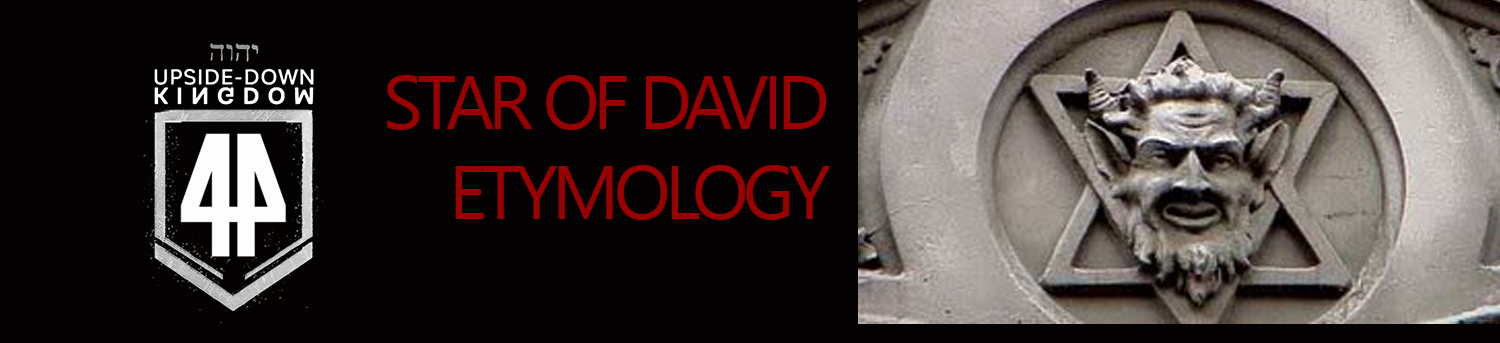
The Magen David or Star of David (מָגֵן דָּוִד, lit. ’Shield of David‘) is a symbol generally recognized as representing both Jewish identity and Judaism.1 It may surprise you to learn that it has no Biblical roots. The earliest the hexagram can be found in a religious context is in the Leningrad Codex, a manuscript of the Hebrew Bible from 11th-century Cairo.2 It became representative of Zionism after it was chosen as the central symbol for a Jewish national flag at the First Zionist Congress in 1897.3 By the end of World War I, it was an internationally accepted symbol for the Jewish people, used on the gravestones of fallen Jewish soldiers. 4 Today, the star is the central symbol on the national flag of the State of Israel.
Unlike the menorah, the Lion of Judah, the shofar and the lulav, the hexagram was not originally a uniquely Jewish symbol.5 There are some early signs of the symbol, in Israel, there is a stone bearing a hexagram from the arch of the 3rd–4th century Khirbet Shura synagogue in Galilee.6 It also appears on a temple on Bar Kokhba Revolt coinage which dates from 135 CE.7 You can also find a hexagram on the ancient synagogue at Capernaum.8
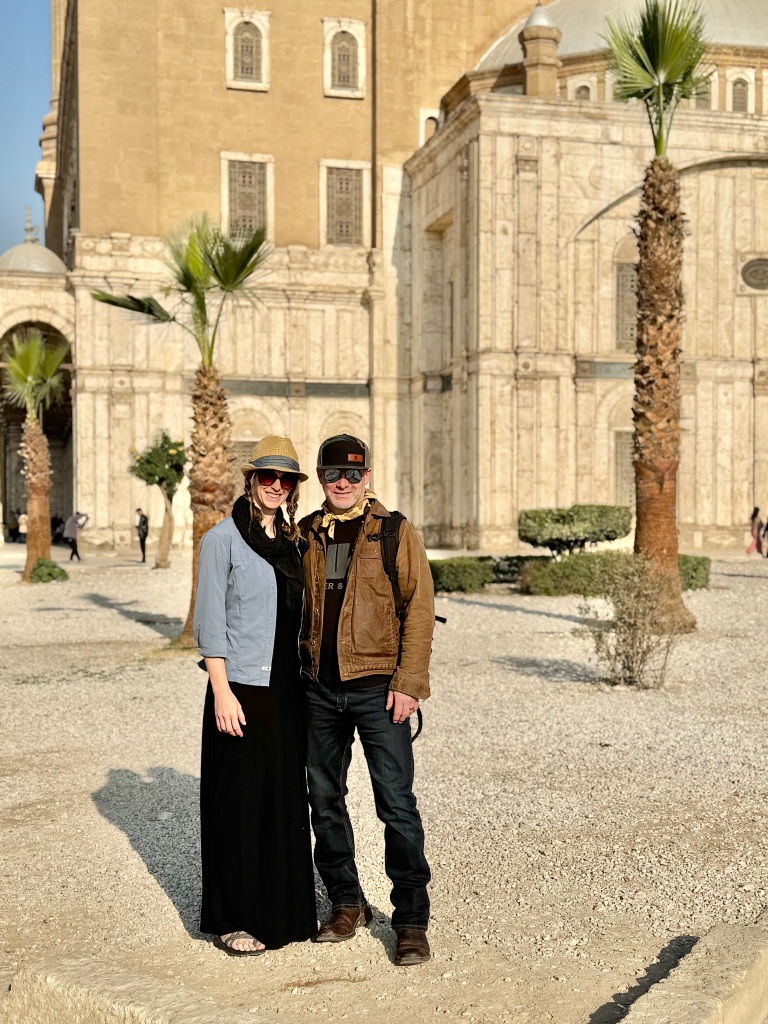
A hexagram has been noted on a Jewish tombstone in Italy and another arguably in Egypt 9 (that I viewed in person earlier this year), which both may date as early as the third century.10 The Jews of Apulia were noted for their scholarship in Kabbalah, which doesn’t sit well in most traditional and Messianic Jewish circles.11
Medieval Kabbalistic grimoires show hexagrams among the tables of segulot, but without identifying them as “Shield of David”.12
REMPHAN
In the New Testament, Stephen condemns Jewish idolatry in Acts 7:3: “Ye took up the tabernacle of Moloch, and the star of your god Remphan, figures which ye made to worship them: and I will carry you away beyond Babylon.” Stephen is quoting word-for-word from Septuagint version of Amos 5:26-27.
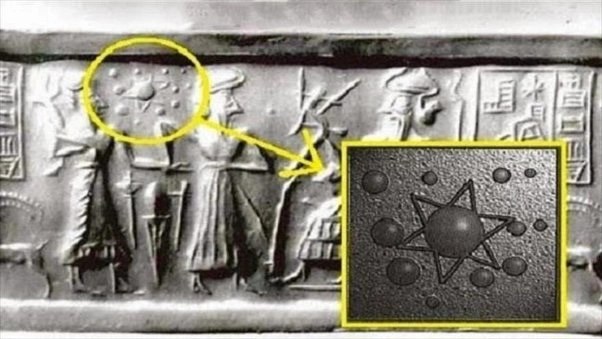
According to some Biblical scholars, the name refers to the Hebrew Kiyyun or Chiun (Hebrew: כִּיּוּן), However, the words “Kiyyun” (“Chiun”) and “Remphan” are each hapax legomena,13 and the text is unclear as to whether they are common or proper nouns and could be a reference to the planet Saturn (which was also connected to Remphan.) The Masoretic Text reads Kiyyun (Chiun), while the Septuagint renders that name as Rephan. Acts 7:42 quotes the Greek form, showing how the prophetic word moved into the early church. Comparative linguistics links Kiyyun to the Assyrian Kayvân, a name for planet saturn. Ancient peoples called planets “wandering stars” and often built cults around a star god. In more modern history you will recognize these terms from Zoroastrianism.14
To be clear the Bible just mentions a star, not 5 or 6 points or anything else. The context is about rebellion to the Lord, but a large part of this discussion would have involved symbols of idolatry which is Exodus 20:3-4 language. Furthermore, as I alluded to earlier, there are some Hebrew issues in the text that you may need to be work through. The Hebrew Kiyyun to the Assyrian Kayvân / Chuin or Kewan, was rendered in the Septuagint, as Ῥαιφάν [Raiphan]. Some try to argue that there was no ancient god named Remphan, but I don’t see merit in that argument.
Others may say that the reference is the Star of Ninurta, which has eight points, not six points.15 But the truth of the matter is there are plenty of stars to be found in ancient culture and they didn’t seem to differentiate between 5,6,7 or 8 points; they all held the similar celestial imagery. For instance, I will remind you that in John’s vision of Revelation, Jesus has seven stars in his right hand. Jesus reveals the mystery: “The seven stars are the angels of the seven churches” (Rev 1:20). Thus, there are seven stars or seven angels (messengers) to God’s redeemed people. In this sense it is important to point out that star imagery itself should not necessarily be condemned, it can be viewed in scripture in both positive and negative light. Jesus is called the Morning Star in Revelation 22:26 but Satan is also referenced with a similar term in Isaiah 14:12.
Moloch, Chiun and Remphan are all associated with the star god, Saturn, whose symbol is most commonly viewed as a six pointed star formed by two triangles, but sometimes as an 8 sided star. Saturn was the supreme god of the Chaldeans. Mo, Chiun, Rephan, or Remphan, and Remphis, all are likely the same with the Serapis of the Egyptians, and the calf of the Israelites; and which idolatry was introduced on account of Joseph, who interpreted the dream of Pharaoh’s kine, and provided for the Egyptians in the years of plenty against the years of famine, and was worshipped under the ox with a bushel on his head.
There is also may be a D32 nephalim connection. Giants, with the Hebrews, were called “Rephaim”; and so Mo, who is here meant, is called “Rephan”, and with an epenthesis “Remphan”, because of his gigantic form; which some have concluded from the massy crown on his head, which, with the precious stones, weighed a talent of gold, which David took from thence, 2 Samuel 12:30 for not the then reigning king of the Ammonites, but Molech, or Milchom, their idol, is meant: this is generally thought to be the same with Chiun in Amos; but it does not stand in a place to answer to that; besides, that should not be left untranslated, it not being a proper name of an idol, but signifies a type or form; and the whole may be rendered thus, “but ye have borne the tabernacle of your king, and the type, or form of your images, the star of your god”; which version agrees with Stephens’s, who, from the Septuagint, adds the name of this their king, and their god Rephan, or Remphan.16 Early Hebrew writing easily could have interpreted Rephaim as Rephan. We see these slight textual subtleties all over early ancient transcripts.17 Rephan, very well could point directly to a connection with fallen spiritual beings revered in the ancient world as gods in a Genesis 6 context.
THE SEAL OF SOLOMON
The Seal of Solomon or Ring of Solomon (חותם שלמה, Ḥotam Shlomo) is the legendary signet ring attributed to king Solomon in medieval mystical traditions, from which it developed in parallel within Jewish mysticism, Islamic mysticism and Western occultism. This story comes from the ancient non-canonical writing sometimes referred to as the “Testament of Solomon.” It is often depicted in the shape of either a hexagram or a pentagram. In mystic Jewish lore, the ring is variously described as having given Solomon the power to command the supernatural, including shedim and jinn, and also the ability to speak with animals. Most scholars would say that this is the predecessor to the Star of David.18
While several Biblical passages emphasize Solomon’s supernatural endowment of wisdom, they do not mention him receiving a ring to control demons. Instead, Scripture highlights Solomon’s extensive knowledge of natural phenomena (1 Kings 4:33) and the building of the Temple in Jerusalem (1 Kings 6). No biblical text describes him subjugating evil spirits via an object or talisman. The extra-biblical work called the “Testament of Solomon” is thought to have been compiled between the 1st and 5th centuries AD (well after the Old Testament period). This document is categorized by scholars as pseudepigraphical, meaning it circulates under Solomon’s name but is not recognized as authentic Scripture. In this story, Solomon purportedly receives a ring from an angel, which bears the name or seal of God and grants him authority over demons, enabling him to command them to assist in building the Temple.19
A legend of a magic ring with which the possessor could command demons was already current in the 1st century Josephus as well as the Tractate Gittin (fol. 68) of the Talmud which also has a story involving Solomon, Asmodeus, and a ring with the divine name engraved: Solomon gives the ring and a chain to one Benaiahu son of Jehoiada to catch the demon Ashmedai, to obtain the demon’s help to build the temple; Ashmedai later tricks Solomon into giving him the ring and swallows it.20
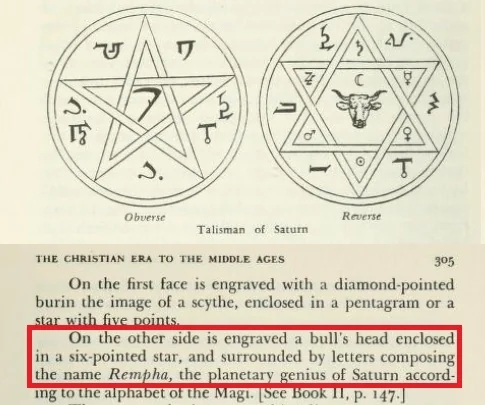
There is also a subtle connection by symbolism to the Magi. The Magi are popularly referred to as wise men and kings. The word magi is used in the original Greek text of the Gospel of Matthew. Magi will later be seen in the etymology of the English term magic. Daniel 2:48 will connect with the same words when describing “Elymas the sorcerer” in Acts 13:6–11. Biblically all of these things fall under divination. The image to the right became part of the Alphabet of the Magi much later in history.
Scripture consistently condemns divination. Deuteronomy 18:10-11 states, “Let no one be found among you…who practices divination, conjury, interprets omens, or sorcery.” This prohibition underscores that seeking information from sources other than God is forbidden. The Israelites were called to be distinct from other nations, which frequently turned to occult rituals for guidance.
Leviticus 19:26 also prohibits divination, reinforcing that God’s people must avoid methods used by pagan cultures. King Manasseh’s downfall exemplifies the tragic consequences of defying these commands: “He sacrificed his sons in the fire in the Valley of Hinnom, practiced sorcery, divination, and witchcraft…” (2 Chronicles 33:6). Through such narratives, the Bible highlights the spiritual dangers and moral corruption that accompany attempts to manipulate or predict the future by occult means.
STARBUCKS ANOLOGY
Some may not like this analogy, but of late, it was a popular “western world” analogy to this conversation so I will mention it. You might consider the question, “Is the star of David rooted in idolatry and divination which was/is rival to Yahweh?” There is certainly an argument for that view. But many symbols both in and out of the Bible can go both ways. Foundationally, evil has always sought to take what is good and turn it to be a symbol of Evil. The Bible doesn’t really give us the whole story here, as that isn’t it’s primary intention. At least with the “taking back of the Rainbow”, there is a clear mention in the Bible. The roots of the rainbow representing something good and of God is not arguable. But with the 6-sided star we don’t necessarily have that. To most people if something has occult type of roots or even some strain of a negative connotation, we aren’t going to use the same symbol for our entity of good intention. When people and organizations do things like this it raises red flags, but it doesn’t make it wrong per se.
A good example is the Starbucks logo. The way it is used most recently seems simple. But when you dig into the history you scratch your head wondering why would a corporate coffee company “go there.” You have probably heard this, but most Christians would call the Starbucks logo downright “DEMONIC.” The image in the center of the Starbucks logo is not a mermaid. She’s actually a mythological Siren, a female creature that lured mariners to destruction by her sex appeal. Since coffee beans typically traveled overseas on large container ships, the founders decided to use a “seductive siren” logo that would lure coffee lovers to its stores. The original Starbucks logo was X rated, a bare-breasted, female Siren with two serpentine tails spread apart (a legs spread open sense.)
In an article published by Revealing Truth, it was claimedthat the Starbucks logo also has sinister roots. By turning the original Starbucks logo upside down, you can see the image of satan. In 2014, Starbucks got into trouble after its employees were drawing satanic pentagrams and the number “666” in the foam of coffee.
However, it is quite possible you visit Starbucks every day and look at the logo and can’t see anything evil in it anymore, and care very little about its dark history. As a Christian should you not support the organization because of its roots? I am not sure we should hold the organizations themselves and the people that represent them accountable for choices they specifically didn’t make. Isn’t that a Biblical theme? God isn’t judging you for the actions of others, just you. (I realize there are views within reformed theology that might see this differently.) There is an argument along these same lines with MONSTER energy Drink. I won’t get into that here. If you drink Monster or Starbucks, you shouldn’t have an issue with the Star of David, if you don’t – well than you might have an issue with the Star of David; but they are all slightly different to this analogy.
SEEING THE GOOD
I do believe there is a perspective of seeing the good in things despite their dark past. Isn’t that the restorative nature of scripture? You can choose to let ancient bygones be bygones and see the beauty and peace that the star of David a new meaning and we can see it for what it has come to represent. Shouldn’t we all be hopeful that a dark symbol could find There may even be an element of interpretation not specifically declared in the Bible but theologically deduced. The Star of David and the pomegranate are deeply intertwined in Jewish tradition. The pomegranate is one of the seven species mentioned in Deuteronomy 8:8, symbolizing God’s blessings and the good deeds of the people. It is also associated with the Temple and High Priestly garments and is used during the Feasts of Shavuot and Sukkot.21 The pomegranate’s six petals form the Star of David, and its significance extends to kingship and the Messiah Those who see the Star of David as Biblical, see the pomegranate’s deep red color and the presence of seeds that symbolize blood pointing to Jesus. Together, these symbols can be seen as representative to the holiness of God, the good deeds of the people, and point towards Jesus.
CONCLUSION
Going back to the Star of David. Knowing the History of how a 6-sided star has been used in Ancient Near Eastern history as connected to gods against Yahweh and divination, it seems “off” that Israel and Zionism would then adopt it as their logo claiming to be a God-fearing Nation. Yet there are also some beautiful connections to the pomegranate and seeing the hope that the symbol has come to represent many years before they adopted it.
WORKS CITED:
Jacob Newman; Gabriel Sivan; Avner Tomaschoff (1980). Judaism A–Z. World Zionist Organization. p. 116. ↩︎
Kittel, Rud; Alt, A; Eissfeldt, Otto; Kahle, Paul; Weil, Gerard E; Schenker, Adrian (1977). Biblia Hebraica Stuttgartensia. ISBN9783438052186. (in Foreword by Gérard E. Weil). ↩︎
“The Flag and the Emblem” (MFA). “The Star of David became the emblem of Zionist Jews everywhere. Non-Jews regarded it as representing not only the Zionist current in Judaism, but Jewry as a whole.” ↩︎
“The Flag and the Emblem” (MFA). “Unlike the menora (candelabrum), the Lion of Judah, the shofar (ram’s horn) and the lulav (palm frond), the Star of David was never a uniquely Jewish symbol.” ↩︎
Plaut, W. Gunther (1991). The Magen David: How the six-pointed Star became an emblem for the Jewish People. Washington, D.C.: B’nai B’rith Books. pp. 26, 61–62. ISBN0-910250-17-0. ↩︎
The Egyptian officials accused the delegation of German archaeologists that has been working on the site’s reconstruction of engraving the Stars of David into the Shrine’s stone. The engravings are found on a 3rd century B.C, temple located in Elephantine Island in Aswan. ↩︎
Herbert M. Adler, JQR, vol. 14:111. Cited in “Magen David”, Jewish Encyclopedia, retrieved May 28, 2010. ↩︎
Amar Annus, The God Ninurta in the Mythology and Royal Ideology of Ancient Mesopotamia, State Archives of Assyria Studies, Volume XIV Helsinki 2002. Pg. 104 ↩︎







 EXPEDITION 44