
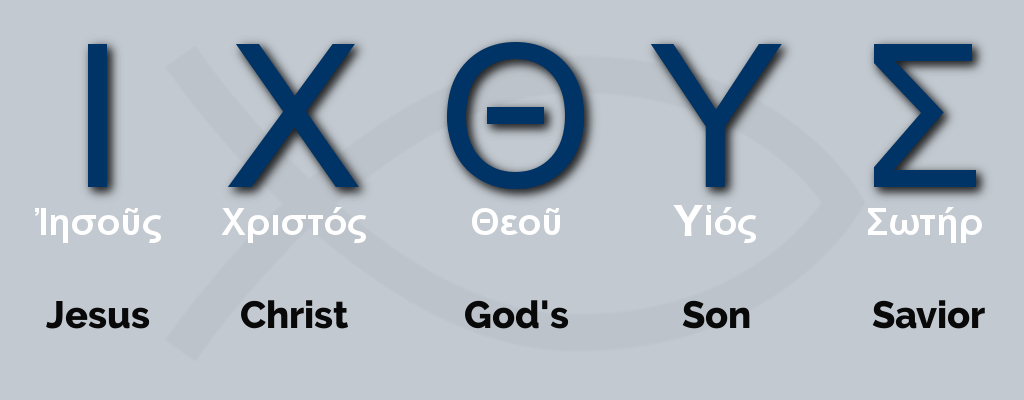
Is Christmas Pagan? Well sort of yes, sort of not. It’s a great discussion. I’ll frame it first like this as an easy reference. Some Christians are triggered when people say XMASS instead of Christmas, saying things like your taking “Christ” out of Christmas. Well actually X has been a symbol for Christ since at least His death. IXOYE, the Christian Fish Symbol, (ichthus) means “Jesus Christ God’s Son Savior” in Greek. Christ in Greek starts with the X symbol or character. Since Greek is more Biblically correct than English XMass may actually be a more Bible way of saying Christmas than “Christmas” is. As I will go on to show. It is really a similar argument with Christmas as a whole. Is it Pagan? Well yea, there are some pagan things, are we taking back what is Biblical (Christ and celebrating His birth) as ambassadors of truth? Yea I hope so! In that way some of this gets a bit dicey and comes down to how you’re going to think about it or frame it. I love it that the world celebrates the Birth of Jesus! But I want my readers to work through this on your own, so as usual, nothing is spoon fed. Here are some notes, good luck!
- Dec 25, -“unconquered son” (Christians stole this day from the Pagans) Not really. There is no reason to conflate some pagan festivity no one cares about with Christmas. If there was a conspiracy back in the fourth Century, then St. Augustine would likely have said something about it. What he did say was that when the barbarians came to sack Rome, they left the churches alone, out of respect for traditions that were foreign to them, but which they could see were clearly holy.
- It likely is a result of mixed Jews and Christians trying to figure out how to be unified in the first few centuries after Christ. Some are aware that during the reformation England banned Christmas in 1647 in some part because of connections to paganism. But the reformation had a lot of problems this really shouldn’t surprise anyone. The accusation that Christmas was usurped from Sol Invictus is probably a result of works of the puritans of the 16/17th Century England.
- In America Christmas was banned between the years of 1659-1681. Christmas as we know it really didn’t start happening until the late 1800’s and even then, it was foreign to most people. Puritans then where preaching and distributing literature denouncing such celebration. Christmas really became what we think of it today, when in 1843 Charles Dickens wrote “A Christmas Carol”.
- If we look at the outlook of the early Western Church (and by Western, I mean both the Latin Catholics and the various Eastern Orthodoxies) towards pagan life and rituals in general, its abundantly clear that they saw it with utter disgust.
- Incensing is also interesting. In the Torah it signified holiness, yet later within some orthodoxy it is outright condemned. For them, it was nothing more than a pagan remnant that would defile Christianity, if adopted. Lactantius, the 4th Cent. Christian writer and one of Constantine’s main advisers condemns it in his book Institutiones Divinae. Hippolytus of Roma omits the use of incense entirely in his work, Apostolic Traditions. Of course, Constantine was a mess.
- Accusing the Roman Church of usurping/adopting an entire pagan festival and rebranding it as Christmas to gain pagan converts, when it was repulsed by something so frivolous as a stick of incense which it perceived to be pagan, is in the realm of the absurd.
- The Roman Empire wasn’t the only place with Christians in the 4th Century. There is no evidence that Sol Invictus was observed anywhere outside of the borders of the Roman Empire. Earliest record of Sol Invictus being celebrated on the 25th of December is from AD354. There is little evidence to suggest it was celebrated before 4th Century in Rome. But we know that the Syriac Christians were already celebrating Christmas (although it was considered a minor feast leading up to Epiphany) in the last week of their season of Subbara, which falls on December in the Gregorian Calendar – this practice dates from at least the mid-4th Century.
- During the early centuries AD, the Jews clearly did not give Hanukkah much importance, as the Mishnah obviously omits it. Neither does Hanukkah have any theological connotations – after all, it’s kept for the memory of the Maccabees. Christianity had no need to find a replacement for an obscure Jewish holiday. But I do agree that some Christian communities, especially the ones with Jewish origins, like the Christians of St’ Thomas of Kerala, do observe some rituals reminiscent of Hanukkah. But they do it in the week of Epiphany, not the week of Christmas.
- Christ was likely born on Sep 11, 3bc – Yes, I know some think 4BC was the death of Herod but that is definitely not concrete.
- It was winter, and the Festival of the Dedication of the Temple was being celebrated in Jerusalem. Jesus was walking in Solomon’s Porch in the Temple, when the people gathered round him and asked, “How long are you going to keep us in suspense? Tell us the plain truth: are you the Messiah?” – John 10: 22 The Hanukkah festivals that Jesus likely took part in was similar enough to Christmas in ritual and custom to assume that early Christians continued with the festival in honor of the birth of Jesus – that might well have fallen on the same day of the year.
- The Feast of the Lights (Hanukkah or ‘Festival of Dedication’) took place for two days on the twenty-fifth and twenty-sixth days of Kislev starting with the lighting of candles on the evening of the twenty-fourth. (The Judaic month of Kislev is almost the same as December.) Candles were then lit for a further six or possibly eight days. The specific reason for the festival of Hanukkah is to celebrate the victory of the Maccabees over the Seleucids and the result of that victory, which was the re-dedication of the altar in the Temple after three years when no services took place. In general, it celebrates religious freedom, the light that was lit in Israel for all people, and the spread of that light throughout the world.
- The date was of particular importance in the Greek /Roman calendar and in the calendars of many of the ancient societies. On or roundabout this day the star Sirius (the brightest of all stars) that flies behind the earth in its path around the Milky Way is right overhead at midnight. When Sirius is overhead at midnight it means that the sun is at its furthest south and that summer is coming again. For this reason, the date had been associated in many ancient and not so ancient religions with the birth of a god or a new period of religion. It was therefore no accident that Antiochus Epiphanes offered the first sacrifice to Zeus Olympios in the Temple on this date in 167 BCE. It was intended to show that a new period of rule of the Greek gods over the land had begun. Judah Maccabeus would have been fully aware of this and made sure that the first Hanukkah also fell on 25 December 164 (165) BCE to counter the Greek claim. (Now upon the same day that the strangers profaned the Temple, on the very same day it was cleansed again, even the five and twentieth day of the same month, which is Kislev – II Maccabees 10: 5)
- Persia was different from the other countries in their beliefs around Sirius and used the star to make predictions. This is based either on changes in color (white, blue, emerald) the star undergoes (in the past there were times when it has appeared red) or on the positional shift in relation to the background stars due to the gravitational influence of a white dwarf companion star. Because these changes are minute and dependent on great knowledge, it is no surprise that nobody, but the Magi noticed them. (This would explain why Herod and the scribes did not notice it. If a huge comet hung over Bethlehem, millions of people would have turned up, as they were strong believers in the magic of stars.)
- Because it is closely linked with the Feast of the Tabernacles (Succoth), so close that it is even called that in some communities as an interchangeable title; and now we see that that ye keep the Feast of Tabernacles in the month Kislev – II Maccabees 1: 9. To the original promise made in the desert by the festival of Sukkoth (that one day Israel would no longer live in tents but in houses) the important facet of lights were added. With the rededication of the Temple, came the profound moment of the lighting of the candelabra. They made also new holy vessels, and into the temple they brought the candlestick . . . and the lamps that were upon the candlestick they lighted, that they might give light in the temple – I Maccabees 4: 49 – 50. Josephus said (Antiquities of the Jews, 12: 7: 7), and from that time to this we celebrate this festival, and called it Lights. I suppose the reason was, because this liberty beyond our hopes appeared to us; and that thence was the name given to that festival.
- The festival is supposed to be a happy time in accordance with I Maccabees 4: 59 – the days of the dedication of the altar should be kept in their season from year to year by the space of eight days, from the five and twentieth day of the month Casleu, with mirth and gladness. From the earliest, the festivalgoers bare branches, and fair boughs, and palms also, and sang Psalms – II Maccabees 10: 7.
- Israel in winter is green as this is the time of the rains and what snow there is (if at all) quickly melts. Bringing greenery into the home therefore has nothing to do with the pagan midwinter festival but with the promise made in the desert and celebrated during the Feast of the Tabernacles.
- The twenty-fifth of December (Kislev) that became important to Christianity together with joyous songs and the Christmas tree and lights all originated in Hanukkah.
- Dies Natalis of Sol Invictus, or that is the birthday of the unconquerable sun. It is also called Saturnalia as it Honors the deity Saturn. Saturn was worshiped for agricultural purposes. This was later celebrated by the Romans as Dies Natalis of Sol Invictus. It celebrated the renewal of light and the coming of the new year. What day was it celebrated on? You guessed it December 17-23 and 25. Saturnalia was celebrated with feasting, partying, and gifts. Saturnalia
- As the Roman empire came under Christian rule pagan holidays were added to help convert pagans to Christianity. You see this mainly under emperor Constantine’s rule. The people whom the Romans conquered had their “religion” and celebrations added to the Romans celebrations.
- The names of Saturnalia where later changed to take on a more Christian aspect. The church commemorated December 25 as Jesus’s birthday. The church got pagan converts, and the pagans simply got to keep their holidays.
- What about Mithra? Well that is also a good conversation. Mithra the Pagan Christ
Dr. Will Ryan
NOTE: The best general and easily understood book I have yet seen on ‘Jewish’ holidays is ‘Guide to Jewish Holy Days’ by Hayyim Schauss, published in paperback by Schocken Books of New York in 1962.
Here is more on Christmas: Unfortunately, the churches audio video was not great, but it still has some good content.
 EXPEDITION 44