Jesus and Egypt

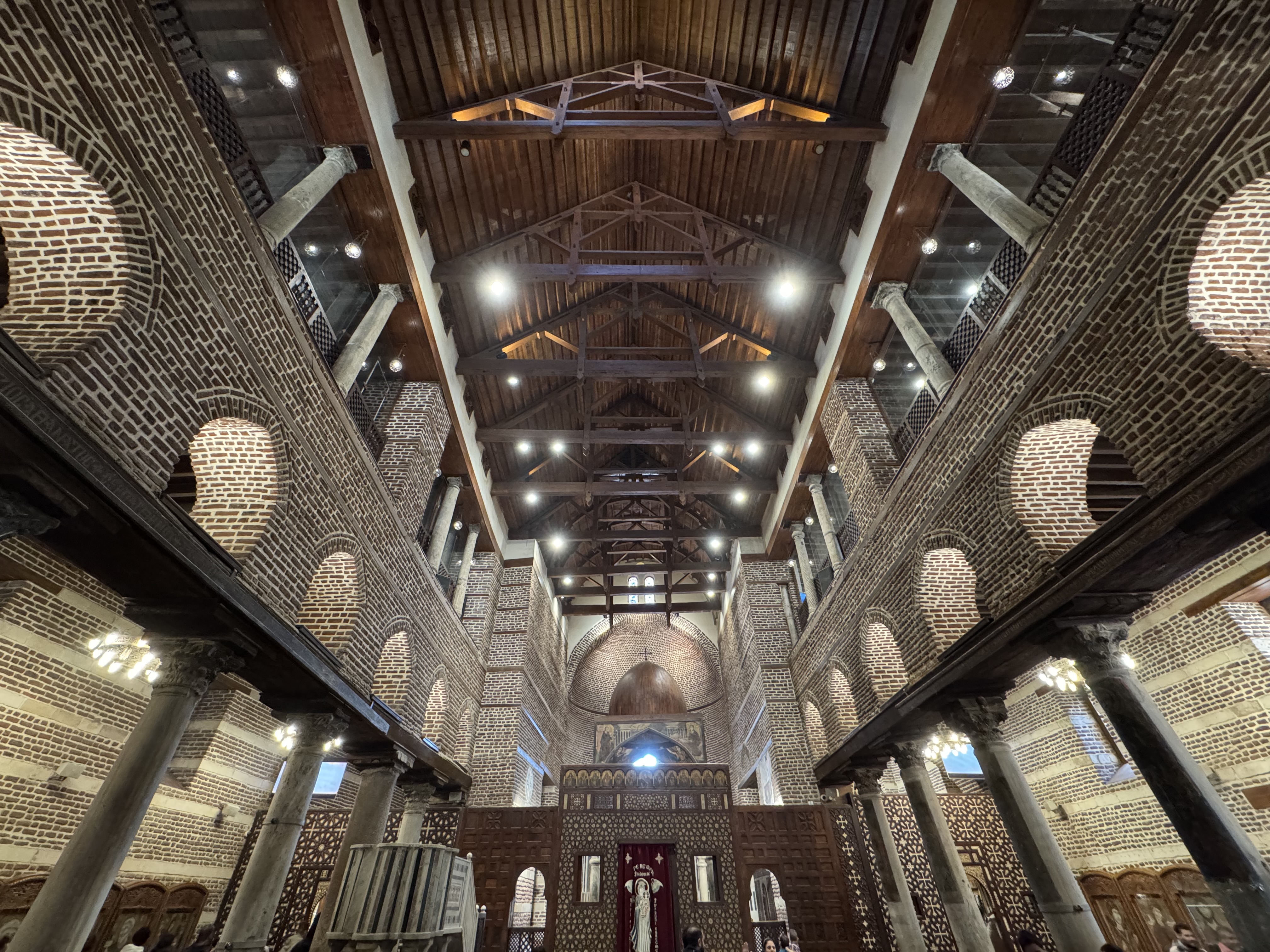
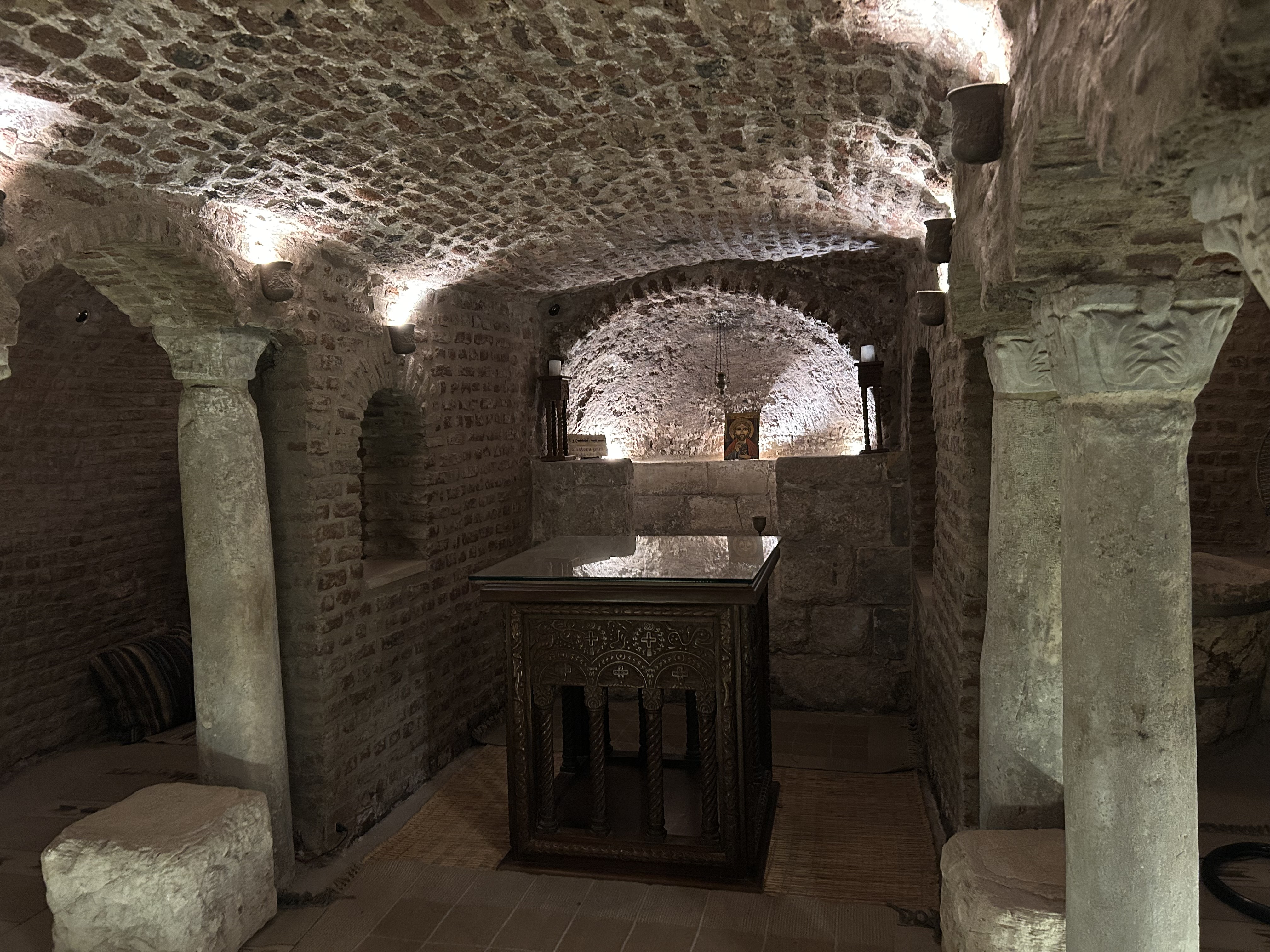
In Egypt today we visited several churches, one of which was The Church of Martyrs Sergius and Bacchus in The Cave, also known as the Abu Serga Church, and is one of the oldest Coptic Christian churches in Egypt, dating back to the 4th century.[1] Tradition holds that Saints Sergius and Bacchus Church was built on the spot where the Joseph, Mary, and the infant Jesus rested at the end of their journey into Egypt.

The flight into Egypt is a story told in Matthew 2:13–23 and in New Testament apocrypha. Soon after the visit by the Magi, an angel appeared to Joseph in a dream telling him to flee to Egypt with Mary and the infant Jesus since King Herod would seek the child to kill him.

You might remember, when the Magi came in search of Jesus, they went to Herod the Great in Jerusalem to ask where to find the newborn “King of the Jews”. Herod became afraid that the child would threaten his throne and sought to kill him (2:1–8). Herod initiated the Massacre of the Innocents in hopes of killing the child (Matthew 2:16). But an angel appeared to Joseph in a dream and warned him to take Jesus and his mother into Egypt (Matthew 2:13). Both Egypt and Judea were part of the Roman Empire, linked by a coastal road known as “the way of the sea”,[2] making travel between them easy and relatively safe.

After Herod passed, Joseph was told by an angel in a dream to return to the land of Israel. However, upon hearing that Archelaus had succeeded his father as ruler of Judaea he “was afraid to go there” (Matthew 2:22), and was again warned in a dream by God “and turned aside to the region of” Galilee. This is Matthew’s explanation of why Jesus was born in Bethlehem in Judea but grew up in Nazareth. Herod died is 4BC, which is stated by Matthew and affirmed by Josephus. Mary and Joseph return to Judah. This is the only time the Biblical Text uses the term “Judah” as a geographical place identifying Judah and Galilee. The text indicates that they first come to Judah but them quickly relocate to Galilee after learning that Archelaus had become the new king who was known to be violent and aggressive.

As an interesting rabbit hole, the beginning and conclusion of Jesus’ parable of the minas in the Gospel of Luke, chapter 19, may refer to Archelaus’ journey to Rome. Some interpreters conclude from this that Jesus’ parables and preaching made use of events familiar to the people as examples for bringing his spiritual lessons to life. Others read the allusion as arising from later adaptations of Jesus’ parables in the oral tradition, before the parables were recorded in the gospels.

Many would deduct the flight to Egypt to fulfill a prophecy by Hosea. Matthew’s use of Hosea 11:1 has been explained in several ways. A sensus plenior approach states that the text in Hosea contains a meaning intended by God and acknowledged by Matthew, but unknown to Hosea. A typological reading interprets the fulfillment as found in the national history of Israel and the antitypical fulfillment as found in the personal history of Jesus. Matthew’s use of typological interpretation may also be seen in his use of Isaiah 7:14 and 9:1, and Jeremiah 31:15. Some have pointed out that “Hosea 11.1 points back to the Exodus, where God’s ‘first-born son’ (Ex 4:22), Israel, was delivered from slavery under the oppressive Pharaoh. Matthew sees this text also pointing forward, when Jesus, the eternal first-born Son (Rom 8:29), is delivered from the tyrant Herod and later brought out of Egypt (2:21).”[3]

The Orthodox Study Bible states that the citation of Hosea 11.1 “refers first to Israel being brought out of captivity. In the Old Testament ‘son’ can refer to the whole nation of Israel. Here Jesus fulfills this calling as the true Son of God by coming out of Egypt.[4] The Anglican scholar N. T. Wright has pointed out that “The narrative exhibits several points of contact with exodus and exile traditions where Jesus’ infancy recapitulates a new exodus and the end of exile, marking him out further as the true representative of Israel.”[5]

The Masoretic Text reads my son, whereas the Septuagint reads his sons or his children;[6] I typically prefer the Septuagint but, in this case, the Masoretic seems more accurate. The Septuagint seeks to find agreement in the plurals of Hosea 11:2 they and them. I bring this up because Luke does not recount this story, relating instead that they went to the Temple in Jerusalem, and then home to Nazareth. However, both texts can be in Harmony without Luke mentioning the flight to Egypt. A theme of Matthew is likening Jesus to Moses for a Judean audience, and the Flight into Egypt illustrates just that theme.[7]

“[Joseph’s] choice of Egypt as a place of exile … was in line with the practice of other Palestinians who feared reprisals from the government; as a neighbouring country with a sizeable Jewish population it was an obvious refuge. And his subsequent avoidance of Judea under Archelaus, and expectation of safety in Galilee, accords with the political circumstances as we know them.”[8]

We also get some strange tales in the extra biblical apocropha. Jesus tames dragons, the trees bow to Him, and the story of the two thieves that later appear on the cross with Him. [9] These stories have certainly influenced Egypt and the Coptic Orthodox Church which was established by Mark, an apostle and evangelist, during the middle of the 1st century (c. AD 42).[10] There are a number of churches and shrines such as the one I visited today marking places where the family stayed.

There is another difficulty here that I should point out. Nazareth is not mentioned in the Old Testament, or by Josephus or any other rabbinical sources.[11] In other words, the quote, “he will be called a Nazarene” is that it occurs nowhere in the Old Testament, or any other extant source. In Judges 13:5 we see a similar clause of Samson but reads “nazirite.” Did Matthew suggest Jesus was intended to have been a Nazirite? Dis the text change and eventually the area became known as Nazareth? Jesus later would not match the description of a first century Nazarite so this has left scholars scratching their heads.

Much of Matthew was likely penned in Hebrew and when you translate this back to Hebrew you find a wordplay that I think answers our difficulty. Isaiah 11:1 states that there shall come forth a rod out of the stem of Jesse, and a Branch shall grow out of his roots:  the Hebrew for branch is נצר (netzer). The priestly clan of the “netzerites” possibly settled in the place which became known as Netzereth/ Nazareth. This leaves us clearly seeing that the title Nazarene alludes not so much to his town of origin as to his royal descent.

At any rate, I hope you enjoyed a venture into my mind and appreciate the way that I view history, theology, and a working through a better lens of agreement within the entire text taking into account several different textures of interpretation. I pray that it deepens your enthusiasm for the Word as it has moved me.

WORKS CITED:

  1. Sheehan, Peter (2015). Babylon of Egypt: The Archaeology of Old Cairo and the Origins of the City. Oxford University Press. pp. 35, 40. ISBN 978-977-416-731-7.
  2. Von Hagen, Victor W. The Roads that Led to Rome published by Weidenfeld & Nicolson 1967. p. 106.
  3. Ignatius Catholic Study Bible, New Testament (2010). San Francisco: Ignatius Press. p. 9. ISBN 978-1586174842
  4. The Orthodox Study Bible (2008). Nashville: Thomas Nelson. p. 1268. ISBN 978-0718003593
  5. Wright, N. T. and Michael F. Bird (2019). The New Testament in its World. London: SPCK; Grand Rapids: Zondervan Academic. p. 590. ISBN 978-0310499305
  6. Brenton’s Septuagint Translation of Hosea 11, accessed 4 December 2016
  7. Harris, Stephen L., Understanding the Bible. Palo Alto: Mayfield. 1985. “Matthew” pp. 272–285
  8. France, R. T. (1981). “Scripture, Tradition and History in the Infancy Narratives of Matthew”. In France, R. T.; Wenham, David (eds.). Gospel Perspectives: Studies of History and Tradition in the Four Gospels. Vol. 2. Sheffield (UK): JSOT Press. p. 257. ISBN 0-905774-31-0.
  9. The Gospel of Pseudo-Matthew at The Gnostic Society Library, Christian Apocrypha and Early Christian Literature
  10. Meinardus, Otta Friedrich August (1999). “The Coptic Church: Its History, Traditions, Theology, and Structure.”. Two Thousand Years of Coptic Christianity. American University in Cairo Press. p. 28. ISBN 9789774247576. JSTOR j.ctt15m7f64.
  11. Perkins, P. (1996). Nazareth. In P. J. Achtemeier (Ed.), The HarperCollins Bible dictionary, pp. 741–742. San Francisco: HarperCollins. ISBN 0-06-060037-3.
  12. Galilee Archived 9 May 2006 at the Wayback Machine.
Translations in Giza

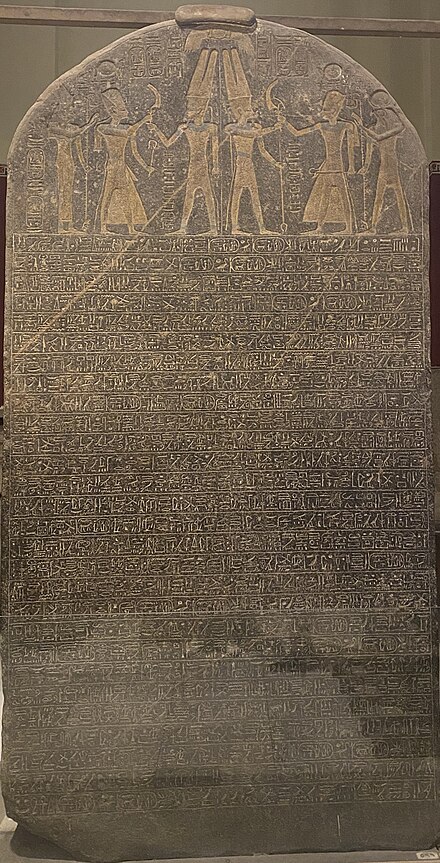
Today I was able to view the Merneptah Stele. This is a pretty big deal in my theological world. The Merneptah Stele, also known as the Israel Stele or the Victory Stele of Merneptah, is an inscription by Merneptah, a pharaoh in ancient Egypt who reigned from 1213 to 1203 BCE. It was discovered by Flinders Petrie at Thebes in 1896, and it is now housed at the Egyptian Museum in Cairo where I visited and was given hands on access to this today.[1][2]

A stele or stela (plural stelae) is a commemorative slab decorated with text and/or images. Ancient Egyptians erected stelae for many purposes including to document historical events, to record decrees (the Rosetta Stone is a famous example), and to remember the dead. [3] Such monuments were made by a variety of cultures in the ancient world, including the Assyrians, Maya, Greeks and Romans. The most common Egyptian term for a stela is wedj, which originally meant “command” and stems from wedj–nesu, “royal decree.” Various qualifiers could be used to further classify wedj, such as wedj-her-tash – “boundary stela” – or wedj-en-nekhtu – “victory stela.” [4]

The “victory stela” here has text engraved and is largely an account of Merneptah’s victory over the ancient Libyans and their allies, but the last three of the 28 lines (in the large photo you will view this as slightly darker colored) deal with a separate campaign in Canaan, then part of Egypt’s imperial possessions. It is sometimes referred to as the “Israel Stele” because a majority of scholars translate a set of hieroglyphs in line 27 as “Israel”. Alternative translations have been advanced but are not widely accepted.[5] The stele represents the earliest textual reference to Israel and the only reference from ancient Egypt. [6] It is one of four known inscriptions from the Iron Age that date to the time of and mention ancient Israel by name, with the others being the Mesha Stele, the Tel Dan Stele, and the Kurkh Monoliths.[7][8][9]

For reference here is the timeline of Pharoahs of Egypt before and after the Exodus: [10]

  • 1295 BCE – 1294 BCEThe reign of Ramesses I in Egypt.
  • 1294 BCE – 1279 BCEThe reign of Seti I in Egypt.
  • 1279 BCE – 1212 BCEReign of Ramesses II (The Great) in Egypt.
  • 1212 BCE – 1202 BCEReign of Merneptah in Egypt.

It was first translated by Wilhelm Spiegelberg.[11] Spiegelberg described the stele as “engraved on the rough back of the stele of Amenhotep III. The inscription says it was carved in the 5th year of Merneptah of the 19th dynasty. From a strictly historical perspective here us what scholars have noted. Egypt was the dominant power in the region during the long reign of Merneptah’s predecessor, Ramesses II, but Merneptah and one of his nearest successors, Ramesses III, faced significant invasions. Traditionally Egyptians only document the victories, not the losses. The final lines of this stele deal with a campaign or situation in the East. Traditionally the Egyptians had concerned themselves only with cities, so the problem presented by Israel is interesting in the ay it is breifly mentioned. Merneptah and Ramesses III were thought to have been fairly successful at fighting off their enemies, but history shows us that it is at this time that Egypt ceased to continue control over Canaan – the last evidence of an Egyptian presence in the area is the name of Ramesses VI (1141–1133 BC) inscribed on a statue base from Megiddo. [12]

In terms of translating the language, the “nine bows” is a term the Egyptians used to refer to their enemies;[13] Israel is clear in the transcription and was thought of as smaller units scattered throughout the region, –Canaan might here refer to the city of Gaza,[14] Based on their determinatives, Canaan referred to the land whilst Israel referred to the people.[15]

The line which refers to Israel is below (shown in reverse to match the English translation; the original Egyptian is in right-to-left script):

According to The Oxford History of the Biblical World, this “foreign people … sign is typically used by the Egyptians to signify nomadic groups or peoples, without a fixed city-state home, thus implying a seminomadic or rural status for ‘Israel’ at that time”.[16] The phrase “wasted, bare of seed” is formulaic, and often used of defeated nations – it usually would imply the people posed some sort of a threat to Egypt.[17] The Merneptah stele is considered to be the first extra-biblical reference to ancient Israel in ancient history and is widely considered to be authentic and providing historical information.[18][19]

There isn’t much scholarly disagreement on the interpretation. It is worth pointing out that in the 4th inscription the image I use above interprets seed/grain. In many other known stela inscriptions this notation meant that famine had come, and conflict resulted in another nation or peoples trying to “war” over Egypt’s grain stores. But in the ancient world this notation is much broader than that and simply means conflict. [20]

DOES THIS GIVE US A CLEAR DATE ON THE EXODUS?

Sadly, no. The dates of the Exodus are still largely inconclusive. Many have chimed in such as Flavius Josephus (c.70 CE), but unfortunately there are some things in Egyptian history that don’t seem to line up. The easiest explanation I have already implied. Most of the documentation of Egypt is in the form of “VICTORY” stela and they are just that, embellished records of victory, not failure. The pharaohs were known widely for covering their less than astounding feats. According to Biblical chronology, the Exodus took place in the 890th year before the destruction of the Temple by the Babylonians in 421 BCE (generally accepted date: 587 BCE). [21] This was 1310 BCE (1476 BCE). In this year, the greatest warlord Egypt ever knew, Thutmose III, deposed his aunt Hatshepsut and embarked on a series of conquests, extending the Egyptian sphere of influence and tribute over Israel and Syria and crossing the Euphrates into Mesopotamia itself. While it is interesting that this date actually saw the death of an Egyptian ruler – and there have been those who tried to identify Queen Hatshepsut as the Pharaoh of the Exodus – the power and prosperity of Egypt at this time is hard to square with the biblical account of the Exodus.

Some historians have been attracted by the name of the store-city Ramses built by the Israelites before the Exodus. They have drawn connections to the best-known Pharaoh of that name, Ramses II, or Ramses the Great, and set the Exodus around his time, roughly 1134 BCE (1300 BCE). [22] In order to do this, they had to reduce the time between the Exodus and the destruction of the Temple by 180 years, which they did by reinterpreting the 480 years between the Exodus and the building of the Temple (1 Kings 6: 1) as twelve generations of forty years. By “correcting” the Bible and setting a generation equal to twenty five years, these imaginary twelve generations become 300 years. Is this acceptable? Generations are fairly generic language in the Bible so there is some textual merit to do this. Others feel strongly that such “adjustments” of the Biblical text imply that the Bible cannot be trusted, Ramses 11 was a conqueror second only to Thutmose III. And as in the case of Thutmose III, the Egyptian records make it clear that nothing even remotely resembling the Exodus happened anywhere near his time of history. However, I come back to, the more powerful and well liked the rulers were, the greater power they had to dictate what was remembered of them. It is also worth noting that Egyptian dating is a disaster in the scholarly community. Few things agree.

Does this stone tell us who the Pharoah of the Exodus was? No; but perhaps it supplies you with a more educated proposition.

WORKS CITED

  1. Drower 1995, p. 221.
  2. Redmount 2001, pp. 71–72, 97.
  3. https://www.artic.edu/articles/824/reading-ancient-egyptian-art-a-curator-answers-common-questions
  4. https://arce.org/resource/stelae-ancient-egypts-versatile-monumental-form/
  5. Sparks 1998, pp. 96–.
  6. Hasel 1998, p. 194.
  7.  Lemche 1998, pp. 46, 62: “No other inscription from Palestine, or from Transjordan in the Iron Age, has so far provided any specific reference to Israel… The name of Israel was found in only a very limited number of inscriptions, one from Egypt, another separated by at least 250 years from the first, in Transjordan. A third reference is found in the stele from Tel Dan – if it is genuine, a question not yet settled. The Assyrian and Mesopotamian sources only once mentioned a king of Israel, Ahab, in a spurious rendering of the name.”
  8. Maeir, Aren. Maeir, A. M. 2013. Israel and Judah. pp. 3523–27, The Encyclopedia of Ancient History. New York: BlackwellThe earliest certain mention of the ethnonym Israel occurs in a victory inscription of the Egyptian king Merenptah, his well-known “Israel Stela” (c. 1210 BCE); recently, a possible earlier reference has been identified in a text from the reign of Rameses II (see Rameses I–XI). Thereafter, no reference to either Judah or Israel appears until the ninth century. The pharaoh Sheshonq I (biblical Shishak; see Sheshonq I–VI) mentions neither entity by name in the inscription recording his campaign in the southern Levant during the late tenth century. In the ninth century, Israelite kings, and possibly a Judaean king, are mentioned in several sources: the Aramaean stele from Tel Dan, inscriptions of Shalmaneser III of Assyria, and the stela of Mesha of Moab. From the early eighth century onward, the kingdoms of Israel and Judah are both mentioned somewhat regularly in Assyrian and subsequently Babylonian sources, and from this point on there is relatively good agreement between the biblical accounts on the one hand and the archaeological evidence and extra-biblical texts on the other.
  9. Fleming, Daniel E. (1998-01-01). “Mari and the Possibilities of Biblical Memory”. Revue d’Assyriologie et d’Archéologie Orientale92 (1): 41–78. JSTOR 23282083. The Assyrian royal annals, along with the Mesha and Dan inscriptions, show a thriving northern state called Israël in the mid—9th century, and the continuity of settlement back to the early Iron Age suggests that the establishment of a sedentary identity should be associated with this population, whatever their origin. In the mid—14th century, the Amarna letters mention no Israël, nor any of the biblical tribes, while the Merneptah stele places someone called Israël in hill-country Palestine toward the end of the Late Bronze Age. The language and material culture of emergent Israël show strong local continuity, in contrast to the distinctly foreign character of early Philistine material culture.
  10. https://www.worldhistory.org/timeline/pharaoh/
  11. Nestor 2015, p. 296.
  12. Drews 1995, pp. 18–20.
  13. William Museum, UK: Ancient Egypt
  14.  H. Jacob Katzenstein, ‘Gaza in the Egyptian Texts of the New Kingdom,’ Journal of the American Oriental Society, January-March 1982, Vol. 102, No. 1 pp. 111-113 pp.111-112
  15.  Smith 2002, p. 26.
  16. FitzWilliam Museum, UK: Ancient Egypt
  17. H. Jacob Katzenstein, ‘Gaza in the Egyptian Texts of the New Kingdom,’ Journal of the American Oriental Society, January-March 1982, Vol. 102, No. 1 pp. 111-113 pp.111-112
  18. Dever 2009, p. 89–91.
  19. Faust, Avraham (2016). Israel’s Ethnogenesis: Settlement, Interaction, Expansion and Resistance (reprinted ed.)
  20. Jones, Daniel (2003) [1917], Roach, Peter; Hartmann, James; Setter, Jane (eds.), English Pronouncing Dictionary, Cambridge University Press, ISBN 978-3-12-539683-8
  21. Contrary to the Jewish historical tradition, the generally accepted date is 166 years earlier, or 587 BCE (see “Fixing the History Books – Dr. Chaim Heifetz’s Revision of Persian History,” in the Spring 199.1 issue of Jewish Action). This difference applies to all Mesopotamian and Egyptian history prior to the Persian period. The dates for Egyptian history given in the history books are therefore off by this amount. For our purposes, we will use the corrected date followed by the generally accepted date in parenthesis.
  22. Some people have been excited about the generally accepted date for Ramses II coming so close to the traditional date for the Exodus. This is a mistake, as Egyptian and Mesopotamian histories are linked. If Ramses II lived c.1300 BCE, then the destruction of the Temple was in 587 BCE, and the Exodus was in 1476 BCE.