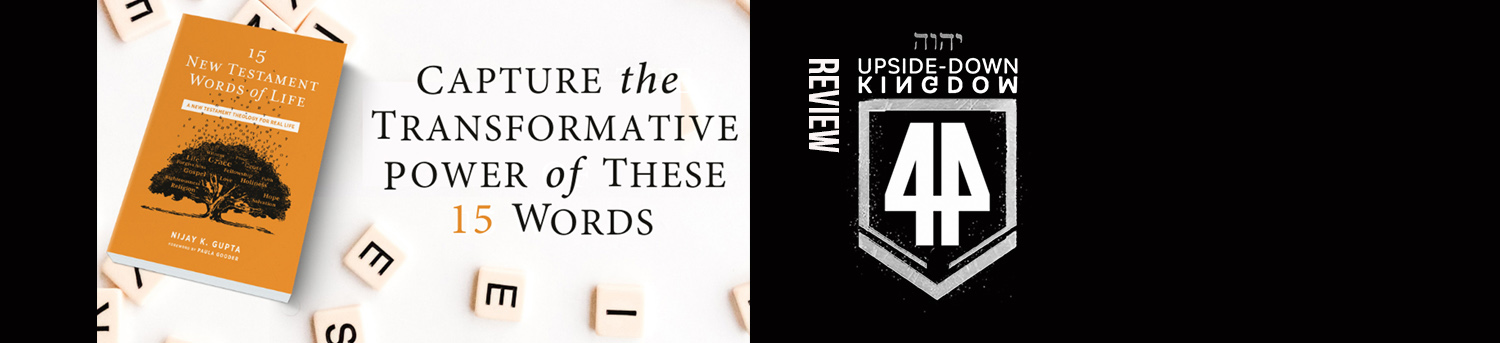
A Review of Nijay K. Gupta’s 15 New Testament Words of Life
Introduction: Lexical Theology as Theological Retrieval
In 15 New Testament Words of Life, Nijay K. Gupta undertakes a project that is at once modest in scope and ambitious in implication: the retrieval of key New Testament terms as living theological categories rather than flattened doctrinal abstractions.¹ From the opening pages, Gupta signals his central thesis—that salvation in the biblical imagination is not primarily about individual destiny (“heaven,” “inner peace”), but about a world restored to righteousness.² This programmatic claim functions as a hermeneutical key for the entire volume, reorienting the reader away from reductionistic soteriology toward a participatory and communal vision of redemption. The work stands within a growing scholarly movement that resists the fragmentation of New Testament theology into either purely historical description or systematic abstraction. Gupta’s contribution is distinctive, however, in its lexical concentration: by organizing theology around fifteen “load-bearing” terms, he demonstrates how language itself mediates theological imagination.³
Methodological Strength: Canonical-Narrative Integration
Gupta’s threefold interpretive method—canonical, literary, and historical—is not merely pedagogical but deeply theological. Each term is situated within:
- its Old Testament narrative background,
- its immediate New Testament textual context, and
- its Second Temple and Greco-Roman conceptual world.⁴
This approach resists the decontextualization that often plagues word studies. Instead, meaning emerges from intertextual resonance and narrative continuity. In this respect, Gupta’s work aligns with the canonical sensibilities of scholars such as N. T. Wright, who insists that theological terms cannot be abstracted from Israel’s story without distortion.⁵ At the same time, Gupta avoids the encyclopedic density of works such as I. Howard Marshall’s New Testament Theology or Frank Matera’s synthetic treatments.⁶ His method is selective but intentional, privileging formational clarity over exhaustive coverage.
Righteousness as Restored Order (pp. 1–3): A Programmatic Reorientation
One of the clearest “homeruns” occurs in Gupta’s opening treatment of righteousness. His assertion that biblical writers envision salvation as “a world restored to righteousness” rather than merely individual moral rectitude represents a decisive corrective to modern Western individualism.⁷ Here Gupta’s work resonates strongly with the covenantal reading of δικαιοσύνη advanced by Wright and others, yet he articulates it in a more accessible idiom.⁸ Righteousness is not merely forensic status but the restoration of right relationships within God’s covenantal world.⁹ This reframing has significant implications: it situates ethics within ontology and community rather than legal compliance. Gupta’s treatment thus implicitly critiques both moralism and reductionist justification frameworks without engaging in polemic.
Life (pp. 46–51): Present Participation over Deferred Eschatology
Gupta’s discussion of ζωή constitutes another major strength. Drawing on post-exilic developments in resurrection theology, he carefully distinguishes between afterlife expectation and present participation in divine life.¹⁰ His reading of Hosea and related prophetic imagery emphasizes that “new life” is fundamentally relational—life “with and from God”—rather than merely temporal extension beyond death.¹¹ This insight aligns with Johannine theology, particularly the present-tense possession of eternal life (John 5:24; 17:3), and echoes the participatory soteriology articulated by Michael J. Gorman, who defines salvation as “participation in the life of God.”¹² Gupta’s contribution here is not novelty but clarity: he retrieves inaugurated eschatology in a way that is both exegetically grounded and pastorally accessible.
Grace (χάρις) and Reciprocity (pp. 93–95): Beyond Transactional Reduction
In his treatment of grace, Gupta offers a nuanced account that avoids both legalistic distortion and antinomian misreading. By situating χάρις within ancient frameworks of gift and reciprocity, he demonstrates that divine generosity is neither impersonal nor devoid of relational expectation.¹³ Crucially, Gupta insists that reciprocity does not imply repayment but participation in a relationship initiated by grace.¹⁴ This aligns closely with John Barclay’s analysis of grace as “incongruous gift” that nonetheless generates transformed allegiance.¹⁵ The strength of Gupta’s argument lies in its balance: grace remains unconditioned in origin yet formative in effect, preserving both divine initiative and human response.
Peace (pp. 133–137): Shalom as Communal Wholeness
Gupta’s exposition of peace draws deeply from prophetic traditions, particularly Micah 4:4. He challenges modern reductions of peace to the absence of conflict, recovering instead its biblical sense as holistic flourishing—economic, social, and relational.¹⁶ His description of peace as the “wholeness” longed for by a sin-frustrated creation situates the concept within a broader cosmic framework.¹⁷ This resonates with Willard Swartley’s argument that peace in the New Testament is inseparable from covenantal restoration and communal ethics.¹⁸ Importantly, Gupta’s integration of peace with mediation (Hebrews) highlights the relational dimension of atonement: Christ’s work is not merely juridical but reconciliatory and communal.
Forgiveness (pp. 41–42): Embodied Reconciliation
Gupta’s treatment of forgiveness, particularly his use of the prodigal son narrative, exemplifies his pastoral sensitivity. His striking description of forgiveness as “kisses on your cheek” reframes the concept as embodied relational restoration rather than abstract acquittal.¹⁹ This aligns with recent work in atonement theology, such as Joel B. Green’s emphasis on salvation as relational restoration rather than merely legal transaction.²⁰ Gupta’s contribution lies in his ability to render this insight experientially vivid without sacrificing theological depth.
Comparative Assessment: Position within Contemporary Scholarship
When placed alongside major New Testament theologies—Marshall (IVP), Dunn (Abingdon), Matera (Westminster John Knox), and Wright (Fortress)—Gupta’s work is notably more lexically focused and pastorally oriented.²¹ Compared to Baker Academic and Eerdmans volumes that emphasize either systematic coherence or historical depth, Gupta offers a formationally oriented theology that bridges academic rigor and ecclesial application.²² His work is perhaps most comparable to Scot McKnight’s A Fellowship of Differents (Zondervan), though Gupta’s lexical method provides a more structured entry point into theological reflection.²³ Thus, while not as comprehensive as traditional New Testament theologies, Gupta’s work excels in clarity, integration, and applicability, making it particularly valuable for pedagogical and pastoral contexts.
Conclusion: Theology as Lived Language
Gupta’s 15 New Testament Words of Life does more than clarify theological language—it quietly reorients how we live with God and one another. What begins as a study of words becomes, by the end, an invitation into a different kind of life—one that is less about mastering doctrine and more about participating in the reality those doctrines were always meant to describe.
The great gift of this book is how it returns familiar words to us—righteousness, grace, life, peace, forgiveness—and allows them to breathe again. Righteousness is no longer reduced to personal moral effort, but becomes a vision of a world being set right under God’s reign. Life is not something postponed, but something received and shared now in Christ. Grace is not a static concept, but a living relationship that draws us into deeper trust and response. Peace is not merely the absence of conflict, but the presence of wholeness among people who are learning to live together under God. And forgiveness—perhaps most beautifully—is no longer abstract, but something we can almost feel: the embrace of a Father who runs toward us and brings us home.
For the church, this book serves as both a correction and a gift. It gently exposes where we have allowed our language to become thin, individualistic, or overly transactional. But it does so without harshness. Instead, Gupta offers something better—he gives us back a vocabulary that is rich enough to form communities, not just inform individuals.
For pastors, teachers, and leaders, this work provides a framework for preaching and discipleship that is deeply biblical and profoundly practical. It reminds us that our task is not simply to explain theological terms, but to help people inhabit them—to live into grace, to practice peace, to embody forgiveness, to walk in new life.
For the layperson, the impact may be even more significant. This book helps bridge the gap between what we say we believe and how we actually live. It reassures the reader that the gospel is not distant or abstract—it is near, relational, and already at work in the ordinary rhythms of life.
There is also something deeply encouraging about the tone of the work. Gupta writes not as one standing above the church, but as one serving it, offering clarity with humility and insight with care. That posture alone makes this book a gift.
In the end, what remains is a sense of gratitude. Gratitude for a work that does not complicate the faith unnecessarily, but instead deepens it in the right places. Gratitude for a reminder that the language of Scripture is not meant to be mastered from a distance, but lived from within.
And perhaps most importantly, gratitude for the simple but profound truth that these are not just “words of life”—they are words that lead us back into Life Himself.
PUBLISHER: Zondervan Academic

Special thanks to the TKC Cohort think tank—your thoughtful research, rich discussion, and shared pursuit of truth were not only instrumental in shaping this work, but deeply reflective of the very kind of life together this book calls us into. This article is better because of your voices, your questions, and your commitment to pressing deeper into the language and life of the New Testament. Grateful to walk this out alongside you.
- Corey Britcher
- Dylan Shower
- Kevin Harper
- David Hay
- Jen Austin
Notes (SBL Style)
- Nijay K. Gupta, 15 New Testament Words of Life (Grand Rapids: Zondervan Academic, 2022).
- Gupta, Words of Life, 2.
- Gupta, “Why I Wrote 15 New Testament Words of Life.”
- Gupta, Words of Life, Introduction; cf. publisher description.
- N. T. Wright, Paul and the Faithfulness of God (Minneapolis: Fortress, 2013), 799–801.
- I. Howard Marshall, New Testament Theology (Downers Grove, IL: IVP Academic, 2004), 17–25; Frank J. Matera, New Testament Theology (Louisville: Westminster John Knox, 2007), 1–12.
- Gupta, Words of Life, 2.
- Wright, Paul and the Faithfulness of God, 799–820.
- Gupta, Words of Life, 1–3.
- Gupta, Words of Life, 46.
- Ibid., 46–47.
- Michael J. Gorman, Becoming the Gospel (Grand Rapids: Eerdmans, 2015), 28–35.
- Gupta, Words of Life, 93.
- Ibid., 94–95.
- John M. G. Barclay, Paul and the Gift (Grand Rapids: Eerdmans, 2015), 562–65.
- Gupta, Words of Life, 133.
- Ibid., 137.
- Willard M. Swartley, Covenant of Peace (Grand Rapids: Eerdmans, 2006), 21–35.
- Gupta, Words of Life, 41–42.
- Joel B. Green, Why Salvation? (Nashville: Abingdon, 2014), 45–60.
- James D. G. Dunn, New Testament Theology (Nashville: Abingdon, 2009); Marshall, New Testament Theology.
- Englewood Review assessment.
- Scot McKnight, A Fellowship of Differents (Grand Rapids: Zondervan, 2014), 15–30.