
Anyone else sometimes feel like our laser and lightshow, skinny jeans and smoke machine Christian culture has sort of lost the sacred approach that seems to be so rich to the textures of the Bible? One prominent blogger says, “My Father’s House Shall be a House of… Entertainment?”1 I agree with much of his sentiment. I grew up attending the classic white steepled church adorned by stained glass telling the story of the covenant community that had faithfully gone before us, and I have to say when I return to a more traditional looking church building there is just something that feels more sacred than the auditoriums parading led walls bigger than the strip of Las Vegas. But perhaps even more than a steeple and stained glass, I long for an antiquated upper room with a table set for me.2 But at the same time, I love the diversity of the church and find a place for nearly every recipe of the faith.
Recently TKC students went to a Brian Zahnd Prayer school. Brian started in the Jesus Movement3 and shifted into Word of Faith.4 From there he had a deeper bought with Theology and found himself turning back the pages to a more conservative Anglican5, or Eastern Orthodox6 approach. Amongst other things he brought back the liturgy7 into his prayers. One of the other things that you will see in his church is a return to icons8, specifically Jesus on the cross. Before I go any further, I love Brian Zahnd. If you have a chance to attend one of his prayer schools, you will be immensely blessed. I can’t recommend the school or any of his soon to be 12 books enough. All of it is life changing and will bear great fruit for the kingdom.
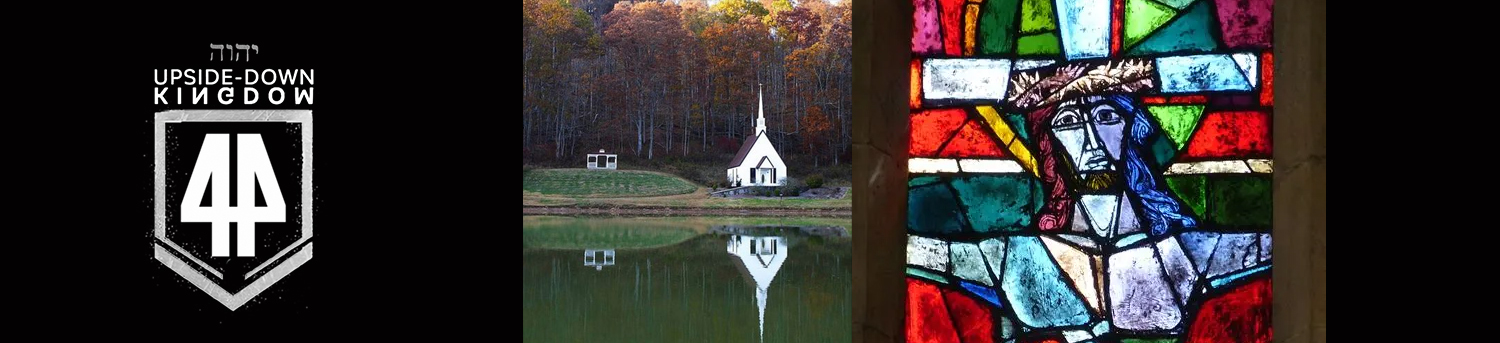
As much as I LOVED THIS endeavor, I have to admit, I still found myself struggling with the longer liturgy, iconography, beads, repetition and chants (and I chant in Hebrew regularly). I know so many people that were “saved” from all of this. There are some things about the more liturgical experiences I love, and some things that I don’t. I love the sacred approach and the stressing of Biblical theology; but I also don’t want to harness or put the moving of the Holy Spirit in a box (which to be clear I don’t think Brian does.) I also have never felt good about iconography that leaves Jesus on the cross.
“Being disguised under the disfigurement of an ugly crucifixion and death, Christ upon the cross is paradoxically they clearest revelation of who God is.” – Brian Zahnd
I agree with his quote. In fact, I think it is right on. But I am not sure I want to “stay” there or make that my dwelling place. I feel like to do so sort of takes a perspective similar to when those of the reformed mindset that get so bound by total depravity (and the other TULIP ideology)9 that they can never emerge from that mindset, affirm their new life and identity in Christ and live in victorious sanctified life here and now bringing Heaven to earth – in the words of NT Wright.10
As I write this, I am asking myself (as all good theologians should do)11 to be unbiased and consider what is the best approach according to the scripture and the revelation of Jesus Christ. I will invite you to a Mars Hill experience12 with me. Let’s consider the tough questions. Why focus on the image of Jesus on the cross? Some would say we are leaving Jesus on the cross, not celebrating the triumph of the resurrection ascension and enthronement of Jesus that is the completed image of living a complete sanctified life.13
Others will say the cross by itself is an abstraction of Jesus.14
To say it a different way… A beaten, humiliated man dying on a cross doesn’t seem like we “picked a winner…”15 But as you likely know if you are reading this, that is the worlds way of thinking. We as Christian’s see the beauty in the humble sacrifice (Beauty will save the world) and see that through Him the meek will inherit the earth. This is upside down or backwards kingdom ideology – the first shall be last kingdom that Expedition 44 has become known for. Christ (the meek) inherited the earth & we are sons and daughters of God and therefore we also inherit His kingdom. We lead humbly from beneath in peace. Jesus’ way of leading puts devotion and service ahead of prominence and power. This perspective aligns with the concept of servant leadership, where the leader serves others rather than seeking to dominate or assert authority over people. 16
Yes, I know all of that and do my best to live it out. In the same way, I can see how the image of Christ on the cross is a great iconic missional reminder of what we should be doing each and every day.
Then he said to them all: “Whoever wants to be my disciple must deny themselves and take up their cross daily and follow me. Luke 9:23
However, with all that said, so much of the voice of Jesus and message that follows is to claim the full revelation of Jesus which is post enthronement -His spirit poured out into us that we might represent the One that has “won” or “championed” the world.17
Please don’t get me wrong, I don’t think the kick butt Jesus icon18 works. I even sometimes struggle with the battle language in Christianity (when the battle belongs to the Lord not us); but Jesus is both the Lion and the Lamb. Let’s not lose sight of either.
My primary problem with leaving Jesus on the cross is that scripture tells me that my identity isn’t in my former defeated person but is now grafted into the glory of the enthroned Christ. In some ways I see the transformation of the cross as a caricature or mosaic (comparison image) of my personal transformation enthroned by Him as a royal holy ruler -not defeated. To leave Christ on the cross doesn’t seem to match the thrust of 2 Corinthians 5 following my example to be like Jesus in total transformation.19
The Greeks believed that peace (eirḗnē) was simply the small intermission between war (pólemos) and war was (and possibly should be) the natural state of the world.20 This Greek idea stands in opposition to shālôm, the Hebraic idea of well-being that was and is the intended condition of humanity. shālôm is the gift of YHVH. But shālôm is not just the peace between the wars, but the balance that found revelation in Jesus Christ Himself. “Peace I leave you, My peace I give you; not as the world gives, do I give to you. Do not let your hearts be troubled, nor fearful” (John 14:27 NASB).
I want to dwell on the complete revelation of Jesus, that is a balance of the cross and the enthroned king.
Will Ryan Th.D.
- https://jaronalexander.medium.com/skinny-jeans-and-smoke-machines-11e3d6ee28b ↩︎
- Cambridge Bible for Schools and Colleges on Acts 1, “The eleven were the tenants of the upper room, to which the other disciples resorted for conference and communion”. ↩︎
- Bustraan, R. A. (2014). The Jesus People Movement: A Story of Spiritual Revolution Among the Hippies. Wipf & Stock Publishers. ISBN 978-1620324646. ↩︎
- Harrison, Milmon F. (2005). Righteous Riches: The Word of Faith Movement in Contemporary African American Religion. Oxford: Oxford University Press. ISBN 9780195153880. ↩︎
- “What it means to be an Anglican”. Church of England. Archived from the original on 30 August 2011. ↩︎
- “The Orthodox Faith – Volume I – Doctrine and Scripture – The Symbol of Faith – Resurrection”. http://www.oca.org. ↩︎
- Baldovin, John F., SJ (2008) Reforming the Liturgy: a Response to the Critics. The Liturgical Press ↩︎
- Erwin Panofsky, Studies in Iconology: Humanistic Themes in the Art of the Renaissance. Oxford 1939. ↩︎
- Sproul, R. C. (2016). What Is Reformed Theology?: Understanding the Basics. Grand Rapids, Michigan: Baker Books. p. 32. ISBN 978-0-8010-1846-6. ↩︎
- Van Biema, David (7 February 2008). “Christians Wrong About Heaven, Says Bishop”. Time. Archived from the original on 9 February 2008. ↩︎
- Kogan, Michael S. 1995. “Toward a Jewish Theology of Christianity.” Journal of Ecumenical Studies 32(1):89–106. ↩︎
- Bruce, F.F. The Acts of the Apostles. The Greek Text with Introduction and Commentary. 2nd Ed. (Grand Rapids: Eerdmans, 1952). 335. ↩︎
- Philip Edgecumbe Hughes, A Commentary on the Epistle to the Hebrews, p. 401, 1988: “The theme of Christ’s heavenly session, announced here by the statement he sat down at the right hand of God, .. Hebrews 8:1 “we have such a high priest, one who is seated at the right hand of the throne of the Majesty in heaven”)” ↩︎
- Clark, Elizabeth Ann (1999). Reading Renunciation: Asceticism and Scripture in Early Christianity. Princeton: Princeton University Press. ISBN 978-0-691-00512-6. ↩︎
- Leithart, Peter (July 1995). “When the Son Is Glorified”. Biblical Horizons. 75. Retrieved 3 May 2012. ↩︎
- Ignatius of Antioch. The Epistle of Ignatius to Polycarp. IV. ↩︎
- https://www.faiththeevidence.com/faith-evidence-blog-_1/jesus-our-champion ↩︎
- https://thinkchristian.net/jesusfreaks-butt-kicking-christ ↩︎
- Dallas Willard – Renovation of the Heart proposes that the human self is made up of several interrelated components: one’s spirit, i.e. one’s “heart” or “will”; one’s mind, or the collection of one’s thoughts and feelings; the body; one’s social context; and one’s soul. Willard argues that one’s identity is largely a function of how those components are subordinated to one another, and whether the whole is subordinated to God. Willard argues that popular rejection of subordination to God and the dominance of the body and feelings has resulted in addictions and futile pursuits of stimulation for the body or feelings. Willard argues that the subordinated alignment of one’s being can be corrected through apprenticeship to Jesus Christ, which renovates one’s heart. ↩︎
- Josephus, Jewish War, 1.370 (Loeb ed.) ↩︎
 EXPEDITION 44