
We have several Expedition 44 (x44) videos that have alluded to our views on Humanity, but this post is going to be a bit more specifically geared towards Adam and Eve and whether or not they were the first Humans.
HERE IS A LINK TO THE YOUTUBE VERSION OF THIS POST
I have been a part of mainstream evangelical Christianity all my life and graduated from Moody Bible Institute (but I am not dispensational) which is one of the most “conservative” and “traditional” Bible colleges in the country. To some not familiar with scholarly Biblical Studies this post might come off as a surprise to some challenging your traditional notions of the Bible. I assure you; I still maintain a very traditional view of scripture and am regularly frustrated by the watering down of scripture. My conviction in life has always been to truly seek the best interpretation of scripture.
With that said, one of the positions I have leaned towards for most of my life which admittingly, is a minor view in mainstream theology (but possibly not within scholarly Biblical studies), is that Adam and Eve were not the only humans on Earth before they were expelled from the Temple Garden. This is referred to as a belief in a pre-adamic race. Sometimes within this term there is a “white race” debate which I will not be touching on.
Regarding Adam and Eve we need to approach the question of whether or not Adam and Eve were the first humans and whether or not they were “real humans” or just treated as typology in the narrative of Genesis 1-3. There are also issues surrounding creation that come into play when considering these questions which I will also briefly address. The mission of this article is to explain why I lean towards a pre-adamic race briefly explaining some of the issues that affect this analysis. There are several books and websites dedicated to these discussions so I will keep this as to the point as possible.
MY BASIC PREMISE:
- I believe God created Adam and Eve by His direct hand and in His image and that they were actual people but also serve as a typology, they were the first priests in the line of the Messiah but likely not the first people on earth.
- God inaugurated creation in 7 days as a cosmic temple
- The focus of Genesis 1-3 is God’s relationship with humankind and not necessary the details of building the creation. The Bible therefore becomes the love story of God reclaiming the treasured possession of humanity that was lost. (house vs home story.)
- Genesis 1-3 (specifically) should be read in light of its intended audience (Ancient Near East Mesopotamian) culture.
THE ISSUES
There are some things we need to consider when we are navigating a landing pattern for our theology and the harmony of the lens of scripture. Here are some difficult things that you’re going to have to decide what to do with or how they fit into your overall theology.
- Can a literal Adam and Eve agree with science?
- How did Adam accomplish so much in one day according to the traditional view of creation?
- If there weren’t people living at the time of Adam and Eve there are some parts of the story that are difficult to make sense of. (Who does Cain Marry, why is he fearing for his life, and how did he build a city.)
- If you believe in a pre-Adamic race why does Paul seem to refer to Adam as the first man?
- Typology: Does the Hebrew favor an archetype language for the word Adam?
- Does understanding the Ancient Near East culture change the story at all?
- Genesis has elements that were borrowed from other cultures and religions. When it comes to the bits about Adam and Eve, some key pieces are cribbed from the Enuma Elis (the Babylonian creation story) and Gilgamesh. The standard Akkadian Epic of Gilgamesh was composed by a scribe named Sîn-lēqi-unninni, probably during the Middle Babylonian Period (c. 1600 – c. 1155 BC), based on much older source material. Most classical historians agree the Epic of Gilgamesh exerted substantial influence on the Iliad and the Odyssey, two epic poems written in ancient Greek during the 8th century BC.
- What about the rib problem? The Hebrew word “tsela” appears 40 times in the Bible, and the only time it’s translated as “rib” is when Eve shows up. It usually refers to the side of something, or “limbs lateral to the vertical axis of an erect human body.” It’s a very strange use of the Hebrew word. An interesting theory is that Eve was in fact made from Adam’s baculum. The baculum is the penis bone in mammals but human’s males are missing one. If God took a bone from Adam, then his descendants presumably wouldn’t have that bone. Men have an even number of ribs but are missing the baculum. So it stands to reason, he says, that’s the real bone God formed Eve from.
- According to a Gallup poll in 2017, only 38 percent of adult American Christians surveyed believed God created Adam and Eve as fully human individuals about 10,000 years ago. An equal amount believed evolution happened but with God’s guidance in some way. And 19 percent of the group believed in a God-free evolution process, with Protestants more likely to believe in some version of evolution than Catholics.
- Science is sending conflicting reports. In a major shock to those who believe in evolution, a study of the genetic code shows the human race sprang from a single adult couple. The research was led by the Rockefeller University and the University of Basel, Switzerland, and stunned all involved. On the other hand, Sheehan et al., building on earlier work by Li and Durbin, calculated that the minimum population size associated with the worldwide expansion of humans out of Africa roughly 100,000 years ago was 2,250 individuals, while the population that remained in Africa was no smaller than about 10,000 individuals. (In other words, this scientific report says there is no way all of us got here from 2 people less than 10,000 years ago. They say it is statistically impossible.) Science doesn’t agree here. One scientific report has claimed that according to population genetics, particularly those concerning Y-chromosomal Adam and Mitochondrial Eve, a single first “Adam and Eve” pair of human beings never existed.
BASIC THEOLOGICAL VIEWS:
Literal: In this view, Adam and Eve were the historical first parents of humanity. The literal interpretation is usually associated with young earth creationism, placing Adam and Eve only about 6-10,000 years ago. For the most part this view is ok not agreeing with science that suggests the earth and civilization to be much older.
Federal Headship is tied to the Calvinistic idea of total depravity. Adam is viewed as the “federal head” or head male who brought all of humanity into sin. This view takes on a literal or historical person for Adam. They have to reconcile the problem that it was actually Eve that sinned. Eve’s agreement to do the will of the serpent represents an inversion of the hierarchical order of creation. Likewise, instead of listening to God, Adam listened to his wife and became like the serpent, eating dust all the days of his toil. Adam’s fall recalls his origins from dust: “And God formed man of the dust of the earth, and breathed into his nostrils the breath of life; and man became a living soul” (Gen. 2:7). I think this view shares some good elements but I don’t think we can pin all the problems of the world on Adam.
Allegory is a literary and artistic device in which characters represent an idea or a religious or moral principle. Those who hold this view need not insist that Adam and Eve were historical persons. An example of the allegorical approach is Philo’s commentary which looks at the history of mankind, beginning at Genesis 2. Typology and Archetype views consider Adam as allegory but also may agree on a historical person.
THE TRADITIONAL VIEWS: Adam and Eve were the first [real] Humans
The traditional view of Adam and Eve is tied in some part to the first point of the Calvinistic doctrine of Total Depravity (T in TULIP). That they were tempted and fall, and the rest of mankind are plunged into rebellion against God’s order. And this rebellion is also the reason we die today. Romans 5:12 is often cited as the reasoning. Without a historical Adam, the Calvinistic doctrine of original sin and guilt does not hold together. I also tie this conversation into a reformed view of Paul’s mention of a second Adam. I also have an issue with rebellion as the reason for death. Extended life whether on earth or eschatologically is always granted by God. Without the “breath” of God, human beings die and return to dust. (Psalm 104) When Adam and Eve were expelled, they no longer had access to what gave unending life (likely a tree but also embodied as the life-giving source-breath of God).
This is a bit of a tangent, but if you haven’t read Heiser’s article on Romans 5:12 and guilt you should.
Adam’s Sin and Old Testament Theology – Dr. Michael Heiser (drmsh.com)
I will say that there are valid reasons to believe that Adam and Eve were the first Humans and that is why I use the word “lean” when I say that I favor the pre-adamic race view; I don’t want to totally rule this view out.
“But I do not allow a woman to teach or exercise authority over a man, but to remain quiet. For it was Adam who was first created, and then Eve.” (2 Timothy 2:11-14) And: “For indeed man was not created for the woman’s sake, but woman for the man’s sake.” (1 Corinthians 11:9) Romans 5:12: “Therefore, even as through one man sin entered into the world, and death by sin, and so death passed on all men inasmuch as all sinned”
Death refers to spiritual death, not to physical death. Adam, being the first man to be made in the image of God, would have been the first human to break God’s trust. But still, to me the biggest reason to believe that Adam and Eve were the first “real” humans is that Paul seems to believe in a historical Adam as did many of the second temple writers and a lot of the early church. But this in of itself isn’t a “bombproof” argument for Adam being the real first human. There are some difficulties with this view. We often read the authors views on things into their narrative; Paul could have been thinking wrongly here. To better explain this, consider 1 Corinthians 7:10, where theologians often wonder if they should separate the Lord’s command in the first phrase, but only consider Paul’s personal opinion in the second? Both statements are fully authoritative, but the source of authority differs in each instance. If you are not familiar with this type of narrative theology a good place to start is Exploring the texture of texts by Vernon K. Robbins.
As it affects this conversation, some traditional creationists would continue to argue that if you deny a real Adam and real Eve, many of the doctrines in the Bible (including the gospel) would be incoherent, which I also somewhat agree with especially if you are reformed, but also believe outside of reformed theology the difficulties cab easily be reconciled. These traditionalist views are often stated in a way to divide those who think differently with statements such as stated on the Answers in Genesis website, “It’s not possible to deny a real Adam and Eve while at the same time believing the rest of the Bible.”
I Corinthians 15:22 is often cited as the next proof text for Adam as the “first human”, “For as in Adam all die, so also in Christ shall all be made alive.” The problem with the use of Romans 5 and I Cor 15 as proof texts for Adam as the first person is they are slightly used out of theological context. In theology it is understood that if something is teaching on a major topic like the deity of Christ, you shouldn’t make a major doctrine out of a minor statement. In other words, was the main goal of this passage to say that Adam was the first human? No, it was teaching on the deity of Christ. Lastly and most importantly, if you are going to read it as making a statement that Adam was the first man, you would also have to conclude that Christ was the last man to exist. You can’t philosophically make one statement without making the other, and since we know the latter not to be true, we need to interpret the former differently and in the same way as the latter. I would encourage you to read Hesiers discussion on the idea of original guilt here. I mostly agree with it. I personally do not think that Romans 5:12 teaches that humans inherit Adams guilt. The text says that we inherit death, but not guilt.
I personally resonate with the view that Adam and Eve were real people, not just a mythological story or “only” as archetypical. The genealogies in 1 Chronicles 1 and Luke 3 treat Adam as historical. Where I differ, is that I believe parts of the oral stories carried over for generations and rewritten into Genesis resembled stories of ANE lore.
You will often find a main defense of the historical Adam to say that for most of history we have interpreted Adam and Eve as the first Humans. There is some merit to this argument. If a lot of smart people have ended up here it might mean something! But there has also been a good deal of people in history that haven’t gone this way, and many will argue that a great contingency of scholars (those that have devoted countless hours to Biblical study in this area) don’t.
Is the story of Adam and Eve Real? Where they real people? I think the easiest answer is to say, they were real, but they also at times represent handed down lore (very much represented in near exact stories of other ANE cultures) and represent an archetype for humanity. I might also say, they may be real people, but they also don’t have to be. It doesn’t devalue the text if they aren’t. As I have mentioned previously, some theology (reformed) hinges on the views that they are actual people; but I also don’t think that all of theology comes crashing down if they aren’t real people. There are many great theologians that have worked through this dilemma. The main goal of Genesis 1-3 is to tell the narrative of love and intimacy lost with God and the need and plan for God to regain it. The Adam and Eve story is making the theological premise for the rest of the book. Heiser puts it like this, “I don’t need a single real-time event involving an original human couple to know with theological certainty that all humans are mortal, that all humans sin, and that all humans are totally helpless to remedy either problem. If Genesis 3, an important passage that communicates these truths, is only a story, the points are still clearly and forcibly put forth. Do we need Job to be a historical person to know that the righteous can indeed suffer and we must trust God for why that happens? That would be an incredibly narrow (and reality-defying) position to take.”
A PRE-ADAMIC RACE: ADAM AND EVE LIKLEY WERE NOT THE FIRST HUMANS
I want to start this with a very simple logical and philosophical argument that anyone can appreciate. You won’t need to know Hebrew or understands much about theology. It’s an argument fit for a child.
From childhood most Christians have readily accepted that Adam and Eve were the first humans. But if you simply read the first two or three chapters of Genesis like any other book (modern or Ancient Near Eastern -ANE), you would simply read it and likely arrive at a simple yet different conclusion. I love teaching children, and this has been a lifetime thought experiment of mine. Read a preschooler the Genesis story and ask them to summarize it and you know what they will say (especially if they have never read the story)? They will say that God created humans then He created Adam and Eve. That is simply how we would read Genesis based on the way we read any other story. God created humankind on day 6 in Chapter 1, rested on day 7 and then chapter 2 tells us He created Adam. Why would it be retelling the same event? According to the basic laws of hermeneutics the idea of “retelling the story again” is actually a more problematic interpretation than assuming they are separate events. We don’t read any other part of the Bible this way within its own book. Even the gospels that tell the same story from different perspectives you will find are telling separate but similar accounts. For instance, when you get into harmonizing the gospels you find that Jesus called his disciples three times, not once. In the same way, He also commissioned them three times, not once. If you don’t take this view, you have a lot of theological gymnastics to accomplish as the different descriptions of these events don’t “agree.” I have found the Bible always agrees but sometimes we have to go on a journey to figure it out. It is no difference with Genesis 1-2. Over the years tradition has (in my opinion) likely misread the texts. But I am also not very dogmatic here. I can see a more traditional interpretation; I personally just don’t think it is the “best” hermeneutic. To some this is a “go to war” or “fall on the sword” topic. To me it isn’t, it is simply about what makes the most theological and philosophical sense within the lens and agreement of the harmony of scripture. I literally have nothing to gain or lose over a view on this subject.
Genesis 2:4 says “This is the account of the heavens and the earth when they were created, when the LORD God made the earth and the heavens.”
Most of you know me best for my Hebrew word studies, so let me show you something here. The Hebrew word translated as “account” in Genesis 2:4 is Toledot. Traditional Jews are familiar with this literary formula and we see it several times in the book of Genesis. In Genesis 5:1 we get this with the parallel sequel story of Cain and Seth. Then we get the pre-flood condition with Noah is Genesis 6:9, and again with Noah and his sons resulting in the table of nations in Genesis 10:11. Then it takes us to Gen 11:10 where we get the table of nations transitioning to Shem’s Descendents and then to Gen 11:27 where it takes the descendants to Terah and Abraham. From there we see the sequel in Gen 25:12 going to Ishmael. This is called the Toledat Formula and every time we see a report on what happens after the preceding passage. This is really important. There isn’t one time that we see it as a recapitulation or retelling of the same story. In other words to handle Gen 1-2 this way would be completely opposite of how Genesis tells every other story/sequel event. But even when we get out of Genesis, there is not one instance in The Old Testament in which toledot is used to retell a previous narrative in more detail as the traditional take on Genesis suggests we do. In other words treating Genesis 1-2 as a recursive narrative is simply poor hermeneutics. You wouldn’t and you don’t treat any other story in the Bible like this.
Richard Deem expounds on this kind of thinking making the point that within the traditional view of a recursive narrative and literal day view Adam couldn’t have possibly completed his assignments. “The text indicates that God planted a garden. This garden was not planted full-grown, since the text says that the trees were caused to sprout or grow (Hebrew tsamach). The amount of time allowed for the garden to grow is not stated, but would presumably take longer than 24-hours. After the garden had grown sufficiently, the man was placed into the garden to cultivate it. By this time, the trees were producing fruit so that Adam could eat. This process takes a period of time greater than 24 hours. Next, Adam was given the assignment of naming the birds, cattle and wild animals. The list includes only birds and mammals and does not mention fish or other lower life forms. Even so, it would require that Adam name at least 14,600 species (8,600 species of birds and 4,000 species of mammals). This would require Adam to name more than 10 species per minute (assuming he had the entire 24 hours). For those who believe in a young earth, it would require that Adam name not only all of the existing birds and mammals but all the ones in the fossil record also (since they would all have to be alive on day 6 – since no animal death occurred before the fall). This type of assignment would almost certainly double the number of animals Adam had to name. However, Adam did not have the entire 24 hours, since part of it was required for the planting and growing of the garden, Adam tending the garden, and God putting Adam to sleep to create Eve. Realistically, Adam would have to name at least 20 species per minute, including all the species found in the fossil record. Following this naming of the animals, no suitable helper was found for Adam. So, God put Adam to sleep, took at piece of Adam’s side, and created Eve.”
To sum up his point, you couldn’t cram the accounts of Genesis 2 into a day. This is going to be really problematic for a traditionalist. Either you have to adopt the Day-Age view (which a traditionalist won’t do) or conclude that Genesis 2 comes after day 6. The day-age interpretations says that the days of Genesis 1 are long time periods. This also opens the door for theistic evolution (which I am “open” to but admittingly do not like to do). The reason the scientists date the world to be 3 billion years old is because that is how long it may have taken God to create it. This view of creationism is called day-age theory and basically states that one day was not literal.
Personally, I don’t rule out day-age theory, but I don’t like it partly because I am a Hebrew scholar. The Hebrew word translated as “Day” is “yom” and often refers to a long period of time. But as a Hebrew scholar and someone into hermeneutics this is also problematic. Yom is best interpreted as “in that day.” It becomes an idiomatic expression. The closest thing we have in English is the word “when.” This doesn’t rule out the Day-Age interpretation, it just doesn’t give it the clout that some think it does that don’t have a good understanding of Hebrew. Because of this, it again, makes the most sense to not include Genesis 2 as a retelling of Genesis 1.
Walton alludes to this, “Since interpreting Yom as long time periods is problematic in Genesis 1, our only other option is to not put the events of Genesis 2 in Genesis 1’s day 6 at all. Genesis 2 is a sequel. Now, the fact that I think “Yom” should be interpreted as a 24 hour period does not suggest that we must all become Young Earth Creationists. I have written elsewhere that the days of Genesis 1 are part of God inaugurating the universe as His cosmic temple, that God’s “creation” of everything within the 7 days is only about assigning functions and roles, and that the 7 days come after a period of material manufacturing that precedes the 7 days.” In my estimation, Genesis 1 is, therefore, compatible with any view of material origins that the scientists may want to propose, it is how you handle Genesis 2 that defines your view of creation and the role or person of Adam.
There are also other more theological reasons to lean towards the view that Adam and Eve were not the first humans on earth. When God God placed Adam in the Garden of Eden, He was told to protect (keep) it. “Keep” is shâmar, which means “to guard or protect.” So, why would Adam need to guard if there weren’t any Humans? The most logical answer is that he was to defend it from other men, most likely the ones to whom Cain fled in Nod.
Adam and Eve had two children initially, Cain and Abel. Cain killed Abel and then feared for his life (he would be murdered) when banished by God, into the world. God marked him as a warning sign to others, not to murder him. Cain wound up marrying and starting his own family. Who did he have to fear? Who would murder him? The only people alive on earth up to that point, according to a traditional interpretation, were Adam, Eve and Cain (Abel was dead). Furthermore, who did Cain go and marry, since the only people alive up to that point, in a traditional interpretation, were Adam, Eve and Cain (Eve was the only female, and she stayed with Adam). Traditional interpretations would say that they populated rapidly creating lots of people (perhaps 130 years with 13 siblings if you try to do the math in Gen 5) and that we don’t have a clear timeline since people lived longer. But then we still have the issue of incest as sin, could they have been a pure seed so this “law” that was later given not apply to them according to a traditionalist viewpoint? The idea that a later law was ok for them should be problematic for you to accept, it seems like a bit of contortion. There is also the issue of Cain building a city in Gen 4:16. That is hard to reconcile and seems like a stretch, and we get no indication from scripture that God was acting supernaturally here.
It would seem that the most natural solution is that the creation of humans on day 6 was the creation of a multitude of humans (not Adam and Eve), and they were sent out into the world to populate it. That would give Cain someone to fear. That would give Cain someone to marry. That would allow for a city to be built. That would give Adam people to “rule” over. Sumerians would have been the people that populated the landscape for Cain and Science and archeology seem to point that direction.
We also should briefly consider Genesis 1:28 where God says, “Be fruitful and multiply, and Replenish the earth.” The word replenish means “to fill”, and one cannot replenish something if it was not plenished (filled) to some degree before God’s command was issued. If Adam and Eve were the only two humans, then this would make God’s instruction arbitrary and out of place. Instead, God could have said, “Be fruitful and multiply, fill the whole earth.”
When you dive deep Jude also supports the belief that Cain married outside his race and not one of Adam and Eves daughters. Jude speaks to the sin of miscegenation in verse seven he states that Sodom and Gomorrah had “given themselves over to sexual immorality and gone after strange flesh.” In verse eleven he states the apostates had “gone in the way of Cain” and had followed “the error of Balaam.” The error of Balaam was his advice to Balak, King of Moab, to destroy Israel by allowing Israelites to intermarry with them. Using Cain’s name in parallel with Balaam, Jude strongly suggests that both were guilty of the same sin — miscegenation.
In my opinion, the main problem people have is actually a reformed problem or not wanting to open the door for any kind of allegorical interpretation. In regard to reformed theology, the underlying issue here becomes a historical Adam whose disobedience is somehow put on the shoulders of all humans and makes God wrathful and angry. That is the story of the Calvinist God that needs appeasement that I have long preached isn’t a good view of scripture and God’s character. Why would God be so mad at all of humanity for the sin of one woman and the man that went along with it? This is one area where I likely might disagree with Pete Enns take on the subject. I don’t believe that God was a wrathful God, I believe the Israelites interpreted Him that way just like all of the rest of the angry gods of the ANE culture. But I do agree with where he ends up, I might not use his words “angry or wrath” but I agree with his premise that “Jesus is plenty angry, though the object of his wrath is Jewish infidelity to God, much like the Old Testament prophets were angry with Israel (and it seems that Jesus’ hell-talk was largely, if not entirely, aimed at his fellow Jews.)” -Peter Enns
In regard to the latter, which is allegory. The Bible contains a good amount of allegory. There is no such thing as a view of devout Christians who take a completely literal view. If there were, they should have plucked out their eyes and cut off their hands by now. Your goal is to determine where the blurry lines might fall throughout the scriptures.
What about the other issues that come creeping in. As you probably know, I am big on the harmony of scripture. Your theology across the Old and New Testament should agree. Here are some other parts of the equation that will be affected by your take on the Adam and Eve Dilemma.
TYPOLOGY AND ARCHETYPE ALLEGORY
In Romans 5:14, Paul declares that Adam “is a figure (tupos) of him that was to come”, i.e., Christ. Charles T. Fritsch wrote that “A type is an institution, historical event or person, ordained by God, which effectively prefigures some truth connected with Christianity.” By this definition we can’t say that Jesus is like Adam or like Melchizedek. Instead we must hold that Adam is a type of the true Man Jesus and Melchizedek is a type of the One Priest whose ministry is Messianic and eternal.
Alice C. Linsley helps us with this understanding, “Typology can be approach from another angle. Instead of prefiguring, a type can be understood as a shadow cast on the pages of Old Testament by a reality, embodiment or antitype found in the New Testament. According to this view, Adam is but a shadow (skia, following Colossians 2:17) of the eternal Form Man, who is Christ Jesus.
Typology must always be considered against the backdrop of the pattern of Reality. John Walton is often associated with archetype placement of Adam and Eve. In some cases Adam and Eve become an archetype only, while in other cases (such as my view) they may be considered literal people but also as an archetype.
Linsley says, “Adam and Eve as archetype does not necessarily exclude the possibility that they are also ancestors. The ancient Afro-Asiatics regarded ancestors as archetypes and archtypes as ancestors. A problem comes when we insist that they lived as the historical first parnets of all the people in the world. When we make this statement, we force the Bible to say something that it doesn’t say. In fact, we make it say the opposite of what it says, because analysis of Genesis 4 and 5 reveals that Cain and Seth married the daughters of an African chief name Nok (Enoch) and where there are chiefs, there already exists a social fabric, laws, traditions, language and artifacts. Cain and Seth are themselves associated with the symbols of authority. So if Adam and Eve are ancestors, they are ancestors of the descendants of Cain and Seth whose reigns were in Central East Africa.”
Myth: Alot of Christians consider this term to be fighting words. They consider the word itself to be a lie, but there is actually a bit of merit in exploring the view. A myth is connection of relationships. This is important because in Hebrew words connect. Many have pointed out that Adam has a connection to red dirt and there is a strange cultural context of the Genesis creation stories that is African. It is interesting that adamah is rendered as land 105 times, found 67, earth 37, and soil 6 times; it is never translated as a person. This is going to take a second to explain this because most people reading this are coming from a western view of scripture. The biblical worldview, on the other hand, allows for metaphysical realness in the Platonic sense (although Plato likely borrowed his binary idea of Form and Image from the ancient Egyptians). Genesis presents Adam as real, not in the Empirical sense, but in the sense of archetypes. In Platonic thought, the temporal and material is a reflection of the eternal and immaterial. The temporal passes away, but the eternal can neither pass away nor can it be corrupted or changed. When you consider it this way you have no problem with Paul’s take on Adam. Paul is a great master of the method and he views Adam as the archetype of the God-Man. Adam, the temporal and material points to Jesus Christ. Adam experiences corruption and passes away. Christ is ever without corruption and eternal. When Adam was made in the image of the eternal true Form, he was made in the Divine Image. In His incarnation, Christ our God was eternally ‘begotten’ of the Father, but without corruption since His existence is from before time. Everyone accepts some typology in scripture, the question is how far are you going to go with it.
Priest, King, and Temple Theology
Why do we have the story of Adam and Eve? Here are some options:
- They were the first Humans
- They are the first in the lineage of Jesus
- They are simply the first people to sin
- They are the first priests.
The Bible just doesn’t come out and say exactly why they were special, we have to figure it out. We may have the story because they were the first people. As I keep saying, I am not ruling that out, I just don’t think it is the best option. They might be the first in Christ’s lineage and the seed that would then be preserved through Noah. They may just be the story of how sin entered the world. Or perhaps the best view is they fulfill the vocation of the image bearer; the language used to keep and cultivate and reign and rule which is what we find later in Leviticus as the role of the priest. This is the original plan of returning to intimacy with God. That the priests represent God to the people and the people to God and reclaim a lost world for intimacy with God. This seems like the view most consistent with scripture.
Michael LeFebvre offers this: In the beginning Kings and priests shared the same plan. There is a lot of kingship language here to that carries of to us in the New Testament as being Heirs. Often, readers mistakenly equate “Eden” with the “Garden of Eden.” But the two are not identical. The garden was an orchard located within the broader region called “Eden.” Note especially Genesis 2:10, where the text describes a river flowing “out of Eden to water the garden.” Eden was the larger territory of Adam’s rule and labor, in which the garden was a place for his residence. Throughout the description of palaces we are going to get similar descriptions gardens as linked to shepherds and sacred domain —including in Israel (Ecclesiastes 2:4-5; Jeremiah 39:4 & 52:7; Nehemiah 3:15).
This is referred to as temple imagery in the Garden of Eden. Adam had a priestly role. However, the priestly role of Adam is only half the picture. Priests went in and out of garden temples, but sacral kings lived in garden palaces adjacent to the temple. By this arrangement, the heavenly king (the god) and his earthly king (the deity’s “son”) dwelt together in the same garden.
This is exemplified in the later architecture of Jerusalem, where the palace of Solomon was built adjacent to the temple of Yahweh on Mount Zion. The king’s palace was literally “at the right hand” (Psalm 110:1) of Yahweh’s palace. This is the arrangement depicted in Adam’s residence adjacent to Yahweh’s dwelling in the garden overlooking the territory of Eden. G. K. Beale observes, “God places Adam into a royal temple to begin to reign as his priestly vice-regent. In fact, Adam should always be referred to as a ‘priest-king,’… [just as] Israel’s eschatological expectation is of a messianic priest-king.”
THE NAME ADAM
I am going to summarize Heiser’s explanation. If you care to really dive deeper, you will enjoy this:
Is ‘adam “Adam”? – Dr. Michael Heiser (drmsh.com)
In Hebrew as in English, you don’t put a definite article (like the word the) in front of a personal name. I don’t call myself “the Dr. Ryan.” What we get with the translation of Adam is typically ha-‘adam meaning humankind not the person of Adam.
1. ‘adam with the definite article (ha-‘adam) = avoiding the proper name, and so: “humankind”; “the man”; “humanity”; “man” (definite collective); “the human”; or “this human” (with the article having demonstrative force).
2. ‘adam with no definite article could be rendered either generally as “a man” or “a human,” or as the proper name, “Adam.”
You will find that when you read Genesis with an understanding of the two your thoughts on Adam may be impacted.
DUST AND RIB: Consider Genesis 2:7: “the LORD God formed the man of dust from the ground.” As Old Testament scholars Walton and Benner have pointed out, the word is very clearly dust, not clay. But dust cannot be formed into a shape. More likely this is a reference to Adam’s mortality. Psalm 103:14 states, “for he knows how we are formed, he remembers that we are dust.” If we who were born in the normal biological way are made of dust, why is Adam’s body necessarily different? It may be that Adam was born of a woman and is also made of dust, just as the Bible indicates repeatedly elsewhere. As for Eve, John Walton points out that the Hebrew word for “rib” could also be translated “side.” I also alluded earlier to a different interpretation as the baculum bone. But here the rib or side can be interpreted more traditionally as the “Eve” meaning literally Adam’s other half. Also, Adam says Eve is “bone of my bones and flesh of my flesh.” Kathryn Applegate says, “Science is silent here: it doesn’t point to this possibility, nor does it rule it out. God could have miraculously created Adam and Eve in this way, but it doesn’t seem necessary to me in order to affirm a historical pair.” I will say that in Hebrew this creation of Adam and Eve seems to take on the idea of a literal event. So, in most cases, if you are going to believe them to be real people you don’t rule out that God made them directly from His hand. Obviously if you take them to not be “real” people by any means of interpretation this becomes part of the poetic story of an intimate love lost with the creator to be regained through Christ.
Heiser also comments that, “Other than Genesis 3 and then Genesis 4-5, where Adam is mentioned with respect to having children with Eve, the person Adam is mentioned only two times in the entire Old Testament. One reference is a genealogy (1 Chron 1:1).” As this doesn’t mean Adam wasn’t a real person, it does support a more archetypal usage in the rest of the Bible of the term Adam simply representing Humankind.
SCIENCE AND SCRIPTURE – WHAT ABOUT THEISTIC EVOLUTION
Today most Christians simply decide that they don’t agree with science. That God and science (at least scientists view of how man came to exist) can’t co-exist. I have found that they can, but most Christians won’t consider a non-traditional form of thought on creation that could agree with science, and when other Christians such as myself do consider other avenues of thought, they are often deemed heretical by the mainstream church crowd. Perhaps the most simple way for a Christian to reconcile Genesis 1-3 with Science is to believe in Theistic Evolution.
If you are not familiar with theistic evolution, I will give you a very brief and simplistic view of it, although there is a lot more to it. Essentially in Genesis 1 God Creates the world and Humanity and a good amount of time goes by. Perhaps many years, or perhaps not (this is simply the place were theistic evolution finds its way into the discussion). Either way God does it. Can God choose to create something and let evolution continue the process? If you think He can then you believe in Theistic Evolution. Analogous terms to theistic evolution include “evolutionary creation,” “fully gifted creation,” and “biologos.”
Could the scriptures possibly be in harmony with a view that God creates humans in Genesis 1 and over a lot of time God allows them to evolve? I have to admit, as someone who wants to lean conservative, I have a hard time even saying the word evolution and Christianity in the same sentence! But I have to be careful when I regularly say that in God all things are possible. Do you actually believe that? Then why would you rule theistic evolution out. You believe that God has the power to work that way. But that is the question, does it align with scripture? I haven’t gone down that road too far because frankly, I don’t think I need to. But someone that has the need for theology to match science might need to (although what science thinks and claims seems to regularly change as does theology in the same way). As capable as God is of allowing theistic evolution, He is just as capable of not needing to. Both involve a sense of supernatural power and faith in them. I personally think it is “easier” or “more logical” to believe that God didn’t use evolution. This can present a problem with science though. If you want to agree with science within the Biblical Narrative, you either accept a theistic evolution, or possibly believe that when God created the earth, he created it as if it had already aged. In other words, he had the power to create it with what would appear scientifically to look like a “history.” Both views require you to believe and accept a supernatural work of God to have taken place.
YOUNG EARTH CREATIONISM & LITERAL VS DAY AGE THEORIES
“Young Earth creationism (YEC) is a form of creationism which holds as a central tenet that the Earth and its lifeforms were created in their present forms by supernatural acts of the God of Abraham between approximately 6,000 and 10,000 years ago. In its most widespread version, YEC is based on the religious belief in the inerrancy of certain literal interpretations of the Book of Genesis. Its primary adherents are Christians and Jews who believe that God created the Earth in six literal days, in contrast with old Earth creationism (OEC), which holds literal interpretations of Genesis that are compatible with the scientifically determined ages of the Earth and universe and theistic evolution, which posits that the scientific principles of evolution, the Big Bang, abiogenesis, solar nebular theory, age of the universe, and age of Earth are compatible with a metaphorical interpretation of Genesis.” -Wikipedia
Some “creationists” believe in a day age view. This view holds that the days weren’t what we consider a literal 24 hour time span and could be “as 1000 years” or perhaps even billions of years (opening the door for theistic evolution) according to our human timeline. I have already touched on the Hebrew word used for day being “yom: and the difficulties that come with it.
I typically would contend that since the time of Adam and Eve the earth is likely just over 6,000 years old (but that actually doesn’t make me a Young Earth Creationist leaving the door open for a longer period of time before Adam and Eve and during the creation process. I am simply a creationist.
- Young Earth advocates are not the only “creationists.” This notion has only existed since the 1990’s. Old earth Creationism has been around for centuries.
- Different young earth organizations date the world differently. Answers in Genesis says earth began in 4004 bc, creation.com says the earth is 6000 years old, yet many other young earth organizations say anywhere in between up to 10,000 years. However, Modern science does the same thing ranging from 3 to 4.6 billion years old.
- The early church typically held to a young earth interpretation; however, Irenaeus claimed the days were not literal (claimed the days of Genesis 1 were thousand-year periods. Justin Martyr also went with the 1000 year interpretation. Clement of Alexandria believed the days of Genesis 1 were figurative in the same way that Philo of Alexandria explained an instantaneous creation. St Athanasius, Origen, and St Augustine also believed this. Augustine claimed that all 7 days were called 1 day in Gen. 2 and therefore were not literal days. He believed in the narrative structure of Genesis 1 and took it figuratively (non-literal reading) as did all of these early church fathers.
- Newton and Kepler both aged the world to be about 4000 years old according to the research of their time.
- According to Numbers and Rupke many Christian colleges taught evolutionary theory for decades up until the 1920’s. Organized resistance to evolution (namely Darwin) began in the 1920’s. The Schoefield reference Bible claimed the Gap Theory. William Jennings Bryan (prosecutor in the scopes trial) was a proponent of the day age theory.
- Young Earth became popularized by the 7th Day Adventist Movement in the mid 1900’s. (Argued for a Young Earth not Young Universe)
- The age of the earth in regard to the interpretation of Genesis has not been very disputed until the last 50 years. Christianity has always been compatible with many different interpretations of Genesis.
GLOBAL OR LOCAL FLOOD
As long as we are on Controversial Genesis topics, let me quickly address the flood. Does it matter? Maybe. For some people they can’t accept the Biblical story and therefore, accept God’s plan for them because they believe Science geologically proves a global flood never happened. Science would also tell you that the last time the entire planet was covered with water was over three billion years ago when land did not yet exist, let alone humans. Again. could God have created it over that much time and could the flood of Noah have been a more local flood? I would say that is possible. It is a view that allows nearly everyone or every theory to agree. Perhaps there was a global flood when God started and created it, aren’t we told that in Genesis 1? Why couldn’t the flood of Noah have been more local? I personally don’t get caught up here. I don’t know. But I know if it happened God was there and likely the one doing it! I am not going to get hung up on local or global flood. Personally, my take is a larger local (nearly global) flood.
Jeremy Christian points out that “Even in the traditional context this would not make sense as the flood occurred just 10 generations after Adam. So Adam’s descendants could not have populated more than a small portion of the Earth. There would be no need in that sense to flood the entire planet. Not to mention the fact that the authors of the bible would have no sense of what global really means as the entirety of the Earth from their perspective was the land they lived in.”
CONCLUSION
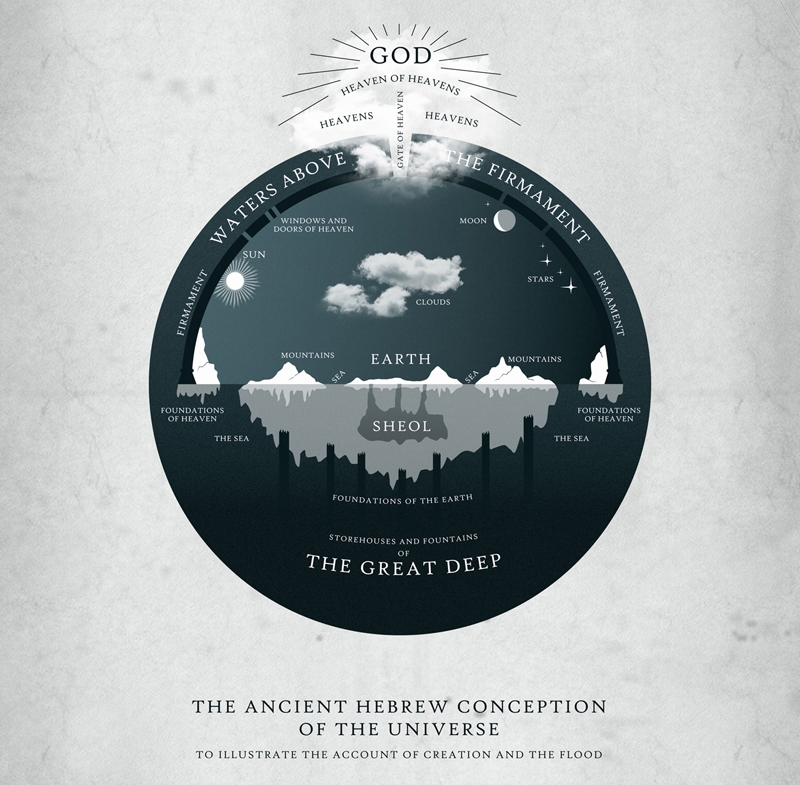
We mostly struggle with the concept of Adam and Eve and ancient things because we think in terms of western cosmology and Platonic logic. We don’t think like the ANE authors of Genesis did. We want to read the Bible like a history or science book and that simply isn’t what the Bible is or how it was intended to be read. The Bible describes the earth as sitting above deep waters with spheres connecting the heavens. Does this make the stories mythology? In most cases God meets people and even allows them to be part of the story. Sometimes that means borrowed words, and ideas become part of the story and we find that God in his mercy goes along with a lot of man’s ways. We want to read the Bible like a textbook, but that doesn’t work. The nature of God and his mission to reclaim what was lost reads a whole lot more like a love story that isn’t overly concerned with painting any other pictures. To get the whole story we have to find our place in the culture. I like the image and words used with it by Skip Moen, “A God who delivers a message of vital importance in words that no one understands is either cruel or ignorant. YHVH is neither. Therefore, our task is to understand the meaning within the original culture. David wrote about a cosmology that he thought described the universe. It was true for his paradigm. It just isn’t true for ours. But then, again, perhaps David wasn’t actually writing science at all. Perhaps we are the ones who have forced the biblical texts into boxes from our paradigms, boxes that were never imaginable in the world of the ancient Middle East.”
Our goal should be to understand the story as it was given to the intended audience and figure out how we are impacted and fit in. What does God desire of you based on the story we are given? As you explore the possibilities, I pray that you will find you are also falling in love with the Word and the Word is Jesus. This is the pre-emanate calling of the New Testament, to grow deeper in intimacy with Jesus and lead others to also embark on that beautiful journey.
May the Lord Bless you and Keep you. -Dr. Will Ryan








 EXPEDITION 44