
A theological–exegetical reflection on the U.S. attack on Iran in light of divine judgment and the cruciform way of Jesus
Introduction: the moral dissonance of sanctified violence
There are moments when the Christian conscience recoils—not from the reality of evil, but from the way in which violence is celebrated as though it were synonymous with righteousness. (Weaponizing Christianity.) When political leaders invoke God to justify military action, and segments of the church respond with eager affirmation, a deep theological dissonance emerges. The instincts of the New Testament—enemy love, cruciform humility, reconciliation—seem to stand in sharp tension with the rhetoric of domination and national triumph.
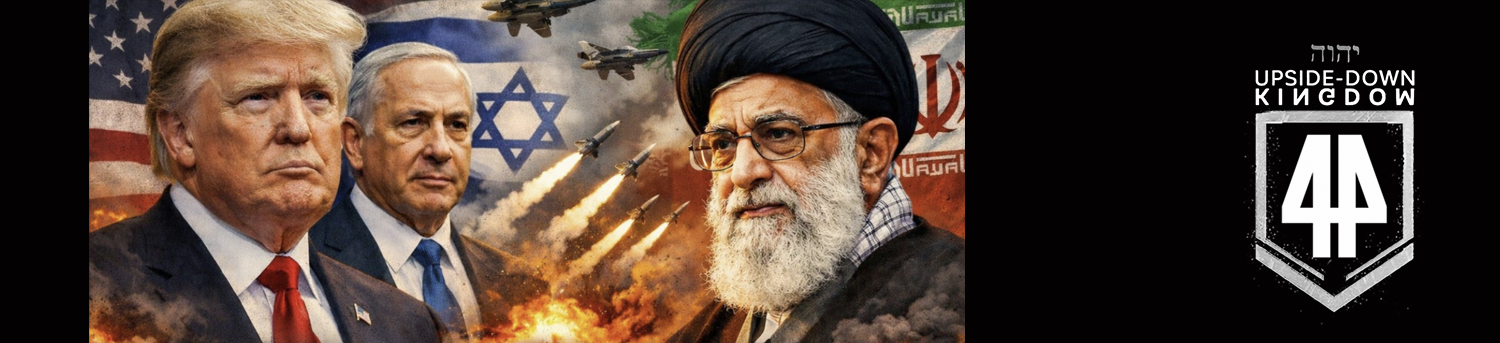
Recent reports of a U.S.–Israel strike on Iran, described as a preemptive response to perceived nuclear threat and followed by rapid escalation and global concern, have once again brought these tensions to the surface.¹–⁵ Some Christian voices have interpreted such actions as necessary measures against profound evil; others have expressed grief, lament, and unease, particularly in light of reports of civilian casualties and the language of totalizing force.
How does the biblical witness—especially when read through the lens of Jesus Christ—shape Christian moral reflection on violence, judgment, and national power? While Scripture clearly affirms that God judges evil, it simultaneously reveals that the kingdom inaugurated by Jesus redefines how God’s people participate in confronting that evil.
Divine judgment and the reality of evil in the Old Testament
The Hebrew Scriptures do not minimize the severity of evil. In fact, they often portray it as systemic, violent, and corrosive to creation itself. The Flood narrative in Genesis 6–9 provides the earliest canonical example. Humanity’s corruption is not framed as private moral failure alone but as a saturation of violence that fills the earth.⁶ The deluge functions as an act of de-creation—waters returning the world to primordial chaos—followed by a re-creation under covenant. Yet the story does not culminate in triumphalist destruction; rather, God binds himself to the preservation of the world despite humanity’s continued inclination toward evil.⁷ Divine judgment is therefore real, but it is restrained by divine mercy.
The destruction of Sodom and Gomorrah (Genesis 18–19) further illustrates this tension. The narrative is framed judicially: God responds to a “cry” of injustice, investigates, and renders judgment.⁸ Abraham’s intercession reveals a profound theological principle—God’s justice is not arbitrary but accountable to the standard of righteousness itself: “Shall not the Judge of all the earth do what is right?” Later prophetic reflection identifies Sodom’s sin not only in sexual immorality but in arrogance, oppression, and neglect of the vulnerable.¹⁰ The text therefore portrays divine judgment as morally responsive and relationally grounded.
Perhaps the most contested passages concern the judgment of the Canaanite nations (Deuteronomy 7; 20; Leviticus 18). These texts must be approached with several exegetical controls. First, the judgment is delayed; Genesis 15:16 indicates that the iniquity of these nations must reach its full measure before action is taken.¹¹ Second, the commands are bound to Israel’s unique covenant vocation and are not offered as a transferable model for other nations. Third, the rationale centers on moral pollution and systemic corruption that threatens covenantal identity.¹² Finally, the prophetic tradition later subjects Israel itself to judgment when it mirrors the very practices it was commanded to resist. The logic of these texts therefore underscores divine justice and impartiality, not nationalistic license.
A necessary counterbalance appears in the story of Nineveh. The Assyrian empire, notorious for violence and oppression, repents at Jonah’s proclamation and is spared divine judgment.¹⁴ The narrative exposes the human desire for retribution and God’s surprising inclination toward mercy. Judgment and compassion remain intertwined throughout the canon.
The Christological re-centering of judgment and power
The decisive interpretive key for Christian theology is the person of Jesus Christ. In him, divine justice and mercy converge in a way that reframes how God’s people engage with the world. Jesus’ teaching consistently rejects retaliation and commands love for enemies.¹⁵ When violence is employed in his defense, he rebukes it, insisting that the kingdom of God does not advance by the sword.¹⁶ Leadership is redefined as servanthood rather than domination.¹⁷
The apostolic witness extends this vision. Believers are instructed not to repay evil with evil but to overcome evil with good, entrusting judgment to God.¹⁸ The apocalyptic vision of Revelation portrays victory not through imperial conquest but through the Lamb who was slain; the faithful participate in this victory through witness and endurance rather than coercion.¹⁹ The New Testament therefore does not deny the reality of judgment but relocates the people of God within a cruciform mode of participation in God’s redemptive purposes.
Theologically, this shift is profound. The people of God are no longer a territorial nation executing covenantal warfare but a transnational body whose identity is rooted in Christ. Their allegiance is not to any single nation but to the kingdom of God, and their political ethic is shaped by the character of Jesus.
Rival nations and the temptation to sacralize power
Throughout history, the church has wrestled with the temptation to align itself uncritically with national power. Political leaders frequently invoke religious language to frame military action as righteous or divinely sanctioned. Such rhetoric can subtly shift Christian allegiance from Christ to nation, transforming the gospel into a tool of civil religion.
The New Testament offers a sober warning. While governing authorities are recognized as part of God’s providential order, they remain subject to moral evaluation and can become beastly when they demand ultimate allegiance or justify violence without accountability.²⁴ The prophetic tradition consistently resists the sacralization of political power, calling rulers to justice while reminding them that they are not God.
To claim divine sanction for national violence without humility, repentance, and moral scrutiny risks assuming a prerogative that belongs to God alone. It is, in a theological sense, an attempt to “play God”—to take into human hands the authority to determine ultimate judgment and righteousness.
Confronting extreme evil: justice, children, and the limits of force
The presence of genuine evil complicates Christian ethics. Few would deny that some regimes or movements perpetrate grave injustice and violence. The question is how such evil is to be confronted in a manner consistent with the character of God as revealed in Christ.
Within Christian tradition, two primary ethical frameworks have emerged. The just war tradition argues that force may be tragically necessary to restrain greater evil, provided strict criteria are met, including proportionality and the protection of noncombatants. The nonviolent or pacifist tradition, represented by voices such as Brian Zahnd, Greg Boyd, and others, contends that the cross reveals a fundamentally different mode of confronting evil—one that refuses to replicate violence even in the pursuit of justice.²⁶,²⁷
Both traditions converge on a crucial point: the lives of civilians, particularly children, are not expendable. They are bearers of the image of God. The loss of innocent life therefore demands lament, repentance, and sober moral reflection. It cannot be dismissed as collateral damage without eroding the theological foundation of human dignity.
When Christians align themselves uncritically with national violence, they risk becoming more shaped by empire than by the kingdom of God. The church must resist the formation of its imagination by the narratives of power and instead be shaped by the story of the crucified and risen Christ.
The cruciform witness of the Church in a violent world
The biblical narrative does not offer simplistic answers to the problem of violence. It affirms that God judges evil and that injustice must be confronted. Yet it also reveals that the definitive expression of God’s power is the cross—a power that absorbs violence rather than perpetuating it.
The vocation of the church, therefore, is not to wield the sword of the state but to bear witness to the kingdom of God. This witness includes speaking truth about injustice, advocating for the vulnerable, resisting idolatrous nationalism, and embodying the love of enemies. It is a witness that refuses to dehumanize even those who commit evil, recognizing that all people remain objects of God’s redemptive desire.
In the face of geopolitical conflict, the central question for Christians is not simply whether a particular action is strategically justified but whether their response reflects the character of Christ. Does it cultivate humility, compassion, and a longing for reconciliation, or does it mirror the pride and hostility of rival nations? Does it affirm the dignity of all persons, or does it reduce them to enemies to be eliminated?
The New Testament’s answer is clear: the people of God are called to a different way. Their ultimate allegiance is to the kingdom of Jesus. Their ethics are shaped by the cross. Their hope rests not in military victory but in the final renewal of all things under Christ’s lordship.
In a world marked by profound evil and suffering, such a witness may appear weak. Yet within the logic of the gospel, this weakness is the very power of God—the power that overcomes evil not by destroying enemies but by transforming them.

Footnotes
- Reuters, “Iranian leader Khamenei killed in strikes, Israel says,” Feb 28, 2026.
- Associated Press, “Russia condemns US-Israel strikes on Iran as ‘unprovoked act of armed aggression’,” Feb 28, 2026.
- The Guardian, “US and Israel strike Iran as Netanyahu says ‘many signs’ Khamenei ‘no longer alive’,” Feb 28, 2026.
- PBS NewsHour, “What to know about the U.S.-Israel attacks on Iran,” Feb 28, 2026.
- Council on Foreign Relations, “Gauging the Impact of Massive U.S.-Israeli Strikes on Iran,” Feb 28, 2026.
- Genesis 6:5–13.
- Genesis 8:21–22; 9:8–17.
- Genesis 18:16–33.
- Genesis 19.
- Ezekiel 16:49–50.
- Genesis 15:13–16.
- Leviticus 18:24–30.
- Deuteronomy 7; 20.
- Jonah 3–4.
- Matthew 5:38–48.
- Matthew 26:52–54.
- Mark 10:42–45.
- Romans 12:17–21.
- Revelation 5:5–10; 12:11.
- Brian Zahnd, A Farewell to Mars (Cascade, 2014).
- Brian Zahnd, Sinners in the Hands of a Loving God (WaterBrook, 2017).
- Greg Boyd, The Myth of a Christian Nation (Zondervan, 2005).
- Steve Gregg, Revelation: Four Views (Thomas Nelson, 2013).
- Oliver O’Donovan, The Desire of the Nations (Cambridge University Press, 1996).
- Stanley Hauerwas, The Peaceable Kingdom (Notre Dame, 1983).
- Glen Stassen and David Gushee, Kingdom Ethics (IVP Academic, 2003).
- John Howard Yoder, The Politics of Jesus (Eerdmans, 1994).
- N. T. Wright, Jesus and the Victory of God (Fortress, 1996).
- Christopher J. H. Wright, Old Testament Ethics for the People of God (IVP, 2004).
- Miroslav Volf, Exclusion and Embrace (Abingdon, 1996).
- Augustine, City of God, trans. Henry Bettenson (Penguin, 2003).
 EXPEDITION 44