
Recent developments within American political life raise serious theological and pastoral concerns, particularly when Christian language and symbols are invoked to legitimize the exercise of state power. When sectors of evangelical and fundamentalist Christianity publicly align themselves with coercive or dehumanizing immigration enforcement practices, such alignment risks distancing Christian witness from the ethic and teachings of Jesus himself (Matt 7:15–20; Luke 4:18–19).
This week, 37-year-old Alex Jeffrey Pretti, an intensive care nurse from Minneapolis, was shot and killed by federal agents during an immigration enforcement operation on January 24, 2026. Pretti was well-known locally as a VA hospital ICU nurse with no serious criminal history. Bystander video analyzed by news outlets appears to show Pretti holding only a phone and not a weapon before being sprayed with a chemical agent, tackled to the ground, and then shot by agents. Footage suggests that one of the agents appears to remove a handgun from the struggle just moments before shots are fired. As many as 10 shots can be heard in the clip that captured the event. Federal officials have said that agents fired in what they described as defensive action after Pretti allegedly approached with a handgun and resisted disarmament; local authorities have confirmed he was a lawful gun owner with a permit to carry. The shooting has sparked protests and intense public scrutiny over the handling of the incident and the actions of federal forces in Minneapolis. The NRA specifically made a statement against the Trump administration.* Perhaps we don’t know all of the story; it is hard to tell if Alex was just being tackled by several government officials or if he was part of the struggle. So far in the footage, we can’t see what was happening up close. But all of this seems excessive and out of line.
Regardless of whether Alex was resistant, as an ardent constitutional 2A supporter and owner of an NRA gun range, this has me considering a revolution. I have taught History at many educational levels. The American Revolution emerged from a growing conviction that British authority had become unjust and tyrannical. Colonists faced taxation without representation, loss of local self-governance, standing armies enforcing civil law, economic restrictions, and denial of due process. Influenced by the Enlightenment and biblical ideas of God-given rights, many concluded (right or wrong) that when government violates its covenant to protect liberty, resistance becomes morally justified. Minnesota is getting dangerously close to the similarities of the Boston Massacre, which occurred on March 5, 1770. Could we be six years away from a Civil War revolution?
I recognize how complex these conversations are. Unlike some voices on my side who completely reject any connection to the MAGA movement, I do not. In fact, I can see certain elements of Christian language and symbolism appearing in our government. Yet, these are often eclipsed by hypocrisy and rhetoric that conflict with biblical teaching. I sometimes smile, but the reflection behind it remains sorrowful.
I don’t watch the news much anymore; I have decided it isn’t good for my desire to be completely kingdom-minded. So, when I get too enthralled with discussions like this, I am thankful that my pastoral senses kick in (likely the Holy Spirit) and I remember the Jesus that I am faithfully in covenant with never called for the faithful to start that sort of a revolution. In fact, the political climate of Jeremiah was likely significantly worse, with sons and daughters taken into slavery by the coming empire, and Jeremiah’s words were strikingly calm,
“Build houses and settle down; plant gardens and eat what they produce. 6 Marry and have sons and daughters; find wives for your sons and give your daughters in marriage, so that they too may have sons and daughters. Increase in number there; do not decrease. Also, seek the peace and prosperity of the city to which I have carried you into exile. Pray to the Lord for it, because if it prospers, you too will prosper.”1
Recently you may have observed that federal recruitment materials have, at times, incorporated Scripture and explicitly religious language. The concern is not merely that biblical texts appear in public discourse, but that such language is deployed by agencies tasked with the use of force. As David Wehner argues, when Immigration and Customs Enforcement frames its mission in theological terms, it implicitly communicates that its actions carry divine sanction. In one regard, isn’t this good? Is the government finally trying to align with the path of the scripture?
One of several example of this can be found in the September 2025, (a now-renamed) U.S. Department of War social media account that posted a video showing military personnel with overlaid Bible text:
“Be strong and of good courage. Do not be afraid, nor dismayed. For the Lord your God is with you, wherever you go.” — Joshua 1:9
In the 1920s and 1930s, elements within the German Evangelical Church aligned themselves with nationalist ideology through the Deutsche Christen (“German Christians”) movement. Christian theology was reshaped to support political aims, including the construction of a “heroic” and racially reimagined Jesus, detached from his Jewish identity and biblical context (Heschel, The Aryan Jesus). While contemporary America is not equivalent to Germany under National Socialism, Dietrich Bonhoeffer’s warning remains instructive: when the church confuses loyalty to Christ with loyalty to political power, it ceases to function as the church at all (Ethics; Letters and Papers from Prison).
From a discipleship perspective, the central question is not partisan but Christological: What does faithfulness to Jesus require when power is exercised in ways that harm the vulnerable? The New Testament consistently places the treatment of the stranger, the poor, and the powerless at the center of faithful obedience (Matt 25:31–46; Lev 19:33–34; Heb 13:2).
The Gospels portray Jesus as resisting coercive power, refusing to dehumanize opponents, and explicitly rejecting the use of divine authority to justify domination (Luke 22:25–27; John 18:36). Any policy or practice that undermines human dignity must therefore be assessed not merely by its legality, but by its conformity to the character of Christ (Hauerwas, The Peaceable Kingdom).
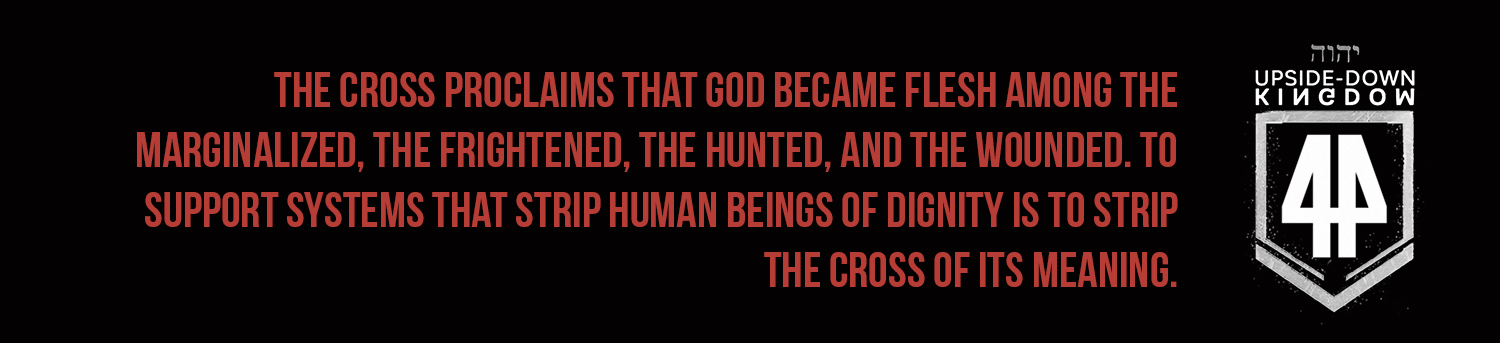
At the center of Christian confession stands the claim that God became flesh among the marginalized, the displaced, and the suffering (John 1:14; Luke 2:7). Faithfulness to Christ calls the church not to baptize power, but to bear witness to a kingdom that restores dignity, practices mercy, and speaks truth—even when doing so is costly.
I believe our government has drifted far from the ethics of Jesus. The way power is being exercised in the name of immigration enforcement (as well as other ideals) is not consistent with the character of Christ.
It is not Christlike to use children as instruments of coercion or entrapment. It is not Christlike to publicly humiliate an elderly citizen—forcing him out into freezing conditions in his underwear. It is not Christlike to fire on unarmed protesters at close range. It is not Christlike to detain human beings in degrading, inhumane conditions. It is not Christlike to tear gas a family’s vehicle and send three children, including an infant, to the hospital. And it is not Christlike to terrorize immigrant communities, communities of color, or anyone else, for that matter.2
Make no mistake, America is not a “Christian nation” nor was that ever the intent. Yet the way many Christians behave in public life today resembles something far closer to a distorted form of Christianity than to the faith of Jesus. In many cases, authoritarian power is being legitimized by a misuse of Christian language and symbols.
When Christianity is weaponized for political control, it becomes something other than the gospel. When the name of Jesus is invoked to justify fear, exclusion, or violence, the message of the cross is compromised. And when Christians remain silent—or worse, defend policies that dehumanize and brutalize others—we betray the very gospel we claim to uphold. If you didn’t catch the satire, don’t worry—I’m not starting or joining any militant revolution, no matter how messed up things seem. The only revolution in my future is sharing the joy and peace of following Jesus—you could definitely call that a revolution!
Bibliography
- Bellah, Robert N. “Civil Religion in America.” Daedalus 96, no. 1 (1967): 1–21.
- Bonhoeffer, Dietrich. Ethics. Minneapolis: Fortress Press, 2005.
- Bonhoeffer, Dietrich. Letters and Papers from Prison. New York: Touchstone, 1997.
- Hauerwas, Stanley. The Peaceable Kingdom. Notre Dame: University of Notre Dame Press, 1983.
- Heschel, Susannah. The Aryan Jesus: Christian Theologians and the Bible in Nazi Germany. Princeton: Princeton University Press, 2008.
- The Bible, New Revised Standard Version.
- Wehner, David. “The MAGA Jesus.” The Atlantic.
NOTES:
*https://www.bbc.com/news/articles/cnvg812n01no
The title of this article is a bit tongue and cheek; I do not believe the War Scroll was aligned with the view of Jesus in any way. I hope you are able to pick up on the hyperbole. The War Scroll, found among the Dead Sea Scrolls at Qumran, is a detailed eschatological text attributed to the Essenes, a Jewish sect living in the area during the Second Temple period. It describes a final, cosmic battle between the “Sons of Light” (the righteous community) and the “Sons of Darkness” (their enemies, including the forces of evil and oppressive nations). The scroll outlines military organization, strategy, and rituals, presenting the war as part of God’s ultimate plan to purify Israel and establish divine rule. Scholars view it as reflecting the Essenes’ apocalyptic worldview and their belief in an imminent, divinely guided victory over evil.

 EXPEDITION 44