
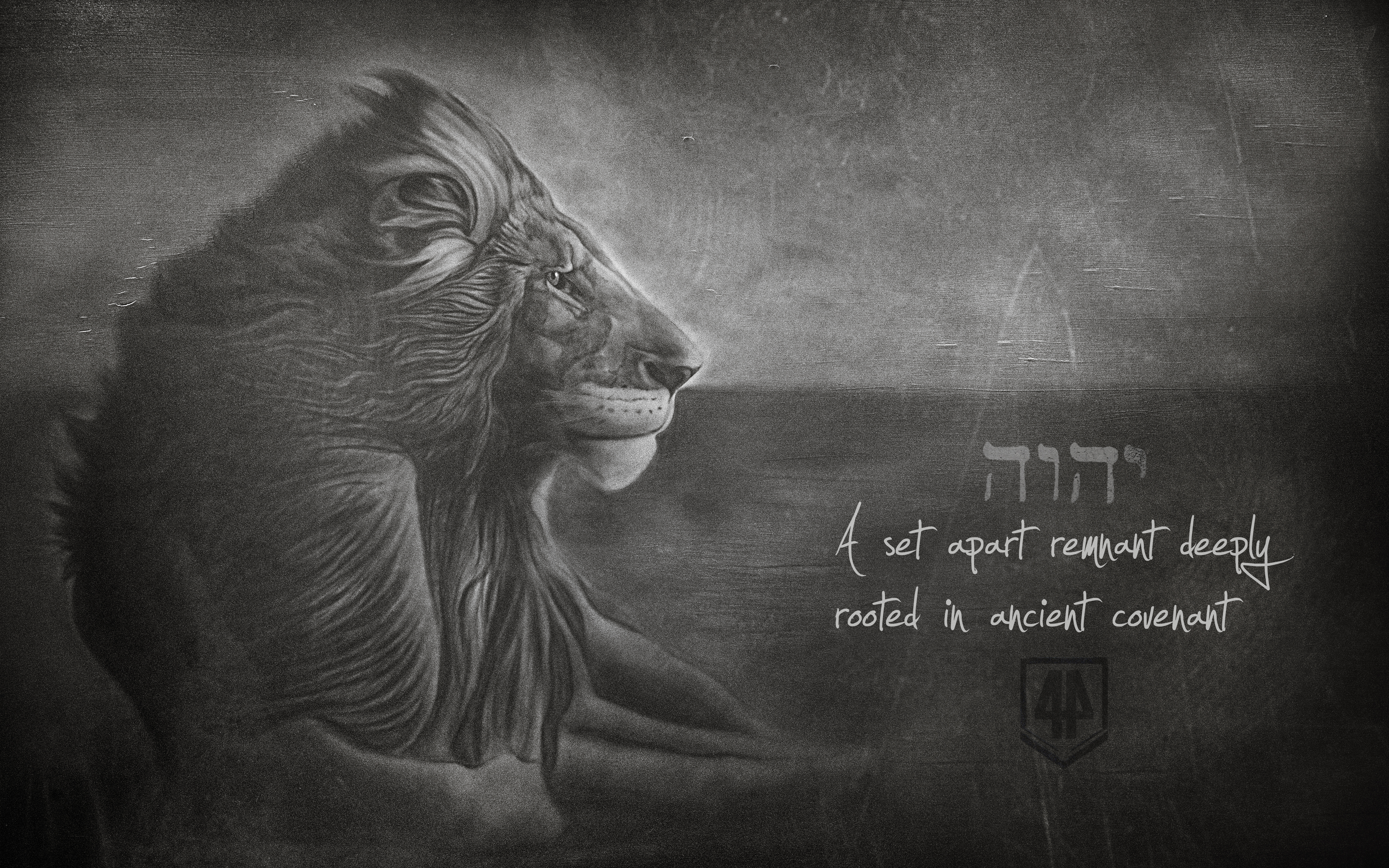
I have this large print rendering on the wall of our home. Many ask about it and I am usually pretty quiet and generic in my response to people. There is something about the name of God that seems unutterable. I kind of feel like saying, “If you have to ask me, then you are not going to understand.”
The best name for referring to God is יהוה (YHWH). This is called “THE” Tetragrammaton and comes from the Greek tetra, meaning “four,” and gramma, which means “letters.” It refers to the four consonants Yod, He, Vav and He (written from right to left in the Hebrew), used to designate God’s name in the Old Testament’s original manuscripts. They represent the English letters (from left to right) of YHWH (or YHVH). The Tetragrammaton is commonly translated as Lord, God or Jehovah in modern Bibles. Most translations, such as the KJV, NIV, NASB, HBFV and others, capitalize these words (e.g. LORD) when the underlying Hebrew referencing God is (usually) the Tetragrammaton. YHWH (or YHVH) is the most common proper name of the one true God found in Scripture. The Tetragrammaton occurs 5,410 times in the Old Testament manuscripts according to the 1906 Jewish Encyclopedia. The encyclopedia also states it is found the most in the Psalms (645) followed by the book of Jeremiah (555).1
The Bible actually only calls God by 7 different names, the rest of the “names” often attributed are actually descriptions of God, which I will admit, could also be construed as a “name” since God is in essence the definition of these attributes. Most of our research will land in the Old Testament, but I will finish with the New. Here is a better understanding to the names of God.
Tetragrammaton
YHWH is called the Tetragrammaton which is the four-letter Hebrew-language theonym יהוה (transliterated as YHWH or YHVH). This is the best and most used name for God in the scripture, some would argue that is really the only “real” name. Contrary to what some believe, Jehovah is not the Divine Name revealed to Israel. The name Jehovah is a product of mixing different words and different alphabets of different languages. Due to a fear of accidentally taking God’s name in vain (Leviticus 24:16), the Jews basically quit saying it out loud altogether. Instead, when reading Scripture aloud, the Jews substituted the tetragrammaton YHWH with the word Adonai (“Lord”). Even in the Septuagint (the Greek translation of the Old Testament), the translators substituted Kurios (“Lord”) for the Divine Name. Eventually, the vowels from Adonai (“Lord”) or Elohim (“God”) found their way in between the consonants of YHWH, thus forming YaHWeH. But this interpolation of vowels does not mean that was how God’s name was originally pronounced. In fact, we aren’t entirely sure if YHWH should have two syllables or three.2
The four Hebrew letters, written and read from right to left, are yod, he, vav, and he. The name is derived from a verb that means ‘to be’, ‘to exist’, ‘to cause to become’, or ‘to come to pass’.3 This is based off of many scriptures such as when Moses asks for God’s name at the burning bush, God answers ‘I AM WHO I AM.’ He then tells Moses that when the Israelites ask the name of the God of their ancestors, Moses should tell them ‘I AM’ has sent you (Exodus 3:14). In Hebrew the word is Ehyeh, the Hebrew word Yahweh is a derivative of Ehyeh and means “he will be.” The name Yahweh is used over six thousand times in the Old Testament and is so closely identified with the essence of God’s nature that, out of reverence, many orthodox Jewish people refuse to say the name out loud. Instead, they say HaShem—which means “the name,” or Adonai, which means “Lord.” Modern translations of the Bible print LORD, in all capital letters, to denote the use of the Hebrew word YHWH throughout scripture.4 Owing to the expansion of chumra, the idea of ‘building a fence around the Torah’, the word Adonai itself has come to be too holy to say for Orthodox Jews outside of prayer, leading to its replacement by HaShem (‘The Name’). In modernity, Christianity is the only Abrahamic religion in which the Tetragrammaton is freely and openly pronounced. As other traditions might view this openness as irreverent, Christians believe that God has offered a personal relationship to which bearing His image and claiming His name has been offered to them. The books of the Torah and the rest of the Hebrew Bible except Esther, Ecclesiastes, and (with a possible instance of יה (Jah) in verse 8:6) the Song of Songs contain this Hebrew name.5
7 NAMES OF GOD
The Jewish sages would say that there are 7 names of God that, once written, cannot be erased because of their holiness6 are the Tetragrammaton (YHWH), Adonai, El, Elohim, Shaddai, Tzevaot; some also include I Am that I Am, from which “YHWH” is believed to be derived.7 As mentioned previously, all other names, such as “Merciful”, “Gracious” and “Faithful”, merely represent attributes that are also common to human beings.8
- יהוה (YHWH) – The Tetragrammaton appears in Genesis and occurs 6,828 times in total in the Biblia Hebraica Stuttgartensia edition of the Masoretic Text. It is thought to be an archaic third-person singular of the imperfective aspect of the verb “to be” (i.e., “[He] is/was/will be”). This agrees with the passage in Exodus where God names himself as “I Will Be What I Will Be” using the first-person singular imperfective aspect, open to interpretation as present tense (“I am what I am”), future (“I shall be what I shall be”), or imperfect (“I used to be what I used to be”).9
- אֲדֹנָי (Adonai transl. my Lord[s]) -As with Elohim, Adonai’s grammatical form is usually explained as a form akin to the “royal we”. In the Hebrew Bible, the word is nearly always used to refer to God (approximately 450 occurrences). The Deuteronomy 32 Worldview is largely based around a plural understanding of El and Adonai.
- אֵל (El transl. God) – El appears in Ugaritic, Phoenician and other late Bronze and Iron Age Levant texts both as generic “god” and as the head of the divine pantheon.10 In the Hebrew Bible, El (אל, ʾel) appears very occasionally alone (e.g. Genesis 33:20, el elohei yisrael, ‘Mighty God of Israel’, and Genesis 46:3, ha’el elohei abika, ‘El the God of thy father’), but usually with some epithet or attribute attached (e.g. El Elyon, ‘Most High El’, El Shaddai, El Shaddai, El ʿOlām ‘Everlasting El’, El Hai, ‘Living El’, El Ro’i ‘El my Shepherd’, and El Gibbor ‘El of Strength’). In can also be seen in theophoric names such as Gabriel (“Strength of God”), Michael (“Who is like God?”), Raphael (“God healed”), Ariel (“My lion is God”), Daniel (“My judgment is God”), Ezekiel (“God shall strengthen”), Israel (“one who has struggled with God”), Immanuel (“God is with us”), and Ishmael (“God hears/ will hear / listens/ will listen”).
- אֱלֹהִים (Elohim transl. Gods/Godhead) – A common name of God in the Hebrew Bible is Elohim (אלהים, ʾĕlōhīm), the plural of אֱלוֹהַּ (Eloha). When Elohim refers to God in the Hebrew Bible, singular verbs are used. The word is identical to elohim meaning gods and is cognate to the ‘lhm found in Ugaritic, where it is used for the pantheon of Canaanite gods, the children of El and conventionally vocalized as “Elohim” although the original Ugaritic vowels are unknown. When the Hebrew Bible uses elohim not in reference to God, it is plural (for example, Exodus 20:2). There are a few other such uses in Hebrew, for example Behemoth. In Modern Hebrew, the singular word ba’alim (‘owner’) looks plural, but likewise takes a singular verb. Therefore scholars would consider “elohim” as the most generic term for God and can mean other gods. There is a view to which Elohim is translated as the plural construct ‘powers’; Hebrew grammar allows for this form to mean “He is the Power (singular) over powers (plural)”, such as LORD MOST HIGH.
- שַׁדַּי (Shaddai transl. Almighty) – El Shaddai is conventionally translated as “God Almighty”. While the translation of El as ‘god’ in Ugaritic/Canaanite languages is straightforward, the literal meaning of Shaddai is the subject of debate.
- צְבָאוֹת (Tzevaoth transl. [Lord of] Hosts) – Tzevaot, Tzevaoth, Tsebaoth or Sabaoth (צבאות, ṣəḇāʾōṯ, lit. “Armies”), usually translated “Hosts”, appears in reference to armies or armed hosts of men but is not used as a divine epithet in the Torah, Joshua, or Judges. Starting in the Books of Samuel, the term “Lord of Hosts” appears hundreds of times throughout the Prophetic books, in Psalms, and in Chronicles. Tertullian and other Fathers of the Church used it with the meaning of “Army of angels of God”.11
- I Am that I Am – already explained above
OTHER NAMES FOR GOD
Early authorities considered other Hebrew names mere epithets or descriptions of God, many Orthodox Jews have adopted the chumras of writing “G-d” instead of “God”.
You also might be surprised to learn that Baal meant ‘owner’ and, by extension, ‘lord’, ‘master’, and ‘husband’ in Hebrew and the other Northwest Semitic languages.12 In some early contexts and theophoric names, it and Baali (“My Lord”) were treated as synonyms of Adon and Adonai.13
There are other “names” used for God, but all of them are a bit more arguable. Elim and Elah are often Hebrew/Aramaic words for God. Elah is used to describe both pagan gods and the Abrahamic God and therefore is often considered the Aramic version of the Hebrew Elohim. El Roi is a “name” found in Genesis, when Hagar uses this name for the God who spoke to her through His Angel. In Hebrew, her phrase El Roi, is literally, ‘God of Seeing Me’. But as I have made the point previously, it really isn’t another proper name for God but a description of God that might perhaps be entitled as a name. In the ancient world an original name was given (sometimes later than the original name) according to what you were known for. That is also true when considering the name changes given by God to others in the Bible. Therefore, there is an argument for the many other “names” of God being defined as original attributes… such as God isn’t just described as being Holy, He actually is Holy; He has defined the attribute.
In a Deuteronomy 32 worldview (Divine Council) there is another name worth mentioning. The name Elyon (עליון) occurs in combination with El, YHWH, Elohim and alone. It appears chiefly in poetic and later Biblical passages. The modern Hebrew adjective ‘Elyon means ‘supreme’ (as in “Supreme Court”: Hebrew: בית המשפט העליון) or ‘Most High’. El Elyon has been traditionally translated into English as ‘God Most High’. 14 But again, the name is really just “El” attached to an adjective, but does the original adjective then become Him?
Shekhinah (שכינה) is the presence or manifestation of God which has descended to “dwell” among humanity. The term never appears in the Hebrew Bible; later rabbis used the word when speaking of God dwelling either in the Tabernacle or amongst the people of Israel. The root of the word means “dwelling”. Of the principal names of God, it is the only one that is of the feminine gender in Hebrew grammar. The term, however, may not be a name, as it may merely describe the presence of God, and not God Himself.15 I mention this because some wonder about the femininity of God. You might consider reading this post if you are interested in those that hold views this way. However, to get back to the name shekinah, in the New Testament after Jesus ascends to the throne and sends His spirit to indwell every believe we are now the manifestation physically of that Spirit. God in us. The phrase “God with us” is often associated with the Hebrew name “Immanuel” (sometimes spelled “Emmanuel”), which directly translates to “God with us.” This phrase appears prophetically in the Old Testament and is quoted in the New Testament to reveal a profound truth about the identity of Jesus. It proclaims that the Messiah is not merely a human representative but the very presence of God dwelling among humanity.16 In similar ontological idea, at Pentecost God now dwells in His people.
NEW TESTAMANT NAMES OF GOD
While the Old Testament has a wide variety of names and epithets that refer to God in Hebrew, the Greek text of the New Testament uses far fewer variants.17 In the New Testament God’s names are written as Theos (θεός the Greek term for God), Kyrios (i.e. Lord in Greek) and Patēr (πατήρ i.e. Father in Greek). The Aramaic word “Abba” (אבא), meaning “Father” is used by Jesus in Mark 14:36 and also appears in Romans 8:15 and Galatians 4:6. Paul refers to “the Father of mercies” in his Second Letter to the Corinthians,[and James refers to “the Father of lights” in his epistle.
The names of the Father, Son and the Holy Spirit are inherently related in the New Testament, e.g. with Jesus’ instruction to His disciples at the end of the Gospel of Matthew (28:19): “make disciples of all the nations, baptizing them into the name of the Father and of the Son and of the Holy Spirit”.
The Greek word pneuma, generally translated spirit, is found around 385 times in the New Testament. The “Spirit of Truth” is used in John 14:17, 15:26 and 16:13. The First Epistle of John then contrasts this with the “spirit of error” in 1 John 4:6. Although most of the evangelical word believes in the Trinity to be “God Himself”, much of the orthodox world does not view “GOD” this way. They would view God and Jesus and the ability for either of them to “send” their spirit, but not necessarily as a separate entity or person. There is a consistent argument for both the New and Old Testaments to interpret the spirit in this sense. Some would then call it a matter of semantics, but to be clear this does divide those that call themselves trinitarians and those that don’t. Here is a Biblically conservative post that dives into this conversation.
CONCLUSIVE THOUGHTS
Although in some modern culture’s names are simply labels and designators that distinguish one item from another, in Christian theology the names of God have always had much deeper meaning and significance.18 In the religious sense, the names of God are not human inventions, but have divine origin and are based on divine revelation. Berkhof states that the issue surrounding the use and interpretation of the names of God provide a theological puzzle in that given that God is “infinite and incomprehensible”, His names transcend human thought, yet they allow Him to be revealed to humans as he descends to what is finite and comprehensible. 19 The name(s) of God have always been revered in the Christian tradition and has been associated with His presence. We often say, there is power in the name and we truly believe that. All the power and all the authority that Jesus had is invested in His Name and given through His Spirit to manifest in them. Jesus said we could use His Name in prayer. He said we could use His Name in dealing with demons. He said we could use His Name in ministering healing.
Kenyon wrote: The measure of His ability [the measure of the ability of the Lord Jesus Christ] is the measure of the value of that Name, and all that is invested in that Name belongs to us, for Jesus gave us the unqualified use of His Name.20
CLICK HERE TO DOWNLOAD A SMALL GROUP STUDY GUIDE

- https://www.biblestudy.org/beginner/definition-of-christian-terms/tetragrammaton.html ↩︎
- https://www.gotquestions.org/YHWH-tetragrammaton.html ↩︎
- Kitz, Anne Marie (2019). “The Verb *yahway”. Journal of Biblical Literature. 138 (1): 39–62. ↩︎
- https://www.biblestudytools.com/bible-study/topical-studies/what-meaning-gods-name-i-am.html ↩︎
- Geoffrey William Bromiley; Erwin Fahlbusch; Jan Milic Lochman; John Mbiti; Jaroslav Pelikan; Lukas Vischer, eds. (2008). “Yahweh”. The Encyclopedia of Christianity. Vol. 5. Translated by Geoffrey William Bromiley. Wm. B. Eerdmans Publishing ; Brill. pp. 823–824. ISBN 978-90-04-14596-2. ↩︎
- “If an error is made in writing it, it may not be erased, but a line must be drawn round it to show that it is canceled…” Archived 2011-11-14 at the Wayback Machine, “Names of God”, 1906 Jewish Encyclopedia ↩︎
- Online Etymology Dictionary. . ↩︎
- “Names Of God”. JewishEncyclopedia.com. ↩︎
- “Biblical Hebrew Grammar for Beginners” Archived 2015-03-19 at the Wayback Machine, University of Texas at Austin ↩︎
- Toorn, Karel van der; Becking, Bob (1999), K. van der Toorn, Bob Becking, Pieter Willem van der Horst, Dictionary of deities and demons in the Bible, pp. 274-277, Wm. B. Eerdmans, ISBN 978-0-8028-2491-2 ↩︎
- Georges, O. Badellini, F. Calonghi, Dizionario latino–italiano [Latin-to-Italian Dictionary], Rosenberg & Sellier, Turin, 17th edition, 1989, page 2431 of 2959 ↩︎
- Pope, Marvin H. (2006), “Baal Worship”, Encyclopaedia Judaica, 2nd ed., vol. III, New York: Thomas Gale, ISBN 978-0-02-865928-2 ↩︎
- Britannica Encyclopedia of World Religions, New York: Encyclopædia Britannica, 2006, ISBN 978-1-59339-491-2 ↩︎
- https://drmsh.com/TheNakedBible/HeiserReplyToStarkMostHeiser.pdf ↩︎
- https://www.myjewishlearning.com/article/the-divine-feminine-in-kabbalah-an-example-of-jewish-renewal/ ↩︎
- https://biblehub.com/q/what_does_’god_with_us’_mean_for_jesus.htm ↩︎
- All the Divine Names and Titles in the Bible by Herbert Lockyer (Sep 29, 1988) ISBN 0310280419 page 93 ↩︎
- Mercer dictionary of the Bible by Watson E. Mills, Roger Aubrey Bullard 1998 ISBN 0-86554-373-9 page 336 ↩︎
- Systematic Theology by Louis Berkhof (Sep 24, 1996) ISBN 0802838200 pages47-51 (yes, I am actually referencing a systematic theology book OUCH! ↩︎
- https://www.hopefaithprayer.com/salvationnew/what-we-are-in-christ-kenyon/ ↩︎
 EXPEDITION 44