
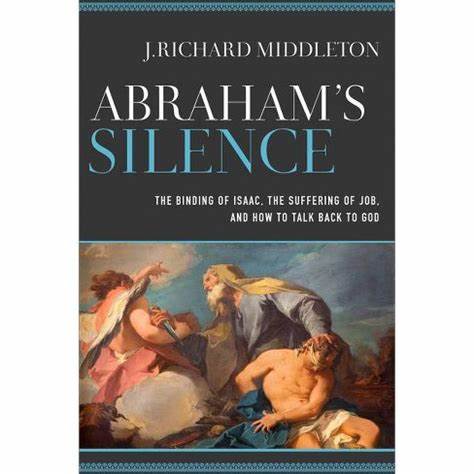
One of the most difficult stories in the Bible to understand is in Genesis 22 when God asks Abraham to sacrifice Isaac. There is a lot going on here and we can’t address everything, but we are going to open the door for you. We are going to get out of our normal scholarly position in terms of citation and border on the dangerous waters of plagiarism in this article; (ok, not really, but as a couple of Th.D.’s we always prefer to give credit where do) -we strongly feel that this needs to be communicated as part of our ministry and the Kingdom. Too many people have dug theological and religious ditches over this text. Abraham’s Silence by J. Richard Middleton is a great read and Middleton is one of our all-time favorites. We diverge just slightly from his view (mostly in regard to his take on Hebrews and James and NT interpretations of this text) but can’t praise this amazing work enough, one of our favorite reads in years.
Introduction
Let’s start with, And He said, “Take your son, your favored one, Isaac, whom you love, and go to the land of Moriah, and offer him there” Genesis 22:2
We always need to read in context and it is important to read chapters 12-22 as a unit signifying grace, obedience, and trust tied to the character of God. Some call this the bookends of faith. In Hebrew the words translated as go forth are lech lekha and have turned into an idiom of covenant relationship returning to Edenic principle. God asks Abraham to cut ties with His past and put everything on Him. This is a picture or snapshot of what God later asks His entire nation to do and still asks us to do in Him today. Abraham serves as the archetype of this calling and faith. He asks us to die to ourselves, cut the ties of old and be remade completely sanctified in and through Jesus. This story is the story of the person who the Bible defines as having the most faith. Perhaps God is asking him to do something in crazy faith and that might be warranted as a picture of the one with the most faith of anyone in History. That is the traditional take on this, but perhaps there is even more to it. Yes, it’s difficult to leave everything – to cut loose from all those ties that brought us into the world and that give us our identity, safety, and community. But if we are to follow Him, the ties must be cut. Lech lekha is an idiom in of itself that signifies cutting a new covenant with the Lord and it is personal! Perhaps what God is asking has more to do with his character and desire to intimately tabernacle with us than anything else.

This is the story of the binding/offering of Isaac in Genesis 22. In Hebrew they call this the The Binding of Isaac (Hebrew: עֲקֵידַת יִצְחַק ʿAqēḏaṯ Yīṣḥaq), or simply “The Binding” (הָעֲקֵידָה hāʿAqēḏā). In the biblical narrative, God orders Abraham to sacrifice his son Isaac at Moriah. As Abraham begins to comply, having bound Isaac to an altar, he is stopped by the Angel of the Lord; a ram appears and is slaughtered in Isaac’s stead, as God seemingly commends Abraham’s pious obedience to offer his son as a human sacrifice. The traditional interpretation is that Abraham passed the test because he didn’t withhold his son when God asked him to sacrifice him, but what if that was not the answer to the test?
There are various views on this subject, some are more traditional, some are not. Here are a few:
In The Binding of Isaac, Religious Murders & Kabbalah, Lippman Bodoff argues that Abraham never intended to actually sacrifice his son, and that he had faith that God had no intention that he do so. Rabbi Ari Kahn elaborates this view on the Orthodox Union website as follows:
Isaac’s death was never a possibility – not as far as Abraham was concerned, and not as far as God was concerned. God’s commandment to Abraham was very specific, and Abraham understood it very precisely: Isaac was to be “raised up as an offering,” and God would use the opportunity to teach humankind, once and for all, that human sacrifice, child sacrifice, is not acceptable. This is precisely how the sages of the Talmud (Taanit 4a) understood the Akedah. Citing the Prophet Jeremiah’s exhortation against child sacrifice (Chapter 19), they state unequivocally that such behavior “never crossed God’s mind,” referring specifically to the sacrificial slaughter of Isaac. Though readers of this parashah throughout the generations have been disturbed, even horrified, by the Akedah, there was no miscommunication between God and Abraham. The thought of actually killing Isaac never crossed their minds. [1]
Maimonides takes a very modern progressive or philosophical stance:
In The Guide for the Perplexed, Maimonides argues that the story of the binding of Isaac contains two “great notions”. First, Abraham’s willingness to sacrifice Isaac demonstrates the limit of humanity’s capability to both love and fear God. Second, because Abraham acted on a prophetic vision of what God had asked him to do, the story exemplifies how prophetic revelation has the same truth value as philosophical argument and thus carries equal certainty, notwithstanding the fact that it comes in a dream or vision. [2]
Progressive religious views such as this are often criticized as being less exegetical and based on your own human intellect; psychology in some cases is seen as trumping “ancient” perspectives that didn’t know better. We are weary of most of these views, but also want to best present what people are considering over this text.
There are also several traditional Jewish sources such as the book of Jubilees, a non-canonical book written in ancient Israel around 180 BCE, which credits Satan with the suggestion to Abraham to bind and sacrifice His son. Borrowing from the biblical book of Job, Jubilees rewrites the story of the binding of Isaac by inserting Satan into the tale, having him approach God (perhaps in a divine council style meeting) and raise the question of how faithful Abraham would be if God demanded that Abraham sacrifice his and Sarah’s only child.
There are also some non-traditional views to consider (much of which we do not usually align with), they might attribute Abraham’s decisions to possibly mental illness or perhaps becoming senile in old age. Some even go down the road as “crazy devotion” meaning that in Abraham’s mind he took what God was asking of him possibly too far. This also gets into conversations of both Abraham and Moses wondering if they left their wives in a similar form of reasoning; literally or figuratively “divorcing” them to be fully devoted to the Lord. These are extreme views but could be considered. Along these lines you also should be open to the idea that perhaps Abraham was not discerning the voice of God well. In this article we will consider Sarah being the one to possibly discern the voice and sight of the Lord “better” than Abraham. Did Abraham not discern the character of God and act on his own outside of God’s will? Did God have to intervene? Did that bring Sarah to separation from Abraham or possibly even death? Was Abraham obeying God like the pagans obeyed their gods? Perhaps the sacrifice was not God’s intention, but what Abraham thought. The Hebrew Grammar could support this view. When Abraham left, he seemed unsettled. This sounds like chaos not God’s order, it doesn’t embody the peace that the Lord usually instills. Much of the story would reiterate this idea, leaving before Sarah woke, cut wood, saddled the likely impatient donkeys, he was in a hurry.
As we believe these views and observations are at least to some degree valid and deserve consideration, we believe there is also a lot more going on than any one of these views.
I will summarize Dr. Stu Halpern’s synopsis saying, that readers, both ancient and modern, have struggled with how to justify such an awful sacrifice of Abraham, regardless of your theology, everyone has had to wrestle with the legacy, and lessons, of the heart-rendering near-slaughter of Isaac. Recent works like Rutgers professor James Goodman’s “But Where is the Lamb? Imagining the Story of Abraham and Isaac,” and Harvard professor Jon Levenson’s “Inheriting Abraham: The Legacy of the Patriarch in Judaism, Christianity, and Islam,” have offered surveys of the tale’s interpretation over millennia (including modern examples from Bob Dylan, Elie Wiesel, and the Israeli writer A. B. Yehoshua) and emphasizing the ways that the opacity of the 19 biblical verses have allowed for wildly divergent understandings.
Expedition 44 wants you to consider better theological views and grow deeper and more intimate through your theology with God the Father. We invite you to dive into “the journey” with us.
The point
As John Walton often says, this story wasn’t written to us, but it is for us. What can we learn and take away? God wants us to wrestle with him (lament) in trials so that he can teach us His character. He doesn’t want just blind obedience but wants us to work through the hard things to know the deeper things of Him and His character. Deep intimate relationships often are forged in fire; thus, iron sharpens iron resulting in relationships that are much stronger. We encourage followers to dive deeper into a “Mars Hill” style of learning, that is largely what expedition 44 is embodied by and unto.
Our contention through study is that God wanted Abraham to contend/intercede for his son and learn that God is merciful. Later in the Biblical story we see God commissioning Moses to teach Israel about His character and His ways saying:
Then the Lord passed by in front of him and proclaimed, “The Lord, the Lord God, compassionate and gracious, slow to anger, and abounding in lovingkindness and truth; who keeps lovingkindness for thousands, who forgives iniquity, transgression and sin (Exodus 34:6-7a)
And he wanted the same thing of Abraham earlier in the narrative:
“For I have chosen him [Abraham], so that he may teach his children and his household after him to walk the way of the Lord by doing righteousness and justice [God’s character], so that the Lord may bring upon Abraham what He has spoken about him.” (Gen 18:19)
Now we believe that Abraham is the archetype of faith as he did believe God and was credited as righteous, but it seems that Abraham did not really know the character of God, and this affected the way he lived. He seemed to think God was like the false gods he worshipped in Ur (Babylon). He had mere fidelity and not a transformational understanding of God’s character…I know this is a bold statement but hear us out… (God can still work with and is pleased by mere fidelity but it is not where he wants to leave us). Often in the early Old Testament narratives we are reading what people thought of the gods and how they might be “appeased”. We believe in a Deuteronomy 32 worldview sense that these gods were fallen spiritual beings and often imitated God (as in the exodus story) and likely even tormented the people. So, this story of Abraham echoes the voice of Abraham trying to understand who God was. We still even use the phrase “God is for me not against me” which takes us back to these days where God’s people were trying to figure out why the “LORD OF LORDS” would want to have a personal relationship with them. Why would a God want to tabernacle or walk in intimacy with mere mortals? In many ways this is a reintroduction to God’s invitation for humanity to walk with Him as a recursive narrative throughout the Bible. God shows his continued covenant faithfulness despite humankind failing over and over. Perhaps this story of archetype faith could be more about failure than faith; showing us that perhaps it is failure that creates faith.
The backstory in context Genesis 12-22
- Genesis 12 Abram is called out of Ur and God makes a covenant with Him
- Genesis 15 Abram is promised a son
- Genesis 16 Abram takes things into his own hands- sleeps with Hagar and conceives Ishmael
- Genesis 17 Their names are changed to Abraham and Sarah and the covenant of circumcision is established.
Sodom and Gomorrah
Genesis 18 has an interesting exchange between Abraham and God where God reveals to Abraham that the outcry of Sodom has risen to Him and he was going down to check it out. Now in the text it never says that the Lord was intent on destroying it. Abraham over-interprets this when he starts bargaining with God assuming that this is what God is going to do anyways. (We often assume a lot about the Bible that has been spoon fed and might need to more transparently approach this text and others.)
Abraham does intercede for Sodom asking if God was going to destroy the righteous with the unrighteous and he challenges God despite merely being “dust and ashes” (which is interesting, because Job is the only other one to use this phrase… more on that later).
Contrary to how some have interpreted the text, this is not bartering or haggling. If it was like what we do with buying a house or a used car one would make an offer, and another would raise it and an agreement would come meeting in the middle. God is giving Abraham all that he is asking for each time.
His opening offer is 50 and God says sure. Then 45 and God says fine. Then he says 30 and God says yes. Then he says 20 and God agrees. Then his final offer is 10 and God says ten it is. And then he stops asking. Now the question is what was God trying to teach Abraham in this exchange? That righteousness and justice is infused with mercy. I think If Abraham asked for the town to be spared God would have done it. God was teaching Abraham about his mercy. What if he kept asking?
After this the angels go to Sodom and meet with Lot and tell him to flee to the hills Lot says it is too far and asks if he could go to the next town and asks for it to be spared for his sake and the request is granted (19:18-20). Lot asked for what Abraham did not.
Did Abraham love Isaac?
Next in the narrative we have the birth of Isaac. But right after this we have Sarah getting jealous over Ishmael. Some translations say he was “mocking”, some say he was “playing”, the Hebrew says he was “Isaac-ing”. Rhetorically it points to the fact that he was in the place of Isaac and I think that was likely in Abraham’s eyes too. So Sarah tells Abraham to send away Ishmael and Hagar and he does this.
Back in Genesis 17 God gives the covenant of circumcision and talks about the birth of Isaac through Sarah but immediately Abraham speaks up about Ishmael and asks God not to forget him (17:8), which God agrees to, while reiterating the promise about Isaac (17:19-21). And in Genesis 21 we see Abraham being very distressed about sending away his son. He seems to favor Ishmael.
In God’s test of Abraham in Genesis 22:2, we see Isaac being called Abraham’s “only son that he loves” but is this rhetorical? It can also be translated as “your remaining son” and I think the part of “whom you love” is God asking Abraham if he really loves him. God is once again trying to teach His character to Abraham of love for all image bearing humans and how God is not partial, especially about partiality between children. We’ll see more about this below…
The Aqedah
There is so much we could get into here, but I want to focus just on a few big picture things (read Abraham’s Silence by J. Richard Middleton).
Elohim or Yahweh?
The first thing to notice is that the name Yahweh is not used who is making the “command” or initiating the test. This is the only time that “God” talks to Abraham that the name “Yahweh” is not used, but “elohim” is. (12:1, 7 ; 13:14; 15:1, 4, 7; 17:1; 18:13, 17, 20, 26, 33 all use Yahweh when talking to Abraham). The writer of Jubilees picks up on this and attributes the request to sacrifice Isaac coming from Masteema (The Satan figure in Jubilees) and not Yahweh. The use of elohim here shows us that something interesting is going on and maybe the narrator is giving us a clue that this is not the intended command of Yahweh that displays His character but is a test to see if Abraham thinks God is like the other gods (also translated as elohim [spiritual being- good or evil] in the Bible, which can be singular or plural for may gods [false gods and their character]).
Also, why make a 3 day journey? Why not sacrifice Isaac right where they were? Maybe God wanted to give Abraham time to contemplate the request and discern God’s character along the way.
The Lord will provide, Isaac or The Lord will provide Isaac?
When Isaac asks about the sacrifice Abraham seems to have a Freudian slip when you read it in Hebrew and it could be translated as either “the Lord will provide a sacrifice” or that “Isaac is the sacrifice”.
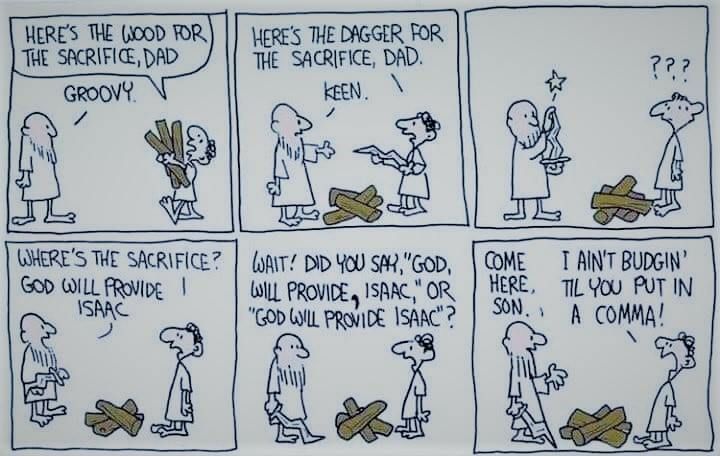
Abraham does have faith that God will fulfill his promise as he tells the servants that he and the boy will return to them but Abraham is missing the point of the test.
The Angel’s response
The angel who interrupts Abraham’s sacrifice gives 2 speeches and the first one is about how he knows that Abraham “fears” the Lord. This word for fear is a contranymn and can have the meaning of respect but I think in the context it is more that Abraham is afraid of God. This was evidenced in not wanting to make God angry when he was bargaining for Sodom in chapter 18. Abraham may have an unhealthy fear of God, seeing Him like the gods of Ur, and this is keeping him from knowing God’s true character.
The second response is that Abraham did not withhold his son, his only (remaining) son. Notice that “whom you love” is not mentioned here as it was earlier with the same phrase. It seems that Abraham possibly did not love Isaac and this may prove it.
The next thing to notice is that God will still keep his promise because Abraham was obedient. He passed a test but not the right test in my opinion. This part of Abraham’s obedience is what Paul in Romans 4, the author of Hebrews, and James describe as the mere faith of Abraham… But God wants us to lament and talk to him and learn his character.
What if when God asked Abraham to sacrifice Isaac Abraham responded: “I know your character God and you are not like the elohim of the nations who demand child sacrifice, you are a gracious and compassionate God who is full of mercy. So I plead with you not to ask me to do this. I cannot live with this, if you want to kill him then do it yourself. I plead your character to you!”
This is exactly what Moses did in the incident of the Golden calf on Mt. Sinai- He declared God’s character and God did not destroy Israel. This was also likely a test to see of Moses understood who God was. He passed the test, Abraham did not out of fear.
The Aftermath
After the Angel speaks twice Abraham goes down the mountain and returns with the servants, but Isaac does not return with them. Isaac and Abraham don’t speak or meet again in the narrative of Genesis. Isaac lives elsewhere.
Sarah also separates from Abraham and lives in another region and Abraham only goes to her to bury her later in the narrative.
Abraham lives in the same region as Hagar- maybe together
Also, God doesn’t speak to Abraham again in the narrative of the Bible after this. If we have an unhealthy fear of God does that cut off or at least hinder communication with God?
What if Abraham learned love and not favoritism and taught His family the true character of Yahweh? It seems like favoritism was passed down generation to generation: Abraham favoring Ishmael, Isaac favoring Esau, Jacob favoring Joseph.
Talking back to God
Did you realize that 60% or more of the Psalms are prayers “talking back” to God (lament)? Did you realize that Job was praised by God for “talking back” to Him even when his friends took the “fear” route (and they were told that they spoke wrongly about God!) Who are you battling? Who does the battle belong to? Maybe every battle should be given to Jesus.
We often hear that we should not talk back to God but this is not the message of the Bible. Talking behind God’s back about him makes him angry in scripture, but he wants us to come to him and talk face to face and lament our pain and trials. He wants to teach us who he really is and sometimes the test is where we learn this.
Conclusion
God wants us to talk to him and even protest in our trials- to call out for rescue and to call upon His character. He doesn’t need to be reminded about it but it’s for our benefit. It is how we pass the test. And he will correct us when we are wrong in love.
Remember that God does not command Abraham to sacrifice Isaac. The verb “take” has the particle na attached to it. This effectively converts the verb to a request, not a command. It should be translated, “Please take.” Abraham is free to refuse without moral guilt. This cut is completely voluntary. It is a test of faith, not a command to sacrifice. Nevertheless, it is a confrontation with everything Abraham hopes for the future. God cut Abraham loose from the past a long time ago. Abraham had to learn to trust the Lord without his security blanket. Now God asks him to do the same thing with the future. “Cut away the security blanket – that son whom you believe will guarantee your destiny. Trust only Me and nothing else. Lech lekha.” This is the covenant I ask of my people – to be completely in.
Has God asked you to “go forth” from your past? Have you responded? You’ve walked with Him for a long time now, but perhaps your future still depends on something in your tangible reality. Now God is asking once more – cut it away to find covenant love that is unimaginable. Will you?
So How does this apply to Mothers’ day? Stay tuned for Part 2….
Dr. Ryan and Dr. Matt of Expedition 44
- Lippman Bodoff (2005). The Binding of Isaac, Religious Murders & Kabbalah: Seeds of Jewish Extremism and Alienation?. Devora Publishing. ISBN 978-1-932687-53-8. OCLC 1282116298.
- Maimonides. The Guide of the Perplexed, Vol. 2, Book III, Ch. 24. English translation by Shlomo Pines. Chicago: University of Chicago Press, 1963.
 EXPEDITION 44